Marketing Management: Business Orientations and STP Analysis
VerifiedAdded on 2022/12/15
|14
|3796
|413
Essay
AI Summary
This essay delves into the critical concepts of marketing management, beginning with an exploration of various business orientations, including product, sales, and marketing orientations, with a particular emphasis on the growing significance of customer orientation. The assignment examines the components of marketing orientation, such as customer and competitor orientation, interfunctional coordination, organizational culture, and the creation of shareholder value. Furthermore, the essay analyzes the Segmentation, Targeting, and Positioning (STP) framework, explaining its role in market segmentation and the development of effective marketing strategies. It discusses the importance of brand differentiation, competitive positioning, and customer focus in achieving sustainable competitiveness within the market. The essay integrates academic literature to critically evaluate different business orientations and their impact on the success of contemporary organizations. The essay concludes with a discussion on the importance of customer focus in marketing, and how it can be used to improve the overall performance of a brand and ensure its sustainability in the competitive market.
Running head: MARKETING MANAGEMENT
MARKETING MANAGEMENT
Name of the student
Name of the university
Author Note
MARKETING MANAGEMENT
Name of the student
Name of the university
Author Note

Paraphrase This Document
Need a fresh take? Get an instant paraphrase of this document with our AI Paraphraser
1MARKETING MANAGEMENT
Question 1
Business orientation: Definition and Explanation
Business leaders in today’s world are faced with a numerous ideas as well as challenges
everyday which compel them to take up different decisions. The options as well as strategies laid
in front of the business leaders are numerous and ever evolving. The way a business approaches
to its strategies for its success is called orientation. There are numerous orientations in business,
which are product, planning, market and sales orientation (Deutscher et al. 2016). The product
orientation in business, as the name suggests, focuses heavily on the manufacturing parts and
phases in the business. The product orientation in business is heavily based on the production
functioning, its statics and dynamics. The strategy, in the respective case of product orientation,
is completely focusing in the operations of the business in order to achieve a cost leadership in
the business league, which is generally offering of the cheapest products. If the companies or
businesses are able to reduce the costs of their commodities in order to sell the lowest priced
manufactured goods and commodities in the market, it can actually overshadow as well as
outnumber the competitors who might be selling the same or the similar products. The customary
as well as the general strategies taken up by the business managers in case of product oriented
business is generally concerned about saving finances in the fields of production and cost of
goods sold. The most important part of the production orientation in business is that it is
completely centered on the production and the cost dynamics, which is an integral part of
business and needs to be given more emphasis in the contemporary business world. The next
customary and one of the most important forms of orientation is product orientation. Product
orientation is the approach to the business where the concept, perspective and focus of the
business is always concerned on the quality of the products. The next important orientation of
Question 1
Business orientation: Definition and Explanation
Business leaders in today’s world are faced with a numerous ideas as well as challenges
everyday which compel them to take up different decisions. The options as well as strategies laid
in front of the business leaders are numerous and ever evolving. The way a business approaches
to its strategies for its success is called orientation. There are numerous orientations in business,
which are product, planning, market and sales orientation (Deutscher et al. 2016). The product
orientation in business, as the name suggests, focuses heavily on the manufacturing parts and
phases in the business. The product orientation in business is heavily based on the production
functioning, its statics and dynamics. The strategy, in the respective case of product orientation,
is completely focusing in the operations of the business in order to achieve a cost leadership in
the business league, which is generally offering of the cheapest products. If the companies or
businesses are able to reduce the costs of their commodities in order to sell the lowest priced
manufactured goods and commodities in the market, it can actually overshadow as well as
outnumber the competitors who might be selling the same or the similar products. The customary
as well as the general strategies taken up by the business managers in case of product oriented
business is generally concerned about saving finances in the fields of production and cost of
goods sold. The most important part of the production orientation in business is that it is
completely centered on the production and the cost dynamics, which is an integral part of
business and needs to be given more emphasis in the contemporary business world. The next
customary and one of the most important forms of orientation is product orientation. Product
orientation is the approach to the business where the concept, perspective and focus of the
business is always concerned on the quality of the products. The next important orientation of
2MARKETING MANAGEMENT
business is sales orientation. Sales orientation is the process by which the business focuses and
makes most of the short term and long term strategies on the sales dynamics of the products or
the services the business offers. The most important part of the business orientation is marketing
orientation. Marketing orientation is the process by which businesses make their strategies and
orientations completely based on the marketing ideals and the placements of brands and
advertisements. The businesses which have marketing orientation focus on the brand
specification and exaggeration at the same time with tendency to keep their brand on the top of
the market in order to squeeze customers (Davcik and Sharma 2015). Marketing orientations
help the customers associate the company’s products and services with specific feelings and
positive solutions. Such associations of different positive as well as nostalgic feelings among the
consumers are brought about by creative, effective and extensive advertisement campaigning. the
organizations and enterprises that are highly marketing oriented often tend to create an aura, with
appointing the most efficient industrial and behavioral psychologists, about their products and
services among the customers, nowadays with the help of digital marketing experts and content
specialists, in order to mould or manipulate the mind of the customers towards buying that
product and/ or becoming skeptical about the other products. Often, the other competitive firms
are faced with negative campaigning in the market in order to shame the competitive products
and glorify their own products. Therefore, it has to be remembered that marketing orientation can
also be called the most important orientation a business can ever take up which not only
enhances the brand value of the product but also upgrades the market both regionally as well as
globally (Urde, Baumgarth and Merrilees 2013).
However, there has been a growing emphasis of customer orientation in the marketing
orientation process of a business. Customer orientation in market oriented business can be
business is sales orientation. Sales orientation is the process by which the business focuses and
makes most of the short term and long term strategies on the sales dynamics of the products or
the services the business offers. The most important part of the business orientation is marketing
orientation. Marketing orientation is the process by which businesses make their strategies and
orientations completely based on the marketing ideals and the placements of brands and
advertisements. The businesses which have marketing orientation focus on the brand
specification and exaggeration at the same time with tendency to keep their brand on the top of
the market in order to squeeze customers (Davcik and Sharma 2015). Marketing orientations
help the customers associate the company’s products and services with specific feelings and
positive solutions. Such associations of different positive as well as nostalgic feelings among the
consumers are brought about by creative, effective and extensive advertisement campaigning. the
organizations and enterprises that are highly marketing oriented often tend to create an aura, with
appointing the most efficient industrial and behavioral psychologists, about their products and
services among the customers, nowadays with the help of digital marketing experts and content
specialists, in order to mould or manipulate the mind of the customers towards buying that
product and/ or becoming skeptical about the other products. Often, the other competitive firms
are faced with negative campaigning in the market in order to shame the competitive products
and glorify their own products. Therefore, it has to be remembered that marketing orientation can
also be called the most important orientation a business can ever take up which not only
enhances the brand value of the product but also upgrades the market both regionally as well as
globally (Urde, Baumgarth and Merrilees 2013).
However, there has been a growing emphasis of customer orientation in the marketing
orientation process of a business. Customer orientation in market oriented business can be
⊘ This is a preview!⊘
Do you want full access?
Subscribe today to unlock all pages.

Trusted by 1+ million students worldwide
3MARKETING MANAGEMENT
defined as an approach to sales and customer relations in which the crew, employees and staff
focus completely (for both long term and short term plans) to help customers to meet their
greater needs and wants from the respective company or brand. Often in such cases, the
businesses hire the most proficient and efficient marketing managers, digital marketing experts,
marketing management scholars and eminent sales personnel who make an attempt to provide
the organizations with the best possible ways by which the organization does most to make the
customers satisfied and make the best possible ways to deliver the services which the customers
ultimately desire. Customer focus marketing is more relevant in social media. Through the
digital media, the target customers are identified, realized and determined. Then, the needs of the
customers and prospective customers are identified and verified with the help of different digital
marketing tools. In order to accelerate the marketing approach, the marketing management
officers and marketing heads determine the key factors about their customers, their preferences,
abhorrances, statics and dynamics and through the help of various strategies, the companies try
to penetrate into the target market to grab the target customers for increasing the sales turnover
of the company. Customer focus can be called as a central tenet for the market orientation in
business. Customer focus can be alternately defined as a set of beliefs within the business which
keeps the customers’ interest in the first place and which also does not include any other
stakeholders other than customers, such as owners, suppliers and employees. The focus of
customer orientation in market oriented business is to develop long term as well as short term
profitability. Customer focus has different, multidimensional and multifaceted definitions.
Certain management scholars have also put forth the definition that customer focus has also been
considered as an overall part of the corporate culture whose values and dynamics are re-enforced
and perpetuated through various strategies and schemes focusing on the respective issue. The
defined as an approach to sales and customer relations in which the crew, employees and staff
focus completely (for both long term and short term plans) to help customers to meet their
greater needs and wants from the respective company or brand. Often in such cases, the
businesses hire the most proficient and efficient marketing managers, digital marketing experts,
marketing management scholars and eminent sales personnel who make an attempt to provide
the organizations with the best possible ways by which the organization does most to make the
customers satisfied and make the best possible ways to deliver the services which the customers
ultimately desire. Customer focus marketing is more relevant in social media. Through the
digital media, the target customers are identified, realized and determined. Then, the needs of the
customers and prospective customers are identified and verified with the help of different digital
marketing tools. In order to accelerate the marketing approach, the marketing management
officers and marketing heads determine the key factors about their customers, their preferences,
abhorrances, statics and dynamics and through the help of various strategies, the companies try
to penetrate into the target market to grab the target customers for increasing the sales turnover
of the company. Customer focus can be called as a central tenet for the market orientation in
business. Customer focus can be alternately defined as a set of beliefs within the business which
keeps the customers’ interest in the first place and which also does not include any other
stakeholders other than customers, such as owners, suppliers and employees. The focus of
customer orientation in market oriented business is to develop long term as well as short term
profitability. Customer focus has different, multidimensional and multifaceted definitions.
Certain management scholars have also put forth the definition that customer focus has also been
considered as an overall part of the corporate culture whose values and dynamics are re-enforced
and perpetuated through various strategies and schemes focusing on the respective issue. The
Paraphrase This Document
Need a fresh take? Get an instant paraphrase of this document with our AI Paraphraser
4MARKETING MANAGEMENT
value creation within the organization with the help of customer focus is created and
accomplished by providing increased benefits to the buyers or customers, as well as decreasing
the cost of the products which also leads to an ultimate rise in the demand of the products with
certain magnitude of customer satisfaction. According to Hooley, in his academic piece named
“Market strategy and competitive positioning”, competitive positioning is sometimes considered
the heart of marketing strategy in order to implement the marketing strategy on the right
direction (Hooley, Piercy and Nicoulaud 2012). Competitive positioning is often defined as
how a business owner or an entrepreneur differentiates his or her offering and how he or she
creates value for his or her market. There are plethora of ideas that roam into the minds of the
young entrepreneurs. The budding entrepreneurs in today’s generation produce the most
innovative commodities and services than that happened in any decade. However, it should also
have to be considered that producing innovative products are always not enough for the
company. The entrepreneur has to show what is so special or different in his or her product
which stands apart from all other products in the market. In short, such tricks are needed in order
to gain a competitive edge or competitive advantage in the market which is an essential part of
any kind of marketing or a market oriented, customer focused business. Brand differentiation is
indeed a very important part of marketing oriented business. Brand differentiation is particularly
done in order to focus on the target customers and attract them towards the respective brand by
showing uniqueness as well as authenticity of the brand that intrigues the mind of the customers
accordingly. Without brand differentiation, it takes more time and budget to entice the market to
engage with you; as a result, many companies end up competing on price – a tough position to
sustain over the long term. Customer orientation is important for the performance of the brand
and its sustainability in the competitive market. As it is traditionally said in the business world
value creation within the organization with the help of customer focus is created and
accomplished by providing increased benefits to the buyers or customers, as well as decreasing
the cost of the products which also leads to an ultimate rise in the demand of the products with
certain magnitude of customer satisfaction. According to Hooley, in his academic piece named
“Market strategy and competitive positioning”, competitive positioning is sometimes considered
the heart of marketing strategy in order to implement the marketing strategy on the right
direction (Hooley, Piercy and Nicoulaud 2012). Competitive positioning is often defined as
how a business owner or an entrepreneur differentiates his or her offering and how he or she
creates value for his or her market. There are plethora of ideas that roam into the minds of the
young entrepreneurs. The budding entrepreneurs in today’s generation produce the most
innovative commodities and services than that happened in any decade. However, it should also
have to be considered that producing innovative products are always not enough for the
company. The entrepreneur has to show what is so special or different in his or her product
which stands apart from all other products in the market. In short, such tricks are needed in order
to gain a competitive edge or competitive advantage in the market which is an essential part of
any kind of marketing or a market oriented, customer focused business. Brand differentiation is
indeed a very important part of marketing oriented business. Brand differentiation is particularly
done in order to focus on the target customers and attract them towards the respective brand by
showing uniqueness as well as authenticity of the brand that intrigues the mind of the customers
accordingly. Without brand differentiation, it takes more time and budget to entice the market to
engage with you; as a result, many companies end up competing on price – a tough position to
sustain over the long term. Customer orientation is important for the performance of the brand
and its sustainability in the competitive market. As it is traditionally said in the business world
5MARKETING MANAGEMENT
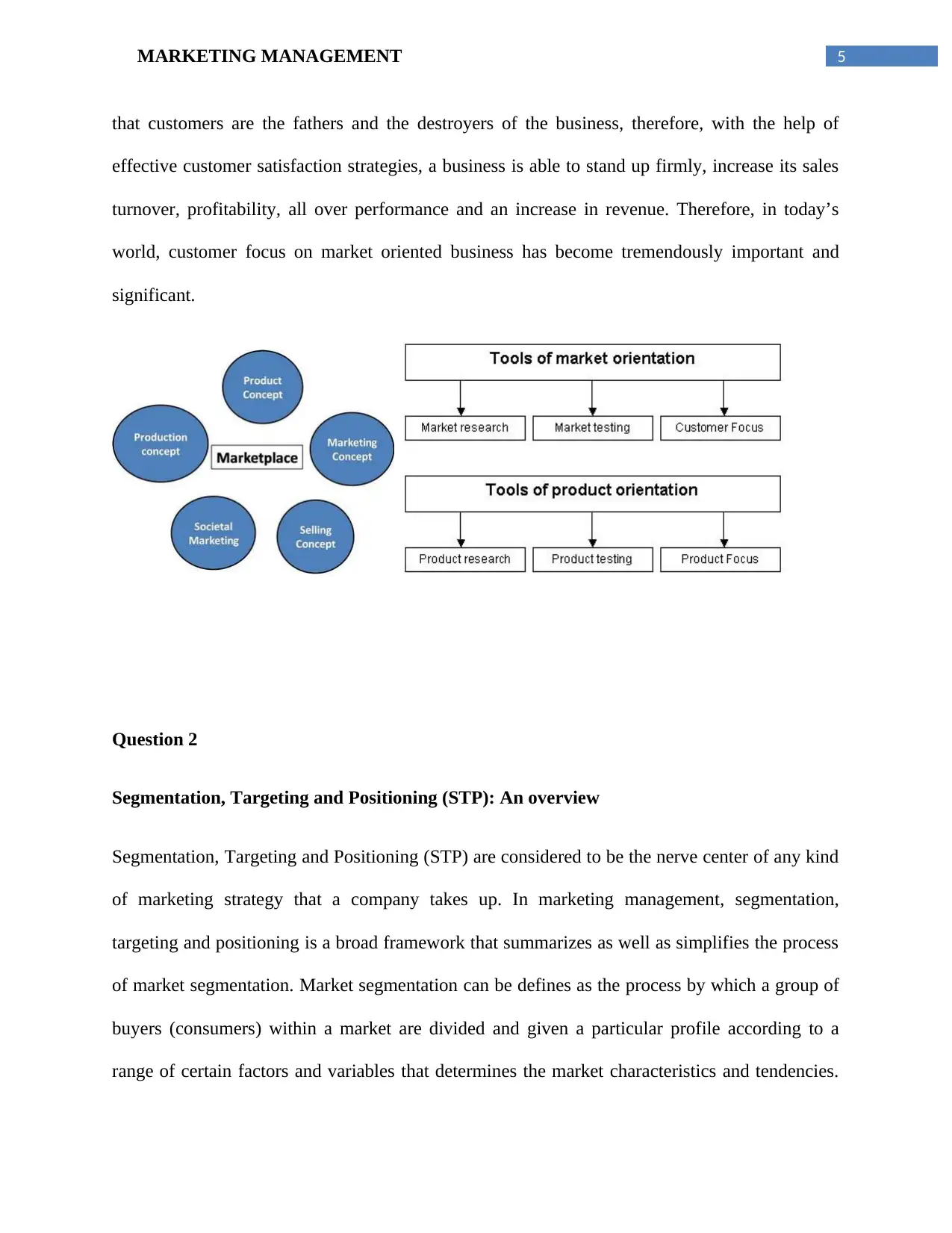
that customers are the fathers and the destroyers of the business, therefore, with the help of
effective customer satisfaction strategies, a business is able to stand up firmly, increase its sales
turnover, profitability, all over performance and an increase in revenue. Therefore, in today’s
world, customer focus on market oriented business has become tremendously important and
significant.
Question 2
Segmentation, Targeting and Positioning (STP): An overview
Segmentation, Targeting and Positioning (STP) are considered to be the nerve center of any kind
of marketing strategy that a company takes up. In marketing management, segmentation,
targeting and positioning is a broad framework that summarizes as well as simplifies the process
of market segmentation. Market segmentation can be defines as the process by which a group of
buyers (consumers) within a market are divided and given a particular profile according to a
range of certain factors and variables that determines the market characteristics and tendencies.
that customers are the fathers and the destroyers of the business, therefore, with the help of
effective customer satisfaction strategies, a business is able to stand up firmly, increase its sales
turnover, profitability, all over performance and an increase in revenue. Therefore, in today’s
world, customer focus on market oriented business has become tremendously important and
significant.
Question 2
Segmentation, Targeting and Positioning (STP): An overview
Segmentation, Targeting and Positioning (STP) are considered to be the nerve center of any kind
of marketing strategy that a company takes up. In marketing management, segmentation,
targeting and positioning is a broad framework that summarizes as well as simplifies the process
of market segmentation. Market segmentation can be defines as the process by which a group of
buyers (consumers) within a market are divided and given a particular profile according to a
range of certain factors and variables that determines the market characteristics and tendencies.
⊘ This is a preview!⊘
Do you want full access?
Subscribe today to unlock all pages.
Trusted by 1+ million students worldwide
6MARKETING MANAGEMENT
The processes of segmentation, targeting and positioning are integral parts of market
segmentation where the respective elements are put in a chronological manner in order to carry
out the market mix for proposing any kind of marketing strategy/ ies (Hooley et al. 2012). The
definition and comprisation of STP are provided hereafter.
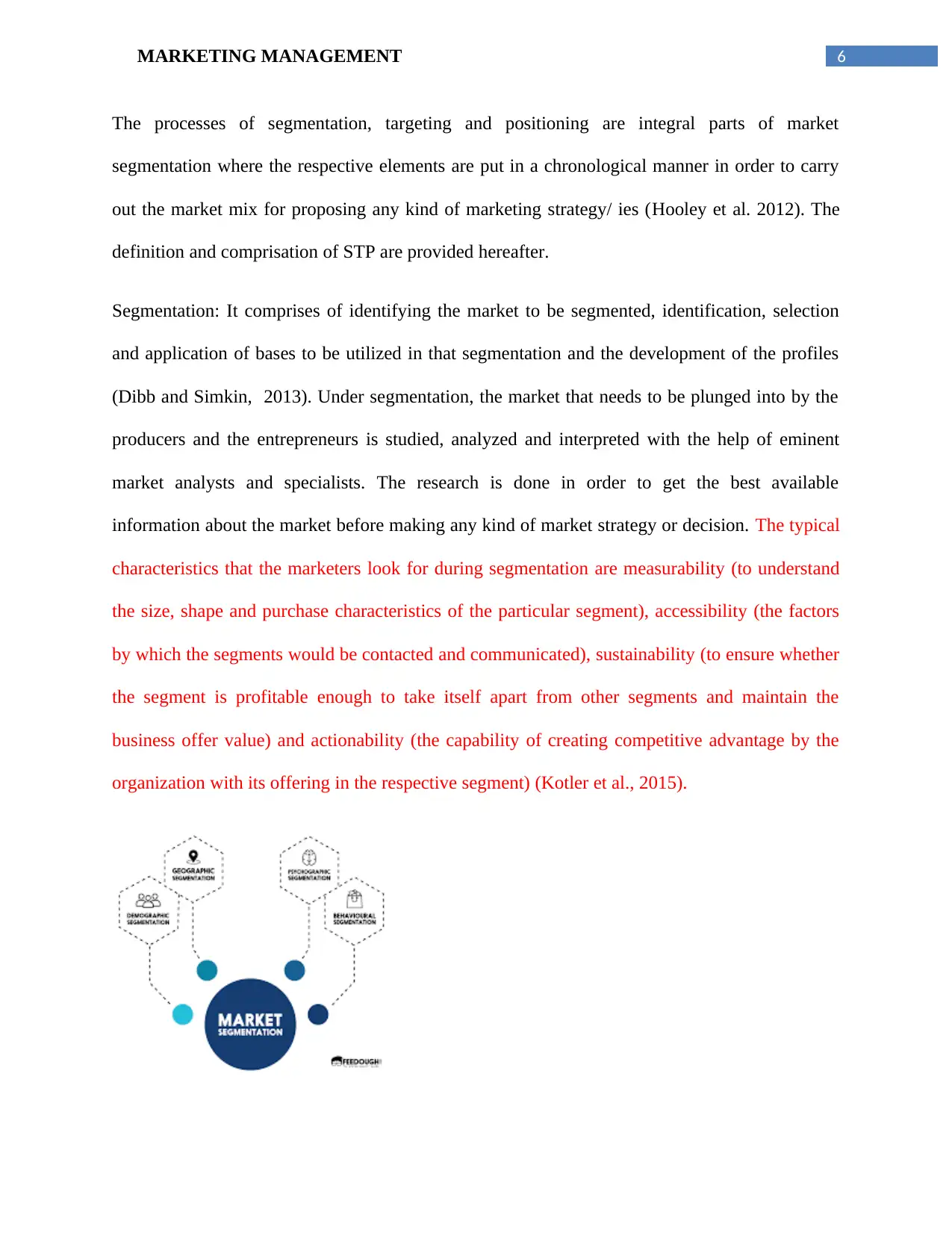
Segmentation: It comprises of identifying the market to be segmented, identification, selection
and application of bases to be utilized in that segmentation and the development of the profiles
(Dibb and Simkin, 2013). Under segmentation, the market that needs to be plunged into by the
producers and the entrepreneurs is studied, analyzed and interpreted with the help of eminent
market analysts and specialists. The research is done in order to get the best available
information about the market before making any kind of market strategy or decision. The typical
characteristics that the marketers look for during segmentation are measurability (to understand
the size, shape and purchase characteristics of the particular segment), accessibility (the factors
by which the segments would be contacted and communicated), sustainability (to ensure whether
the segment is profitable enough to take itself apart from other segments and maintain the
business offer value) and actionability (the capability of creating competitive advantage by the
organization with its offering in the respective segment) (Kotler et al., 2015).
The processes of segmentation, targeting and positioning are integral parts of market
segmentation where the respective elements are put in a chronological manner in order to carry
out the market mix for proposing any kind of marketing strategy/ ies (Hooley et al. 2012). The
definition and comprisation of STP are provided hereafter.
Segmentation: It comprises of identifying the market to be segmented, identification, selection
and application of bases to be utilized in that segmentation and the development of the profiles
(Dibb and Simkin, 2013). Under segmentation, the market that needs to be plunged into by the
producers and the entrepreneurs is studied, analyzed and interpreted with the help of eminent
market analysts and specialists. The research is done in order to get the best available
information about the market before making any kind of market strategy or decision. The typical
characteristics that the marketers look for during segmentation are measurability (to understand
the size, shape and purchase characteristics of the particular segment), accessibility (the factors
by which the segments would be contacted and communicated), sustainability (to ensure whether
the segment is profitable enough to take itself apart from other segments and maintain the
business offer value) and actionability (the capability of creating competitive advantage by the
organization with its offering in the respective segment) (Kotler et al., 2015).
Paraphrase This Document
Need a fresh take? Get an instant paraphrase of this document with our AI Paraphraser
7MARKETING MANAGEMENT
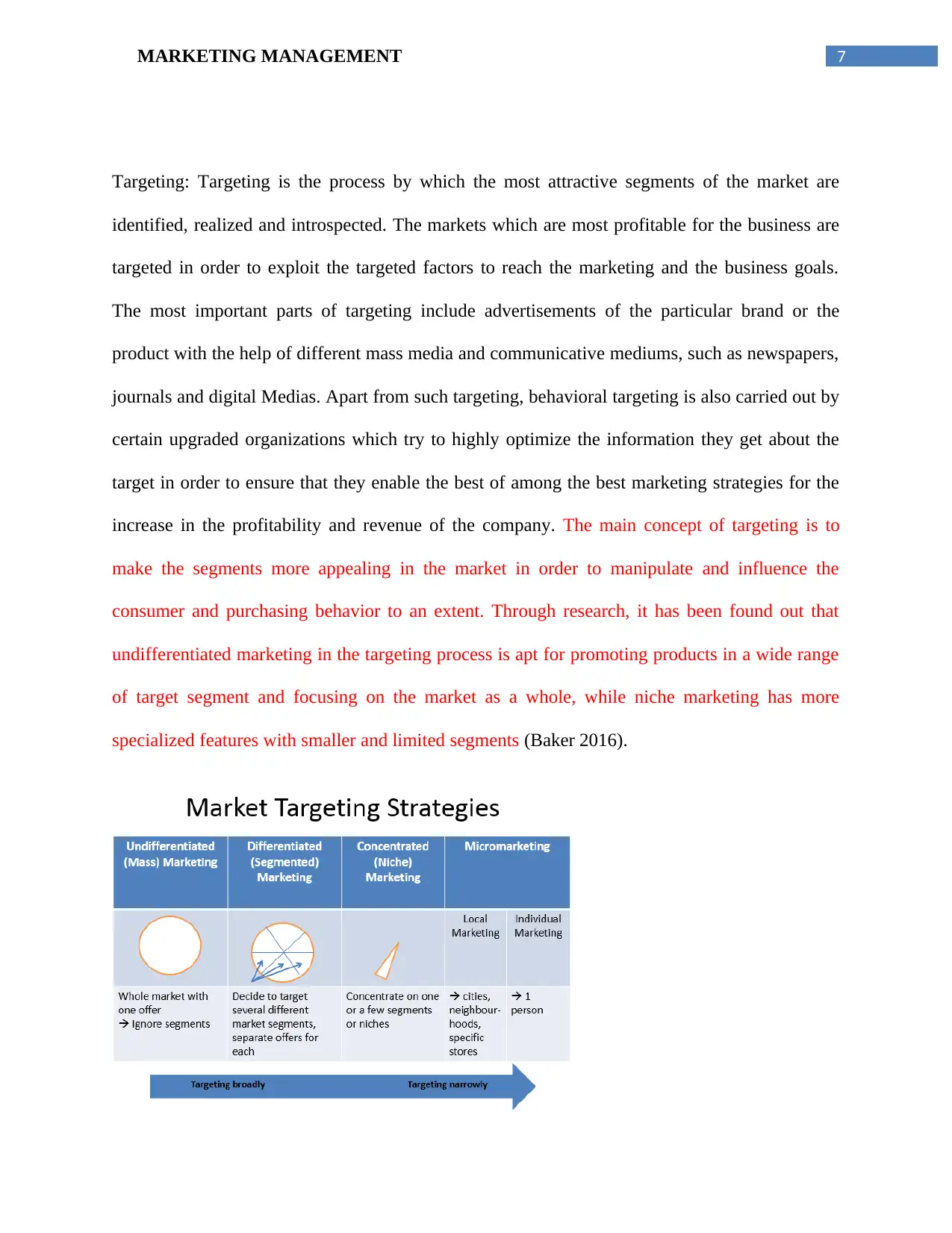
Targeting: Targeting is the process by which the most attractive segments of the market are
identified, realized and introspected. The markets which are most profitable for the business are
targeted in order to exploit the targeted factors to reach the marketing and the business goals.
The most important parts of targeting include advertisements of the particular brand or the
product with the help of different mass media and communicative mediums, such as newspapers,
journals and digital Medias. Apart from such targeting, behavioral targeting is also carried out by
certain upgraded organizations which try to highly optimize the information they get about the
target in order to ensure that they enable the best of among the best marketing strategies for the
increase in the profitability and revenue of the company. The main concept of targeting is to
make the segments more appealing in the market in order to manipulate and influence the
consumer and purchasing behavior to an extent. Through research, it has been found out that
undifferentiated marketing in the targeting process is apt for promoting products in a wide range
of target segment and focusing on the market as a whole, while niche marketing has more
specialized features with smaller and limited segments (Baker 2016).
Targeting: Targeting is the process by which the most attractive segments of the market are
identified, realized and introspected. The markets which are most profitable for the business are
targeted in order to exploit the targeted factors to reach the marketing and the business goals.
The most important parts of targeting include advertisements of the particular brand or the
product with the help of different mass media and communicative mediums, such as newspapers,
journals and digital Medias. Apart from such targeting, behavioral targeting is also carried out by
certain upgraded organizations which try to highly optimize the information they get about the
target in order to ensure that they enable the best of among the best marketing strategies for the
increase in the profitability and revenue of the company. The main concept of targeting is to
make the segments more appealing in the market in order to manipulate and influence the
consumer and purchasing behavior to an extent. Through research, it has been found out that
undifferentiated marketing in the targeting process is apt for promoting products in a wide range
of target segment and focusing on the market as a whole, while niche marketing has more
specialized features with smaller and limited segments (Baker 2016).
8MARKETING MANAGEMENT
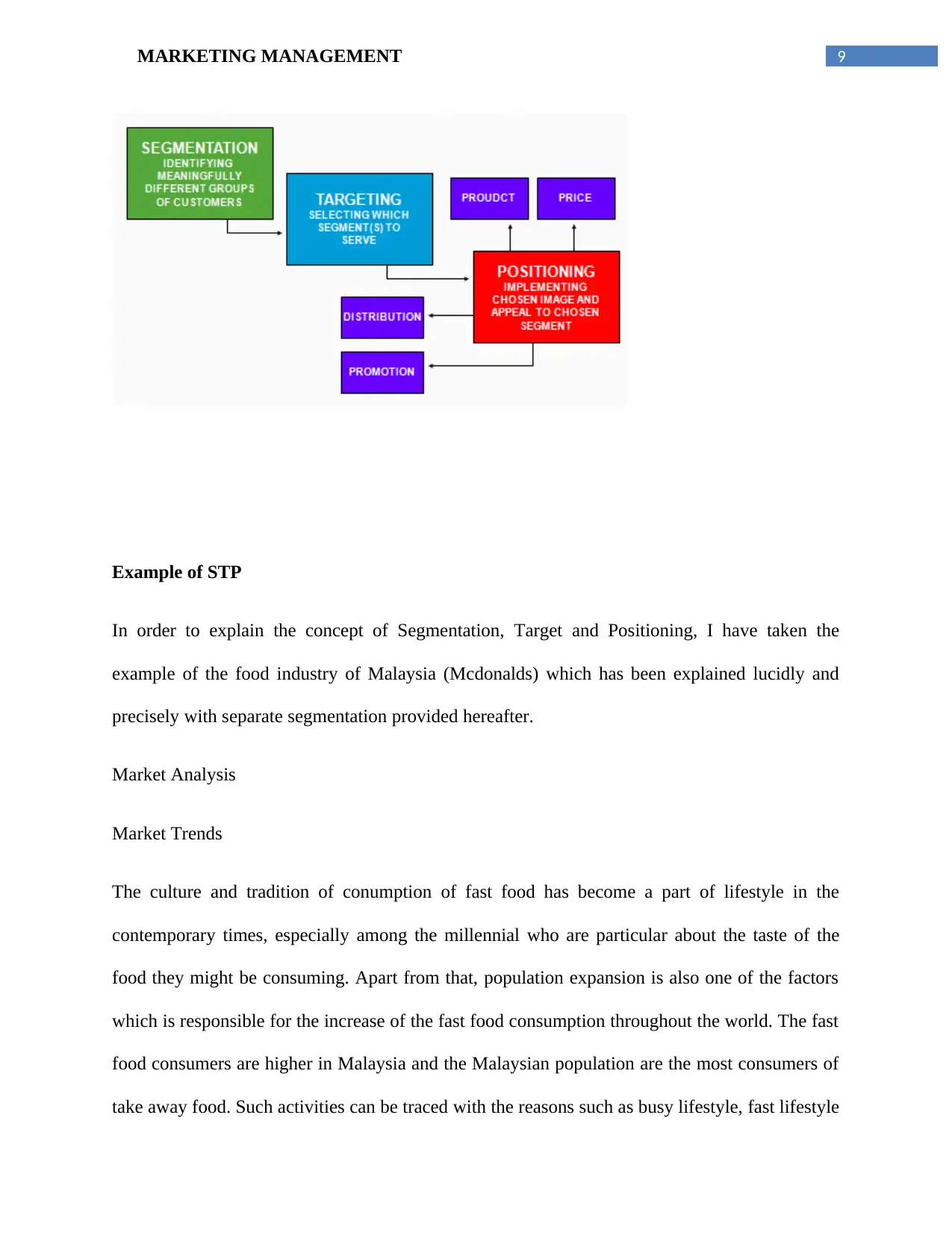
Positioning, on the other hand, is often considered as the final stage of the process of
STP, which is (Segmentation, Target and Positioning), focuses on the fact that how the
customers view the products and service of the business in comparison to the competitors of the
respective business and it is also important in order to gain a competitive advantage in the
market. Therefore, it can be well understood that positioning is an important factor in the
segmentation phase of marketing. According to David Ogilvy, the definition of positioning is
referred as “what a product does, and who is it for”, which means, positioning can be defined as
a psychological mechanism utilized by the consumers to differentiate between overemphasized/
garrulous advertisements and the advertisements that say what exactly the respective consumer
wants/ desires or needs (Hannah et al. 2014). Factors such as product features, style, aesthetics,
product benefits and value of money are the factors that play important role in positioning
process. Customers’ perceptions have a huge impact on the positioning of the brand in the
market. There are generally three types of positioning in the segmentation phase, which are
functional positioning, symbolic positioning and experimental positioning (Kerin and Hartley
2015). The Functional Positioning is focused on the aspects of the products or services that can
fulfill consumers' needs or desires. Symbolic Positioning is based on the characteristics of the
brand that fulfill customers' self-esteem. Experiential positioning is based around the
characteristics of the brands that stimulate the sensory or emotional connection with the
customers. Therefore, a combination of the three kinds of positioning would hence provide the
commodities or products with a specific competitive advantage to its immediate competition
(Proctor 2014).
Positioning, on the other hand, is often considered as the final stage of the process of
STP, which is (Segmentation, Target and Positioning), focuses on the fact that how the
customers view the products and service of the business in comparison to the competitors of the
respective business and it is also important in order to gain a competitive advantage in the
market. Therefore, it can be well understood that positioning is an important factor in the
segmentation phase of marketing. According to David Ogilvy, the definition of positioning is
referred as “what a product does, and who is it for”, which means, positioning can be defined as
a psychological mechanism utilized by the consumers to differentiate between overemphasized/
garrulous advertisements and the advertisements that say what exactly the respective consumer
wants/ desires or needs (Hannah et al. 2014). Factors such as product features, style, aesthetics,
product benefits and value of money are the factors that play important role in positioning
process. Customers’ perceptions have a huge impact on the positioning of the brand in the
market. There are generally three types of positioning in the segmentation phase, which are
functional positioning, symbolic positioning and experimental positioning (Kerin and Hartley
2015). The Functional Positioning is focused on the aspects of the products or services that can
fulfill consumers' needs or desires. Symbolic Positioning is based on the characteristics of the
brand that fulfill customers' self-esteem. Experiential positioning is based around the
characteristics of the brands that stimulate the sensory or emotional connection with the
customers. Therefore, a combination of the three kinds of positioning would hence provide the
commodities or products with a specific competitive advantage to its immediate competition
(Proctor 2014).
⊘ This is a preview!⊘
Do you want full access?
Subscribe today to unlock all pages.
Trusted by 1+ million students worldwide
9MARKETING MANAGEMENT
Example of STP
In order to explain the concept of Segmentation, Target and Positioning, I have taken the
example of the food industry of Malaysia (Mcdonalds) which has been explained lucidly and
precisely with separate segmentation provided hereafter.
Market Analysis
Market Trends
The culture and tradition of conumption of fast food has become a part of lifestyle in the
contemporary times, especially among the millennial who are particular about the taste of the
food they might be consuming. Apart from that, population expansion is also one of the factors
which is responsible for the increase of the fast food consumption throughout the world. The fast
food consumers are higher in Malaysia and the Malaysian population are the most consumers of
take away food. Such activities can be traced with the reasons such as busy lifestyle, fast lifestyle
Example of STP
In order to explain the concept of Segmentation, Target and Positioning, I have taken the
example of the food industry of Malaysia (Mcdonalds) which has been explained lucidly and
precisely with separate segmentation provided hereafter.
Market Analysis
Market Trends
The culture and tradition of conumption of fast food has become a part of lifestyle in the
contemporary times, especially among the millennial who are particular about the taste of the
food they might be consuming. Apart from that, population expansion is also one of the factors
which is responsible for the increase of the fast food consumption throughout the world. The fast
food consumers are higher in Malaysia and the Malaysian population are the most consumers of
take away food. Such activities can be traced with the reasons such as busy lifestyle, fast lifestyle
Paraphrase This Document
Need a fresh take? Get an instant paraphrase of this document with our AI Paraphraser
10MARKETING MANAGEMENT
and lack of time which forces them to avail food from outside rather than cooking food at homes.
There have been evidences that customers are spending their finance more on fast food and less
on groceries. Even though the state of health has become one of the most important and primary
concerns for the consumers, yet the way they intake food, especially fast food, are not affected
by such health related thoughts. In the nations such as Hong Kong, Malaysia and the United
States, fast food consumption culture has become a part and parcel of life and customary
tradition.
Market Size and Growth
The fast food industry and market size of Malaysia and Taiwan has been known to be increasing
unprecedentedly from year to year and it has been estimated that it had reached, in the business
year 2007, almost around 2,058.8. The company McDonalds of Malaysia share also increased
tremendously and suddenly by 400 addition, in the functionin year of 2007. The aggregate
purchase of the household and families which means what every family purchases on fast food
reached at 356,482,100 by year 2007. There has been an estimation that around 20 to 30 percent
increment per year can be speculated and expected in the sector of fast food industry.
Buyer analysis
Psychological factors
Consumers buy goods and services in order to meet their desires and wants. The demand for fast
food industries have increased tremendously since the late 1990s. the household income of
Malaysia has somewhat increased after the women also started working outside and earning a
and lack of time which forces them to avail food from outside rather than cooking food at homes.
There have been evidences that customers are spending their finance more on fast food and less
on groceries. Even though the state of health has become one of the most important and primary
concerns for the consumers, yet the way they intake food, especially fast food, are not affected
by such health related thoughts. In the nations such as Hong Kong, Malaysia and the United
States, fast food consumption culture has become a part and parcel of life and customary
tradition.
Market Size and Growth
The fast food industry and market size of Malaysia and Taiwan has been known to be increasing
unprecedentedly from year to year and it has been estimated that it had reached, in the business
year 2007, almost around 2,058.8. The company McDonalds of Malaysia share also increased
tremendously and suddenly by 400 addition, in the functionin year of 2007. The aggregate
purchase of the household and families which means what every family purchases on fast food
reached at 356,482,100 by year 2007. There has been an estimation that around 20 to 30 percent
increment per year can be speculated and expected in the sector of fast food industry.
Buyer analysis
Psychological factors
Consumers buy goods and services in order to meet their desires and wants. The demand for fast
food industries have increased tremendously since the late 1990s. the household income of
Malaysia has somewhat increased after the women also started working outside and earning a
11MARKETING MANAGEMENT
living of their own. Therefore, the Malaysian family has become enough well to do to afford fast
food for everyday consumption. Apart from that, high income also lures the young customers
towards the fast food centers and cafes which is also a part of the so called “cool’ life of the
youth. Therefore, youth are more driven towards fast food. Women who go through different
hormonal and psychological disorders often opt for fast food nowadays as a result of eating
disorders which has also led in increase in consumption of fast food.
Personal factors
Age and Income
The age which generally prefers fast food are the teenaged and the youth of Malaysia, with men
and women equally participating in fast food consumption. More the income of the genders, mor
is the demand for fast food by men and women equally. Therefore, income is directly
proportional to consumption of fast food.
Targeting
Among all the prospective customers and consumers introspected, the most prolific are the
market of the working adults. The working adults of Malaysia have a superbly busy lifestyle
which has forced them to take up the choice of having fast food instead of cooking food and
consuming at home. The working community segment is considered the largest group of
consumer of McDonald compared to children and youth. Also, the working population of adults
in the country is belonging to the middle income as well as higher income range which is also a
factor of making them the supreme target for the expansion of Mcdonalds in Malaysia.
Positioning
living of their own. Therefore, the Malaysian family has become enough well to do to afford fast
food for everyday consumption. Apart from that, high income also lures the young customers
towards the fast food centers and cafes which is also a part of the so called “cool’ life of the
youth. Therefore, youth are more driven towards fast food. Women who go through different
hormonal and psychological disorders often opt for fast food nowadays as a result of eating
disorders which has also led in increase in consumption of fast food.
Personal factors
Age and Income
The age which generally prefers fast food are the teenaged and the youth of Malaysia, with men
and women equally participating in fast food consumption. More the income of the genders, mor
is the demand for fast food by men and women equally. Therefore, income is directly
proportional to consumption of fast food.
Targeting
Among all the prospective customers and consumers introspected, the most prolific are the
market of the working adults. The working adults of Malaysia have a superbly busy lifestyle
which has forced them to take up the choice of having fast food instead of cooking food and
consuming at home. The working community segment is considered the largest group of
consumer of McDonald compared to children and youth. Also, the working population of adults
in the country is belonging to the middle income as well as higher income range which is also a
factor of making them the supreme target for the expansion of Mcdonalds in Malaysia.
Positioning
⊘ This is a preview!⊘
Do you want full access?
Subscribe today to unlock all pages.
Trusted by 1+ million students worldwide

1 out of 14


Related Documents


Your All-in-One AI-Powered Toolkit for Academic Success.
+13062052269
info@desklib.com
Available 24*7 on WhatsApp / Email
![[object Object]](/_next/static/media/star-bottom.7253800d.svg)
Unlock your academic potential
Copyright © 2020–2026 A2Z Services. All Rights Reserved. Developed and managed by ZUCOL.