Brand Management Report: Analysis of Marks & Spencer Strategies
VerifiedAdded on 2020/11/23
|14
|3994
|65
Report
AI Summary
This report provides a comprehensive analysis of brand management strategies employed by Marks & Spencer (M&S), a major British multinational retailer. The introduction highlights the importance of branding, particularly for increasing sales and enhancing a company's image, using M&S as a case study. Task 1 explores the importance of branding, the development of brand equity, and suggestions for extending, reinforcing, and revitalizing the M&S brand. It emphasizes the advantages of branding, such as enhancing image, building loyalty, and increasing trust. The report also examines Keller's Brand Equity Model. Task 2 discusses different brand hierarchy models: house of brands, branded house, and hybrid approaches, with examples. Task 3 defines brand leverage and analyzes M&S's strengths and weaknesses, including its high-quality products, customer service, financial maturity, and shopping environment, while also pointing out weaknesses such as high prices. The report suggests strategies for brand leveraging to revitalize the brand. Finally, Task 4 covers techniques for measuring and managing brand value, brand awareness, consumer attitudes, and purchasing intent. The conclusion summarizes the key findings and recommendations, offering insights into effective brand management for M&S.

BRAND MANAGEMENT

Paraphrase This Document
Need a fresh take? Get an instant paraphrase of this document with our AI Paraphraser
TABLE OF CONTENTS
INTRODUCTION...........................................................................................................................1
TASK 1............................................................................................................................................1
a) Importance of branding for an organisation............................................................................1
b) Growth and development of brand equity by organisations...................................................2
C) Suggestions on how the M&S brand can be extended, reinforce and revitalised..................4
TASK 2............................................................................................................................................4
a) House of brands......................................................................................................................4
b)Branded house..........................................................................................................................5
c)Hybrid:.....................................................................................................................................5
TASK 3............................................................................................................................................5
a)Meaning of brand leverage......................................................................................................5
b) Strengths and weakness of the M&S Brand...........................................................................6
c) M&S collaborations and partnership to help in the brand growth locally and internationally,
.....................................................................................................................................................7
TASK 4............................................................................................................................................7
a) Technique used for measuring and managing brand value:....................................................7
b) Techniques used to measure brand awareness: ......................................................................8
c) Techniques for measuring and managing consumer attitude: ................................................8
d) Techniques used for measuring purchasing intent: ................................................................9
CONCLUSION................................................................................................................................9
REFERENCES: ............................................................................................................................11
INTRODUCTION...........................................................................................................................1
TASK 1............................................................................................................................................1
a) Importance of branding for an organisation............................................................................1
b) Growth and development of brand equity by organisations...................................................2
C) Suggestions on how the M&S brand can be extended, reinforce and revitalised..................4
TASK 2............................................................................................................................................4
a) House of brands......................................................................................................................4
b)Branded house..........................................................................................................................5
c)Hybrid:.....................................................................................................................................5
TASK 3............................................................................................................................................5
a)Meaning of brand leverage......................................................................................................5
b) Strengths and weakness of the M&S Brand...........................................................................6
c) M&S collaborations and partnership to help in the brand growth locally and internationally,
.....................................................................................................................................................7
TASK 4............................................................................................................................................7
a) Technique used for measuring and managing brand value:....................................................7
b) Techniques used to measure brand awareness: ......................................................................8
c) Techniques for measuring and managing consumer attitude: ................................................8
d) Techniques used for measuring purchasing intent: ................................................................9
CONCLUSION................................................................................................................................9
REFERENCES: ............................................................................................................................11
INTRODUCTION
Brand management is the process of improving the image, maintaining a good
relationship with target market and focusing on customer satisfaction. It will help the company in
increasing sales of not only one product but of other products of same brand name as well. In this
present assignment, Marks & Spencer will be chosen for assessment. It is one of the biggest
British multinational retailer, which was founded in the year 1884 and its headquarter is situated
in the city of Westminster, London. This company sells clothing products, own brand food and
home based products. Company has its operating income of around $690.6 million. This report
will cover importance of branding for this company and development of brand equity for
The organisations. In addition to this it will also cover strengths and weaknesses of M&S brand
and techniques that will be used for measuring brand value and awareness. KELLOR'Ss Brand
equity model will also be discussed in this study.
TASK 1
a) Importance of branding for an organisation
Branding is a process of making company's own name and image for a product in mind
of the consumer, advertising is the best way of doing branding which attracts new customers in
the market. It helps in increasing sales of the company and if it can enhance its image through
branding then it can charge high price from consumer, as once consumer is obsessed with any
brand there are very fewer chances of switching to other brand’s products (Lee, O’Cass and Sok,
2017).
Here are some advantages of branding which M&S can enjoy:
Enhances image: Branding will help in improving image of M&S. As though company proves
customers that it cares for its image and have the unique identity to present itself in very every
market.
Builds loyalty: Customers are more loyal towards the company if it has a recognised brand
name and are ready to pay more for the trade name.
Increase trust: Customer trust on brand name easily. If the company has a big and recognised
brand name than it can earn trust of people. So, M&S can gain back its trust by branding and
achieve its objectives of increase in sales and growth of the company.
1
Brand management is the process of improving the image, maintaining a good
relationship with target market and focusing on customer satisfaction. It will help the company in
increasing sales of not only one product but of other products of same brand name as well. In this
present assignment, Marks & Spencer will be chosen for assessment. It is one of the biggest
British multinational retailer, which was founded in the year 1884 and its headquarter is situated
in the city of Westminster, London. This company sells clothing products, own brand food and
home based products. Company has its operating income of around $690.6 million. This report
will cover importance of branding for this company and development of brand equity for
The organisations. In addition to this it will also cover strengths and weaknesses of M&S brand
and techniques that will be used for measuring brand value and awareness. KELLOR'Ss Brand
equity model will also be discussed in this study.
TASK 1
a) Importance of branding for an organisation
Branding is a process of making company's own name and image for a product in mind
of the consumer, advertising is the best way of doing branding which attracts new customers in
the market. It helps in increasing sales of the company and if it can enhance its image through
branding then it can charge high price from consumer, as once consumer is obsessed with any
brand there are very fewer chances of switching to other brand’s products (Lee, O’Cass and Sok,
2017).
Here are some advantages of branding which M&S can enjoy:
Enhances image: Branding will help in improving image of M&S. As though company proves
customers that it cares for its image and have the unique identity to present itself in very every
market.
Builds loyalty: Customers are more loyal towards the company if it has a recognised brand
name and are ready to pay more for the trade name.
Increase trust: Customer trust on brand name easily. If the company has a big and recognised
brand name than it can earn trust of people. So, M&S can gain back its trust by branding and
achieve its objectives of increase in sales and growth of the company.
1
⊘ This is a preview!⊘
Do you want full access?
Subscribe today to unlock all pages.

Trusted by 1+ million students worldwide
Branding allows company to charge a premium: If a company has a good brand name than it
can increase price of its product, and consumers are ready to pay more money because they trust
on the name of the brand Example: Apple company charges more for its product than other
company and consumers are ready to pay more for its brand name (Veloutsou and Guzman,
2017).
A strong brand helps with recruitment and retention: If an organisation has a good brand
name then organisation will let people think that it is a good organisation to work with, and it
will enhance after-image or reputation of the company and ensures the growth of the
organisation.
b) Growth and development of brand equity by organisations
Brand equity is a term used in the marketing industry, which set forth a brand's value.
This value lets the owner know that he can raise money through brand recognition because
consumer believes that a quality product is better than those products with the less well-known
brand name (Borkovsky and et.al., 2017).
Value of brand can be discovered by customer's experiences with the product. If
customers are satisfied with a product and thinks good for that brand, then the company has a
positive brand equity but when any company dissatisfies people and customers does not
recommend that brand to anybody then that brand has a negative brand equity. M&S has the
announcement that it is closing 100 stores by 2022 so to develop and grow its brand equity there
are so many models which M&S can use but the best model is Keller's Brand Equity Model.
Keller's brand equity model is developed by Kelvin Lane Keller. This model says that
keep focus on the customers and make them happy. As customers are heart of the business and
that is why this model is also termed as Customer Based Brand Equity Model.
This model is shown in the shape of a pyramid which has four levels. The four levels are as
follows-
Identity
Meaning
Response
Relationships
2
can increase price of its product, and consumers are ready to pay more money because they trust
on the name of the brand Example: Apple company charges more for its product than other
company and consumers are ready to pay more for its brand name (Veloutsou and Guzman,
2017).
A strong brand helps with recruitment and retention: If an organisation has a good brand
name then organisation will let people think that it is a good organisation to work with, and it
will enhance after-image or reputation of the company and ensures the growth of the
organisation.
b) Growth and development of brand equity by organisations
Brand equity is a term used in the marketing industry, which set forth a brand's value.
This value lets the owner know that he can raise money through brand recognition because
consumer believes that a quality product is better than those products with the less well-known
brand name (Borkovsky and et.al., 2017).
Value of brand can be discovered by customer's experiences with the product. If
customers are satisfied with a product and thinks good for that brand, then the company has a
positive brand equity but when any company dissatisfies people and customers does not
recommend that brand to anybody then that brand has a negative brand equity. M&S has the
announcement that it is closing 100 stores by 2022 so to develop and grow its brand equity there
are so many models which M&S can use but the best model is Keller's Brand Equity Model.
Keller's brand equity model is developed by Kelvin Lane Keller. This model says that
keep focus on the customers and make them happy. As customers are heart of the business and
that is why this model is also termed as Customer Based Brand Equity Model.
This model is shown in the shape of a pyramid which has four levels. The four levels are as
follows-
Identity
Meaning
Response
Relationships
2
Paraphrase This Document
Need a fresh take? Get an instant paraphrase of this document with our AI Paraphraser
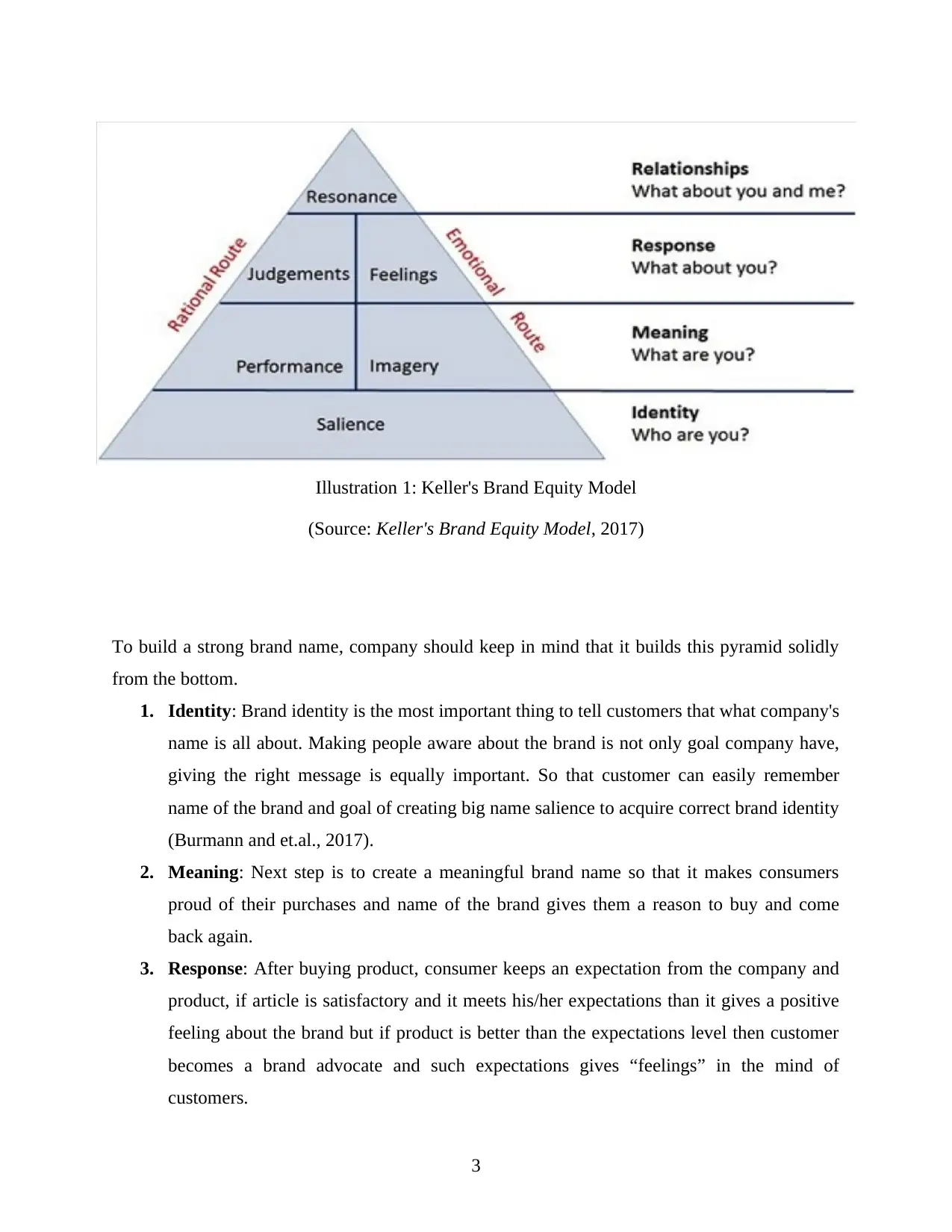
To build a strong brand name, company should keep in mind that it builds this pyramid solidly
from the bottom.
1. Identity: Brand identity is the most important thing to tell customers that what company's
name is all about. Making people aware about the brand is not only goal company have,
giving the right message is equally important. So that customer can easily remember
name of the brand and goal of creating big name salience to acquire correct brand identity
(Burmann and et.al., 2017).
2. Meaning: Next step is to create a meaningful brand name so that it makes consumers
proud of their purchases and name of the brand gives them a reason to buy and come
back again.
3. Response: After buying product, consumer keeps an expectation from the company and
product, if article is satisfactory and it meets his/her expectations than it gives a positive
feeling about the brand but if product is better than the expectations level then customer
becomes a brand advocate and such expectations gives “feelings” in the mind of
customers.
3
Illustration 1: Keller's Brand Equity Model
(Source: Keller's Brand Equity Model, 2017)
from the bottom.
1. Identity: Brand identity is the most important thing to tell customers that what company's
name is all about. Making people aware about the brand is not only goal company have,
giving the right message is equally important. So that customer can easily remember
name of the brand and goal of creating big name salience to acquire correct brand identity
(Burmann and et.al., 2017).
2. Meaning: Next step is to create a meaningful brand name so that it makes consumers
proud of their purchases and name of the brand gives them a reason to buy and come
back again.
3. Response: After buying product, consumer keeps an expectation from the company and
product, if article is satisfactory and it meets his/her expectations than it gives a positive
feeling about the brand but if product is better than the expectations level then customer
becomes a brand advocate and such expectations gives “feelings” in the mind of
customers.
3
Illustration 1: Keller's Brand Equity Model
(Source: Keller's Brand Equity Model, 2017)
4. Relationship: This is very last level of pyramid where, if consumer reaches then he will
get a social and psychological connection with the brand and hardly take the decision of
switching to another trade name, that is why every organisation wishes that consumer
gets into psychological connection with the company.
C) Suggestions on how the M&S brand can be extended, reinforce and revitalised.
Brand equity of M&S is falling down as the company is not following the models of
developing brand equity, Since M&S has made the announcement that it is closing 100 stores by
2022. It is decline of the company so it should take in to account these following suggestions:
Company should focus on brand management by using Keller Equity model which will
help in maintaining and developing brand equity so that branding will help in reinforcing
and extension.
Company should focus on quality of products and services they provide; it will help in
developing trust of customers towards brand so that brand will get reinforced.
To extend the company it should come up with something new and innovative, as in
today's world consumers are highly attracted towards something better
TASK 2
a) House of brands
House of brands is a brand hierarchy model of managing or organizing portfolio. House
of brands is an approach where company markets two or more brands, in which every brand is
supported by a marketing staff with a determined budget. Example of this approach is Proctor&
Gamble and Unilever.
House of brands works well when products cannot replace one another and this model
allows every brand to maintain and establish their own value so that it can have its own meaning
with the customers (Rahman and et.al., 2018).
Advantages of house of brands:
In this strategy, different audiences can be targeted because all products vary from each
other and have their own brand name.
4
get a social and psychological connection with the brand and hardly take the decision of
switching to another trade name, that is why every organisation wishes that consumer
gets into psychological connection with the company.
C) Suggestions on how the M&S brand can be extended, reinforce and revitalised.
Brand equity of M&S is falling down as the company is not following the models of
developing brand equity, Since M&S has made the announcement that it is closing 100 stores by
2022. It is decline of the company so it should take in to account these following suggestions:
Company should focus on brand management by using Keller Equity model which will
help in maintaining and developing brand equity so that branding will help in reinforcing
and extension.
Company should focus on quality of products and services they provide; it will help in
developing trust of customers towards brand so that brand will get reinforced.
To extend the company it should come up with something new and innovative, as in
today's world consumers are highly attracted towards something better
TASK 2
a) House of brands
House of brands is a brand hierarchy model of managing or organizing portfolio. House
of brands is an approach where company markets two or more brands, in which every brand is
supported by a marketing staff with a determined budget. Example of this approach is Proctor&
Gamble and Unilever.
House of brands works well when products cannot replace one another and this model
allows every brand to maintain and establish their own value so that it can have its own meaning
with the customers (Rahman and et.al., 2018).
Advantages of house of brands:
In this strategy, different audiences can be targeted because all products vary from each
other and have their own brand name.
4
⊘ This is a preview!⊘
Do you want full access?
Subscribe today to unlock all pages.
Trusted by 1+ million students worldwide
Complete freedom of making new logo, name and design so product can have their own
identity.
b) Branded house
Branded house is also a brand hierarchy model of managing and organizing its portfolio.
In this approach company uses its brand name at least to some degree while marketing or
communicating about the company's product and services. In this strategy, each product is
known by the name of brand and it does not have its own identification. This strategy is also
known as Monolithic brand.
Advantages of branded house:
Branded house helps in creating brand awareness among public
Company has to do marketing for a single brand identity and its image.
c) Hybrid:
For extension of brand companies use mix of both the strategies with different roles for
various types of product expansion. So it carries benefits of both the above strategies and it helps
company in expansion of market share into different segments in this industry.
In a company, a product that needs success should maintain its brand, but if a new article is
launched and it is very different from original then it is the best idea to make a different sub-
brand.
TASK 3
a) Meaning of brand leverage
Brand leveraging is a strategy in which existing brand name is used to support the entry
in to new but related product category. It communicates about the new product details to
customers, as consumer already carry a mind set about the brand's level of quality and relate the
existing knowledge to new products.
Generally, consumers have a mind-set for every brand until they are disappointed. So
every existing company use the strategy of brand leveraging while introducing new products in
the market.
Here in this case study, M&S is on decline so to reinforce, company can use the strategy
of brand leveraging, where it can use its name to introduce new products in the market. As more
5
identity.
b) Branded house
Branded house is also a brand hierarchy model of managing and organizing its portfolio.
In this approach company uses its brand name at least to some degree while marketing or
communicating about the company's product and services. In this strategy, each product is
known by the name of brand and it does not have its own identification. This strategy is also
known as Monolithic brand.
Advantages of branded house:
Branded house helps in creating brand awareness among public
Company has to do marketing for a single brand identity and its image.
c) Hybrid:
For extension of brand companies use mix of both the strategies with different roles for
various types of product expansion. So it carries benefits of both the above strategies and it helps
company in expansion of market share into different segments in this industry.
In a company, a product that needs success should maintain its brand, but if a new article is
launched and it is very different from original then it is the best idea to make a different sub-
brand.
TASK 3
a) Meaning of brand leverage
Brand leveraging is a strategy in which existing brand name is used to support the entry
in to new but related product category. It communicates about the new product details to
customers, as consumer already carry a mind set about the brand's level of quality and relate the
existing knowledge to new products.
Generally, consumers have a mind-set for every brand until they are disappointed. So
every existing company use the strategy of brand leveraging while introducing new products in
the market.
Here in this case study, M&S is on decline so to reinforce, company can use the strategy
of brand leveraging, where it can use its name to introduce new products in the market. As more
5
Paraphrase This Document
Need a fresh take? Get an instant paraphrase of this document with our AI Paraphraser
products will help the company in achieving higher sales as consumers who have a positive
brand opinion will try to like the new product of the same brand and it will help M&S to increase
its sale through new products and by brand leveraging company will be extend and revitalised. It
is a strategy in which existing brand name is used to support the entry in to new but related
product category (Leitch and Merlot, 2018).
b) Strengths and weakness of the M&S Brand
M&S is a British international retailer with 718 locations across 34 countries. This
company sales home furnishing, clothing, gifts and foods. In order to maintain good quality of
the product company has worked closely with suppliers so that quality can be maintained.
Here are some strengths and weaknesses of M&S:
STRENGTHS:
1) High quality: M&S has always focused on high quality of its products; this is the major
strength of this company which helped it in becoming successful.
2) Customer services: M&S has good relationship with their customers as this company
has always focused on providing best services to their consumers.
3) Financial maturity: This company is across 34 counties and it sales so many products so
firm has a strong background in finance so this is major strength of the organisation to
retain in long run.
4) Shopping environment: M&S has a good and convenient shopping environment for
their customers which makes the consumer feel comfortable and it helps a company in
achieving their goal of customer satisfaction. For example: This organisation has separate
space for lady’s outlet and female staff who help the women while changing dresses or in
selecting the best outfit as per there requirement.
5) Manager training: M&S has such organised training system that every manager gets
familiar to their post and they are arranged to practice for the post so that they can
improve their management skills.
6
brand opinion will try to like the new product of the same brand and it will help M&S to increase
its sale through new products and by brand leveraging company will be extend and revitalised. It
is a strategy in which existing brand name is used to support the entry in to new but related
product category (Leitch and Merlot, 2018).
b) Strengths and weakness of the M&S Brand
M&S is a British international retailer with 718 locations across 34 countries. This
company sales home furnishing, clothing, gifts and foods. In order to maintain good quality of
the product company has worked closely with suppliers so that quality can be maintained.
Here are some strengths and weaknesses of M&S:
STRENGTHS:
1) High quality: M&S has always focused on high quality of its products; this is the major
strength of this company which helped it in becoming successful.
2) Customer services: M&S has good relationship with their customers as this company
has always focused on providing best services to their consumers.
3) Financial maturity: This company is across 34 counties and it sales so many products so
firm has a strong background in finance so this is major strength of the organisation to
retain in long run.
4) Shopping environment: M&S has a good and convenient shopping environment for
their customers which makes the consumer feel comfortable and it helps a company in
achieving their goal of customer satisfaction. For example: This organisation has separate
space for lady’s outlet and female staff who help the women while changing dresses or in
selecting the best outfit as per there requirement.
5) Manager training: M&S has such organised training system that every manager gets
familiar to their post and they are arranged to practice for the post so that they can
improve their management skills.
6
Weaknesses:
1. High prices: All the products of company have high prices as in comparison with the
prices of its competitor, so consumer started buying those similar products which have
low prices, so it will result in declining the sale of the company.
2. Clothing lack segmentation: M&S has many segments, but the outwears are old
designed and old fashioned so younger generation prefer to purchase branded clothes.
3. Wrong choice of partner: M&S has faced the problem of their choice of partner in
different countries which resulted in closing of its stores because choosing a wrong
partner will result in dissolution of the firm.
4. Online services: company is not good at service providing as this organisation has late
online delivery process which makes the customer less satisfied and they do not prefer to
buy the products of the company (Liu and et.al.,2018).
c) M&S collaborations and partnership to help in the brand growth locally and internationally
Collaboration means two or more organization works together to accomplish a common
goal. So organization gets many benefits from collaboration. Here are some advantages that
M&S will get:
1) Reduces risks: M&S will have low risks if it goes for collaboration as risk will not be
required to be bared alone by M&S . Risk will be divided among the organization who
are collaborating.
2) Boost productivity: Productivity will get enhanced after collaborations because
employees and assets of the company gets increased which leads to increase in the
productivity of Organisation.
3) More innovative: M&S will get better and more thoughts and ideas which will help the
company to come up with more innovative ideas and which will result in growing the
brand locally and internationally (Balmer and Chen, 2017).
M&S has collaborations with UNICEF and WWF who works for the welfare of
the society, M&S has collaborations with Non-profit organizations which enhances the image of
company and that results in attracting more people toward it. As the company has main focus on
improving its brand name and to improve its market share.
7
1. High prices: All the products of company have high prices as in comparison with the
prices of its competitor, so consumer started buying those similar products which have
low prices, so it will result in declining the sale of the company.
2. Clothing lack segmentation: M&S has many segments, but the outwears are old
designed and old fashioned so younger generation prefer to purchase branded clothes.
3. Wrong choice of partner: M&S has faced the problem of their choice of partner in
different countries which resulted in closing of its stores because choosing a wrong
partner will result in dissolution of the firm.
4. Online services: company is not good at service providing as this organisation has late
online delivery process which makes the customer less satisfied and they do not prefer to
buy the products of the company (Liu and et.al.,2018).
c) M&S collaborations and partnership to help in the brand growth locally and internationally
Collaboration means two or more organization works together to accomplish a common
goal. So organization gets many benefits from collaboration. Here are some advantages that
M&S will get:
1) Reduces risks: M&S will have low risks if it goes for collaboration as risk will not be
required to be bared alone by M&S . Risk will be divided among the organization who
are collaborating.
2) Boost productivity: Productivity will get enhanced after collaborations because
employees and assets of the company gets increased which leads to increase in the
productivity of Organisation.
3) More innovative: M&S will get better and more thoughts and ideas which will help the
company to come up with more innovative ideas and which will result in growing the
brand locally and internationally (Balmer and Chen, 2017).
M&S has collaborations with UNICEF and WWF who works for the welfare of
the society, M&S has collaborations with Non-profit organizations which enhances the image of
company and that results in attracting more people toward it. As the company has main focus on
improving its brand name and to improve its market share.
7
⊘ This is a preview!⊘
Do you want full access?
Subscribe today to unlock all pages.
Trusted by 1+ million students worldwide
TASK 4
a) Techniques used for measuring and managing brand value
Brand value is a process used to calculate the worth or money that another person is
willing to pay for the brand worth. There are so many ways to calculate value of the brand but
here are some popular valuation techniques which are as follows:
1. Cost based brand valuation: The value of brand will be determined using assets and
liabilities of the company, items that are included while calculating cost are promotion
expenditures, advertising expenses, registration cost of the company and fees for license.
This method is only being used when re-developing the brand. Now, brand value of the
company will be equal to replacing cost for that brand (King, 2017).
2. Income approach brand evaluation: Brand value as per this method is net present
worth of income, savings of cost due to the asset and cash flows.
b) Techniques used to measure brand awareness
Brand awareness means to what extent people are aware or are known with the brand and
to measure knowing of brand among people there are so many ways:
Surveys: Company can conduct surveys by mails, SMS or through telephone by which
firm can ask their customers that how they know about this brand or organisation can
know how many customers are familiar with the brand.
Website traffic: Brand awareness can be known by measuring website traffic but
company should check it at the right place.
Speak with your PR team: Every firm has a PR team which works to increase the reach of
the company, so organisation should ask for monthly reports from the PR team to know
the brand awareness among people.
Customer feedback: Company take feedback from their customers about the brand that
from where they have heard of their trade name and its product, how happy are the
customers to use the product of this brand, this is how the company can measure the
name awareness among people (Kasemsap, 2018).
c) Techniques for measuring and managing consumer attitude
Attitudes can only be measured by the behaviour of the people; it cannot be seen.
Here are some ways to measure the attitude of consumer towards the product and the brand.
8
a) Techniques used for measuring and managing brand value
Brand value is a process used to calculate the worth or money that another person is
willing to pay for the brand worth. There are so many ways to calculate value of the brand but
here are some popular valuation techniques which are as follows:
1. Cost based brand valuation: The value of brand will be determined using assets and
liabilities of the company, items that are included while calculating cost are promotion
expenditures, advertising expenses, registration cost of the company and fees for license.
This method is only being used when re-developing the brand. Now, brand value of the
company will be equal to replacing cost for that brand (King, 2017).
2. Income approach brand evaluation: Brand value as per this method is net present
worth of income, savings of cost due to the asset and cash flows.
b) Techniques used to measure brand awareness
Brand awareness means to what extent people are aware or are known with the brand and
to measure knowing of brand among people there are so many ways:
Surveys: Company can conduct surveys by mails, SMS or through telephone by which
firm can ask their customers that how they know about this brand or organisation can
know how many customers are familiar with the brand.
Website traffic: Brand awareness can be known by measuring website traffic but
company should check it at the right place.
Speak with your PR team: Every firm has a PR team which works to increase the reach of
the company, so organisation should ask for monthly reports from the PR team to know
the brand awareness among people.
Customer feedback: Company take feedback from their customers about the brand that
from where they have heard of their trade name and its product, how happy are the
customers to use the product of this brand, this is how the company can measure the
name awareness among people (Kasemsap, 2018).
c) Techniques for measuring and managing consumer attitude
Attitudes can only be measured by the behaviour of the people; it cannot be seen.
Here are some ways to measure the attitude of consumer towards the product and the brand.
8
Paraphrase This Document
Need a fresh take? Get an instant paraphrase of this document with our AI Paraphraser
Observation: To know the attitude of consumer, start observing the behaviour of customer
regarding product they prefer to buy. It will help the company in knowing that what consumers
likes about the brand and the reason why they shift or switch to another brand or company.
Qualitative studies: Attitude of consumer can be measured by taking personal interviews of
customer where the client is asked about brand and its product/service that the company is
offering. Focus group interviews can also be conducted where group of people are interviewed
together and a discussion is started where they are free to share their ideas and opinions about the
product (John and Torelli,2017).
Quantitative techniques: Knowledge scales are used to measure the attitude of consumer. So
here in this technique, attitude of consumer is measured quantitatively which is based on the
liking and disliking of the product and brand and are rated on a scale of five or seven so
measurement is done in quantitative number that is why it is named as quantitative technique.
d) Techniques used for measuring purchasing intent
Purchasing intent means willingness of a customer to buy a product or service. There are
various techniques or models that are used to measure purchasing intent of a consumer.
Purchasing intent can be measured through social media, as it can give the details by the
updates and posts for willingness to purchase a product or pre-order of product and
requesting others to buy that product will allow the company to know the purchasing
intent of the consumer.
Survey can be done to know purchasing intent as surveys will help in knowing the
willingness of customers to buy products. In surveys, questions are asked to people for
their need and willingness to buy the brand and its product. So it will help in knowing
purchasing intent of the customers.
Feedback from the customer about the product they use and their willingness to buy
another brand or wish to continue with same brand will help in knowing the company
about the purchasing intent of the consumer towards company's product.
CONCLUSION
From the above report it is concluded that Brand management is the process of improving
the brand, maintaining a good relationship with the target market and focus on customer
satisfaction. As the company is on downfall, it can improve its image through branding. Further
9
regarding product they prefer to buy. It will help the company in knowing that what consumers
likes about the brand and the reason why they shift or switch to another brand or company.
Qualitative studies: Attitude of consumer can be measured by taking personal interviews of
customer where the client is asked about brand and its product/service that the company is
offering. Focus group interviews can also be conducted where group of people are interviewed
together and a discussion is started where they are free to share their ideas and opinions about the
product (John and Torelli,2017).
Quantitative techniques: Knowledge scales are used to measure the attitude of consumer. So
here in this technique, attitude of consumer is measured quantitatively which is based on the
liking and disliking of the product and brand and are rated on a scale of five or seven so
measurement is done in quantitative number that is why it is named as quantitative technique.
d) Techniques used for measuring purchasing intent
Purchasing intent means willingness of a customer to buy a product or service. There are
various techniques or models that are used to measure purchasing intent of a consumer.
Purchasing intent can be measured through social media, as it can give the details by the
updates and posts for willingness to purchase a product or pre-order of product and
requesting others to buy that product will allow the company to know the purchasing
intent of the consumer.
Survey can be done to know purchasing intent as surveys will help in knowing the
willingness of customers to buy products. In surveys, questions are asked to people for
their need and willingness to buy the brand and its product. So it will help in knowing
purchasing intent of the customers.
Feedback from the customer about the product they use and their willingness to buy
another brand or wish to continue with same brand will help in knowing the company
about the purchasing intent of the consumer towards company's product.
CONCLUSION
From the above report it is concluded that Brand management is the process of improving
the brand, maintaining a good relationship with the target market and focus on customer
satisfaction. As the company is on downfall, it can improve its image through branding. Further
9
this report also makes understand the Keller's Brand Equity Model and Strengths along with that
weakness of the M&S Brand are briefly discussed. Beside these, techniques to measure brand
awareness among people and their purchasing intent are also discussed so, M&S can use such
techniques to increase their brand awareness among public. In addition to this, difference
between branded house and house of brands as well as importance of branding for an
organisation was also shown separately.
10
weakness of the M&S Brand are briefly discussed. Beside these, techniques to measure brand
awareness among people and their purchasing intent are also discussed so, M&S can use such
techniques to increase their brand awareness among public. In addition to this, difference
between branded house and house of brands as well as importance of branding for an
organisation was also shown separately.
10
⊘ This is a preview!⊘
Do you want full access?
Subscribe today to unlock all pages.
Trusted by 1+ million students worldwide

1 out of 14


Related Documents


Your All-in-One AI-Powered Toolkit for Academic Success.
+13062052269
info@desklib.com
Available 24*7 on WhatsApp / Email
![[object Object]](/_next/static/media/star-bottom.7253800d.svg)
Unlock your academic potential
Copyright © 2020–2025 A2Z Services. All Rights Reserved. Developed and managed by ZUCOL.