Position Tracking of Athlete: ENS6126 Project Proposal and Report
VerifiedAdded on 2022/05/11
|20
|4202
|465
Project
AI Summary
This project proposal outlines the design of a wearable device for tracking athletes' positions, aiming to assist coaches in performance analysis and training program development. The project integrates GPS, IMU, and UWB technologies using sensor fusion and an Extended Kalman Filter to combine sensor data. The objectives include creating an affordable, accurate, and user-friendly device with high security and ethical standards. The significance lies in improving upon existing GPS technology by incorporating IMU and UWB for more precise real-time position estimation. The proposed approach involves literature review, sensor calibration, and the application of a loose coupling technique with an Extended Kalman Filter. The proposal includes a detailed timeline and a risk assessment identifying potential hazards, associated risks, current risk treatments, and additional risk mitigation strategies. The project addresses equipment-related, technical, health, legal, and physical hazards, and provides a comprehensive plan for risk management.
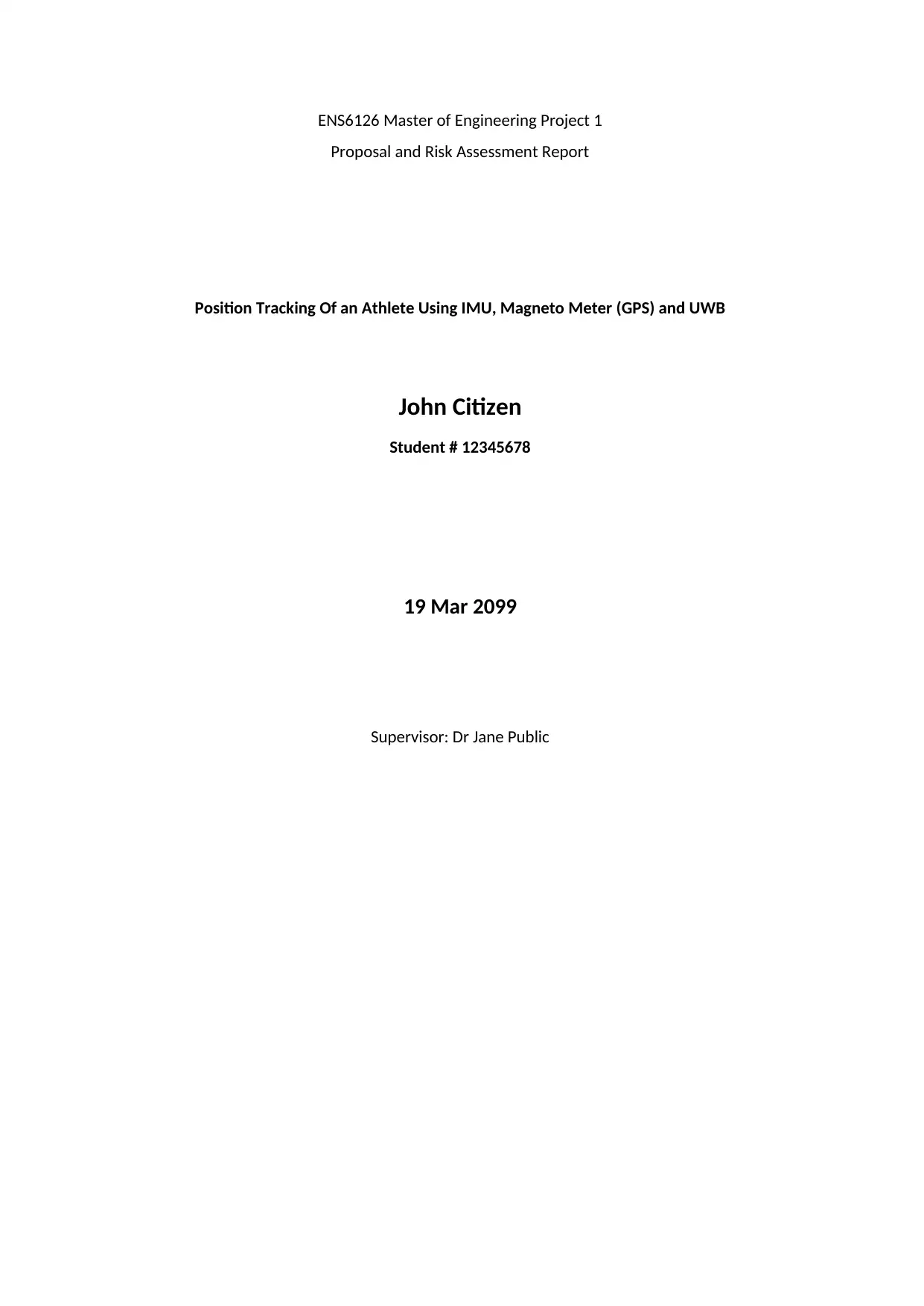
ENS6126 Master of Engineering Project 1
Proposal and Risk Assessment Report
Position Tracking Of an Athlete Using IMU, Magneto Meter (GPS) and UWB
John Citizen
Student # 12345678
19 Mar 2099
Supervisor: Dr Jane Public
Proposal and Risk Assessment Report
Position Tracking Of an Athlete Using IMU, Magneto Meter (GPS) and UWB
John Citizen
Student # 12345678
19 Mar 2099
Supervisor: Dr Jane Public

Paraphrase This Document
Need a fresh take? Get an instant paraphrase of this document with our AI Paraphraser
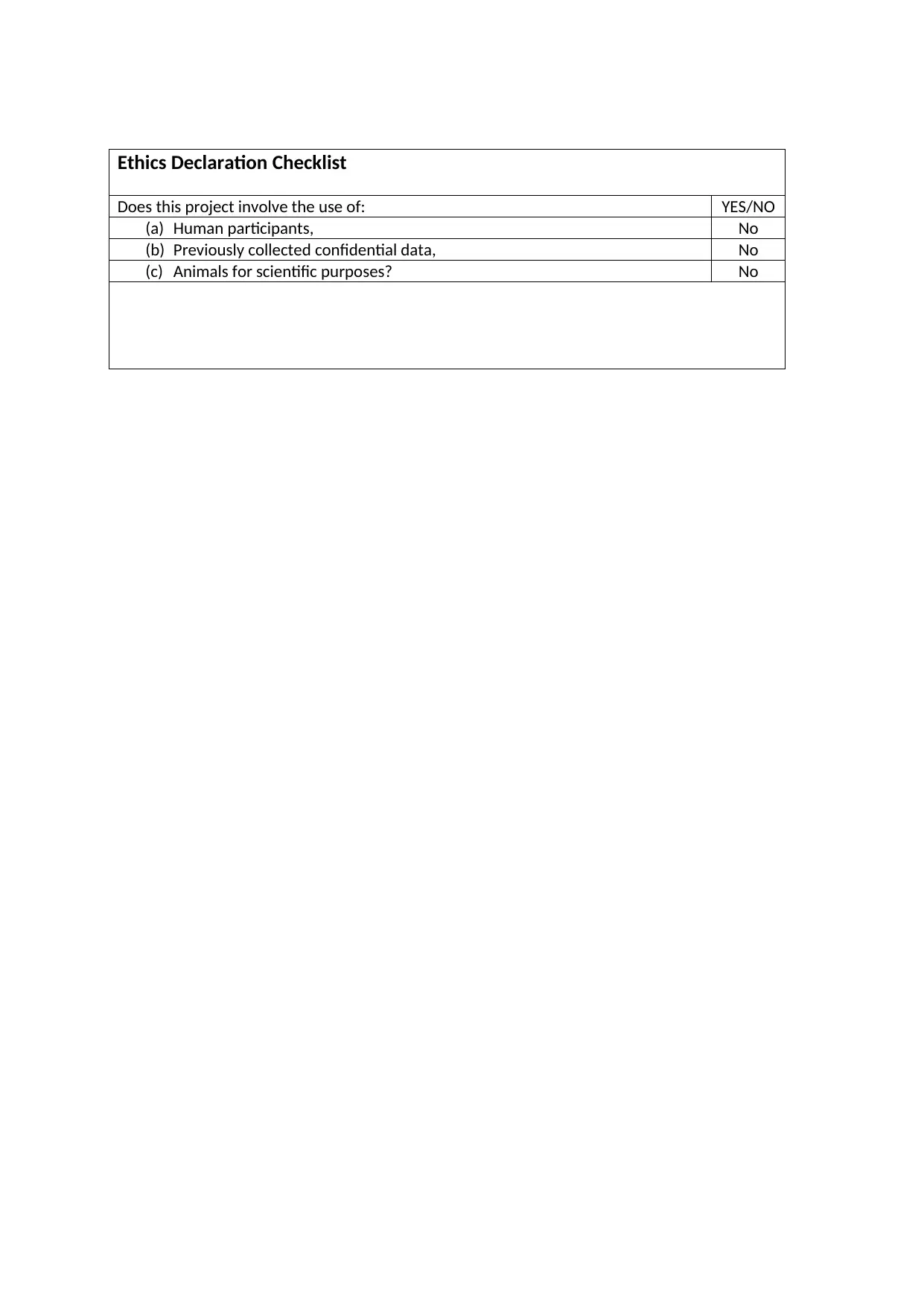
Ethics Declaration Checklist
Does this project involve the use of: YES/NO
(a) Human participants, No
(b) Previously collected confidential data, No
(c) Animals for scientific purposes? No
Does this project involve the use of: YES/NO
(a) Human participants, No
(b) Previously collected confidential data, No
(c) Animals for scientific purposes? No
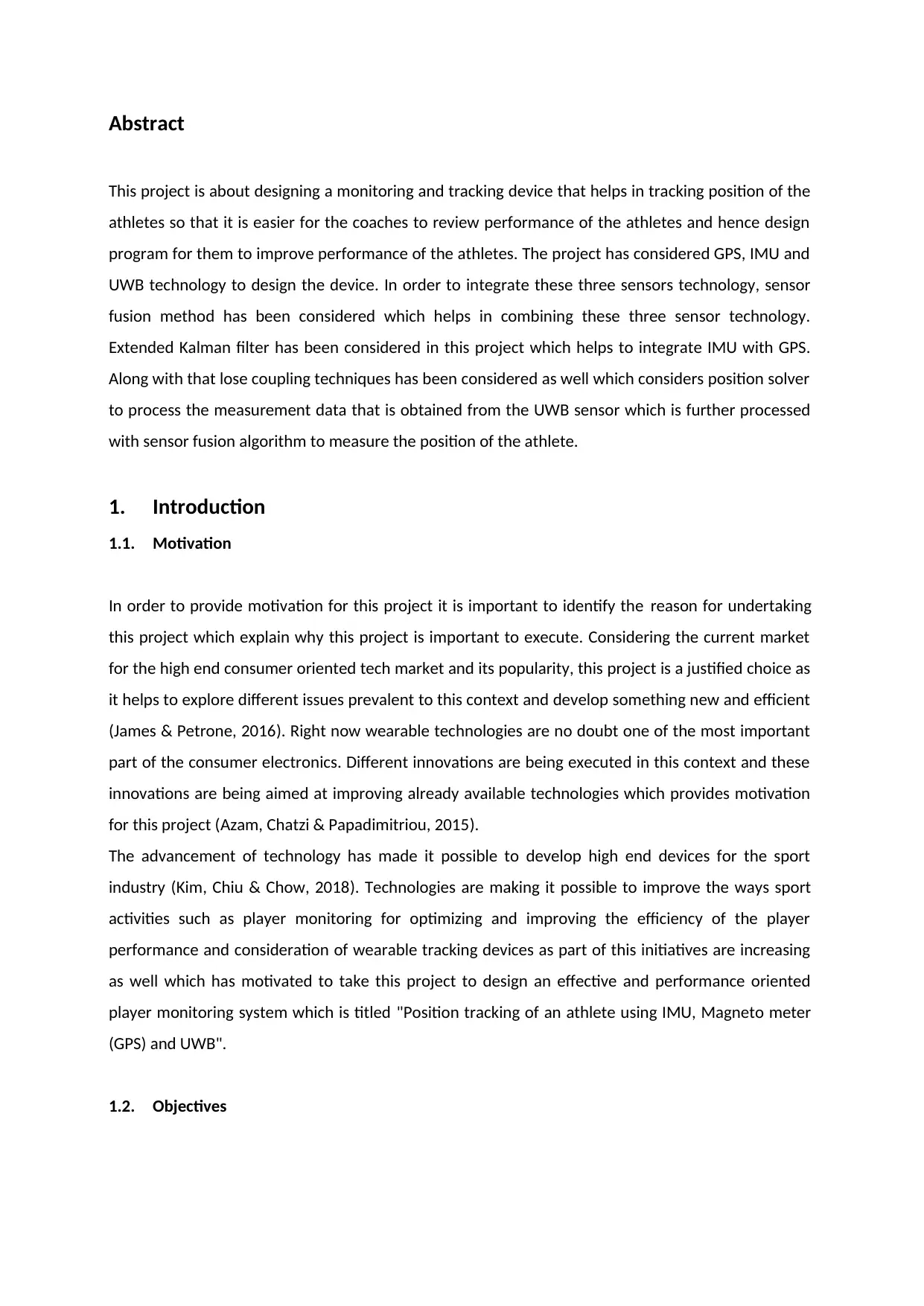
Abstract
This project is about designing a monitoring and tracking device that helps in tracking position of the
athletes so that it is easier for the coaches to review performance of the athletes and hence design
program for them to improve performance of the athletes. The project has considered GPS, IMU and
UWB technology to design the device. In order to integrate these three sensors technology, sensor
fusion method has been considered which helps in combining these three sensor technology.
Extended Kalman filter has been considered in this project which helps to integrate IMU with GPS.
Along with that lose coupling techniques has been considered as well which considers position solver
to process the measurement data that is obtained from the UWB sensor which is further processed
with sensor fusion algorithm to measure the position of the athlete.
1. Introduction
1.1. Motivation
In order to provide motivation for this project it is important to identify the reason for undertaking
this project which explain why this project is important to execute. Considering the current market
for the high end consumer oriented tech market and its popularity, this project is a justified choice as
it helps to explore different issues prevalent to this context and develop something new and efficient
(James & Petrone, 2016). Right now wearable technologies are no doubt one of the most important
part of the consumer electronics. Different innovations are being executed in this context and these
innovations are being aimed at improving already available technologies which provides motivation
for this project (Azam, Chatzi & Papadimitriou, 2015).
The advancement of technology has made it possible to develop high end devices for the sport
industry (Kim, Chiu & Chow, 2018). Technologies are making it possible to improve the ways sport
activities such as player monitoring for optimizing and improving the efficiency of the player
performance and consideration of wearable tracking devices as part of this initiatives are increasing
as well which has motivated to take this project to design an effective and performance oriented
player monitoring system which is titled "Position tracking of an athlete using IMU, Magneto meter
(GPS) and UWB".
1.2. Objectives
This project is about designing a monitoring and tracking device that helps in tracking position of the
athletes so that it is easier for the coaches to review performance of the athletes and hence design
program for them to improve performance of the athletes. The project has considered GPS, IMU and
UWB technology to design the device. In order to integrate these three sensors technology, sensor
fusion method has been considered which helps in combining these three sensor technology.
Extended Kalman filter has been considered in this project which helps to integrate IMU with GPS.
Along with that lose coupling techniques has been considered as well which considers position solver
to process the measurement data that is obtained from the UWB sensor which is further processed
with sensor fusion algorithm to measure the position of the athlete.
1. Introduction
1.1. Motivation
In order to provide motivation for this project it is important to identify the reason for undertaking
this project which explain why this project is important to execute. Considering the current market
for the high end consumer oriented tech market and its popularity, this project is a justified choice as
it helps to explore different issues prevalent to this context and develop something new and efficient
(James & Petrone, 2016). Right now wearable technologies are no doubt one of the most important
part of the consumer electronics. Different innovations are being executed in this context and these
innovations are being aimed at improving already available technologies which provides motivation
for this project (Azam, Chatzi & Papadimitriou, 2015).
The advancement of technology has made it possible to develop high end devices for the sport
industry (Kim, Chiu & Chow, 2018). Technologies are making it possible to improve the ways sport
activities such as player monitoring for optimizing and improving the efficiency of the player
performance and consideration of wearable tracking devices as part of this initiatives are increasing
as well which has motivated to take this project to design an effective and performance oriented
player monitoring system which is titled "Position tracking of an athlete using IMU, Magneto meter
(GPS) and UWB".
1.2. Objectives
⊘ This is a preview!⊘
Do you want full access?
Subscribe today to unlock all pages.

Trusted by 1+ million students worldwide
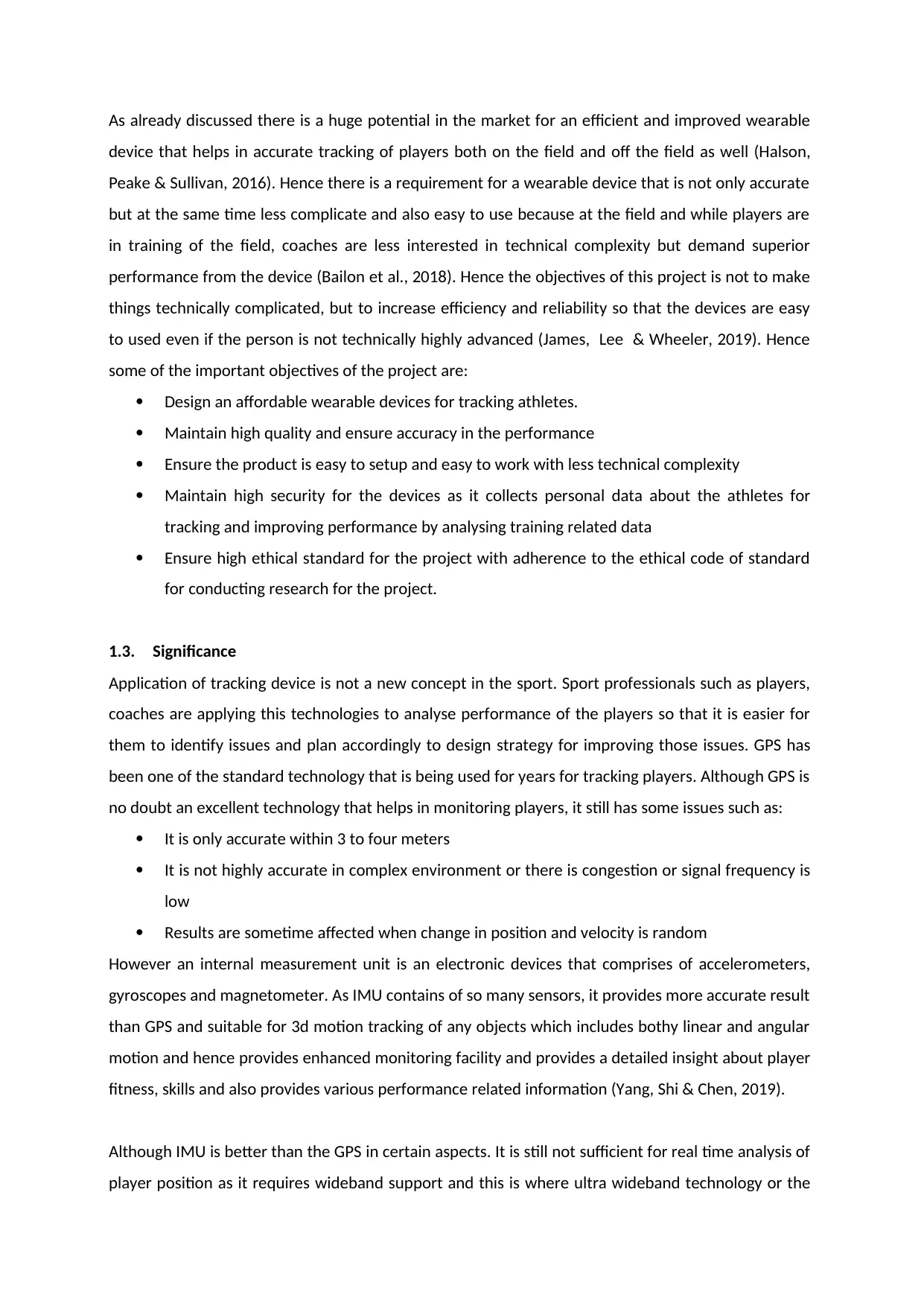
As already discussed there is a huge potential in the market for an efficient and improved wearable
device that helps in accurate tracking of players both on the field and off the field as well (Halson,
Peake & Sullivan, 2016). Hence there is a requirement for a wearable device that is not only accurate
but at the same time less complicate and also easy to use because at the field and while players are
in training of the field, coaches are less interested in technical complexity but demand superior
performance from the device (Bailon et al., 2018). Hence the objectives of this project is not to make
things technically complicated, but to increase efficiency and reliability so that the devices are easy
to used even if the person is not technically highly advanced (James, Lee & Wheeler, 2019). Hence
some of the important objectives of the project are:
Design an affordable wearable devices for tracking athletes.
Maintain high quality and ensure accuracy in the performance
Ensure the product is easy to setup and easy to work with less technical complexity
Maintain high security for the devices as it collects personal data about the athletes for
tracking and improving performance by analysing training related data
Ensure high ethical standard for the project with adherence to the ethical code of standard
for conducting research for the project.
1.3. Significance
Application of tracking device is not a new concept in the sport. Sport professionals such as players,
coaches are applying this technologies to analyse performance of the players so that it is easier for
them to identify issues and plan accordingly to design strategy for improving those issues. GPS has
been one of the standard technology that is being used for years for tracking players. Although GPS is
no doubt an excellent technology that helps in monitoring players, it still has some issues such as:
It is only accurate within 3 to four meters
It is not highly accurate in complex environment or there is congestion or signal frequency is
low
Results are sometime affected when change in position and velocity is random
However an internal measurement unit is an electronic devices that comprises of accelerometers,
gyroscopes and magnetometer. As IMU contains of so many sensors, it provides more accurate result
than GPS and suitable for 3d motion tracking of any objects which includes bothy linear and angular
motion and hence provides enhanced monitoring facility and provides a detailed insight about player
fitness, skills and also provides various performance related information (Yang, Shi & Chen, 2019).
Although IMU is better than the GPS in certain aspects. It is still not sufficient for real time analysis of
player position as it requires wideband support and this is where ultra wideband technology or the
device that helps in accurate tracking of players both on the field and off the field as well (Halson,
Peake & Sullivan, 2016). Hence there is a requirement for a wearable device that is not only accurate
but at the same time less complicate and also easy to use because at the field and while players are
in training of the field, coaches are less interested in technical complexity but demand superior
performance from the device (Bailon et al., 2018). Hence the objectives of this project is not to make
things technically complicated, but to increase efficiency and reliability so that the devices are easy
to used even if the person is not technically highly advanced (James, Lee & Wheeler, 2019). Hence
some of the important objectives of the project are:
Design an affordable wearable devices for tracking athletes.
Maintain high quality and ensure accuracy in the performance
Ensure the product is easy to setup and easy to work with less technical complexity
Maintain high security for the devices as it collects personal data about the athletes for
tracking and improving performance by analysing training related data
Ensure high ethical standard for the project with adherence to the ethical code of standard
for conducting research for the project.
1.3. Significance
Application of tracking device is not a new concept in the sport. Sport professionals such as players,
coaches are applying this technologies to analyse performance of the players so that it is easier for
them to identify issues and plan accordingly to design strategy for improving those issues. GPS has
been one of the standard technology that is being used for years for tracking players. Although GPS is
no doubt an excellent technology that helps in monitoring players, it still has some issues such as:
It is only accurate within 3 to four meters
It is not highly accurate in complex environment or there is congestion or signal frequency is
low
Results are sometime affected when change in position and velocity is random
However an internal measurement unit is an electronic devices that comprises of accelerometers,
gyroscopes and magnetometer. As IMU contains of so many sensors, it provides more accurate result
than GPS and suitable for 3d motion tracking of any objects which includes bothy linear and angular
motion and hence provides enhanced monitoring facility and provides a detailed insight about player
fitness, skills and also provides various performance related information (Yang, Shi & Chen, 2019).
Although IMU is better than the GPS in certain aspects. It is still not sufficient for real time analysis of
player position as it requires wideband support and this is where ultra wideband technology or the
Paraphrase This Document
Need a fresh take? Get an instant paraphrase of this document with our AI Paraphraser
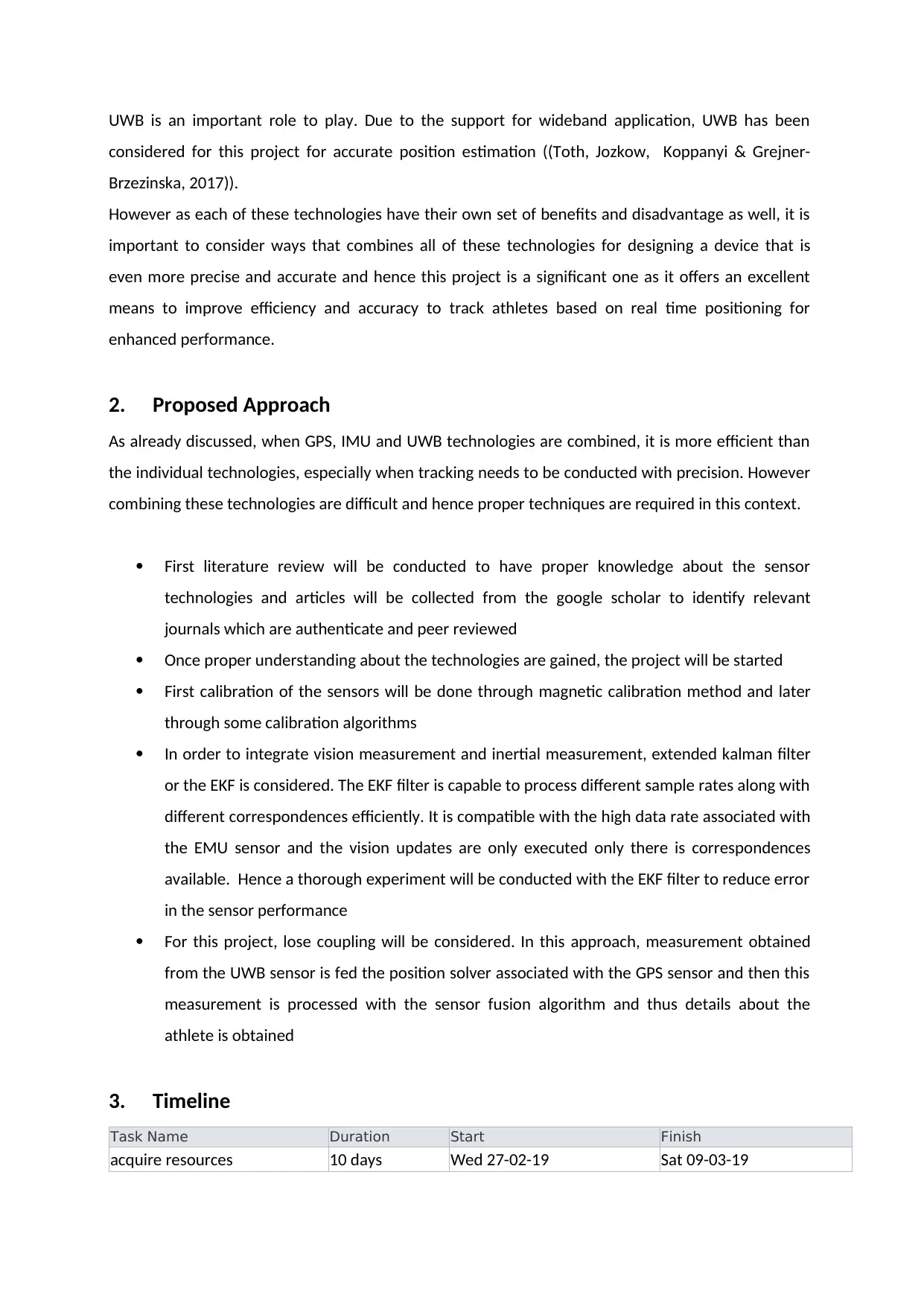
UWB is an important role to play. Due to the support for wideband application, UWB has been
considered for this project for accurate position estimation ((Toth, Jozkow, Koppanyi & Grejner-
Brzezinska, 2017)).
However as each of these technologies have their own set of benefits and disadvantage as well, it is
important to consider ways that combines all of these technologies for designing a device that is
even more precise and accurate and hence this project is a significant one as it offers an excellent
means to improve efficiency and accuracy to track athletes based on real time positioning for
enhanced performance.
2. Proposed Approach
As already discussed, when GPS, IMU and UWB technologies are combined, it is more efficient than
the individual technologies, especially when tracking needs to be conducted with precision. However
combining these technologies are difficult and hence proper techniques are required in this context.
First literature review will be conducted to have proper knowledge about the sensor
technologies and articles will be collected from the google scholar to identify relevant
journals which are authenticate and peer reviewed
Once proper understanding about the technologies are gained, the project will be started
First calibration of the sensors will be done through magnetic calibration method and later
through some calibration algorithms
In order to integrate vision measurement and inertial measurement, extended kalman filter
or the EKF is considered. The EKF filter is capable to process different sample rates along with
different correspondences efficiently. It is compatible with the high data rate associated with
the EMU sensor and the vision updates are only executed only there is correspondences
available. Hence a thorough experiment will be conducted with the EKF filter to reduce error
in the sensor performance
For this project, lose coupling will be considered. In this approach, measurement obtained
from the UWB sensor is fed the position solver associated with the GPS sensor and then this
measurement is processed with the sensor fusion algorithm and thus details about the
athlete is obtained
3. Timeline
Task Name Duration Start Finish
acquire resources 10 days Wed 27-02-19 Sat 09-03-19
considered for this project for accurate position estimation ((Toth, Jozkow, Koppanyi & Grejner-
Brzezinska, 2017)).
However as each of these technologies have their own set of benefits and disadvantage as well, it is
important to consider ways that combines all of these technologies for designing a device that is
even more precise and accurate and hence this project is a significant one as it offers an excellent
means to improve efficiency and accuracy to track athletes based on real time positioning for
enhanced performance.
2. Proposed Approach
As already discussed, when GPS, IMU and UWB technologies are combined, it is more efficient than
the individual technologies, especially when tracking needs to be conducted with precision. However
combining these technologies are difficult and hence proper techniques are required in this context.
First literature review will be conducted to have proper knowledge about the sensor
technologies and articles will be collected from the google scholar to identify relevant
journals which are authenticate and peer reviewed
Once proper understanding about the technologies are gained, the project will be started
First calibration of the sensors will be done through magnetic calibration method and later
through some calibration algorithms
In order to integrate vision measurement and inertial measurement, extended kalman filter
or the EKF is considered. The EKF filter is capable to process different sample rates along with
different correspondences efficiently. It is compatible with the high data rate associated with
the EMU sensor and the vision updates are only executed only there is correspondences
available. Hence a thorough experiment will be conducted with the EKF filter to reduce error
in the sensor performance
For this project, lose coupling will be considered. In this approach, measurement obtained
from the UWB sensor is fed the position solver associated with the GPS sensor and then this
measurement is processed with the sensor fusion algorithm and thus details about the
athlete is obtained
3. Timeline
Task Name Duration Start Finish
acquire resources 10 days Wed 27-02-19 Sat 09-03-19
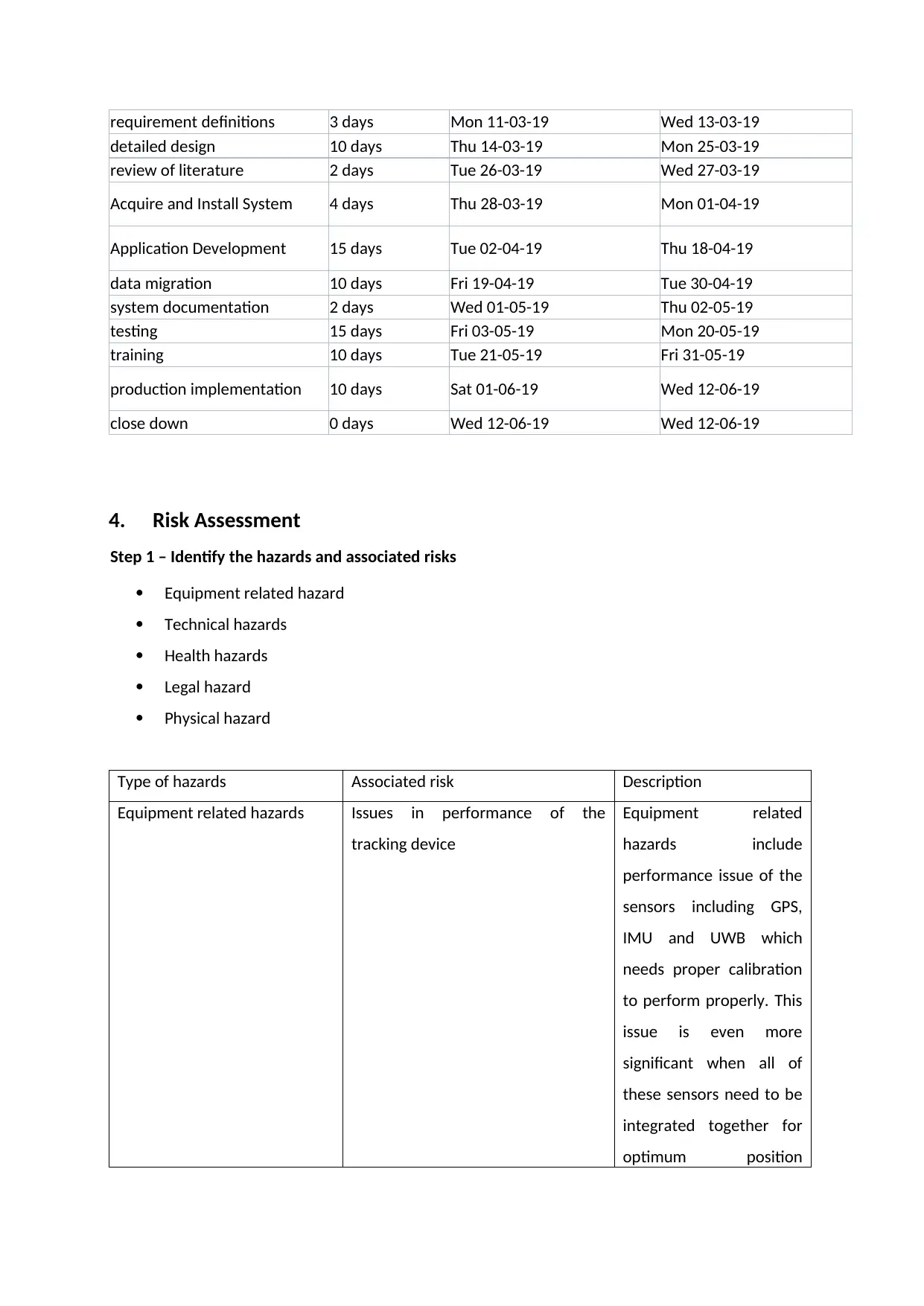
requirement definitions 3 days Mon 11-03-19 Wed 13-03-19
detailed design 10 days Thu 14-03-19 Mon 25-03-19
review of literature 2 days Tue 26-03-19 Wed 27-03-19
Acquire and Install System 4 days Thu 28-03-19 Mon 01-04-19
Application Development 15 days Tue 02-04-19 Thu 18-04-19
data migration 10 days Fri 19-04-19 Tue 30-04-19
system documentation 2 days Wed 01-05-19 Thu 02-05-19
testing 15 days Fri 03-05-19 Mon 20-05-19
training 10 days Tue 21-05-19 Fri 31-05-19
production implementation 10 days Sat 01-06-19 Wed 12-06-19
close down 0 days Wed 12-06-19 Wed 12-06-19
4. Risk Assessment
Step 1 – Identify the hazards and associated risks
Equipment related hazard
Technical hazards
Health hazards
Legal hazard
Physical hazard
Type of hazards Associated risk Description
Equipment related hazards Issues in performance of the
tracking device
Equipment related
hazards include
performance issue of the
sensors including GPS,
IMU and UWB which
needs proper calibration
to perform properly. This
issue is even more
significant when all of
these sensors need to be
integrated together for
optimum position
detailed design 10 days Thu 14-03-19 Mon 25-03-19
review of literature 2 days Tue 26-03-19 Wed 27-03-19
Acquire and Install System 4 days Thu 28-03-19 Mon 01-04-19
Application Development 15 days Tue 02-04-19 Thu 18-04-19
data migration 10 days Fri 19-04-19 Tue 30-04-19
system documentation 2 days Wed 01-05-19 Thu 02-05-19
testing 15 days Fri 03-05-19 Mon 20-05-19
training 10 days Tue 21-05-19 Fri 31-05-19
production implementation 10 days Sat 01-06-19 Wed 12-06-19
close down 0 days Wed 12-06-19 Wed 12-06-19
4. Risk Assessment
Step 1 – Identify the hazards and associated risks
Equipment related hazard
Technical hazards
Health hazards
Legal hazard
Physical hazard
Type of hazards Associated risk Description
Equipment related hazards Issues in performance of the
tracking device
Equipment related
hazards include
performance issue of the
sensors including GPS,
IMU and UWB which
needs proper calibration
to perform properly. This
issue is even more
significant when all of
these sensors need to be
integrated together for
optimum position
⊘ This is a preview!⊘
Do you want full access?
Subscribe today to unlock all pages.
Trusted by 1+ million students worldwide
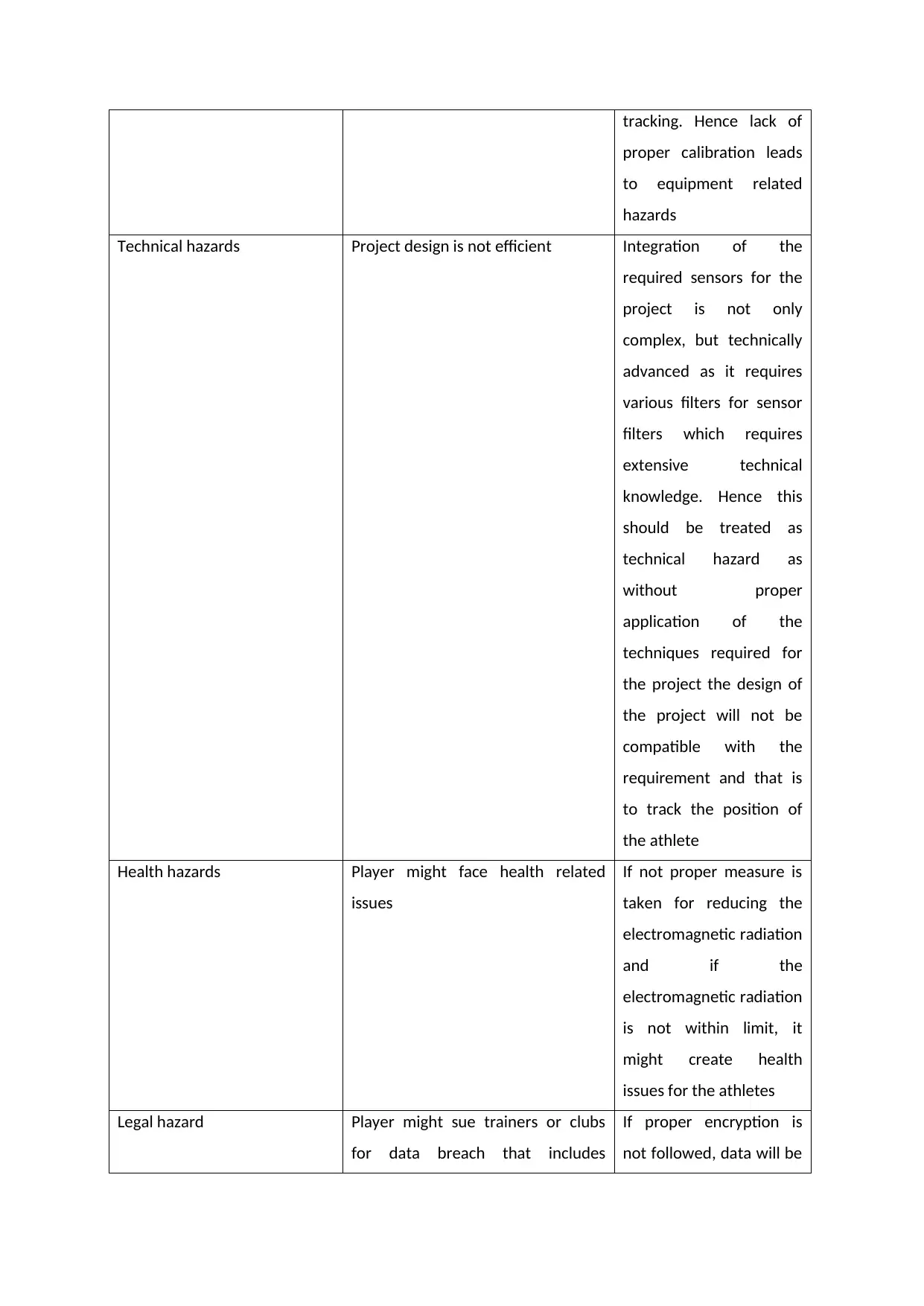
tracking. Hence lack of
proper calibration leads
to equipment related
hazards
Technical hazards Project design is not efficient Integration of the
required sensors for the
project is not only
complex, but technically
advanced as it requires
various filters for sensor
filters which requires
extensive technical
knowledge. Hence this
should be treated as
technical hazard as
without proper
application of the
techniques required for
the project the design of
the project will not be
compatible with the
requirement and that is
to track the position of
the athlete
Health hazards Player might face health related
issues
If not proper measure is
taken for reducing the
electromagnetic radiation
and if the
electromagnetic radiation
is not within limit, it
might create health
issues for the athletes
Legal hazard Player might sue trainers or clubs
for data breach that includes
If proper encryption is
not followed, data will be
proper calibration leads
to equipment related
hazards
Technical hazards Project design is not efficient Integration of the
required sensors for the
project is not only
complex, but technically
advanced as it requires
various filters for sensor
filters which requires
extensive technical
knowledge. Hence this
should be treated as
technical hazard as
without proper
application of the
techniques required for
the project the design of
the project will not be
compatible with the
requirement and that is
to track the position of
the athlete
Health hazards Player might face health related
issues
If not proper measure is
taken for reducing the
electromagnetic radiation
and if the
electromagnetic radiation
is not within limit, it
might create health
issues for the athletes
Legal hazard Player might sue trainers or clubs
for data breach that includes
If proper encryption is
not followed, data will be
Paraphrase This Document
Need a fresh take? Get an instant paraphrase of this document with our AI Paraphraser
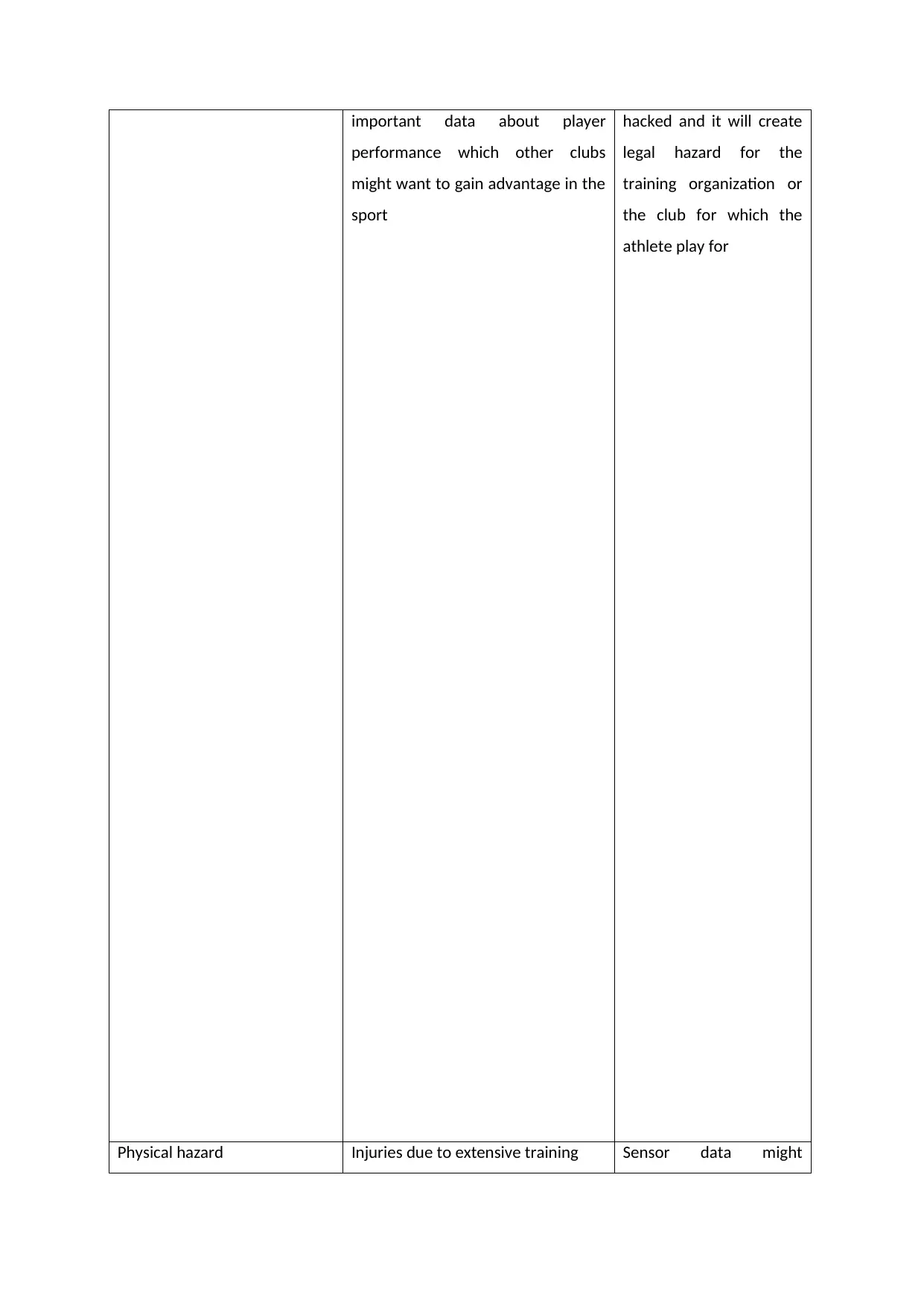
important data about player
performance which other clubs
might want to gain advantage in the
sport
hacked and it will create
legal hazard for the
training organization or
the club for which the
athlete play for
Physical hazard Injuries due to extensive training Sensor data might
performance which other clubs
might want to gain advantage in the
sport
hacked and it will create
legal hazard for the
training organization or
the club for which the
athlete play for
Physical hazard Injuries due to extensive training Sensor data might
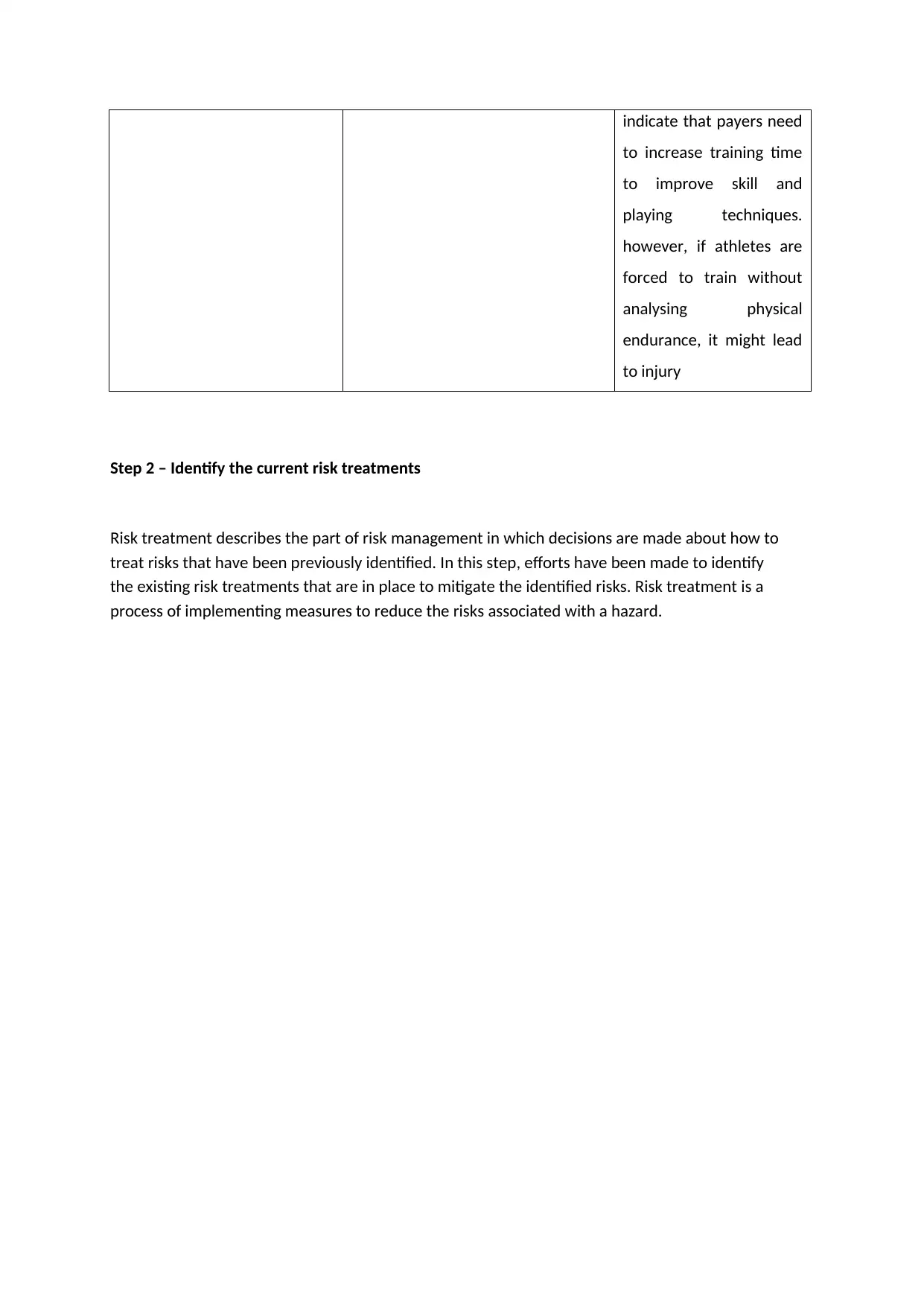
indicate that payers need
to increase training time
to improve skill and
playing techniques.
however, if athletes are
forced to train without
analysing physical
endurance, it might lead
to injury
Step 2 – Identify the current risk treatments
Risk treatment describes the part of risk management in which decisions are made about how to
treat risks that have been previously identified. In this step, efforts have been made to identify
the existing risk treatments that are in place to mitigate the identified risks. Risk treatment is a
process of implementing measures to reduce the risks associated with a hazard.
to increase training time
to improve skill and
playing techniques.
however, if athletes are
forced to train without
analysing physical
endurance, it might lead
to injury
Step 2 – Identify the current risk treatments
Risk treatment describes the part of risk management in which decisions are made about how to
treat risks that have been previously identified. In this step, efforts have been made to identify
the existing risk treatments that are in place to mitigate the identified risks. Risk treatment is a
process of implementing measures to reduce the risks associated with a hazard.
⊘ This is a preview!⊘
Do you want full access?
Subscribe today to unlock all pages.
Trusted by 1+ million students worldwide
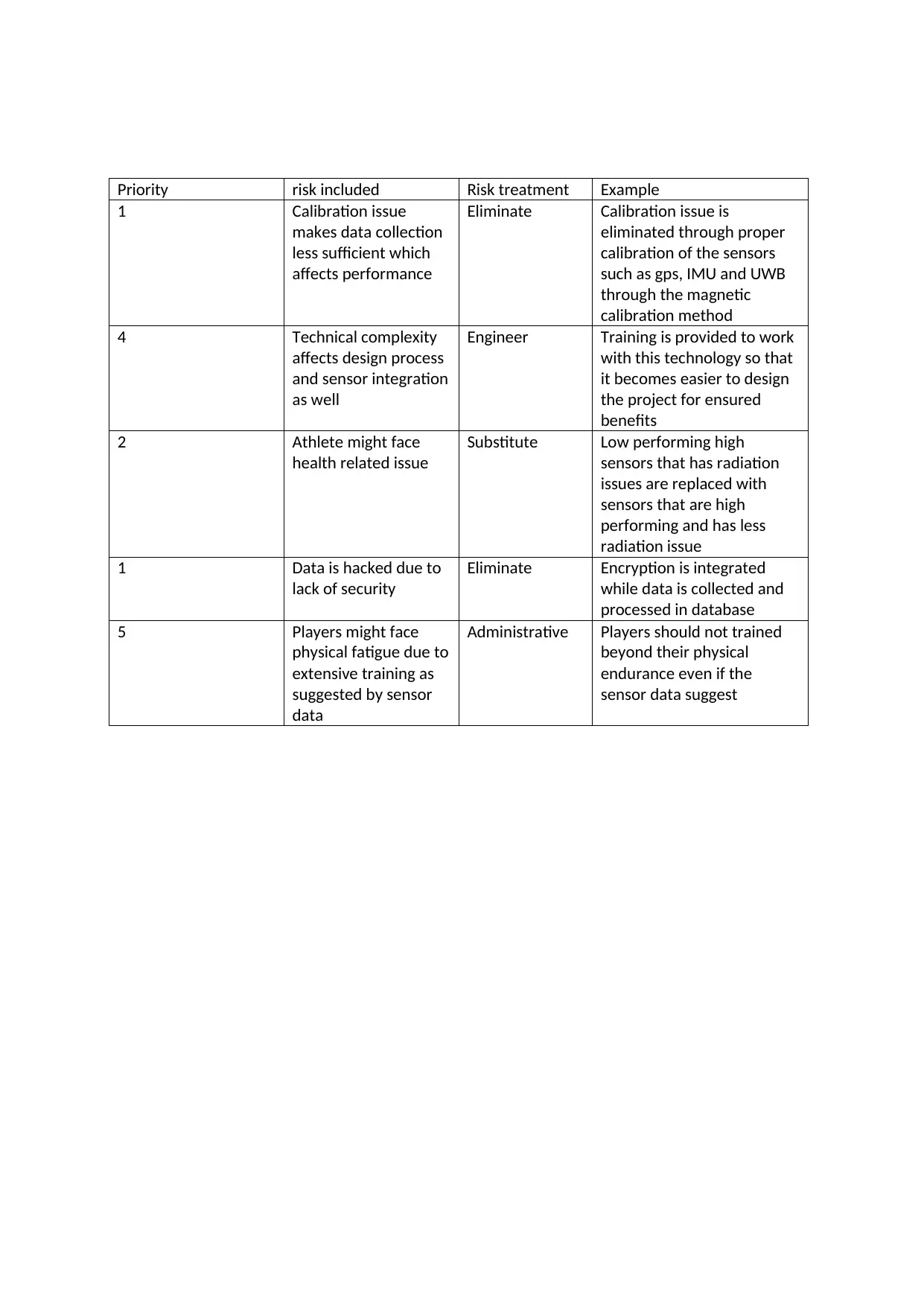
Priority risk included Risk treatment Example
1 Calibration issue
makes data collection
less sufficient which
affects performance
Eliminate Calibration issue is
eliminated through proper
calibration of the sensors
such as gps, IMU and UWB
through the magnetic
calibration method
4 Technical complexity
affects design process
and sensor integration
as well
Engineer Training is provided to work
with this technology so that
it becomes easier to design
the project for ensured
benefits
2 Athlete might face
health related issue
Substitute Low performing high
sensors that has radiation
issues are replaced with
sensors that are high
performing and has less
radiation issue
1 Data is hacked due to
lack of security
Eliminate Encryption is integrated
while data is collected and
processed in database
5 Players might face
physical fatigue due to
extensive training as
suggested by sensor
data
Administrative Players should not trained
beyond their physical
endurance even if the
sensor data suggest
1 Calibration issue
makes data collection
less sufficient which
affects performance
Eliminate Calibration issue is
eliminated through proper
calibration of the sensors
such as gps, IMU and UWB
through the magnetic
calibration method
4 Technical complexity
affects design process
and sensor integration
as well
Engineer Training is provided to work
with this technology so that
it becomes easier to design
the project for ensured
benefits
2 Athlete might face
health related issue
Substitute Low performing high
sensors that has radiation
issues are replaced with
sensors that are high
performing and has less
radiation issue
1 Data is hacked due to
lack of security
Eliminate Encryption is integrated
while data is collected and
processed in database
5 Players might face
physical fatigue due to
extensive training as
suggested by sensor
data
Administrative Players should not trained
beyond their physical
endurance even if the
sensor data suggest
Paraphrase This Document
Need a fresh take? Get an instant paraphrase of this document with our AI Paraphraser
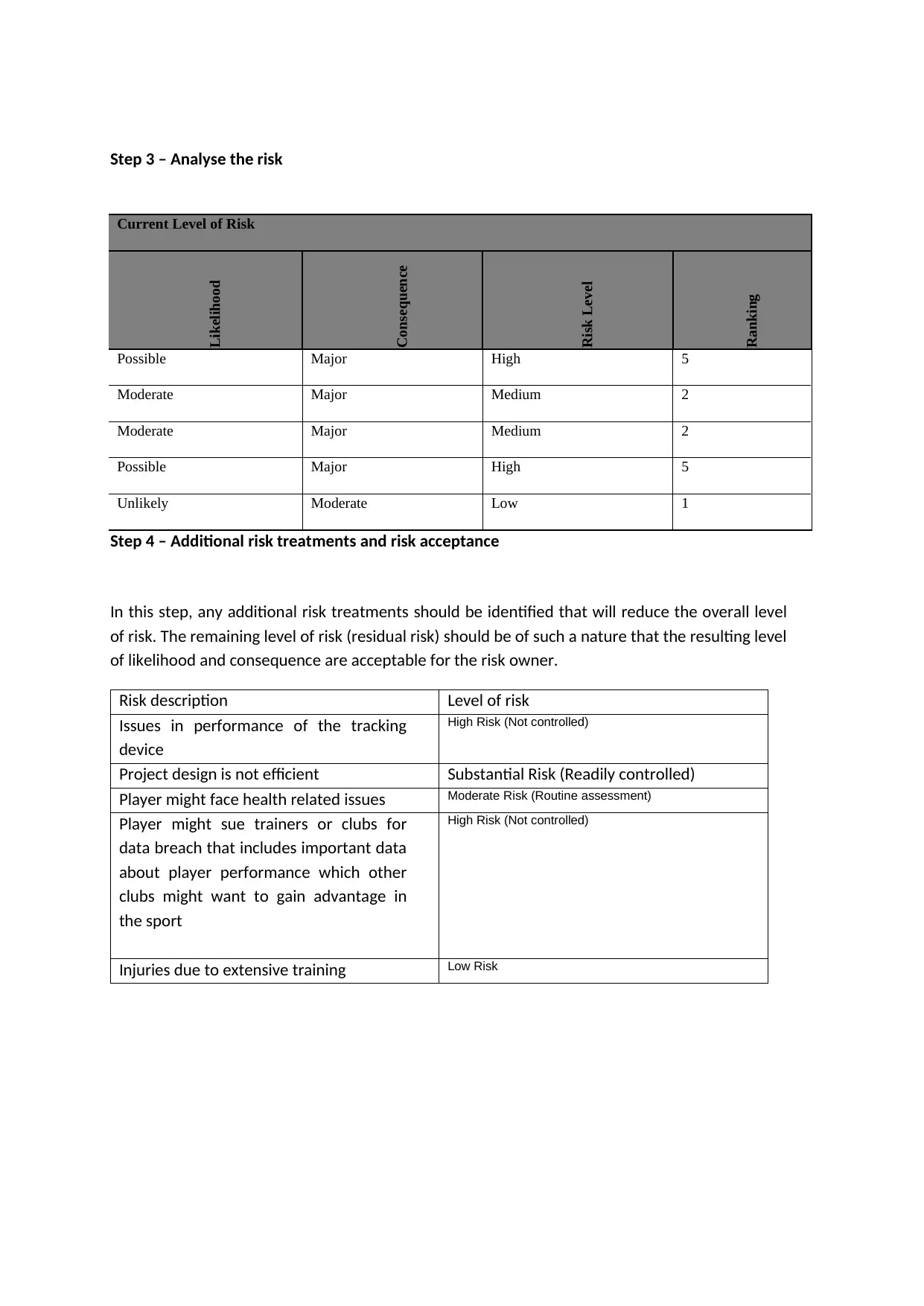
Step 3 – Analyse the risk
Current Level of Risk
Likelihood
Consequence
Risk Level
Ranking
Possible Major High 5
Moderate Major Medium 2
Moderate Major Medium 2
Possible Major High 5
Unlikely Moderate Low 1
Step 4 – Additional risk treatments and risk acceptance
In this step, any additional risk treatments should be identified that will reduce the overall level
of risk. The remaining level of risk (residual risk) should be of such a nature that the resulting level
of likelihood and consequence are acceptable for the risk owner.
Risk description Level of risk
Issues in performance of the tracking
device
High Risk (Not controlled)
Project design is not efficient Substantial Risk (Readily controlled)
Player might face health related issues Moderate Risk (Routine assessment)
Player might sue trainers or clubs for
data breach that includes important data
about player performance which other
clubs might want to gain advantage in
the sport
High Risk (Not controlled)
Injuries due to extensive training Low Risk
Current Level of Risk
Likelihood
Consequence
Risk Level
Ranking
Possible Major High 5
Moderate Major Medium 2
Moderate Major Medium 2
Possible Major High 5
Unlikely Moderate Low 1
Step 4 – Additional risk treatments and risk acceptance
In this step, any additional risk treatments should be identified that will reduce the overall level
of risk. The remaining level of risk (residual risk) should be of such a nature that the resulting level
of likelihood and consequence are acceptable for the risk owner.
Risk description Level of risk
Issues in performance of the tracking
device
High Risk (Not controlled)
Project design is not efficient Substantial Risk (Readily controlled)
Player might face health related issues Moderate Risk (Routine assessment)
Player might sue trainers or clubs for
data breach that includes important data
about player performance which other
clubs might want to gain advantage in
the sport
High Risk (Not controlled)
Injuries due to extensive training Low Risk
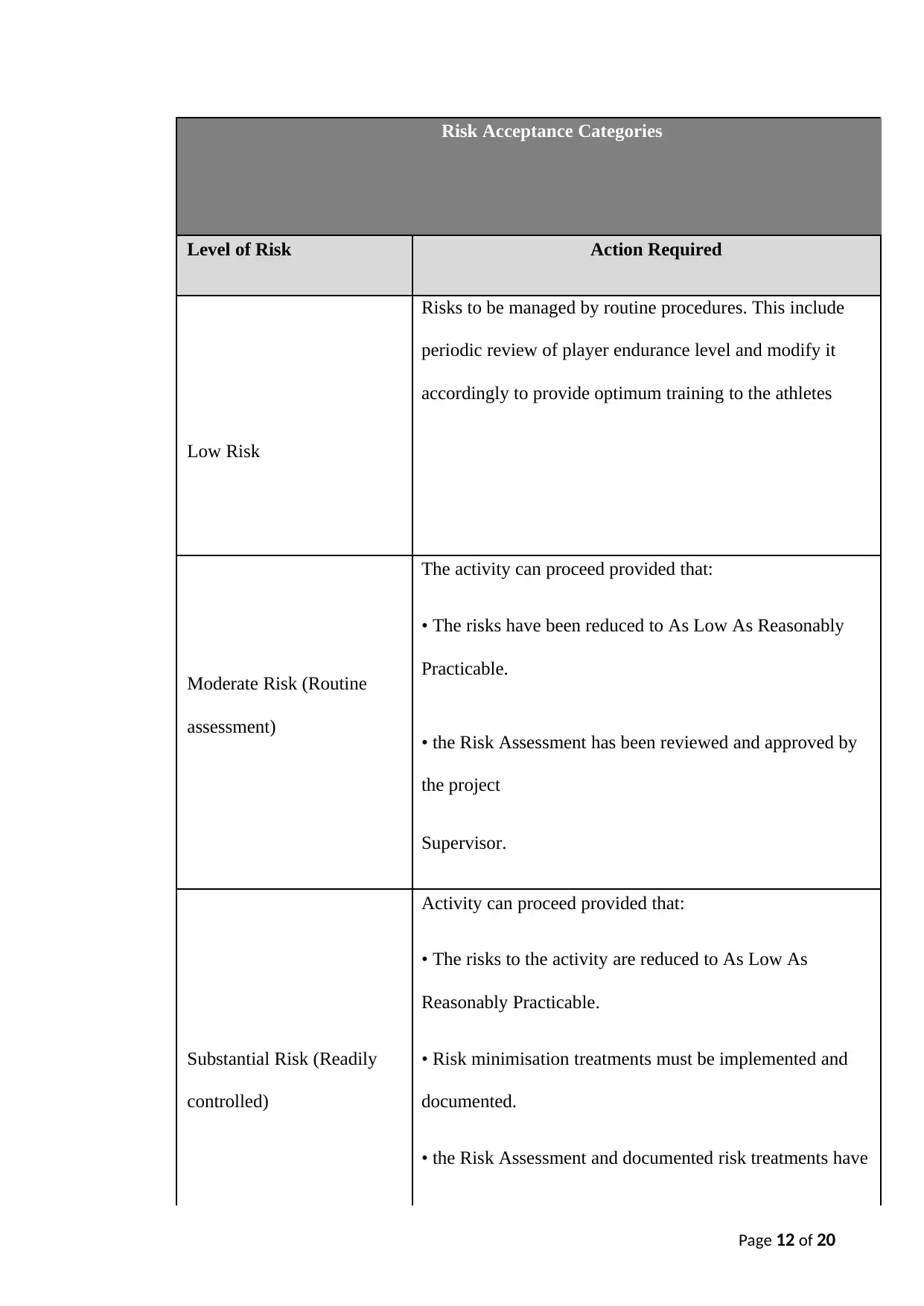
Risk Acceptance Categories
Level of Risk Action Required
Low Risk
Risks to be managed by routine procedures. This include
periodic review of player endurance level and modify it
accordingly to provide optimum training to the athletes
The activity can proceed provided that:
Moderate Risk (Routine
assessment)
• The risks have been reduced to As Low As Reasonably
Practicable.
• the Risk Assessment has been reviewed and approved by
the project
Supervisor.
Activity can proceed provided that:
• The risks to the activity are reduced to As Low As
Reasonably Practicable.
Substantial Risk (Readily
controlled)
• Risk minimisation treatments must be implemented and
documented.
• the Risk Assessment and documented risk treatments have
Page 12 of 20
Level of Risk Action Required
Low Risk
Risks to be managed by routine procedures. This include
periodic review of player endurance level and modify it
accordingly to provide optimum training to the athletes
The activity can proceed provided that:
Moderate Risk (Routine
assessment)
• The risks have been reduced to As Low As Reasonably
Practicable.
• the Risk Assessment has been reviewed and approved by
the project
Supervisor.
Activity can proceed provided that:
• The risks to the activity are reduced to As Low As
Reasonably Practicable.
Substantial Risk (Readily
controlled)
• Risk minimisation treatments must be implemented and
documented.
• the Risk Assessment and documented risk treatments have
Page 12 of 20
⊘ This is a preview!⊘
Do you want full access?
Subscribe today to unlock all pages.
Trusted by 1+ million students worldwide

1 out of 20


Related Documents


Your All-in-One AI-Powered Toolkit for Academic Success.
+13062052269
info@desklib.com
Available 24*7 on WhatsApp / Email
![[object Object]](/_next/static/media/star-bottom.7253800d.svg)
Unlock your academic potential
Copyright © 2020–2026 A2Z Services. All Rights Reserved. Developed and managed by ZUCOL.