Material Science Report: University Assignment on Materials Science

Verified

Added on  2023/05/31

|7
|811
|487
Report
AI Summary
This report delves into the realm of material science, exploring the properties and applications of polymers and thin films. It begins by defining polymers and highlighting their prevalence in various applications, including those in the human body. The report then examines the preparation of polycrystalline thin films using solid-phase crystallization, emphasizing the importance of grain boundaries and electron mobility. The process of creating single crystal thin films from iron-based alloys, such as FeAl, is also discussed, focusing on the influence of substrate temperature and alloy composition on film structure and orientation. The report concludes with a table summarizing the applications of different types of polymers in the electrical industry. References to supporting literature are included, providing a comprehensive overview of the subject matter.
Document Page
Running Head: MATERIAL SCIENCE
MATERIAL SCIENCE
Name of the Student
Name of University
Author’s Note
tabler-icon-diamond-filled.svg

Paraphrase This Document

Need a fresh take? Get an instant paraphrase of this document with our AI Paraphraser
Document Page
1MATERIAL SCIENCE
Answer 1.
Polymers are materials that are built from the repeating chains of various chemical units
that tae comparatively small. Many of the polymers are artificial. Polymers are present almost
everywhere like water bottles, jackets, shoes and many more. Some proteins present in our body
are also polymers (Charlesby 2016). Polymers can be defined as large molecules that are made
by chemically linking or bonding a series of building blocks. Polymer has been derived from a
Greek word called that means many parts.
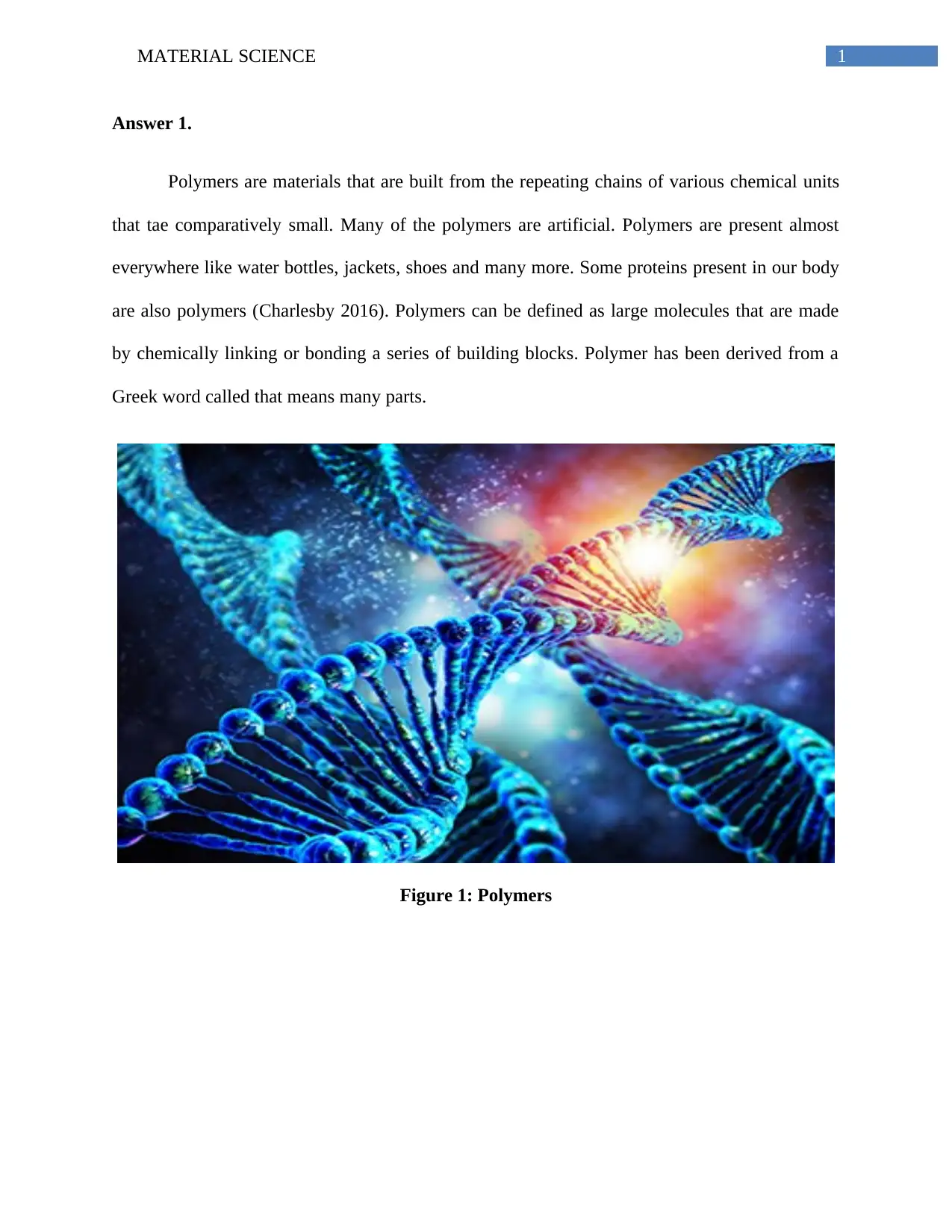
Figure 1: Polymers
Document Page
2MATERIAL SCIENCE
Answer 2.
Preparation of poly crystal thin film from raw materials
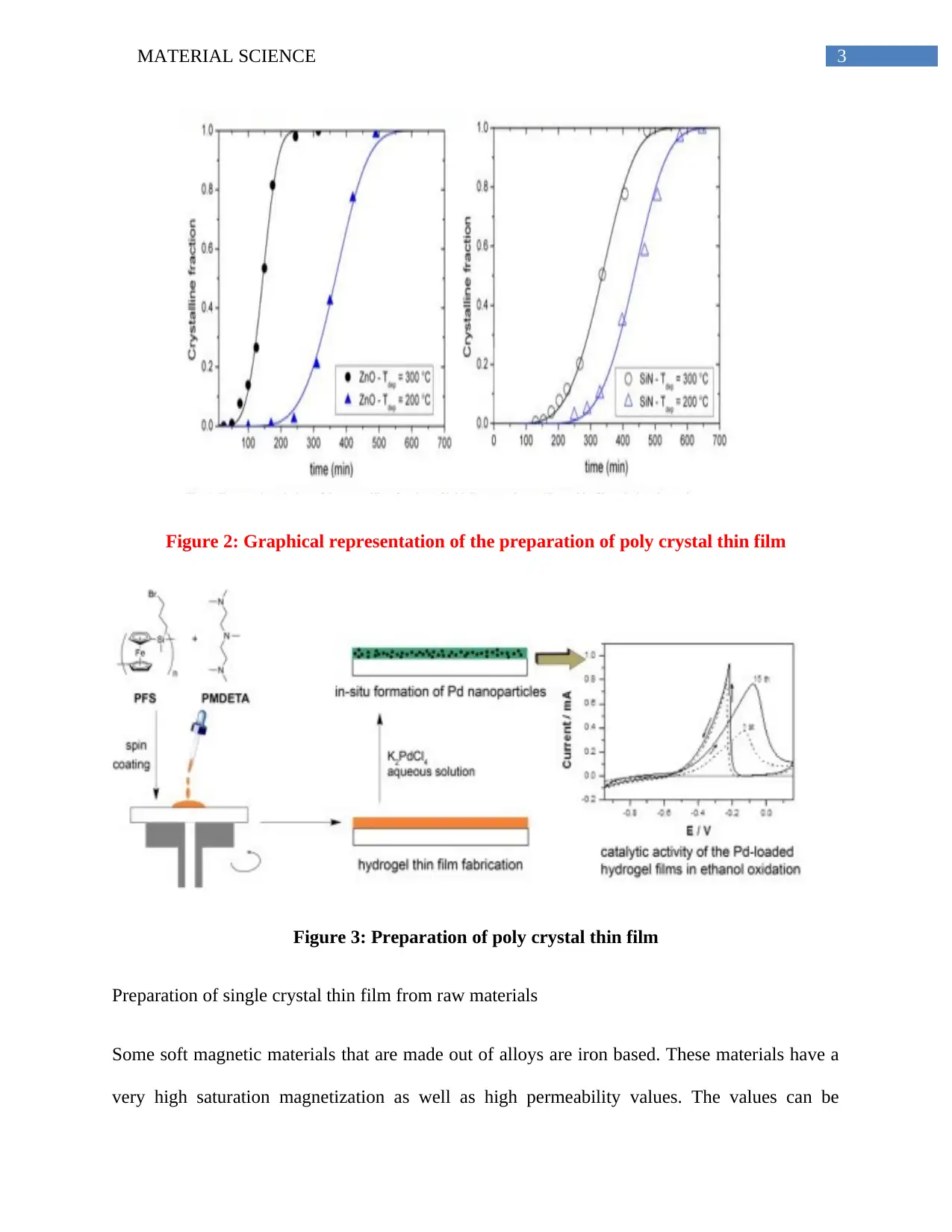
Poly crystal thin films have the ability to overcome the usual limits of silicon films. Poly
crystal thin film can be prepared with the help of the process of solid phase crystallization. The
thin films of polycrystalline silicon that are of high quality needs to be fabricated without leaving
any boundary (Goddard 2017). The boundary should not be present from bottom surface towards
the top; this helps the film to achieve a very high mobility of electrons of around 808cm2/V. this
is carried out by the process of solid phase crystallization.
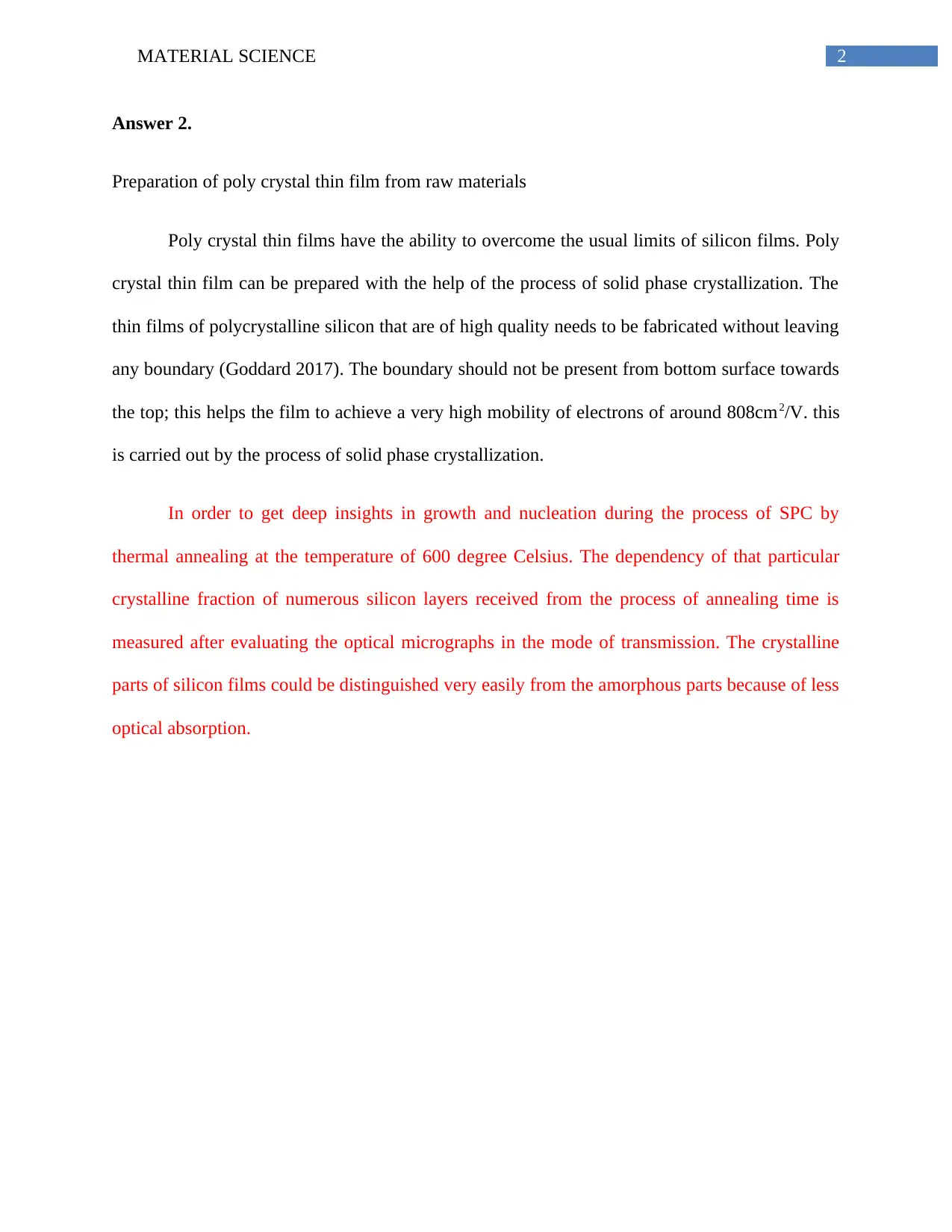
In order to get deep insights in growth and nucleation during the process of SPC by
thermal annealing at the temperature of 600 degree Celsius. The dependency of that particular
crystalline fraction of numerous silicon layers received from the process of annealing time is
measured after evaluating the optical micrographs in the mode of transmission. The crystalline
parts of silicon films could be distinguished very easily from the amorphous parts because of less
optical absorption.
Document Page
3MATERIAL SCIENCE
Figure 2: Graphical representation of the preparation of poly crystal thin film
Figure 3: Preparation of poly crystal thin film
Preparation of single crystal thin film from raw materials
Some soft magnetic materials that are made out of alloys are iron based. These materials have a
very high saturation magnetization as well as high permeability values. The values can be
tabler-icon-diamond-filled.svg

Paraphrase This Document

Need a fresh take? Get an instant paraphrase of this document with our AI Paraphraser
Document Page
4MATERIAL SCIENCE
utilized as core materials for various transformers, electric motors and electro magnets. These
particular materials can be utilized for numerous purposes like micro-machines, magnetic
sensors and many more (Nguyen and Yoon 2016). Single crystal thin films are made on oxide of
various single crystal substrates, g-factor, damping constant and magnetostriction. These factors
were studied with the help of the alloy single crystal thin films.
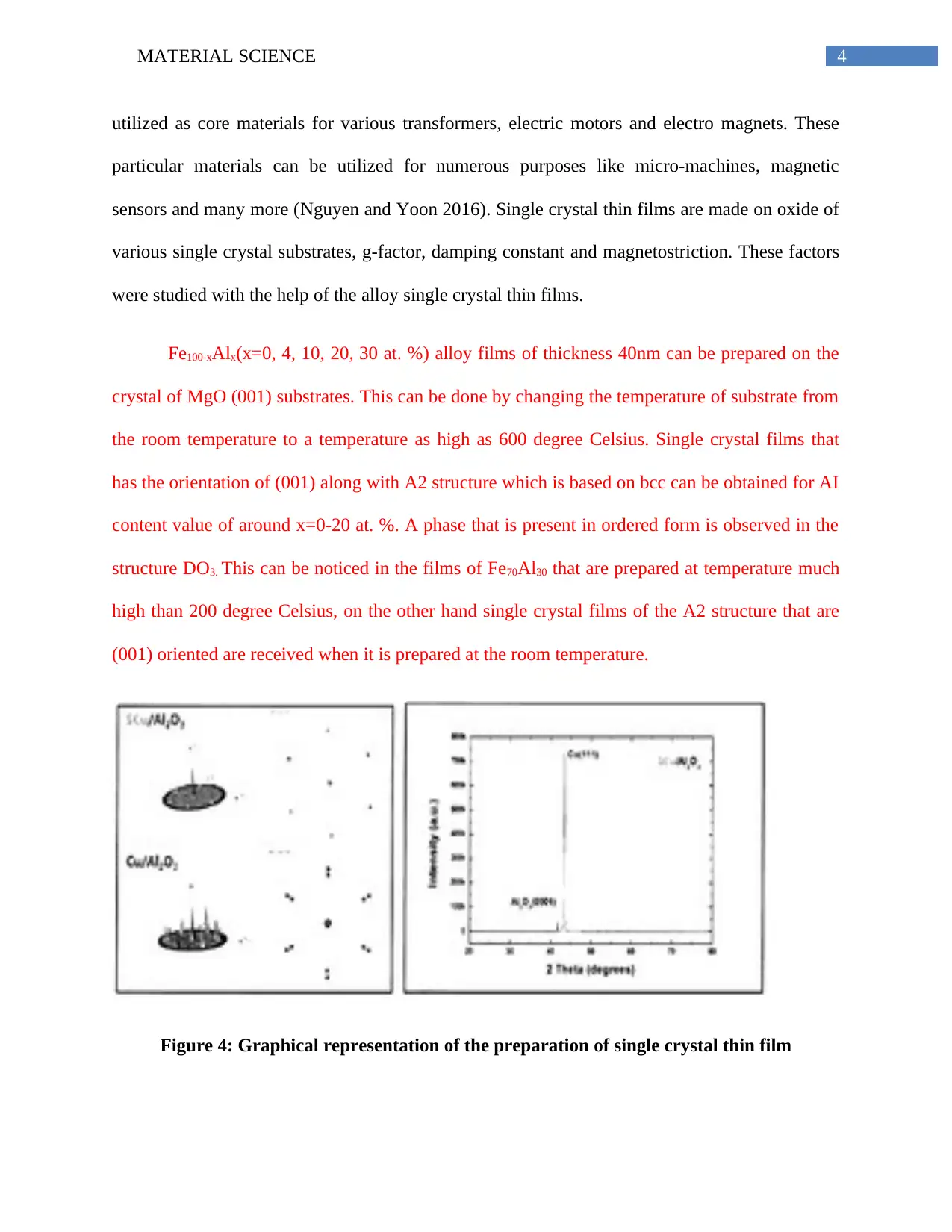
Fe100-xAlx(x=0, 4, 10, 20, 30 at. %) alloy films of thickness 40nm can be prepared on the
crystal of MgO (001) substrates. This can be done by changing the temperature of substrate from
the room temperature to a temperature as high as 600 degree Celsius. Single crystal films that
has the orientation of (001) along with A2 structure which is based on bcc can be obtained for AI
content value of around x=0-20 at. %. A phase that is present in ordered form is observed in the
structure DO3. This can be noticed in the films of Fe70Al30 that are prepared at temperature much
high than 200 degree Celsius, on the other hand single crystal films of the A2 structure that are
(001) oriented are received when it is prepared at the room temperature.
Figure 4: Graphical representation of the preparation of single crystal thin film
Document Page
5MATERIAL SCIENCE
Answer 3.
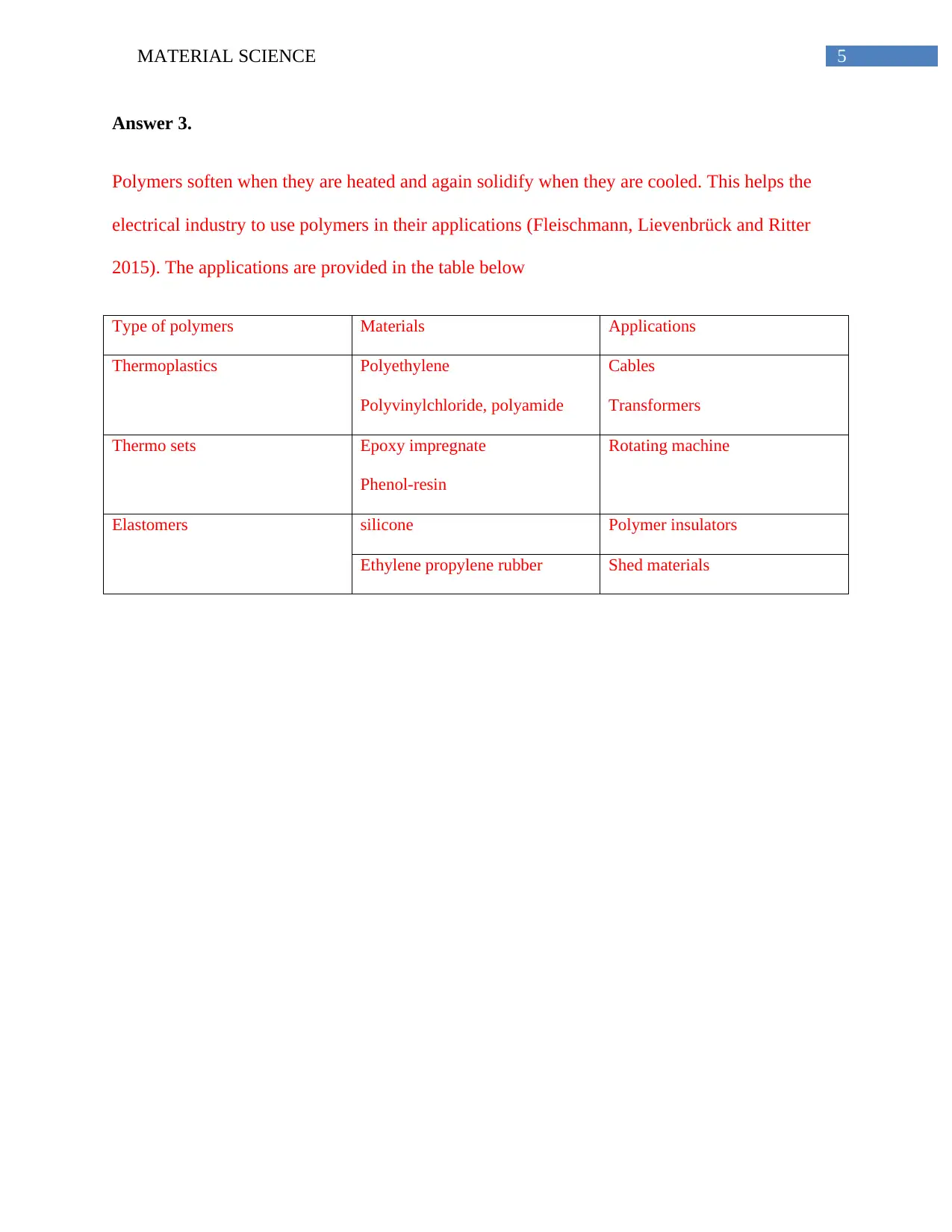
Polymers soften when they are heated and again solidify when they are cooled. This helps the
electrical industry to use polymers in their applications (Fleischmann, Lievenbrück and Ritter
2015). The applications are provided in the table below
Type of polymers Materials Applications
Thermoplastics Polyethylene
Polyvinylchloride, polyamide
Cables
Transformers
Thermo sets Epoxy impregnate
Phenol-resin
Rotating machine
Elastomers silicone Polymer insulators
Ethylene propylene rubber Shed materials
Document Page
6MATERIAL SCIENCE
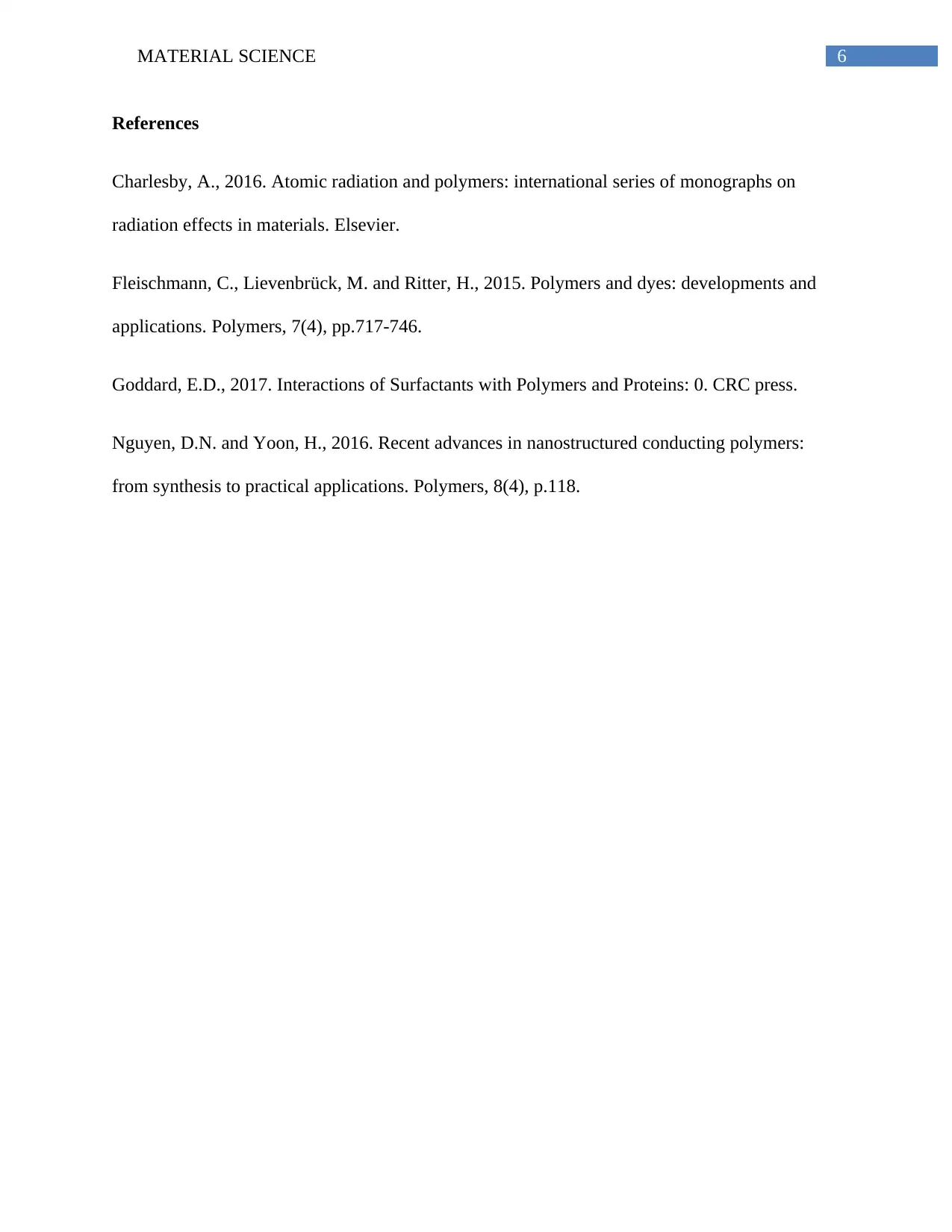
References
Charlesby, A., 2016. Atomic radiation and polymers: international series of monographs on
radiation effects in materials. Elsevier.
Fleischmann, C., Lievenbrück, M. and Ritter, H., 2015. Polymers and dyes: developments and
applications. Polymers, 7(4), pp.717-746.
Goddard, E.D., 2017. Interactions of Surfactants with Polymers and Proteins: 0. CRC press.
Nguyen, D.N. and Yoon, H., 2016. Recent advances in nanostructured conducting polymers:
from synthesis to practical applications. Polymers, 8(4), p.118.
chevron_up_icon
1 out of 7
circle_padding
hide_on_mobile
zoom_out_icon
[object Object]