Math Modeling and Decision Making: Integer Linear Programming Project

Verified

Added on  2022/11/26

|9
|1812
|459
Project
AI Summary
This project models a decision-making problem faced by a community outreach program focused on drug abuse prevention. The program's management must decide which projects to fund, given a fixed budget and community feedback on the importance of various initiatives. The student employs integer linear programming to formulate a mathematical model, defining decision variables (whether to fund a project or not) and constraints (budget, job creation, project requirements). The objective function aims to maximize the acceptability of the outreach programs based on community feedback. The model considers nine potential projects with associated costs, job creation potential, and public opinion scores. The student uses Excel Solver to find the optimal combination of projects to fund, considering various constraints. The results of the optimization suggest that the outreach program should fund programs such as risk awareness, understanding drug abuse, life balancing, sports, music, and computer programs for high school students to improve their time management. The project demonstrates the practical application of integer linear programming in optimizing resource allocation for community outreach programs, offering valuable insights for decision-makers.

Document Page
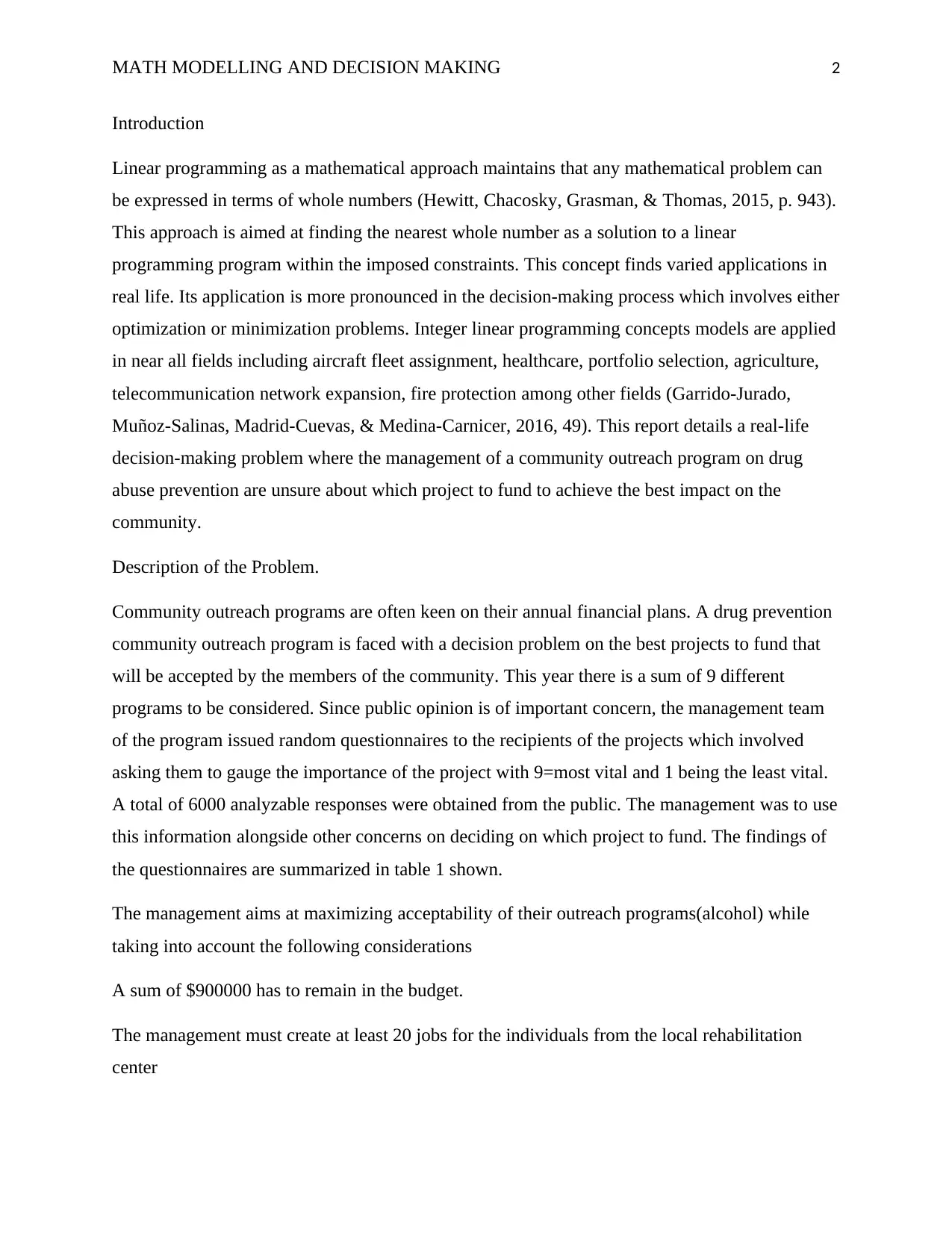
Running Head: MATH MODELLING AND DECISION MAKING 1
Math Modelling and Decision Making
By(name)
Institutional Affiliation
tabler-icon-diamond-filled.svg

Paraphrase This Document

Need a fresh take? Get an instant paraphrase of this document with our AI Paraphraser
Document Page
MATH MODELLING AND DECISION MAKING 2
Introduction
Linear programming as a mathematical approach maintains that any mathematical problem can
be expressed in terms of whole numbers (Hewitt, Chacosky, Grasman, & Thomas, 2015, p. 943).
This approach is aimed at finding the nearest whole number as a solution to a linear
programming program within the imposed constraints. This concept finds varied applications in
real life. Its application is more pronounced in the decision-making process which involves either
optimization or minimization problems. Integer linear programming concepts models are applied
in near all fields including aircraft fleet assignment, healthcare, portfolio selection, agriculture,
telecommunication network expansion, fire protection among other fields (Garrido-Jurado,
Muñoz-Salinas, Madrid-Cuevas, & Medina-Carnicer, 2016, 49). This report details a real-life
decision-making problem where the management of a community outreach program on drug
abuse prevention are unsure about which project to fund to achieve the best impact on the
community.
Description of the Problem.
Community outreach programs are often keen on their annual financial plans. A drug prevention
community outreach program is faced with a decision problem on the best projects to fund that
will be accepted by the members of the community. This year there is a sum of 9 different
programs to be considered. Since public opinion is of important concern, the management team
of the program issued random questionnaires to the recipients of the projects which involved
asking them to gauge the importance of the project with 9=most vital and 1 being the least vital.
A total of 6000 analyzable responses were obtained from the public. The management was to use
this information alongside other concerns on deciding on which project to fund. The findings of
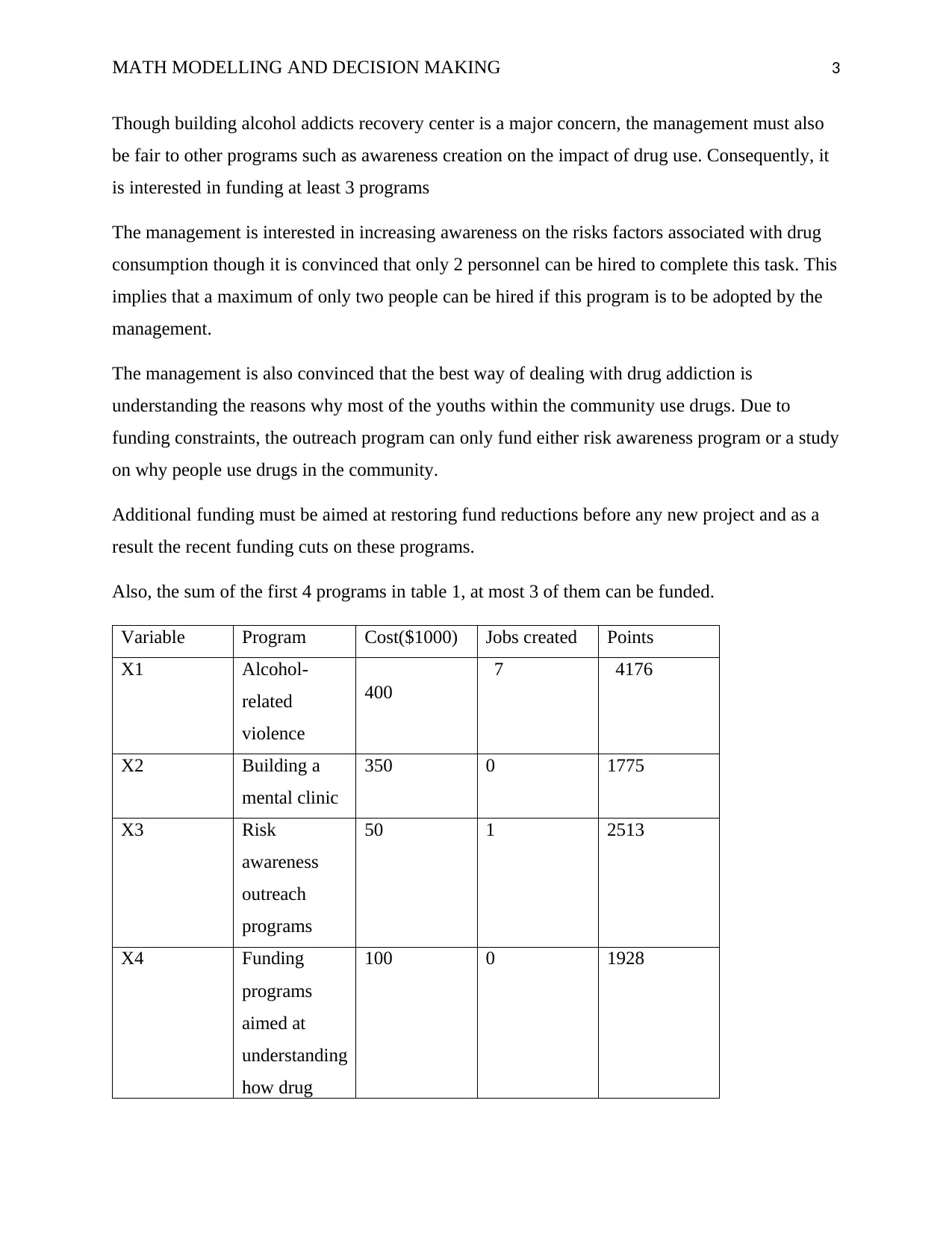
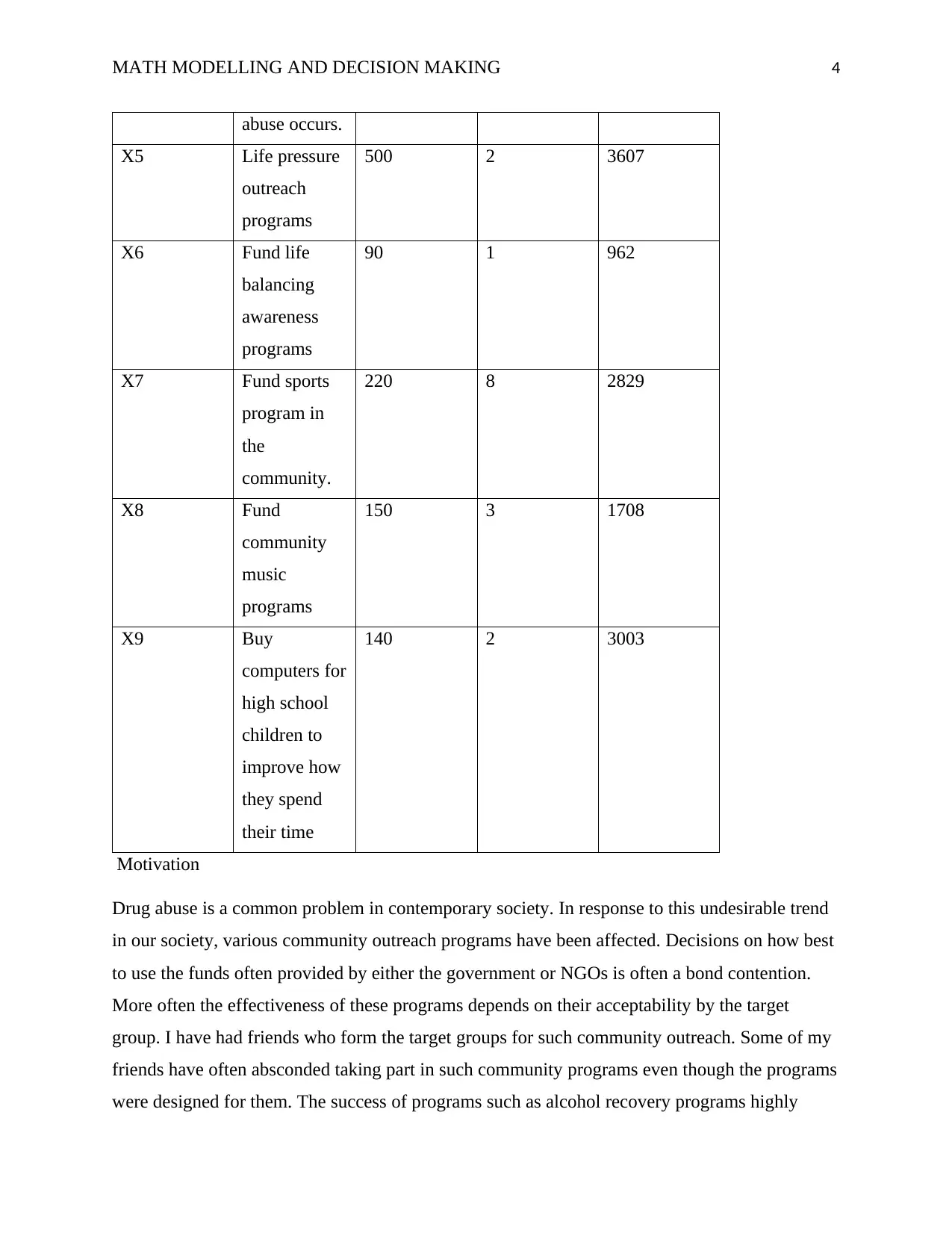
the questionnaires are summarized in table 1 shown.
The management aims at maximizing acceptability of their outreach programs(alcohol) while
taking into account the following considerations
A sum of $900000 has to remain in the budget.
The management must create at least 20 jobs for the individuals from the local rehabilitation
center
Document Page
MATH MODELLING AND DECISION MAKING 3
Though building alcohol addicts recovery center is a major concern, the management must also
be fair to other programs such as awareness creation on the impact of drug use. Consequently, it
is interested in funding at least 3 programs
The management is interested in increasing awareness on the risks factors associated with drug
consumption though it is convinced that only 2 personnel can be hired to complete this task. This
implies that a maximum of only two people can be hired if this program is to be adopted by the
management.
The management is also convinced that the best way of dealing with drug addiction is
understanding the reasons why most of the youths within the community use drugs. Due to
funding constraints, the outreach program can only fund either risk awareness program or a study
on why people use drugs in the community.
Additional funding must be aimed at restoring fund reductions before any new project and as a
result the recent funding cuts on these programs.
Also, the sum of the first 4 programs in table 1, at most 3 of them can be funded.
Variable Program Cost($1000) Jobs created Points
X1 Alcohol-
related
violence
400
7 4176
X2 Building a
mental clinic
350 0 1775
X3 Risk
awareness
outreach
programs
50 1 2513
X4 Funding
programs
aimed at
understanding
how drug
100 0 1928
Document Page
MATH MODELLING AND DECISION MAKING 4
abuse occurs.
X5 Life pressure
outreach
programs
500 2 3607
X6 Fund life
balancing
awareness
programs
90 1 962
X7 Fund sports
program in
the
community.
220 8 2829
X8 Fund
community
music
programs
150 3 1708
X9 Buy
computers for
high school
children to
improve how
they spend
their time
140 2 3003
Motivation
Drug abuse is a common problem in contemporary society. In response to this undesirable trend
in our society, various community outreach programs have been affected. Decisions on how best
to use the funds often provided by either the government or NGOs is often a bond contention.
More often the effectiveness of these programs depends on their acceptability by the target
group. I have had friends who form the target groups for such community outreach. Some of my
friends have often absconded taking part in such community programs even though the programs
were designed for them. The success of programs such as alcohol recovery programs highly
tabler-icon-diamond-filled.svg

Paraphrase This Document

Need a fresh take? Get an instant paraphrase of this document with our AI Paraphraser
Document Page
MATH MODELLING AND DECISION MAKING 5
depends on the target victim's perception of the program's ability to help them with their
condition. These concerns formed the basis of my decision model such a scenario
mathematically and solve the problem using integer linear programming.
Solution of the problem.
The management of the program must choose which program to fund. The objective helps the
management identify within the above-mentioned constraints a set of programs that maximizes
acceptability of the programs for the outreach program for its decisions based on the evidence
provided by the questionnaires.
The decision variables
The variables x1, x2,…, x9 refers to the binary decision variables: xj=1if the program is to be
funded and xj=0 if it not funded.
The objective function
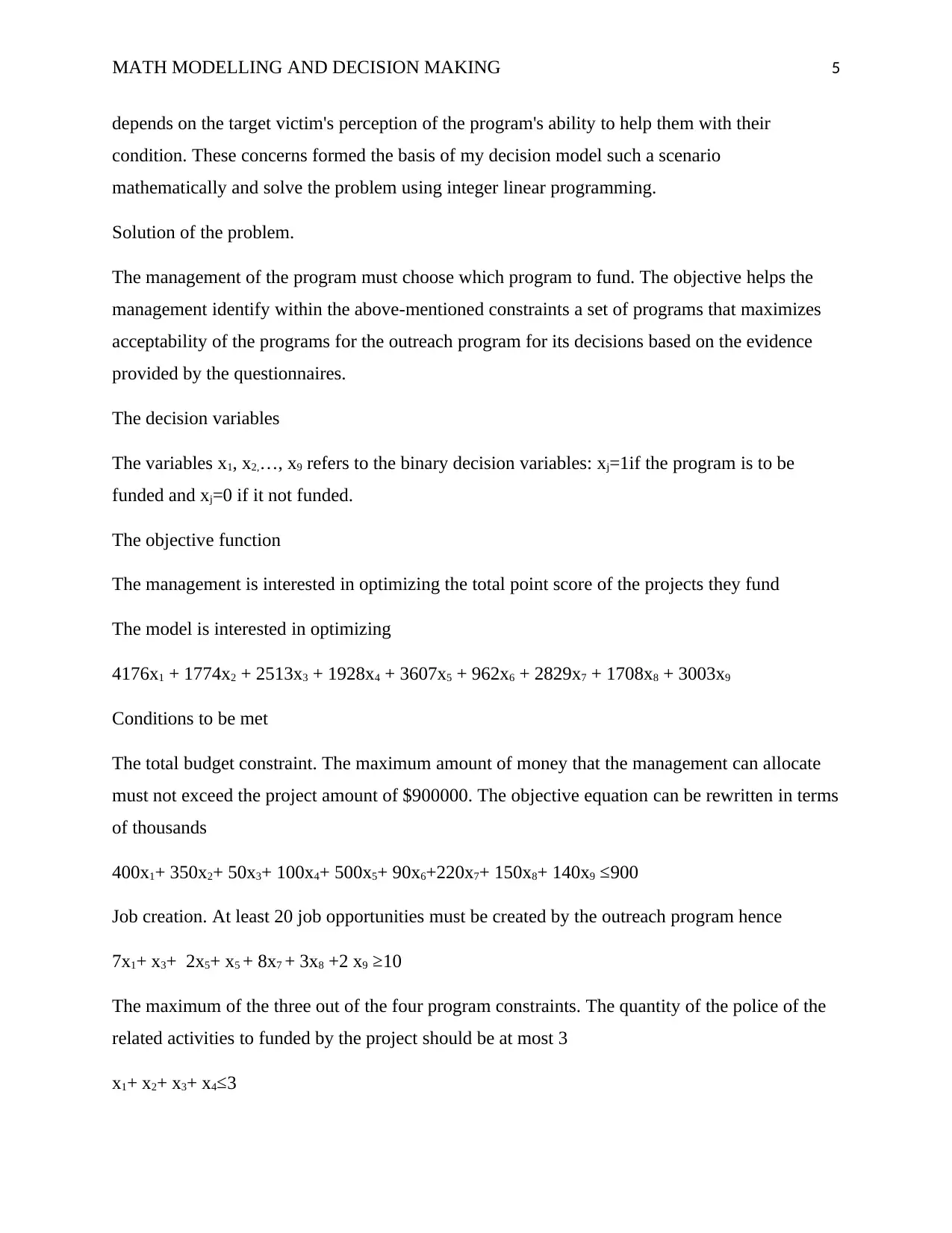
The management is interested in optimizing the total point score of the projects they fund
The model is interested in optimizing
4176x1 + 1774x2 + 2513x3 + 1928x4 + 3607x5 + 962x6 + 2829x7 + 1708x8 + 3003x9
Conditions to be met
The total budget constraint. The maximum amount of money that the management can allocate
must not exceed the project amount of $900000. The objective equation can be rewritten in terms
of thousands
400x1+ 350x2+ 50x3+ 100x4+ 500x5+ 90x6+220x7+ 150x8+ 140x9 900
Job creation. At least 20 job opportunities must be created by the outreach program hence
7x1+ x3+ 2x5+ x5 + 8x7 + 3x8 +2 x9 10
The maximum of the three out of the four program constraints. The quantity of the police of the
related activities to funded by the project should be at most 3
x1+ x2+ x3+ x43
Document Page
MATH MODELLING AND DECISION MAKING 6
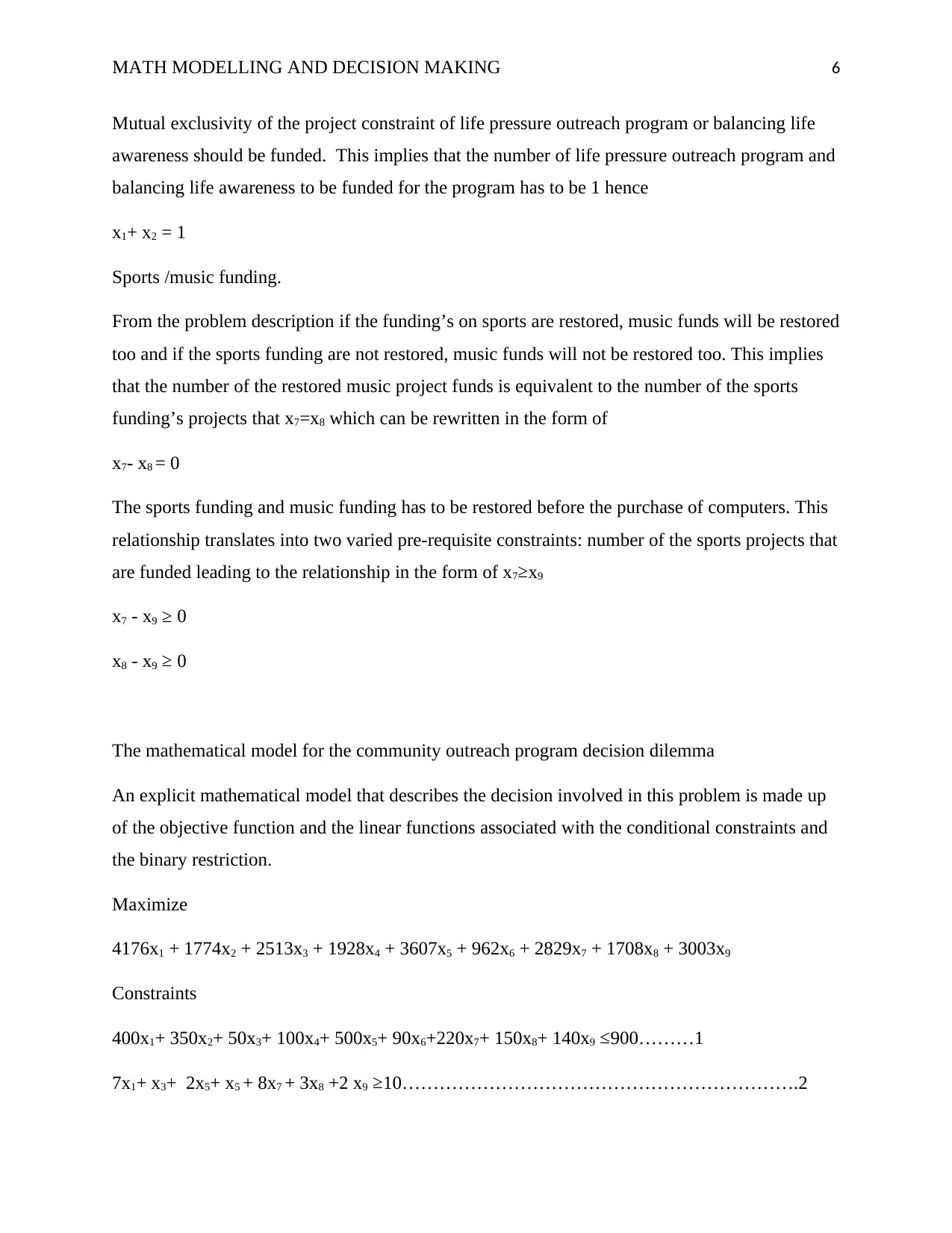
Mutual exclusivity of the project constraint of life pressure outreach program or balancing life
awareness should be funded. This implies that the number of life pressure outreach program and
balancing life awareness to be funded for the program has to be 1 hence
x1+ x2 = 1
Sports /music funding.
From the problem description if the funding’s on sports are restored, music funds will be restored
too and if the sports funding are not restored, music funds will not be restored too. This implies
that the number of the restored music project funds is equivalent to the number of the sports
funding’s projects that x7=x8 which can be rewritten in the form of
x7- x8 = 0
The sports funding and music funding has to be restored before the purchase of computers. This
relationship translates into two varied pre-requisite constraints: number of the sports projects that
are funded leading to the relationship in the form of x7x9
x7 - x9 0
x8 - x9 0
The mathematical model for the community outreach program decision dilemma
An explicit mathematical model that describes the decision involved in this problem is made up
of the objective function and the linear functions associated with the conditional constraints and
the binary restriction.
Maximize
4176x1 + 1774x2 + 2513x3 + 1928x4 + 3607x5 + 962x6 + 2829x7 + 1708x8 + 3003x9
Constraints
400x1+ 350x2+ 50x3+ 100x4+ 500x5+ 90x6+220x7+ 150x8+ 140x9 900………1
7x1+ x3+ 2x5+ x5 + 8x7 + 3x8 +2 x9 10……………………………………………………….2
Document Page
MATH MODELLING AND DECISION MAKING 7
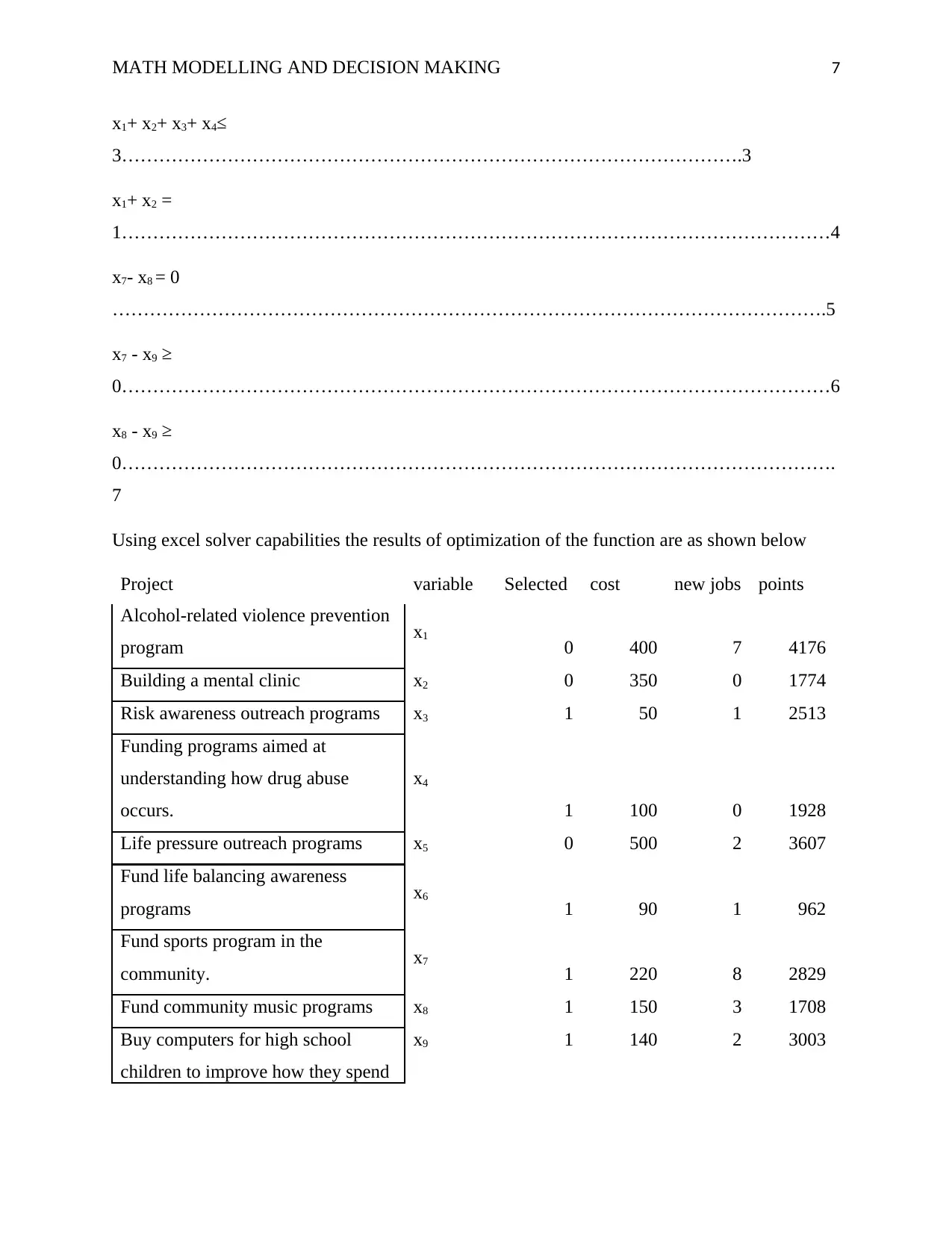
x1+ x2+ x3+ x4
3……………………………………………………………………………………….3
x1+ x2 =
1……………………………………………………………………………………………………4
x7- x8 = 0
…………………………………………………………………………………………………….5
x7 - x9
0……………………………………………………………………………………………………6
x8 - x9
0…………………………………………………………………………………………………….
7
Using excel solver capabilities the results of optimization of the function are as shown below
Project variable Selected cost new jobs points
Alcohol-related violence prevention
program x1
0 400 7 4176
Building a mental clinic x2 0 350 0 1774
Risk awareness outreach programs x3 1 50 1 2513
Funding programs aimed at
understanding how drug abuse
occurs.
x4
1 100 0 1928
Life pressure outreach programs x5 0 500 2 3607
Fund life balancing awareness
programs x6
1 90 1 962
Fund sports program in the
community. x7
1 220 8 2829
Fund community music programs x8 1 150 3 1708
Buy computers for high school
children to improve how they spend
x9 1 140 2 3003
tabler-icon-diamond-filled.svg

Paraphrase This Document

Need a fresh take? Get an instant paraphrase of this document with our AI Paraphraser
Document Page
MATH MODELLING AND DECISION MAKING 8
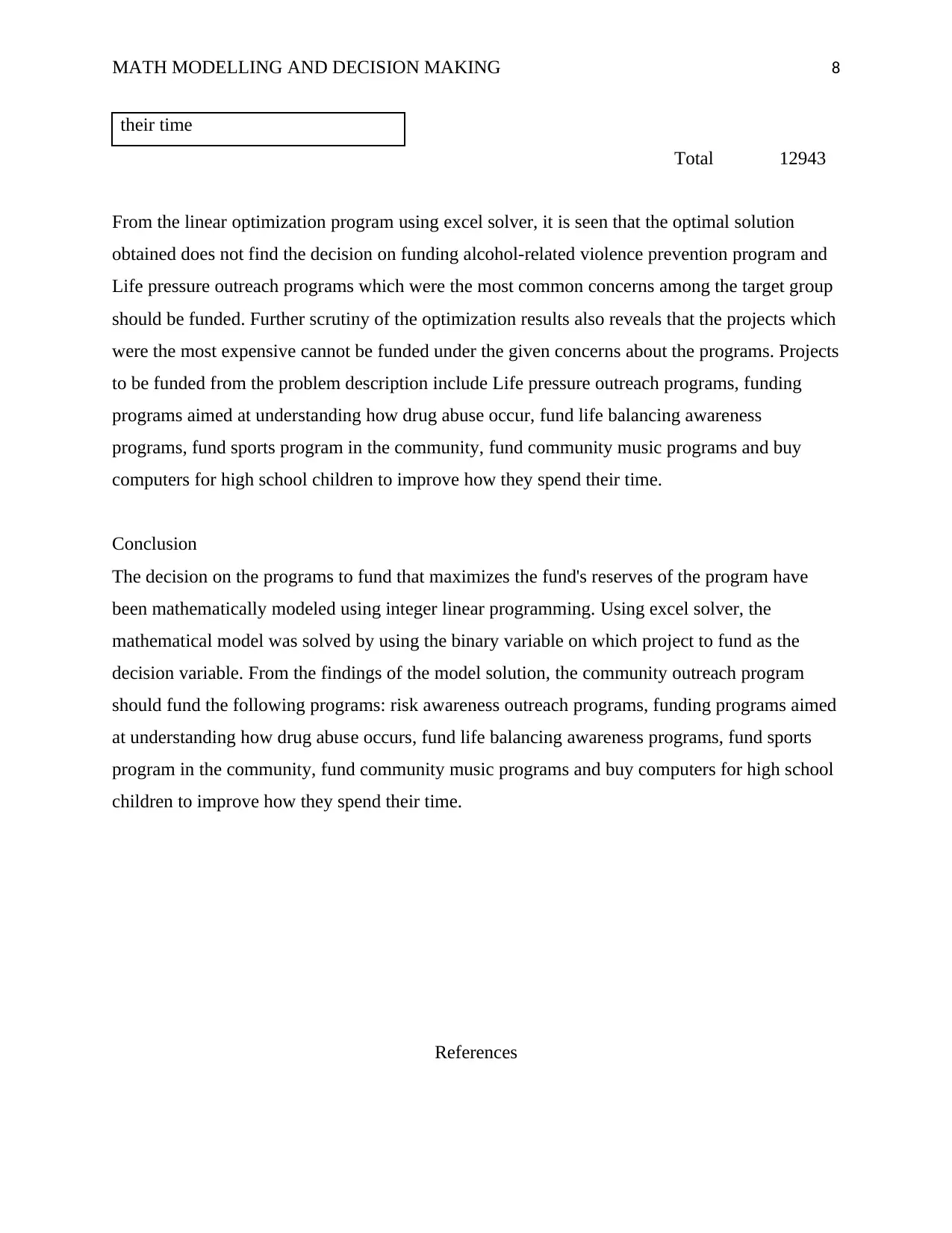
their time
Total 12943
From the linear optimization program using excel solver, it is seen that the optimal solution
obtained does not find the decision on funding alcohol-related violence prevention program and
Life pressure outreach programs which were the most common concerns among the target group
should be funded. Further scrutiny of the optimization results also reveals that the projects which
were the most expensive cannot be funded under the given concerns about the programs. Projects
to be funded from the problem description include Life pressure outreach programs, funding
programs aimed at understanding how drug abuse occur, fund life balancing awareness
programs, fund sports program in the community, fund community music programs and buy
computers for high school children to improve how they spend their time.
Conclusion
The decision on the programs to fund that maximizes the fund's reserves of the program have
been mathematically modeled using integer linear programming. Using excel solver, the
mathematical model was solved by using the binary variable on which project to fund as the
decision variable. From the findings of the model solution, the community outreach program
should fund the following programs: risk awareness outreach programs, funding programs aimed
at understanding how drug abuse occurs, fund life balancing awareness programs, fund sports
program in the community, fund community music programs and buy computers for high school
children to improve how they spend their time.
References
Document Page
MATH MODELLING AND DECISION MAKING 9
Garrido-Jurado, S., Munoz-Salinas, R., Madrid-Cuevas, F. J., & Medina-Carnicer, R. (2016).
Generation of fiducial marker dictionaries using mixed integer linear programming. Pattern
Recognition, 51, 481-491.
Hewitt, M., Chacosky, A., Grasman, S. E., & Thomas, B. W. (2015). Integer programming
techniques for solving non-linear workforce planning models with learning. European Journal of
Operational Research, 242(3), 942-950.
chevron_up_icon
1 out of 9
circle_padding
hide_on_mobile
zoom_out_icon
[object Object]