CYC423: Measurement Paper: Body Dysmorphic Disorder Assessment Tools
VerifiedAdded on 2022/12/29
|12
|2331
|26
Report
AI Summary
This paper provides an evaluation of various measurement tools used in assessing Body Dysmorphic Disorder (BDD). It begins by defining BDD and then considers two primary tools: the Appearance Anxiety Inventory (AAI), a quantitative scale, and the Body Dysmorphic Disorder Questionnaire (BDDQ), a qualitative scale. The paper offers detailed descriptions of each tool, followed by a critique of their reliability and validity, highlighting both strengths and limitations. It then proposes and develops two new quantitative measurement tools, building upon the initial AAI and BDDQ, and discusses their potential for improved assessment. The paper includes tables illustrating each measurement tool and relevant references. The overall goal is to analyze the effectiveness of existing tools and suggest improvements for more accurate BDD assessment.

MEASUREMENT PAPER: BODY DYSMORPHIC DISORDER

Paraphrase This Document
Need a fresh take? Get an instant paraphrase of this document with our AI Paraphraser
MEASUREMENT PAPER
Contents
MEASUREMENT PAPER.........................................................................................................................3
QUANTITATIVE MEASUREMENT TOOL.............................................................................................3
DESCRIPTION.......................................................................................................................................3
CRITIQUE..............................................................................................................................................5
QUALITATIVE MEASUREMENT TOOL................................................................................................6
DESCRIPTION.......................................................................................................................................6
CRITIQUE..............................................................................................................................................6
NEW MEASUREMENT TOOLS...............................................................................................................7
BASED ON THE QUANTITATIVE MEASUREMENT TOOL............................................................7
BASED ON THE QUALITATIVE MEASUREMENT TOOL...............................................................8
CONCLUSION.........................................................................................................................................10
REFERENCES..........................................................................................................................................11
APPENDIX: BDDQ TOOL......................................................................................................................12
2
Contents
MEASUREMENT PAPER.........................................................................................................................3
QUANTITATIVE MEASUREMENT TOOL.............................................................................................3
DESCRIPTION.......................................................................................................................................3
CRITIQUE..............................................................................................................................................5
QUALITATIVE MEASUREMENT TOOL................................................................................................6
DESCRIPTION.......................................................................................................................................6
CRITIQUE..............................................................................................................................................6
NEW MEASUREMENT TOOLS...............................................................................................................7
BASED ON THE QUANTITATIVE MEASUREMENT TOOL............................................................7
BASED ON THE QUALITATIVE MEASUREMENT TOOL...............................................................8
CONCLUSION.........................................................................................................................................10
REFERENCES..........................................................................................................................................11
APPENDIX: BDDQ TOOL......................................................................................................................12
2
MEASUREMENT PAPER
MEASUREMENT PAPER
This paper focuses on the evaluation of different types of measurement tools (scales)
used in body dysmorphic disorder assessment. Body dysmorphic disorder refers to a mental
health condition whereby an individual is overly worried about their appearances and the
appearance flaws they think they have (Bernstein, 2010). This paper considers two measurement
tools for the assessment of body dysmorphic disorder; a quantitative measurement scale and a
qualitative measurement scale.
The quantitative measurement tool evaluated in this paper is the Appearance Anxiety
Inventory (AAI) while the qualitative measurement tool evaluated is the Body Dysmorphic
Disorder Questionnaire (BDDQ). The evaluation involves description of the quantitative and
qualitative tools. The evaluation also involves the critique of the tools with regards to reliability
and validity. From the initials quantitative and qualitative tools, two additional quantitative tools
will be developed.
QUANTITATIVE MEASUREMENT TOOL
DESCRIPTION
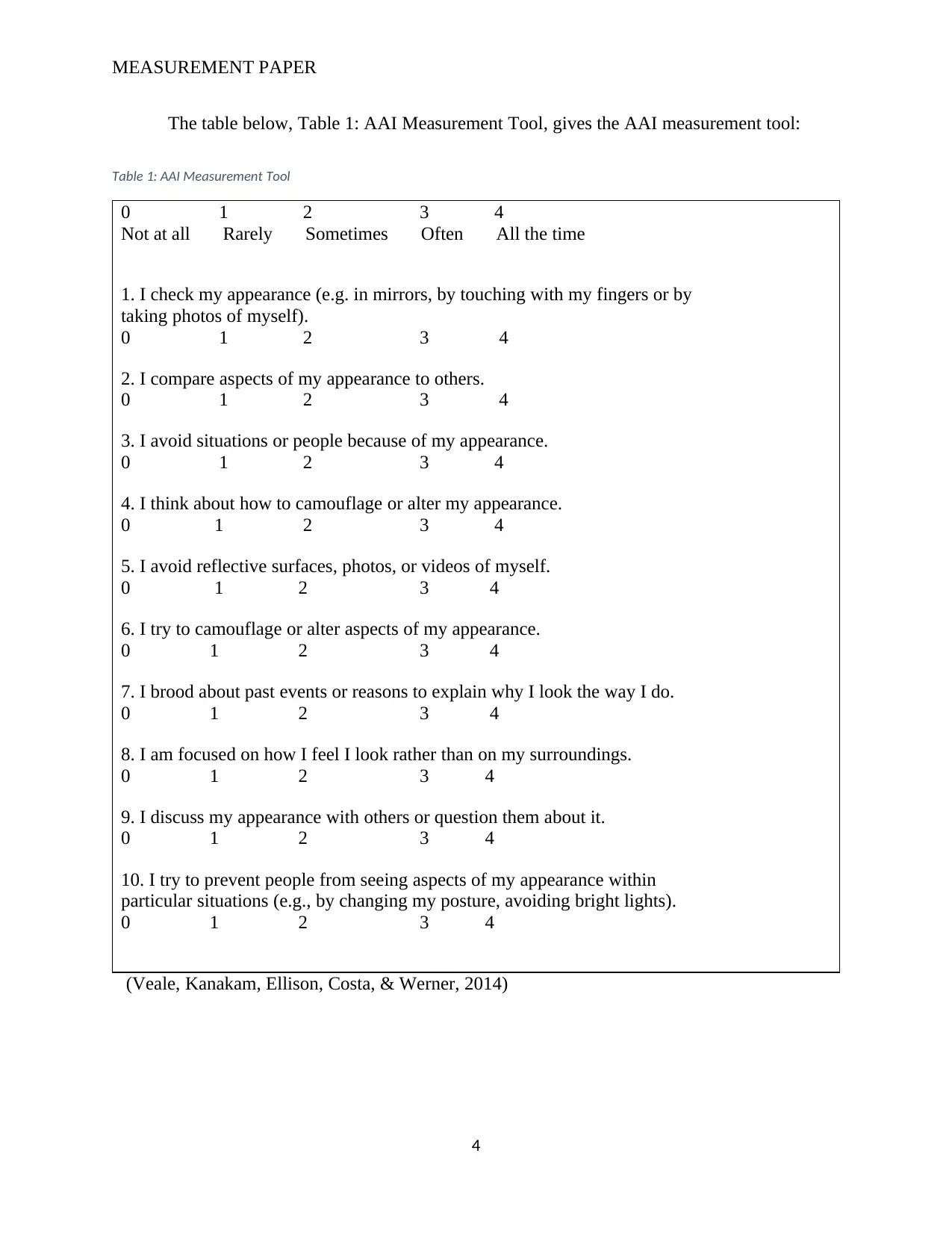
The quantitative measurement tool considered in this paper is the Appearance Anxiety
Inventory shown in Table 1: AAI Measurement Tool below. The AAI is a 10 question self-
report measurement tool that uses a 5-point Likert Scale (Veale, Kanakam, Ellison, Costa, &
Werner, 2014). An individual is expected to provide a response for each of the 10 questions
based on how frequent they perform any of the actions described in the questions. The Likert
Scale for the AAI is: 0 – Not at all, 1 – Rarely, 2 – Sometimes, 3- Often, 4 – All the time.
3
MEASUREMENT PAPER
This paper focuses on the evaluation of different types of measurement tools (scales)
used in body dysmorphic disorder assessment. Body dysmorphic disorder refers to a mental
health condition whereby an individual is overly worried about their appearances and the
appearance flaws they think they have (Bernstein, 2010). This paper considers two measurement
tools for the assessment of body dysmorphic disorder; a quantitative measurement scale and a
qualitative measurement scale.
The quantitative measurement tool evaluated in this paper is the Appearance Anxiety
Inventory (AAI) while the qualitative measurement tool evaluated is the Body Dysmorphic
Disorder Questionnaire (BDDQ). The evaluation involves description of the quantitative and
qualitative tools. The evaluation also involves the critique of the tools with regards to reliability
and validity. From the initials quantitative and qualitative tools, two additional quantitative tools
will be developed.
QUANTITATIVE MEASUREMENT TOOL
DESCRIPTION
The quantitative measurement tool considered in this paper is the Appearance Anxiety
Inventory shown in Table 1: AAI Measurement Tool below. The AAI is a 10 question self-
report measurement tool that uses a 5-point Likert Scale (Veale, Kanakam, Ellison, Costa, &
Werner, 2014). An individual is expected to provide a response for each of the 10 questions
based on how frequent they perform any of the actions described in the questions. The Likert
Scale for the AAI is: 0 – Not at all, 1 – Rarely, 2 – Sometimes, 3- Often, 4 – All the time.
3
⊘ This is a preview!⊘
Do you want full access?
Subscribe today to unlock all pages.

Trusted by 1+ million students worldwide
MEASUREMENT PAPER
The table below, Table 1: AAI Measurement Tool, gives the AAI measurement tool:
Table 1: AAI Measurement Tool
0 1 2 3 4
Not at all Rarely Sometimes Often All the time
1. I check my appearance (e.g. in mirrors, by touching with my fingers or by
taking photos of myself).
0 1 2 3 4
2. I compare aspects of my appearance to others.
0 1 2 3 4
3. I avoid situations or people because of my appearance.
0 1 2 3 4
4. I think about how to camouflage or alter my appearance.
0 1 2 3 4
5. I avoid reflective surfaces, photos, or videos of myself.
0 1 2 3 4
6. I try to camouflage or alter aspects of my appearance.
0 1 2 3 4
7. I brood about past events or reasons to explain why I look the way I do.
0 1 2 3 4
8. I am focused on how I feel I look rather than on my surroundings.
0 1 2 3 4
9. I discuss my appearance with others or question them about it.
0 1 2 3 4
10. I try to prevent people from seeing aspects of my appearance within
particular situations (e.g., by changing my posture, avoiding bright lights).
0 1 2 3 4
(Veale, Kanakam, Ellison, Costa, & Werner, 2014)
4
The table below, Table 1: AAI Measurement Tool, gives the AAI measurement tool:
Table 1: AAI Measurement Tool
0 1 2 3 4
Not at all Rarely Sometimes Often All the time
1. I check my appearance (e.g. in mirrors, by touching with my fingers or by
taking photos of myself).
0 1 2 3 4
2. I compare aspects of my appearance to others.
0 1 2 3 4
3. I avoid situations or people because of my appearance.
0 1 2 3 4
4. I think about how to camouflage or alter my appearance.
0 1 2 3 4
5. I avoid reflective surfaces, photos, or videos of myself.
0 1 2 3 4
6. I try to camouflage or alter aspects of my appearance.
0 1 2 3 4
7. I brood about past events or reasons to explain why I look the way I do.
0 1 2 3 4
8. I am focused on how I feel I look rather than on my surroundings.
0 1 2 3 4
9. I discuss my appearance with others or question them about it.
0 1 2 3 4
10. I try to prevent people from seeing aspects of my appearance within
particular situations (e.g., by changing my posture, avoiding bright lights).
0 1 2 3 4
(Veale, Kanakam, Ellison, Costa, & Werner, 2014)
4
Paraphrase This Document
Need a fresh take? Get an instant paraphrase of this document with our AI Paraphraser
MEASUREMENT PAPER
CRITIQUE
The AAI measurement tool contains well formulated statements that can easily be
answered using the responses on the 5-point Likert Scale. This ensures that the respondent
understands the question and the context of the question. This is an important aspect of this
measurement tool especially since it is a self-report scale where an interviewer in not present to
contextualize the questions. This improves on the validity of the AAI measurement tool.
Although the AAI has well specified questions (statements), it contains closely related
and conflicting questions. Considering question 4, where the participant is asked to give the
frequency of the action described in the statement: “I think about how to camouflage or alter my
appearance” and question 6 where the participant is asked to give the frequency of the action
described in the statement: “I try to camouflage or alter my appearance”. These two questions are
closely related. The action of trying to camouflage or alter appearance is assessed in question 6
while question 4 assesses the thought of camouflaging or altering appearance. However, the
action is a product of the thought and hence the rank of question 6 for the action is expected to be
similar to question 4 for the thought. The response on the action for question 6 is a product of the
thought for question 4 and thus assessing only one of the statement would make more sense.
Considering question 3, where the participant is asked to give the frequency of the action
described in the statement: “I avoid situations or people because of my appearance” and question
9, where the participant is asked to give the frequency of the action described in the statement: “I
discuss my appearance with others or question them about it”. The respondent is presented with
conflicting statements. Having conflicting statements may lead to confusion in terms of the
expected response and thus reducing the reliability of the measurement tool. Apart from the
5
CRITIQUE
The AAI measurement tool contains well formulated statements that can easily be
answered using the responses on the 5-point Likert Scale. This ensures that the respondent
understands the question and the context of the question. This is an important aspect of this
measurement tool especially since it is a self-report scale where an interviewer in not present to
contextualize the questions. This improves on the validity of the AAI measurement tool.
Although the AAI has well specified questions (statements), it contains closely related
and conflicting questions. Considering question 4, where the participant is asked to give the
frequency of the action described in the statement: “I think about how to camouflage or alter my
appearance” and question 6 where the participant is asked to give the frequency of the action
described in the statement: “I try to camouflage or alter my appearance”. These two questions are
closely related. The action of trying to camouflage or alter appearance is assessed in question 6
while question 4 assesses the thought of camouflaging or altering appearance. However, the
action is a product of the thought and hence the rank of question 6 for the action is expected to be
similar to question 4 for the thought. The response on the action for question 6 is a product of the
thought for question 4 and thus assessing only one of the statement would make more sense.
Considering question 3, where the participant is asked to give the frequency of the action
described in the statement: “I avoid situations or people because of my appearance” and question
9, where the participant is asked to give the frequency of the action described in the statement: “I
discuss my appearance with others or question them about it”. The respondent is presented with
conflicting statements. Having conflicting statements may lead to confusion in terms of the
expected response and thus reducing the reliability of the measurement tool. Apart from the
5
MEASUREMENT PAPER
contradicting and closely related questions, the AAI measurement tool presents a reasonably
adequate tool for the assessment of body dysmorphic disorder.
The credibility and validity of the measurement tool in Table 1: AAI Measurement Tool
above are tested using the Internal Consistency and Content Validity tests respectively. The
correlation between questions 1 and 5 is used to check for the credibility in the Internal
Consistency test where the responses to the two questions are expected to be negatively
correlated for a credible measurement tool. Based on content validity, the measure adequately
covers the construct of interest; appearance and anxiety.
QUALITATIVE MEASUREMENT TOOL
DESCRIPTION
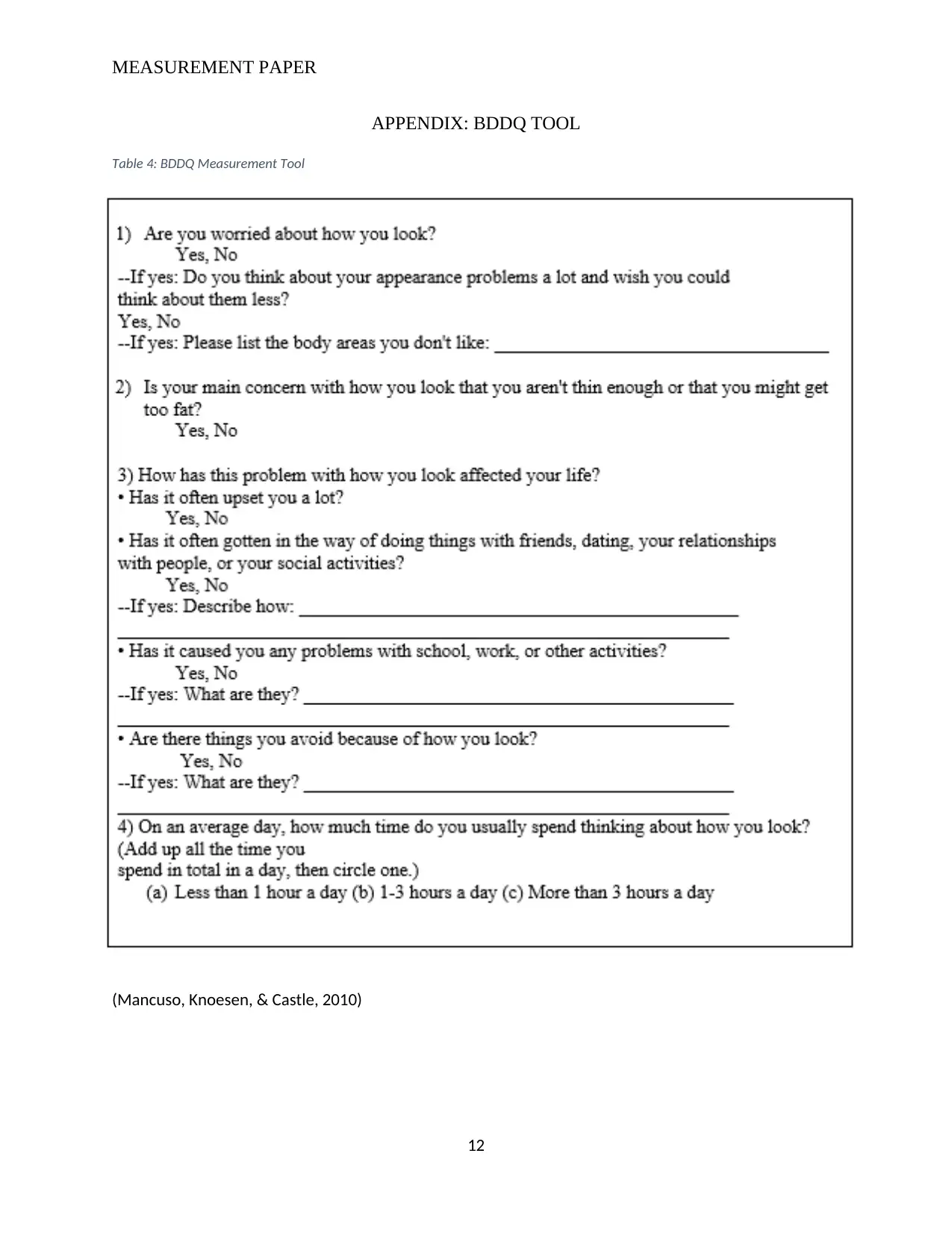
The qualitative measurement tool considered for this paper is the Body Dysmorphic
Disorder Questionnaire (Mancuso, Knoesen, & Castle, 2010). The BDDQ is a 4 question self-
report measurement tool. The questions have two general parts; the first part the respondent is
asked for a response on the truthfulness of a statement, with a “Yes” or “No” response. For the
second part; If the response is a positive affirmation to the statement (“Yes” response), then the
respondent is asked to provide a description in their own words with regards to the statement in
the first part. Table 4: BDDQ Measurement Tool gives the BDDQ measurement tool.
CRITIQUE
The BDDQ measurement tool is precise with respect to participants’ responses. With the
exception of question 4, the first part of all the questions provide for the affirmation on the
6
contradicting and closely related questions, the AAI measurement tool presents a reasonably
adequate tool for the assessment of body dysmorphic disorder.
The credibility and validity of the measurement tool in Table 1: AAI Measurement Tool
above are tested using the Internal Consistency and Content Validity tests respectively. The
correlation between questions 1 and 5 is used to check for the credibility in the Internal
Consistency test where the responses to the two questions are expected to be negatively
correlated for a credible measurement tool. Based on content validity, the measure adequately
covers the construct of interest; appearance and anxiety.
QUALITATIVE MEASUREMENT TOOL
DESCRIPTION
The qualitative measurement tool considered for this paper is the Body Dysmorphic
Disorder Questionnaire (Mancuso, Knoesen, & Castle, 2010). The BDDQ is a 4 question self-
report measurement tool. The questions have two general parts; the first part the respondent is
asked for a response on the truthfulness of a statement, with a “Yes” or “No” response. For the
second part; If the response is a positive affirmation to the statement (“Yes” response), then the
respondent is asked to provide a description in their own words with regards to the statement in
the first part. Table 4: BDDQ Measurement Tool gives the BDDQ measurement tool.
CRITIQUE
The BDDQ measurement tool is precise with respect to participants’ responses. With the
exception of question 4, the first part of all the questions provide for the affirmation on the
6
⊘ This is a preview!⊘
Do you want full access?
Subscribe today to unlock all pages.
Trusted by 1+ million students worldwide
MEASUREMENT PAPER
statement described. Then only positive affirmation responses are assessed in the qualitative
assessment in the second part. The “Yes” or “No” affirmation test in the first part can however
be considered as narrow in the sense that responses can never truly be represented in a direct
“Yes” or “No” reply, but rather there exist a range of responses between “Yes” or “No”. The
argument of the existence of a range of responses between “Yes” or “No” forms the basis for the
Likert Scale (Norman, 2010; Naomi & Heiberger, 2011).
The tool applies the use of both open ended and close ended questions which allows for
the collection of more information. The items in the measurement tool are sufficient in
evaluating BDDQ, however the use of a 5 point Likert scale would allow the assessment across a
range of responses. Triangulation would also prove to be a viable adoption for this measurement
tool by employing an observation study on the subject in addition to the use of the questionnaire.
NEW MEASUREMENT TOOLS
BASED ON THE QUANTITATIVE MEASUREMENT TOOL
The table below, Table 2: New Quantitative Measurement Tool Based on the AAI,
represents the new quantitative measurement tool based on the initial quantitative measurement
tool. This new tool is a self-report 5-point Likert Scale tool with 4 questions. The tool applies the
same Likert Scale as the one used in the AAI measurement tool; 0 – Not at all, 1 – Rarely, 2 –
Sometimes, 3- Often, 4 – All the time. Scores on the measurement tool above 12 indicate
symptoms of Appearance Anxiety.
The credibility and validity of the measurement tool in Table 2: New Quantitative
Measurement Tool Based on the AAI below will be tested using the Internal Consistency and
Criterion Validity tests respectively. The correlation between questions 2 and 4 will be used to
7
statement described. Then only positive affirmation responses are assessed in the qualitative
assessment in the second part. The “Yes” or “No” affirmation test in the first part can however
be considered as narrow in the sense that responses can never truly be represented in a direct
“Yes” or “No” reply, but rather there exist a range of responses between “Yes” or “No”. The
argument of the existence of a range of responses between “Yes” or “No” forms the basis for the
Likert Scale (Norman, 2010; Naomi & Heiberger, 2011).
The tool applies the use of both open ended and close ended questions which allows for
the collection of more information. The items in the measurement tool are sufficient in
evaluating BDDQ, however the use of a 5 point Likert scale would allow the assessment across a
range of responses. Triangulation would also prove to be a viable adoption for this measurement
tool by employing an observation study on the subject in addition to the use of the questionnaire.
NEW MEASUREMENT TOOLS
BASED ON THE QUANTITATIVE MEASUREMENT TOOL
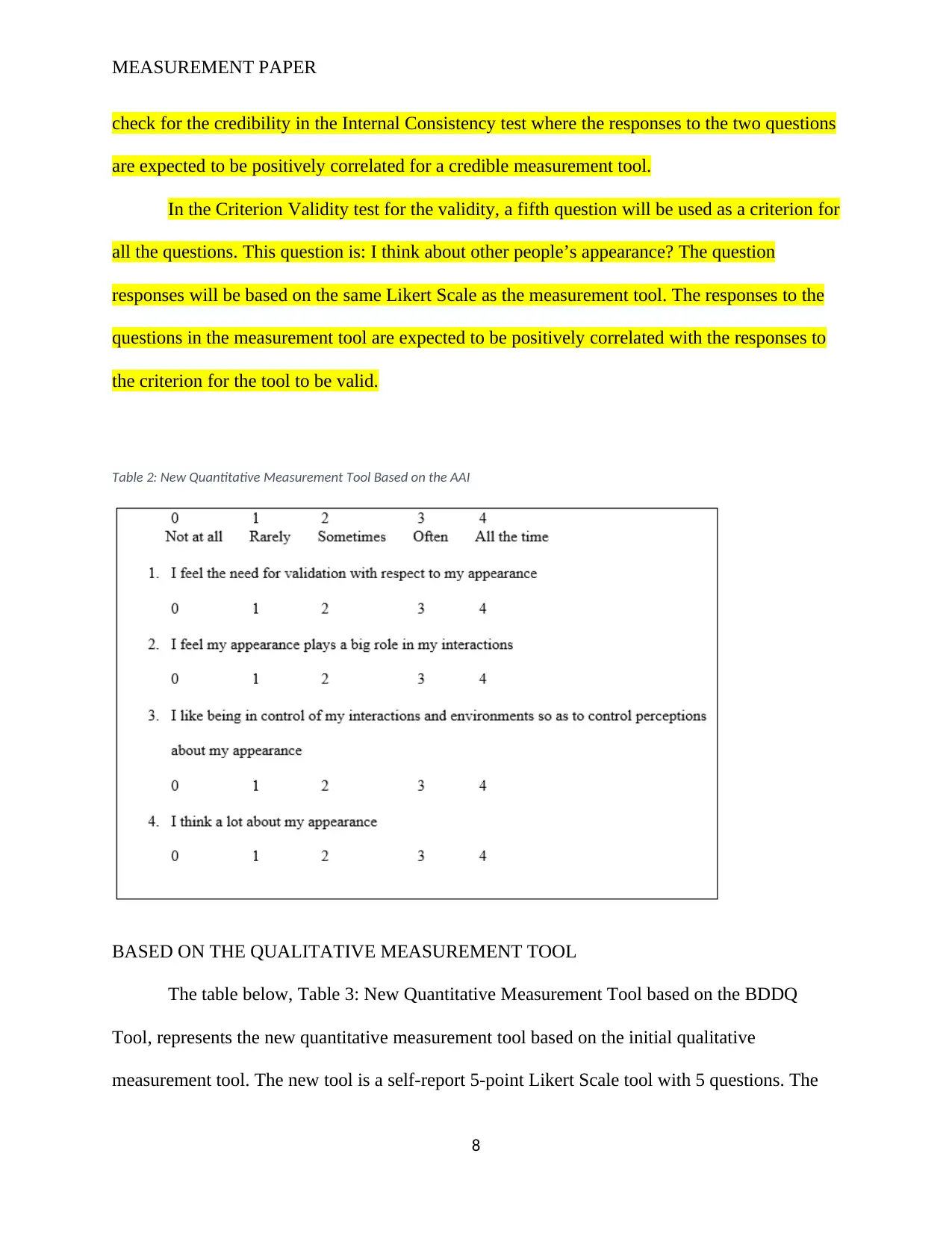
The table below, Table 2: New Quantitative Measurement Tool Based on the AAI,
represents the new quantitative measurement tool based on the initial quantitative measurement
tool. This new tool is a self-report 5-point Likert Scale tool with 4 questions. The tool applies the
same Likert Scale as the one used in the AAI measurement tool; 0 – Not at all, 1 – Rarely, 2 –
Sometimes, 3- Often, 4 – All the time. Scores on the measurement tool above 12 indicate
symptoms of Appearance Anxiety.
The credibility and validity of the measurement tool in Table 2: New Quantitative
Measurement Tool Based on the AAI below will be tested using the Internal Consistency and
Criterion Validity tests respectively. The correlation between questions 2 and 4 will be used to
7
Paraphrase This Document
Need a fresh take? Get an instant paraphrase of this document with our AI Paraphraser
MEASUREMENT PAPER
check for the credibility in the Internal Consistency test where the responses to the two questions
are expected to be positively correlated for a credible measurement tool.
In the Criterion Validity test for the validity, a fifth question will be used as a criterion for
all the questions. This question is: I think about other people’s appearance? The question
responses will be based on the same Likert Scale as the measurement tool. The responses to the
questions in the measurement tool are expected to be positively correlated with the responses to
the criterion for the tool to be valid.
Table 2: New Quantitative Measurement Tool Based on the AAI
BASED ON THE QUALITATIVE MEASUREMENT TOOL
The table below, Table 3: New Quantitative Measurement Tool based on the BDDQ
Tool, represents the new quantitative measurement tool based on the initial qualitative
measurement tool. The new tool is a self-report 5-point Likert Scale tool with 5 questions. The
8
check for the credibility in the Internal Consistency test where the responses to the two questions
are expected to be positively correlated for a credible measurement tool.
In the Criterion Validity test for the validity, a fifth question will be used as a criterion for
all the questions. This question is: I think about other people’s appearance? The question
responses will be based on the same Likert Scale as the measurement tool. The responses to the
questions in the measurement tool are expected to be positively correlated with the responses to
the criterion for the tool to be valid.
Table 2: New Quantitative Measurement Tool Based on the AAI
BASED ON THE QUALITATIVE MEASUREMENT TOOL
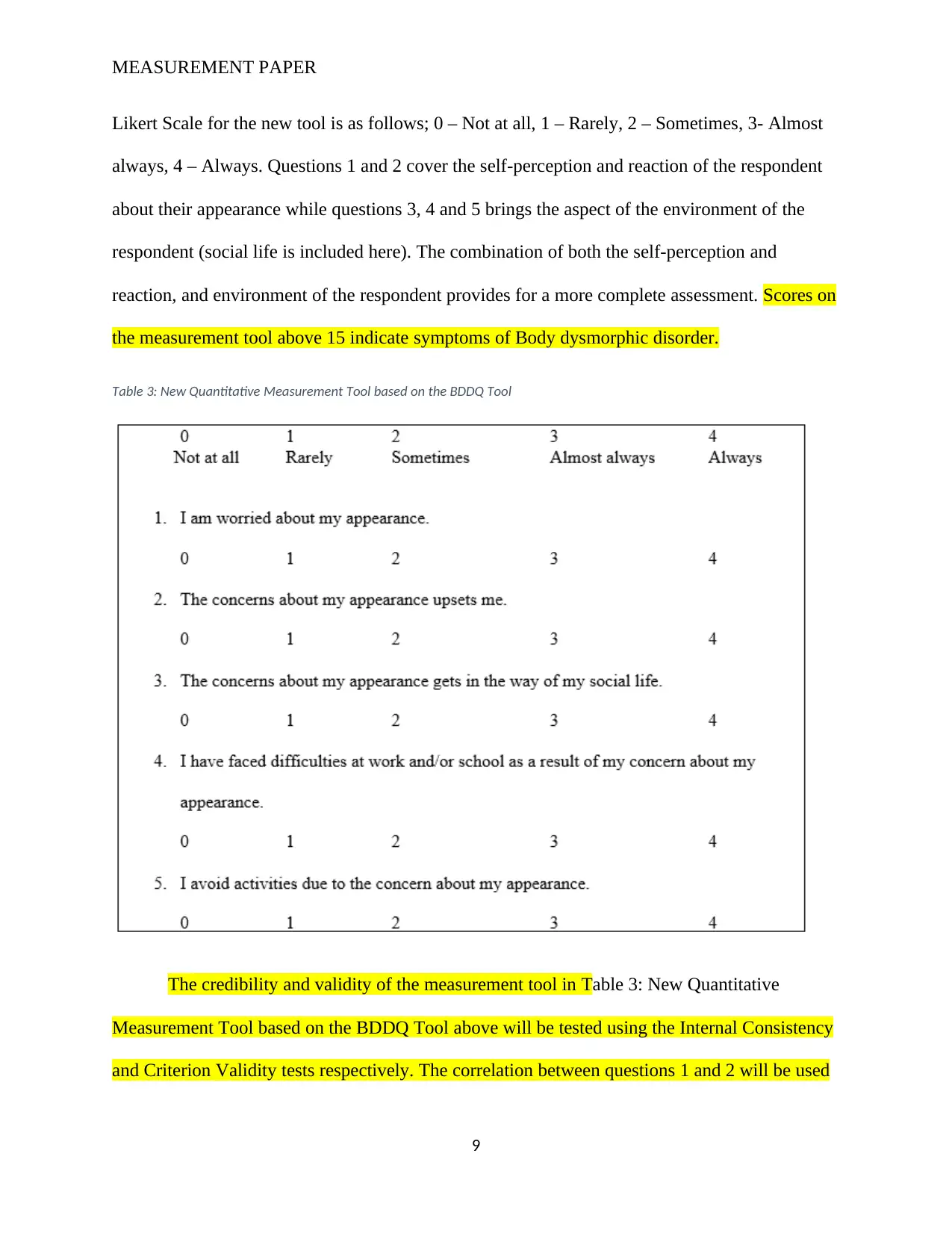
The table below, Table 3: New Quantitative Measurement Tool based on the BDDQ
Tool, represents the new quantitative measurement tool based on the initial qualitative
measurement tool. The new tool is a self-report 5-point Likert Scale tool with 5 questions. The
8
MEASUREMENT PAPER
Likert Scale for the new tool is as follows; 0 – Not at all, 1 – Rarely, 2 – Sometimes, 3- Almost
always, 4 – Always. Questions 1 and 2 cover the self-perception and reaction of the respondent
about their appearance while questions 3, 4 and 5 brings the aspect of the environment of the
respondent (social life is included here). The combination of both the self-perception and
reaction, and environment of the respondent provides for a more complete assessment. Scores on
the measurement tool above 15 indicate symptoms of Body dysmorphic disorder.
Table 3: New Quantitative Measurement Tool based on the BDDQ Tool
The credibility and validity of the measurement tool in Table 3: New Quantitative
Measurement Tool based on the BDDQ Tool above will be tested using the Internal Consistency
and Criterion Validity tests respectively. The correlation between questions 1 and 2 will be used
9
Likert Scale for the new tool is as follows; 0 – Not at all, 1 – Rarely, 2 – Sometimes, 3- Almost
always, 4 – Always. Questions 1 and 2 cover the self-perception and reaction of the respondent
about their appearance while questions 3, 4 and 5 brings the aspect of the environment of the
respondent (social life is included here). The combination of both the self-perception and
reaction, and environment of the respondent provides for a more complete assessment. Scores on
the measurement tool above 15 indicate symptoms of Body dysmorphic disorder.
Table 3: New Quantitative Measurement Tool based on the BDDQ Tool
The credibility and validity of the measurement tool in Table 3: New Quantitative
Measurement Tool based on the BDDQ Tool above will be tested using the Internal Consistency
and Criterion Validity tests respectively. The correlation between questions 1 and 2 will be used
9
⊘ This is a preview!⊘
Do you want full access?
Subscribe today to unlock all pages.
Trusted by 1+ million students worldwide
MEASUREMENT PAPER
to check for the credibility in the Internal Consistency test where the responses to the two
questions are expected to be positively correlated for a credible measurement tool.
In the Criterion Validity test for the validity, a sixth question will be used as a criterion
for all the questions. This question is: How often do you go out? The question responses will be
based on the same Likert Scale as the measurement tool. The responses to the questions in the
measurement tool are expected to be negatively correlated with the responses to the criterion for
the tool to be valid.
CONCLUSION
The evaluations in this paper on the AAI and BDDQ measurement tools for body
dysmorphic disorder indicate the existence of limitations to the applicability of the tools. These
limitations reduce the efficiency, reliability and validity of the two measurement tools. However,
the limitations are few and hence do not invalidate the AAI and BDDQ measurement tools. The
two new developed quantitative tools based on the AAI and BDDQ measurement tools, address
some the limitations of the AAI and BDDQ measurement tools. Thereby presenting options with
the possibility of higher efficiency, reliability and validity in the body dysmorphic disorder
assessment.
10
to check for the credibility in the Internal Consistency test where the responses to the two
questions are expected to be positively correlated for a credible measurement tool.
In the Criterion Validity test for the validity, a sixth question will be used as a criterion
for all the questions. This question is: How often do you go out? The question responses will be
based on the same Likert Scale as the measurement tool. The responses to the questions in the
measurement tool are expected to be negatively correlated with the responses to the criterion for
the tool to be valid.
CONCLUSION
The evaluations in this paper on the AAI and BDDQ measurement tools for body
dysmorphic disorder indicate the existence of limitations to the applicability of the tools. These
limitations reduce the efficiency, reliability and validity of the two measurement tools. However,
the limitations are few and hence do not invalidate the AAI and BDDQ measurement tools. The
two new developed quantitative tools based on the AAI and BDDQ measurement tools, address
some the limitations of the AAI and BDDQ measurement tools. Thereby presenting options with
the possibility of higher efficiency, reliability and validity in the body dysmorphic disorder
assessment.
10
Paraphrase This Document
Need a fresh take? Get an instant paraphrase of this document with our AI Paraphraser
MEASUREMENT PAPER
REFERENCES
Bernstein, D. A. (2010). Essentials of Psychology (1st ed.). Chicago: Cengage Learning.
Mancuso, S. G., Knoesen, N. P., & Castle, D. J. (2010). The Dysmorphic Concern
Questionnaire: A screening measure for body dysmorphic disorder. Australian and New
Zealand Journal of Psychiatry, 44(6), 535-542.
Naomi, B. R., & Heiberger, M. R. (2011). Plotting Likert and Other Rating Scales. JSM 2011,
2011(1), 1058-1066.
Norman, G. (2010). Likert Scales, Levels of Measurement and the Laws of Statistics. Advances
in Health Science Education , 15(5), 625-632.
Veale, E. D., Kanakam, E., Ellison, N., Costa, A., & Werner, T. (2014). The Appearance
Anxiety Inventory: Validation of a process measure in the treatment of body dysmorphic
disorder. Behavioural and Cognitive Psychotherapy, 42(5), 605-616.
11
REFERENCES
Bernstein, D. A. (2010). Essentials of Psychology (1st ed.). Chicago: Cengage Learning.
Mancuso, S. G., Knoesen, N. P., & Castle, D. J. (2010). The Dysmorphic Concern
Questionnaire: A screening measure for body dysmorphic disorder. Australian and New
Zealand Journal of Psychiatry, 44(6), 535-542.
Naomi, B. R., & Heiberger, M. R. (2011). Plotting Likert and Other Rating Scales. JSM 2011,
2011(1), 1058-1066.
Norman, G. (2010). Likert Scales, Levels of Measurement and the Laws of Statistics. Advances
in Health Science Education , 15(5), 625-632.
Veale, E. D., Kanakam, E., Ellison, N., Costa, A., & Werner, T. (2014). The Appearance
Anxiety Inventory: Validation of a process measure in the treatment of body dysmorphic
disorder. Behavioural and Cognitive Psychotherapy, 42(5), 605-616.
11
MEASUREMENT PAPER
APPENDIX: BDDQ TOOL
Table 4: BDDQ Measurement Tool
(Mancuso, Knoesen, & Castle, 2010)
12
APPENDIX: BDDQ TOOL
Table 4: BDDQ Measurement Tool
(Mancuso, Knoesen, & Castle, 2010)
12
⊘ This is a preview!⊘
Do you want full access?
Subscribe today to unlock all pages.
Trusted by 1+ million students worldwide

1 out of 12


Related Documents


Your All-in-One AI-Powered Toolkit for Academic Success.
+13062052269
info@desklib.com
Available 24*7 on WhatsApp / Email
![[object Object]](/_next/static/media/star-bottom.7253800d.svg)
Unlock your academic potential
Copyright © 2020–2026 A2Z Services. All Rights Reserved. Developed and managed by ZUCOL.