The Correlation Between Brainwaves and Introspective Transformation

Verified

Added on  2022/08/21

|1
|344
|20
Thesis and Dissertation
AI Summary
This dissertation investigates the correlation between brainwaves and introspective transformation, focusing on the impact of meditation and brain music. The study uses EEG technology to record brain frequencies of 10 participants, divided into two groups: one exposed to brainwave music and a control group. Data from brainwaves, accelerometers, gyros, and reference electrodes (REST, AR, LM) are analyzed. The research aims to determine if brainwave patterns correlate with introspective changes and to assess the effects of different meditation approaches. The findings are expected to highlight significant relationships between brainwave power and natural methods of introspective transformation. The study will analyze how changes in brainwave patterns may reflect altered states of consciousness and the effectiveness of various approaches to introspection.
Document Page
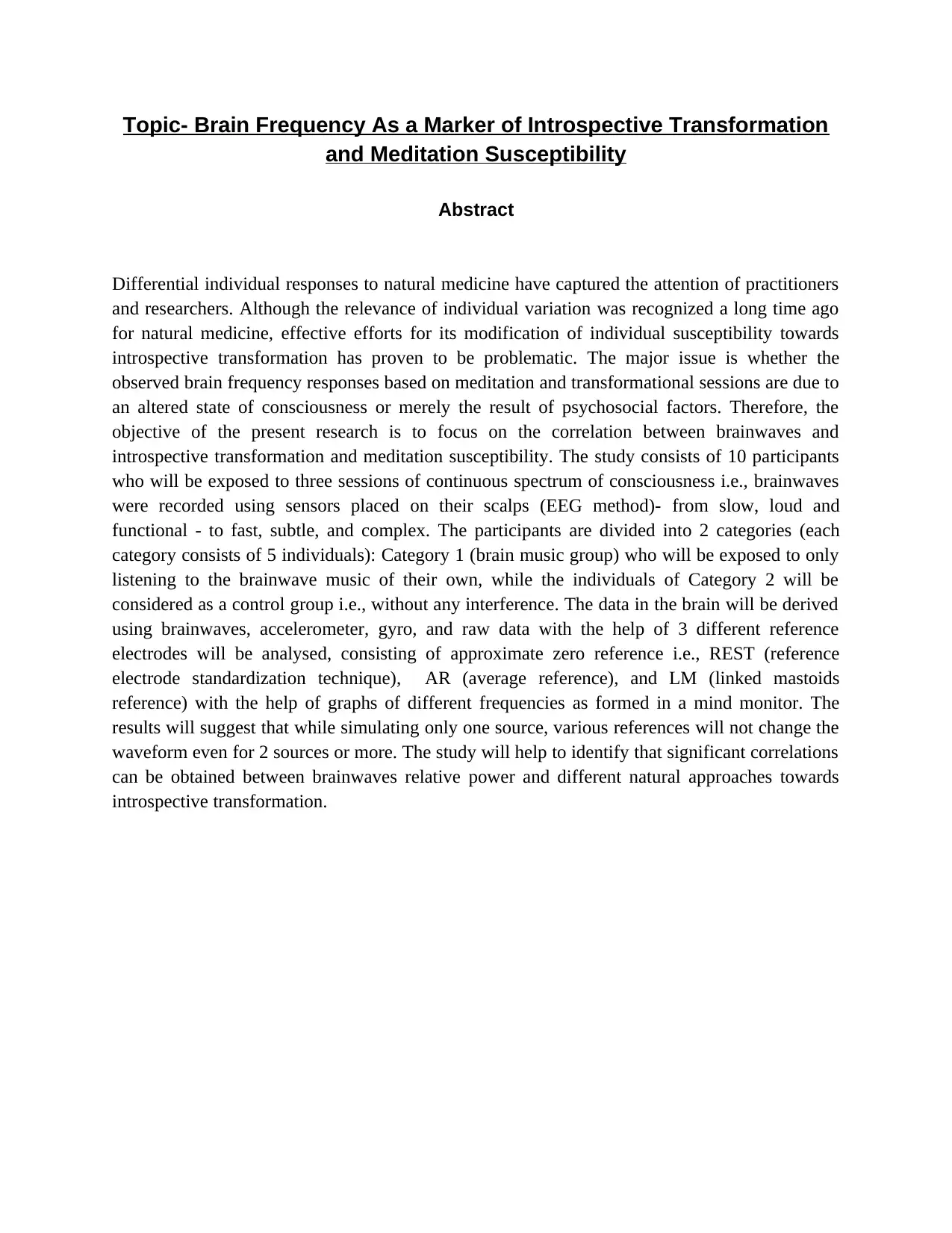
Topic- Brain Frequency As a Marker of Introspective Transformation
and Meditation Susceptibility
Abstract
Differential individual responses to natural medicine have captured the attention of practitioners
and researchers. Although the relevance of individual variation was recognized a long time ago
for natural medicine, effective efforts for its modification of individual susceptibility towards
introspective transformation has proven to be problematic. The major issue is whether the
observed brain frequency responses based on meditation and transformational sessions are due to
an altered state of consciousness or merely the result of psychosocial factors. Therefore, the
objective of the present research is to focus on the correlation between brainwaves and
introspective transformation and meditation susceptibility. The study consists of 10 participants
who will be exposed to three sessions of continuous spectrum of consciousness i.e., brainwaves
were recorded using sensors placed on their scalps (EEG method)- from slow, loud and
functional - to fast, subtle, and complex. The participants are divided into 2 categories (each
category consists of 5 individuals): Category 1 (brain music group) who will be exposed to only
listening to the brainwave music of their own, while the individuals of Category 2 will be
considered as a control group i.e., without any interference. The data in the brain will be derived
using brainwaves, accelerometer, gyro, and raw data with the help of 3 different reference
electrodes will be analysed, consisting of approximate zero reference i.e., REST (reference
electrode standardization technique), AR (average reference), and LM (linked mastoids
reference) with the help of graphs of different frequencies as formed in a mind monitor. The
results will suggest that while simulating only one source, various references will not change the
waveform even for 2 sources or more. The study will help to identify that significant correlations
can be obtained between brainwaves relative power and different natural approaches towards
introspective transformation.
tabler-icon-diamond-filled.svg

Paraphrase This Document

Need a fresh take? Get an instant paraphrase of this document with our AI Paraphraser
[object Object]