Mechanical Engineering: Tasks, Expertise, and Skills Development

Verified

Added on  2024/05/21

|7
|1727
|284
Essay
AI Summary
This essay delves into the multifaceted world of mechanical engineering, outlining the roles and responsibilities of mechanical engineers in various industries. It highlights specific tasks, such as utilizing Computational Fluid Dynamics (CFD) for fluid mechanics analysis, and reflects on how university education contributes to practical engineering skills. The essay further examines the value mechanical engineers add to their field, including their expertise in energy usage, automation, and materials processing, as well as their adaptability to roles in aerospace and other sectors. The discussion extends to defining and achieving expertise in mechanical engineering, emphasizing the importance of continuous learning, practical experience, and theoretical knowledge, culminating in the integration of study, hands-on experience, and learning from real-world applications to foster innovation and problem-solving abilities.
Document Page
Mechanical Engineering
tabler-icon-diamond-filled.svg

Paraphrase This Document

Need a fresh take? Get an instant paraphrase of this document with our AI Paraphraser
Document Page
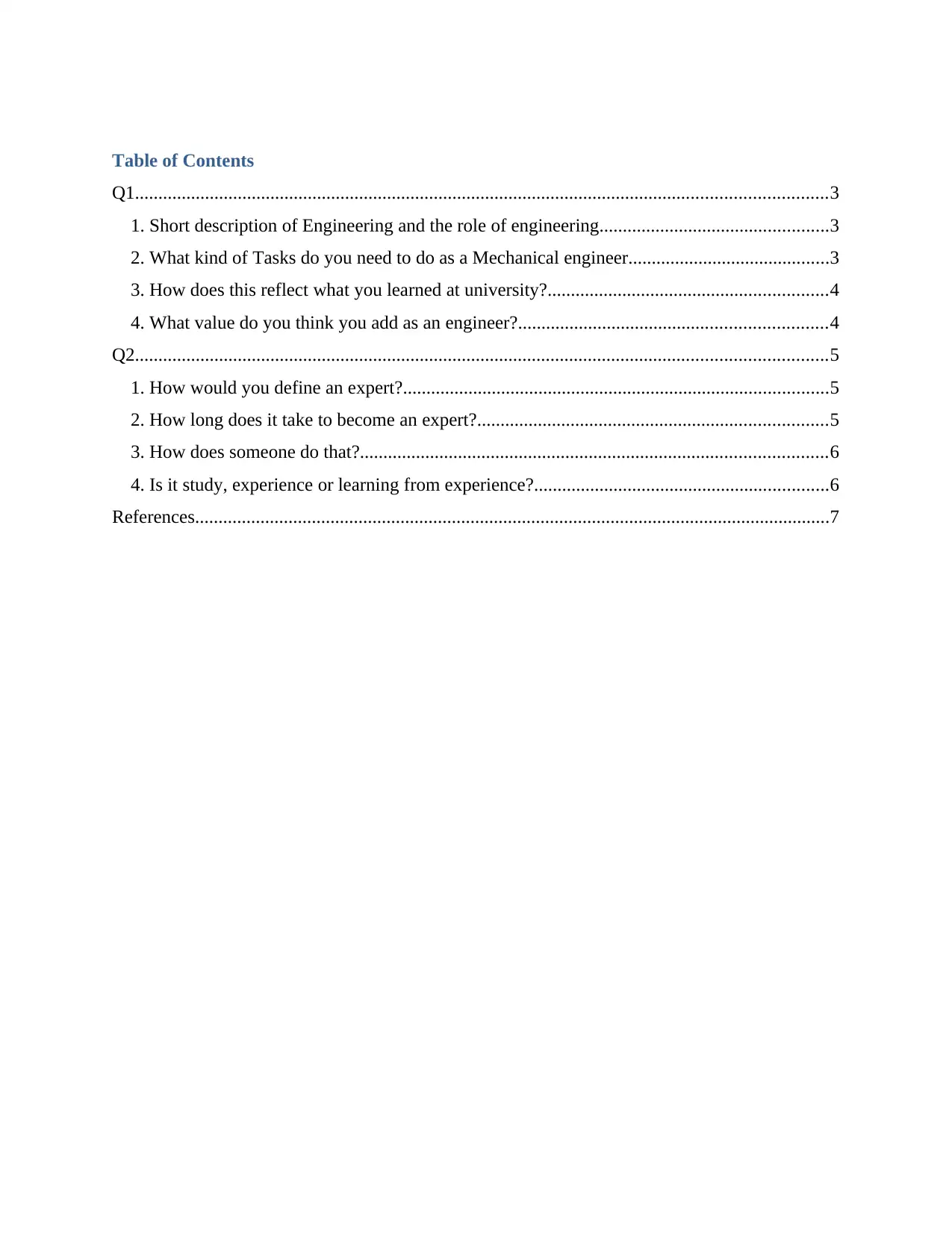
Table of Contents
Q1....................................................................................................................................................3
1. Short description of Engineering and the role of engineering.................................................3
2. What kind of Tasks do you need to do as a Mechanical engineer...........................................3
3. How does this reflect what you learned at university?............................................................4
4. What value do you think you add as an engineer?..................................................................4
Q2....................................................................................................................................................5
1. How would you define an expert?...........................................................................................5
2. How long does it take to become an expert?...........................................................................5
3. How does someone do that?....................................................................................................6
4. Is it study, experience or learning from experience?...............................................................6
References........................................................................................................................................7
Document Page
Q1.
1. Short description of Engineering and the role of engineering
Engineers are termed as specialists in engineering are the ones who design, analyse, invent,
construct and check systems, structure, machines and materials so that objective can be fulfilled.
The requirements are fulfilled by considering the limitations been imposed on safety, cost,
regulation and practicality. The engineers established a link among scientific discoveries,
applications to business needs and human and excellence of life.
A Mechanical engineer is able to get with the responsibilities of applying engineering knowledge
and science in design, manufacturing, managing, construction, research and superintending.
Mechanical Engineering role in the industry are-
1. The mechanical engineer uses innovative platforms to implement methods for the
production of composite materials.
2. They include enterprise content management, production management, efficiency and
lean management.
3. Eco-processes in the field of mechanics are done for the sustainable development.
4. Mechatronics of the machine tools and control is done by a Mechanical engineer.
5. Product processes design is done for design simulation to attain product lifecycle
management (Altran, 2017).
2. What kind of Tasks do you need to do as a Mechanical engineer
The tasks which I performed being a mechanical engineering is from Fluid mechanics. In it, CFD
which is Computational fluid dynamics will be used for stimulating the 3D stream of fluid from a
single hole to a solid plate. Then solid-liquid separation will be made in the whirlpool, turbulent
flow will be made in an open channel, mixing in wild non-newtonian flows will take place,
stimulating of drops splashing, displaying solid-liquid transportation in fluids, noval reactor
design, fluid flow in a swirling pipe, experimental chaos and building agitation. Afterwards, flow
is been stimulated through many holes via various approximations. This task would be best for
the ones who know or have some experience on CFD (computational fluid dynamics) and on
Linux operating system.
Document Page
This task would help out the practitioners in getting hands-on-experience, building, designing
and examining industrial devices and quantifying the fluid mechanical mechanisms via which it
operates.
3. How does this reflect what you learned at university?
This task made me learn about the fluid mechanic's principles of the mechanical systems.
University helped me in illustrating all the practical engineering applications in relation to fluid
systems. My university helped me in applying engineering principles for the performance
analysis and forecasting of simple fluid systems. Improvement in performance, understanding of
the vital theoretical basis of the science of fluid mechanics and application to wide problems was
also learned by me. This course also makes me know about learning activities and learning
resources involved in the task of fluid mechanics. Its study relates to fundamental laws of applied
mechanics for establishing a relation between mass conservation, momentum and energy.
4. What value do you think you add as an engineer?
There are many areas which mechanical engineer tend to learn and add to their portfolio.
1. Being a Mechanical engineering I can focus on the usage of energy, automation and
control of manufacturing systems, development and design of machines and processing
of materials.
2. Aerospace engineers are the Mechanical engineers who apply their engineering in
spacecraft and aircraft. It is because aerostructure, manufacturing engineering, mrb
teams, tool design and quality control topics are covered in the curriculum of a
mechanical engineer. They can also fit in roles of production planning, supply chain
management and production control (Kalyan, 2018).
3. I have here understudied mathematical fundamentals of fluid flows of differential and
integral modelling for the purpose of conservation laws of energy, momentum and mass.
4. A mechanical engineer adds in the knowledge of technology, science, maths,
management and business. It will enable a mechanical engineer to solve problems using
logic, innovative and creative approaches.
5. On a personal basis, a mechanical engineer is able to plan and highlight the work under
pressure or on deadline. Careful consideration of details, accepting responsibility and
exercising good judgment are traits of a mechanical engineer.
tabler-icon-diamond-filled.svg

Paraphrase This Document

Need a fresh take? Get an instant paraphrase of this document with our AI Paraphraser
Document Page
Q2.
1. How would you define an expert?
According to me, an expert is someone who is very knowledgeable and skilful in some specific
area. Being an expert mechanical engineer demands a lot of things which are discussed below.
1. Building justifiable power plants at isolated places, enhancing safety in the working
environment for workers and developing new technologies so that pollution can be
controlled are all glimpses of a variety of tasks a mechanical expert can do.
2. Good knowledge of different phenomena’s and materials related to the component
fatigue and vibration are termed as a strong advantage for a mechanical expert.
3. Mechanical experts tend to have good experience with the analysis, research and testing
of the machinery, consumer products, manufacturing equipment, mechanical systems and
industrial equipment (Aaker, 2016).
4. They have a background from industries like heating and cooling, construction,
weaponry, transportation and more.
5. If in case some legal action is made on the defect of design then at this moment only a
mechanical expert would be able to navigate with all the intricacies and provide with
proper analysis to resolve the legal argument decisively.
2. How long does it take to become an expert?
Firstly it is very important to get studied from the top and renowned engineering schools which
is specifically good in studies of mechanical engineering as it would not only help in gaining
good knowledge from the proficient professors but also will give you exposure into the practical
environment of business. Above all when you are recruited into good and established companies
then it is bound to see more of the upcoming, the latest and new technologies.
If the start is good which means from good and esteemed university then it will be taking
approximately 8 years to get yourself updated with all the trends and expertise needed whereas if
there is no prestigious engineering school then it would take approximately 15 years to become
an expert in the specific field. Otherwise one can also follow the straight path up to PhD.
Document Page
3. How does someone do that?
Becoming a mechanical expert is definitely a daunting journey be it in the field of metal matrix
composites, microfluidics, understandable etc. For mastering it altogether one can follow the
conventional path till PhD which will help you in covering up a range of subjects, particularly in
the leading journals. Over the course, if one can make themselves a recognized figure in the
community of research then it will mean that the person has entered an elite club. But here with
studies, it will only make you a mechanical expert in theoretical and a bit of practical knowledge.
On the other hand, if someone retains in the industry than to become an expertise in practical
front, a person needs to lay all to work and make out with some factual stuff and real skills of
tooling preferably from the scratch.
4. Is it study, experience or learning from experience?
Well to become an expertise again in the field of mechanical engineering, all the three stages
which are study, leaning and then experience are important. Below I will be discussing how.
Studies- From the high school itself to become a mechanical engineer I studied science,
computer science and mathematics. This will act as a backbone for the engineering also I had
participated in fairs and contests to sharpen with the knowledge. Again, after this, there must be
bachelors done from a good college.
Experience- I tried to learn different kinds of tools and stuff available by dispatching them and
assembling them. This process helped me in figuring out what is inside and what is going on. It
will open up the mind and will help in inventing something no matter how small the product is.
Then the interest will soon boost up in the field of manufacturing to build something.
Learning from Experience- In the industry when the person is learning, it will help in
developing creativity and shaping of all the ideas. It is required here to keep oneself involved in
the events because then only a person can increase its familiarity with the problems of real life
engineering. This is the point when a mechanical engineer will be proficient in theory as well as
practical knowledge giving wings to inventions.
Document Page
References
Altran, 2017, Mechanical Engineering, viewed 17 March 2018,
http://www.altran-latam.com/mecheng.html#.Wq0GTB1ubcc
Kalyan, S. 2018, What jobs can a mechanical engineer bag in aviation industry?, viewed 17
March 2018, https://www.quora.com/What-jobs-can-a-mechanical-engineer-bag-in-aviation-
industry
Aaker, P.E. 2016, Mechanical Engineering Expert, viewed 17 March 2018,
http://www.engineering-experts.com/mechanical-engineering-expert.html
chevron_up_icon
1 out of 7
circle_padding
hide_on_mobile
zoom_out_icon
[object Object]