Adelaide Nursing School: Clinical Audit of Medication Management
VerifiedAdded on 2020/03/04
|24
|5324
|111
Report
AI Summary
This report presents a clinical audit focused on medication management within a hospital's emergency department, conducted by a student at the University of Adelaide's Nursing School. The audit investigates medication administration practices among registered nurses to identify areas for improvement and reduce medication errors. The report details the audit's importance, standards, questions, and setup, including population and sampling methodologies. It also provides an introduction to medication management, emphasizing the role of nurses and the significance of adhering to established protocols. The audit aims to enhance patient safety by promoting the implementation of best practices and reducing adverse drug events. The report explores the methods, including data collection, ethical considerations, and the development of audit standards based on the emergency department's context. The audit's purpose is to assess and monitor the quality of service, provide evidence of competence, prevent errors, demonstrate accountability, and support staff development and training. The report also includes references and appendices to support the findings and recommendations.
Running head: CLINICAL AUDIT
The University of Adelaide
Adelaide Nursing School
Title of Audit: Medication Management
Name of the student:
Student Number:
Author Note
The University of Adelaide
Adelaide Nursing School
Title of Audit: Medication Management
Name of the student:
Student Number:
Author Note

Paraphrase This Document
Need a fresh take? Get an instant paraphrase of this document with our AI Paraphraser
1
CLINICAL AUDIT
Table of Contents
Assessment: 1.............................................................................................................................3
Importance of the topic: Medication Management................................................................3
Audit Standards Maintained...................................................................................................3
Audit Questions......................................................................................................................7
Audit Setup.............................................................................................................................7
Population and Sampling.......................................................................................................7
Assessment 2..............................................................................................................................8
Introduction............................................................................................................................8
Methods................................................................................................................................11
Data collection Table.......................................................................................................13
Ethical consideration........................................................................................................16
Appendix 3...............................................................................................................................18
The audit purpose.................................................................................................................18
Issue or the Produce to be Audited......................................................................................18
The standard of audit............................................................................................................18
Area to be Audited...............................................................................................................18
Population to be Audited......................................................................................................18
Number of People included in the Audit..............................................................................18
Sample Recruiting....................................................................................................................19
Data Collection.....................................................................................................................19
CLINICAL AUDIT
Table of Contents
Assessment: 1.............................................................................................................................3
Importance of the topic: Medication Management................................................................3
Audit Standards Maintained...................................................................................................3
Audit Questions......................................................................................................................7
Audit Setup.............................................................................................................................7
Population and Sampling.......................................................................................................7
Assessment 2..............................................................................................................................8
Introduction............................................................................................................................8
Methods................................................................................................................................11
Data collection Table.......................................................................................................13
Ethical consideration........................................................................................................16
Appendix 3...............................................................................................................................18
The audit purpose.................................................................................................................18
Issue or the Produce to be Audited......................................................................................18
The standard of audit............................................................................................................18
Area to be Audited...............................................................................................................18
Population to be Audited......................................................................................................18
Number of People included in the Audit..............................................................................18
Sample Recruiting....................................................................................................................19
Data Collection.....................................................................................................................19
2
CLINICAL AUDIT
How data will be recorded...................................................................................................19
Data Analysis.......................................................................................................................19
Permission for audit.............................................................................................................19
References................................................................................................................................20
CLINICAL AUDIT
How data will be recorded...................................................................................................19
Data Analysis.......................................................................................................................19
Permission for audit.............................................................................................................19
References................................................................................................................................20
⊘ This is a preview!⊘
Do you want full access?
Subscribe today to unlock all pages.

Trusted by 1+ million students worldwide
3
CLINICAL AUDIT
Assessment: 1
Importance of the topic: Medication Management
Medication error is a kind of error that causes inappropriate application of medication
over the patient, causing potential harm (Fatemah et al. 2013). The medication error is
preventable but when it occurs in an emergency department of a hospital, the situation
becomes fatal. The medication management lies solely in the hand of the health care
professionals and generally deals with the norms, process and the mode of administration of
the medicines. The importance of the topic lies in the fact that such management directed
towards the medication will cut-short the occurrence of the manual error occurring in the
emergency department and thereby reducing the rate of mortality and unwanted deterioration
of the patient’s health condition. The medication management system will promote the
development of the proper medication plan, or the routine protocol that needs to be
undertaken while providing medication to any patient admitted in an emergency unit and will
also encourage proper interaction between the nurses and the doctors (Patanwala et al. 2012;
Moorhead et al. 2014).
Audit Standards Maintained
The number of nurses with respect to doctors is high along with the increase in the
number of non-veterans doctors; amount of medication error is increasing vigorously. The
latest data obtained from the Kings Hospital, Singapore states that, majority of the casualties
in the emergency unit of the hospitals have occurred because of the medication errors. The
medication error statistics shows drastic increase of medication error incidence. 3 cases are
reported in 2016 and 10 cases in 2017. Moreover, there are 2 unfortunate Serious Reportable
Events (SREs) that have occurred within one-month in year of 2017. Here SRE is defined as
adverse event that causes negative effect leading to an unintended harmful impact on the
CLINICAL AUDIT
Assessment: 1
Importance of the topic: Medication Management
Medication error is a kind of error that causes inappropriate application of medication
over the patient, causing potential harm (Fatemah et al. 2013). The medication error is
preventable but when it occurs in an emergency department of a hospital, the situation
becomes fatal. The medication management lies solely in the hand of the health care
professionals and generally deals with the norms, process and the mode of administration of
the medicines. The importance of the topic lies in the fact that such management directed
towards the medication will cut-short the occurrence of the manual error occurring in the
emergency department and thereby reducing the rate of mortality and unwanted deterioration
of the patient’s health condition. The medication management system will promote the
development of the proper medication plan, or the routine protocol that needs to be
undertaken while providing medication to any patient admitted in an emergency unit and will
also encourage proper interaction between the nurses and the doctors (Patanwala et al. 2012;
Moorhead et al. 2014).
Audit Standards Maintained
The number of nurses with respect to doctors is high along with the increase in the
number of non-veterans doctors; amount of medication error is increasing vigorously. The
latest data obtained from the Kings Hospital, Singapore states that, majority of the casualties
in the emergency unit of the hospitals have occurred because of the medication errors. The
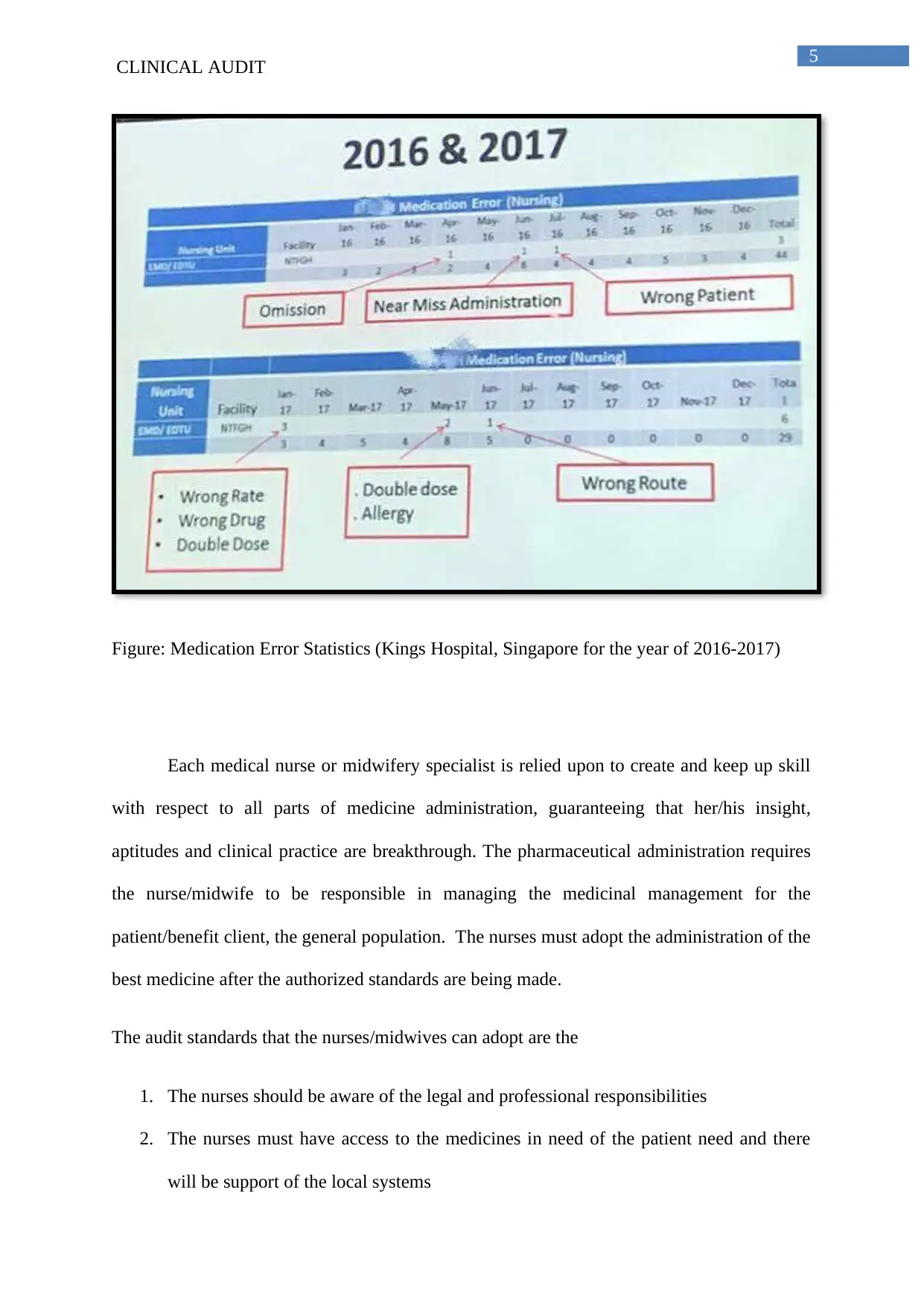
medication error statistics shows drastic increase of medication error incidence. 3 cases are
reported in 2016 and 10 cases in 2017. Moreover, there are 2 unfortunate Serious Reportable
Events (SREs) that have occurred within one-month in year of 2017. Here SRE is defined as
adverse event that causes negative effect leading to an unintended harmful impact on the
Paraphrase This Document
Need a fresh take? Get an instant paraphrase of this document with our AI Paraphraser
4
CLINICAL AUDIT
patient, which may or may not have been prevented (MOH 2014). Emergency Department
(ED) has a stressful environment with high turnover rate of patient and unpredictable critical
events. Such sudden events and work pressure make ED to suffer from high frequency of
medication error. The statement holds true across the nation (Vazin, Zamani and Hatam
2014). In promotion of patient safety level, medication safety had long been recognized to be
important in the field of healthcare provision (MOH 2006) Based on the escalating
medication error incidence in the beginning of 2017; it was predicted the same scenario will
prevail for the rest of the year. Given the significance of the current report of MEs in ED, it is
very important to develop an audit on the medication administration on all Registered Nurses
(RN) in this ED in order to find out their performance and identify the area of improvement.
This will help to combat further ME incidence and will enhance the level of patient safety.
The nursing audit is an exercise to elucidate whether good nursing practices are followed in a
particular health care unit where the nursing audit is being carried out. In Singapore,
according to Medication Safety Practice Guide, all healthcare professionals have equal share
of responsibility to ensure medication safety especially for the nurses. Nurses hold a
important position which acts as a last barrier to prevent any medication error happening at
the bedside. (MOH 2006) All nurses must abide by the authorized guidelines, standards and
evidence based best practices (MOH 2006).
CLINICAL AUDIT
patient, which may or may not have been prevented (MOH 2014). Emergency Department
(ED) has a stressful environment with high turnover rate of patient and unpredictable critical
events. Such sudden events and work pressure make ED to suffer from high frequency of
medication error. The statement holds true across the nation (Vazin, Zamani and Hatam
2014). In promotion of patient safety level, medication safety had long been recognized to be
important in the field of healthcare provision (MOH 2006) Based on the escalating
medication error incidence in the beginning of 2017; it was predicted the same scenario will
prevail for the rest of the year. Given the significance of the current report of MEs in ED, it is
very important to develop an audit on the medication administration on all Registered Nurses
(RN) in this ED in order to find out their performance and identify the area of improvement.
This will help to combat further ME incidence and will enhance the level of patient safety.
The nursing audit is an exercise to elucidate whether good nursing practices are followed in a
particular health care unit where the nursing audit is being carried out. In Singapore,
according to Medication Safety Practice Guide, all healthcare professionals have equal share
of responsibility to ensure medication safety especially for the nurses. Nurses hold a
important position which acts as a last barrier to prevent any medication error happening at
the bedside. (MOH 2006) All nurses must abide by the authorized guidelines, standards and
evidence based best practices (MOH 2006).
5
CLINICAL AUDIT
Figure: Medication Error Statistics (Kings Hospital, Singapore for the year of 2016-2017)
Each medical nurse or midwifery specialist is relied upon to create and keep up skill
with respect to all parts of medicine administration, guaranteeing that her/his insight,
aptitudes and clinical practice are breakthrough. The pharmaceutical administration requires
the nurse/midwife to be responsible in managing the medicinal management for the
patient/benefit client, the general population. The nurses must adopt the administration of the
best medicine after the authorized standards are being made.
The audit standards that the nurses/midwives can adopt are the
1. The nurses should be aware of the legal and professional responsibilities
2. The nurses must have access to the medicines in need of the patient need and there
will be support of the local systems
CLINICAL AUDIT
Figure: Medication Error Statistics (Kings Hospital, Singapore for the year of 2016-2017)
Each medical nurse or midwifery specialist is relied upon to create and keep up skill
with respect to all parts of medicine administration, guaranteeing that her/his insight,
aptitudes and clinical practice are breakthrough. The pharmaceutical administration requires
the nurse/midwife to be responsible in managing the medicinal management for the
patient/benefit client, the general population. The nurses must adopt the administration of the
best medicine after the authorized standards are being made.
The audit standards that the nurses/midwives can adopt are the
1. The nurses should be aware of the legal and professional responsibilities
2. The nurses must have access to the medicines in need of the patient need and there
will be support of the local systems
⊘ This is a preview!⊘
Do you want full access?
Subscribe today to unlock all pages.
Trusted by 1+ million students worldwide
6
CLINICAL AUDIT
3. The nurses must be aware of the actions and omissions of the role of the nurses in
administering a prescribed medicine
4. They must actively follow the transcription as mentioned by the visiting doctor
5. They will have to follow the administration and frequently monitor the desired effect
of the drug and make review
6. The nurses should have an understanding for the drug prescription and the potential
side effects. They must be efficient enough to identify, intervene and report the
adverse conditions
7. They should understand the purpose of the medicines that is been registered. The
nurses must seek all the information in a written form prior to the audit study
8. The audit can be done if the nurses know the potential benefits and the misuse of the
drugs which is being administered to the patient
9. The nurses must adhere with the requirements of the Misuse of Drugs act and
regulations to follow a strict regime in the audit
10. They must be well aware of the factors that are involved in the medicinal errors like
right of the patient, mode of administration of the prescribed drug, the time of cyclic
administration of the medicine in a routine base and route of administration
11. Nurses must be aware of the special care regime need to be undertaken during the
intravenous administration of the drugs and these include the duration of
administration, the ratio of dilution, the drug compatibility and the speed to
administration or transfusion through the veins (Gardner, Gardner and O'connell
2014)
CLINICAL AUDIT
3. The nurses must be aware of the actions and omissions of the role of the nurses in
administering a prescribed medicine
4. They must actively follow the transcription as mentioned by the visiting doctor
5. They will have to follow the administration and frequently monitor the desired effect
of the drug and make review
6. The nurses should have an understanding for the drug prescription and the potential
side effects. They must be efficient enough to identify, intervene and report the
adverse conditions
7. They should understand the purpose of the medicines that is been registered. The
nurses must seek all the information in a written form prior to the audit study
8. The audit can be done if the nurses know the potential benefits and the misuse of the
drugs which is being administered to the patient
9. The nurses must adhere with the requirements of the Misuse of Drugs act and
regulations to follow a strict regime in the audit
10. They must be well aware of the factors that are involved in the medicinal errors like
right of the patient, mode of administration of the prescribed drug, the time of cyclic
administration of the medicine in a routine base and route of administration
11. Nurses must be aware of the special care regime need to be undertaken during the
intravenous administration of the drugs and these include the duration of
administration, the ratio of dilution, the drug compatibility and the speed to
administration or transfusion through the veins (Gardner, Gardner and O'connell
2014)
Paraphrase This Document
Need a fresh take? Get an instant paraphrase of this document with our AI Paraphraser
7
CLINICAL AUDIT
Audit Questions
The 5 specific audit questions, solely directed towards the concept of the medication
management which the nurses are requirement to fill at the time of medicine administration
are
Does the hospital have a medicines policy that is practiced in the hospital?
Are the medicines kept safe in the hospital?
Are medicines requiring refrigeration stored in a separate refrigerator?
Are refrigerated medicines properly labeled to indicate storage requirements?
Are dosage instructions clear and is the medication administration record completed
correctly?
Audit Setup
The audit was done at emergency department of the Kings hospital Singapore. It is a
multidisciplinary hospital.
Population and Sampling
All the nurses of the emergency unit of the Kings hospital in Singapore will be
involved in the audit. The exact population who will be examined are the 150 registered
nurses. The number of samples who are actually being audited are 150 veteran nurses of the
emergency unit.
CLINICAL AUDIT
Audit Questions
The 5 specific audit questions, solely directed towards the concept of the medication
management which the nurses are requirement to fill at the time of medicine administration
are
Does the hospital have a medicines policy that is practiced in the hospital?
Are the medicines kept safe in the hospital?
Are medicines requiring refrigeration stored in a separate refrigerator?
Are refrigerated medicines properly labeled to indicate storage requirements?
Are dosage instructions clear and is the medication administration record completed
correctly?
Audit Setup
The audit was done at emergency department of the Kings hospital Singapore. It is a
multidisciplinary hospital.
Population and Sampling
All the nurses of the emergency unit of the Kings hospital in Singapore will be
involved in the audit. The exact population who will be examined are the 150 registered
nurses. The number of samples who are actually being audited are 150 veteran nurses of the
emergency unit.
8
CLINICAL AUDIT
Assessment 2
Introduction
Medication management can be regarded as the principal responsibility of a nurse in
any health care setting (Health Information and Quality Authority (HIQA) 2009). It is a
complex process, which involves several steps like prescribing proper medicines, ordering
the medicines, dispensing the used vials and syringes, supplying the medicines to the wards,
then finally administering the drug, and storing via proper refrigeration (Dilles et al. 2012).
Research suggests that error in any phase of the medication cycle, adversely effects the
patients’ physical safety, which is comes under the highest priority in the nursing practice
(Weaver et al. 20013). Moreover, adverse drug events are common in the emergency unit of
the hospitals and hospital residents are more susceptible to such threats because of high
occurrence of polypharmacy and change in pharmacokinetics and pharmacodynamics. The
pharmacokinetic and pharmacodynamics varies with age and have a huge influence over the
durg interactions and associated side-effects (Dilles et al. 2012, p.172).
In the nursing practice, the nurses are religiously trained to preach the five basic rights
of medication administration. The 5 rights are include, the right of medication, right dose,
right route, right time and right patient. However, evidence indicates that majority of the
nurse fail to preach these five basic rights. Therefore, additional strategies are required to be
implemented in order to negate the chances of the medication errors. This additional strategy
comes in the form of nursing audit.
The objectives of this audit were:
CLINICAL AUDIT
Assessment 2
Introduction
Medication management can be regarded as the principal responsibility of a nurse in
any health care setting (Health Information and Quality Authority (HIQA) 2009). It is a
complex process, which involves several steps like prescribing proper medicines, ordering
the medicines, dispensing the used vials and syringes, supplying the medicines to the wards,
then finally administering the drug, and storing via proper refrigeration (Dilles et al. 2012).
Research suggests that error in any phase of the medication cycle, adversely effects the
patients’ physical safety, which is comes under the highest priority in the nursing practice
(Weaver et al. 20013). Moreover, adverse drug events are common in the emergency unit of
the hospitals and hospital residents are more susceptible to such threats because of high
occurrence of polypharmacy and change in pharmacokinetics and pharmacodynamics. The
pharmacokinetic and pharmacodynamics varies with age and have a huge influence over the
durg interactions and associated side-effects (Dilles et al. 2012, p.172).
In the nursing practice, the nurses are religiously trained to preach the five basic rights
of medication administration. The 5 rights are include, the right of medication, right dose,
right route, right time and right patient. However, evidence indicates that majority of the
nurse fail to preach these five basic rights. Therefore, additional strategies are required to be
implemented in order to negate the chances of the medication errors. This additional strategy
comes in the form of nursing audit.
The objectives of this audit were:
⊘ This is a preview!⊘
Do you want full access?
Subscribe today to unlock all pages.
Trusted by 1+ million students worldwide
9
CLINICAL AUDIT
The aim of this project is to implement best practices prevalent in medication
management in the emergency unit of the hospital. The principal objectives are to reduce the
overall rate of occurrence of the medication errors or the chances of adverse drug events
through incident reporting and adherence to the medication administration via following
safety guidelines. The additional objectives of this dissertation are to promote the overall
safety quotient of the residents via complying the professional and national standards of
nursing on the medication management.
Rationale
Medical Audits Technology Systems have designed an audit system to promote the
improvement of the operation of the medication safety in the clinical areas. It also ensures
compliance with legislation and thereby improves medication management to prevent patient
harm (McBane et al. 2015).
The importance of the medication management lies in the fact that it promotes proper
monitoring of the medicines that are going to be administered to the patients. It also evade the
chances of the unsafe medication communications with over-the-counter medications or
different cross-reactivity of the pharmaceuticals. This is particularly imperative for those
taking extensive quantities of drugs to address interminable ailments and different maladies,
which is more predominant among seniors (Wager, Lee and Glaser 2017).
The Health (Nursing Homes) (Amendment) Act (Health Act) (2007) states that all the
suppliers and the social care administrations (private and government hospitals), need to
enlist with HIQA and need to claim that they attempt to observe controlled exercises as
characterized in the Act. Numerous proposals were made to guarantee that the
supplier/individual in control (nurture director/pioneer) conform to the Health Act 2007 and
National Quality Standards for Residential Care Settings for Older People before they get
CLINICAL AUDIT
The aim of this project is to implement best practices prevalent in medication
management in the emergency unit of the hospital. The principal objectives are to reduce the
overall rate of occurrence of the medication errors or the chances of adverse drug events
through incident reporting and adherence to the medication administration via following
safety guidelines. The additional objectives of this dissertation are to promote the overall
safety quotient of the residents via complying the professional and national standards of
nursing on the medication management.
Rationale
Medical Audits Technology Systems have designed an audit system to promote the
improvement of the operation of the medication safety in the clinical areas. It also ensures
compliance with legislation and thereby improves medication management to prevent patient
harm (McBane et al. 2015).
The importance of the medication management lies in the fact that it promotes proper
monitoring of the medicines that are going to be administered to the patients. It also evade the
chances of the unsafe medication communications with over-the-counter medications or
different cross-reactivity of the pharmaceuticals. This is particularly imperative for those
taking extensive quantities of drugs to address interminable ailments and different maladies,
which is more predominant among seniors (Wager, Lee and Glaser 2017).
The Health (Nursing Homes) (Amendment) Act (Health Act) (2007) states that all the
suppliers and the social care administrations (private and government hospitals), need to
enlist with HIQA and need to claim that they attempt to observe controlled exercises as
characterized in the Act. Numerous proposals were made to guarantee that the
supplier/individual in control (nurture director/pioneer) conform to the Health Act 2007 and
National Quality Standards for Residential Care Settings for Older People before they get
Paraphrase This Document
Need a fresh take? Get an instant paraphrase of this document with our AI Paraphraser
10
CLINICAL AUDIT
officially enrolled. These suggestions can only be implemented by the change in structure and
frameworks of the association (Smith, Bates and Bodenheimer 2013).
Background
Drug administration in nursing is extensively characterized. It deals with the protected
and successful utilization of the remedy and over-the-counter restorative items. The nurses
and midwives are the most important members in solution administration and add to
persistent/benefit client mind. Pharmaceutical administration is a complete mediation, which
includes the learning of trained nurses and the exercises that are performed to help the
patient/benefit client in accomplishing the best advantage and best results including drugs.
The duties of pharmaceutical administration fuse the appraisal, arranging, execution and
assessment of the nurses (Sousa et al. 2017).
The Medication Management Plan (MMP) of Singapore furnishes wellbeing specialist
co-ops with a standard frame that can be utilized by nurses and the associated wellbeing staff
to enhance the exactness of data recorded on confirmation and accessible to the clinician in
charge of restorative basic leadership (Westbrook et al. 2015).
Standard recording of the prescriptions taken preceding introduction at the hospital
and accommodating of patients' pharmaceuticals on affirmation, intra-doctor's facility
exchange and at release is viewed as fundamental for the medicine compromise process. The
MMP gives an appropriate paper frame to this reason. The MMP shape was intended for use
in minor and grown-up patients (Walker and Colledge 2013).
Audit purpose
1. Assessing and monitoring the quality of service provisions
2. To provide the evidence of competence
CLINICAL AUDIT
officially enrolled. These suggestions can only be implemented by the change in structure and
frameworks of the association (Smith, Bates and Bodenheimer 2013).
Background
Drug administration in nursing is extensively characterized. It deals with the protected
and successful utilization of the remedy and over-the-counter restorative items. The nurses
and midwives are the most important members in solution administration and add to
persistent/benefit client mind. Pharmaceutical administration is a complete mediation, which
includes the learning of trained nurses and the exercises that are performed to help the
patient/benefit client in accomplishing the best advantage and best results including drugs.
The duties of pharmaceutical administration fuse the appraisal, arranging, execution and
assessment of the nurses (Sousa et al. 2017).
The Medication Management Plan (MMP) of Singapore furnishes wellbeing specialist
co-ops with a standard frame that can be utilized by nurses and the associated wellbeing staff
to enhance the exactness of data recorded on confirmation and accessible to the clinician in
charge of restorative basic leadership (Westbrook et al. 2015).
Standard recording of the prescriptions taken preceding introduction at the hospital
and accommodating of patients' pharmaceuticals on affirmation, intra-doctor's facility
exchange and at release is viewed as fundamental for the medicine compromise process. The
MMP gives an appropriate paper frame to this reason. The MMP shape was intended for use
in minor and grown-up patients (Walker and Colledge 2013).
Audit purpose
1. Assessing and monitoring the quality of service provisions
2. To provide the evidence of competence
11
CLINICAL AUDIT
3. Preventing and reducing errors
4. Demonstrating accountability
5. Developing and training staffs
Methods
Standards
The audit standards will be created on the basis of the emergency department of the
organization. The audit survey will be conducted at the emergency department of the
multidisciplinary hospital in Singapore, Kings Hospital.
Setting
The audit will be done in the emergency ward of the department of multidisciplinary
hospital, Kings hospital Singapore.
Population
The population required in this will be 150 registered nurses in the emergency unit out of 150
total nurses.
Data collection
The data was collected by distributing the questionnaire among the nurses who are
attending patients in the emergency unit. The nurses only after having the proper knowledge
about the patient and the medicines are asked to fill the questionnaire in Yes or No format
while administering the medicine to the patient.
A planned investigation includes the accumulation of the information related to
pharmaceutical information. Audit examination is finished utilizing graph audits or other
information sources to survey pharmaceutical use as indicated by pointers and criteria
CLINICAL AUDIT
3. Preventing and reducing errors
4. Demonstrating accountability
5. Developing and training staffs
Methods
Standards
The audit standards will be created on the basis of the emergency department of the
organization. The audit survey will be conducted at the emergency department of the
multidisciplinary hospital in Singapore, Kings Hospital.
Setting
The audit will be done in the emergency ward of the department of multidisciplinary
hospital, Kings hospital Singapore.
Population
The population required in this will be 150 registered nurses in the emergency unit out of 150
total nurses.
Data collection
The data was collected by distributing the questionnaire among the nurses who are
attending patients in the emergency unit. The nurses only after having the proper knowledge
about the patient and the medicines are asked to fill the questionnaire in Yes or No format
while administering the medicine to the patient.
A planned investigation includes the accumulation of the information related to
pharmaceutical information. Audit examination is finished utilizing graph audits or other
information sources to survey pharmaceutical use as indicated by pointers and criteria
⊘ This is a preview!⊘
Do you want full access?
Subscribe today to unlock all pages.
Trusted by 1+ million students worldwide

1 out of 24


Related Documents


Your All-in-One AI-Powered Toolkit for Academic Success.
+13062052269
info@desklib.com
Available 24*7 on WhatsApp / Email
![[object Object]](/_next/static/media/star-bottom.7253800d.svg)
Unlock your academic potential
Copyright © 2020–2026 A2Z Services. All Rights Reserved. Developed and managed by ZUCOL.