Comprehensive Nursing Care Report: Mental Health of Mr. John Gray
VerifiedAdded on 2020/11/23
|17
|5533
|319
Report
AI Summary
This report analyzes the nursing care of Mr. John Gray, a 28-year-old single male admitted for self-harm. It identifies key nursing problems such as non-responsive behavior, refusal to eat, and violent tendencies, highlighting immediate needs like effective counseling, appropriate medication (Venlafaxine, multivitamins, and Vitamin B), and strategies to build resilience. The report establishes goals for nursing care, including motivational activities, redefining the clinician's role to include nutrition, and rapid implementation of interventions with continuous monitoring. It details the nursing care process, linking assessment data and patient history to interventions, and evaluates the effectiveness of care strategies. The report also reflects on patient outcomes, emphasizing the importance of comprehensive assessment, continuous monitoring, and appropriate medication to manage mental health challenges. The report underscores the necessity of addressing the patient's emotional state through cognitive behavioral therapy and emphasizes the role of nutrition in the healing process.
Mental health

Paraphrase This Document
Need a fresh take? Get an instant paraphrase of this document with our AI Paraphraser
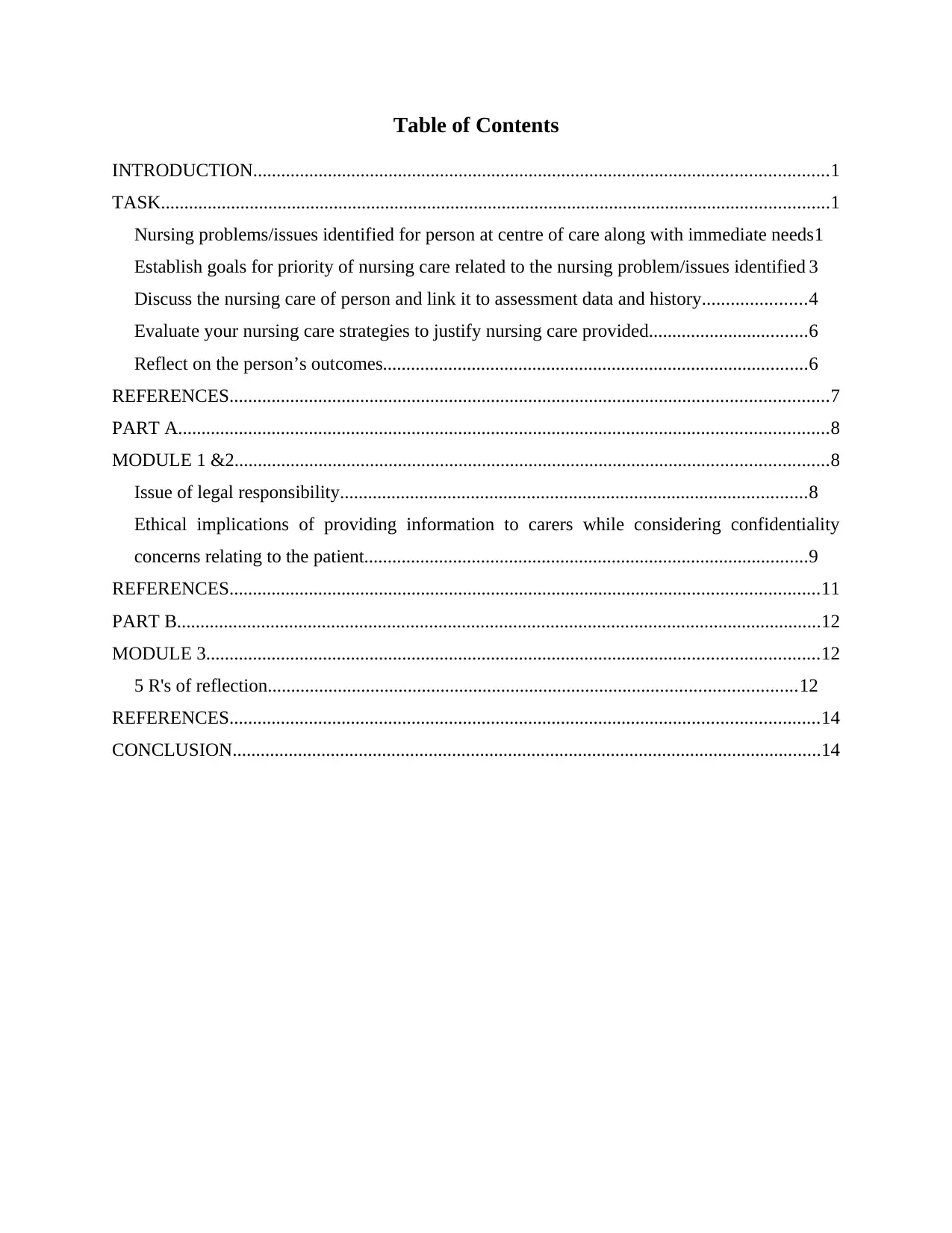
Table of Contents
INTRODUCTION...........................................................................................................................1
TASK...............................................................................................................................................1
Nursing problems/issues identified for person at centre of care along with immediate needs1
Establish goals for priority of nursing care related to the nursing problem/issues identified 3
Discuss the nursing care of person and link it to assessment data and history......................4
Evaluate your nursing care strategies to justify nursing care provided..................................6
Reflect on the person’s outcomes...........................................................................................6
REFERENCES................................................................................................................................7
PART A...........................................................................................................................................8
MODULE 1 &2...............................................................................................................................8
Issue of legal responsibility....................................................................................................8
Ethical implications of providing information to carers while considering confidentiality
concerns relating to the patient...............................................................................................9
REFERENCES..............................................................................................................................11
PART B..........................................................................................................................................12
MODULE 3...................................................................................................................................12
5 R's of reflection.................................................................................................................12
REFERENCES..............................................................................................................................14
CONCLUSION..............................................................................................................................14
INTRODUCTION...........................................................................................................................1
TASK...............................................................................................................................................1
Nursing problems/issues identified for person at centre of care along with immediate needs1
Establish goals for priority of nursing care related to the nursing problem/issues identified 3
Discuss the nursing care of person and link it to assessment data and history......................4
Evaluate your nursing care strategies to justify nursing care provided..................................6
Reflect on the person’s outcomes...........................................................................................6
REFERENCES................................................................................................................................7
PART A...........................................................................................................................................8
MODULE 1 &2...............................................................................................................................8
Issue of legal responsibility....................................................................................................8
Ethical implications of providing information to carers while considering confidentiality
concerns relating to the patient...............................................................................................9
REFERENCES..............................................................................................................................11
PART B..........................................................................................................................................12
MODULE 3...................................................................................................................................12
5 R's of reflection.................................................................................................................12
REFERENCES..............................................................................................................................14
CONCLUSION..............................................................................................................................14

⊘ This is a preview!⊘
Do you want full access?
Subscribe today to unlock all pages.

Trusted by 1+ million students worldwide
INTRODUCTION
Mental health includes several factors of an individual such as emotional, psychological
and social well being because all of these impacts on thinking, feeling & acting. It is necessary
for a person to remain mentally stable as it impacts negatively on life regularly. Moreover, it is
essential for people to have mental stability at every stage of life which includes childhood,
adolescents, adulthood to old age (Clements and Koenig, 2014). This involves certain elements
which may responsible for psychic sickness like biologic components, life experience and family
past times the same. The positive psychological wellness make people realise their full
prospective, coping with tension of living, occupation fruitfully and form purposeful
contributions to their gatherings. A person can hold out their intellectual wellness by acquiring
professional aids, conjunctive with else, stay optimistic, remain physically active, get adequate
nap, development copping ability and many more. The present project will focus on nursing
problems, goals and strategies by considering person situations along with issues or safety &
legal responsibility.
TASK
Nursing problems/issues identified for person at centre of care along with immediate needs
A nurse has a responsibility to thoroughly examine actual medical condition of an
individual in which they have to provide services to make them psychologically normal (Mellor
and Brownell, 2013). In case of Mr. John Gray, he is 28 years old single male who conduct
intentional self- harm is required to be motivated towards life by carrying out an appropriate
counselling along with desired medication for making him mentally and physically comfortable.
There are several issues which are faced by medical professionals while dealing with patient
such as –
Patient's non- responding behaviour : This states that an individual can only improve
their medical health situation when they are willing to cooperate with doctors or nurses
(Cutcliffe, Travale and Green, 2018). It creates problems for medical professionals to conduct
diagnosis when patient will not respond to them properly. In case of Mr. John Gray, he did not
provide response to anyone, grunts and turns over to face the wall away so that it is very difficult
for specialist to make them healthy.
1
Mental health includes several factors of an individual such as emotional, psychological
and social well being because all of these impacts on thinking, feeling & acting. It is necessary
for a person to remain mentally stable as it impacts negatively on life regularly. Moreover, it is
essential for people to have mental stability at every stage of life which includes childhood,
adolescents, adulthood to old age (Clements and Koenig, 2014). This involves certain elements
which may responsible for psychic sickness like biologic components, life experience and family
past times the same. The positive psychological wellness make people realise their full
prospective, coping with tension of living, occupation fruitfully and form purposeful
contributions to their gatherings. A person can hold out their intellectual wellness by acquiring
professional aids, conjunctive with else, stay optimistic, remain physically active, get adequate
nap, development copping ability and many more. The present project will focus on nursing
problems, goals and strategies by considering person situations along with issues or safety &
legal responsibility.
TASK
Nursing problems/issues identified for person at centre of care along with immediate needs
A nurse has a responsibility to thoroughly examine actual medical condition of an
individual in which they have to provide services to make them psychologically normal (Mellor
and Brownell, 2013). In case of Mr. John Gray, he is 28 years old single male who conduct
intentional self- harm is required to be motivated towards life by carrying out an appropriate
counselling along with desired medication for making him mentally and physically comfortable.
There are several issues which are faced by medical professionals while dealing with patient
such as –
Patient's non- responding behaviour : This states that an individual can only improve
their medical health situation when they are willing to cooperate with doctors or nurses
(Cutcliffe, Travale and Green, 2018). It creates problems for medical professionals to conduct
diagnosis when patient will not respond to them properly. In case of Mr. John Gray, he did not
provide response to anyone, grunts and turns over to face the wall away so that it is very difficult
for specialist to make them healthy.
1
Paraphrase This Document
Need a fresh take? Get an instant paraphrase of this document with our AI Paraphraser
Avoid to take meal : The meal is very important for human body as it helps to facilitates
overall metabolism which provide support to person for remaining physically fit. It is necessary
for patient to take proper balanced diet then only several medications will perform
appropriately . According to given case, Mr. John Gray have not waking up for the meal, then
went to lunch unwilling only because he was oblige to but ate nearly null and returned to his bed
instantly subsequently.
Violent activities of person : This can be explained about violent behaviour of patient in
which they conduct intentional self- harm and harm medical professionals as well (Albert, 2018).
Nurse face difficulty to deal with Mr. John Gray because of self-harming nature and non-
responding behaviour to provide proper medication. For example, John has a rope burning grade
on his neck, some bruising and broken skin on his arms & legs.
Immediate requirements of patient Effective counselling : Behaviour of person impacts on mental status of an individual so
that it is essential to make people mentally strong by motivating them properly. In case of
Mr. John Gray, he is admitted due to episode of self harm so that it is necessary to
conduct appropriate counselling to make him morally strong. Cognitive behavioural
therapy can be used for Mr. John Gray to make him emotionally strong and this method
focus on restructuring negative thinking of person into real and positive ideas (Abrams
and et. al., 2012). Appropriate medication : The medication should be provide as per particular mental
situation of an individual. In case of John Gray, several medicines are effective for him
such as Venlafaxine 75 mg bd, Multivitamin in a day for a once and Vitamin B one time
on daily basis.
Make them morally strong : In several cases of self- harm, people try to convert their
emotional pain into the physical one when they get depressed due to unable to face
certain situations. According to given scenario, it is essential to build several skills into
patient such as overcoming with affectionate suffering, boost up capabilities to sort out
problem and societal help so that they reduce feeling lost, despairing, lonely or unfree in
any particular destructive position (DuPee, 2016).
2
overall metabolism which provide support to person for remaining physically fit. It is necessary
for patient to take proper balanced diet then only several medications will perform
appropriately . According to given case, Mr. John Gray have not waking up for the meal, then
went to lunch unwilling only because he was oblige to but ate nearly null and returned to his bed
instantly subsequently.
Violent activities of person : This can be explained about violent behaviour of patient in
which they conduct intentional self- harm and harm medical professionals as well (Albert, 2018).
Nurse face difficulty to deal with Mr. John Gray because of self-harming nature and non-
responding behaviour to provide proper medication. For example, John has a rope burning grade
on his neck, some bruising and broken skin on his arms & legs.
Immediate requirements of patient Effective counselling : Behaviour of person impacts on mental status of an individual so
that it is essential to make people mentally strong by motivating them properly. In case of
Mr. John Gray, he is admitted due to episode of self harm so that it is necessary to
conduct appropriate counselling to make him morally strong. Cognitive behavioural
therapy can be used for Mr. John Gray to make him emotionally strong and this method
focus on restructuring negative thinking of person into real and positive ideas (Abrams
and et. al., 2012). Appropriate medication : The medication should be provide as per particular mental
situation of an individual. In case of John Gray, several medicines are effective for him
such as Venlafaxine 75 mg bd, Multivitamin in a day for a once and Vitamin B one time
on daily basis.
Make them morally strong : In several cases of self- harm, people try to convert their
emotional pain into the physical one when they get depressed due to unable to face
certain situations. According to given scenario, it is essential to build several skills into
patient such as overcoming with affectionate suffering, boost up capabilities to sort out
problem and societal help so that they reduce feeling lost, despairing, lonely or unfree in
any particular destructive position (DuPee, 2016).
2
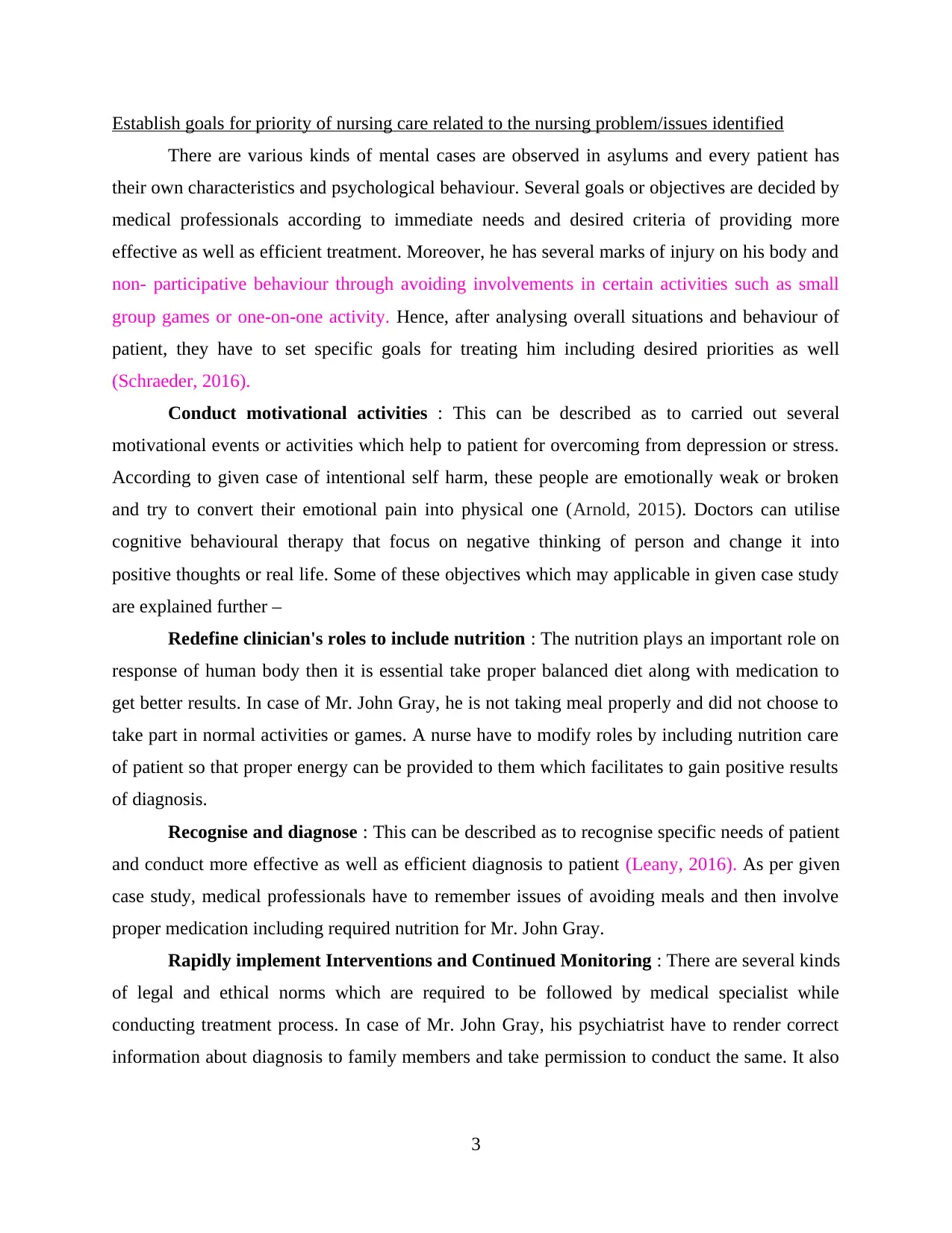
Establish goals for priority of nursing care related to the nursing problem/issues identified
There are various kinds of mental cases are observed in asylums and every patient has
their own characteristics and psychological behaviour. Several goals or objectives are decided by
medical professionals according to immediate needs and desired criteria of providing more
effective as well as efficient treatment. Moreover, he has several marks of injury on his body and
non- participative behaviour through avoiding involvements in certain activities such as small
group games or one-on-one activity. Hence, after analysing overall situations and behaviour of
patient, they have to set specific goals for treating him including desired priorities as well
(Schraeder, 2016).
Conduct motivational activities : This can be described as to carried out several
motivational events or activities which help to patient for overcoming from depression or stress.
According to given case of intentional self harm, these people are emotionally weak or broken
and try to convert their emotional pain into physical one (Arnold, 2015). Doctors can utilise
cognitive behavioural therapy that focus on negative thinking of person and change it into
positive thoughts or real life. Some of these objectives which may applicable in given case study
are explained further –
Redefine clinician's roles to include nutrition : The nutrition plays an important role on
response of human body then it is essential take proper balanced diet along with medication to
get better results. In case of Mr. John Gray, he is not taking meal properly and did not choose to
take part in normal activities or games. A nurse have to modify roles by including nutrition care
of patient so that proper energy can be provided to them which facilitates to gain positive results
of diagnosis.
Recognise and diagnose : This can be described as to recognise specific needs of patient
and conduct more effective as well as efficient diagnosis to patient (Leany, 2016). As per given
case study, medical professionals have to remember issues of avoiding meals and then involve
proper medication including required nutrition for Mr. John Gray.
Rapidly implement Interventions and Continued Monitoring : There are several kinds
of legal and ethical norms which are required to be followed by medical specialist while
conducting treatment process. In case of Mr. John Gray, his psychiatrist have to render correct
information about diagnosis to family members and take permission to conduct the same. It also
3
There are various kinds of mental cases are observed in asylums and every patient has
their own characteristics and psychological behaviour. Several goals or objectives are decided by
medical professionals according to immediate needs and desired criteria of providing more
effective as well as efficient treatment. Moreover, he has several marks of injury on his body and
non- participative behaviour through avoiding involvements in certain activities such as small
group games or one-on-one activity. Hence, after analysing overall situations and behaviour of
patient, they have to set specific goals for treating him including desired priorities as well
(Schraeder, 2016).
Conduct motivational activities : This can be described as to carried out several
motivational events or activities which help to patient for overcoming from depression or stress.
According to given case of intentional self harm, these people are emotionally weak or broken
and try to convert their emotional pain into physical one (Arnold, 2015). Doctors can utilise
cognitive behavioural therapy that focus on negative thinking of person and change it into
positive thoughts or real life. Some of these objectives which may applicable in given case study
are explained further –
Redefine clinician's roles to include nutrition : The nutrition plays an important role on
response of human body then it is essential take proper balanced diet along with medication to
get better results. In case of Mr. John Gray, he is not taking meal properly and did not choose to
take part in normal activities or games. A nurse have to modify roles by including nutrition care
of patient so that proper energy can be provided to them which facilitates to gain positive results
of diagnosis.
Recognise and diagnose : This can be described as to recognise specific needs of patient
and conduct more effective as well as efficient diagnosis to patient (Leany, 2016). As per given
case study, medical professionals have to remember issues of avoiding meals and then involve
proper medication including required nutrition for Mr. John Gray.
Rapidly implement Interventions and Continued Monitoring : There are several kinds
of legal and ethical norms which are required to be followed by medical specialist while
conducting treatment process. In case of Mr. John Gray, his psychiatrist have to render correct
information about diagnosis to family members and take permission to conduct the same. It also
3
⊘ This is a preview!⊘
Do you want full access?
Subscribe today to unlock all pages.
Trusted by 1+ million students worldwide
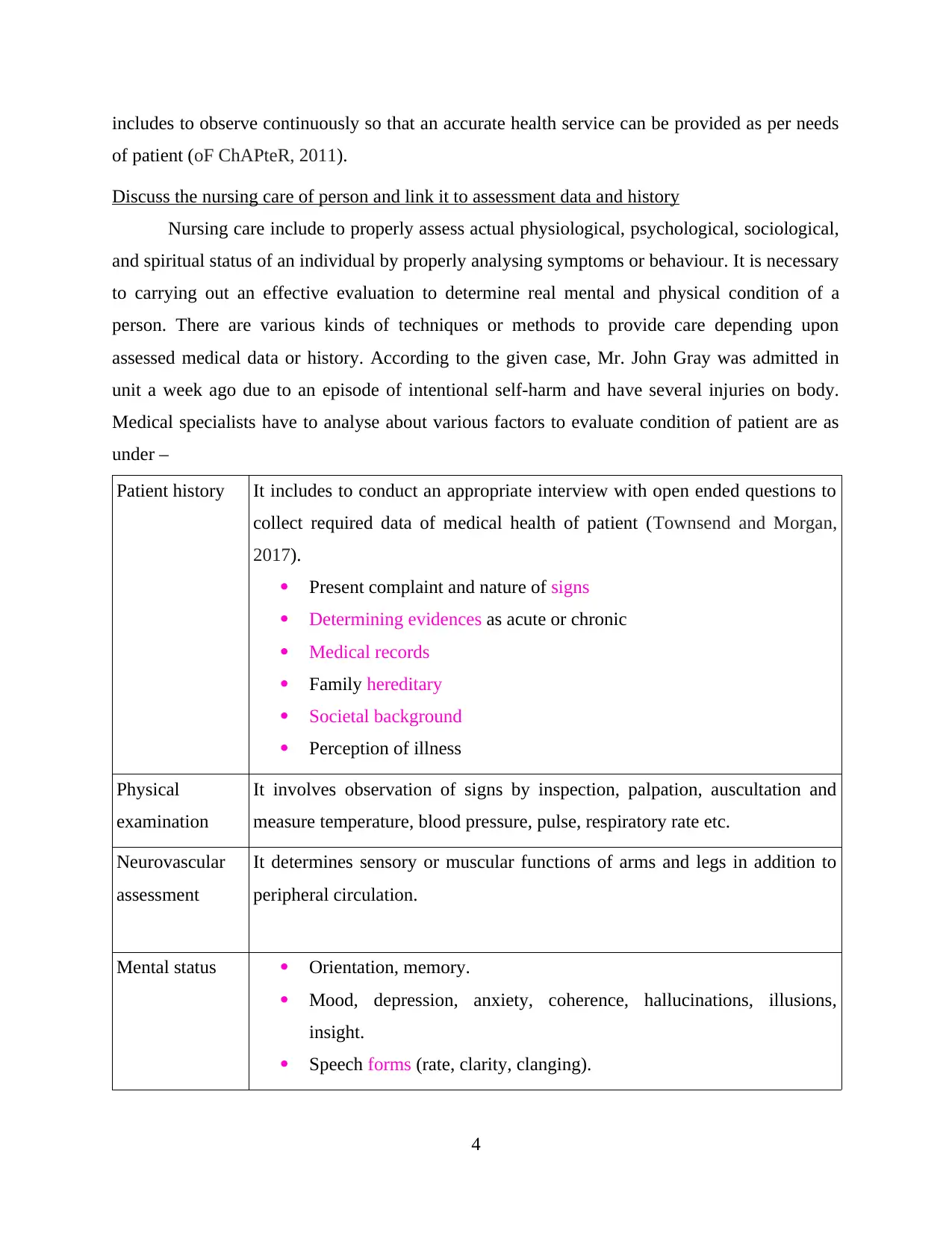
includes to observe continuously so that an accurate health service can be provided as per needs
of patient (oF ChAPteR, 2011).
Discuss the nursing care of person and link it to assessment data and history
Nursing care include to properly assess actual physiological, psychological, sociological,
and spiritual status of an individual by properly analysing symptoms or behaviour. It is necessary
to carrying out an effective evaluation to determine real mental and physical condition of a
person. There are various kinds of techniques or methods to provide care depending upon
assessed medical data or history. According to the given case, Mr. John Gray was admitted in
unit a week ago due to an episode of intentional self-harm and have several injuries on body.
Medical specialists have to analyse about various factors to evaluate condition of patient are as
under –
Patient history It includes to conduct an appropriate interview with open ended questions to
collect required data of medical health of patient (Townsend and Morgan,
2017).
Present complaint and nature of signs
Determining evidences as acute or chronic
Medical records
Family hereditary
Societal background
Perception of illness
Physical
examination
It involves observation of signs by inspection, palpation, auscultation and
measure temperature, blood pressure, pulse, respiratory rate etc.
Neurovascular
assessment
It determines sensory or muscular functions of arms and legs in addition to
peripheral circulation.
Mental status Orientation, memory.
Mood, depression, anxiety, coherence, hallucinations, illusions,
insight.
Speech forms (rate, clarity, clanging).
4
of patient (oF ChAPteR, 2011).
Discuss the nursing care of person and link it to assessment data and history
Nursing care include to properly assess actual physiological, psychological, sociological,
and spiritual status of an individual by properly analysing symptoms or behaviour. It is necessary
to carrying out an effective evaluation to determine real mental and physical condition of a
person. There are various kinds of techniques or methods to provide care depending upon
assessed medical data or history. According to the given case, Mr. John Gray was admitted in
unit a week ago due to an episode of intentional self-harm and have several injuries on body.
Medical specialists have to analyse about various factors to evaluate condition of patient are as
under –
Patient history It includes to conduct an appropriate interview with open ended questions to
collect required data of medical health of patient (Townsend and Morgan,
2017).
Present complaint and nature of signs
Determining evidences as acute or chronic
Medical records
Family hereditary
Societal background
Perception of illness
Physical
examination
It involves observation of signs by inspection, palpation, auscultation and
measure temperature, blood pressure, pulse, respiratory rate etc.
Neurovascular
assessment
It determines sensory or muscular functions of arms and legs in addition to
peripheral circulation.
Mental status Orientation, memory.
Mood, depression, anxiety, coherence, hallucinations, illusions,
insight.
Speech forms (rate, clarity, clanging).
4
Paraphrase This Document
Need a fresh take? Get an instant paraphrase of this document with our AI Paraphraser
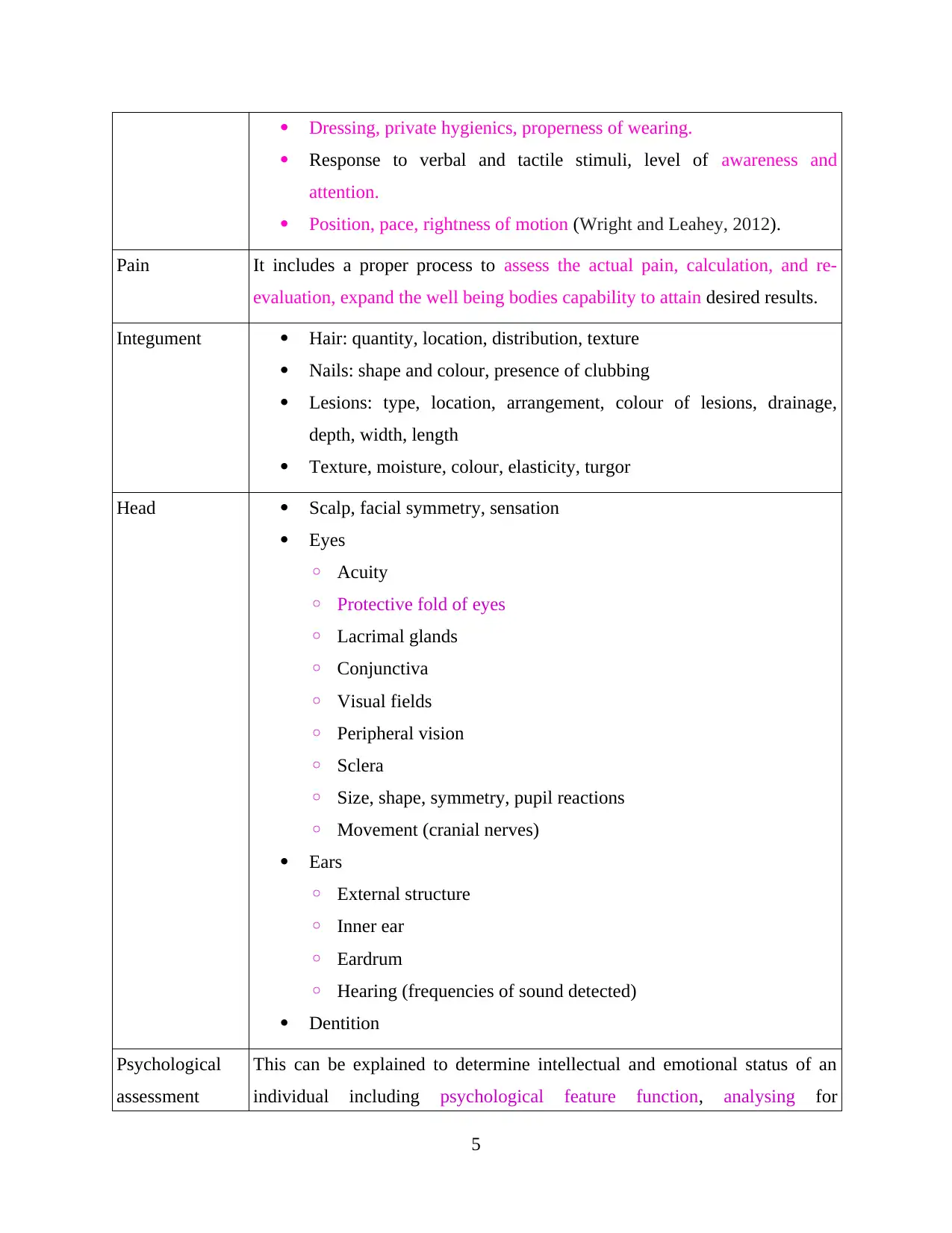
Dressing, private hygienics, properness of wearing.
Response to verbal and tactile stimuli, level of awareness and
attention.
Position, pace, rightness of motion (Wright and Leahey, 2012).
Pain It includes a proper process to assess the actual pain, calculation, and re-
evaluation, expand the well being bodies capability to attain desired results.
Integument Hair: quantity, location, distribution, texture
Nails: shape and colour, presence of clubbing
Lesions: type, location, arrangement, colour of lesions, drainage,
depth, width, length
Texture, moisture, colour, elasticity, turgor
Head Scalp, facial symmetry, sensation
Eyes
◦ Acuity
◦ Protective fold of eyes
◦ Lacrimal glands
◦ Conjunctiva
◦ Visual fields
◦ Peripheral vision
◦ Sclera
◦ Size, shape, symmetry, pupil reactions
◦ Movement (cranial nerves)
Ears
◦ External structure
◦ Inner ear
◦ Eardrum
◦ Hearing (frequencies of sound detected)
Dentition
Psychological
assessment
This can be explained to determine intellectual and emotional status of an
individual including psychological feature function, analysing for
5
Response to verbal and tactile stimuli, level of awareness and
attention.
Position, pace, rightness of motion (Wright and Leahey, 2012).
Pain It includes a proper process to assess the actual pain, calculation, and re-
evaluation, expand the well being bodies capability to attain desired results.
Integument Hair: quantity, location, distribution, texture
Nails: shape and colour, presence of clubbing
Lesions: type, location, arrangement, colour of lesions, drainage,
depth, width, length
Texture, moisture, colour, elasticity, turgor
Head Scalp, facial symmetry, sensation
Eyes
◦ Acuity
◦ Protective fold of eyes
◦ Lacrimal glands
◦ Conjunctiva
◦ Visual fields
◦ Peripheral vision
◦ Sclera
◦ Size, shape, symmetry, pupil reactions
◦ Movement (cranial nerves)
Ears
◦ External structure
◦ Inner ear
◦ Eardrum
◦ Hearing (frequencies of sound detected)
Dentition
Psychological
assessment
This can be explained to determine intellectual and emotional status of an
individual including psychological feature function, analysing for
5
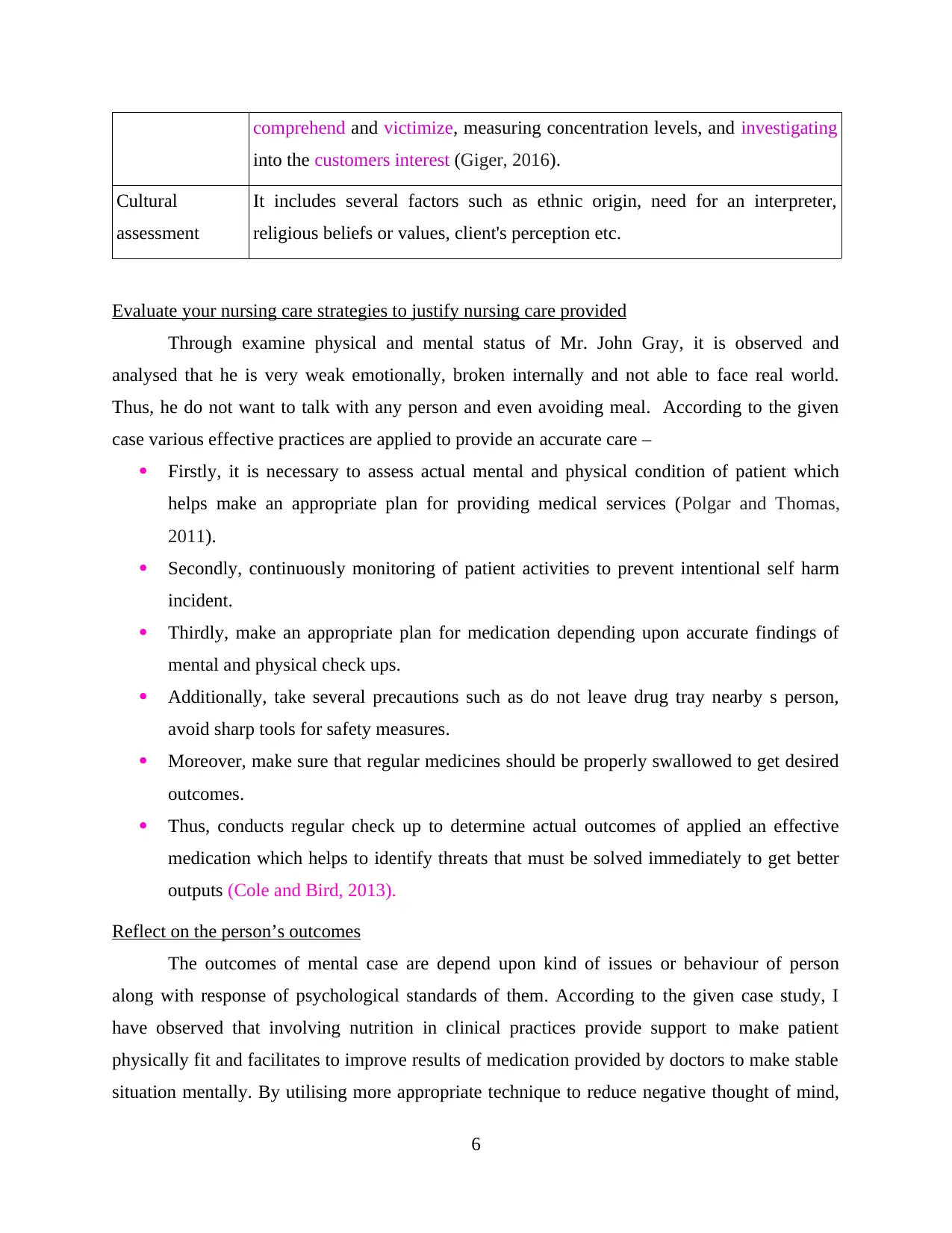
comprehend and victimize, measuring concentration levels, and investigating
into the customers interest (Giger, 2016).
Cultural
assessment
It includes several factors such as ethnic origin, need for an interpreter,
religious beliefs or values, client's perception etc.
Evaluate your nursing care strategies to justify nursing care provided
Through examine physical and mental status of Mr. John Gray, it is observed and
analysed that he is very weak emotionally, broken internally and not able to face real world.
Thus, he do not want to talk with any person and even avoiding meal. According to the given
case various effective practices are applied to provide an accurate care –
Firstly, it is necessary to assess actual mental and physical condition of patient which
helps make an appropriate plan for providing medical services (Polgar and Thomas,
2011).
Secondly, continuously monitoring of patient activities to prevent intentional self harm
incident.
Thirdly, make an appropriate plan for medication depending upon accurate findings of
mental and physical check ups.
Additionally, take several precautions such as do not leave drug tray nearby s person,
avoid sharp tools for safety measures.
Moreover, make sure that regular medicines should be properly swallowed to get desired
outcomes.
Thus, conducts regular check up to determine actual outcomes of applied an effective
medication which helps to identify threats that must be solved immediately to get better
outputs (Cole and Bird, 2013).
Reflect on the person’s outcomes
The outcomes of mental case are depend upon kind of issues or behaviour of person
along with response of psychological standards of them. According to the given case study, I
have observed that involving nutrition in clinical practices provide support to make patient
physically fit and facilitates to improve results of medication provided by doctors to make stable
situation mentally. By utilising more appropriate technique to reduce negative thought of mind,
6
into the customers interest (Giger, 2016).
Cultural
assessment
It includes several factors such as ethnic origin, need for an interpreter,
religious beliefs or values, client's perception etc.
Evaluate your nursing care strategies to justify nursing care provided
Through examine physical and mental status of Mr. John Gray, it is observed and
analysed that he is very weak emotionally, broken internally and not able to face real world.
Thus, he do not want to talk with any person and even avoiding meal. According to the given
case various effective practices are applied to provide an accurate care –
Firstly, it is necessary to assess actual mental and physical condition of patient which
helps make an appropriate plan for providing medical services (Polgar and Thomas,
2011).
Secondly, continuously monitoring of patient activities to prevent intentional self harm
incident.
Thirdly, make an appropriate plan for medication depending upon accurate findings of
mental and physical check ups.
Additionally, take several precautions such as do not leave drug tray nearby s person,
avoid sharp tools for safety measures.
Moreover, make sure that regular medicines should be properly swallowed to get desired
outcomes.
Thus, conducts regular check up to determine actual outcomes of applied an effective
medication which helps to identify threats that must be solved immediately to get better
outputs (Cole and Bird, 2013).
Reflect on the person’s outcomes
The outcomes of mental case are depend upon kind of issues or behaviour of person
along with response of psychological standards of them. According to the given case study, I
have observed that involving nutrition in clinical practices provide support to make patient
physically fit and facilitates to improve results of medication provided by doctors to make stable
situation mentally. By utilising more appropriate technique to reduce negative thought of mind,
6
⊘ This is a preview!⊘
Do you want full access?
Subscribe today to unlock all pages.
Trusted by 1+ million students worldwide
ideas of patient will become positive and decrease chances of intentional self harm. Along with
all this, body injuries or wounds are also get dissolved (Thibaut, 2017). Moreover, Mr. John
Gray achieved physical fitness in proper manner and improved mental condition as well.
This patient face severe situation of mental health problem because of emotionally and
morally broken which is mandatory to be overcome for attaining normal medical situation of an
individual. It is evaluated by me that use of cognitive behavioural therapy render help to convert
negative thinking into positive thoughts which facilitates to build them morally strong which
supports to face real life issues.
REFERENCES
Clements, W.M. and Koenig, H.G., 2014. Aging and God: Spiritual pathways to mental health
in midlife and later years. Routledge.
Cutcliffe, J.R., Travale, R. and Green, T., 2018. Psychiatric/Mental Health Nurses Care of the
Client Who Presents with Both Mental Health and Substance Misuse Problems.
In European Psychiatric/Mental Health Nursing in the 21st Century (pp. 533-548).
Springer, Cham.
Albert, N.M., 2018. Operationalizing a Nursing Innovation Center Within a Health Care
System. Nursing administration quarterly, 42(1), pp.43-53.
DuPee, C.E., 2016. Evidence-based practice in a community hospital setting: A baseline
assessment (Doctoral dissertation, Western University of Health Sciences).
Arnold, E.C., 2015. Developing Therapeutic Relationships. Interpersonal Relationships-E-Book:
Professional Communication Skills for Nurses, p.180.
oF ChAPteR, F., 2011. Planning the evaluation Process. Evaluation of Peer and Prevention
Programs: A Blueprint for Successful Design and Implementation, p.101.
Townsend, M.C. and Morgan, K.I., 2017. Psychiatric mental health nursing: Concepts of care in
evidence-based practice. FA Davis.
Wright, L.M. and Leahey, M., 2012. Nurses and families: A guide to family assessment and
intervention. FA Davis.
Giger, J.N., 2016. Transcultural Nursing-E-Book: Assessment and Intervention. Elsevier Health
Sciences.
Polgar, S. and Thomas, S.A., 2011. Introduction to Research in the Health Sciences E-Book.
Elsevier Health Sciences.
Thibaut, J. W., 2017. The social psychology of groups. Routledge.
Mellor, J. and Brownell, P., 2013. Ethical and Psychosocial Issues Raised by the Practice in
Cases of Mistreatment of Older Adults. In Elder Abuse and Mistreatment (pp. 183-270).
Routledge.
Abrams, A. and et. al., 2012. Alcoholism: a guide for the primary care physician. Springer
Science & Business Media.
Schraeder, T., 2016. A guide to school services in speech-language pathology. Plural Publishing.
Leany, B. D., 2016. Seriously Mentally Ill and Integrated Care Among Hispanic Populations.
In Enhancing Behavioral Health in Latino Populations (pp. 297-309). Springer, Cham.
7
all this, body injuries or wounds are also get dissolved (Thibaut, 2017). Moreover, Mr. John
Gray achieved physical fitness in proper manner and improved mental condition as well.
This patient face severe situation of mental health problem because of emotionally and
morally broken which is mandatory to be overcome for attaining normal medical situation of an
individual. It is evaluated by me that use of cognitive behavioural therapy render help to convert
negative thinking into positive thoughts which facilitates to build them morally strong which
supports to face real life issues.
REFERENCES
Clements, W.M. and Koenig, H.G., 2014. Aging and God: Spiritual pathways to mental health
in midlife and later years. Routledge.
Cutcliffe, J.R., Travale, R. and Green, T., 2018. Psychiatric/Mental Health Nurses Care of the
Client Who Presents with Both Mental Health and Substance Misuse Problems.
In European Psychiatric/Mental Health Nursing in the 21st Century (pp. 533-548).
Springer, Cham.
Albert, N.M., 2018. Operationalizing a Nursing Innovation Center Within a Health Care
System. Nursing administration quarterly, 42(1), pp.43-53.
DuPee, C.E., 2016. Evidence-based practice in a community hospital setting: A baseline
assessment (Doctoral dissertation, Western University of Health Sciences).
Arnold, E.C., 2015. Developing Therapeutic Relationships. Interpersonal Relationships-E-Book:
Professional Communication Skills for Nurses, p.180.
oF ChAPteR, F., 2011. Planning the evaluation Process. Evaluation of Peer and Prevention
Programs: A Blueprint for Successful Design and Implementation, p.101.
Townsend, M.C. and Morgan, K.I., 2017. Psychiatric mental health nursing: Concepts of care in
evidence-based practice. FA Davis.
Wright, L.M. and Leahey, M., 2012. Nurses and families: A guide to family assessment and
intervention. FA Davis.
Giger, J.N., 2016. Transcultural Nursing-E-Book: Assessment and Intervention. Elsevier Health
Sciences.
Polgar, S. and Thomas, S.A., 2011. Introduction to Research in the Health Sciences E-Book.
Elsevier Health Sciences.
Thibaut, J. W., 2017. The social psychology of groups. Routledge.
Mellor, J. and Brownell, P., 2013. Ethical and Psychosocial Issues Raised by the Practice in
Cases of Mistreatment of Older Adults. In Elder Abuse and Mistreatment (pp. 183-270).
Routledge.
Abrams, A. and et. al., 2012. Alcoholism: a guide for the primary care physician. Springer
Science & Business Media.
Schraeder, T., 2016. A guide to school services in speech-language pathology. Plural Publishing.
Leany, B. D., 2016. Seriously Mentally Ill and Integrated Care Among Hispanic Populations.
In Enhancing Behavioral Health in Latino Populations (pp. 297-309). Springer, Cham.
7
Paraphrase This Document
Need a fresh take? Get an instant paraphrase of this document with our AI Paraphraser
Cole, S. A. and Bird, J., 2013. The Medical Interview E-Book: The Three Function Approach.
Elsevier Health Sciences.
PART A
MODULE 1 &2
Issue of legal responsibility
There are various kinds of issues which are relevant to legal responsibility that should be
focused by medical professionals while dealing with patients. In medical sector, different types
of cases are observed and analysed because all of them has own symptoms and unique response
of immune system. Thus, overall factors relevant to body and signs of health issues are required
to be evaluates in an accurate way to conduct desired diagnosing method to sort out particular
mental problems (Wexler, 2013). It is necessary for medical professionals to properly understand
needs of a person and actual mental status to provide an appropriate treatment to solve mental
health problems properly. An accurate plan should be made by nurse to deal with such individual
and carrying out correct diagnosing practices to make them health as well as comfortable.
Moreover, there are various kinds of legislations which are mandatory to be considered in health
organisations while providing medical facilities to people to gain desired outcomes in terms to
make them health and comfortable to spend lives properly. Apart from this, several safety
measures are also necessary to be implemented for remaining patient secure in a every means
(Fortinash and Worret, 2014). According to the given case, several issues can be evolve related
to safety or legal responsibility and these are explained further –
An appropriate documentation is required like MRI/CT scan reports of patient including
preoperative assessment, care provided by the surgical team, the outcomes and evaluation
plan because lack of the same may creates critical problems for patient (Bromley and
Bromley, 2014).
Carrying out medication procedure without taking approval of family members of mental
patient through making document to take signatures of them may leads to legal case on
health organisations including all medical professionals associated with the same.
Ignoring safety measures may creates crucial situation of mental patient and may leads to
death of the same (Roy, 2011).
Tools and techniques should be carefully used because they may generate critical
problems for psychological patient as brain related treatments are critical.
8
Elsevier Health Sciences.
PART A
MODULE 1 &2
Issue of legal responsibility
There are various kinds of issues which are relevant to legal responsibility that should be
focused by medical professionals while dealing with patients. In medical sector, different types
of cases are observed and analysed because all of them has own symptoms and unique response
of immune system. Thus, overall factors relevant to body and signs of health issues are required
to be evaluates in an accurate way to conduct desired diagnosing method to sort out particular
mental problems (Wexler, 2013). It is necessary for medical professionals to properly understand
needs of a person and actual mental status to provide an appropriate treatment to solve mental
health problems properly. An accurate plan should be made by nurse to deal with such individual
and carrying out correct diagnosing practices to make them health as well as comfortable.
Moreover, there are various kinds of legislations which are mandatory to be considered in health
organisations while providing medical facilities to people to gain desired outcomes in terms to
make them health and comfortable to spend lives properly. Apart from this, several safety
measures are also necessary to be implemented for remaining patient secure in a every means
(Fortinash and Worret, 2014). According to the given case, several issues can be evolve related
to safety or legal responsibility and these are explained further –
An appropriate documentation is required like MRI/CT scan reports of patient including
preoperative assessment, care provided by the surgical team, the outcomes and evaluation
plan because lack of the same may creates critical problems for patient (Bromley and
Bromley, 2014).
Carrying out medication procedure without taking approval of family members of mental
patient through making document to take signatures of them may leads to legal case on
health organisations including all medical professionals associated with the same.
Ignoring safety measures may creates crucial situation of mental patient and may leads to
death of the same (Roy, 2011).
Tools and techniques should be carefully used because they may generate critical
problems for psychological patient as brain related treatments are critical.
8
Legal authorities may take strict action towards mental asylums if standards of health
care will not followed by specialists (Gostin and Wiley, 2016).
There are several factors which should be considered by medical professionals to avoid various
legal or safety issues on health care organisation that are given below :
Legal obligations
Recognising possible behavioural impacts
How to talk about mental health in the workplace
Reasonable adjustments
Privacy and confidentiality
Terminology
Issue of emotional safety – The psychological and emotional factors plays an important
role in mental patients because they mostly consider these two aspects. It include several
components such as confused thinking, prolonger depression, excessive fears, social withdrawal,
dramatic changes in eating or sleeping habits and many more. Moreover, Patients also get
effected by these factors and care providers are required to be remaining emotionally strong so
that they become capable to secure emotional aspects of an individual. There are several relevant
disorders may takes place such as clinical depression, schizophrenia and bipolar disorder which
can be reduced by providing emotional safety to mentally sick people.
Strategies to ensure emotional safety – The nurse is required to apply protective
mechanism to ensure safety of patient along with providing better quality of treatment to mental
patients in order to make them healthy. Moreover, medical professionals associated with
particular psychological case must take steps in several critical situations of emotional
dissonance to avoid their negative impacts on health patient.
Ethical implications of providing information to carers while considering confidentiality
concerns relating to the patient
The ethical norms includes such values of beliefs which help to an individual for making
decision for real life to determine right and wrong things. It is necessary to follow overall
essential ethical norms while carrying out required activities of procedures. Similarly, there are
different types of ethical rules which are necessary to be followed by medical professionals while
9
care will not followed by specialists (Gostin and Wiley, 2016).
There are several factors which should be considered by medical professionals to avoid various
legal or safety issues on health care organisation that are given below :
Legal obligations
Recognising possible behavioural impacts
How to talk about mental health in the workplace
Reasonable adjustments
Privacy and confidentiality
Terminology
Issue of emotional safety – The psychological and emotional factors plays an important
role in mental patients because they mostly consider these two aspects. It include several
components such as confused thinking, prolonger depression, excessive fears, social withdrawal,
dramatic changes in eating or sleeping habits and many more. Moreover, Patients also get
effected by these factors and care providers are required to be remaining emotionally strong so
that they become capable to secure emotional aspects of an individual. There are several relevant
disorders may takes place such as clinical depression, schizophrenia and bipolar disorder which
can be reduced by providing emotional safety to mentally sick people.
Strategies to ensure emotional safety – The nurse is required to apply protective
mechanism to ensure safety of patient along with providing better quality of treatment to mental
patients in order to make them healthy. Moreover, medical professionals associated with
particular psychological case must take steps in several critical situations of emotional
dissonance to avoid their negative impacts on health patient.
Ethical implications of providing information to carers while considering confidentiality
concerns relating to the patient
The ethical norms includes such values of beliefs which help to an individual for making
decision for real life to determine right and wrong things. It is necessary to follow overall
essential ethical norms while carrying out required activities of procedures. Similarly, there are
different types of ethical rules which are necessary to be followed by medical professionals while
9
⊘ This is a preview!⊘
Do you want full access?
Subscribe today to unlock all pages.
Trusted by 1+ million students worldwide

1 out of 17


Related Documents


Your All-in-One AI-Powered Toolkit for Academic Success.
+13062052269
info@desklib.com
Available 24*7 on WhatsApp / Email
![[object Object]](/_next/static/media/star-bottom.7253800d.svg)
Unlock your academic potential
Copyright © 2020–2025 A2Z Services. All Rights Reserved. Developed and managed by ZUCOL.