Menu Development, Planning, and Design Report for The Monk Restaurant
VerifiedAdded on 2022/12/26
|10
|2860
|91
Report
AI Summary
This report provides a comprehensive analysis of menu development, planning, and design for The Monk restaurant. It begins with an introduction to menu development, emphasizing its significance in the hospitality industry and its impact on consumer preferences and business requirements. The main body of the report is structured around three key tasks. Task 1 delves into the principles of menu planning and design, considering aspects such as the arrangement of food items, the selection of items based on consumer and business needs, and menu planning constraints, including resource availability and various menu types like À la carte, Table d'hôte, and special menus. Furthermore, it explores the determination of consumer and business requirements to maximize profitability, including consumer preferences for healthy options and the importance of meeting business requirements such as offering desired facilities and producing quality and consistency. Task 3 focuses on formulating a realistic plan for menu development, incorporating legal requirements, menu balance and creativity, and menu development according to occasions and functions. A sample menu is formulated to meet consumer and business requirements. The report concludes with a discussion of menu evaluation methods, including key performance indicators, benchmarks, and feedback systems. The report underscores the importance of aligning menu design with consumer preferences and business objectives to drive success in the competitive restaurant industry.
Menu Development and
Planning and Design
Planning and Design

Paraphrase This Document
Need a fresh take? Get an instant paraphrase of this document with our AI Paraphraser
Contents
INTRODUCTION...........................................................................................................................3
MAIN BODY...................................................................................................................................3
TASK 1............................................................................................................................................3
Principles of menu planning and design with some business requirements for a range of
different menu........................................................................................................................3
Determine the consumer and business requirements to maximize the profit for range of
different menus.......................................................................................................................5
TASK 2............................................................................................................................................6
Covered in PPT.......................................................................................................................6
TASK 3............................................................................................................................................6
Formulate a realistic plan to develop menu............................................................................6
Formulate a menu to meet consumer and business requirements..........................................6
Test and evaluate the menu produced....................................................................................8
CONCLUSION................................................................................................................................9
REFERENCES..............................................................................................................................10
INTRODUCTION...........................................................................................................................3
MAIN BODY...................................................................................................................................3
TASK 1............................................................................................................................................3
Principles of menu planning and design with some business requirements for a range of
different menu........................................................................................................................3
Determine the consumer and business requirements to maximize the profit for range of
different menus.......................................................................................................................5
TASK 2............................................................................................................................................6
Covered in PPT.......................................................................................................................6
TASK 3............................................................................................................................................6
Formulate a realistic plan to develop menu............................................................................6
Formulate a menu to meet consumer and business requirements..........................................6
Test and evaluate the menu produced....................................................................................8
CONCLUSION................................................................................................................................9
REFERENCES..............................................................................................................................10
INTRODUCTION
Menu refers to a list that includes all food item that are being offered by a restaurants so that
it will become easy for them to choose food. The menu development refers to assortment of
dishes and that is carried out as per consumer preferences and business requirements. In
hospitality industry, menu plays an essential role as it help business unit to influence and grasp
more consumers by making creative and attractive menu. Here, the management of café always
made customized menu and that comprises cuisines, food, beverages along with rates (Sawicki
and et.al., 2019). The present report is based on The Monk restaurants which is located between
busy high street of railway station and office. This is a small, family owned restaurants and
services good food, drinks, classic beer with some cracking wines await. To increase more
consumers and profitability they wants to development new and creative menu. For this, the
present report cover discussion about principles of menu planning and design with determination
of consumers and business requirements for improving profitability. Moreover, a complete menu
plan has been formulated with the aim of profit increment and consumer base.
MAIN BODY
TASK 1
Principles of menu planning and design with some business requirements for a range of different
menu.
Menu planning can be defined as a process in that decision related with the food and
beverages are taken and it is done by the higher executives or authority of restaurants. It helps
guest in providing detailed information about food items, beverages, drinks etc. along with their
rates that are being offered by respective restaurants (Funk, Sütterlin and Siegrist, 2020). While
preparing any menu it is important to take acre about some principles and with respect to The
Monk, some are as follow:
It has been found that sequence and arrangements of food item in menu is the primary
concern of any menu planning. As it elaborates the maintenance of sequence in hospitality
industry related with the food item that are being offered by restaurants. It makes more attractive
and creative and that influence consumers to go with that particular item.
Menu refers to a list that includes all food item that are being offered by a restaurants so that
it will become easy for them to choose food. The menu development refers to assortment of
dishes and that is carried out as per consumer preferences and business requirements. In
hospitality industry, menu plays an essential role as it help business unit to influence and grasp
more consumers by making creative and attractive menu. Here, the management of café always
made customized menu and that comprises cuisines, food, beverages along with rates (Sawicki
and et.al., 2019). The present report is based on The Monk restaurants which is located between
busy high street of railway station and office. This is a small, family owned restaurants and
services good food, drinks, classic beer with some cracking wines await. To increase more
consumers and profitability they wants to development new and creative menu. For this, the
present report cover discussion about principles of menu planning and design with determination
of consumers and business requirements for improving profitability. Moreover, a complete menu
plan has been formulated with the aim of profit increment and consumer base.
MAIN BODY
TASK 1
Principles of menu planning and design with some business requirements for a range of different
menu.
Menu planning can be defined as a process in that decision related with the food and
beverages are taken and it is done by the higher executives or authority of restaurants. It helps
guest in providing detailed information about food items, beverages, drinks etc. along with their
rates that are being offered by respective restaurants (Funk, Sütterlin and Siegrist, 2020). While
preparing any menu it is important to take acre about some principles and with respect to The
Monk, some are as follow:
It has been found that sequence and arrangements of food item in menu is the primary
concern of any menu planning. As it elaborates the maintenance of sequence in hospitality
industry related with the food item that are being offered by restaurants. It makes more attractive
and creative and that influence consumers to go with that particular item.
⊘ This is a preview!⊘
Do you want full access?
Subscribe today to unlock all pages.

Trusted by 1+ million students worldwide
Another principles that need to take into consideration while planning any menu is section
of items and it is according to the requirements of consumers along with business. In this the
price of all item is also mentioned so that it will help consumers to make decision.
Some other substantial components that take in mind while preparing menu are a balance
between gender, race, medical requirements, lifestyle choices and so many more as all these
leaves adverse impact on consumer to avail a specific services (Kim and Nicolau, 2021). In
relevance to this, Management team of The Monk have to devise menu by considering this
principle as it will help them to accomplish its desired goal effectively.
Dishes are segregated in effective and appropriate manner to make menu more
synchronised way and also that easy for consumer to selected item easily. This make menu
attractive and creative with some isolation in context of providing suitable offering.
Menu planning constraints: There are number of restraints that occur while planning any
menu and similarly with The Monk restaurants, their managers also address some constraints
while developing new menu like, availability of resources, chef, ingredients, equipments, along
with different types of markets.
Different types of menu:
À la carte: Such type of menu are design in which price of al food team are placed in
effective manner with all significant categories. It provides flexibility to guest for choosing
appropriate item. Also it provides clarity in breakfast, lunch and dinner item so that consumers
will able to easily select.
Table d'hôte: This is related with “the host table” and define those meals which are being
offered by restaurants as it collects all things at a single table for enjoying some course. With due
reference to selected café, they have to plan accordingly so that consumer will able to gain
satisfaction and good experience.
Special menu: This is prepared for limited and special times with the nominal rates. In
which it includes special hours like happy hours, seasonal menu, dinner special etc.
All these menu are being offered by the respective restaurants in order to make consumer
happy
of items and it is according to the requirements of consumers along with business. In this the
price of all item is also mentioned so that it will help consumers to make decision.
Some other substantial components that take in mind while preparing menu are a balance
between gender, race, medical requirements, lifestyle choices and so many more as all these
leaves adverse impact on consumer to avail a specific services (Kim and Nicolau, 2021). In
relevance to this, Management team of The Monk have to devise menu by considering this
principle as it will help them to accomplish its desired goal effectively.
Dishes are segregated in effective and appropriate manner to make menu more
synchronised way and also that easy for consumer to selected item easily. This make menu
attractive and creative with some isolation in context of providing suitable offering.
Menu planning constraints: There are number of restraints that occur while planning any
menu and similarly with The Monk restaurants, their managers also address some constraints
while developing new menu like, availability of resources, chef, ingredients, equipments, along
with different types of markets.
Different types of menu:
À la carte: Such type of menu are design in which price of al food team are placed in
effective manner with all significant categories. It provides flexibility to guest for choosing
appropriate item. Also it provides clarity in breakfast, lunch and dinner item so that consumers
will able to easily select.
Table d'hôte: This is related with “the host table” and define those meals which are being
offered by restaurants as it collects all things at a single table for enjoying some course. With due
reference to selected café, they have to plan accordingly so that consumer will able to gain
satisfaction and good experience.
Special menu: This is prepared for limited and special times with the nominal rates. In
which it includes special hours like happy hours, seasonal menu, dinner special etc.
All these menu are being offered by the respective restaurants in order to make consumer
happy
Paraphrase This Document
Need a fresh take? Get an instant paraphrase of this document with our AI Paraphraser
Determine the consumer and business requirements to maximize the profit for range of different
menus.
To operate business, consumers are very essential as they are the source of income. In food
and beverages, industry companies’ plays vital role as business is mainly affected by the
changing trends and preferences of consumers. For example some prefer vegetarian food only
whereas other prefer both and that all depend on their lifestyles, taste and likes. Some recent
trends that affects business of respective restaurants are as follow:
Consumer requirements:
In recent time consumers are more conscious towards health. Therefore, they mainly prefer
only healthy and nutrient food. So the most of the people think to make food at home is more
delicious and healthy rather than any restaurants and that affects the business of food and
beverages industry (PUSIRAN and et. al., 2021).
Another those who are conscious towards fitness, those individuals prefer low calories food
and that is purchase by local vendor. This ultimately affects the business and down the sales.
While developing any menu, it is vital for management team to determine suitable market
and target market in order to reach potential consumers and to make strategies accordingly.
Business requirements:
Offer desired facilities: While formulating and menu, The Monk ensure have to make sure
that they provides required facilities to employees so that they will able to get motivates and
perform well in restaurants.
Produced quality and consistency: This is considered as significant requirements of any
business in order to make guest happy in hospitality industry. To main quality become crucial for
retaining consumer base. Also for maintaining coordination among all departments it is vital to
carry out effective communication and clearly defines all roles and responsibility. There are
some perquisites to maintain consistency like daily checking, recipes, flexibly in shift etc.
Meeting current laws: Respective company need to work under all legislation and rule that
are imposed by government. For instance food safety act & Hygiene, 2013: This law are
proposed with the safety and security of guest along with business (Abdelmassih and Arendt,
2020). This is because according to this law restaurants or hotel need to make sure that they will
definitely maintain the quality of foods with hygiene.
menus.
To operate business, consumers are very essential as they are the source of income. In food
and beverages, industry companies’ plays vital role as business is mainly affected by the
changing trends and preferences of consumers. For example some prefer vegetarian food only
whereas other prefer both and that all depend on their lifestyles, taste and likes. Some recent
trends that affects business of respective restaurants are as follow:
Consumer requirements:
In recent time consumers are more conscious towards health. Therefore, they mainly prefer
only healthy and nutrient food. So the most of the people think to make food at home is more
delicious and healthy rather than any restaurants and that affects the business of food and
beverages industry (PUSIRAN and et. al., 2021).
Another those who are conscious towards fitness, those individuals prefer low calories food
and that is purchase by local vendor. This ultimately affects the business and down the sales.
While developing any menu, it is vital for management team to determine suitable market
and target market in order to reach potential consumers and to make strategies accordingly.
Business requirements:
Offer desired facilities: While formulating and menu, The Monk ensure have to make sure
that they provides required facilities to employees so that they will able to get motivates and
perform well in restaurants.
Produced quality and consistency: This is considered as significant requirements of any
business in order to make guest happy in hospitality industry. To main quality become crucial for
retaining consumer base. Also for maintaining coordination among all departments it is vital to
carry out effective communication and clearly defines all roles and responsibility. There are
some perquisites to maintain consistency like daily checking, recipes, flexibly in shift etc.
Meeting current laws: Respective company need to work under all legislation and rule that
are imposed by government. For instance food safety act & Hygiene, 2013: This law are
proposed with the safety and security of guest along with business (Abdelmassih and Arendt,
2020). This is because according to this law restaurants or hotel need to make sure that they will
definitely maintain the quality of foods with hygiene.
Therefore, from above stated requirements of business and consumers it can be said that
both are important in order to maximize the profitability.
TASK 2
Covered in PPT
TASK 3
Formulate a realistic plan to develop menu.
To develop new menu, The Monk needs to have awareness about some factor also considered
that in order to produces effective and creative so that restaurants will able to meet the desired
goal successfully. Some elements are as follow:
Legal requirements: To run food and beverages industry smoothly, some of the
legislation or compliances are imposed and all these are necessary to obey by all restaurants and
hotel for operating function effectively. In context of The Monk, its manger need to considered
all legal laws and requirements such as food and safety laws, FDI etc. So that they will run their
restaurants efficiently.
Menu balance and creativity: To influence more and retain existing consumers,
creativity and attractiveness in menus plays critical role. Therefore, manager of restaurants need
to add some pictures and tagline related with the food in menu so that guest will easily influences
and make decision (Rapoport and Hult, 2017). In this regards, The Monk have to balance its
menu in creative and effective manner by mentioning all beverages, drinks, and meals at
affordable price. Also they have to use attractive practices like fun activities and games so that
guest will able to make memories. From this the overall profitability will maximizes.
Menu development according to occasion and function: As per the changes of
preferences and trends, restaurants and café also need to modify their menu accordingly. It will
help them to meet all desired objectives and able to improve consumer base. Respective
restaurant can offer different menu on occasion, days, festivals etc. to grasp more consumers.
Formulate a menu to meet consumer and business requirements
Menu includes all dishes, meal, beverages, drinks and so many other foods and drinks item
that are being offered by restaurants/ café. This is for meeting the consumers’ needs and
both are important in order to maximize the profitability.
TASK 2
Covered in PPT
TASK 3
Formulate a realistic plan to develop menu.
To develop new menu, The Monk needs to have awareness about some factor also considered
that in order to produces effective and creative so that restaurants will able to meet the desired
goal successfully. Some elements are as follow:
Legal requirements: To run food and beverages industry smoothly, some of the
legislation or compliances are imposed and all these are necessary to obey by all restaurants and
hotel for operating function effectively. In context of The Monk, its manger need to considered
all legal laws and requirements such as food and safety laws, FDI etc. So that they will run their
restaurants efficiently.
Menu balance and creativity: To influence more and retain existing consumers,
creativity and attractiveness in menus plays critical role. Therefore, manager of restaurants need
to add some pictures and tagline related with the food in menu so that guest will easily influences
and make decision (Rapoport and Hult, 2017). In this regards, The Monk have to balance its
menu in creative and effective manner by mentioning all beverages, drinks, and meals at
affordable price. Also they have to use attractive practices like fun activities and games so that
guest will able to make memories. From this the overall profitability will maximizes.
Menu development according to occasion and function: As per the changes of
preferences and trends, restaurants and café also need to modify their menu accordingly. It will
help them to meet all desired objectives and able to improve consumer base. Respective
restaurant can offer different menu on occasion, days, festivals etc. to grasp more consumers.
Formulate a menu to meet consumer and business requirements
Menu includes all dishes, meal, beverages, drinks and so many other foods and drinks item
that are being offered by restaurants/ café. This is for meeting the consumers’ needs and
⊘ This is a preview!⊘
Do you want full access?
Subscribe today to unlock all pages.
Trusted by 1+ million students worldwide
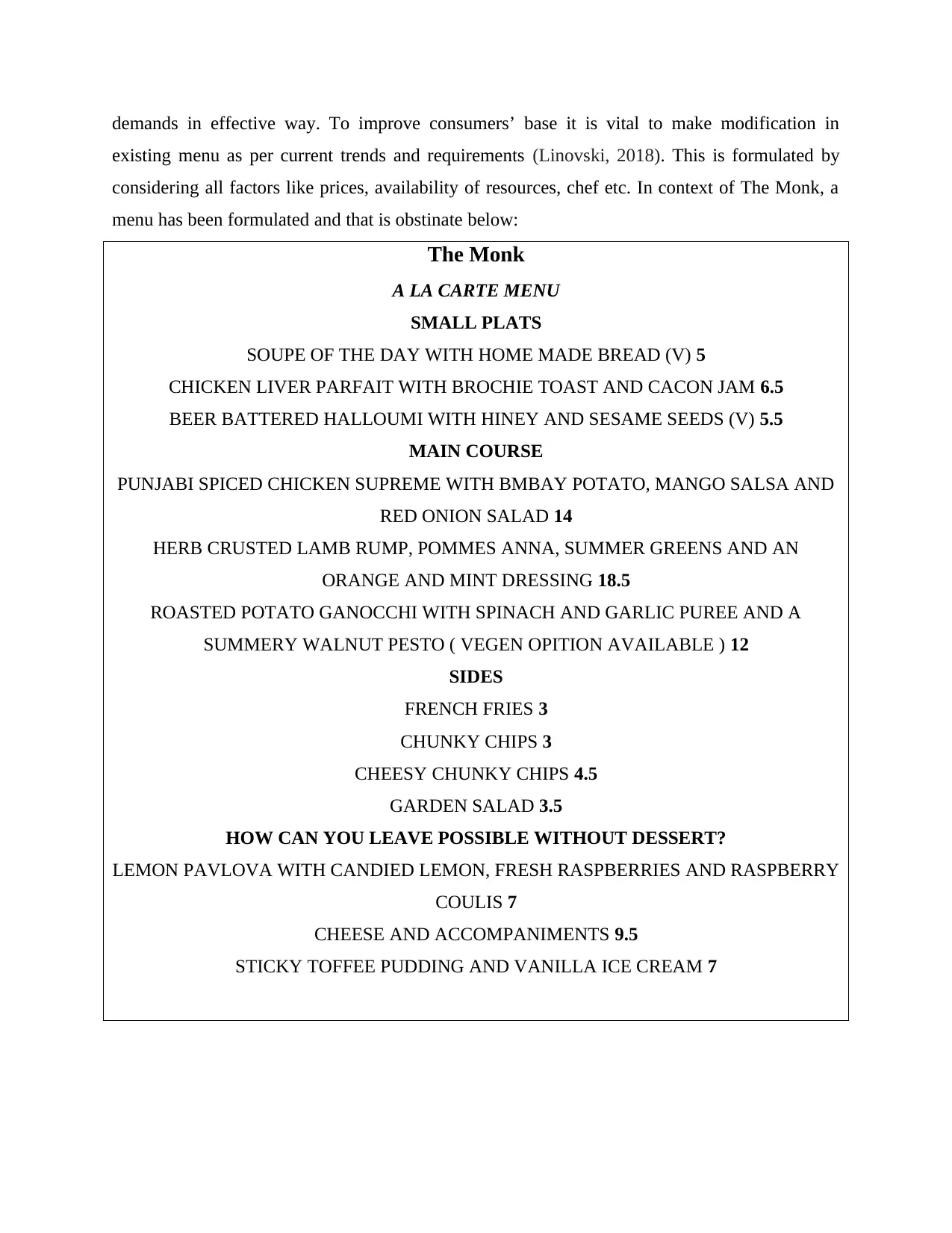
demands in effective way. To improve consumers’ base it is vital to make modification in
existing menu as per current trends and requirements (Linovski, 2018). This is formulated by
considering all factors like prices, availability of resources, chef etc. In context of The Monk, a
menu has been formulated and that is obstinate below:
The Monk
A LA CARTE MENU
SMALL PLATS
SOUPE OF THE DAY WITH HOME MADE BREAD (V) 5
CHICKEN LIVER PARFAIT WITH BROCHIE TOAST AND CACON JAM 6.5
BEER BATTERED HALLOUMI WITH HINEY AND SESAME SEEDS (V) 5.5
MAIN COURSE
PUNJABI SPICED CHICKEN SUPREME WITH BMBAY POTATO, MANGO SALSA AND
RED ONION SALAD 14
HERB CRUSTED LAMB RUMP, POMMES ANNA, SUMMER GREENS AND AN
ORANGE AND MINT DRESSING 18.5
ROASTED POTATO GANOCCHI WITH SPINACH AND GARLIC PUREE AND A
SUMMERY WALNUT PESTO ( VEGEN OPITION AVAILABLE ) 12
SIDES
FRENCH FRIES 3
CHUNKY CHIPS 3
CHEESY CHUNKY CHIPS 4.5
GARDEN SALAD 3.5
HOW CAN YOU LEAVE POSSIBLE WITHOUT DESSERT?
LEMON PAVLOVA WITH CANDIED LEMON, FRESH RASPBERRIES AND RASPBERRY
COULIS 7
CHEESE AND ACCOMPANIMENTS 9.5
STICKY TOFFEE PUDDING AND VANILLA ICE CREAM 7
existing menu as per current trends and requirements (Linovski, 2018). This is formulated by
considering all factors like prices, availability of resources, chef etc. In context of The Monk, a
menu has been formulated and that is obstinate below:
The Monk
A LA CARTE MENU
SMALL PLATS
SOUPE OF THE DAY WITH HOME MADE BREAD (V) 5
CHICKEN LIVER PARFAIT WITH BROCHIE TOAST AND CACON JAM 6.5
BEER BATTERED HALLOUMI WITH HINEY AND SESAME SEEDS (V) 5.5
MAIN COURSE
PUNJABI SPICED CHICKEN SUPREME WITH BMBAY POTATO, MANGO SALSA AND
RED ONION SALAD 14
HERB CRUSTED LAMB RUMP, POMMES ANNA, SUMMER GREENS AND AN
ORANGE AND MINT DRESSING 18.5
ROASTED POTATO GANOCCHI WITH SPINACH AND GARLIC PUREE AND A
SUMMERY WALNUT PESTO ( VEGEN OPITION AVAILABLE ) 12
SIDES
FRENCH FRIES 3
CHUNKY CHIPS 3
CHEESY CHUNKY CHIPS 4.5
GARDEN SALAD 3.5
HOW CAN YOU LEAVE POSSIBLE WITHOUT DESSERT?
LEMON PAVLOVA WITH CANDIED LEMON, FRESH RASPBERRIES AND RASPBERRY
COULIS 7
CHEESE AND ACCOMPANIMENTS 9.5
STICKY TOFFEE PUDDING AND VANILLA ICE CREAM 7
Paraphrase This Document
Need a fresh take? Get an instant paraphrase of this document with our AI Paraphraser
Test and evaluate the menu produced.
During menu planning process, it is important to assess the effectiveness and productivity
that will bring in café. Therefore, menu is prepared by considering all factor and principles
effectively. In context of this there are number of systems and techniques that are helpful in
assessing the menu produce, some are as follow:
Key performance indicator (KPI): To monitor the performance and menu produces, this
KPI indicator is used and this is a quantified measurements. It gives comparison to company in
term of achievements, financial efficiency with productivity of companies within similar
industry. In hospitality industry there are several hotels, restaurants and café run their business
with similar purpose (Silva, Pinto and Bertolini, 2019). Therefore it is important for them to
gauge their performance on regular basis. The Monk need to undertake this KPI and assess their
performance for making changes. With the help of this system, entities will able to improve their
profit and sales volume.
Benchmarks: It can be defined as a principles that are helpful in attaining desired goals.
It provides right direction and path to entity for performing function properly. In this regards, the
mangers of The Monk have to set some standards to meet all desired objective in predefined
time. Then they will able to compare their performance, analyse the gap and overcome that by
taking necessary steps. Therefore, this is also a helps technique in term of evaluation and
monitoring. Additionally aid to makes changes for improving profitability.
System for gather, recording and evaluating the feedbacks: Feedback are outstanding
process in order to known the reviews and perception of guest. It can be of two types positive
and negative. Positive feedback means consumer get full satisfaction while negative refers there
is need of changes in services. Apart from this. It gives another informational also like
preferences affordability factor, desire, etc. so that café can make changes accordingly. The
Monk restaurant have to take feedback and suggestion from their guest and keep them to make
necessary changes for avoiding future uncertainties.
Modernise menu according to the consumer’s feedback: When feedback is received from
consumers it is not only sufficient, it have to be considered while preparing any menu. The
primary motive of taking feedback is to known where the restaurant are lacking and how they
can change as per consumers (Seyitoglu, 2017). Through this, they will able to offer better
During menu planning process, it is important to assess the effectiveness and productivity
that will bring in café. Therefore, menu is prepared by considering all factor and principles
effectively. In context of this there are number of systems and techniques that are helpful in
assessing the menu produce, some are as follow:
Key performance indicator (KPI): To monitor the performance and menu produces, this
KPI indicator is used and this is a quantified measurements. It gives comparison to company in
term of achievements, financial efficiency with productivity of companies within similar
industry. In hospitality industry there are several hotels, restaurants and café run their business
with similar purpose (Silva, Pinto and Bertolini, 2019). Therefore it is important for them to
gauge their performance on regular basis. The Monk need to undertake this KPI and assess their
performance for making changes. With the help of this system, entities will able to improve their
profit and sales volume.
Benchmarks: It can be defined as a principles that are helpful in attaining desired goals.
It provides right direction and path to entity for performing function properly. In this regards, the
mangers of The Monk have to set some standards to meet all desired objective in predefined
time. Then they will able to compare their performance, analyse the gap and overcome that by
taking necessary steps. Therefore, this is also a helps technique in term of evaluation and
monitoring. Additionally aid to makes changes for improving profitability.
System for gather, recording and evaluating the feedbacks: Feedback are outstanding
process in order to known the reviews and perception of guest. It can be of two types positive
and negative. Positive feedback means consumer get full satisfaction while negative refers there
is need of changes in services. Apart from this. It gives another informational also like
preferences affordability factor, desire, etc. so that café can make changes accordingly. The
Monk restaurant have to take feedback and suggestion from their guest and keep them to make
necessary changes for avoiding future uncertainties.
Modernise menu according to the consumer’s feedback: When feedback is received from
consumers it is not only sufficient, it have to be considered while preparing any menu. The
primary motive of taking feedback is to known where the restaurant are lacking and how they
can change as per consumers (Seyitoglu, 2017). Through this, they will able to offer better
services to consumers and satisfy them. In context of The Monk, they have to also take feedback
from their guest for improving the quality of services and satisfaction level of guest.
CONCLUSION
From above discussed report it can concluded that there are number of different type of
menu and their designing includes list of foods & beverages to give positive and good experience
to consumers. Menu planning is considered as crucial part of overall food and beverages
industry. While preparing any menu, manager of company need to take care about some
principles necessarily. Also there are various requirement of business & customers and that all
need to be full fill by restaurants for maximizing profitability. Further are so many factor that
need to considered while making any cost in menu. Moreover, number of methods are available
in order to test and evaluate the produced menu such as Feedback, bench marketing, KPI etc.
Menu development is important to make sure that consumer will able to get better and efficient
services and that help them to increase profitability.
from their guest for improving the quality of services and satisfaction level of guest.
CONCLUSION
From above discussed report it can concluded that there are number of different type of
menu and their designing includes list of foods & beverages to give positive and good experience
to consumers. Menu planning is considered as crucial part of overall food and beverages
industry. While preparing any menu, manager of company need to take care about some
principles necessarily. Also there are various requirement of business & customers and that all
need to be full fill by restaurants for maximizing profitability. Further are so many factor that
need to considered while making any cost in menu. Moreover, number of methods are available
in order to test and evaluate the produced menu such as Feedback, bench marketing, KPI etc.
Menu development is important to make sure that consumer will able to get better and efficient
services and that help them to increase profitability.
⊘ This is a preview!⊘
Do you want full access?
Subscribe today to unlock all pages.
Trusted by 1+ million students worldwide
REFERENCES
Books and journals
Abdelmassih, K. and Arendt, S.W., 2020, August. Menu development for meetings and events:
an opportunity for conveying cultural diversity and inclusion initiatives. In Journal of
Convention & Event Tourism (Vol. 21, No. 4, pp. 355-364). Routledge.
Funk, A., Sütterlin, B. and Siegrist, M., 2020. The stereotypes attributed to hosts when they offer
an environmentally-friendly vegetarian versus a meat menu. Journal of Cleaner
Production, 250, p.119508.
Kim, E. and Nicolau, J.L., 2021. Impact of the Menu Labeling Act Upon the Market Value of
Foodservice Firms. Journal of Hospitality & Tourism Research, 45(3), pp.447-473.
Linovski, O., 2018. Designing for development: Growth and the practice of urban design in Los
Angeles. Journal of Planning History, 17(2), pp.118-143.
PUSIRAN, A.K., and et. al., 2021. Food Culture Integration in Menu Plan for a Sustainable
Homestay Business. Journal of Environmental Management and Tourism, 12(1), pp.258-
265.
Rapoport, E. and Hult, A., 2017. The travelling business of sustainable urbanism: International
consultants as norm-setters. Environment and Planning A: Economy and Space, 49(8),
pp.1779-1796.
Sawicki, E., and et.al., 2019. A menu to evaluate factors influencing implementation of obesity
prevention early care and education regulations. Journal of Public Health Management
and Practice, 25(3), pp.E11-E18.
Seyitoglu, F., 2017. Components of the menu planning process: the case of five star hotels in
Antalya. British Food Journal.
Silva, C., Pinto, N. and Bertolini, L. eds., 2019. Designing accessibility instruments: lessons on
their usability for integrated land use and transport planning practices. Routledge.
Books and journals
Abdelmassih, K. and Arendt, S.W., 2020, August. Menu development for meetings and events:
an opportunity for conveying cultural diversity and inclusion initiatives. In Journal of
Convention & Event Tourism (Vol. 21, No. 4, pp. 355-364). Routledge.
Funk, A., Sütterlin, B. and Siegrist, M., 2020. The stereotypes attributed to hosts when they offer
an environmentally-friendly vegetarian versus a meat menu. Journal of Cleaner
Production, 250, p.119508.
Kim, E. and Nicolau, J.L., 2021. Impact of the Menu Labeling Act Upon the Market Value of
Foodservice Firms. Journal of Hospitality & Tourism Research, 45(3), pp.447-473.
Linovski, O., 2018. Designing for development: Growth and the practice of urban design in Los
Angeles. Journal of Planning History, 17(2), pp.118-143.
PUSIRAN, A.K., and et. al., 2021. Food Culture Integration in Menu Plan for a Sustainable
Homestay Business. Journal of Environmental Management and Tourism, 12(1), pp.258-
265.
Rapoport, E. and Hult, A., 2017. The travelling business of sustainable urbanism: International
consultants as norm-setters. Environment and Planning A: Economy and Space, 49(8),
pp.1779-1796.
Sawicki, E., and et.al., 2019. A menu to evaluate factors influencing implementation of obesity
prevention early care and education regulations. Journal of Public Health Management
and Practice, 25(3), pp.E11-E18.
Seyitoglu, F., 2017. Components of the menu planning process: the case of five star hotels in
Antalya. British Food Journal.
Silva, C., Pinto, N. and Bertolini, L. eds., 2019. Designing accessibility instruments: lessons on
their usability for integrated land use and transport planning practices. Routledge.

1 out of 10


Related Documents


Your All-in-One AI-Powered Toolkit for Academic Success.
+13062052269
info@desklib.com
Available 24*7 on WhatsApp / Email
![[object Object]](/_next/static/media/star-bottom.7253800d.svg)
Unlock your academic potential
Copyright © 2020–2026 A2Z Services. All Rights Reserved. Developed and managed by ZUCOL.