Analyzing Microsoft's Acquisition of LinkedIn: A Detailed Report

Verified

Added on  2019/09/13

|7
|904
|386
Report
AI Summary
This report examines the merger and acquisition between Microsoft and LinkedIn, focusing on the challenges and potential solutions. The acquisition, valued at $26.2 billion, is analyzed as a conglomerate merger, highlighting issues such as unprofitable assets, unclear business plans, and cultural differences. The report recommends strategies for Microsoft to generate higher revenue, including reasonable staff decisions, effective acquisition strategies, and integrated business plans. It also details the implications of these recommendations, emphasizing the importance of the human resource department and smooth business operations. The resources needed, benefits of the recommendations, and key milestones, risks, and assumptions are also discussed, providing a comprehensive overview of the acquisition's strategic considerations.

Document Page
Merger & Acquisition
tabler-icon-diamond-filled.svg

Paraphrase This Document

Need a fresh take? Get an instant paraphrase of this document with our AI Paraphraser
Document Page
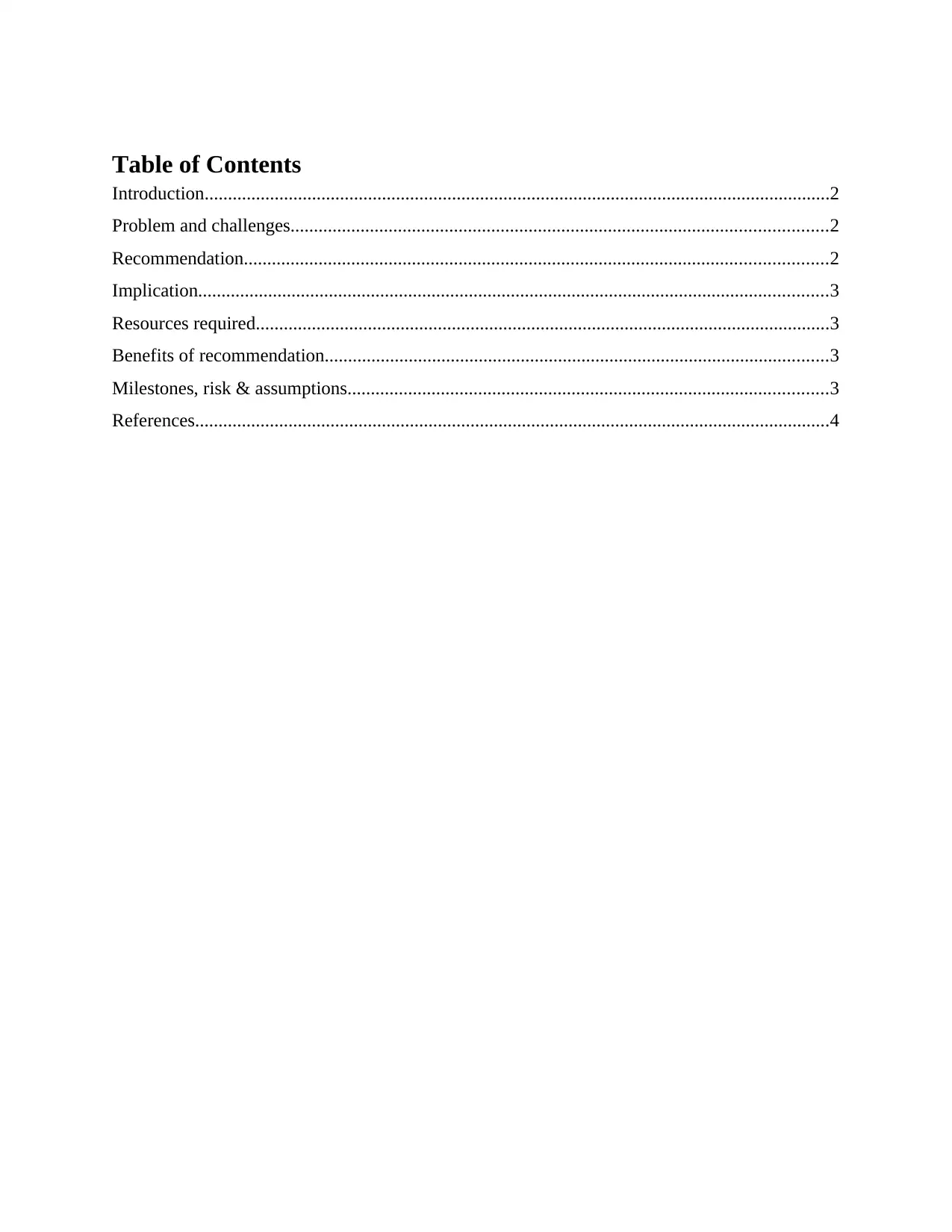
Table of Contents
Introduction......................................................................................................................................2
Problem and challenges...................................................................................................................2
Recommendation.............................................................................................................................2
Implication.......................................................................................................................................3
Resources required...........................................................................................................................3
Benefits of recommendation............................................................................................................3
Milestones, risk & assumptions.......................................................................................................3
References........................................................................................................................................4
Document Page
Introduction
In this present paper, we will discuss the merger and acquisition between the Microsoft and
LinkedIn. The Microsoft has acquired the LinkedIn by paying $26.2 Billion. It is the biggest
heftiest acquisition in the software industry. It is a type of conglomerate merger and acquisition
because both the companies have different industries and business process.
Problem and challenges
The problems and challenges are explained below:
1. Unprofitable asset
The asset of LinkedIn is not profitable for the company due to which is a major challenge for
the company because the acquisition is mainly made to add synergy to an organization, but
the company has faced the problem of managing the unprofitable assets.
2. No clear path forward
The business plan of LinkedIn is not viable due to which the company has faced the major
challenge to integrate the LinkedIn with their company which helps to provide the
competitive advantage to the company.
3. Poor revenue forecast
The revenue forecasting of LinkedIn is poor revenue which is $11 Billion due to which the
company faced the problem of generating the higher revenue by the acquisition of the
company. The nature of the business is not providing synergies to the business which is a
major problem for the company (Piesse et al., 2013).
4. Brand image
Document Page
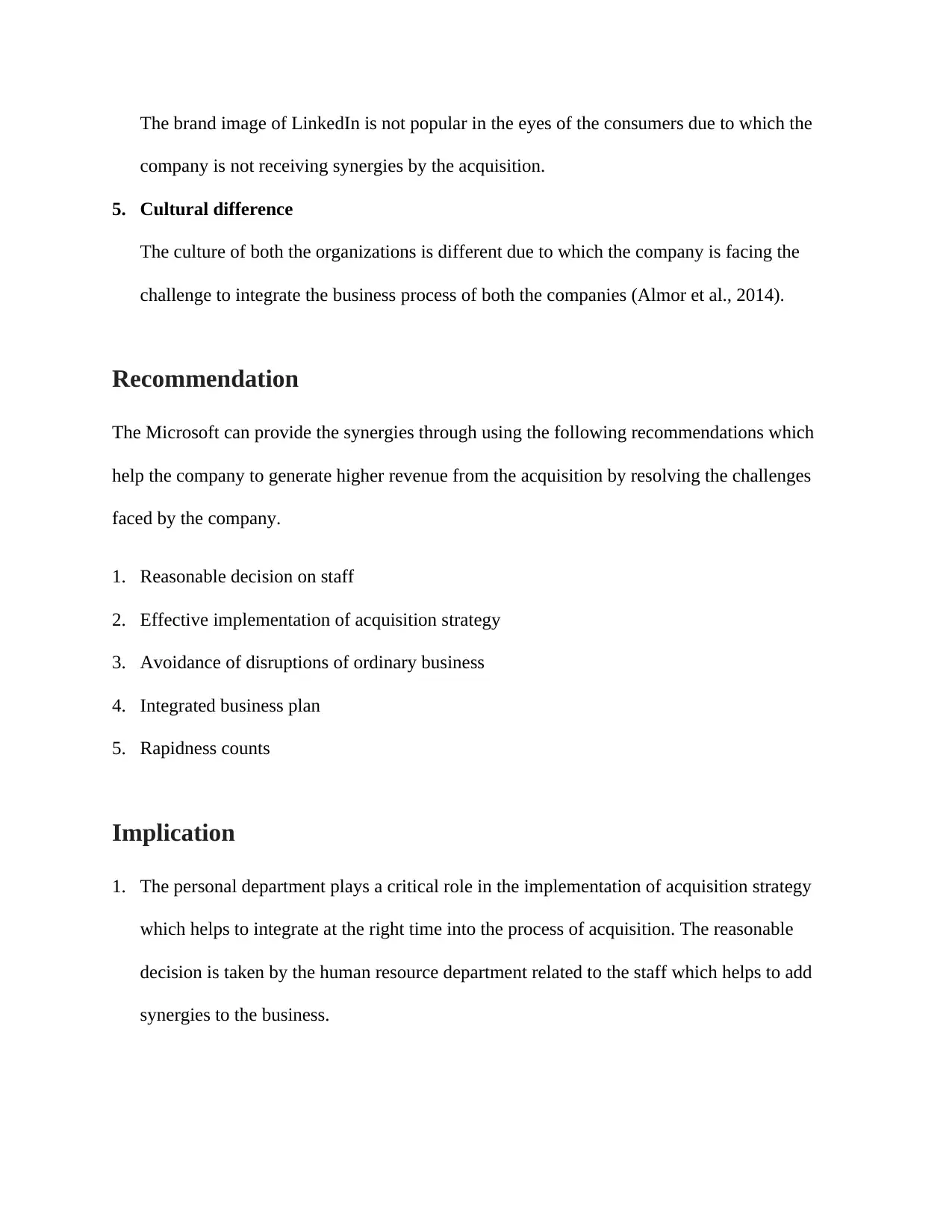
The brand image of LinkedIn is not popular in the eyes of the consumers due to which the
company is not receiving synergies by the acquisition.
5. Cultural difference
The culture of both the organizations is different due to which the company is facing the
challenge to integrate the business process of both the companies (Almor et al., 2014).
Recommendation
The Microsoft can provide the synergies through using the following recommendations which
help the company to generate higher revenue from the acquisition by resolving the challenges
faced by the company.
1. Reasonable decision on staff
2. Effective implementation of acquisition strategy
3. Avoidance of disruptions of ordinary business
4. Integrated business plan
5. Rapidness counts
Implication
1. The personal department plays a critical role in the implementation of acquisition strategy
which helps to integrate at the right time into the process of acquisition. The reasonable
decision is taken by the human resource department related to the staff which helps to add
synergies to the business.
tabler-icon-diamond-filled.svg

Paraphrase This Document

Need a fresh take? Get an instant paraphrase of this document with our AI Paraphraser
Document Page
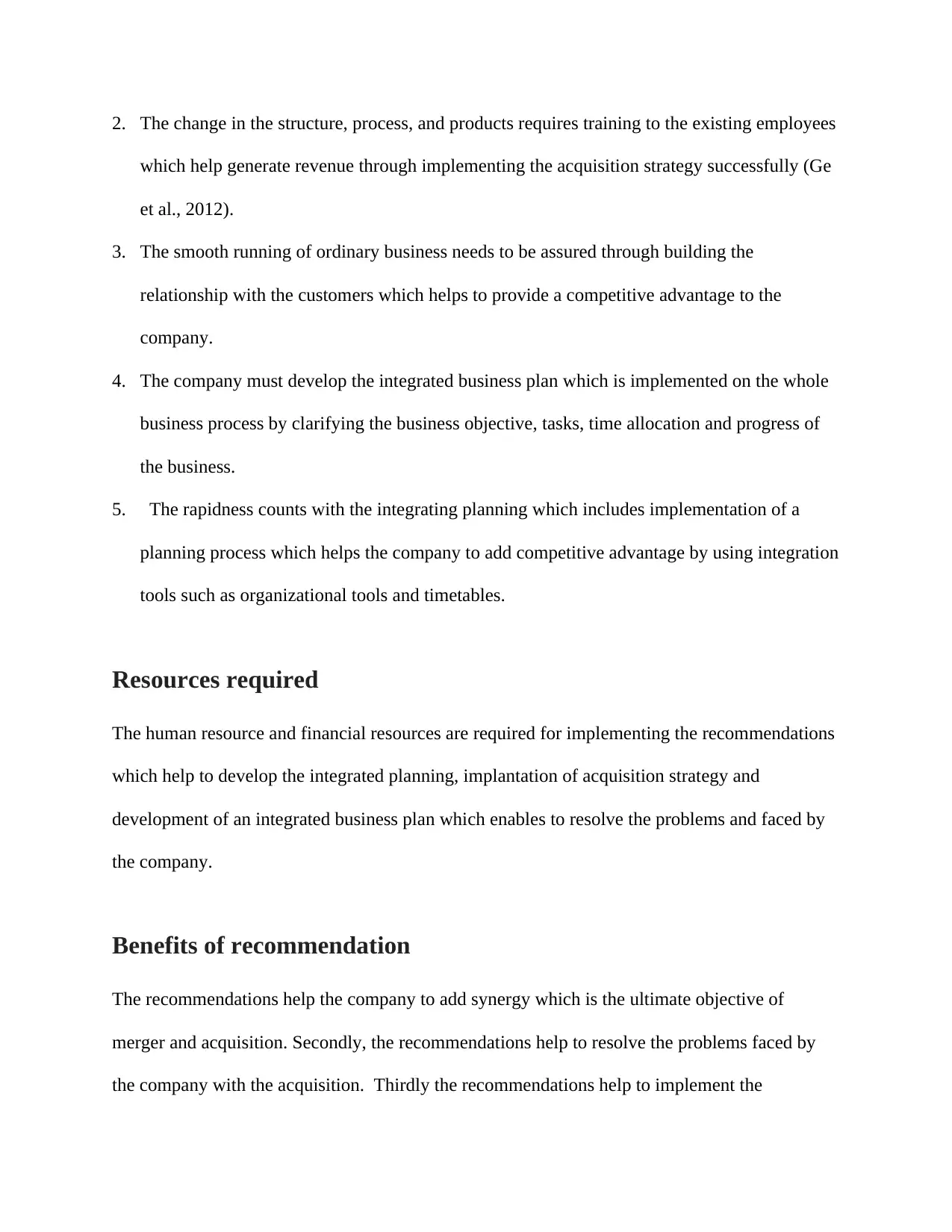
2. The change in the structure, process, and products requires training to the existing employees
which help generate revenue through implementing the acquisition strategy successfully (Ge
et al., 2012).
3. The smooth running of ordinary business needs to be assured through building the
relationship with the customers which helps to provide a competitive advantage to the
company.
4. The company must develop the integrated business plan which is implemented on the whole
business process by clarifying the business objective, tasks, time allocation and progress of
the business.
5. The rapidness counts with the integrating planning which includes implementation of a
planning process which helps the company to add competitive advantage by using integration
tools such as organizational tools and timetables.
Resources required
The human resource and financial resources are required for implementing the recommendations
which help to develop the integrated planning, implantation of acquisition strategy and
development of an integrated business plan which enables to resolve the problems and faced by
the company.
Benefits of recommendation
The recommendations help the company to add synergy which is the ultimate objective of
merger and acquisition. Secondly, the recommendations help to resolve the problems faced by
the company with the acquisition. Thirdly the recommendations help to implement the
Document Page
acquisition strategy in a most efficient and effective manner which enables to add competitive
advantage to the company.
Milestones, risk & assumptions
The milestones that need to be considered includes the development of integration acquisition
plan, integration of business plan, time framework, implementation of acquisition plan, and
effective communication plan. The various risk factors that need to be considered at the time of
acquisition includes financial risk, credit risk, security risk, legal risk, operational risk, and
market risk which needs to be considered by the company at the time of merger and acquisition.
The company must assume inherited risk, difficulty in implementation of the acquisition
strategy, the time required for adding synergy and others factors which are generated at the time
of acquisition.
Document Page
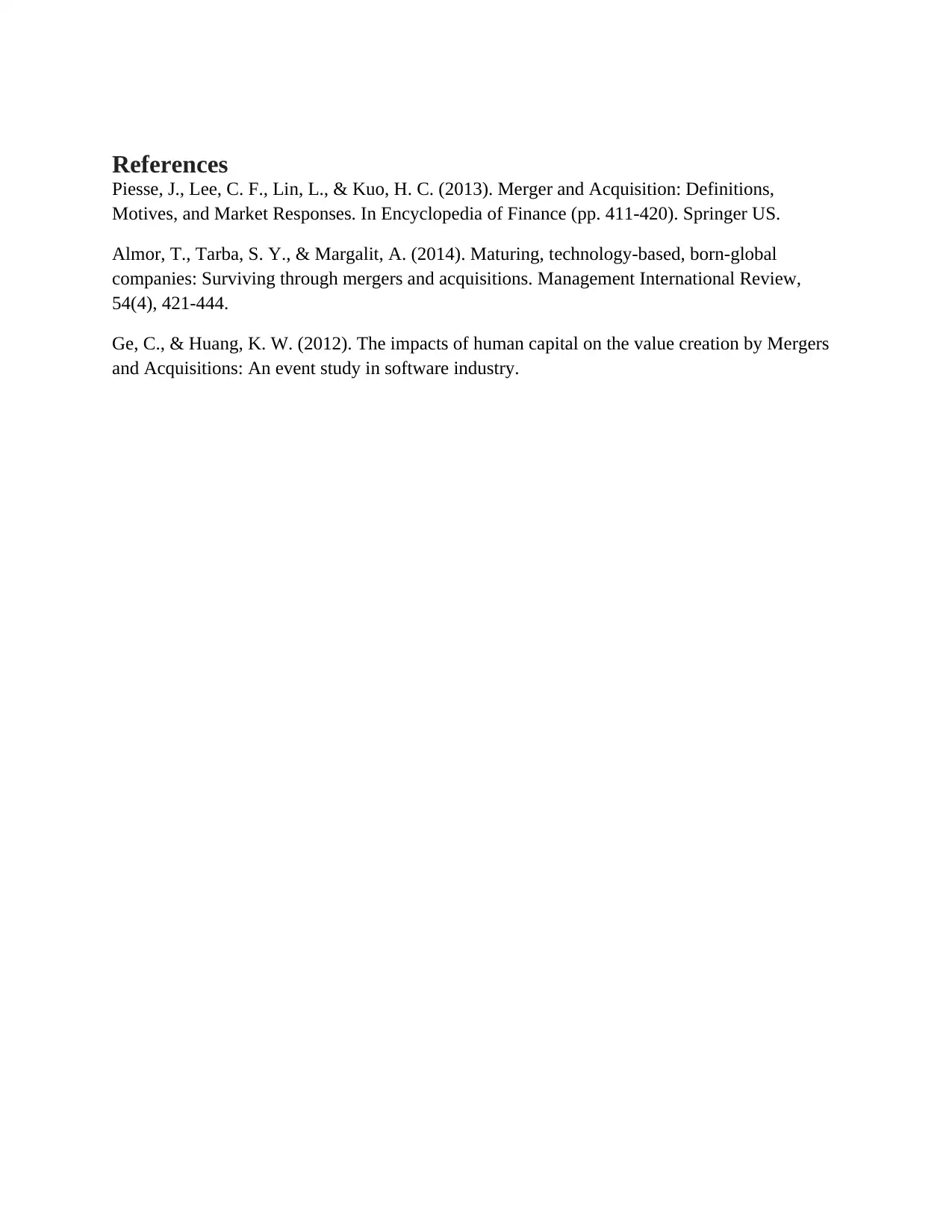
References
Piesse, J., Lee, C. F., Lin, L., & Kuo, H. C. (2013). Merger and Acquisition: Definitions,
Motives, and Market Responses. In Encyclopedia of Finance (pp. 411-420). Springer US.
Almor, T., Tarba, S. Y., & Margalit, A. (2014). Maturing, technology-based, born-global
companies: Surviving through mergers and acquisitions. Management International Review,
54(4), 421-444.
Ge, C., & Huang, K. W. (2012). The impacts of human capital on the value creation by Mergers
and Acquisitions: An event study in software industry.
chevron_up_icon
1 out of 7
circle_padding
hide_on_mobile
zoom_out_icon
[object Object]