Analyzing the Metamorphosis of the Self in Lady Lazarus by Plath

Verified

Added on  2022/09/26

|5
|1157
|47
Essay
AI Summary
This essay provides a detailed analysis of Sylvia Plath's poem, 'Lady Lazarus,' focusing on the central theme of the metamorphosis of the self. The essay explores the poem's autobiographical elements, drawing connections to Plath's life and struggles with identity, death, and resurrection. It examines the speaker's repeated attempts at suicide and the subsequent transformations, drawing on critical perspectives that discuss the use of Nazi imagery and the poem's theatricality. The essay highlights the poem's exploration of power dynamics, the interplay between victim and witness, and the speaker's complex relationship with 'Herr Enemy'. The analysis considers how Plath manipulates language and imagery to create a disturbing yet compelling portrayal of suffering and self-discovery, ultimately concluding that the speaker's identity and act of resurrection are intricately tied to external forces, underscoring the poem's profound exploration of the self.
Document Page
Running Head: METAMORPHOSIS OF THE SELF IN LADY LAZARUS BY SYLVIA
PLATH
Metamorphosis of the Self in Lady Lazarus by Sylvia Plath
Name of the Student:
Name of the University:
Author Note:
tabler-icon-diamond-filled.svg

Paraphrase This Document

Need a fresh take? Get an instant paraphrase of this document with our AI Paraphraser
Document Page
1METAMORPHOSIS OF THE SELF IN LADY LAZARUS BY SYLVIA PLATH
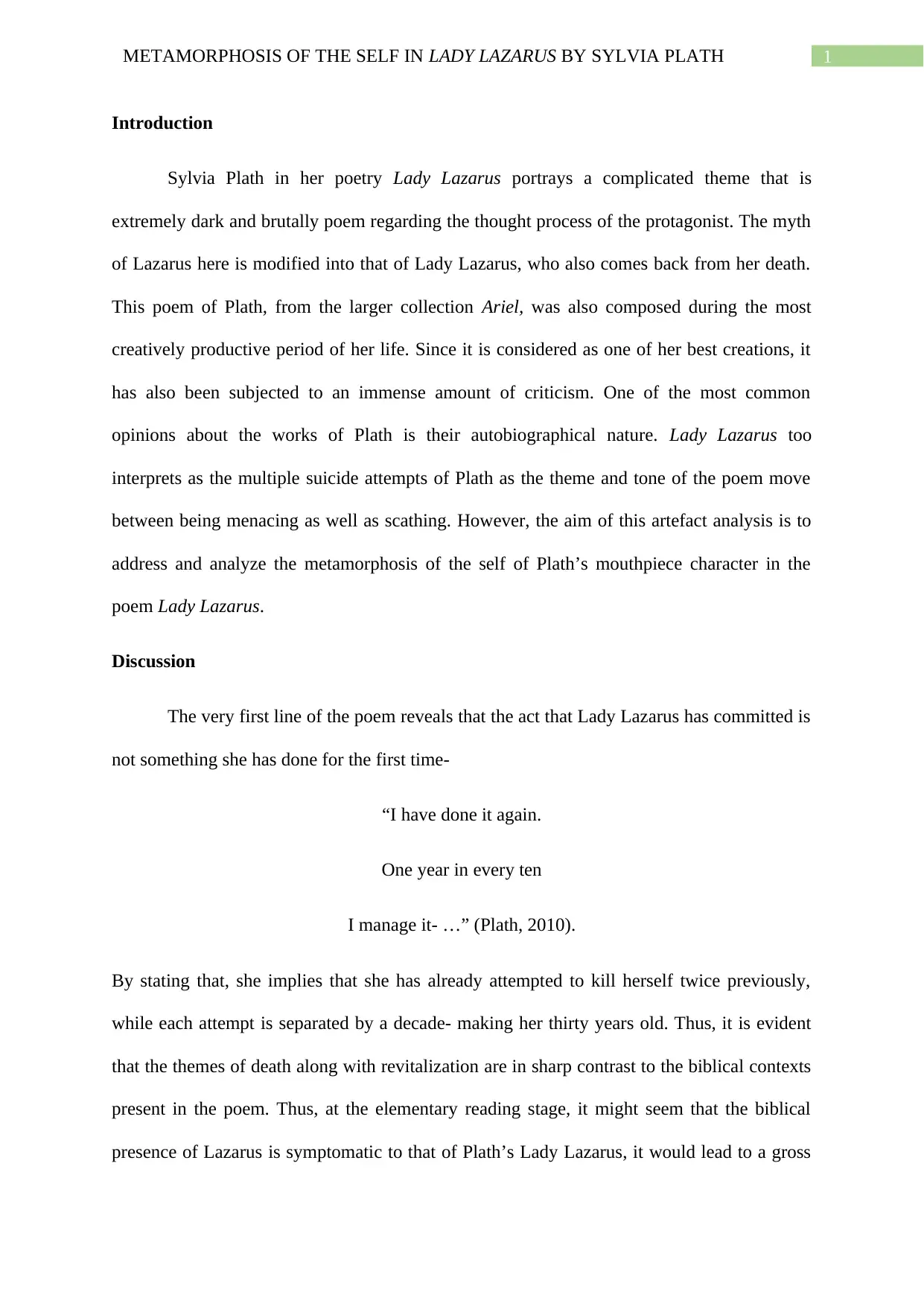
Introduction
Sylvia Plath in her poetry Lady Lazarus portrays a complicated theme that is
extremely dark and brutally poem regarding the thought process of the protagonist. The myth
of Lazarus here is modified into that of Lady Lazarus, who also comes back from her death.
This poem of Plath, from the larger collection Ariel, was also composed during the most
creatively productive period of her life. Since it is considered as one of her best creations, it
has also been subjected to an immense amount of criticism. One of the most common
opinions about the works of Plath is their autobiographical nature. Lady Lazarus too
interprets as the multiple suicide attempts of Plath as the theme and tone of the poem move
between being menacing as well as scathing. However, the aim of this artefact analysis is to
address and analyze the metamorphosis of the self of Plath’s mouthpiece character in the
poem Lady Lazarus.
Discussion
The very first line of the poem reveals that the act that Lady Lazarus has committed is
not something she has done for the first time-
“I have done it again.
One year in every ten
I manage it- …” (Plath, 2010).
By stating that, she implies that she has already attempted to kill herself twice previously,
while each attempt is separated by a decade- making her thirty years old. Thus, it is evident
that the themes of death along with revitalization are in sharp contrast to the biblical contexts
present in the poem. Thus, at the elementary reading stage, it might seem that the biblical
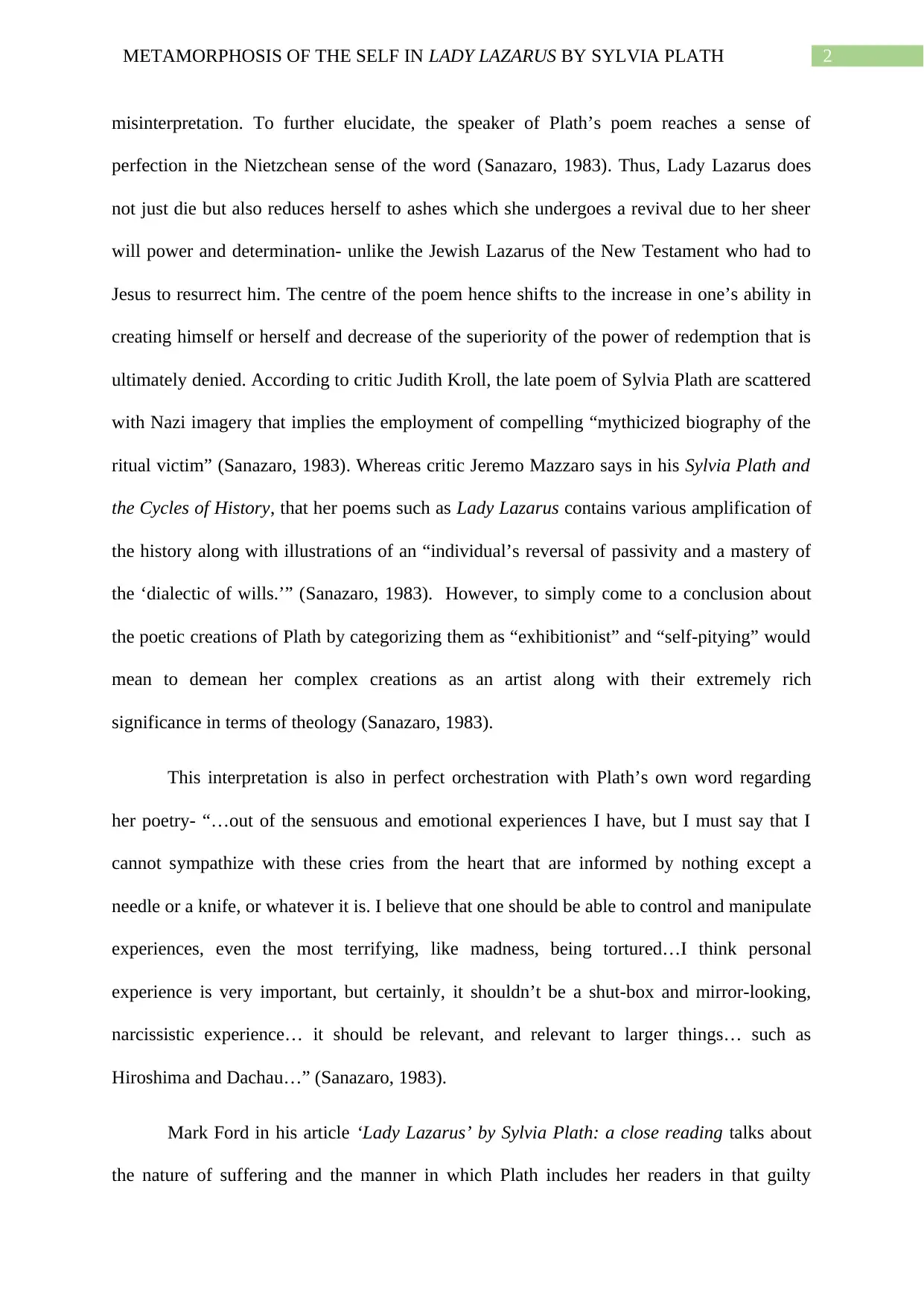
presence of Lazarus is symptomatic to that of Plath’s Lady Lazarus, it would lead to a gross
Document Page
2METAMORPHOSIS OF THE SELF IN LADY LAZARUS BY SYLVIA PLATH
misinterpretation. To further elucidate, the speaker of Plath’s poem reaches a sense of
perfection in the Nietzchean sense of the word (Sanazaro, 1983). Thus, Lady Lazarus does
not just die but also reduces herself to ashes which she undergoes a revival due to her sheer
will power and determination- unlike the Jewish Lazarus of the New Testament who had to
Jesus to resurrect him. The centre of the poem hence shifts to the increase in one’s ability in
creating himself or herself and decrease of the superiority of the power of redemption that is
ultimately denied. According to critic Judith Kroll, the late poem of Sylvia Plath are scattered
with Nazi imagery that implies the employment of compelling “mythicized biography of the
ritual victim” (Sanazaro, 1983). Whereas critic Jeremo Mazzaro says in his Sylvia Plath and
the Cycles of History, that her poems such as Lady Lazarus contains various amplification of
the history along with illustrations of an “individual’s reversal of passivity and a mastery of
the ‘dialectic of wills.’” (Sanazaro, 1983). However, to simply come to a conclusion about
the poetic creations of Plath by categorizing them as “exhibitionist” and “self-pitying” would
mean to demean her complex creations as an artist along with their extremely rich
significance in terms of theology (Sanazaro, 1983).
This interpretation is also in perfect orchestration with Plath’s own word regarding
her poetry- “…out of the sensuous and emotional experiences I have, but I must say that I
cannot sympathize with these cries from the heart that are informed by nothing except a
needle or a knife, or whatever it is. I believe that one should be able to control and manipulate
experiences, even the most terrifying, like madness, being tortured…I think personal
experience is very important, but certainly, it shouldn’t be a shut-box and mirror-looking,
narcissistic experience… it should be relevant, and relevant to larger things… such as
Hiroshima and Dachau…” (Sanazaro, 1983).
Mark Ford in his article ‘Lady Lazarus’ by Sylvia Plath: a close reading talks about
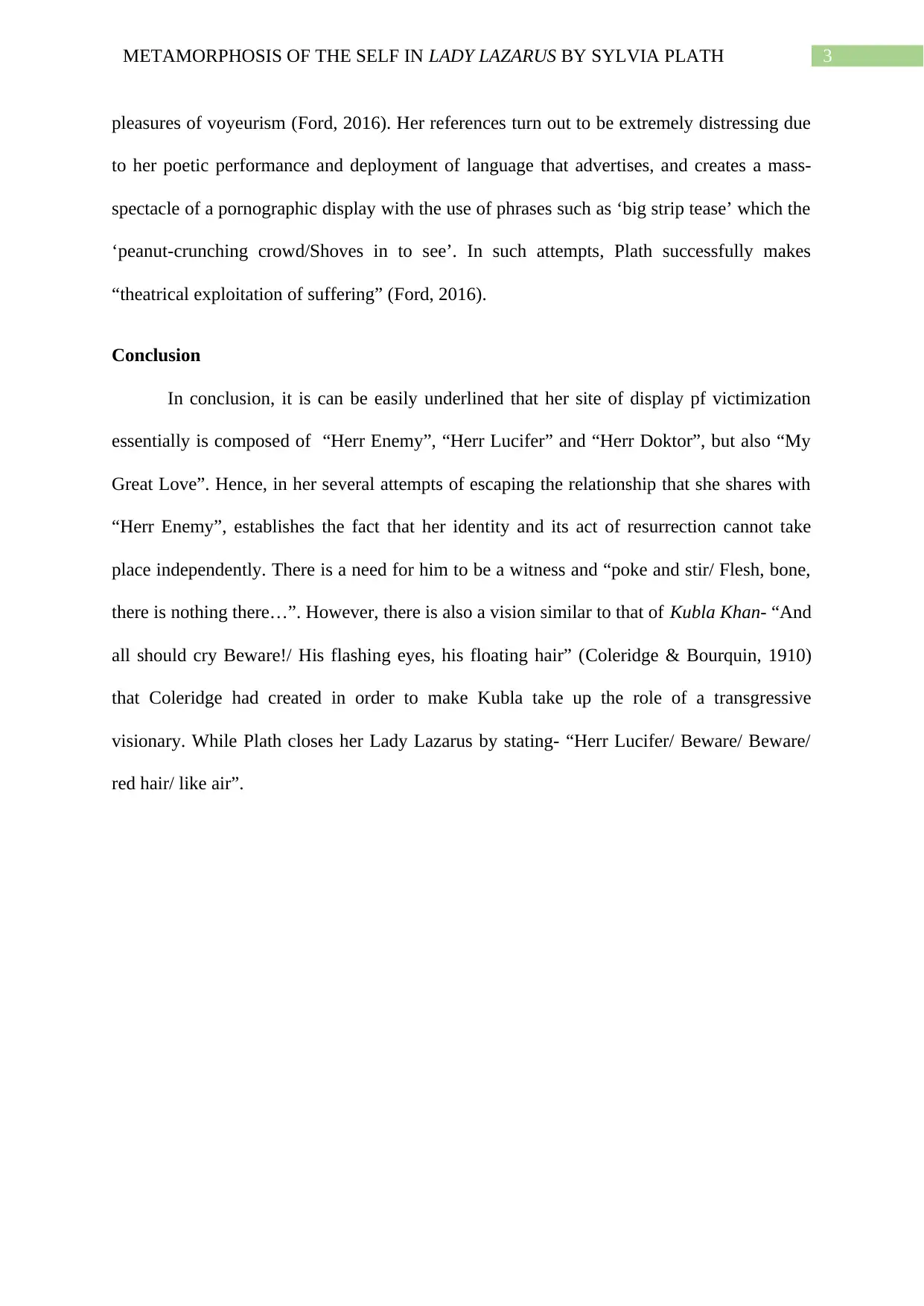
the nature of suffering and the manner in which Plath includes her readers in that guilty
Document Page
3METAMORPHOSIS OF THE SELF IN LADY LAZARUS BY SYLVIA PLATH
pleasures of voyeurism (Ford, 2016). Her references turn out to be extremely distressing due
to her poetic performance and deployment of language that advertises, and creates a mass-
spectacle of a pornographic display with the use of phrases such as ‘big strip tease’ which the
‘peanut-crunching crowd/Shoves in to see’. In such attempts, Plath successfully makes
“theatrical exploitation of suffering” (Ford, 2016).
Conclusion
In conclusion, it is can be easily underlined that her site of display pf victimization
essentially is composed of “Herr Enemy”, “Herr Lucifer” and “Herr Doktor”, but also “My
Great Love”. Hence, in her several attempts of escaping the relationship that she shares with
“Herr Enemy”, establishes the fact that her identity and its act of resurrection cannot take
place independently. There is a need for him to be a witness and “poke and stir/ Flesh, bone,
there is nothing there…”. However, there is also a vision similar to that of Kubla Khan- “And
all should cry Beware!/ His flashing eyes, his floating hair” (Coleridge & Bourquin, 1910)
that Coleridge had created in order to make Kubla take up the role of a transgressive
visionary. While Plath closes her Lady Lazarus by stating- “Herr Lucifer/ Beware/ Beware/
red hair/ like air”.
tabler-icon-diamond-filled.svg

Paraphrase This Document

Need a fresh take? Get an instant paraphrase of this document with our AI Paraphraser
Document Page
4METAMORPHOSIS OF THE SELF IN LADY LAZARUS BY SYLVIA PLATH
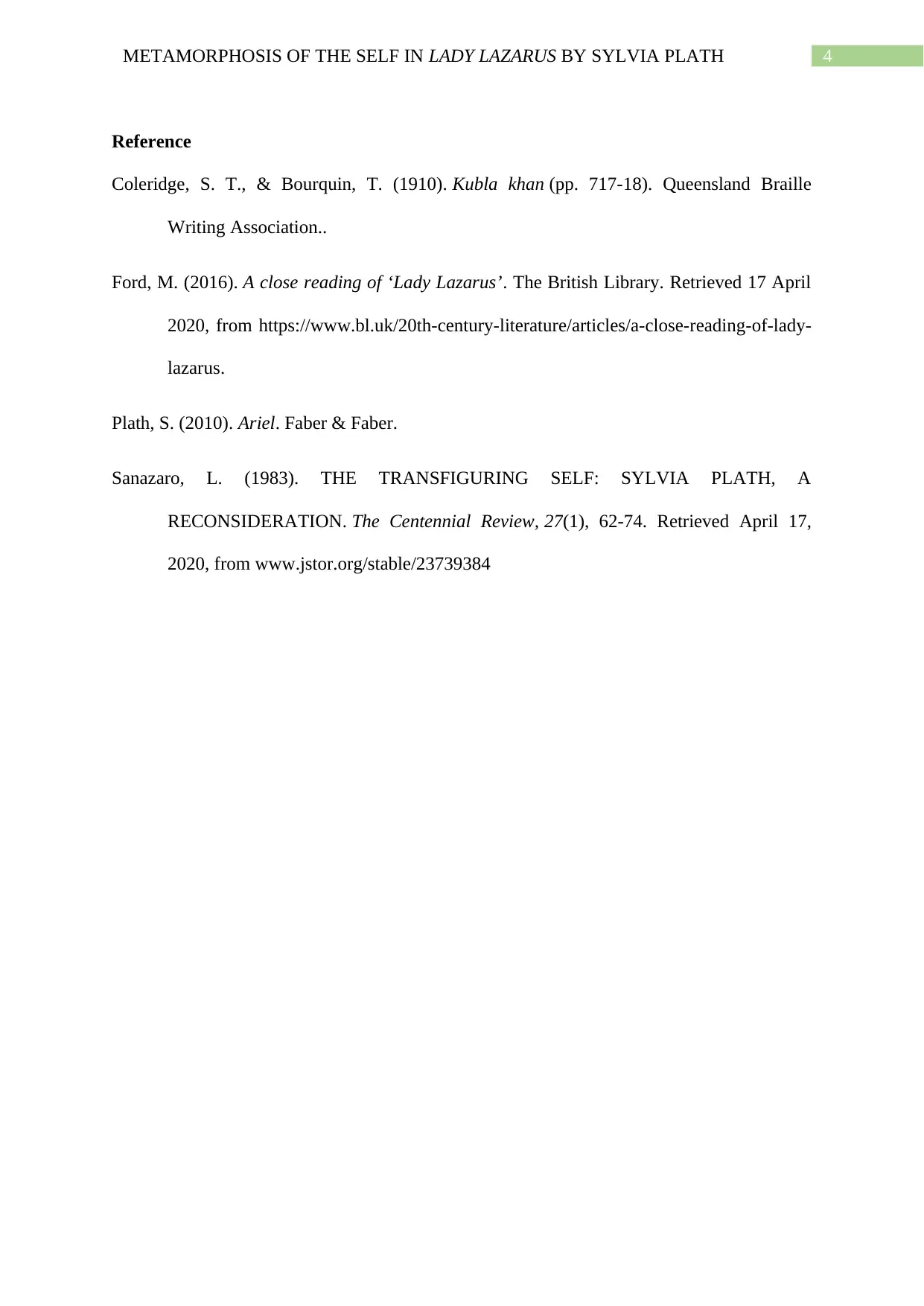
Reference
Coleridge, S. T., & Bourquin, T. (1910). Kubla khan (pp. 717-18). Queensland Braille
Writing Association..
Ford, M. (2016). A close reading of ‘Lady Lazarus’. The British Library. Retrieved 17 April
2020, from https://www.bl.uk/20th-century-literature/articles/a-close-reading-of-lady-
lazarus.
Plath, S. (2010). Ariel. Faber & Faber.
Sanazaro, L. (1983). THE TRANSFIGURING SELF: SYLVIA PLATH, A
RECONSIDERATION. The Centennial Review, 27(1), 62-74. Retrieved April 17,
2020, from www.jstor.org/stable/23739384
chevron_up_icon
1 out of 5
circle_padding
hide_on_mobile
zoom_out_icon
[object Object]