Comprehensive Study on Methodologies for Bioplastics Biodegradation

Verified

Added on  2020/09/27

|6
|1159
|69
Report
AI Summary
This report provides a detailed overview of methodologies employed to monitor the biodegradation of bioplastics using enzymes and microbes. It covers techniques such as aerobic and anaerobic biodegradation processes, explaining how microbes break down polymers into smaller compounds and byproducts. The report further explores spectroscopic analysis, including infrared and NMR spectroscopy, to evaluate changes in bioplastic spectra during degradation. Additionally, it discusses anaerobic hydrocarbon metabolism and mass loss techniques, providing insights into the assessment of biodegradation under various conditions and the measurement of molecular weight changes. The report also highlights the assessment standards and tools used, such as respirometers and biochemical methane potential (BMP), to measure CO2 and methane production, thereby offering a comprehensive understanding of the analytical methods used in the field of bioplastics biodegradation.
Document Page
Methodologies
In this section contains the significant procedures and illustrations used in monitoring biodegradation
processes of bioplastics materials using enzymes and microbes. The procedures involve measuring and
determining the percentage composition of organic carbon (IV) oxide and methane in the bioplastics.
The commonly used methods are; aerobic conditioning biodegradation, Spectroscopy, mass loss,
virtual analysis. and anaerobic hydrocarbon metabolism.
Aerobic degradation process utilizes the microbes as a natural method for reducing pollutants
hazardous wastes deposits. In the aerobic degradation organic chemicals (polymer) are broken down
into smaller compounds (monomers), and by products –water and carbon (IV) oxide using oxygen as the
electron acceptor. In anaerobic degradation conditioning the organic chemical wastes are decomposed
by microbes in absence of oxygen. The bacteria utilizes chemical compounds such as nitrate,
manganese, sulfate and carbon (IV) oxide in their reactions as electron acceptors to breakdown the
polymers into monomers and biomass (C plastic ––> CH4 + CO2 +H2O + C residual + biomass).
Aerobic conditioning biodegradation; The microbes delay in moving the polymers through their outer
cell membrane to reach the inner biochemical processing cells because the polymer molecules are large
and insoluble in water. In order to reach the carbon and hydrocarbon compounds and apply the
biochemical activities, the microbes evolve and initiate the excretion of extracellular enzymes the
breakdown the polymers in a process known as depolymerization. The process involves two steps;
(i) The microorganism attaches itself on the polymer surface (on hydrophilic polymers)
(ii) The microorganism uses the polymer as a source of carbon for its growth hence degrading
the polymer. While extracellular enzymes released inflict the primary chain and split it to
low-molecular-weight monomers and dimers which are further used as source of electricity
and carbon.
Figure
tabler-icon-diamond-filled.svg

Paraphrase This Document

Need a fresh take? Get an instant paraphrase of this document with our AI Paraphraser
Document Page
Biodegradation of bioplastics
Bioplastics are biomaterials that is synthesized from different microorganisms under special
environmental and nutritional conditions for instance, polyesters (PLA, PHA, cellulose, PBS, PCL, and
PBAT) are made from accumulating plant lipid and mixing it with microbes in containers and allow it
grow together. The number, weight and size of granules, monomers and macromolecular structure, and
the properties of polymer depend on the producer microbe. The table below shows the assessment
standards of bioplastics under aerobic condition
Table 1
The CO2 produced during biodegradation is equated to a blank containing developed compost added to
positive material, that is an assessed and biodegraded cellulose (Sakimoto et al., 2017). The
measurement of methane and carbon (IV) oxide is based on the assumption that biodegradation of
cellulose used I the assessment is complete (Zhao et al., 2016). Moreover, the measurement and
assessment of emission of CO2 gas from biodegradation process is done using different tools; which are
the gravimetric measurement respirometer (GMR) and cumulative measurement respirometer (CMR).
The direct measurement respirometer (DMR) tool has non-dispersive infrared (NDIR) sensor or a gas
chromatograph (GC) fixed to thermal conductivity detector (TCD) to analyze the transformed CO2
quantity in the output gas. However, in anaerobic conditions biodegradation process is evaluated via
measuring production of biogas CH4 and CO2 as illustrated in ASTM D5526-94d (Yang et al., 2018).the
other method used to assess and measure biodegradability under anaerobic condition is biochemical
methane potential (BMP) (Zhang et al., 2018), it is grounded on the definite methane yield of the test
material.
Table 5 (anaerobic)
Figure 3
Graph
Spectroscopy is another method used to assess and evaluate the process of biodegradation via changes
in the bioplastic spectrum during the degradation process. The use of infrared spectroscopy (IR) to
facilitate IR radiation absorption in wavelength range of 4000-400 per centimeter. The IR band are
characterized by magnitude and frequency whereby the frequency is represented on the values on the
horizontal axis which correspond to the wavenumbers absorbed in the IR while the magnitude is the
amount of IR visible on the spectrum and is represented on the vertical axis of IR graph. Most commonly
used method of spectroscopic analysis is the Nuclear magnetic resonance (NMR). It expresses the series
and sequence of active nuclei based on C, H, and O. Near infrared (NIR) and attenuated total reflectance
spectroscopy (ATR-FTIR) are used to detect material spectra and in monitor the process of
biodegradation in PCL plastic for 28 days at 370C temperatures under anaerobic and aerobic settings.
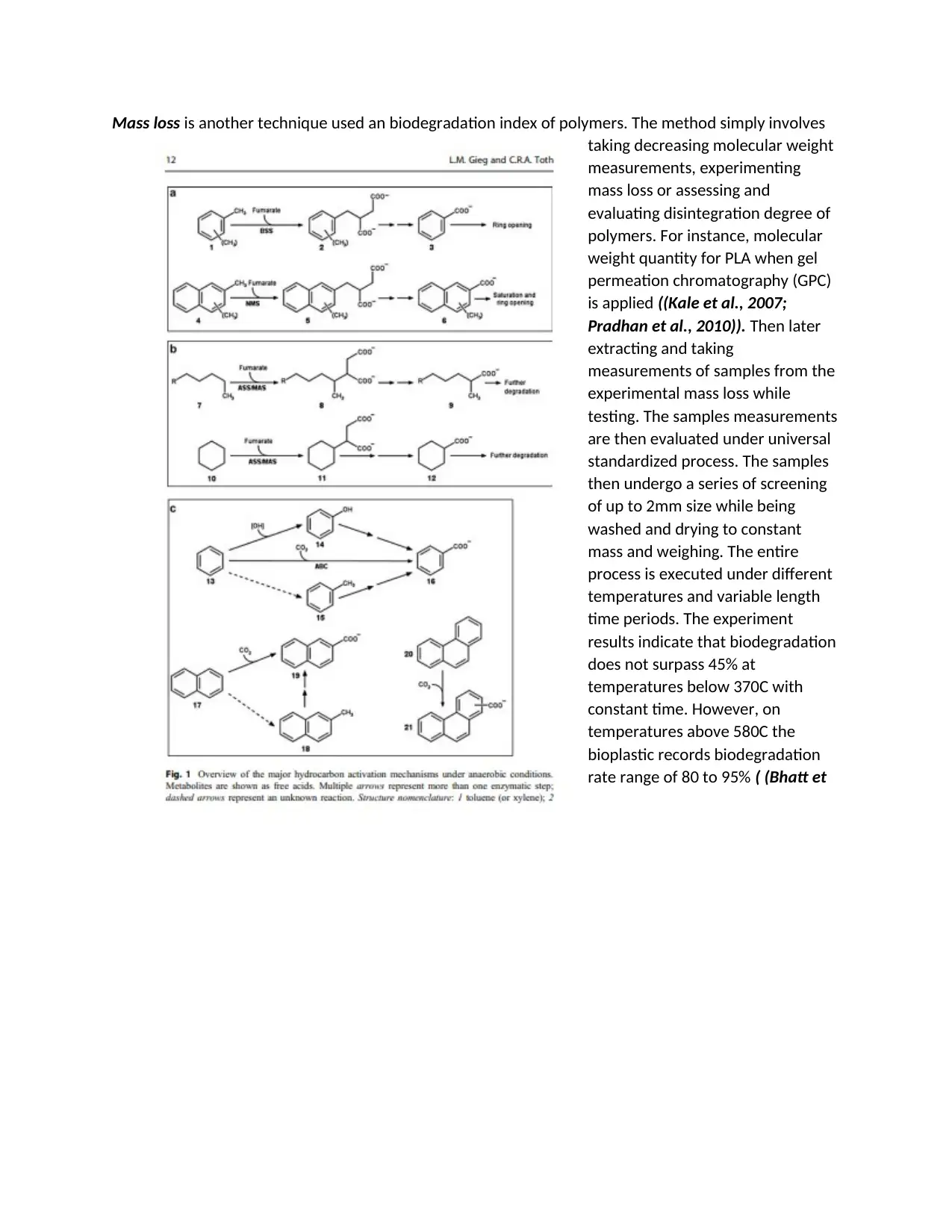
Anaerobic hydrocarbon metabolism is another methodological approach used in anaerobic
biodegradation of various hydrocarbon compounds such as alkanes, polycyclic aromatic hydrocarbons
(PAHs), and mono-aromatic hydrocarbons (Biochemistry of Anaerobic Degradation of Hydrocarbons;
Meckenstock et al., 2016). The Anaerobic hydrocarbon metabolism process is regulated by principles
Document Page
developed deep study in greatly enhanced cultures or isolation of pure cultures from environments that
endure hydrocarbons while including bacteria reducing chemical such as nitrates and sulfates (Stagars et
al. 2016). Well enhanced methanogenic principles coupled with syntrophic convert hydrocarbons to
methane as confirmed in the study of Jiménez et al. (2016) to evaluate conditioned bio-conversion of
hydrocarbons. For instance, activation of hydrocarbons under anoxic conditions case is the degradation
of ethylbenzene with nitrate-reducing bacteria condition through either hydroxylation or carboxylation
as the primary activation techniques for the irreplaceable aromatics like phenanthrene, naphthalene,
and benzene (Meckenstock et al. 2016).
Document Page
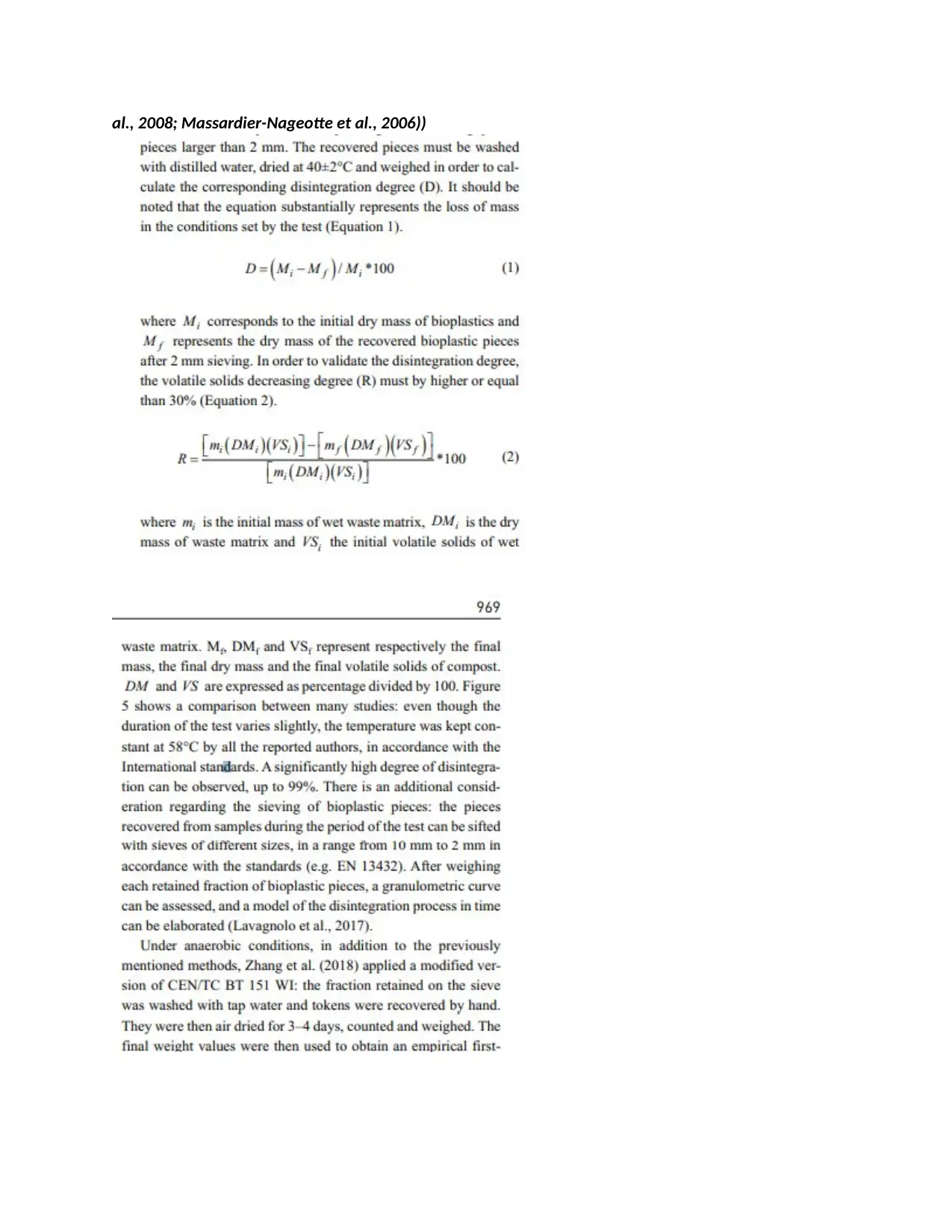
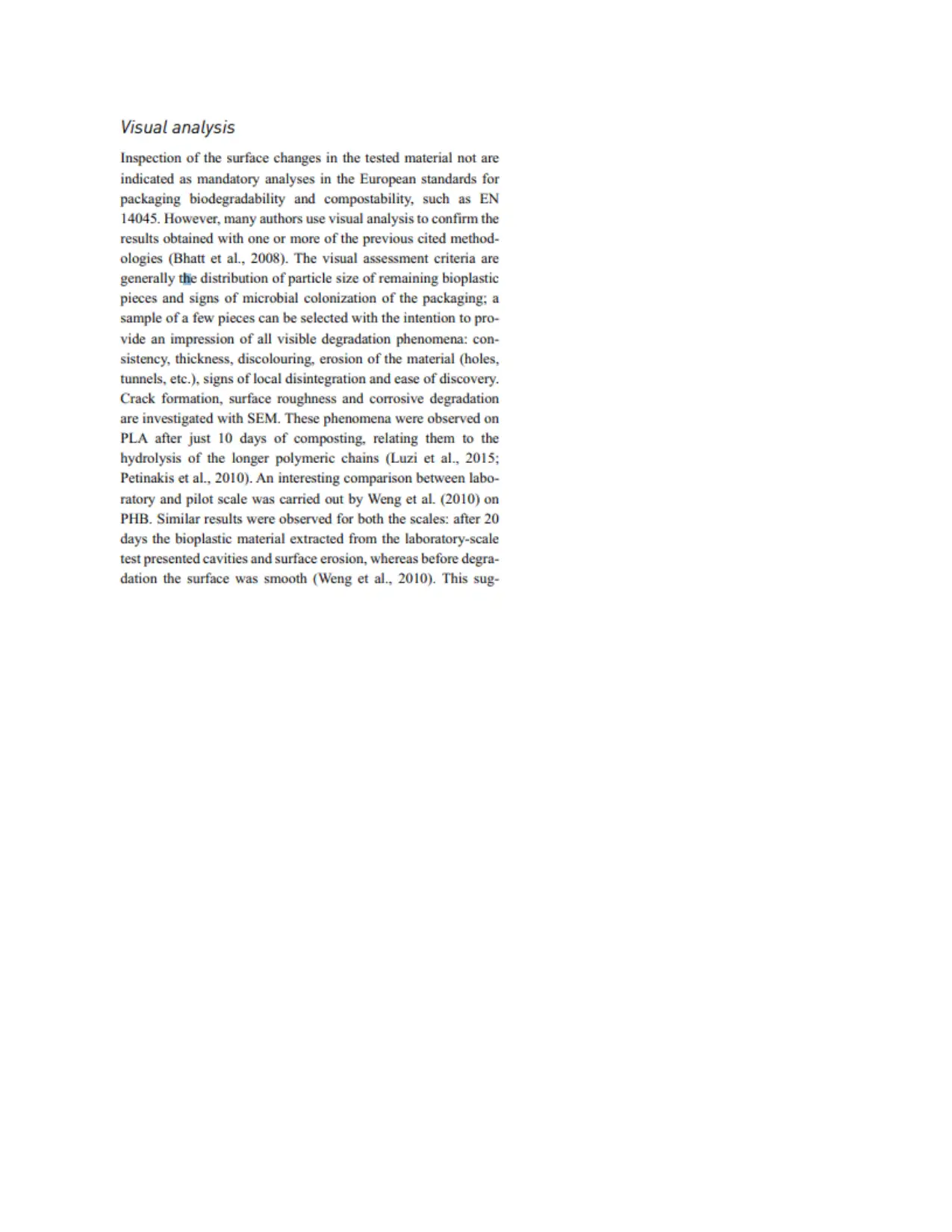
Mass loss is another technique used an biodegradation index of polymers. The method simply involves
taking decreasing molecular weight
measurements, experimenting
mass loss or assessing and
evaluating disintegration degree of
polymers. For instance, molecular
weight quantity for PLA when gel
permeation chromatography (GPC)
is applied ((Kale et al., 2007;
Pradhan et al., 2010)). Then later
extracting and taking
measurements of samples from the
experimental mass loss while
testing. The samples measurements
are then evaluated under universal
standardized process. The samples
then undergo a series of screening
of up to 2mm size while being
washed and drying to constant
mass and weighing. The entire
process is executed under different
temperatures and variable length
time periods. The experiment
results indicate that biodegradation
does not surpass 45% at
temperatures below 370C with
constant time. However, on
temperatures above 580C the
bioplastic records biodegradation
rate range of 80 to 95% ( (Bhatt et
tabler-icon-diamond-filled.svg

Paraphrase This Document

Need a fresh take? Get an instant paraphrase of this document with our AI Paraphraser
Document Page
al., 2008; Massardier-Nageotte et al., 2006))
Document Page
chevron_up_icon
1 out of 6
circle_padding
hide_on_mobile
zoom_out_icon
[object Object]