Microbiology Report: Analyzing Disease Spread and Occurrence Patterns

Verified

Added on  2022/08/12

|4
|412
|15
Report
AI Summary
This microbiology assignment explores the characteristics and differences between various types of diseases. It defines and differentiates between sporadic, endemic, epidemic, and pandemic diseases. The assignment provides examples of each disease type, such as tetanus (sporadic), malaria (endemic), whooping cough (epidemic), and the Coronavirus (pandemic). It examines the geographic spread and impact of each type of disease, providing insights into their occurrence patterns and the factors that influence their spread. The assignment is designed to enhance understanding of disease dynamics and public health implications. The assignment is a valuable resource for students studying microbiology.
Document Page
Running head: MICROBIOLOGY 1
Microbiology
Name
Institution
tabler-icon-diamond-filled.svg

Paraphrase This Document

Need a fresh take? Get an instant paraphrase of this document with our AI Paraphraser
Document Page
MICROBIOLOGY 2
Microbiology
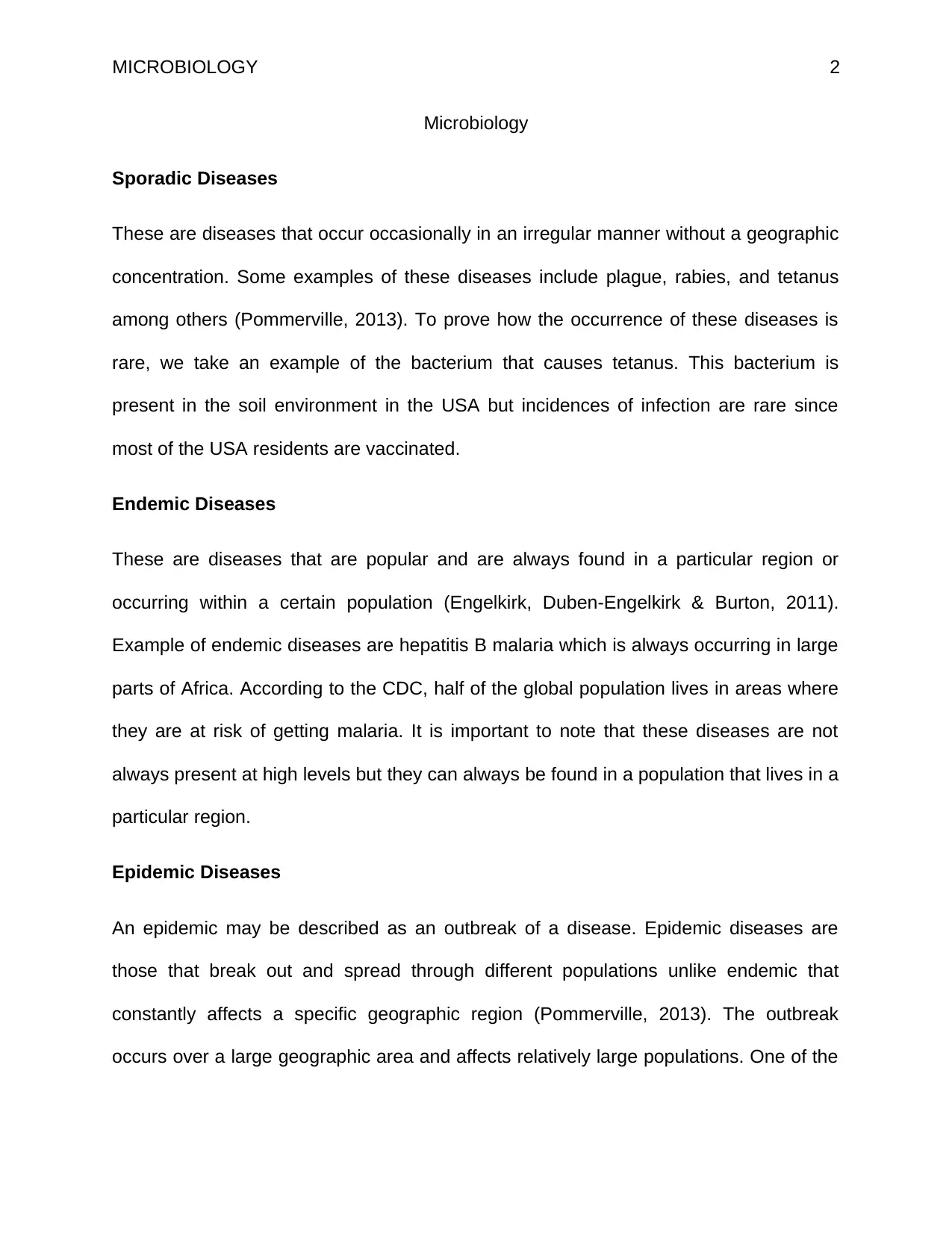
Sporadic Diseases
These are diseases that occur occasionally in an irregular manner without a geographic
concentration. Some examples of these diseases include plague, rabies, and tetanus
among others (Pommerville, 2013). To prove how the occurrence of these diseases is
rare, we take an example of the bacterium that causes tetanus. This bacterium is
present in the soil environment in the USA but incidences of infection are rare since
most of the USA residents are vaccinated.
Endemic Diseases
These are diseases that are popular and are always found in a particular region or
occurring within a certain population (Engelkirk, Duben-Engelkirk & Burton, 2011).
Example of endemic diseases are hepatitis B malaria which is always occurring in large
parts of Africa. According to the CDC, half of the global population lives in areas where
they are at risk of getting malaria. It is important to note that these diseases are not
always present at high levels but they can always be found in a population that lives in a
particular region.
Epidemic Diseases
An epidemic may be described as an outbreak of a disease. Epidemic diseases are
those that break out and spread through different populations unlike endemic that
constantly affects a specific geographic region (Pommerville, 2013). The outbreak
occurs over a large geographic area and affects relatively large populations. One of the
Document Page
MICROBIOLOGY 3
most recent epidemics in the history of the USA is whooping cough that affected over
10,000 infants.
Pandemic Diseases
A pandemic can be described as an infectious disease that spreads over very large
geographical areas like countries or continents affecting a very huge number of people.
They occur in epidemic proportions across different continent worldwide at about the
same time (Engelkirk et al., 2011). It is important to note that the severity of a disease
does not justify whether it is a pandemic; the geographic spread does. One of the most
recent pandemics is Coronavirus.
Document Page
MICROBIOLOGY 4
References
Engelkirk, P. G., Duben-Engelkirk, J. L., & Burton, G. R. W. (2011). Burton's
microbiology for the health sciences. Lippincott Williams & Wilkins.
Pommerville, J. C. (2013). Fundamentals of microbiology. Jones & Bartlett Publishers.
chevron_up_icon
1 out of 4
circle_padding
hide_on_mobile
zoom_out_icon
[object Object]