Exploring Demand, Supply, and Market Structure: An Economic View

Verified

Added on  2023/06/12

|11
|787
|129
Essay
AI Summary
This essay delves into microeconomic concepts, focusing on demand and supply theories and various market structures, to analyze economic trends and business environments. It discusses the impact of factors like customer behavior, employee availability, media influence, competition levels, and investor confidence on organizational profitability and market share. The essay explains how price fluctuations affect demand and supply dynamics, referencing the impact of trampoline price increases as an example. Different market structures, including perfect competition, monopoly, monopolistic competition, and oligopoly, are examined to understand diverse service and manufacturing areas. Ultimately, the essay concludes that understanding microeconomic principles is crucial for comprehending economic trends and the effects of market dynamics on business operations. Desklib provides access to a variety of study resources including solved assignments and past papers.

Document Page
Economic concepts and
models
tabler-icon-diamond-filled.svg

Paraphrase This Document

Need a fresh take? Get an instant paraphrase of this document with our AI Paraphraser
Document Page
Table of content
INTRODUCTION
MAIN BODY
Discussing main arguments related to article by taking use of micro economic
concepts.
Explaining the theory of demand & supply and market structure
CONCLUSION
References
Document Page
INTRODUCTION
The business environment is the sum total of all internal and
external elements that influence how a firm operates, either
directly or indirectly. The business environment involves the
factors of employees, customer needs, supply and demand,
management government and many more. With the help of
business environment business opportunities are identified, assists
in planning, and improves overall performance, growth and
business profitability. For any business business environment is
mos important aspects (Kochan, and et.al., 2018).
Document Page
Describing main arguments relating to the
article by using the micro economic concepts.
The following are the factors which is been discussed-
Impact of customers- For an organisation customers are considered as backbone as they
helps in supporting organisation profitability. The increase in product prices makes
difficult for customer in selection of same brand or product they are purchasing currently.
Availability of employees- The business run smoothly when employees work for the
organisation benefit by performing their role with full efficiency and effectiveness. The
organisation requires skilled and expert staff or employees who can handle work with
ease whether the company is working in technical industry or manufacturing industry.
tabler-icon-diamond-filled.svg

Paraphrase This Document

Need a fresh take? Get an instant paraphrase of this document with our AI Paraphraser
Document Page
Continue…
Media and general public- They serve as the company's face because they are familiar
with the product in terms of purchase and consumption, which aids in brand awareness and
image.
Level of competition- The market and competition level in which organisation functions
affects directly and its market share. The product demand is on high scale which is signified
with the large number of customers.
Availability of investors- Shareholders and investors invest funds in the company for the
purpose of receiving dividends.
Document Page
Explaining the theory of demand & supply and market
structure.
The impact of trampoline price increases has been demonstrated in the preceding article,
which may be interpreted using a variety of microeconomic principles.
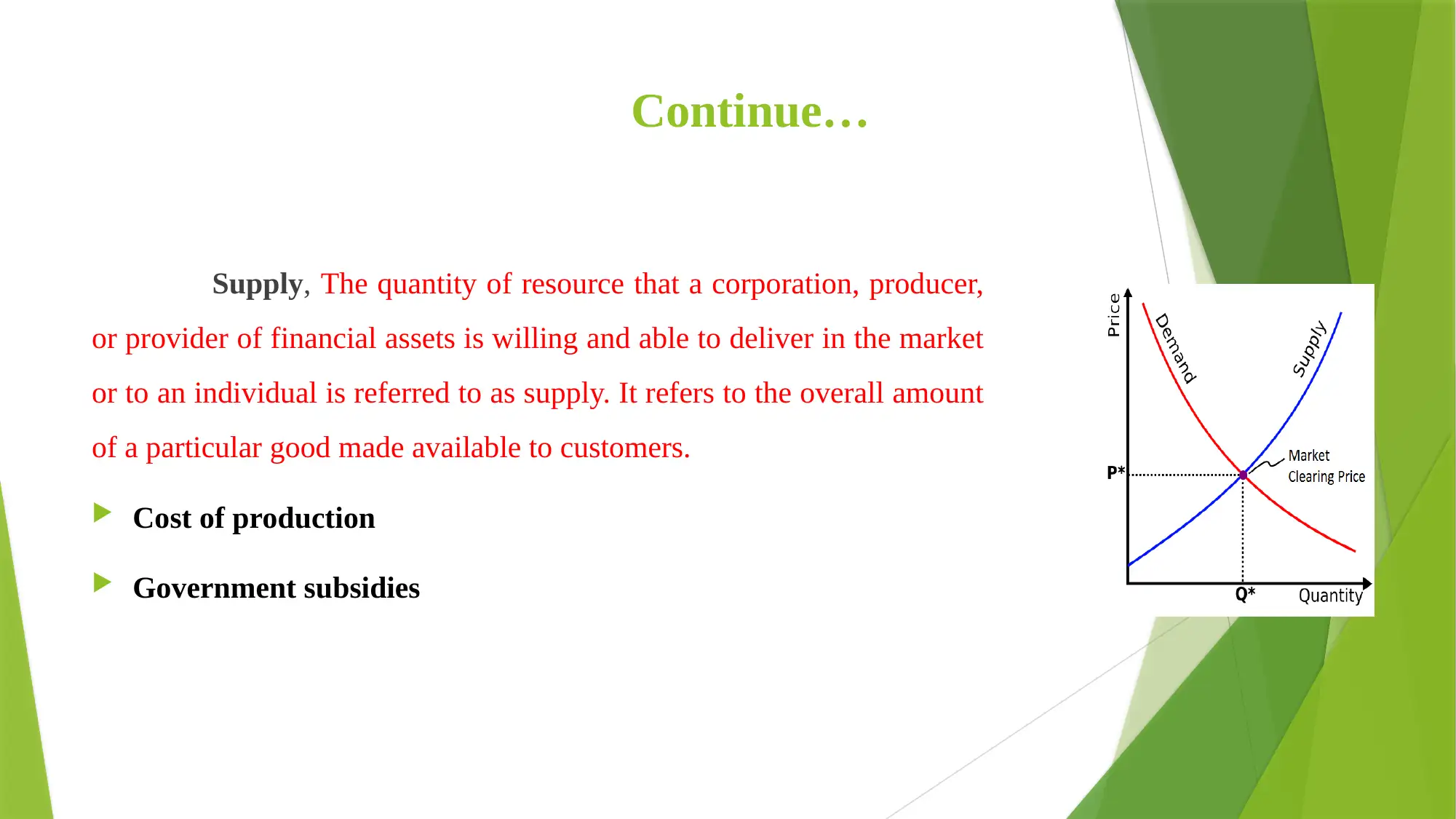
Demand and supply- - This theory explains relationship between price for given goods and
willingness of people for buy or sell. In the terms of economics, demand defines to quantity of good
which consumers is willing and wants to but at several prices during a given time period.
Price of commodity
Consumer income
Document Page
Continue…
Supply, The quantity of resource that a corporation, producer,
or provider of financial assets is willing and able to deliver in the market
or to an individual is referred to as supply. It refers to the overall amount
of a particular good made available to customers.
Cost of production
Government subsidies
tabler-icon-diamond-filled.svg

Paraphrase This Document

Need a fresh take? Get an instant paraphrase of this document with our AI Paraphraser
Document Page
Market structure
In economics, market structure defines how diverse industries is classified and differentiated
on basis of degree and nature of competition for product and services. There are several factors which
determines market structure which involves number of buyers and sellers, degree of concentration,
degree of differentiated product etc. The types of market structure are as follows-
Perfect competition
Monopoly market
Monopolistic competition
Oligopolistic market
Document Page
CONCLUSION
From the above it is concluded that study of microeconomic concepts helps in
understanding economic trends and several factors. Due to change in the price there was
the major impact through which there was fluctuation in demand and supply in particular
market. The study of various market structures aids in the understanding of many service
and manufacturing areas. The rate of inflation has risen, labor availability has increased,
and the economy's productive activities have decreased.
Document Page
REFERENCES
Kochan, and et.al., 2018. Impact of cloud-based information sharing on hospital supply
chain performance: A system dynamics framework. International Journal of Production
Economics. 195. pp.168-185.
Misra, and et.al., 2021. Integration of Supply and Demand Side Management Using
Renewable Power Sources: Application on an Air Separation Plant. Industrial &
Engineering Chemistry Research.60(9).pp.3670-3686.
Shadrina, E., 2018. The Common Gas Market of the Eurasian Economic Union: Progress
and Prospects for Institutionalization. Region.7(1). pp.105-138.
Tian, H., 2018. Role of capital market to accelerate the transition to low-carbon energy
system. In Financing for low-carbon energy transition (pp. 211-238). Springer,
Singapore.
tabler-icon-diamond-filled.svg

Paraphrase This Document

Need a fresh take? Get an instant paraphrase of this document with our AI Paraphraser
Document Page
THANK YOU
chevron_up_icon
1 out of 11
circle_padding
hide_on_mobile
zoom_out_icon
[object Object]