Microeconomics Assignment 8: Single-Price Monopoly, Trade, and Tariffs

Verified

Added on  2019/09/18

|5
|955
|395
Homework Assignment
AI Summary
This microeconomics assignment explores the concepts of single-price monopolies, market structures, and international trade. Part A analyzes a single-price monopoly, examining profit maximization (MR=MC), output and pricing decisions, and the economic implications of such a market structure. It also contrasts a monopoly with a perfectly competitive market, highlighting differences in barriers to entry, long-run profits, and price-setting power. Part B delves into international trade, comparing the effects of tariffs and quotas on consumers. It demonstrates how consumers benefit more from quotas than tariffs. The assignment also calculates opportunity costs and explains the basis for trade between two countries, emphasizing how consumers in Panama can benefit from trading gloves and hats with Russia due to comparative advantage. The solution includes references to relevant academic articles.
Document Page
Running Head: MICROECONOMICS
MICROECONOMICS
ASSIGNMENT 8
tabler-icon-diamond-filled.svg

Paraphrase This Document

Need a fresh take? Get an instant paraphrase of this document with our AI Paraphraser
Document Page
MICROECONOMICS 1
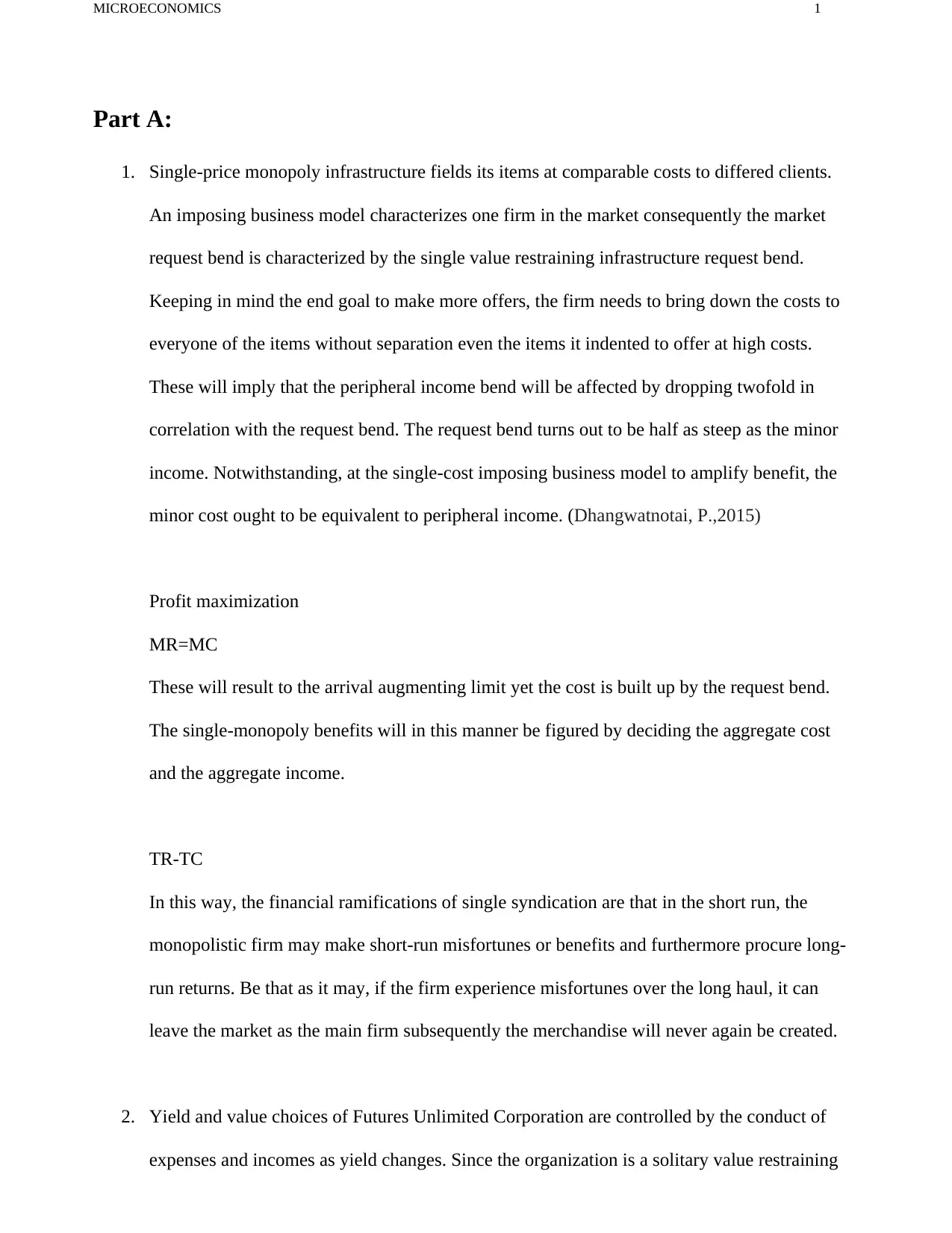
Part A:
1. Single-price monopoly infrastructure fields its items at comparable costs to differed clients.
An imposing business model characterizes one firm in the market consequently the market
request bend is characterized by the single value restraining infrastructure request bend.
Keeping in mind the end goal to make more offers, the firm needs to bring down the costs to
everyone of the items without separation even the items it indented to offer at high costs.
These will imply that the peripheral income bend will be affected by dropping twofold in
correlation with the request bend. The request bend turns out to be half as steep as the minor
income. Notwithstanding, at the single-cost imposing business model to amplify benefit, the
minor cost ought to be equivalent to peripheral income. (Dhangwatnotai, P.,2015)
Profit maximization
MR=MC
These will result to the arrival augmenting limit yet the cost is built up by the request bend.
The single-monopoly benefits will in this manner be figured by deciding the aggregate cost
and the aggregate income.
TR-TC
In this way, the financial ramifications of single syndication are that in the short run, the
monopolistic firm may make short-run misfortunes or benefits and furthermore procure long-
run returns. Be that as it may, if the firm experience misfortunes over the long haul, it can
leave the market as the main firm subsequently the merchandise will never again be created.
2. Yield and value choices of Futures Unlimited Corporation are controlled by the conduct of
expenses and incomes as yield changes. Since the organization is a solitary value restraining
Document Page
MICROECONOMICS 2
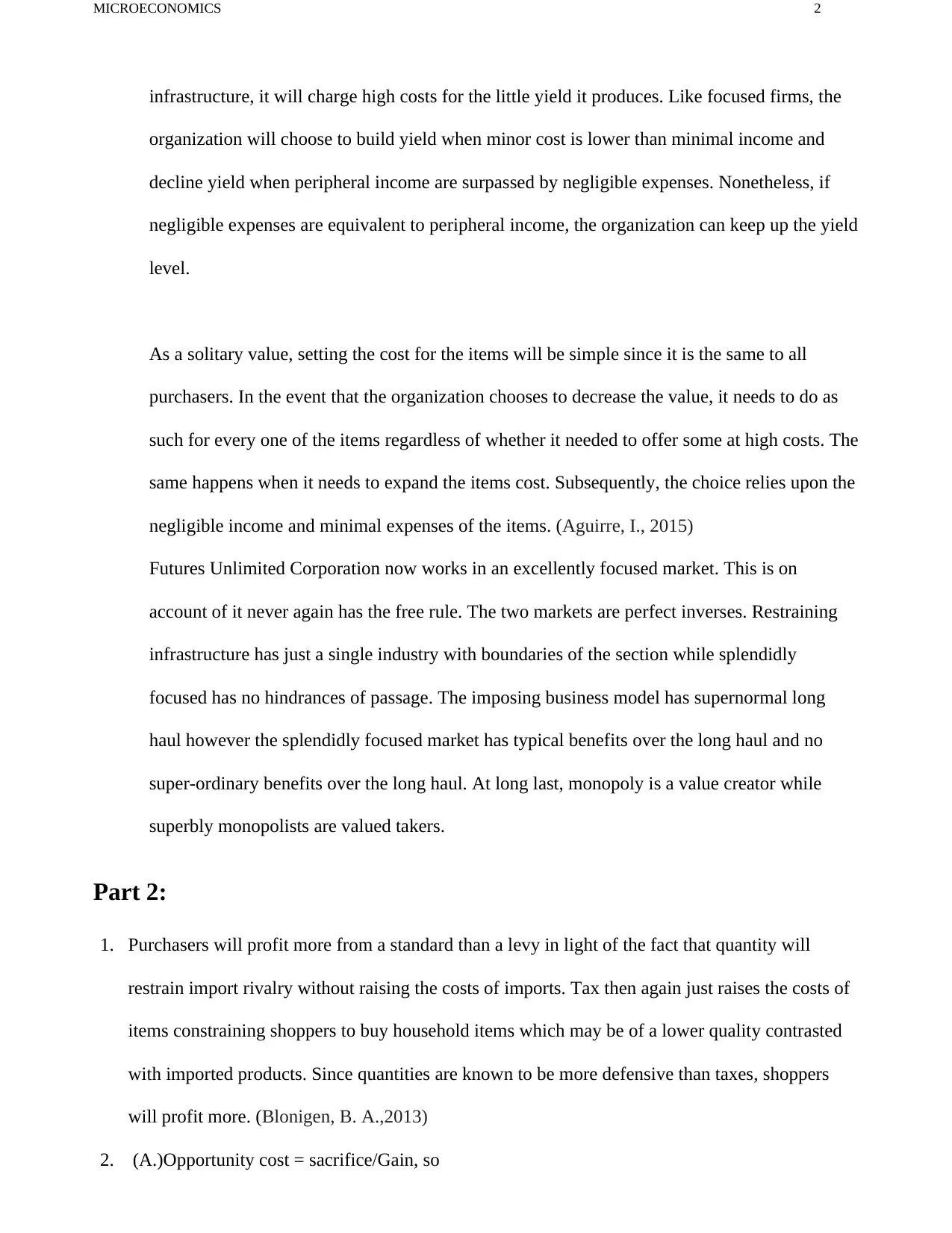
infrastructure, it will charge high costs for the little yield it produces. Like focused firms, the
organization will choose to build yield when minor cost is lower than minimal income and
decline yield when peripheral income are surpassed by negligible expenses. Nonetheless, if
negligible expenses are equivalent to peripheral income, the organization can keep up the yield
level.
As a solitary value, setting the cost for the items will be simple since it is the same to all
purchasers. In the event that the organization chooses to decrease the value, it needs to do as
such for every one of the items regardless of whether it needed to offer some at high costs. The
same happens when it needs to expand the items cost. Subsequently, the choice relies upon the
negligible income and minimal expenses of the items. (Aguirre, I., 2015)
Futures Unlimited Corporation now works in an excellently focused market. This is on
account of it never again has the free rule. The two markets are perfect inverses. Restraining
infrastructure has just a single industry with boundaries of the section while splendidly
focused has no hindrances of passage. The imposing business model has supernormal long
haul however the splendidly focused market has typical benefits over the long haul and no
super-ordinary benefits over the long haul. At long last, monopoly is a value creator while
superbly monopolists are valued takers.
Part 2:
1. Purchasers will profit more from a standard than a levy in light of the fact that quantity will
restrain import rivalry without raising the costs of imports. Tax then again just raises the costs of
items constraining shoppers to buy household items which may be of a lower quality contrasted
with imported products. Since quantities are known to be more defensive than taxes, shoppers
will profit more. (Blonigen, B. A.,2013)
2. (A.)Opportunity cost = sacrifice/Gain, so
Document Page
MICROECONOMICS 3
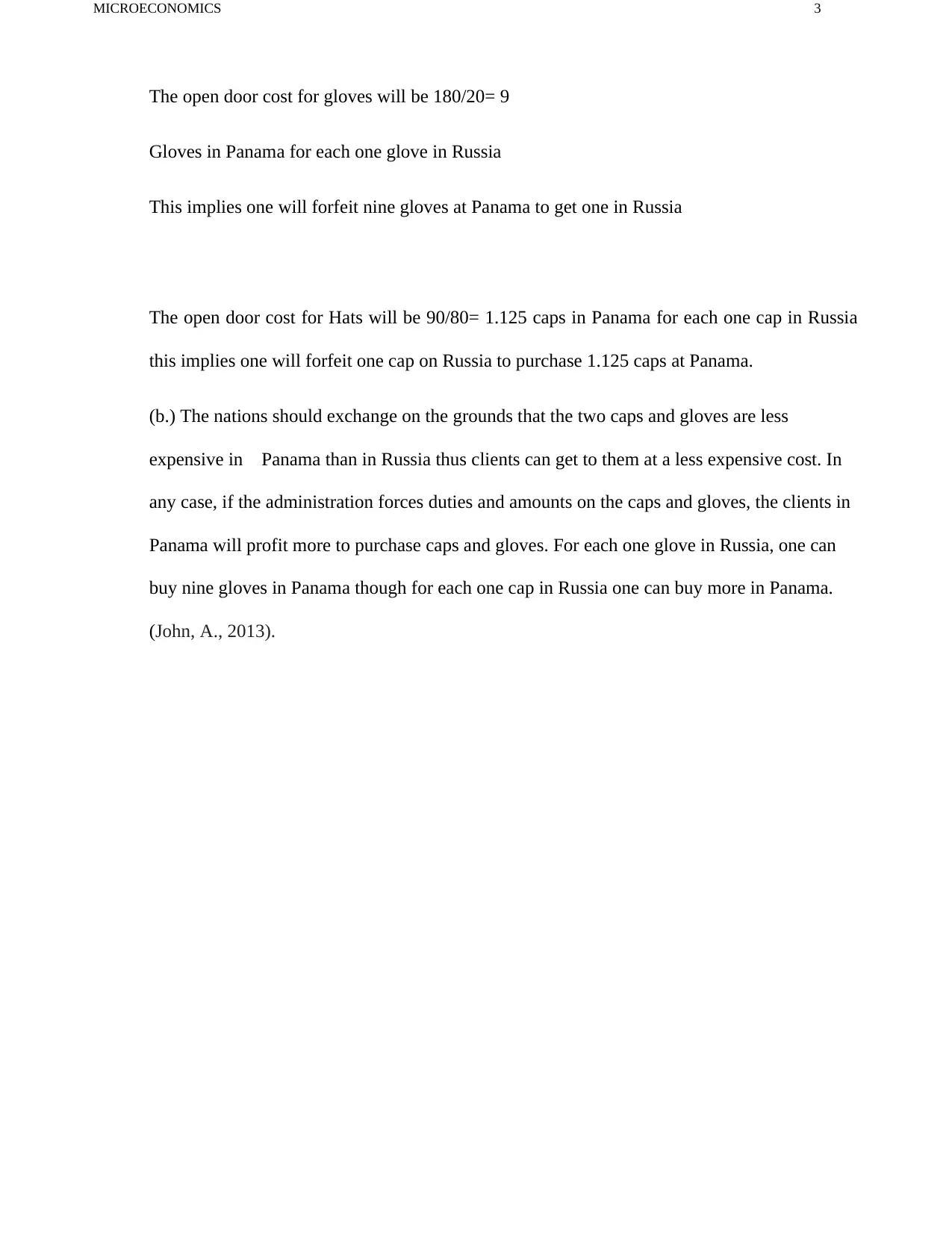
The open door cost for gloves will be 180/20= 9
Gloves in Panama for each one glove in Russia
This implies one will forfeit nine gloves at Panama to get one in Russia
The open door cost for Hats will be 90/80= 1.125 caps in Panama for each one cap in Russia
this implies one will forfeit one cap on Russia to purchase 1.125 caps at Panama.
(b.) The nations should exchange on the grounds that the two caps and gloves are less
expensive in Panama than in Russia thus clients can get to them at a less expensive cost. In
any case, if the administration forces duties and amounts on the caps and gloves, the clients in
Panama will profit more to purchase caps and gloves. For each one glove in Russia, one can
buy nine gloves in Panama though for each one cap in Russia one can buy more in Panama.
(John, A., 2013).
tabler-icon-diamond-filled.svg

Paraphrase This Document

Need a fresh take? Get an instant paraphrase of this document with our AI Paraphraser
Document Page
MICROECONOMICS 4
References
Aguirre, I., & Cowan, S. G. (2015). Monopoly price discrimination with constant elasticity
demand. Economic Theory Bulletin, 3(2), 329-340.
Blonigen, B. A., Liebman, B. H., Pierce, J. R., & Wilson, W. W. (2013). Are all trade protection
policies created equal? Empirical evidence for nonequivalent market power effects of tariffs and
quotas. Journal of International Economics, 89(2), 369-378.
Dhangwatnotai, P., Roughgarden, T., & Yan, Q. (2015). Revenue maximization with a single
sample. Games and Economic Behavior, 91, 318-333.
John, A. (2013). Price relations between export and domestic rice markets in Thailand. Food
Policy, 42, 48-57.
chevron_up_icon
1 out of 5
circle_padding
hide_on_mobile
zoom_out_icon
[object Object]