Microeconomics Analysis: Airline Duopoly and Starbucks Strategy
VerifiedAdded on 2020/07/22
|10
|2191
|105
Homework Assignment
AI Summary
This microeconomics assignment delves into key concepts such as perfect competition, monopolistic competition, and market structures. It analyzes a duopoly game involving two airlines, Jet Star and Tiger, exploring payoff matrices, dominant strategies, Nash equilibrium, and the prisoner's dilemma. The assignment then examines Starbucks' competitive strategies, evaluating its short-run and long-run performance in a monopolistic competitive market. It assesses Starbucks' efficiency, excess capacity, and ability to maintain customer satisfaction through product differentiation. The report utilizes illustrations to depict the short-run and long-run competitive strategies of Starbucks, concluding with an overview of microeconomic principles and their practical applications in business decision-making. The analysis underscores the importance of microeconomics in understanding market dynamics and formulating effective business strategies.
Microeconomics

Paraphrase This Document
Need a fresh take? Get an instant paraphrase of this document with our AI Paraphraser
Table of Contents
INTRODUCTION...........................................................................................................................3
SECTION A.....................................................................................................................................3
SECTION B.....................................................................................................................................4
Q. 21............................................................................................................................................4
a) Pay-off matrix duopoly game.................................................................................................4
b) Dominant strategy and each firm's dominant strategy............................................................5
c) Net equilibrium.......................................................................................................................5
d) Prisoner's dilemma game........................................................................................................5
Q. 22............................................................................................................................................5
a) Short run profit for Starbucks competitive strategy................................................................5
b) Long run monopolistic competition for Starbucks ................................................................6
c) Starbucks performance............................................................................................................7
d) Efficiency of Starbucks for long term period.........................................................................8
CONCLUSION................................................................................................................................8
REFERENCE...................................................................................................................................9
INTRODUCTION...........................................................................................................................3
SECTION A.....................................................................................................................................3
SECTION B.....................................................................................................................................4
Q. 21............................................................................................................................................4
a) Pay-off matrix duopoly game.................................................................................................4
b) Dominant strategy and each firm's dominant strategy............................................................5
c) Net equilibrium.......................................................................................................................5
d) Prisoner's dilemma game........................................................................................................5
Q. 22............................................................................................................................................5
a) Short run profit for Starbucks competitive strategy................................................................5
b) Long run monopolistic competition for Starbucks ................................................................6
c) Starbucks performance............................................................................................................7
d) Efficiency of Starbucks for long term period.........................................................................8
CONCLUSION................................................................................................................................8
REFERENCE...................................................................................................................................9
Illustration Index
Illustration 1: Short run competitive strategy for Starbucks............................................................6
Illustration 2: Long run competitive strategy for Starbucks............................................................8
Illustration 1: Short run competitive strategy for Starbucks............................................................6
Illustration 2: Long run competitive strategy for Starbucks............................................................8
⊘ This is a preview!⊘
Do you want full access?
Subscribe today to unlock all pages.

Trusted by 1+ million students worldwide
INTRODUCTION
Microeconomics refers as study of economy and any organization's market position to
face competition and maintain its position. However, it is related to present different market
structures and forecasting their position regarding competitiveness. The present report is based
on understanding different aspects of microeconomics including perfect competition and
monopolistic market. However, dominant strategies and equilibrium stages for Jet Star and Tiger
two airlines is to be described for further forecasting. Including this, Starbucks' perfect
competitive market strategy and its efficiency can be introduced for further decision making
process and its competitiveness. Thus, learners are able to understand key tools of
microeconomics and different market structures through this report.
SECTION A
Serial
number
Option Answer
1 (A) Long run output of perfect-competitive firm is less than long run
output of monopolistic competitive market. It is because demand
elasticity.
2 (D) There will be no impact on existing profit earning companies for
entrance of new entities. However, market supply will increase as
well demand for products would be enhanced.
3 (A) Price discrimination in monopolist happens when company
changes price to various group of customers for an identical
product or services. However, it is not related with costs of supply.
4 (B)
5 (A) Environment of common goods is rival and non-excludable
because consumption of product by one person is prevented by
other as rivalrousness. However, prevents people who do not paid
for having excludability.
6 (B) Marginal cost is considered as cost of next producing unit, when it
goes down, average variable cost also get decreased. Therefore,
Microeconomics refers as study of economy and any organization's market position to
face competition and maintain its position. However, it is related to present different market
structures and forecasting their position regarding competitiveness. The present report is based
on understanding different aspects of microeconomics including perfect competition and
monopolistic market. However, dominant strategies and equilibrium stages for Jet Star and Tiger
two airlines is to be described for further forecasting. Including this, Starbucks' perfect
competitive market strategy and its efficiency can be introduced for further decision making
process and its competitiveness. Thus, learners are able to understand key tools of
microeconomics and different market structures through this report.
SECTION A
Serial
number
Option Answer
1 (A) Long run output of perfect-competitive firm is less than long run
output of monopolistic competitive market. It is because demand
elasticity.
2 (D) There will be no impact on existing profit earning companies for
entrance of new entities. However, market supply will increase as
well demand for products would be enhanced.
3 (A) Price discrimination in monopolist happens when company
changes price to various group of customers for an identical
product or services. However, it is not related with costs of supply.
4 (B)
5 (A) Environment of common goods is rival and non-excludable
because consumption of product by one person is prevented by
other as rivalrousness. However, prevents people who do not paid
for having excludability.
6 (B) Marginal cost is considered as cost of next producing unit, when it
goes down, average variable cost also get decreased. Therefore,
Paraphrase This Document
Need a fresh take? Get an instant paraphrase of this document with our AI Paraphraser
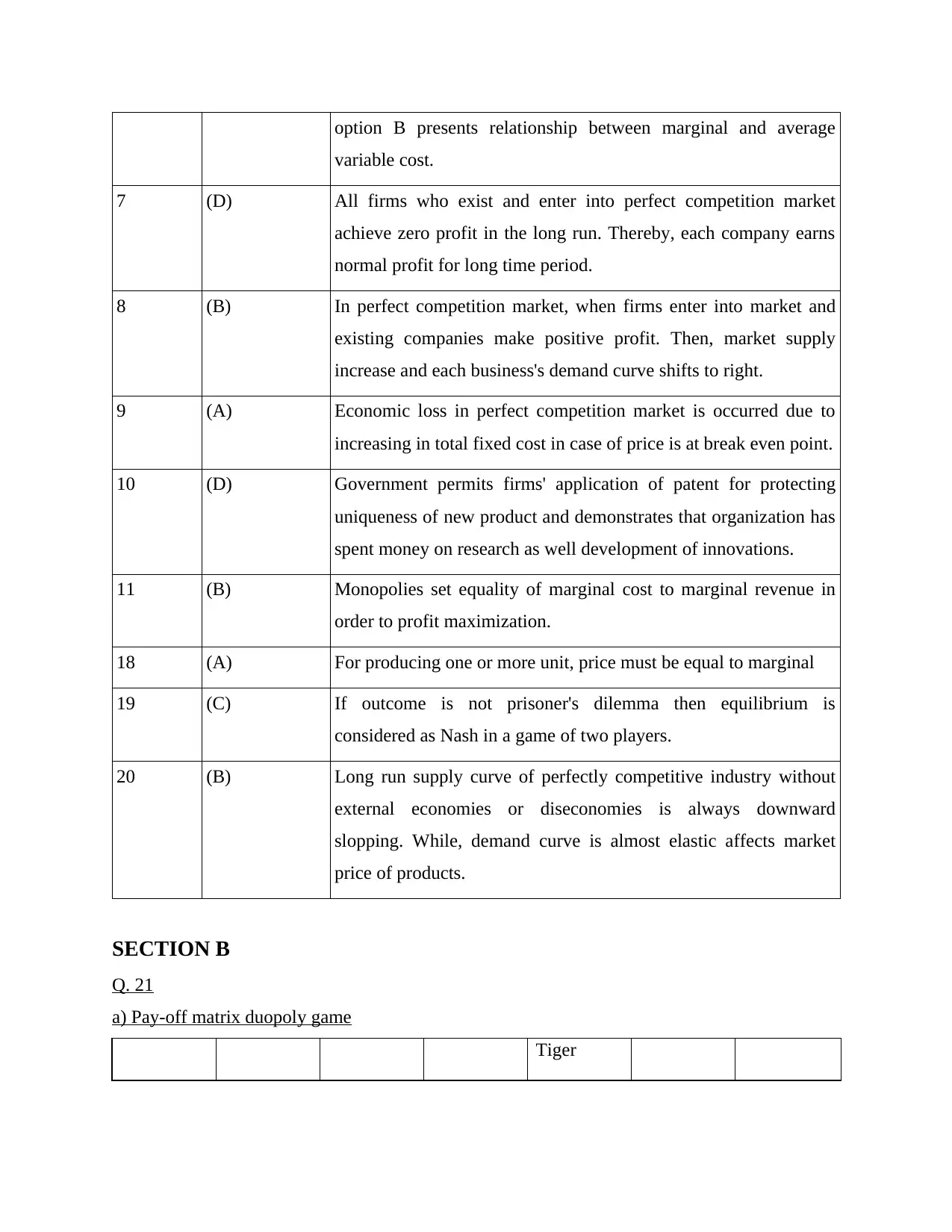
option B presents relationship between marginal and average
variable cost.
7 (D) All firms who exist and enter into perfect competition market
achieve zero profit in the long run. Thereby, each company earns
normal profit for long time period.
8 (B) In perfect competition market, when firms enter into market and
existing companies make positive profit. Then, market supply
increase and each business's demand curve shifts to right.
9 (A) Economic loss in perfect competition market is occurred due to
increasing in total fixed cost in case of price is at break even point.
10 (D) Government permits firms' application of patent for protecting
uniqueness of new product and demonstrates that organization has
spent money on research as well development of innovations.
11 (B) Monopolies set equality of marginal cost to marginal revenue in
order to profit maximization.
18 (A) For producing one or more unit, price must be equal to marginal
19 (C) If outcome is not prisoner's dilemma then equilibrium is
considered as Nash in a game of two players.
20 (B) Long run supply curve of perfectly competitive industry without
external economies or diseconomies is always downward
slopping. While, demand curve is almost elastic affects market
price of products.
SECTION B
Q. 21
a) Pay-off matrix duopoly game
Tiger
variable cost.
7 (D) All firms who exist and enter into perfect competition market
achieve zero profit in the long run. Thereby, each company earns
normal profit for long time period.
8 (B) In perfect competition market, when firms enter into market and
existing companies make positive profit. Then, market supply
increase and each business's demand curve shifts to right.
9 (A) Economic loss in perfect competition market is occurred due to
increasing in total fixed cost in case of price is at break even point.
10 (D) Government permits firms' application of patent for protecting
uniqueness of new product and demonstrates that organization has
spent money on research as well development of innovations.
11 (B) Monopolies set equality of marginal cost to marginal revenue in
order to profit maximization.
18 (A) For producing one or more unit, price must be equal to marginal
19 (C) If outcome is not prisoner's dilemma then equilibrium is
considered as Nash in a game of two players.
20 (B) Long run supply curve of perfectly competitive industry without
external economies or diseconomies is always downward
slopping. While, demand curve is almost elastic affects market
price of products.
SECTION B
Q. 21
a) Pay-off matrix duopoly game
Tiger
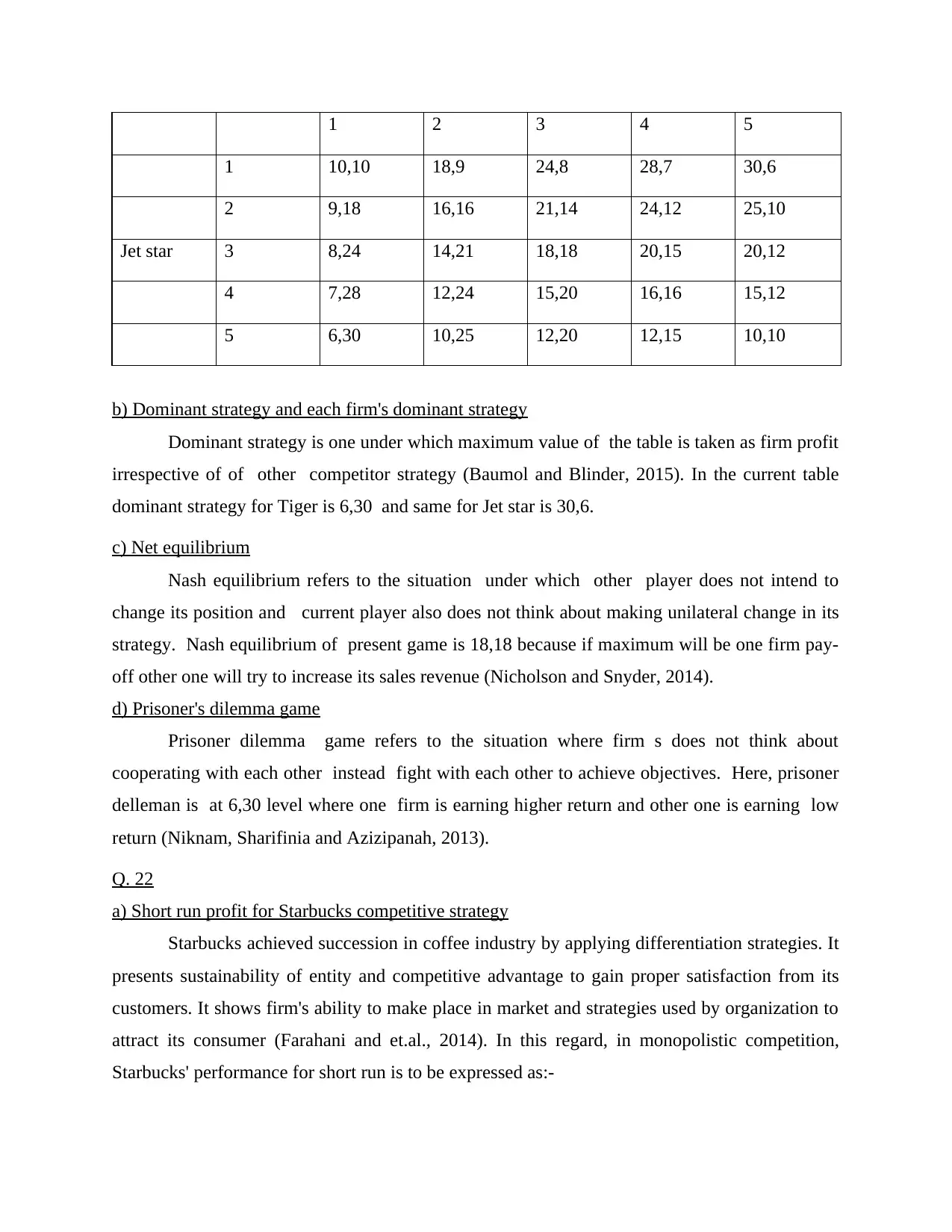
1 2 3 4 5
1 10,10 18,9 24,8 28,7 30,6
2 9,18 16,16 21,14 24,12 25,10
Jet star 3 8,24 14,21 18,18 20,15 20,12
4 7,28 12,24 15,20 16,16 15,12
5 6,30 10,25 12,20 12,15 10,10
b) Dominant strategy and each firm's dominant strategy
Dominant strategy is one under which maximum value of the table is taken as firm profit
irrespective of of other competitor strategy (Baumol and Blinder, 2015). In the current table
dominant strategy for Tiger is 6,30 and same for Jet star is 30,6.
c) Net equilibrium
Nash equilibrium refers to the situation under which other player does not intend to
change its position and current player also does not think about making unilateral change in its
strategy. Nash equilibrium of present game is 18,18 because if maximum will be one firm pay-
off other one will try to increase its sales revenue (Nicholson and Snyder, 2014).
d) Prisoner's dilemma game
Prisoner dilemma game refers to the situation where firm s does not think about
cooperating with each other instead fight with each other to achieve objectives. Here, prisoner
delleman is at 6,30 level where one firm is earning higher return and other one is earning low
return (Niknam, Sharifinia and Azizipanah, 2013).
Q. 22
a) Short run profit for Starbucks competitive strategy
Starbucks achieved succession in coffee industry by applying differentiation strategies. It
presents sustainability of entity and competitive advantage to gain proper satisfaction from its
customers. It shows firm's ability to make place in market and strategies used by organization to
attract its consumer (Farahani and et.al., 2014). In this regard, in monopolistic competition,
Starbucks' performance for short run is to be expressed as:-
1 10,10 18,9 24,8 28,7 30,6
2 9,18 16,16 21,14 24,12 25,10
Jet star 3 8,24 14,21 18,18 20,15 20,12
4 7,28 12,24 15,20 16,16 15,12
5 6,30 10,25 12,20 12,15 10,10
b) Dominant strategy and each firm's dominant strategy
Dominant strategy is one under which maximum value of the table is taken as firm profit
irrespective of of other competitor strategy (Baumol and Blinder, 2015). In the current table
dominant strategy for Tiger is 6,30 and same for Jet star is 30,6.
c) Net equilibrium
Nash equilibrium refers to the situation under which other player does not intend to
change its position and current player also does not think about making unilateral change in its
strategy. Nash equilibrium of present game is 18,18 because if maximum will be one firm pay-
off other one will try to increase its sales revenue (Nicholson and Snyder, 2014).
d) Prisoner's dilemma game
Prisoner dilemma game refers to the situation where firm s does not think about
cooperating with each other instead fight with each other to achieve objectives. Here, prisoner
delleman is at 6,30 level where one firm is earning higher return and other one is earning low
return (Niknam, Sharifinia and Azizipanah, 2013).
Q. 22
a) Short run profit for Starbucks competitive strategy
Starbucks achieved succession in coffee industry by applying differentiation strategies. It
presents sustainability of entity and competitive advantage to gain proper satisfaction from its
customers. It shows firm's ability to make place in market and strategies used by organization to
attract its consumer (Farahani and et.al., 2014). In this regard, in monopolistic competition,
Starbucks' performance for short run is to be expressed as:-
⊘ This is a preview!⊘
Do you want full access?
Subscribe today to unlock all pages.
Trusted by 1+ million students worldwide
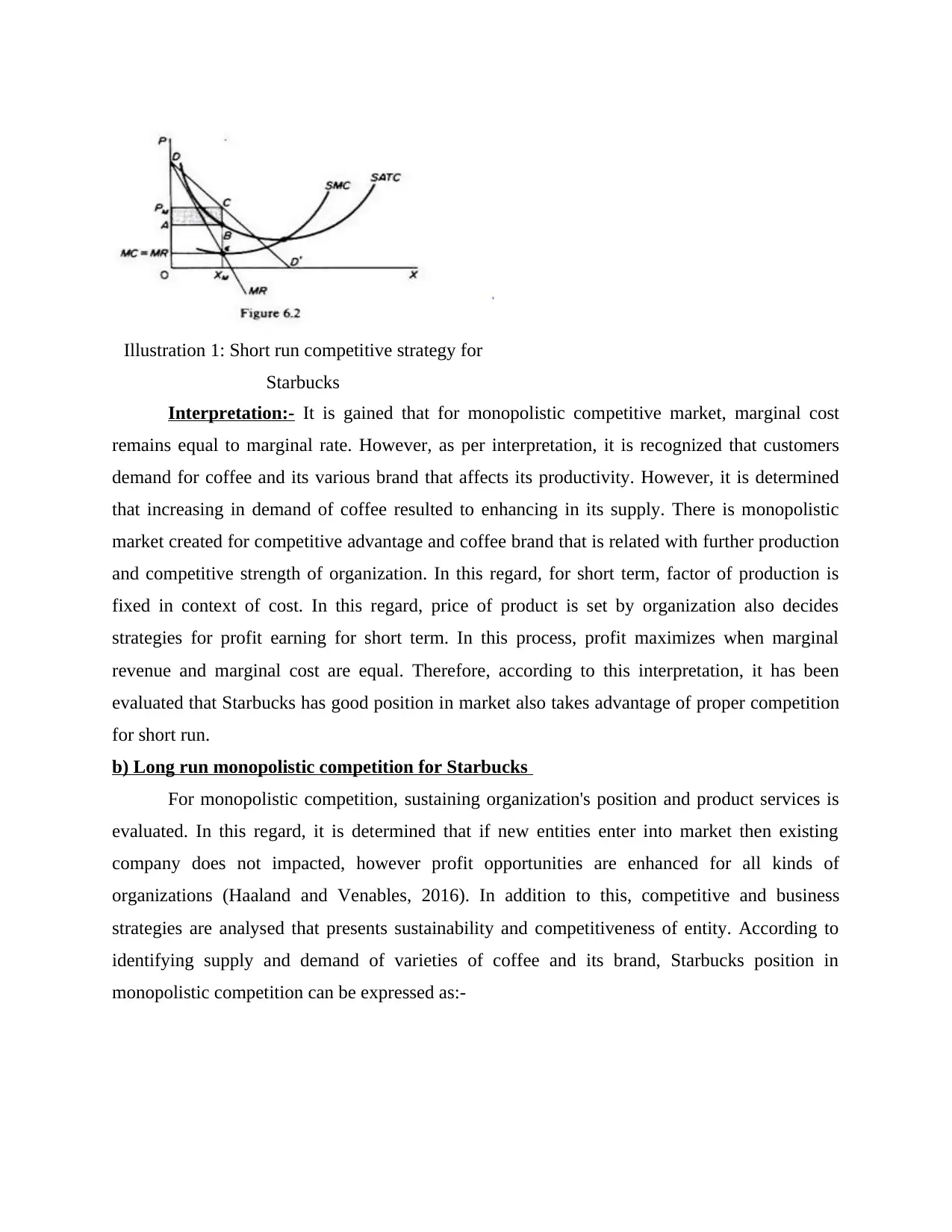
Illustration 1: Short run competitive strategy for
Starbucks
Interpretation:- It is gained that for monopolistic competitive market, marginal cost
remains equal to marginal rate. However, as per interpretation, it is recognized that customers
demand for coffee and its various brand that affects its productivity. However, it is determined
that increasing in demand of coffee resulted to enhancing in its supply. There is monopolistic
market created for competitive advantage and coffee brand that is related with further production
and competitive strength of organization. In this regard, for short term, factor of production is
fixed in context of cost. In this regard, price of product is set by organization also decides
strategies for profit earning for short term. In this process, profit maximizes when marginal
revenue and marginal cost are equal. Therefore, according to this interpretation, it has been
evaluated that Starbucks has good position in market also takes advantage of proper competition
for short run.
b) Long run monopolistic competition for Starbucks
For monopolistic competition, sustaining organization's position and product services is
evaluated. In this regard, it is determined that if new entities enter into market then existing
company does not impacted, however profit opportunities are enhanced for all kinds of
organizations (Haaland and Venables, 2016). In addition to this, competitive and business
strategies are analysed that presents sustainability and competitiveness of entity. According to
identifying supply and demand of varieties of coffee and its brand, Starbucks position in
monopolistic competition can be expressed as:-
Starbucks
Interpretation:- It is gained that for monopolistic competitive market, marginal cost
remains equal to marginal rate. However, as per interpretation, it is recognized that customers
demand for coffee and its various brand that affects its productivity. However, it is determined
that increasing in demand of coffee resulted to enhancing in its supply. There is monopolistic
market created for competitive advantage and coffee brand that is related with further production
and competitive strength of organization. In this regard, for short term, factor of production is
fixed in context of cost. In this regard, price of product is set by organization also decides
strategies for profit earning for short term. In this process, profit maximizes when marginal
revenue and marginal cost are equal. Therefore, according to this interpretation, it has been
evaluated that Starbucks has good position in market also takes advantage of proper competition
for short run.
b) Long run monopolistic competition for Starbucks
For monopolistic competition, sustaining organization's position and product services is
evaluated. In this regard, it is determined that if new entities enter into market then existing
company does not impacted, however profit opportunities are enhanced for all kinds of
organizations (Haaland and Venables, 2016). In addition to this, competitive and business
strategies are analysed that presents sustainability and competitiveness of entity. According to
identifying supply and demand of varieties of coffee and its brand, Starbucks position in
monopolistic competition can be expressed as:-
Paraphrase This Document
Need a fresh take? Get an instant paraphrase of this document with our AI Paraphraser
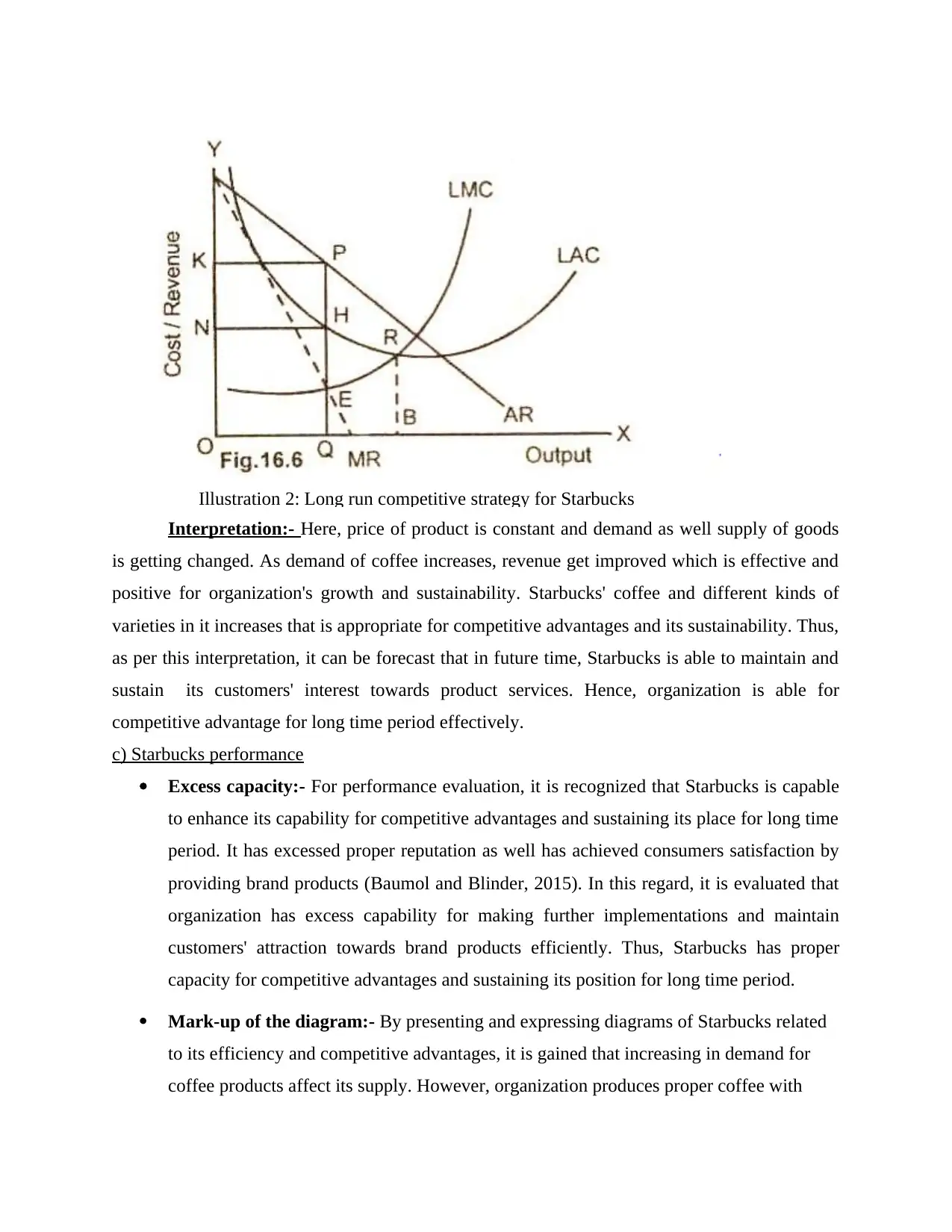
Illustration 2: Long run competitive strategy for Starbucks
Interpretation:- Here, price of product is constant and demand as well supply of goods
is getting changed. As demand of coffee increases, revenue get improved which is effective and
positive for organization's growth and sustainability. Starbucks' coffee and different kinds of
varieties in it increases that is appropriate for competitive advantages and its sustainability. Thus,
as per this interpretation, it can be forecast that in future time, Starbucks is able to maintain and
sustain its customers' interest towards product services. Hence, organization is able for
competitive advantage for long time period effectively.
c) Starbucks performance
Excess capacity:- For performance evaluation, it is recognized that Starbucks is capable
to enhance its capability for competitive advantages and sustaining its place for long time
period. It has excessed proper reputation as well has achieved consumers satisfaction by
providing brand products (Baumol and Blinder, 2015). In this regard, it is evaluated that
organization has excess capability for making further implementations and maintain
customers' attraction towards brand products efficiently. Thus, Starbucks has proper
capacity for competitive advantages and sustaining its position for long time period.
Mark-up of the diagram:- By presenting and expressing diagrams of Starbucks related
to its efficiency and competitive advantages, it is gained that increasing in demand for
coffee products affect its supply. However, organization produces proper coffee with
Interpretation:- Here, price of product is constant and demand as well supply of goods
is getting changed. As demand of coffee increases, revenue get improved which is effective and
positive for organization's growth and sustainability. Starbucks' coffee and different kinds of
varieties in it increases that is appropriate for competitive advantages and its sustainability. Thus,
as per this interpretation, it can be forecast that in future time, Starbucks is able to maintain and
sustain its customers' interest towards product services. Hence, organization is able for
competitive advantage for long time period effectively.
c) Starbucks performance
Excess capacity:- For performance evaluation, it is recognized that Starbucks is capable
to enhance its capability for competitive advantages and sustaining its place for long time
period. It has excessed proper reputation as well has achieved consumers satisfaction by
providing brand products (Baumol and Blinder, 2015). In this regard, it is evaluated that
organization has excess capability for making further implementations and maintain
customers' attraction towards brand products efficiently. Thus, Starbucks has proper
capacity for competitive advantages and sustaining its position for long time period.
Mark-up of the diagram:- By presenting and expressing diagrams of Starbucks related
to its efficiency and competitive advantages, it is gained that increasing in demand for
coffee products affect its supply. However, organization produces proper coffee with
varieties to its consumers at high level. It increases quality services and proper
sustainability to face cut throat competition. In this regard, through analysing diagrams, it
can be forecast that entity will enhance its position in market for long time period
(Farahani and et.al., 2014).
d) Efficiency of Starbucks for long term period
According to above mentioned diagrams and interpretations, it is evaluated that Starbucks has
good position in market also attracts its customers at high level. In accordance to this,
organization's efficiency is determined for competitive advantage and sustainability for long term
period. Including this, it is gained that there is high level of demand for coffee and its various
brand is increased that affects its productivity as well profitability for long run. Besides this,
customers are attracted towards coffee and also demand for products at large scale
(Microeconomics, 2016). It is interrelated with competitive advantages and making place for
long time period. Hence, it is gained that organization's product services enhances its
effectiveness as well efficiencies for competitive advantages for long time periodicity.
CONCLUSION
The report is concluded that microeconomics is essential for acquiring deep knowledge
related to different market structures and their studies. However, monopolistic and perfect
competitive market concepts are presented that affects competitive advantages for their
sustainability. Including this, these market structures and their performances are described with
example of Jet Star- Tiger and Starbucks. In this regard, various tools of microeconomics are
introduced that are interlinked with further competitive advantages through this assignment.
sustainability to face cut throat competition. In this regard, through analysing diagrams, it
can be forecast that entity will enhance its position in market for long time period
(Farahani and et.al., 2014).
d) Efficiency of Starbucks for long term period
According to above mentioned diagrams and interpretations, it is evaluated that Starbucks has
good position in market also attracts its customers at high level. In accordance to this,
organization's efficiency is determined for competitive advantage and sustainability for long term
period. Including this, it is gained that there is high level of demand for coffee and its various
brand is increased that affects its productivity as well profitability for long run. Besides this,
customers are attracted towards coffee and also demand for products at large scale
(Microeconomics, 2016). It is interrelated with competitive advantages and making place for
long time period. Hence, it is gained that organization's product services enhances its
effectiveness as well efficiencies for competitive advantages for long time periodicity.
CONCLUSION
The report is concluded that microeconomics is essential for acquiring deep knowledge
related to different market structures and their studies. However, monopolistic and perfect
competitive market concepts are presented that affects competitive advantages for their
sustainability. Including this, these market structures and their performances are described with
example of Jet Star- Tiger and Starbucks. In this regard, various tools of microeconomics are
introduced that are interlinked with further competitive advantages through this assignment.
⊘ This is a preview!⊘
Do you want full access?
Subscribe today to unlock all pages.
Trusted by 1+ million students worldwide
REFERENCE
Books and Journal
Baumol, W.J. and Blinder, A.S., 2015. Microeconomics: Principles and policy. Cengage
Learning.
Farahani, R.Z. and et.al., 2014. Competitive supply chain network design: An overview of
classifications, models, solution techniques and applications. Omega. 786(6). pp.92-118.
Haaland, J.I. and Venables, A.J., 2016. Optimal trade policy with monopolistic competition and
heterogeneous firms. Journal of International Economics. 89(7). pp.85-95.
McRobbie, A., 2015. Notes on the perfect: competitive femininity in neoliberal times. Australian
Feminist Studies. 67(83). pp.3-20.
Nicholson, W. and Snyder, C.M., 2014. Intermediate microeconomics and its application.
Cengage Learning.
Niknam, T., Sharifinia, S. and Azizipanah-Abarghooee, R., 2013. A new enhanced bat-inspired
algorithm for finding linear supply function equilibrium of GENCOs in the competitive
electricity market. Energy Conversion and Management. 7(6). pp.1015-1028.
Online
Microeconomics. 2016. [online]. Avaialble through:
<https://www.cliffsnotes.com/study-guides/economics/introduction/microeconomics>.
[Accessed on 10th June 2017].
Books and Journal
Baumol, W.J. and Blinder, A.S., 2015. Microeconomics: Principles and policy. Cengage
Learning.
Farahani, R.Z. and et.al., 2014. Competitive supply chain network design: An overview of
classifications, models, solution techniques and applications. Omega. 786(6). pp.92-118.
Haaland, J.I. and Venables, A.J., 2016. Optimal trade policy with monopolistic competition and
heterogeneous firms. Journal of International Economics. 89(7). pp.85-95.
McRobbie, A., 2015. Notes on the perfect: competitive femininity in neoliberal times. Australian
Feminist Studies. 67(83). pp.3-20.
Nicholson, W. and Snyder, C.M., 2014. Intermediate microeconomics and its application.
Cengage Learning.
Niknam, T., Sharifinia, S. and Azizipanah-Abarghooee, R., 2013. A new enhanced bat-inspired
algorithm for finding linear supply function equilibrium of GENCOs in the competitive
electricity market. Energy Conversion and Management. 7(6). pp.1015-1028.
Online
Microeconomics. 2016. [online]. Avaialble through:
<https://www.cliffsnotes.com/study-guides/economics/introduction/microeconomics>.
[Accessed on 10th June 2017].

1 out of 10


Related Documents


Your All-in-One AI-Powered Toolkit for Academic Success.
+13062052269
info@desklib.com
Available 24*7 on WhatsApp / Email
![[object Object]](/_next/static/media/star-bottom.7253800d.svg)
Unlock your academic potential
Copyright © 2020–2026 A2Z Services. All Rights Reserved. Developed and managed by ZUCOL.