Microservices Architecture: Principles, Concepts, and Analysis
VerifiedAdded on 2023/01/06
|6
|1345
|100
Report
AI Summary
This report provides a comprehensive overview of microservices architecture, beginning with an introduction to the concept and its core principles. It delves into the key concepts, including the single responsibility principle, building around business capabilities, the 'you build it, you own it' approach, infrastructure automation, and design for failure. The report then analyzes the advantages of microservices, such as greater agility, faster time to market, better scalability, and easier CI/CD pipeline creation, while also examining the disadvantages, including the need for increased collaboration, the complexity of testing and monitoring, poorer performance due to communication overhead, and security challenges. The report concludes with a summary of the key findings and includes a list of relevant references.

Microservices
Architecture
Architecture
Paraphrase This Document
Need a fresh take? Get an instant paraphrase of this document with our AI Paraphraser

INTRODUCTION...............................................................................................................................2
MAIN BODY.......................................................................................................................................2
a. What are the key principles and concepts of microservices architecture? Please use a paragraph
to cluster similar concepts and principles together in structuring your report....................................2
b. What are the advantages and disadvantages of microservices architecture?..................................3
CONCLUSION....................................................................................................................................4
REFERENCES....................................................................................................................................5
MAIN BODY.......................................................................................................................................2
a. What are the key principles and concepts of microservices architecture? Please use a paragraph
to cluster similar concepts and principles together in structuring your report....................................2
b. What are the advantages and disadvantages of microservices architecture?..................................3
CONCLUSION....................................................................................................................................4
REFERENCES....................................................................................................................................5

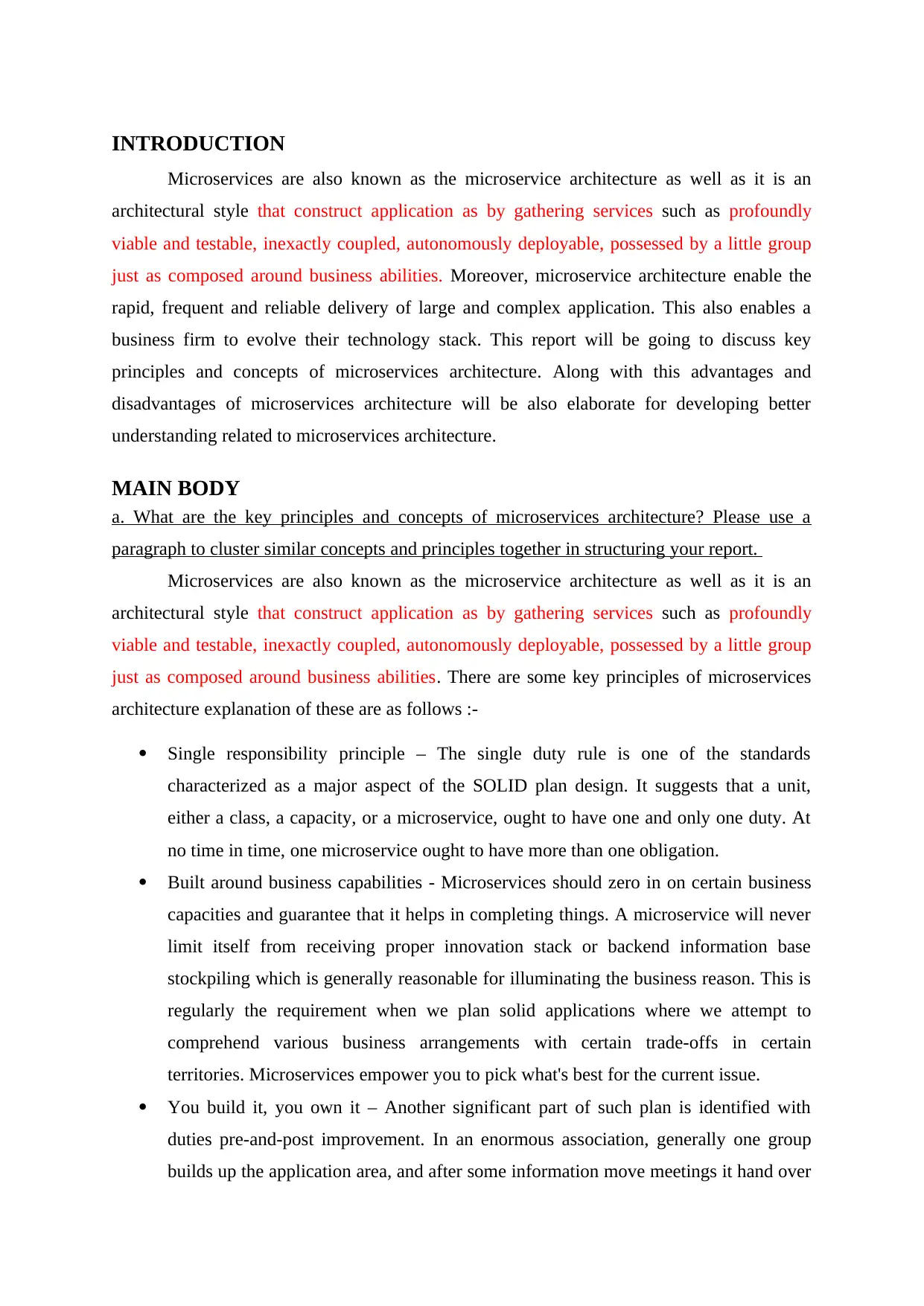
INTRODUCTION
Microservices are also known as the microservice architecture as well as it is an
architectural style that construct application as by gathering services such as profoundly
viable and testable, inexactly coupled, autonomously deployable, possessed by a little group
just as composed around business abilities. Moreover, microservice architecture enable the
rapid, frequent and reliable delivery of large and complex application. This also enables a
business firm to evolve their technology stack. This report will be going to discuss key
principles and concepts of microservices architecture. Along with this advantages and
disadvantages of microservices architecture will be also elaborate for developing better
understanding related to microservices architecture.
MAIN BODY
a. What are the key principles and concepts of microservices architecture? Please use a
paragraph to cluster similar concepts and principles together in structuring your report.
Microservices are also known as the microservice architecture as well as it is an
architectural style that construct application as by gathering services such as profoundly
viable and testable, inexactly coupled, autonomously deployable, possessed by a little group
just as composed around business abilities. There are some key principles of microservices
architecture explanation of these are as follows :-
Single responsibility principle – The single duty rule is one of the standards
characterized as a major aspect of the SOLID plan design. It suggests that a unit,
either a class, a capacity, or a microservice, ought to have one and only one duty. At
no time in time, one microservice ought to have more than one obligation.
Built around business capabilities - Microservices should zero in on certain business
capacities and guarantee that it helps in completing things. A microservice will never
limit itself from receiving proper innovation stack or backend information base
stockpiling which is generally reasonable for illuminating the business reason. This is
regularly the requirement when we plan solid applications where we attempt to
comprehend various business arrangements with certain trade-offs in certain
territories. Microservices empower you to pick what's best for the current issue.
You build it, you own it – Another significant part of such plan is identified with
duties pre-and-post improvement. In an enormous association, generally one group
builds up the application area, and after some information move meetings it hand over
Microservices are also known as the microservice architecture as well as it is an
architectural style that construct application as by gathering services such as profoundly
viable and testable, inexactly coupled, autonomously deployable, possessed by a little group
just as composed around business abilities. Moreover, microservice architecture enable the
rapid, frequent and reliable delivery of large and complex application. This also enables a
business firm to evolve their technology stack. This report will be going to discuss key
principles and concepts of microservices architecture. Along with this advantages and
disadvantages of microservices architecture will be also elaborate for developing better
understanding related to microservices architecture.
MAIN BODY
a. What are the key principles and concepts of microservices architecture? Please use a
paragraph to cluster similar concepts and principles together in structuring your report.
Microservices are also known as the microservice architecture as well as it is an
architectural style that construct application as by gathering services such as profoundly
viable and testable, inexactly coupled, autonomously deployable, possessed by a little group
just as composed around business abilities. There are some key principles of microservices
architecture explanation of these are as follows :-
Single responsibility principle – The single duty rule is one of the standards
characterized as a major aspect of the SOLID plan design. It suggests that a unit,
either a class, a capacity, or a microservice, ought to have one and only one duty. At
no time in time, one microservice ought to have more than one obligation.
Built around business capabilities - Microservices should zero in on certain business
capacities and guarantee that it helps in completing things. A microservice will never
limit itself from receiving proper innovation stack or backend information base
stockpiling which is generally reasonable for illuminating the business reason. This is
regularly the requirement when we plan solid applications where we attempt to
comprehend various business arrangements with certain trade-offs in certain
territories. Microservices empower you to pick what's best for the current issue.
You build it, you own it – Another significant part of such plan is identified with
duties pre-and-post improvement. In an enormous association, generally one group
builds up the application area, and after some information move meetings it hand over
⊘ This is a preview!⊘
Do you want full access?
Subscribe today to unlock all pages.

Trusted by 1+ million students worldwide

the undertaking to the support group. In microservices, the group which fabricates the
administration – possesses it, and is liable for keeping up it later on. This
proprietorship carries engineers into contact with the everyday activity of their
product and they better see how their manufactured item is utilized by clients in
reality.
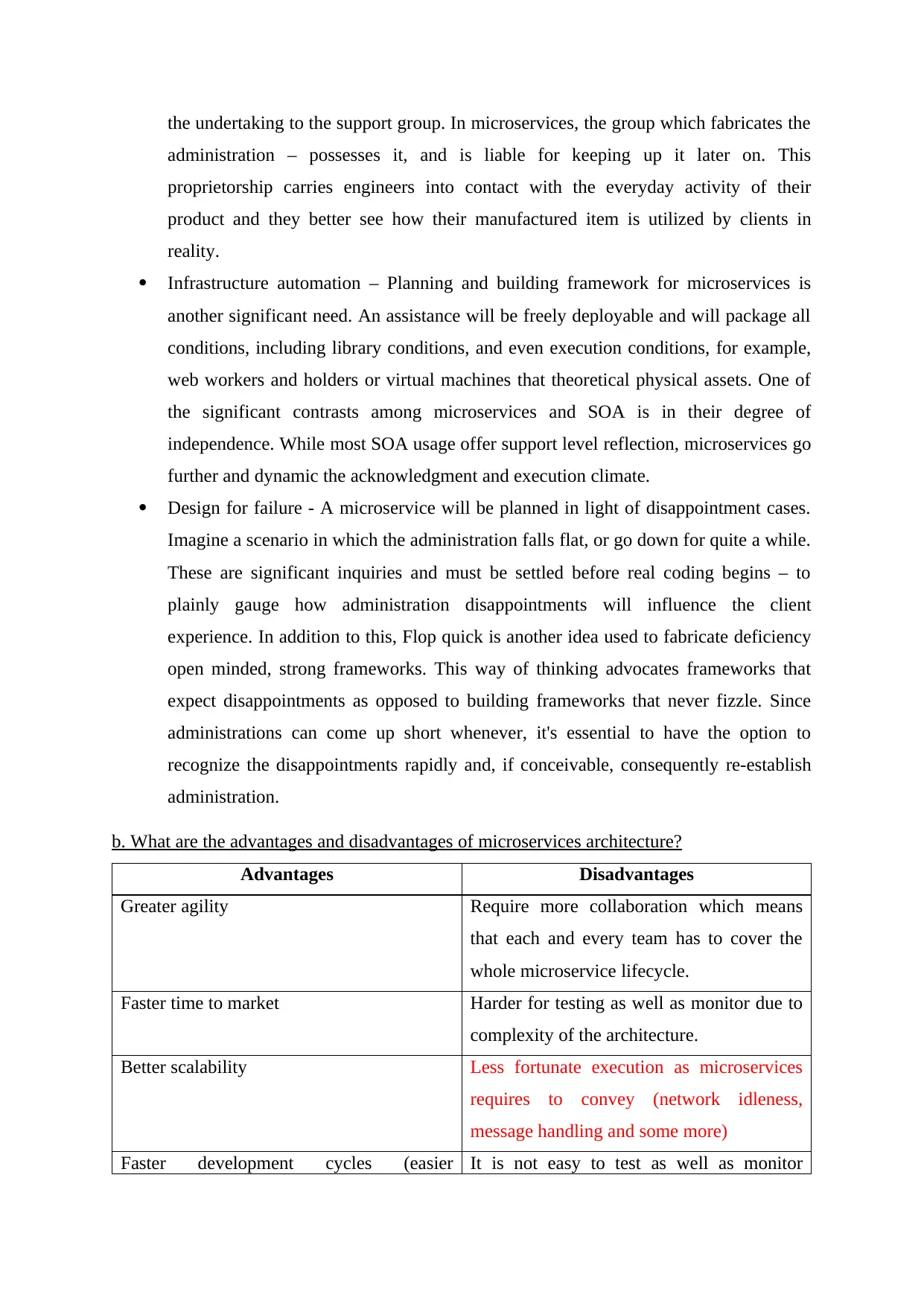
Infrastructure automation – Planning and building framework for microservices is
another significant need. An assistance will be freely deployable and will package all
conditions, including library conditions, and even execution conditions, for example,
web workers and holders or virtual machines that theoretical physical assets. One of
the significant contrasts among microservices and SOA is in their degree of
independence. While most SOA usage offer support level reflection, microservices go
further and dynamic the acknowledgment and execution climate.
Design for failure - A microservice will be planned in light of disappointment cases.
Imagine a scenario in which the administration falls flat, or go down for quite a while.
These are significant inquiries and must be settled before real coding begins – to
plainly gauge how administration disappointments will influence the client
experience. In addition to this, Flop quick is another idea used to fabricate deficiency
open minded, strong frameworks. This way of thinking advocates frameworks that
expect disappointments as opposed to building frameworks that never fizzle. Since
administrations can come up short whenever, it's essential to have the option to
recognize the disappointments rapidly and, if conceivable, consequently re-establish
administration.
b. What are the advantages and disadvantages of microservices architecture?
Advantages Disadvantages
Greater agility Require more collaboration which means
that each and every team has to cover the
whole microservice lifecycle.
Faster time to market Harder for testing as well as monitor due to
complexity of the architecture.
Better scalability Less fortunate execution as microservices
requires to convey (network idleness,
message handling and some more)
Faster development cycles (easier It is not easy to test as well as monitor
administration – possesses it, and is liable for keeping up it later on. This
proprietorship carries engineers into contact with the everyday activity of their
product and they better see how their manufactured item is utilized by clients in
reality.
Infrastructure automation – Planning and building framework for microservices is
another significant need. An assistance will be freely deployable and will package all
conditions, including library conditions, and even execution conditions, for example,
web workers and holders or virtual machines that theoretical physical assets. One of
the significant contrasts among microservices and SOA is in their degree of
independence. While most SOA usage offer support level reflection, microservices go
further and dynamic the acknowledgment and execution climate.
Design for failure - A microservice will be planned in light of disappointment cases.
Imagine a scenario in which the administration falls flat, or go down for quite a while.
These are significant inquiries and must be settled before real coding begins – to
plainly gauge how administration disappointments will influence the client
experience. In addition to this, Flop quick is another idea used to fabricate deficiency
open minded, strong frameworks. This way of thinking advocates frameworks that
expect disappointments as opposed to building frameworks that never fizzle. Since
administrations can come up short whenever, it's essential to have the option to
recognize the disappointments rapidly and, if conceivable, consequently re-establish
administration.
b. What are the advantages and disadvantages of microservices architecture?
Advantages Disadvantages
Greater agility Require more collaboration which means
that each and every team has to cover the
whole microservice lifecycle.
Faster time to market Harder for testing as well as monitor due to
complexity of the architecture.
Better scalability Less fortunate execution as microservices
requires to convey (network idleness,
message handling and some more)
Faster development cycles (easier It is not easy to test as well as monitor
Paraphrase This Document
Need a fresh take? Get an instant paraphrase of this document with our AI Paraphraser

deployment and debugging) because of complexity of architecture.
Easier in creating CI/CD pipeline for single-
responsibility services
Poorer performance which microservices
require to communicate (network latency,
message processing and many more)
Isolated related services have better fault
tolerance.
Security issues as it is more diligently to
keep up exchange wellbeing, conveyed
correspondence turns out badly more
probable, etc.
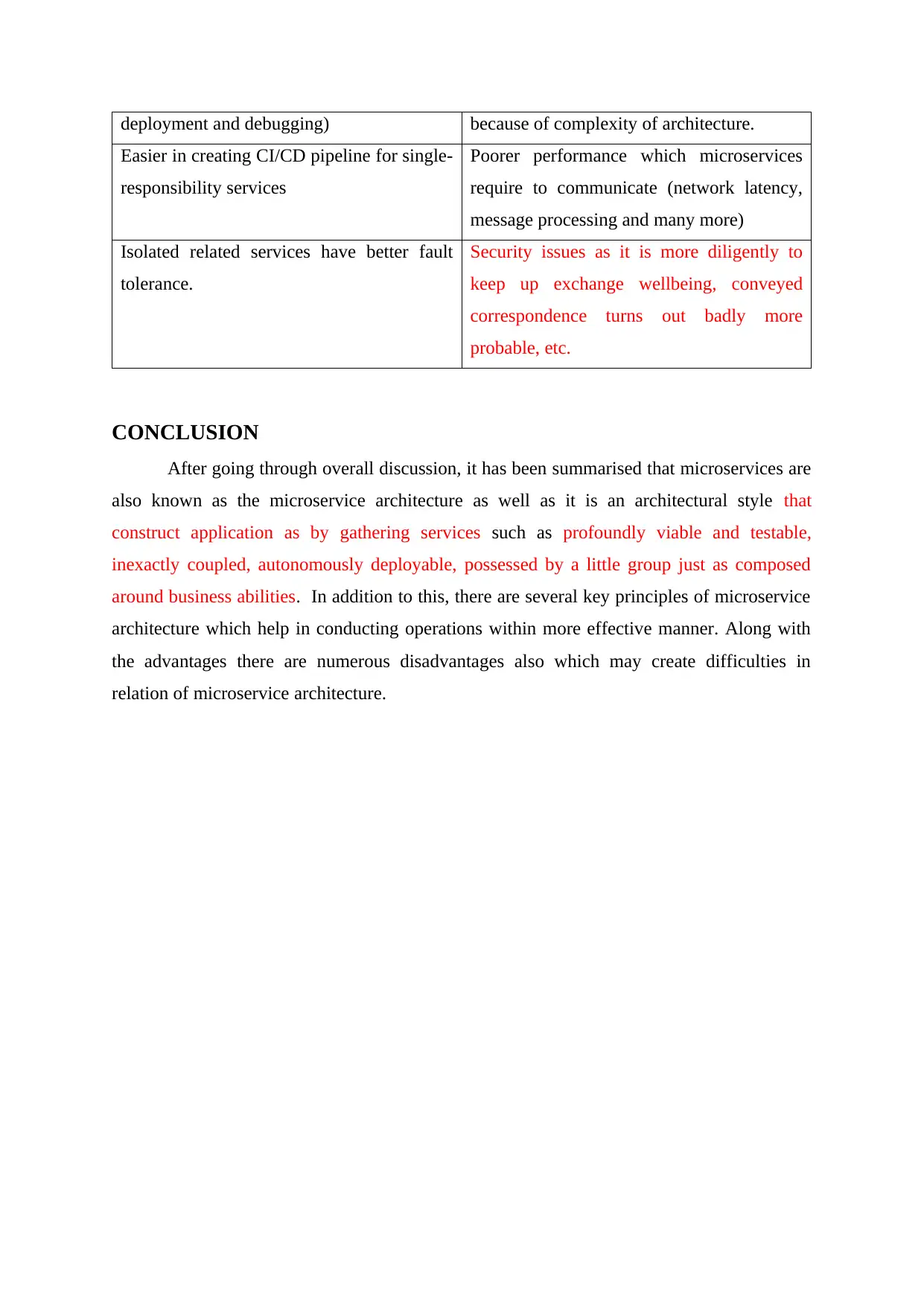
CONCLUSION
After going through overall discussion, it has been summarised that microservices are
also known as the microservice architecture as well as it is an architectural style that
construct application as by gathering services such as profoundly viable and testable,
inexactly coupled, autonomously deployable, possessed by a little group just as composed
around business abilities. In addition to this, there are several key principles of microservice
architecture which help in conducting operations within more effective manner. Along with
the advantages there are numerous disadvantages also which may create difficulties in
relation of microservice architecture.
Easier in creating CI/CD pipeline for single-
responsibility services
Poorer performance which microservices
require to communicate (network latency,
message processing and many more)
Isolated related services have better fault
tolerance.
Security issues as it is more diligently to
keep up exchange wellbeing, conveyed
correspondence turns out badly more
probable, etc.
CONCLUSION
After going through overall discussion, it has been summarised that microservices are
also known as the microservice architecture as well as it is an architectural style that
construct application as by gathering services such as profoundly viable and testable,
inexactly coupled, autonomously deployable, possessed by a little group just as composed
around business abilities. In addition to this, there are several key principles of microservice
architecture which help in conducting operations within more effective manner. Along with
the advantages there are numerous disadvantages also which may create difficulties in
relation of microservice architecture.

REFERENCES
Books and Journals
Alshuqayran, N., Ali, N. and Evans, R., 2016, November. A systematic mapping study in
microservice architecture. In 2016 IEEE 9th International Conference on Service-Oriented
Computing and Applications (SOCA) (pp. 44-51). IEEE.
Cerny, T., Donahoo, M.J. and Trnka, M., 2018. Contextual understanding of microservice
architecture: current and future directions. ACM SIGAPP Applied Computing Review, 17(4),
pp.29-45.
Kalske, M., Mäkitalo, N. and Mikkonen, T., 2017, June. Challenges when moving from
monolith to microservice architecture. In International Conference on Web Engineering (pp.
32-47). Springer, Cham.
Singh, V. and Peddoju, S.K., 2017, May. Container-based microservice architecture for cloud
applications. In 2017 International Conference on Computing, Communication and
Automation (ICCCA) (pp. 847-852). IEEE.
Rademacher, F., Sachweh, S. and Zündorf, A., 2017, April. Differences between model-
driven development of service-oriented and microservice architecture. In 2017 IEEE
International Conference on Software Architecture Workshops (ICSAW) (pp. 38-45). IEEE.
Zirkelbach, C., Krause, A. and Hasselbring, W., 2018, February. On the modernization of
explorviz towards a microservice architecture. CEUR Workshop Proceedings.
Fan, C.Y. and Ma, S.P., 2017, June. Migrating monolithic mobile application to microservice
architecture: An experiment report. In 2017 IEEE International Conference on AI & Mobile
Services (AIMS) (pp. 109-112). IEEE.
Granchelli, G., Cardarelli, M., Di Francesco, P., Malavolta, I., Iovino, L. and Di Salle, A.,
2017, April. Towards recovering the software architecture of microservice-based systems.
In 2017 IEEE International Conference on Software Architecture Workshops (ICSAW) (pp.
46-53). IEEE.
Books and Journals
Alshuqayran, N., Ali, N. and Evans, R., 2016, November. A systematic mapping study in
microservice architecture. In 2016 IEEE 9th International Conference on Service-Oriented
Computing and Applications (SOCA) (pp. 44-51). IEEE.
Cerny, T., Donahoo, M.J. and Trnka, M., 2018. Contextual understanding of microservice
architecture: current and future directions. ACM SIGAPP Applied Computing Review, 17(4),
pp.29-45.
Kalske, M., Mäkitalo, N. and Mikkonen, T., 2017, June. Challenges when moving from
monolith to microservice architecture. In International Conference on Web Engineering (pp.
32-47). Springer, Cham.
Singh, V. and Peddoju, S.K., 2017, May. Container-based microservice architecture for cloud
applications. In 2017 International Conference on Computing, Communication and
Automation (ICCCA) (pp. 847-852). IEEE.
Rademacher, F., Sachweh, S. and Zündorf, A., 2017, April. Differences between model-
driven development of service-oriented and microservice architecture. In 2017 IEEE
International Conference on Software Architecture Workshops (ICSAW) (pp. 38-45). IEEE.
Zirkelbach, C., Krause, A. and Hasselbring, W., 2018, February. On the modernization of
explorviz towards a microservice architecture. CEUR Workshop Proceedings.
Fan, C.Y. and Ma, S.P., 2017, June. Migrating monolithic mobile application to microservice
architecture: An experiment report. In 2017 IEEE International Conference on AI & Mobile
Services (AIMS) (pp. 109-112). IEEE.
Granchelli, G., Cardarelli, M., Di Francesco, P., Malavolta, I., Iovino, L. and Di Salle, A.,
2017, April. Towards recovering the software architecture of microservice-based systems.
In 2017 IEEE International Conference on Software Architecture Workshops (ICSAW) (pp.
46-53). IEEE.
⊘ This is a preview!⊘
Do you want full access?
Subscribe today to unlock all pages.

Trusted by 1+ million students worldwide
1 out of 6
Your All-in-One AI-Powered Toolkit for Academic Success.
+13062052269
info@desklib.com
Available 24*7 on WhatsApp / Email
Unlock your academic potential
Copyright © 2020–2025 A2Z Services. All Rights Reserved. Developed and managed by ZUCOL.