Financial Analysis: Starbucks Accounts, Assets, and Debt (BUS 600)
VerifiedAdded on 2019/09/18
|3
|1217
|547
Report
AI Summary
This report presents a financial analysis of Starbucks, focusing on horizontal and vertical analyses of its accounts receivable, fixed assets, and debt financing. The analysis examines changes in these areas over a two-year period, discussing Starbucks' accounting methods for receivables, uncollectible receivables, asset acquisitions, depreciation, amortization, and debt financing. The report includes an introduction explaining the analysis's purpose, followed by sections detailing the financial analysis of the balance sheet and income statement accounts. It also addresses how Starbucks' methods impact financial statement presentation. The analysis is supported by an Excel spreadsheet containing all calculations and adheres to APA formatting guidelines.
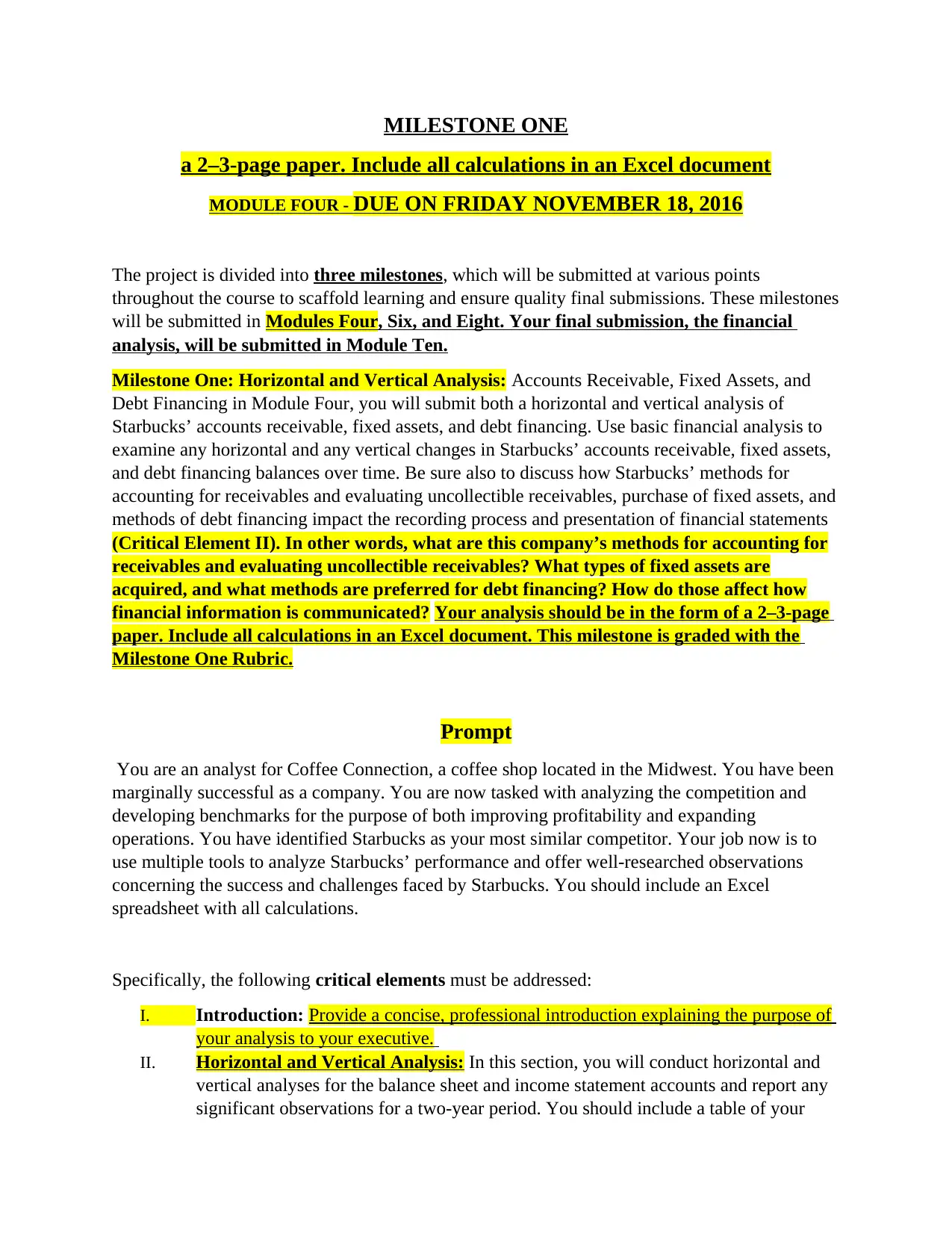
MILESTONE ONE
a 2–3-page paper. Include all calculations in an Excel document
MODULE FOUR - DUE ON FRIDAY NOVEMBER 18, 2016
The project is divided into three milestones, which will be submitted at various points
throughout the course to scaffold learning and ensure quality final submissions. These milestones
will be submitted in Modules Four, Six, and Eight. Your final submission, the financial
analysis, will be submitted in Module Ten.
Milestone One: Horizontal and Vertical Analysis: Accounts Receivable, Fixed Assets, and
Debt Financing in Module Four, you will submit both a horizontal and vertical analysis of
Starbucks’ accounts receivable, fixed assets, and debt financing. Use basic financial analysis to
examine any horizontal and any vertical changes in Starbucks’ accounts receivable, fixed assets,
and debt financing balances over time. Be sure also to discuss how Starbucks’ methods for
accounting for receivables and evaluating uncollectible receivables, purchase of fixed assets, and
methods of debt financing impact the recording process and presentation of financial statements
(Critical Element II). In other words, what are this company’s methods for accounting for
receivables and evaluating uncollectible receivables? What types of fixed assets are
acquired, and what methods are preferred for debt financing? How do those affect how
financial information is communicated? Your analysis should be in the form of a 2–3-page
paper. Include all calculations in an Excel document. This milestone is graded with the
Milestone One Rubric.
Prompt
You are an analyst for Coffee Connection, a coffee shop located in the Midwest. You have been
marginally successful as a company. You are now tasked with analyzing the competition and
developing benchmarks for the purpose of both improving profitability and expanding
operations. You have identified Starbucks as your most similar competitor. Your job now is to
use multiple tools to analyze Starbucks’ performance and offer well-researched observations
concerning the success and challenges faced by Starbucks. You should include an Excel
spreadsheet with all calculations.
Specifically, the following critical elements must be addressed:
I. Introduction: Provide a concise, professional introduction explaining the purpose of
your analysis to your executive.
II. Horizontal and Vertical Analysis: In this section, you will conduct horizontal and
vertical analyses for the balance sheet and income statement accounts and report any
significant observations for a two-year period. You should include a table of your
a 2–3-page paper. Include all calculations in an Excel document
MODULE FOUR - DUE ON FRIDAY NOVEMBER 18, 2016
The project is divided into three milestones, which will be submitted at various points
throughout the course to scaffold learning and ensure quality final submissions. These milestones
will be submitted in Modules Four, Six, and Eight. Your final submission, the financial
analysis, will be submitted in Module Ten.
Milestone One: Horizontal and Vertical Analysis: Accounts Receivable, Fixed Assets, and
Debt Financing in Module Four, you will submit both a horizontal and vertical analysis of
Starbucks’ accounts receivable, fixed assets, and debt financing. Use basic financial analysis to
examine any horizontal and any vertical changes in Starbucks’ accounts receivable, fixed assets,
and debt financing balances over time. Be sure also to discuss how Starbucks’ methods for
accounting for receivables and evaluating uncollectible receivables, purchase of fixed assets, and
methods of debt financing impact the recording process and presentation of financial statements
(Critical Element II). In other words, what are this company’s methods for accounting for
receivables and evaluating uncollectible receivables? What types of fixed assets are
acquired, and what methods are preferred for debt financing? How do those affect how
financial information is communicated? Your analysis should be in the form of a 2–3-page
paper. Include all calculations in an Excel document. This milestone is graded with the
Milestone One Rubric.
Prompt
You are an analyst for Coffee Connection, a coffee shop located in the Midwest. You have been
marginally successful as a company. You are now tasked with analyzing the competition and
developing benchmarks for the purpose of both improving profitability and expanding
operations. You have identified Starbucks as your most similar competitor. Your job now is to
use multiple tools to analyze Starbucks’ performance and offer well-researched observations
concerning the success and challenges faced by Starbucks. You should include an Excel
spreadsheet with all calculations.
Specifically, the following critical elements must be addressed:
I. Introduction: Provide a concise, professional introduction explaining the purpose of
your analysis to your executive.
II. Horizontal and Vertical Analysis: In this section, you will conduct horizontal and
vertical analyses for the balance sheet and income statement accounts and report any
significant observations for a two-year period. You should include a table of your
Paraphrase This Document
Need a fresh take? Get an instant paraphrase of this document with our AI Paraphraser

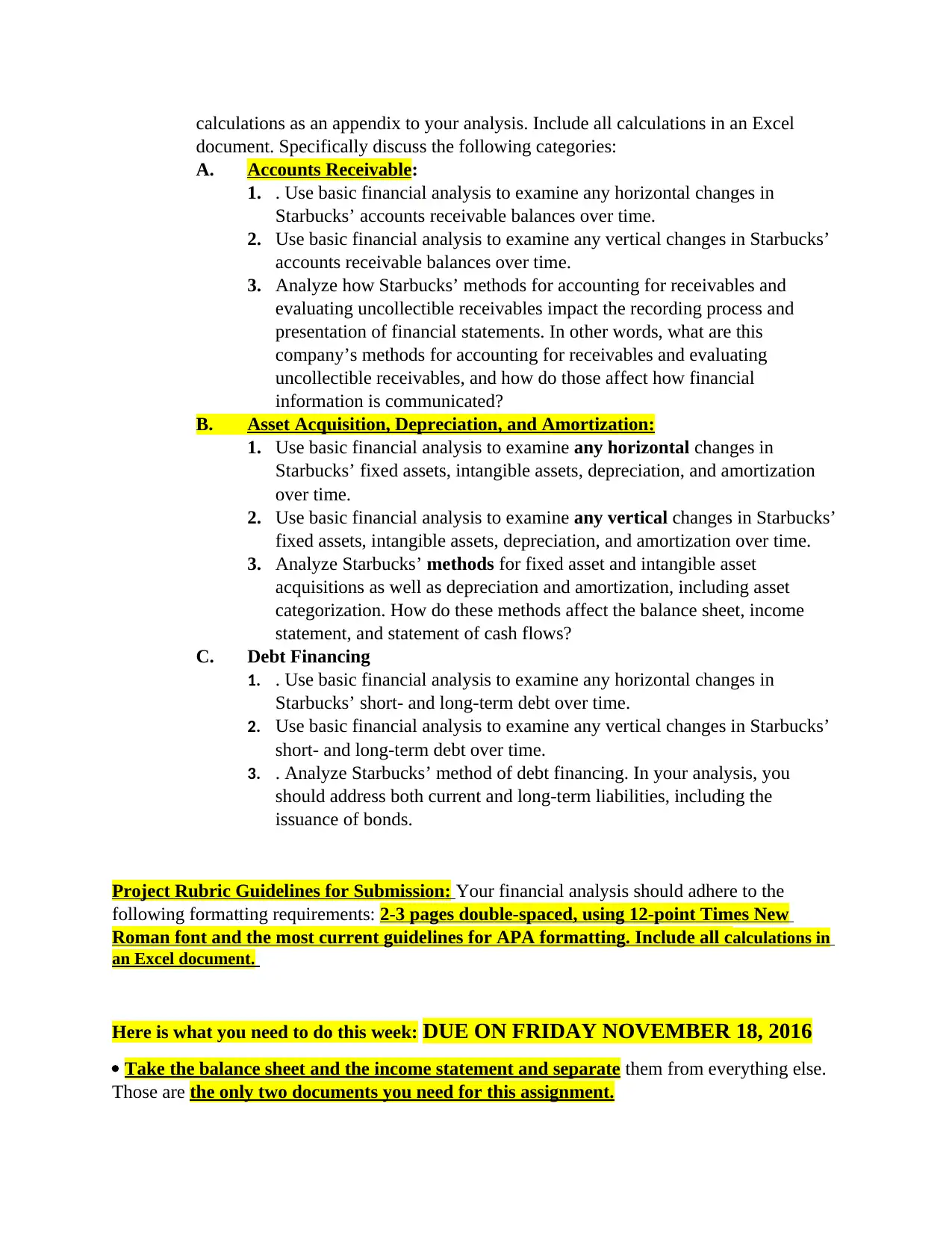
calculations as an appendix to your analysis. Include all calculations in an Excel
document. Specifically discuss the following categories:
A. Accounts Receivable:
1. . Use basic financial analysis to examine any horizontal changes in
Starbucks’ accounts receivable balances over time.
2. Use basic financial analysis to examine any vertical changes in Starbucks’
accounts receivable balances over time.
3. Analyze how Starbucks’ methods for accounting for receivables and
evaluating uncollectible receivables impact the recording process and
presentation of financial statements. In other words, what are this
company’s methods for accounting for receivables and evaluating
uncollectible receivables, and how do those affect how financial
information is communicated?
B. Asset Acquisition, Depreciation, and Amortization:
1. Use basic financial analysis to examine any horizontal changes in
Starbucks’ fixed assets, intangible assets, depreciation, and amortization
over time.
2. Use basic financial analysis to examine any vertical changes in Starbucks’
fixed assets, intangible assets, depreciation, and amortization over time.
3. Analyze Starbucks’ methods for fixed asset and intangible asset
acquisitions as well as depreciation and amortization, including asset
categorization. How do these methods affect the balance sheet, income
statement, and statement of cash flows?
C. Debt Financing
1. . Use basic financial analysis to examine any horizontal changes in
Starbucks’ short- and long-term debt over time.
2. Use basic financial analysis to examine any vertical changes in Starbucks’
short- and long-term debt over time.
3. . Analyze Starbucks’ method of debt financing. In your analysis, you
should address both current and long-term liabilities, including the
issuance of bonds.
Project Rubric Guidelines for Submission: Your financial analysis should adhere to the
following formatting requirements: 2-3 pages double-spaced, using 12-point Times New
Roman font and the most current guidelines for APA formatting. Include all calculations in
an Excel document.
Here is what you need to do this week: DUE ON FRIDAY NOVEMBER 18, 2016
Take the balance sheet and the income statement and separate them from everything else.
Those are the only two documents you need for this assignment.
document. Specifically discuss the following categories:
A. Accounts Receivable:
1. . Use basic financial analysis to examine any horizontal changes in
Starbucks’ accounts receivable balances over time.
2. Use basic financial analysis to examine any vertical changes in Starbucks’
accounts receivable balances over time.
3. Analyze how Starbucks’ methods for accounting for receivables and
evaluating uncollectible receivables impact the recording process and
presentation of financial statements. In other words, what are this
company’s methods for accounting for receivables and evaluating
uncollectible receivables, and how do those affect how financial
information is communicated?
B. Asset Acquisition, Depreciation, and Amortization:
1. Use basic financial analysis to examine any horizontal changes in
Starbucks’ fixed assets, intangible assets, depreciation, and amortization
over time.
2. Use basic financial analysis to examine any vertical changes in Starbucks’
fixed assets, intangible assets, depreciation, and amortization over time.
3. Analyze Starbucks’ methods for fixed asset and intangible asset
acquisitions as well as depreciation and amortization, including asset
categorization. How do these methods affect the balance sheet, income
statement, and statement of cash flows?
C. Debt Financing
1. . Use basic financial analysis to examine any horizontal changes in
Starbucks’ short- and long-term debt over time.
2. Use basic financial analysis to examine any vertical changes in Starbucks’
short- and long-term debt over time.
3. . Analyze Starbucks’ method of debt financing. In your analysis, you
should address both current and long-term liabilities, including the
issuance of bonds.
Project Rubric Guidelines for Submission: Your financial analysis should adhere to the
following formatting requirements: 2-3 pages double-spaced, using 12-point Times New
Roman font and the most current guidelines for APA formatting. Include all calculations in
an Excel document.
Here is what you need to do this week: DUE ON FRIDAY NOVEMBER 18, 2016
Take the balance sheet and the income statement and separate them from everything else.
Those are the only two documents you need for this assignment.

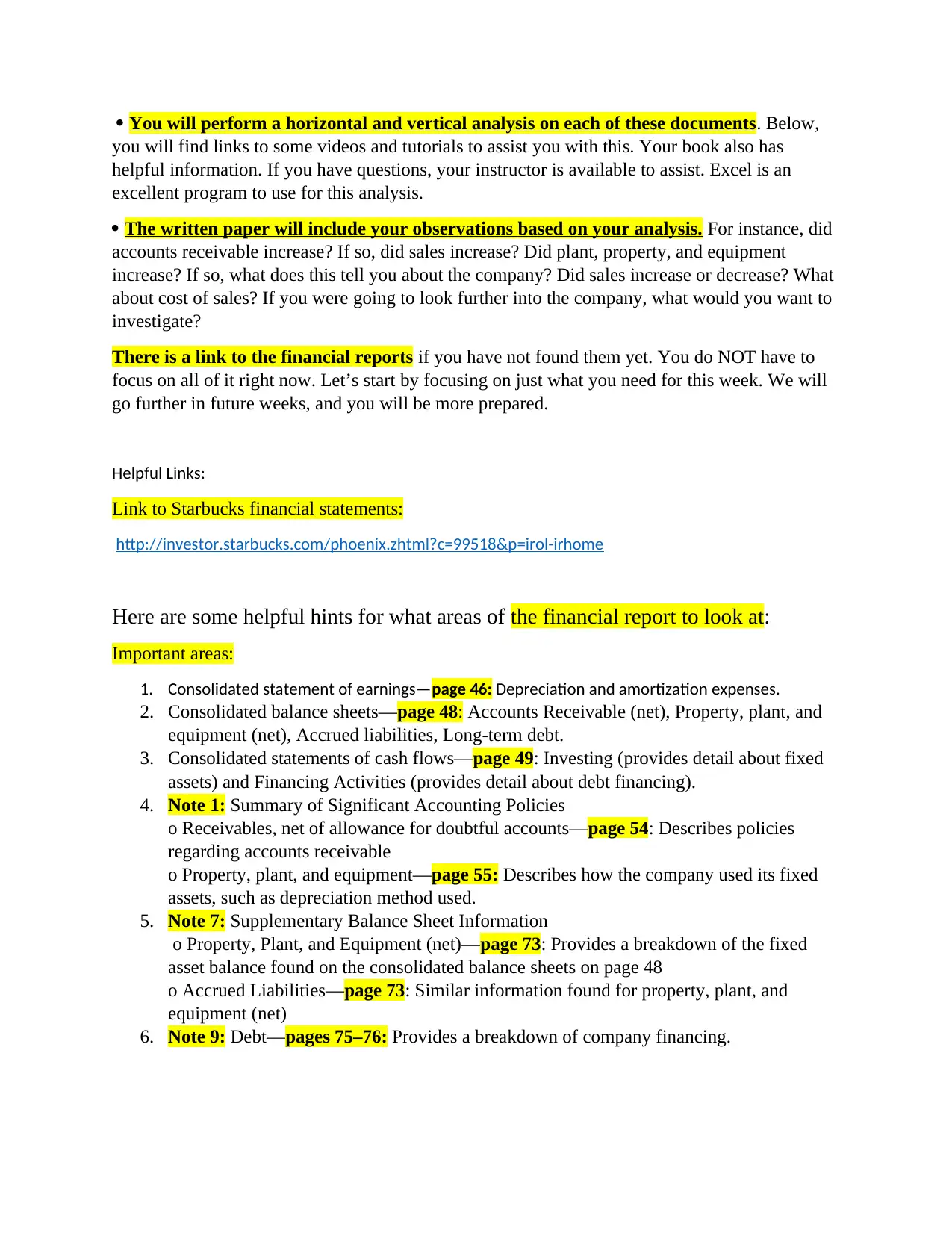
You will perform a horizontal and vertical analysis on each of these documents. Below,
you will find links to some videos and tutorials to assist you with this. Your book also has
helpful information. If you have questions, your instructor is available to assist. Excel is an
excellent program to use for this analysis.
The written paper will include your observations based on your analysis. For instance, did
accounts receivable increase? If so, did sales increase? Did plant, property, and equipment
increase? If so, what does this tell you about the company? Did sales increase or decrease? What
about cost of sales? If you were going to look further into the company, what would you want to
investigate?
There is a link to the financial reports if you have not found them yet. You do NOT have to
focus on all of it right now. Let’s start by focusing on just what you need for this week. We will
go further in future weeks, and you will be more prepared.
Helpful Links:
Link to Starbucks financial statements:
http://investor.starbucks.com/phoenix.zhtml?c=99518&p=irol-irhome
Here are some helpful hints for what areas of the financial report to look at:
Important areas:
1. Consolidated statement of earnings—page 46: Depreciation and amortization expenses.
2. Consolidated balance sheets—page 48: Accounts Receivable (net), Property, plant, and
equipment (net), Accrued liabilities, Long-term debt.
3. Consolidated statements of cash flows—page 49: Investing (provides detail about fixed
assets) and Financing Activities (provides detail about debt financing).
4. Note 1: Summary of Significant Accounting Policies
o Receivables, net of allowance for doubtful accounts—page 54: Describes policies
regarding accounts receivable
o Property, plant, and equipment—page 55: Describes how the company used its fixed
assets, such as depreciation method used.
5. Note 7: Supplementary Balance Sheet Information
o Property, Plant, and Equipment (net)—page 73: Provides a breakdown of the fixed
asset balance found on the consolidated balance sheets on page 48
o Accrued Liabilities—page 73: Similar information found for property, plant, and
equipment (net)
6. Note 9: Debt—pages 75–76: Provides a breakdown of company financing.
you will find links to some videos and tutorials to assist you with this. Your book also has
helpful information. If you have questions, your instructor is available to assist. Excel is an
excellent program to use for this analysis.
The written paper will include your observations based on your analysis. For instance, did
accounts receivable increase? If so, did sales increase? Did plant, property, and equipment
increase? If so, what does this tell you about the company? Did sales increase or decrease? What
about cost of sales? If you were going to look further into the company, what would you want to
investigate?
There is a link to the financial reports if you have not found them yet. You do NOT have to
focus on all of it right now. Let’s start by focusing on just what you need for this week. We will
go further in future weeks, and you will be more prepared.
Helpful Links:
Link to Starbucks financial statements:
http://investor.starbucks.com/phoenix.zhtml?c=99518&p=irol-irhome
Here are some helpful hints for what areas of the financial report to look at:
Important areas:
1. Consolidated statement of earnings—page 46: Depreciation and amortization expenses.
2. Consolidated balance sheets—page 48: Accounts Receivable (net), Property, plant, and
equipment (net), Accrued liabilities, Long-term debt.
3. Consolidated statements of cash flows—page 49: Investing (provides detail about fixed
assets) and Financing Activities (provides detail about debt financing).
4. Note 1: Summary of Significant Accounting Policies
o Receivables, net of allowance for doubtful accounts—page 54: Describes policies
regarding accounts receivable
o Property, plant, and equipment—page 55: Describes how the company used its fixed
assets, such as depreciation method used.
5. Note 7: Supplementary Balance Sheet Information
o Property, Plant, and Equipment (net)—page 73: Provides a breakdown of the fixed
asset balance found on the consolidated balance sheets on page 48
o Accrued Liabilities—page 73: Similar information found for property, plant, and
equipment (net)
6. Note 9: Debt—pages 75–76: Provides a breakdown of company financing.
⊘ This is a preview!⊘
Do you want full access?
Subscribe today to unlock all pages.

Trusted by 1+ million students worldwide
1 out of 3
Related Documents
Your All-in-One AI-Powered Toolkit for Academic Success.
+13062052269
info@desklib.com
Available 24*7 on WhatsApp / Email
Unlock your academic potential
Copyright © 2020–2025 A2Z Services. All Rights Reserved. Developed and managed by ZUCOL.