A Report on Milk Fraud: Impact on Food Safety and Nutrition Risks
VerifiedAdded on 2023/05/29
|13
|15322
|273
Report
AI Summary
This report investigates the impacts of milk fraud on food safety and nutrition, with a focus on developing countries. It highlights the increasing global milk consumption, especially in developing nations, and the rise in milk fraud due to market competition and complex supply chains. The review discusses common adulterants like water, reconstituted milk powder, urea, cane sugar, melamine, formalin, caustic soda, and detergents, which pose significant health risks. It also examines the global trends in milk production and consumption, emphasizing the nutritional importance of milk and the economic factors driving increased demand. The report concludes by underscoring the need for stricter vigilance by food safety authorities to protect public health and prevent financial losses in the dairy industry. Desklib provides students access to similar solved assignments and past papers.
Impacts of Milk Fraud on Food Safety
and Nutrition with Special Emphasis on
Developing Countries
Caroline E. Handford, Katrina Campbell, and Christopher T. Elliott
Abstract: Milk in its natural form has a high food value, since it is comprised of a wide variety of nutrients
essentialfor proper growth and maintenance of the human body. In recent decades, there has been an upsu
consumption worldwide,especially in developing countries,and it is now forming a significant part ofthe diet for a
high proportion of the global population. As a result of the increased demand, in addition to the growth in
in the dairy market and the increasing complexity of the supply chain,some unscrupulous producers are indulging in
milk fraud.This malpractice has become a common problem in the developing countries,which lack strict vigilance
by food safety authorities. Milk is often subjected to fraud (by means of adulteration) for financialgain, but it can also
be adulterated due to ill-informed attempts to improve hygiene conditions. Water is the most common adu
which decreases the nutritionalvalue of milk. If the water is contaminated, for example, with chemicals or patho
this poses a serious health risk for consumers.To the diluted milk,inferior cheaper materials may be added such as
reconstituted milk powder, urea, and cane sugar, even more hazardous chemicals including melamine, for
soda,and detergents.These additions have the potentialto cause serious health-related problems.This review aims to
investigate the impacts of milk fraud on nutrition and food safety, and it points out the potentialadverse human health
effects associated with the consumption of adulterated milk.
Keywords: adulteration, food safety, health, milk fraud, nutrition
Introduction
Food fraud is a serious issue which has come under increased
scrutiny as a potentialfood safety and public health concern in
recent years (Spink and Moyer 2011). Regulators, food producers,
retailers, and consumers all have an interest in safeguarding foods
and ensuring they are safe,genuine,and ofthe highestquality.
Nevertheless, food fraud has been conducted since ancient times,
with evidence oflawsdating back to Roman timesregarding
the adulteration of wine, through the addition of sweeteners and
coloring agents, or dilution with water. At that time the scale of
fraud wasmuch more limited to a smaller geographicalregion
(Armstrong 2009; Spink and Moyer 2011). Because of the growth
and increasing complexity ofthe modern globalfood supply
systems, this has heightened the risk of food fraud to include an
entire globalpopulation, therefore having a major impact on the
ability to protect consumer health (Moore and others 2012).
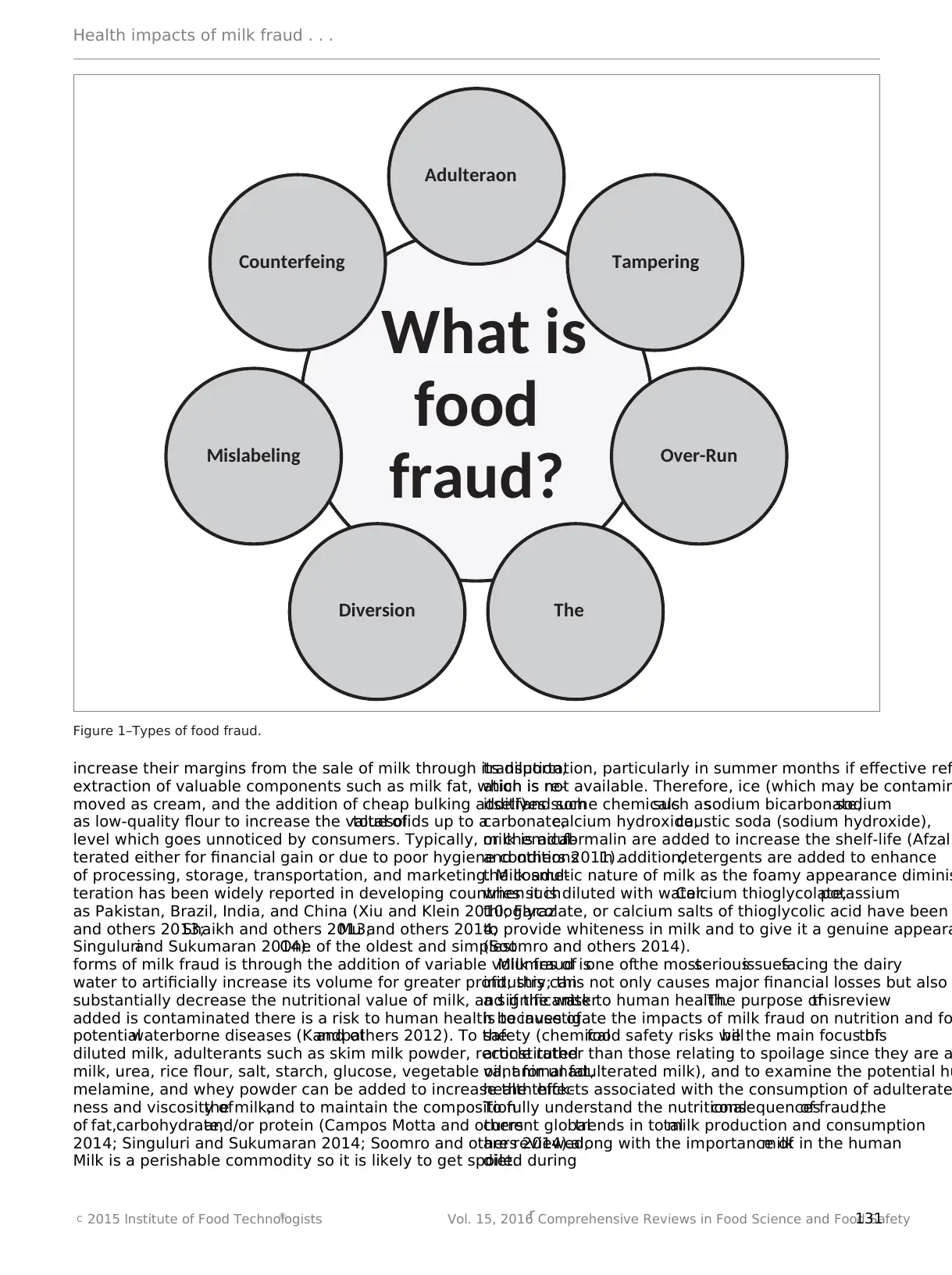
Food fraud is a broader term than adulteration (Figure 1).An
adulterated food isone which may be spoiled orintentionally
altered by illegaladdition ofa foreign chemicalsubstance (the
MS 20151220 Submitted 20/7/2015, Accepted 29/9/2015. Authors are with the
Inst.forGlobalFood Security,SchoolofBiologicalSciences,Queen’s Univ.Belfast,
18-30 Malone Rd., Belfast, Northern Ireland, BT9 5BN, United Kingdom. Direct
inquiries to author Handford (E-mail: chandford01@qub.ac.uk).
adulterant;Spink and Moyer 2011).Virtually allfoods have the
potentialto be adulterated,butthose thatare more expensive
or are producedunderchangeableweatherand harvesting
conditions are especially vulnerable (Sharma and Paradakar 2
Economically motivated adulteration isa subcategory offood
fraud and is a cause of public health risks (Spink and Moyer 2
It has been defined as “the fraudulent, intentional substitutio
addition of a substance in a product for the purpose of increa
the apparentvalue ofthe productor reducing the costof its
production” (FDA 2009). While the motivation for fraud is ofte
financial,the impact is a realthreat to public health;whether a
public health incident does in fact follow, the adulteration cau
the potential for harm (Spink and Moyer 2011).
Milk products are important components of the diets for ma
populations. The high nutritional value of milk has led to its h
consumption worldwide,but increased demand has also made it
prone to fraudulent activity. Moore and others (2012) recentl
alyzed the United States Pharmacopeial(USP) Convention food
fraud database to determine the 25 food ingredientswhich are
most prone to fraud worldwide. The USP database was origin
developed to help identify food ingredientsprone to fraud and
to catalog analyticaldetection methods (USP 2015).Of the top
fraudulent food ingredients, milk contributed to 14% of all sc
arly records during 1980 to 2010;this was 2nd only to olive oil
(16%; Moore and others 2012). Unscrupulous milk producers
130 Comprehensive Reviews in Food Science and Food Safetyr Vol. 15, 2016
C 2015 Institute of Food Technologists®
doi: 10.1111/1541-4337.12181
and Nutrition with Special Emphasis on
Developing Countries
Caroline E. Handford, Katrina Campbell, and Christopher T. Elliott
Abstract: Milk in its natural form has a high food value, since it is comprised of a wide variety of nutrients
essentialfor proper growth and maintenance of the human body. In recent decades, there has been an upsu
consumption worldwide,especially in developing countries,and it is now forming a significant part ofthe diet for a
high proportion of the global population. As a result of the increased demand, in addition to the growth in
in the dairy market and the increasing complexity of the supply chain,some unscrupulous producers are indulging in
milk fraud.This malpractice has become a common problem in the developing countries,which lack strict vigilance
by food safety authorities. Milk is often subjected to fraud (by means of adulteration) for financialgain, but it can also
be adulterated due to ill-informed attempts to improve hygiene conditions. Water is the most common adu
which decreases the nutritionalvalue of milk. If the water is contaminated, for example, with chemicals or patho
this poses a serious health risk for consumers.To the diluted milk,inferior cheaper materials may be added such as
reconstituted milk powder, urea, and cane sugar, even more hazardous chemicals including melamine, for
soda,and detergents.These additions have the potentialto cause serious health-related problems.This review aims to
investigate the impacts of milk fraud on nutrition and food safety, and it points out the potentialadverse human health
effects associated with the consumption of adulterated milk.
Keywords: adulteration, food safety, health, milk fraud, nutrition
Introduction
Food fraud is a serious issue which has come under increased
scrutiny as a potentialfood safety and public health concern in
recent years (Spink and Moyer 2011). Regulators, food producers,
retailers, and consumers all have an interest in safeguarding foods
and ensuring they are safe,genuine,and ofthe highestquality.
Nevertheless, food fraud has been conducted since ancient times,
with evidence oflawsdating back to Roman timesregarding
the adulteration of wine, through the addition of sweeteners and
coloring agents, or dilution with water. At that time the scale of
fraud wasmuch more limited to a smaller geographicalregion
(Armstrong 2009; Spink and Moyer 2011). Because of the growth
and increasing complexity ofthe modern globalfood supply
systems, this has heightened the risk of food fraud to include an
entire globalpopulation, therefore having a major impact on the
ability to protect consumer health (Moore and others 2012).
Food fraud is a broader term than adulteration (Figure 1).An
adulterated food isone which may be spoiled orintentionally
altered by illegaladdition ofa foreign chemicalsubstance (the
MS 20151220 Submitted 20/7/2015, Accepted 29/9/2015. Authors are with the
Inst.forGlobalFood Security,SchoolofBiologicalSciences,Queen’s Univ.Belfast,
18-30 Malone Rd., Belfast, Northern Ireland, BT9 5BN, United Kingdom. Direct
inquiries to author Handford (E-mail: chandford01@qub.ac.uk).
adulterant;Spink and Moyer 2011).Virtually allfoods have the
potentialto be adulterated,butthose thatare more expensive
or are producedunderchangeableweatherand harvesting
conditions are especially vulnerable (Sharma and Paradakar 2
Economically motivated adulteration isa subcategory offood
fraud and is a cause of public health risks (Spink and Moyer 2
It has been defined as “the fraudulent, intentional substitutio
addition of a substance in a product for the purpose of increa
the apparentvalue ofthe productor reducing the costof its
production” (FDA 2009). While the motivation for fraud is ofte
financial,the impact is a realthreat to public health;whether a
public health incident does in fact follow, the adulteration cau
the potential for harm (Spink and Moyer 2011).
Milk products are important components of the diets for ma
populations. The high nutritional value of milk has led to its h
consumption worldwide,but increased demand has also made it
prone to fraudulent activity. Moore and others (2012) recentl
alyzed the United States Pharmacopeial(USP) Convention food
fraud database to determine the 25 food ingredientswhich are
most prone to fraud worldwide. The USP database was origin
developed to help identify food ingredientsprone to fraud and
to catalog analyticaldetection methods (USP 2015).Of the top
fraudulent food ingredients, milk contributed to 14% of all sc
arly records during 1980 to 2010;this was 2nd only to olive oil
(16%; Moore and others 2012). Unscrupulous milk producers
130 Comprehensive Reviews in Food Science and Food Safetyr Vol. 15, 2016
C 2015 Institute of Food Technologists®
doi: 10.1111/1541-4337.12181

Paraphrase This Document
Need a fresh take? Get an instant paraphrase of this document with our AI Paraphraser
Health impacts of milk fraud . . .
What is
food
fraud?
Adulteraon
Tampering
Over-Run
TheDiversion
Mislabeling
Counterfeing
Figure 1–Types of food fraud.
increase their margins from the sale of milk through its dilution,
extraction of valuable components such as milk fat, which is re-
moved as cream, and the addition of cheap bulking additives such
as low-quality flour to increase the value oftotalsolids up to a
level which goes unnoticed by consumers. Typically, milk is adul-
terated either for financial gain or due to poor hygiene conditions
of processing, storage, transportation, and marketing. Milk adul-
teration has been widely reported in developing countries such
as Pakistan, Brazil, India, and China (Xiu and Klein 2010; Faraz
and others 2013;Shaikh and others 2013;Mu and others 2014;
Singuluriand Sukumaran 2014).One of the oldest and simplest
forms of milk fraud is through the addition of variable volumes of
water to artificially increase its volume for greater profit; this can
substantially decrease the nutritional value of milk, and if the water
added is contaminated there is a risk to human health because of
potentialwaterborne diseases (Kandpaland others 2012). To the
diluted milk, adulterants such as skim milk powder, reconstituted
milk, urea, rice flour, salt, starch, glucose, vegetable oil, animal fat,
melamine, and whey powder can be added to increase the thick-
ness and viscosity ofthe milk,and to maintain the composition
of fat,carbohydrate,and/or protein (Campos Motta and others
2014; Singuluri and Sukumaran 2014; Soomro and others 2014).
Milk is a perishable commodity so it is likely to get spoiled during
transportation, particularly in summer months if effective ref
ation is not available. Therefore, ice (which may be contamin
itself)and some chemicalssuch assodium bicarbonate,sodium
carbonate,calcium hydroxide,caustic soda (sodium hydroxide),
or chemicalformalin are added to increase the shelf-life (Afzal
and others 2011).In addition,detergents are added to enhance
the cosmetic nature of milk as the foamy appearance diminis
when it is diluted with water.Calcium thioglycolate,potassium
thioglycolate, or calcium salts of thioglycolic acid have been
to provide whiteness in milk and to give it a genuine appeara
(Soomro and others 2014).
Milk fraud isone ofthe mostseriousissuesfacing the dairy
industry; this not only causes major financial losses but also
a significantrisk to human health.The purpose ofthisreview
is to investigate the impacts of milk fraud on nutrition and fo
safety (chemicalfood safety risks willbe the main focus ofthis
article rather than those relating to spoilage since they are a
vant for unadulterated milk), and to examine the potential hu
health effects associated with the consumption of adulterate
To fully understand the nutritionalconsequencesof fraud,the
current globaltrends in totalmilk production and consumption
are reviewed,along with the importance ofmilk in the human
diet.
C 2015 Institute of Food Technologists® Vol. 15, 2016r Comprehensive Reviews in Food Science and Food Safety131
What is
food
fraud?
Adulteraon
Tampering
Over-Run
TheDiversion
Mislabeling
Counterfeing
Figure 1–Types of food fraud.
increase their margins from the sale of milk through its dilution,
extraction of valuable components such as milk fat, which is re-
moved as cream, and the addition of cheap bulking additives such
as low-quality flour to increase the value oftotalsolids up to a
level which goes unnoticed by consumers. Typically, milk is adul-
terated either for financial gain or due to poor hygiene conditions
of processing, storage, transportation, and marketing. Milk adul-
teration has been widely reported in developing countries such
as Pakistan, Brazil, India, and China (Xiu and Klein 2010; Faraz
and others 2013;Shaikh and others 2013;Mu and others 2014;
Singuluriand Sukumaran 2014).One of the oldest and simplest
forms of milk fraud is through the addition of variable volumes of
water to artificially increase its volume for greater profit; this can
substantially decrease the nutritional value of milk, and if the water
added is contaminated there is a risk to human health because of
potentialwaterborne diseases (Kandpaland others 2012). To the
diluted milk, adulterants such as skim milk powder, reconstituted
milk, urea, rice flour, salt, starch, glucose, vegetable oil, animal fat,
melamine, and whey powder can be added to increase the thick-
ness and viscosity ofthe milk,and to maintain the composition
of fat,carbohydrate,and/or protein (Campos Motta and others
2014; Singuluri and Sukumaran 2014; Soomro and others 2014).
Milk is a perishable commodity so it is likely to get spoiled during
transportation, particularly in summer months if effective ref
ation is not available. Therefore, ice (which may be contamin
itself)and some chemicalssuch assodium bicarbonate,sodium
carbonate,calcium hydroxide,caustic soda (sodium hydroxide),
or chemicalformalin are added to increase the shelf-life (Afzal
and others 2011).In addition,detergents are added to enhance
the cosmetic nature of milk as the foamy appearance diminis
when it is diluted with water.Calcium thioglycolate,potassium
thioglycolate, or calcium salts of thioglycolic acid have been
to provide whiteness in milk and to give it a genuine appeara
(Soomro and others 2014).
Milk fraud isone ofthe mostseriousissuesfacing the dairy
industry; this not only causes major financial losses but also
a significantrisk to human health.The purpose ofthisreview
is to investigate the impacts of milk fraud on nutrition and fo
safety (chemicalfood safety risks willbe the main focus ofthis
article rather than those relating to spoilage since they are a
vant for unadulterated milk), and to examine the potential hu
health effects associated with the consumption of adulterate
To fully understand the nutritionalconsequencesof fraud,the
current globaltrends in totalmilk production and consumption
are reviewed,along with the importance ofmilk in the human
diet.
C 2015 Institute of Food Technologists® Vol. 15, 2016r Comprehensive Reviews in Food Science and Food Safety131
Health impacts of milk fraud . . .
Global Trends in Total Milk Production and
Consumption
Milk is nutritionally important as it contains allof the macro-
and micronutrientsrequired to sustain the life ofthe neonate
and the young infant,aswellasadding to the quality ofthe
overallhuman diet (Konuspayeva and others 2009;Medhammer
and others 2011).Thus,milk products are an important part of
the diet for most populations globally.
In recentdecades,milk productconsumption hasrapidly
increased in a numberof developing countries,particularly in
parts of East and Southeast Asia; even so, the level of consumption
is still lower than in developed countries (FAOSTAT 2014). The
composition of milk product consumption fluctuates across differ-
ent regions worldwide; while processed milk products (including
butter, cheese, and yogurts) are becoming increasingly important,
liquid milk is still largely the most important product by volume.
For example,annualper capita liquid milk consumption in the
European Union (EU) was 61.6 L in 2013,compared with less
than 40 L (and even as little as 5 L) in some Asian and African
countries (Canadian Dairy Information Centre 2013). However,
a numberof factorsare stimulating the increase in demand in
developingcountries,includingeconomicgrowth,urbaniza-
tion, nationalpopulation growth,increased public interestin
high-protein diets,increasing awarenessand availability ofmilk
products through the retail sector, and greater affordability due to
increased disposable incomes. In addition, governmentalsupport
of milk consumption through schoolmilk programs,the rising
demand for cheese variety,new uses for milk-based ingredients,
and an increase in niche market products have supported this de-
velopment. Milk products are currently the main source of animal
protein in the diet in South Asia (Food and AgriculturalOrga-
nization of the United Nations (FAO) 2013; Longvah and others
2013).
In developing countries,milk production hasmatched the
growth in demand for and consumption ofmilk.Consequently,
over the last 3 decades, global total milk production has increased
by nearly 50%, from 500 million metric tons in 1983 to 747 mil-
lion tonsin 2013 (FAO 2015).In Asia,totalmilk production
has increased from 80 million tons in 1983 to 270 million tons
in 2013.India isnow the largestproducerof milk worldwide
(18%),followed by the U.S.(12%),and then China and Brazil
(both at 4%;FAO 2015).Most countries produce milk for local
consumption. However, the cost of production varies greatly de-
pending on factors such as labor costs,animalgenetics,on-farm
technology,and fodderand wateravailability (More 2009).At
the globallevel,cow milk production remainsby far the most
significant,representing 85% ofglobalmilk production in 2013
(FAO 2015).
In developed countries,almostallmilk is produced by cows.
However,noncattle milk iseconomically and nutritionally sig-
nificantand formsan importantpartof milk consumption in
severalcountries,particularly in developing countries where ap-
proximately one-third ofmilk production comesfrom buffalos,
goats,camels,and sheep (Faye and Konuspayeva 2012).Buffalo
milk accounted for 11% of the world’s milk production in 2013,
followed by goat (2%),sheep (1%),and camelmilk (0.4%).The
remaining share is produced by other milk species such as horses,
donkeys, and yaks (FAO 2015).
India achieved an output of 132.4 million tons of milk (mainly
from cows and buffalos) during 2012 to 2013, compared to 127.9
million tons in 2011 to 2012, which is a growth of 3.5%. Projec-
tions for the country’s total milk production during the year 2013
to 2014 are approximately 138 million tons (Department of A
Husbandry, Dairying & Fisheries 2014). The country accounts
approximately one-third ofdeveloping country production and
18% of the world’s total milk production (FAO 2013, 2015). In
is not only the leading producer but is also the largest consum
milk in the world, consuming almost all of its own milk produc
tion. Over the last decade, the Indian milk products consump
market has grown at an annualrate of6.8% (Mani2013).Eco-
nomic development has led to an increased demand for milk
ucts, which are the preferred choice of products of animal ori
due to the population being largely vegetarian. Milk products
account for approximately 12% of the total diet consumed in
(Longvah and others2013).The NationalDairy Development
Board has said that the demand for milk is likely to be betwe
200 and 210 million tons in 2021 to 2022 and, therefore, ann
average milk production needsto increase further to 6 million
tons per year to meet the needs over the next 12 y. Consequ
the NationalDairy Plan was approved in 2012 to help meet the
projected nationaldemands;thisconcentrateson improvements
to genetics, animal nutrition, and procurement in the dairy se
(Mani 2013).
Consumption and production levels of milk products have a
grown rapidly in East and Southeast Asia since the early 2000
particularly in China, which has averaged a 12.8% annual gro
rate since 2000,with the country producing 41 million tons of
milk in 2010;thisis mainly from cowsand to a lesserdegree
buffalos(FAO 2012).Economic growth and urbanization have
contributed to this growth, with milk products becoming an in
creasingly important source of protein and calcium for the Ch
community (Sharma and Rou 2014). There are variations in m
production and consumption levels between urban and rural
and between regions,which may be accredited to historicaldif-
ferences and culturalpreferences.Approximately 85% of China’s
milk is produced in North China, which has the most suited cl
mate and the greatest availability of feed materials.The fact that
60% of the human population lives in the South of the countr
creates difficulty in matching production with demand. Moreo
urban areas have a much higher milk consumption than rural
eas, which is probably due to the fact that much of the larger
operations are in the bigger cities, such as Beijing and Shang
so there is greater availability in these areas (FAO 2013;Sharma
and Rou 2014).
Methods for the Detection of Milk Fraud
Methodsto detectadulterantsin milk include measurement
of freezing pointdepression,electricaladmittance spectroscopy,
single-frequency conductance measurements, digital image c
matography,ultraviolet(UV) visible lightspectroscopy,and en-
zymelinked immunosorbentassay (Santosand others2013;
Musara and Pote 2014).
Targeted approachesprovide specific information on specific
adulterants and their abundance. Whereas untargeted appro
provide less information on the nature ofthe adulteration.Un-
targeted analysis of chromatographic and spectraldata consists of
reviewing the entire spectrum, and applying multivariate dat
ysis for the large number of variables and samples generated
these methods. A range of targeted analytical methods have
developed to identify specific foreign propertiesin milk;these
include high-performance liquid chromatography with single-
channelUV-absorbance detection (HPLC–UV), and size exclu-
sion chromatography and HPLC–mass spectrometry (HPLC–M
Jablonski and others 2014).
132 Comprehensive Reviews in Food Science and Food Safetyr Vol. 15, 2016 C 2015 Institute of Food Technologists®
Global Trends in Total Milk Production and
Consumption
Milk is nutritionally important as it contains allof the macro-
and micronutrientsrequired to sustain the life ofthe neonate
and the young infant,aswellasadding to the quality ofthe
overallhuman diet (Konuspayeva and others 2009;Medhammer
and others 2011).Thus,milk products are an important part of
the diet for most populations globally.
In recentdecades,milk productconsumption hasrapidly
increased in a numberof developing countries,particularly in
parts of East and Southeast Asia; even so, the level of consumption
is still lower than in developed countries (FAOSTAT 2014). The
composition of milk product consumption fluctuates across differ-
ent regions worldwide; while processed milk products (including
butter, cheese, and yogurts) are becoming increasingly important,
liquid milk is still largely the most important product by volume.
For example,annualper capita liquid milk consumption in the
European Union (EU) was 61.6 L in 2013,compared with less
than 40 L (and even as little as 5 L) in some Asian and African
countries (Canadian Dairy Information Centre 2013). However,
a numberof factorsare stimulating the increase in demand in
developingcountries,includingeconomicgrowth,urbaniza-
tion, nationalpopulation growth,increased public interestin
high-protein diets,increasing awarenessand availability ofmilk
products through the retail sector, and greater affordability due to
increased disposable incomes. In addition, governmentalsupport
of milk consumption through schoolmilk programs,the rising
demand for cheese variety,new uses for milk-based ingredients,
and an increase in niche market products have supported this de-
velopment. Milk products are currently the main source of animal
protein in the diet in South Asia (Food and AgriculturalOrga-
nization of the United Nations (FAO) 2013; Longvah and others
2013).
In developing countries,milk production hasmatched the
growth in demand for and consumption ofmilk.Consequently,
over the last 3 decades, global total milk production has increased
by nearly 50%, from 500 million metric tons in 1983 to 747 mil-
lion tonsin 2013 (FAO 2015).In Asia,totalmilk production
has increased from 80 million tons in 1983 to 270 million tons
in 2013.India isnow the largestproducerof milk worldwide
(18%),followed by the U.S.(12%),and then China and Brazil
(both at 4%;FAO 2015).Most countries produce milk for local
consumption. However, the cost of production varies greatly de-
pending on factors such as labor costs,animalgenetics,on-farm
technology,and fodderand wateravailability (More 2009).At
the globallevel,cow milk production remainsby far the most
significant,representing 85% ofglobalmilk production in 2013
(FAO 2015).
In developed countries,almostallmilk is produced by cows.
However,noncattle milk iseconomically and nutritionally sig-
nificantand formsan importantpartof milk consumption in
severalcountries,particularly in developing countries where ap-
proximately one-third ofmilk production comesfrom buffalos,
goats,camels,and sheep (Faye and Konuspayeva 2012).Buffalo
milk accounted for 11% of the world’s milk production in 2013,
followed by goat (2%),sheep (1%),and camelmilk (0.4%).The
remaining share is produced by other milk species such as horses,
donkeys, and yaks (FAO 2015).
India achieved an output of 132.4 million tons of milk (mainly
from cows and buffalos) during 2012 to 2013, compared to 127.9
million tons in 2011 to 2012, which is a growth of 3.5%. Projec-
tions for the country’s total milk production during the year 2013
to 2014 are approximately 138 million tons (Department of A
Husbandry, Dairying & Fisheries 2014). The country accounts
approximately one-third ofdeveloping country production and
18% of the world’s total milk production (FAO 2013, 2015). In
is not only the leading producer but is also the largest consum
milk in the world, consuming almost all of its own milk produc
tion. Over the last decade, the Indian milk products consump
market has grown at an annualrate of6.8% (Mani2013).Eco-
nomic development has led to an increased demand for milk
ucts, which are the preferred choice of products of animal ori
due to the population being largely vegetarian. Milk products
account for approximately 12% of the total diet consumed in
(Longvah and others2013).The NationalDairy Development
Board has said that the demand for milk is likely to be betwe
200 and 210 million tons in 2021 to 2022 and, therefore, ann
average milk production needsto increase further to 6 million
tons per year to meet the needs over the next 12 y. Consequ
the NationalDairy Plan was approved in 2012 to help meet the
projected nationaldemands;thisconcentrateson improvements
to genetics, animal nutrition, and procurement in the dairy se
(Mani 2013).
Consumption and production levels of milk products have a
grown rapidly in East and Southeast Asia since the early 2000
particularly in China, which has averaged a 12.8% annual gro
rate since 2000,with the country producing 41 million tons of
milk in 2010;thisis mainly from cowsand to a lesserdegree
buffalos(FAO 2012).Economic growth and urbanization have
contributed to this growth, with milk products becoming an in
creasingly important source of protein and calcium for the Ch
community (Sharma and Rou 2014). There are variations in m
production and consumption levels between urban and rural
and between regions,which may be accredited to historicaldif-
ferences and culturalpreferences.Approximately 85% of China’s
milk is produced in North China, which has the most suited cl
mate and the greatest availability of feed materials.The fact that
60% of the human population lives in the South of the countr
creates difficulty in matching production with demand. Moreo
urban areas have a much higher milk consumption than rural
eas, which is probably due to the fact that much of the larger
operations are in the bigger cities, such as Beijing and Shang
so there is greater availability in these areas (FAO 2013;Sharma
and Rou 2014).
Methods for the Detection of Milk Fraud
Methodsto detectadulterantsin milk include measurement
of freezing pointdepression,electricaladmittance spectroscopy,
single-frequency conductance measurements, digital image c
matography,ultraviolet(UV) visible lightspectroscopy,and en-
zymelinked immunosorbentassay (Santosand others2013;
Musara and Pote 2014).
Targeted approachesprovide specific information on specific
adulterants and their abundance. Whereas untargeted appro
provide less information on the nature ofthe adulteration.Un-
targeted analysis of chromatographic and spectraldata consists of
reviewing the entire spectrum, and applying multivariate dat
ysis for the large number of variables and samples generated
these methods. A range of targeted analytical methods have
developed to identify specific foreign propertiesin milk;these
include high-performance liquid chromatography with single-
channelUV-absorbance detection (HPLC–UV), and size exclu-
sion chromatography and HPLC–mass spectrometry (HPLC–M
Jablonski and others 2014).
132 Comprehensive Reviews in Food Science and Food Safetyr Vol. 15, 2016 C 2015 Institute of Food Technologists®
⊘ This is a preview!⊘
Do you want full access?
Subscribe today to unlock all pages.

Trusted by 1+ million students worldwide
Health impacts of milk fraud . . .
Developmentsin infrared spectroscopic (IR)instrumentation
and the amalgamation with chemometric methodshave made
this method invaluable in determining food authenticity.IR is a
quality assurance tool to determine functional and compositional
analysisof food ingredients,processintermediates,and finished
products (Santos and others 2013). Chemometrics is an interdis-
ciplinary research that applies multivariate data analysis, which is
often combined with data-rich instrumentaltechniques (such as
MS and infrared spectroscopy) used qualitatively for categorizing
unknown samples with comparable characteristics and quantita-
tively for determining adulterantsin samples(Souza and others
2011; Santos and others 2013). IR is highly desirable for analysis
of milk components because it is straightforward to use, it is able
to analyze samples with minimal or no sample preparation, it pro-
vides rapid and online analysis, it has high sensitivity and specificity,
and it is possible to run multiple tests on a single sample.Other
spectroscopic methods,namely,mid-infrared (MIR)and near-
infrared, have been applied for the determination of severalmilk
properties, including milk composition (protein, fat, and lactose),
though these studies are limited with regards to milk authenticity
(Karoui and others 2010; Santos and others 2013). For example,
MIR spectroscopy combined with 2-dimensional correlation has
been applied to detect adulteration by adding melamine, urea, and
glucose to milk. The peak positions and shapes show differences
between the control and adulterated milk, therefore validating the
potential of this method to detect milk adulteration (He and others
2010).
Milk Fraud in the Developing World: 4 Cases Outlining
the Impact on Nutrition,Food Safety,and Consumer
Confidence
Milk fraud has occurred throughout history and continues to
be a serious globalissue. This is generally related to bovine milk
from dairy cows and buffalos as they contribute to the vast ma-
jority ofmilk production worldwide.Recentscholarly reports
have revealed that fraudulent milk products can be found in many
regionsworldwide,particularly in developing countriessuch as
India where the scale ofmilk production isvast,yetthey have
a high levelof unregulated practices(Moore and Others2012;
Lipp and Moore 2013;Ayza and Yilma 2014;Padala and others
2014). An overview of milk fraud scandals across the developing
world is presented in Table 1. Conversely, in developed countries,
such as the EU and U.S., there is a much lower concern of milk
fraud. The EU has one of the highest food safety standards in the
world and, thus, cases of milk fraud are scarce. The Rapid Alert
System for Food and Feed Safety provides information when risks
to public health are detected in the food chain, and as such pro-
vides details of the few incidents of milk fraud that have occurred
in the EU,including an attempted illegalimportof milk from
China,which had been adulterated with melamine (European
Commission 2015). Similarly, the U.S. has applied very high food
safety standards, and, this along with their short supply chains and
monitoring of the product quality has vastly reduced the risk of
milk fraud.
Malpractice or negligence occurring in developing countries
appears to go largely undeterred due to a lack of stringent con-
trolby the food safety authorities (Padala and others 2014). This
fraud may be greatly reducing the health benefits ofmilk prod-
uct consumption and presenting potential health hazards to many
consumers.
India
In India, adulterated and synthetic milk issues have been w
reported in the mass media and this has been supported by r
ports from scientists and government authorities (Lipp and M
2013). Bhatt and others (2008) surveyed a total of 365 house
in Uttar Pradesh, India, to quantify their children’s daily intak
milk,analyze milk samples from their household to test for th
presence of urea,vegetable oil,and detergent,and to determine
their effecton health.In total,365 children were surveyed;70
children were ofthe age group 1 to 5 y,150 were aged 6 to
18 y,and 145 were 19 to 22 y.A further 160 samplesof milk
were collected from different local market vendors and stalls
mean intake ofmilk by children ofthe age group 1 to 5 y was
160 mL/d, for the age group of 6 to 18 y it was 500 mL/d, and
for the age group of19 to 22 y it was 800 mL/d.Fraud detec-
tion in milk samples with urea and detergent ranged from 8%
ruralareas to as high as 40% in urban areas.The most common
problems reported among the children surveyed were in rela
to eyesight,diarrhea,and headaches.In the age group of 1 to 5
y mostof the children were dependenton their mother’smilk
and therefore they showed the least effect on their health. In
age group of6 to 18,28% ofurban children were affected by
headache, while only 4% of rural children were affected. Eye
problems and diarrhea were more prevalent, affecting more
half (57%) of urban and 16% of ruralchildren. However, the 19
to 22 age group was the most affected group overall,with 38%
of children in urban areas and 12% ofruralchildren affected by
headaches. Eyesight problems and diarrhea affected 52% of
children as compared to 12.5% in rural areas. The milk fraud
have contributed to such health problems described here due
the concentration of urea and detergent present (Table 3).
The more recentnationalsurvey on milk adulteration 2011
(a snapshot survey) by the Food Safety and Standards Autho
of India (FSSAI2012)revealed thatthe totalnumberof sam-
ples conforming to the FSSAI standards were 565 (31.5%), w
1226 (68.4%)samplesfailed to meetthem.In some states,the
level of noncompliance was 100%. Milk samples from ruralareas
performed better, with 31% being noncompliant as compared
urban areas where more than two-thirds (68.9%) failed to me
the setstandards.The problemswere also shown to be much
greater for milk sold in bulk than packaged milk.The national
survey also exposed water as being the most common adulte
used in milk in India, which resulted in the samples having m
lowered nutritionalvalues.Of the totalnonconformant samples,
574 (46.8%) samples belonged to the category of low-solid n
(SNF) and this was due to dilution of milk with water. These fi
ings were in line with an earlier study conducted by Grace an
others (2009) on milk safety in North EastIndia,which found
that dilution with water was present in milk from all dairies, w
considerable variation in the level of dilution, ranging from 2
20%.The FSSAI survey also revealed that the 2nd highest non
conformity was skimmed milk powder, which was in 548 (44.
samples,while glucose was present in 477 samples.Glucose was
most likely added to milk to enhance its SNF. The milk sampl
were also shown to be adulterated with substances which pro
more hazardous health effects,including detergents which were
found in 103 (8.4%) samples. It was perceived that due to a l
hygiene and sanitation in milk handling and packaging, deter
(used for cleaning) are not removed (indicating poor cleaning
milk containers) and find their way into milk. In a recent stud
Singuluri and Sukumaran (2014), all of the samples tested ne
C 2015 Institute of Food Technologists® Vol. 15, 2016r Comprehensive Reviews in Food Science and Food Safety133
Developmentsin infrared spectroscopic (IR)instrumentation
and the amalgamation with chemometric methodshave made
this method invaluable in determining food authenticity.IR is a
quality assurance tool to determine functional and compositional
analysisof food ingredients,processintermediates,and finished
products (Santos and others 2013). Chemometrics is an interdis-
ciplinary research that applies multivariate data analysis, which is
often combined with data-rich instrumentaltechniques (such as
MS and infrared spectroscopy) used qualitatively for categorizing
unknown samples with comparable characteristics and quantita-
tively for determining adulterantsin samples(Souza and others
2011; Santos and others 2013). IR is highly desirable for analysis
of milk components because it is straightforward to use, it is able
to analyze samples with minimal or no sample preparation, it pro-
vides rapid and online analysis, it has high sensitivity and specificity,
and it is possible to run multiple tests on a single sample.Other
spectroscopic methods,namely,mid-infrared (MIR)and near-
infrared, have been applied for the determination of severalmilk
properties, including milk composition (protein, fat, and lactose),
though these studies are limited with regards to milk authenticity
(Karoui and others 2010; Santos and others 2013). For example,
MIR spectroscopy combined with 2-dimensional correlation has
been applied to detect adulteration by adding melamine, urea, and
glucose to milk. The peak positions and shapes show differences
between the control and adulterated milk, therefore validating the
potential of this method to detect milk adulteration (He and others
2010).
Milk Fraud in the Developing World: 4 Cases Outlining
the Impact on Nutrition,Food Safety,and Consumer
Confidence
Milk fraud has occurred throughout history and continues to
be a serious globalissue. This is generally related to bovine milk
from dairy cows and buffalos as they contribute to the vast ma-
jority ofmilk production worldwide.Recentscholarly reports
have revealed that fraudulent milk products can be found in many
regionsworldwide,particularly in developing countriessuch as
India where the scale ofmilk production isvast,yetthey have
a high levelof unregulated practices(Moore and Others2012;
Lipp and Moore 2013;Ayza and Yilma 2014;Padala and others
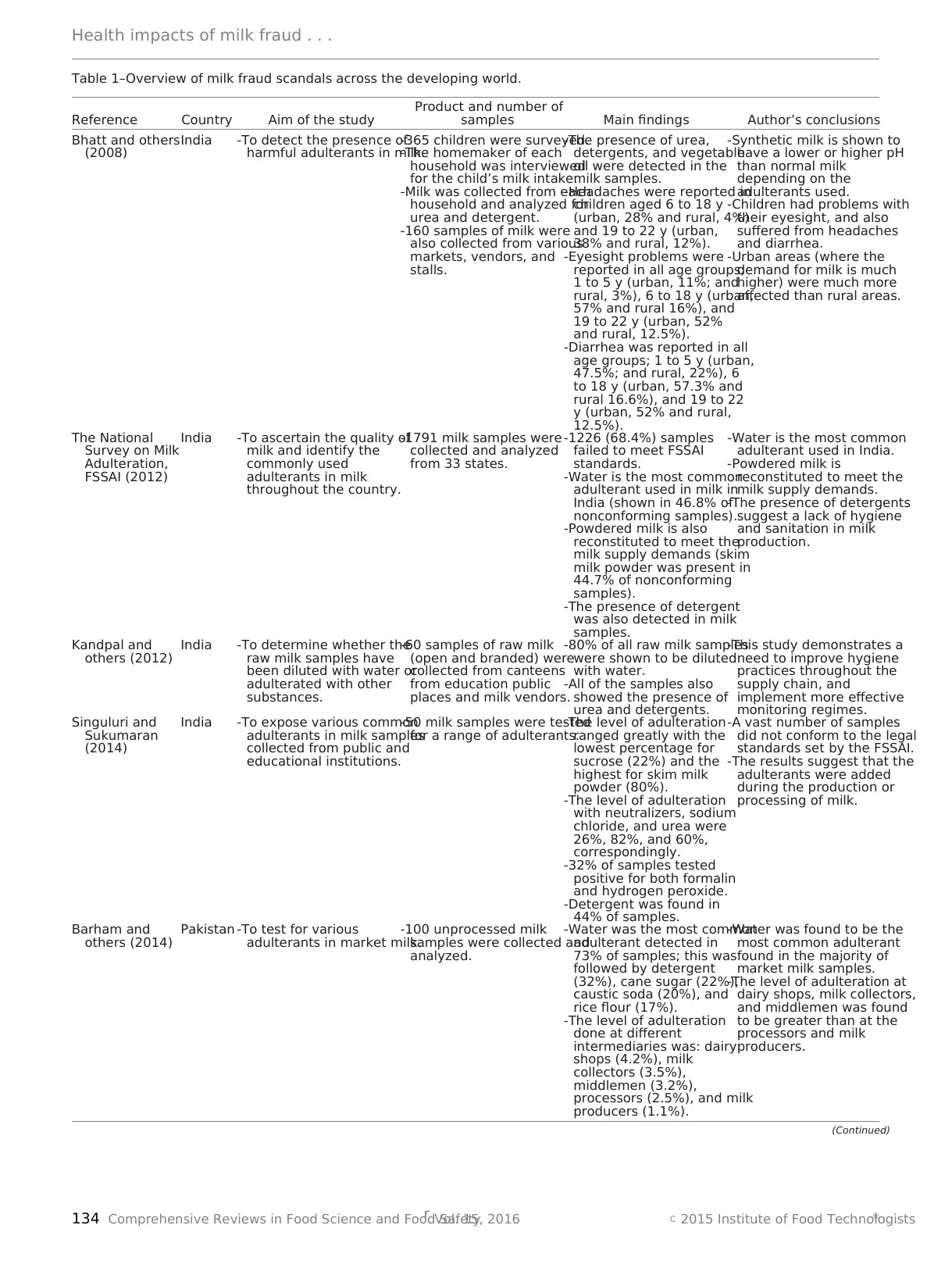
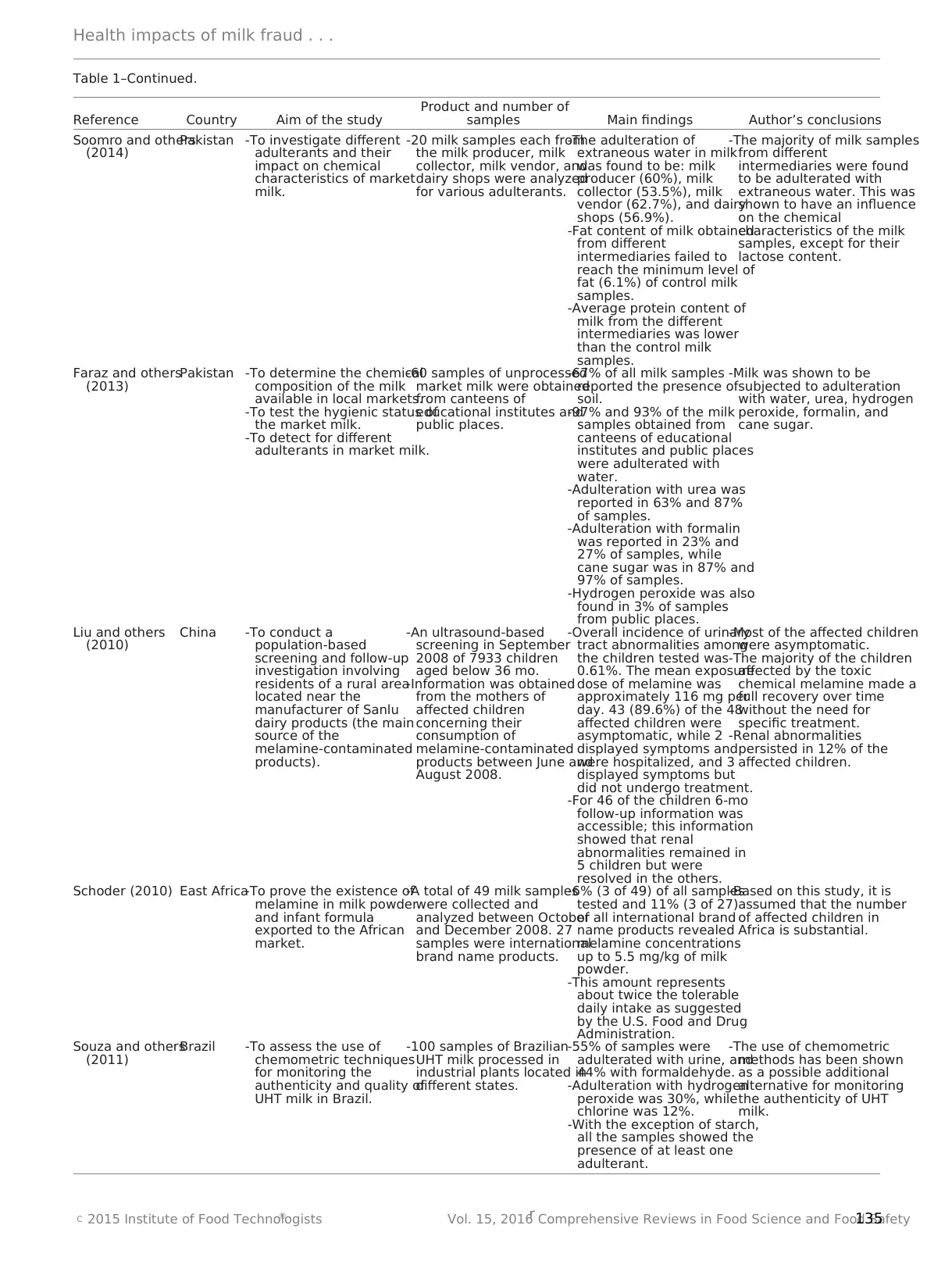
2014). An overview of milk fraud scandals across the developing
world is presented in Table 1. Conversely, in developed countries,
such as the EU and U.S., there is a much lower concern of milk
fraud. The EU has one of the highest food safety standards in the
world and, thus, cases of milk fraud are scarce. The Rapid Alert
System for Food and Feed Safety provides information when risks
to public health are detected in the food chain, and as such pro-
vides details of the few incidents of milk fraud that have occurred
in the EU,including an attempted illegalimportof milk from
China,which had been adulterated with melamine (European
Commission 2015). Similarly, the U.S. has applied very high food
safety standards, and, this along with their short supply chains and
monitoring of the product quality has vastly reduced the risk of
milk fraud.
Malpractice or negligence occurring in developing countries
appears to go largely undeterred due to a lack of stringent con-
trolby the food safety authorities (Padala and others 2014). This
fraud may be greatly reducing the health benefits ofmilk prod-
uct consumption and presenting potential health hazards to many
consumers.
India
In India, adulterated and synthetic milk issues have been w
reported in the mass media and this has been supported by r
ports from scientists and government authorities (Lipp and M
2013). Bhatt and others (2008) surveyed a total of 365 house
in Uttar Pradesh, India, to quantify their children’s daily intak
milk,analyze milk samples from their household to test for th
presence of urea,vegetable oil,and detergent,and to determine
their effecton health.In total,365 children were surveyed;70
children were ofthe age group 1 to 5 y,150 were aged 6 to
18 y,and 145 were 19 to 22 y.A further 160 samplesof milk
were collected from different local market vendors and stalls
mean intake ofmilk by children ofthe age group 1 to 5 y was
160 mL/d, for the age group of 6 to 18 y it was 500 mL/d, and
for the age group of19 to 22 y it was 800 mL/d.Fraud detec-
tion in milk samples with urea and detergent ranged from 8%
ruralareas to as high as 40% in urban areas.The most common
problems reported among the children surveyed were in rela
to eyesight,diarrhea,and headaches.In the age group of 1 to 5
y mostof the children were dependenton their mother’smilk
and therefore they showed the least effect on their health. In
age group of6 to 18,28% ofurban children were affected by
headache, while only 4% of rural children were affected. Eye
problems and diarrhea were more prevalent, affecting more
half (57%) of urban and 16% of ruralchildren. However, the 19
to 22 age group was the most affected group overall,with 38%
of children in urban areas and 12% ofruralchildren affected by
headaches. Eyesight problems and diarrhea affected 52% of
children as compared to 12.5% in rural areas. The milk fraud
have contributed to such health problems described here due
the concentration of urea and detergent present (Table 3).
The more recentnationalsurvey on milk adulteration 2011
(a snapshot survey) by the Food Safety and Standards Autho
of India (FSSAI2012)revealed thatthe totalnumberof sam-
ples conforming to the FSSAI standards were 565 (31.5%), w
1226 (68.4%)samplesfailed to meetthem.In some states,the
level of noncompliance was 100%. Milk samples from ruralareas
performed better, with 31% being noncompliant as compared
urban areas where more than two-thirds (68.9%) failed to me
the setstandards.The problemswere also shown to be much
greater for milk sold in bulk than packaged milk.The national
survey also exposed water as being the most common adulte
used in milk in India, which resulted in the samples having m
lowered nutritionalvalues.Of the totalnonconformant samples,
574 (46.8%) samples belonged to the category of low-solid n
(SNF) and this was due to dilution of milk with water. These fi
ings were in line with an earlier study conducted by Grace an
others (2009) on milk safety in North EastIndia,which found
that dilution with water was present in milk from all dairies, w
considerable variation in the level of dilution, ranging from 2
20%.The FSSAI survey also revealed that the 2nd highest non
conformity was skimmed milk powder, which was in 548 (44.
samples,while glucose was present in 477 samples.Glucose was
most likely added to milk to enhance its SNF. The milk sampl
were also shown to be adulterated with substances which pro
more hazardous health effects,including detergents which were
found in 103 (8.4%) samples. It was perceived that due to a l
hygiene and sanitation in milk handling and packaging, deter
(used for cleaning) are not removed (indicating poor cleaning
milk containers) and find their way into milk. In a recent stud
Singuluri and Sukumaran (2014), all of the samples tested ne
C 2015 Institute of Food Technologists® Vol. 15, 2016r Comprehensive Reviews in Food Science and Food Safety133
Paraphrase This Document
Need a fresh take? Get an instant paraphrase of this document with our AI Paraphraser
Health impacts of milk fraud . . .
Table 1–Overview of milk fraud scandals across the developing world.
Reference Country Aim of the study
Product and number of
samples Main findings Author’s conclusions
Bhatt and others
(2008) India -To detect the presence of
harmful adulterants in milk.
-365 children were surveyed.
-The homemaker of each
household was interviewed
for the child’s milk intake.
-Milk was collected from each
household and analyzed for
urea and detergent.
-160 samples of milk were
also collected from various
markets, vendors, and
stalls.
-The presence of urea,
detergents, and vegetable
oil were detected in the
milk samples.
-Headaches were reported in
children aged 6 to 18 y
(urban, 28% and rural, 4%)
and 19 to 22 y (urban,
38% and rural, 12%).
-Eyesight problems were
reported in all age groups;
1 to 5 y (urban, 11%; and
rural, 3%), 6 to 18 y (urban,
57% and rural 16%), and
19 to 22 y (urban, 52%
and rural, 12.5%).
-Diarrhea was reported in all
age groups; 1 to 5 y (urban,
47.5%; and rural, 22%), 6
to 18 y (urban, 57.3% and
rural 16.6%), and 19 to 22
y (urban, 52% and rural,
12.5%).
-Synthetic milk is shown to
have a lower or higher pH
than normal milk
depending on the
adulterants used.
-Children had problems with
their eyesight, and also
suffered from headaches
and diarrhea.
-Urban areas (where the
demand for milk is much
higher) were much more
affected than rural areas.
The National
Survey on Milk
Adulteration,
FSSAI (2012)
India -To ascertain the quality of
milk and identify the
commonly used
adulterants in milk
throughout the country.
-1791 milk samples were
collected and analyzed
from 33 states.
-1226 (68.4%) samples
failed to meet FSSAI
standards.
-Water is the most common
adulterant used in milk in
India (shown in 46.8% of
nonconforming samples).
-Powdered milk is also
reconstituted to meet the
milk supply demands (skim
milk powder was present in
44.7% of nonconforming
samples).
-The presence of detergent
was also detected in milk
samples.
-Water is the most common
adulterant used in India.
-Powdered milk is
reconstituted to meet the
milk supply demands.
-The presence of detergents
suggest a lack of hygiene
and sanitation in milk
production.
Kandpal and
others (2012) India -To determine whether the
raw milk samples have
been diluted with water or
adulterated with other
substances.
-60 samples of raw milk
(open and branded) were
collected from canteens
from education public
places and milk vendors.
-80% of all raw milk samples
were shown to be diluted
with water.
-All of the samples also
showed the presence of
urea and detergents.
-This study demonstrates a
need to improve hygiene
practices throughout the
supply chain, and
implement more effective
monitoring regimes.
Singuluri and
Sukumaran
(2014)
India -To expose various common
adulterants in milk samples
collected from public and
educational institutions.
-50 milk samples were tested
for a range of adulterants.
-The level of adulteration
ranged greatly with the
lowest percentage for
sucrose (22%) and the
highest for skim milk
powder (80%).
-The level of adulteration
with neutralizers, sodium
chloride, and urea were
26%, 82%, and 60%,
correspondingly.
-32% of samples tested
positive for both formalin
and hydrogen peroxide.
-Detergent was found in
44% of samples.
-A vast number of samples
did not conform to the legal
standards set by the FSSAI.
-The results suggest that the
adulterants were added
during the production or
processing of milk.
Barham and
others (2014)
Pakistan -To test for various
adulterants in market milk.
-100 unprocessed milk
samples were collected and
analyzed.
-Water was the most common
adulterant detected in
73% of samples; this was
followed by detergent
(32%), cane sugar (22%),
caustic soda (20%), and
rice flour (17%).
-The level of adulteration
done at different
intermediaries was: dairy
shops (4.2%), milk
collectors (3.5%),
middlemen (3.2%),
processors (2.5%), and milk
producers (1.1%).
-Water was found to be the
most common adulterant
found in the majority of
market milk samples.
-The level of adulteration at
dairy shops, milk collectors,
and middlemen was found
to be greater than at the
processors and milk
producers.
(Continued)
134 Comprehensive Reviews in Food Science and Food Safetyr Vol. 15, 2016 C 2015 Institute of Food Technologists®
Table 1–Overview of milk fraud scandals across the developing world.
Reference Country Aim of the study
Product and number of
samples Main findings Author’s conclusions
Bhatt and others
(2008) India -To detect the presence of
harmful adulterants in milk.
-365 children were surveyed.
-The homemaker of each
household was interviewed
for the child’s milk intake.
-Milk was collected from each
household and analyzed for
urea and detergent.
-160 samples of milk were
also collected from various
markets, vendors, and
stalls.
-The presence of urea,
detergents, and vegetable
oil were detected in the
milk samples.
-Headaches were reported in
children aged 6 to 18 y
(urban, 28% and rural, 4%)
and 19 to 22 y (urban,
38% and rural, 12%).
-Eyesight problems were
reported in all age groups;
1 to 5 y (urban, 11%; and
rural, 3%), 6 to 18 y (urban,
57% and rural 16%), and
19 to 22 y (urban, 52%
and rural, 12.5%).
-Diarrhea was reported in all
age groups; 1 to 5 y (urban,
47.5%; and rural, 22%), 6
to 18 y (urban, 57.3% and
rural 16.6%), and 19 to 22
y (urban, 52% and rural,
12.5%).
-Synthetic milk is shown to
have a lower or higher pH
than normal milk
depending on the
adulterants used.
-Children had problems with
their eyesight, and also
suffered from headaches
and diarrhea.
-Urban areas (where the
demand for milk is much
higher) were much more
affected than rural areas.
The National
Survey on Milk
Adulteration,
FSSAI (2012)
India -To ascertain the quality of
milk and identify the
commonly used
adulterants in milk
throughout the country.
-1791 milk samples were
collected and analyzed
from 33 states.
-1226 (68.4%) samples
failed to meet FSSAI
standards.
-Water is the most common
adulterant used in milk in
India (shown in 46.8% of
nonconforming samples).
-Powdered milk is also
reconstituted to meet the
milk supply demands (skim
milk powder was present in
44.7% of nonconforming
samples).
-The presence of detergent
was also detected in milk
samples.
-Water is the most common
adulterant used in India.
-Powdered milk is
reconstituted to meet the
milk supply demands.
-The presence of detergents
suggest a lack of hygiene
and sanitation in milk
production.
Kandpal and
others (2012) India -To determine whether the
raw milk samples have
been diluted with water or
adulterated with other
substances.
-60 samples of raw milk
(open and branded) were
collected from canteens
from education public
places and milk vendors.
-80% of all raw milk samples
were shown to be diluted
with water.
-All of the samples also
showed the presence of
urea and detergents.
-This study demonstrates a
need to improve hygiene
practices throughout the
supply chain, and
implement more effective
monitoring regimes.
Singuluri and
Sukumaran
(2014)
India -To expose various common
adulterants in milk samples
collected from public and
educational institutions.
-50 milk samples were tested
for a range of adulterants.
-The level of adulteration
ranged greatly with the
lowest percentage for
sucrose (22%) and the
highest for skim milk
powder (80%).
-The level of adulteration
with neutralizers, sodium
chloride, and urea were
26%, 82%, and 60%,
correspondingly.
-32% of samples tested
positive for both formalin
and hydrogen peroxide.
-Detergent was found in
44% of samples.
-A vast number of samples
did not conform to the legal
standards set by the FSSAI.
-The results suggest that the
adulterants were added
during the production or
processing of milk.
Barham and
others (2014)
Pakistan -To test for various
adulterants in market milk.
-100 unprocessed milk
samples were collected and
analyzed.
-Water was the most common
adulterant detected in
73% of samples; this was
followed by detergent
(32%), cane sugar (22%),
caustic soda (20%), and
rice flour (17%).
-The level of adulteration
done at different
intermediaries was: dairy
shops (4.2%), milk
collectors (3.5%),
middlemen (3.2%),
processors (2.5%), and milk
producers (1.1%).
-Water was found to be the
most common adulterant
found in the majority of
market milk samples.
-The level of adulteration at
dairy shops, milk collectors,
and middlemen was found
to be greater than at the
processors and milk
producers.
(Continued)
134 Comprehensive Reviews in Food Science and Food Safetyr Vol. 15, 2016 C 2015 Institute of Food Technologists®
Health impacts of milk fraud . . .
Table 1–Continued.
Reference Country Aim of the study
Product and number of
samples Main findings Author’s conclusions
Soomro and others
(2014) Pakistan -To investigate different
adulterants and their
impact on chemical
characteristics of market
milk.
-20 milk samples each from
the milk producer, milk
collector, milk vendor, and
dairy shops were analyzed
for various adulterants.
-The adulteration of
extraneous water in milk
was found to be: milk
producer (60%), milk
collector (53.5%), milk
vendor (62.7%), and dairy
shops (56.9%).
-Fat content of milk obtained
from different
intermediaries failed to
reach the minimum level of
fat (6.1%) of control milk
samples.
-Average protein content of
milk from the different
intermediaries was lower
than the control milk
samples.
-The majority of milk samples
from different
intermediaries were found
to be adulterated with
extraneous water. This was
shown to have an influence
on the chemical
characteristics of the milk
samples, except for their
lactose content.
Faraz and others
(2013)
Pakistan -To determine the chemical
composition of the milk
available in local markets.
-To test the hygienic status of
the market milk.
-To detect for different
adulterants in market milk.
-60 samples of unprocessed
market milk were obtained
from canteens of
educational institutes and
public places.
-67% of all milk samples
reported the presence of
soil.
-97% and 93% of the milk
samples obtained from
canteens of educational
institutes and public places
were adulterated with
water.
-Adulteration with urea was
reported in 63% and 87%
of samples.
-Adulteration with formalin
was reported in 23% and
27% of samples, while
cane sugar was in 87% and
97% of samples.
-Hydrogen peroxide was also
found in 3% of samples
from public places.
-Milk was shown to be
subjected to adulteration
with water, urea, hydrogen
peroxide, formalin, and
cane sugar.
Liu and others
(2010)
China -To conduct a
population-based
screening and follow-up
investigation involving
residents of a rural area
located near the
manufacturer of Sanlu
dairy products (the main
source of the
melamine-contaminated
products).
-An ultrasound-based
screening in September
2008 of 7933 children
aged below 36 mo.
-Information was obtained
from the mothers of
affected children
concerning their
consumption of
melamine-contaminated
products between June and
August 2008.
-Overall incidence of urinary
tract abnormalities among
the children tested was
0.61%. The mean exposure
dose of melamine was
approximately 116 mg per
day. 43 (89.6%) of the 48
affected children were
asymptomatic, while 2
displayed symptoms and
were hospitalized, and 3
displayed symptoms but
did not undergo treatment.
-For 46 of the children 6-mo
follow-up information was
accessible; this information
showed that renal
abnormalities remained in
5 children but were
resolved in the others.
-Most of the affected children
were asymptomatic.
-The majority of the children
affected by the toxic
chemical melamine made a
full recovery over time
without the need for
specific treatment.
-Renal abnormalities
persisted in 12% of the
affected children.
Schoder (2010) East Africa-To prove the existence of
melamine in milk powder
and infant formula
exported to the African
market.
-A total of 49 milk samples
were collected and
analyzed between October
and December 2008. 27
samples were international
brand name products.
-6% (3 of 49) of all samples
tested and 11% (3 of 27)
of all international brand
name products revealed
melamine concentrations
up to 5.5 mg/kg of milk
powder.
-This amount represents
about twice the tolerable
daily intake as suggested
by the U.S. Food and Drug
Administration.
-Based on this study, it is
assumed that the number
of affected children in
Africa is substantial.
Souza and others
(2011) Brazil -To assess the use of
chemometric techniques
for monitoring the
authenticity and quality of
UHT milk in Brazil.
-100 samples of Brazilian
UHT milk processed in
industrial plants located in
different states.
-55% of samples were
adulterated with urine, and
44% with formaldehyde.
-Adulteration with hydrogen
peroxide was 30%, while
chlorine was 12%.
-With the exception of starch,
all the samples showed the
presence of at least one
adulterant.
-The use of chemometric
methods has been shown
as a possible additional
alternative for monitoring
the authenticity of UHT
milk.
C 2015 Institute of Food Technologists® Vol. 15, 2016r Comprehensive Reviews in Food Science and Food Safety135
Table 1–Continued.
Reference Country Aim of the study
Product and number of
samples Main findings Author’s conclusions
Soomro and others
(2014) Pakistan -To investigate different
adulterants and their
impact on chemical
characteristics of market
milk.
-20 milk samples each from
the milk producer, milk
collector, milk vendor, and
dairy shops were analyzed
for various adulterants.
-The adulteration of
extraneous water in milk
was found to be: milk
producer (60%), milk
collector (53.5%), milk
vendor (62.7%), and dairy
shops (56.9%).
-Fat content of milk obtained
from different
intermediaries failed to
reach the minimum level of
fat (6.1%) of control milk
samples.
-Average protein content of
milk from the different
intermediaries was lower
than the control milk
samples.
-The majority of milk samples
from different
intermediaries were found
to be adulterated with
extraneous water. This was
shown to have an influence
on the chemical
characteristics of the milk
samples, except for their
lactose content.
Faraz and others
(2013)
Pakistan -To determine the chemical
composition of the milk
available in local markets.
-To test the hygienic status of
the market milk.
-To detect for different
adulterants in market milk.
-60 samples of unprocessed
market milk were obtained
from canteens of
educational institutes and
public places.
-67% of all milk samples
reported the presence of
soil.
-97% and 93% of the milk
samples obtained from
canteens of educational
institutes and public places
were adulterated with
water.
-Adulteration with urea was
reported in 63% and 87%
of samples.
-Adulteration with formalin
was reported in 23% and
27% of samples, while
cane sugar was in 87% and
97% of samples.
-Hydrogen peroxide was also
found in 3% of samples
from public places.
-Milk was shown to be
subjected to adulteration
with water, urea, hydrogen
peroxide, formalin, and
cane sugar.
Liu and others
(2010)
China -To conduct a
population-based
screening and follow-up
investigation involving
residents of a rural area
located near the
manufacturer of Sanlu
dairy products (the main
source of the
melamine-contaminated
products).
-An ultrasound-based
screening in September
2008 of 7933 children
aged below 36 mo.
-Information was obtained
from the mothers of
affected children
concerning their
consumption of
melamine-contaminated
products between June and
August 2008.
-Overall incidence of urinary
tract abnormalities among
the children tested was
0.61%. The mean exposure
dose of melamine was
approximately 116 mg per
day. 43 (89.6%) of the 48
affected children were
asymptomatic, while 2
displayed symptoms and
were hospitalized, and 3
displayed symptoms but
did not undergo treatment.
-For 46 of the children 6-mo
follow-up information was
accessible; this information
showed that renal
abnormalities remained in
5 children but were
resolved in the others.
-Most of the affected children
were asymptomatic.
-The majority of the children
affected by the toxic
chemical melamine made a
full recovery over time
without the need for
specific treatment.
-Renal abnormalities
persisted in 12% of the
affected children.
Schoder (2010) East Africa-To prove the existence of
melamine in milk powder
and infant formula
exported to the African
market.
-A total of 49 milk samples
were collected and
analyzed between October
and December 2008. 27
samples were international
brand name products.
-6% (3 of 49) of all samples
tested and 11% (3 of 27)
of all international brand
name products revealed
melamine concentrations
up to 5.5 mg/kg of milk
powder.
-This amount represents
about twice the tolerable
daily intake as suggested
by the U.S. Food and Drug
Administration.
-Based on this study, it is
assumed that the number
of affected children in
Africa is substantial.
Souza and others
(2011) Brazil -To assess the use of
chemometric techniques
for monitoring the
authenticity and quality of
UHT milk in Brazil.
-100 samples of Brazilian
UHT milk processed in
industrial plants located in
different states.
-55% of samples were
adulterated with urine, and
44% with formaldehyde.
-Adulteration with hydrogen
peroxide was 30%, while
chlorine was 12%.
-With the exception of starch,
all the samples showed the
presence of at least one
adulterant.
-The use of chemometric
methods has been shown
as a possible additional
alternative for monitoring
the authenticity of UHT
milk.
C 2015 Institute of Food Technologists® Vol. 15, 2016r Comprehensive Reviews in Food Science and Food Safety135
⊘ This is a preview!⊘
Do you want full access?
Subscribe today to unlock all pages.
Trusted by 1+ million students worldwide
Health impacts of milk fraud . . .
for glucose, though the extents of fraud for sucrose and skimmed
milk powder were 22% and 80%, respectively. The levelof fraud
with sodium chloride, neutralizers (including carbonates and bi-
carbonates of different alkalis), and urea were 82%, 26%, and 60%,
correspondingly. It was indicated that neutralizers may have been
added to disguise the acidity values of poorly cooled milk to pass
it off asfresh,while sodium chloride could have been used to
mask the high water content and urea to give false measurements
of protein content in the milk. Other adulterants were detergents
(44%), hydrogen peroxide, and formalin (each 32%).
Pakistan
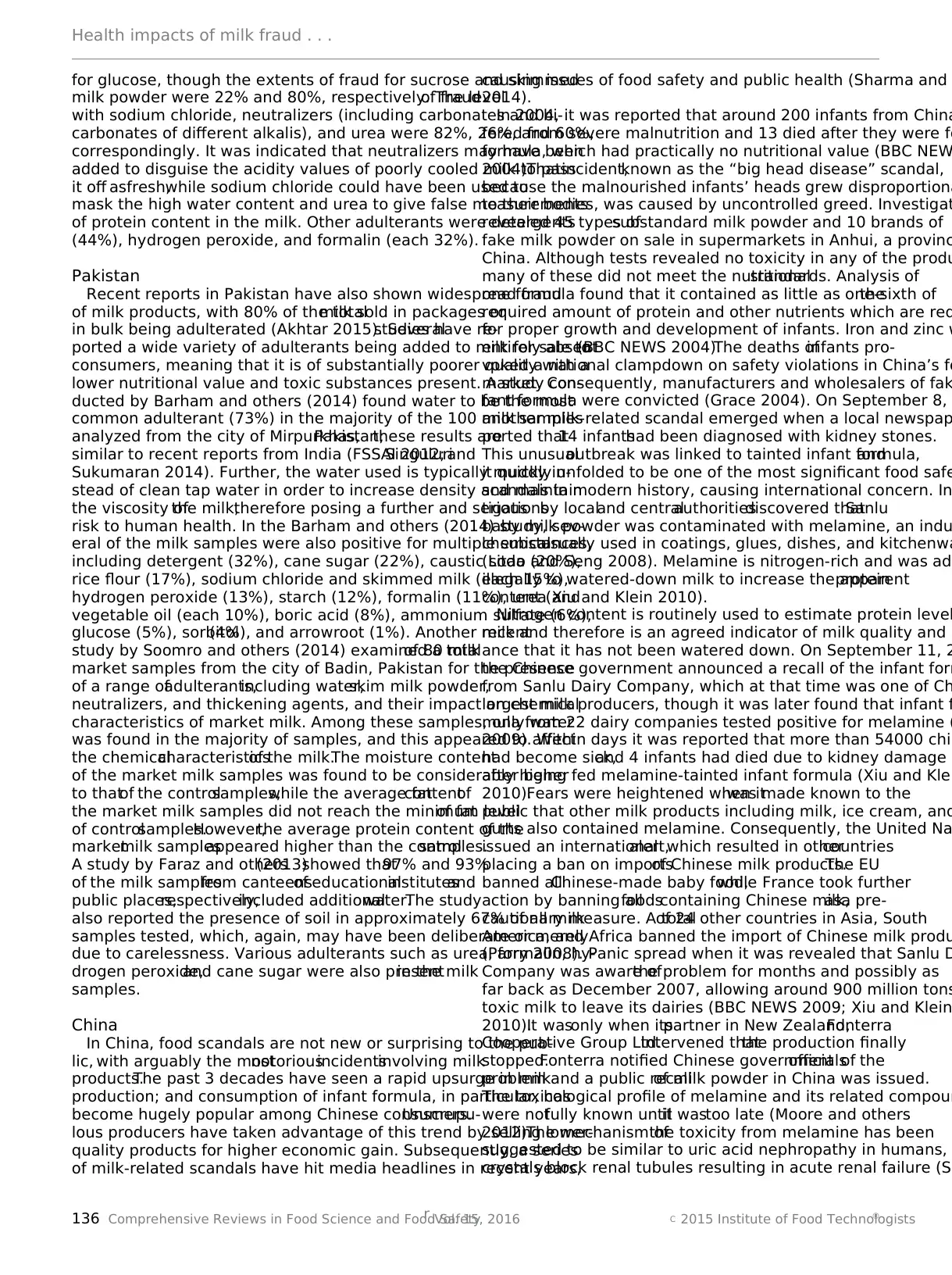
Recent reports in Pakistan have also shown widespread fraud
of milk products, with 80% of the totalmilk sold in packages or
in bulk being adulterated (Akhtar 2015). Severalstudies have re-
ported a wide variety of adulterants being added to milk for sale to
consumers, meaning that it is of substantially poorer quality with a
lower nutritional value and toxic substances present. A study con-
ducted by Barham and others (2014) found water to be the most
common adulterant (73%) in the majority of the 100 milk samples
analyzed from the city of Mirpurkhas,Pakistan;these results are
similar to recent reports from India (FSSAI 2012;Singuluriand
Sukumaran 2014). Further, the water used is typically muddy in-
stead of clean tap water in order to increase density and maintain
the viscosity ofthe milk,therefore posing a further and serious
risk to human health. In the Barham and others (2014) study, sev-
eral of the milk samples were also positive for multiple substances,
including detergent (32%), cane sugar (22%), caustic soda (20%),
rice flour (17%), sodium chloride and skimmed milk (each 15%),
hydrogen peroxide (13%), starch (12%), formalin (11%), urea and
vegetable oil (each 10%), boric acid (8%), ammonium sulfate (6%),
glucose (5%), sorbitol(4%), and arrowroot (1%). Another recent
study by Soomro and others (2014) examined a totalof 80 milk
market samples from the city of Badin, Pakistan for the presence
of a range ofadulterants,including water,skim milk powder,
neutralizers, and thickening agents, and their impact on chemical
characteristics of market milk. Among these samples, only water
was found in the majority of samples, and this appeared to affect
the chemicalcharacteristicsof the milk.The moisture content
of the market milk samples was found to be considerably higher
to thatof the controlsamples,while the average fatcontentof
the market milk samples did not reach the minimum levelof fat
of controlsamples.However,the average protein content of the
marketmilk samplesappeared higher than the controlsamples.
A study by Faraz and others(2013)showed that97% and 93%
of the milk samplesfrom canteensof educationalinstitutesand
public places,respectively,included additionalwater.The study
also reported the presence of soil in approximately 67% of all milk
samples tested, which, again, may have been deliberate or merely
due to carelessness. Various adulterants such as urea, formalin, hy-
drogen peroxide,and cane sugar were also presentin the milk
samples.
China
In China, food scandals are not new or surprising to the pub-
lic, with arguably the mostnotoriousincidentsinvolving milk
products.The past 3 decades have seen a rapid upsurge in milk
production; and consumption of infant formula, in particular, has
become hugely popular among Chinese consumers.Unscrupu-
lous producers have taken advantage of this trend by selling lower-
quality products for higher economic gain. Subsequently, a series
of milk-related scandals have hit media headlines in recent years,
causing issues of food safety and public health (Sharma and
2014).
In 2004, it was reported that around 200 infants from China
fered from severe malnutrition and 13 died after they were fe
formula, which had practically no nutritional value (BBC NEW
2004).Thatincident,known as the “big head disease” scandal,
because the malnourished infants’ heads grew disproportiona
to their bodies, was caused by uncontrolled greed. Investigat
revealed 45 types ofsubstandard milk powder and 10 brands of
fake milk powder on sale in supermarkets in Anhui, a provinc
China. Although tests revealed no toxicity in any of the produ
many of these did not meet the nutritionalstandards. Analysis of
one formula found that it contained as little as one-sixth ofthe
required amount of protein and other nutrients which are req
for proper growth and development of infants. Iron and zinc w
entirely absent(BBC NEWS 2004).The deaths ofinfants pro-
voked a national clampdown on safety violations in China’s fo
market. Consequently, manufacturers and wholesalers of fak
fant formula were convicted (Grace 2004). On September 8,
another milk-related scandal emerged when a local newspap
ported that14 infantshad been diagnosed with kidney stones.
This unusualoutbreak was linked to tainted infant formula,and
it quickly unfolded to be one of the most significant food safe
scandals in modern history, causing international concern. In
tigationsby localand centralauthoritiesdiscovered thatSanlu
baby milk powder was contaminated with melamine, an indu
chemicalusually used in coatings, glues, dishes, and kitchenwa
(Litao and Seng 2008). Melamine is nitrogen-rich and was ad
illegally to watered-down milk to increase the apparentprotein
content (Xiu and Klein 2010).
Nitrogen content is routinely used to estimate protein level
milk and therefore is an agreed indicator of milk quality and a
ance that it has not been watered down. On September 11, 2
the Chinese government announced a recall of the infant form
from Sanlu Dairy Company, which at that time was one of Ch
largest milk producers, though it was later found that infant f
mula from 22 dairy companies tested positive for melamine (
2009). Within days it was reported that more than 54000 chil
had become sick,and 4 infants had died due to kidney damage
after being fed melamine-tainted infant formula (Xiu and Klei
2010).Fears were heightened when itwas made known to the
public that other milk products including milk, ice cream, and
gurts also contained melamine. Consequently, the United Na
issued an internationalalert,which resulted in othercountries
placing a ban on importsof Chinese milk products.The EU
banned allChinese-made baby food,while France took further
action by banning allfoodscontaining Chinese milk,asa pre-
cautionary measure. A totalof 24 other countries in Asia, South
America, and Africa banned the import of Chinese milk produ
(Parry 2008). Panic spread when it was revealed that Sanlu D
Company was aware ofthe problem for months and possibly as
far back as December 2007, allowing around 900 million tons
toxic milk to leave its dairies (BBC NEWS 2009; Xiu and Klein
2010).It wasonly when itspartner in New Zealand,Fonterra
Cooperative Group Ltd.intervened thatthe production finally
stopped.Fonterra notified Chinese governmentofficialsof the
problem and a public recallof milk powder in China was issued.
The toxicological profile of melamine and its related compoun
were notfully known untilit wastoo late (Moore and others
2012).The mechanism ofthe toxicity from melamine has been
suggested to be similar to uric acid nephropathy in humans,
crystals block renal tubules resulting in acute renal failure (Sk
136 Comprehensive Reviews in Food Science and Food Safetyr Vol. 15, 2016 C 2015 Institute of Food Technologists®
for glucose, though the extents of fraud for sucrose and skimmed
milk powder were 22% and 80%, respectively. The levelof fraud
with sodium chloride, neutralizers (including carbonates and bi-
carbonates of different alkalis), and urea were 82%, 26%, and 60%,
correspondingly. It was indicated that neutralizers may have been
added to disguise the acidity values of poorly cooled milk to pass
it off asfresh,while sodium chloride could have been used to
mask the high water content and urea to give false measurements
of protein content in the milk. Other adulterants were detergents
(44%), hydrogen peroxide, and formalin (each 32%).
Pakistan
Recent reports in Pakistan have also shown widespread fraud
of milk products, with 80% of the totalmilk sold in packages or
in bulk being adulterated (Akhtar 2015). Severalstudies have re-
ported a wide variety of adulterants being added to milk for sale to
consumers, meaning that it is of substantially poorer quality with a
lower nutritional value and toxic substances present. A study con-
ducted by Barham and others (2014) found water to be the most
common adulterant (73%) in the majority of the 100 milk samples
analyzed from the city of Mirpurkhas,Pakistan;these results are
similar to recent reports from India (FSSAI 2012;Singuluriand
Sukumaran 2014). Further, the water used is typically muddy in-
stead of clean tap water in order to increase density and maintain
the viscosity ofthe milk,therefore posing a further and serious
risk to human health. In the Barham and others (2014) study, sev-
eral of the milk samples were also positive for multiple substances,
including detergent (32%), cane sugar (22%), caustic soda (20%),
rice flour (17%), sodium chloride and skimmed milk (each 15%),
hydrogen peroxide (13%), starch (12%), formalin (11%), urea and
vegetable oil (each 10%), boric acid (8%), ammonium sulfate (6%),
glucose (5%), sorbitol(4%), and arrowroot (1%). Another recent
study by Soomro and others (2014) examined a totalof 80 milk
market samples from the city of Badin, Pakistan for the presence
of a range ofadulterants,including water,skim milk powder,
neutralizers, and thickening agents, and their impact on chemical
characteristics of market milk. Among these samples, only water
was found in the majority of samples, and this appeared to affect
the chemicalcharacteristicsof the milk.The moisture content
of the market milk samples was found to be considerably higher
to thatof the controlsamples,while the average fatcontentof
the market milk samples did not reach the minimum levelof fat
of controlsamples.However,the average protein content of the
marketmilk samplesappeared higher than the controlsamples.
A study by Faraz and others(2013)showed that97% and 93%
of the milk samplesfrom canteensof educationalinstitutesand
public places,respectively,included additionalwater.The study
also reported the presence of soil in approximately 67% of all milk
samples tested, which, again, may have been deliberate or merely
due to carelessness. Various adulterants such as urea, formalin, hy-
drogen peroxide,and cane sugar were also presentin the milk
samples.
China
In China, food scandals are not new or surprising to the pub-
lic, with arguably the mostnotoriousincidentsinvolving milk
products.The past 3 decades have seen a rapid upsurge in milk
production; and consumption of infant formula, in particular, has
become hugely popular among Chinese consumers.Unscrupu-
lous producers have taken advantage of this trend by selling lower-
quality products for higher economic gain. Subsequently, a series
of milk-related scandals have hit media headlines in recent years,
causing issues of food safety and public health (Sharma and
2014).
In 2004, it was reported that around 200 infants from China
fered from severe malnutrition and 13 died after they were fe
formula, which had practically no nutritional value (BBC NEW
2004).Thatincident,known as the “big head disease” scandal,
because the malnourished infants’ heads grew disproportiona
to their bodies, was caused by uncontrolled greed. Investigat
revealed 45 types ofsubstandard milk powder and 10 brands of
fake milk powder on sale in supermarkets in Anhui, a provinc
China. Although tests revealed no toxicity in any of the produ
many of these did not meet the nutritionalstandards. Analysis of
one formula found that it contained as little as one-sixth ofthe
required amount of protein and other nutrients which are req
for proper growth and development of infants. Iron and zinc w
entirely absent(BBC NEWS 2004).The deaths ofinfants pro-
voked a national clampdown on safety violations in China’s fo
market. Consequently, manufacturers and wholesalers of fak
fant formula were convicted (Grace 2004). On September 8,
another milk-related scandal emerged when a local newspap
ported that14 infantshad been diagnosed with kidney stones.
This unusualoutbreak was linked to tainted infant formula,and
it quickly unfolded to be one of the most significant food safe
scandals in modern history, causing international concern. In
tigationsby localand centralauthoritiesdiscovered thatSanlu
baby milk powder was contaminated with melamine, an indu
chemicalusually used in coatings, glues, dishes, and kitchenwa
(Litao and Seng 2008). Melamine is nitrogen-rich and was ad
illegally to watered-down milk to increase the apparentprotein
content (Xiu and Klein 2010).
Nitrogen content is routinely used to estimate protein level
milk and therefore is an agreed indicator of milk quality and a
ance that it has not been watered down. On September 11, 2
the Chinese government announced a recall of the infant form
from Sanlu Dairy Company, which at that time was one of Ch
largest milk producers, though it was later found that infant f
mula from 22 dairy companies tested positive for melamine (
2009). Within days it was reported that more than 54000 chil
had become sick,and 4 infants had died due to kidney damage
after being fed melamine-tainted infant formula (Xiu and Klei
2010).Fears were heightened when itwas made known to the
public that other milk products including milk, ice cream, and
gurts also contained melamine. Consequently, the United Na
issued an internationalalert,which resulted in othercountries
placing a ban on importsof Chinese milk products.The EU
banned allChinese-made baby food,while France took further
action by banning allfoodscontaining Chinese milk,asa pre-
cautionary measure. A totalof 24 other countries in Asia, South
America, and Africa banned the import of Chinese milk produ
(Parry 2008). Panic spread when it was revealed that Sanlu D
Company was aware ofthe problem for months and possibly as
far back as December 2007, allowing around 900 million tons
toxic milk to leave its dairies (BBC NEWS 2009; Xiu and Klein
2010).It wasonly when itspartner in New Zealand,Fonterra
Cooperative Group Ltd.intervened thatthe production finally
stopped.Fonterra notified Chinese governmentofficialsof the
problem and a public recallof milk powder in China was issued.
The toxicological profile of melamine and its related compoun
were notfully known untilit wastoo late (Moore and others
2012).The mechanism ofthe toxicity from melamine has been
suggested to be similar to uric acid nephropathy in humans,
crystals block renal tubules resulting in acute renal failure (Sk
136 Comprehensive Reviews in Food Science and Food Safetyr Vol. 15, 2016 C 2015 Institute of Food Technologists®
Paraphrase This Document
Need a fresh take? Get an instant paraphrase of this document with our AI Paraphraser
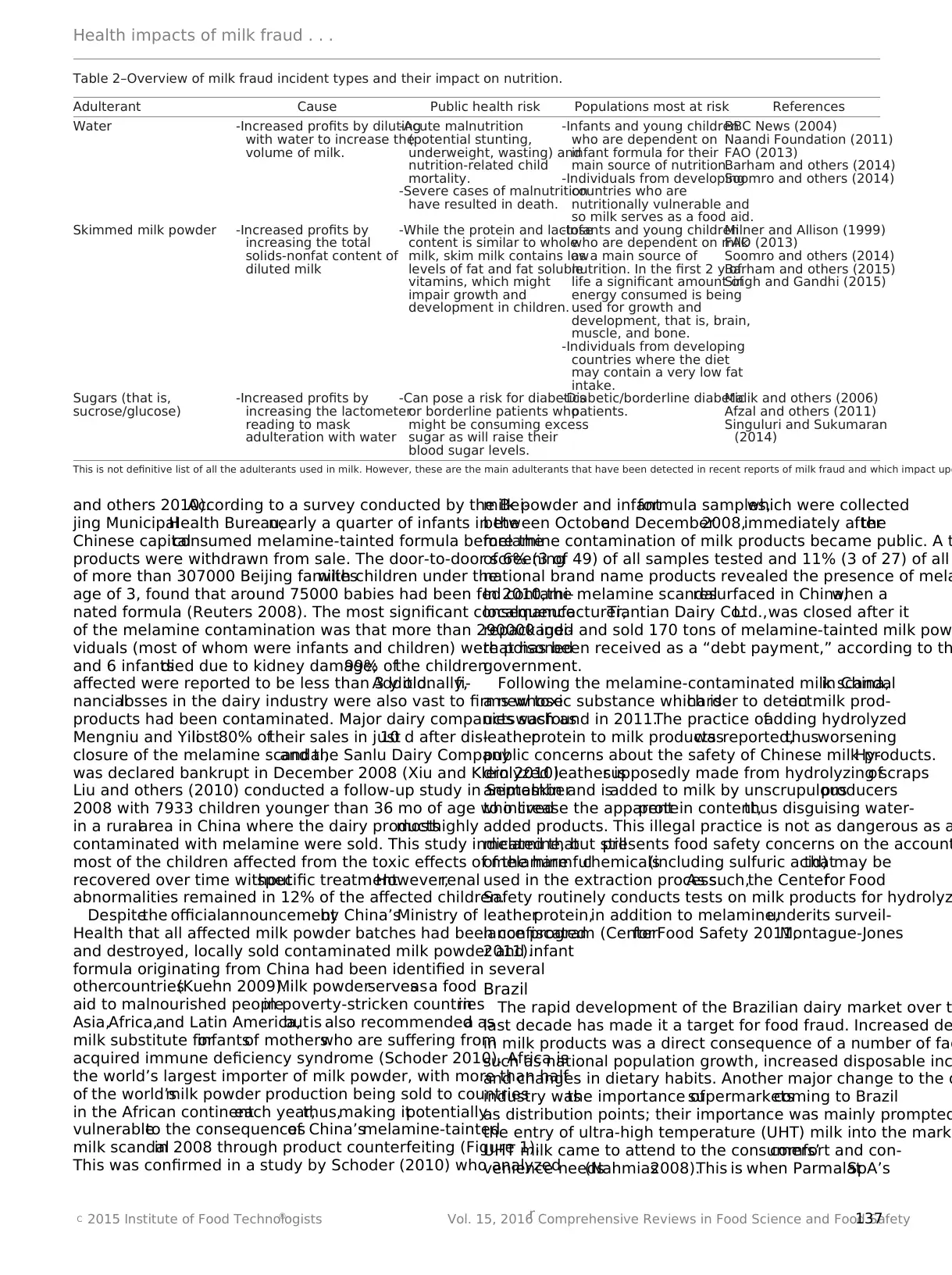
Health impacts of milk fraud . . .
Table 2–Overview of milk fraud incident types and their impact on nutrition.
Adulterant Cause Public health risk Populations most at risk References
Water -Increased profits by diluting
with water to increase the
volume of milk.
-Acute malnutrition
(potential stunting,
underweight, wasting) and
nutrition-related child
mortality.
-Severe cases of malnutrition
have resulted in death.
-Infants and young children
who are dependent on
infant formula for their
main source of nutrition.
-Individuals from developing
countries who are
nutritionally vulnerable and
so milk serves as a food aid.
BBC News (2004)
Naandi Foundation (2011)
FAO (2013)
Barham and others (2014)
Soomro and others (2014)
Skimmed milk powder -Increased profits by
increasing the total
solids-nonfat content of
diluted milk
-While the protein and lactose
content is similar to whole
milk, skim milk contains low
levels of fat and fat soluble
vitamins, which might
impair growth and
development in children.
-Infants and young children
who are dependent on milk
as a main source of
nutrition. In the first 2 y of
life a significant amount of
energy consumed is being
used for growth and
development, that is, brain,
muscle, and bone.
-Individuals from developing
countries where the diet
may contain a very low fat
intake.
Milner and Allison (1999)
FAO (2013)
Soomro and others (2014)
Barham and others (2015)
Singh and Gandhi (2015)
Sugars (that is,
sucrose/glucose)
-Increased profits by
increasing the lactometer
reading to mask
adulteration with water
-Can pose a risk for diabetics
or borderline patients who
might be consuming excess
sugar as will raise their
blood sugar levels.
-Diabetic/borderline diabetic
patients.
Malik and others (2006)
Afzal and others (2011)
Singuluri and Sukumaran
(2014)
This is not definitive list of all the adulterants used in milk. However, these are the main adulterants that have been detected in recent reports of milk fraud and which impact upo
and others 2010).According to a survey conducted by the Bei-
jing MunicipalHealth Bureau,nearly a quarter of infants in the
Chinese capitalconsumed melamine-tainted formula before the
products were withdrawn from sale. The door-to-door screening
of more than 307000 Beijing familieswith children under the
age of 3, found that around 75000 babies had been fed contami-
nated formula (Reuters 2008). The most significant consequence
of the melamine contamination was that more than 290000 indi-
viduals (most of whom were infants and children) were poisoned
and 6 infantsdied due to kidney damage;99% ofthe children
affected were reported to be less than 3 y old.Additionally,fi-
nanciallosses in the dairy industry were also vast to firms whose
products had been contaminated. Major dairy companies such as
Mengniu and Yililost80% oftheir sales in just10 d after dis-
closure of the melamine scandal,and the Sanlu Dairy Company
was declared bankrupt in December 2008 (Xiu and Klein 2010).
Liu and others (2010) conducted a follow-up study in September
2008 with 7933 children younger than 36 mo of age who lived
in a ruralarea in China where the dairy productsmosthighly
contaminated with melamine were sold. This study indicated that
most of the children affected from the toxic effects of melamine
recovered over time withoutspecific treatment.However,renal
abnormalities remained in 12% of the affected children.
Despitethe officialannouncementby China’sMinistry of
Health that all affected milk powder batches had been confiscated
and destroyed, locally sold contaminated milk powder and infant
formula originating from China had been identified in several
othercountries(Kuehn 2009).Milk powderservesasa food
aid to malnourished peoplein poverty-stricken countriesin
Asia,Africa,and Latin America,butis also recommended asa
milk substitute forinfantsof motherswho are suffering from
acquired immune deficiency syndrome (Schoder 2010). Africa is
the world’s largest importer of milk powder, with more than half
of the world’smilk powder production being sold to countries
in the African continenteach year,thus,making itpotentially
vulnerableto the consequencesof China’smelamine-tainted
milk scandalin 2008 through product counterfeiting (Figure 1).
This was confirmed in a study by Schoder (2010) who analyzed
milk powder and infantformula samples,which were collected
between Octoberand December2008,immediately afterthe
melamine contamination of milk products became public. A t
of 6% (3 of 49) of all samples tested and 11% (3 of 27) of all
national brand name products revealed the presence of mela
In 2010,the melamine scandalresurfaced in China,when a
localmanufacturer,Tiantian Dairy Co.Ltd.,was closed after it
repackaged and sold 170 tons of melamine-tainted milk pow
that has been received as a “debt payment,” according to th
government.
Following the melamine-contaminated milk scandalin China,
a new toxic substance which isharder to detectin milk prod-
uctswasfound in 2011.The practice ofadding hydrolyzed
leatherprotein to milk productswasreported,thusworsening
public concerns about the safety of Chinese milk products.Hy-
drolyzed leather issupposedly made from hydrolyzing scrapsof
animalskin and isadded to milk by unscrupulousproducers
to increase the apparentprotein content,thus disguising water-
added products. This illegal practice is not as dangerous as a
melamine, but stillpresents food safety concerns on the account
of the harmfulchemicals(including sulfuric acid)thatmay be
used in the extraction process.As such,the Centerfor Food
Safety routinely conducts tests on milk products for hydrolyz
leatherprotein,in addition to melamine,underits surveil-
lance program (Centerfor Food Safety 2011;Montague-Jones
2011).
Brazil
The rapid development of the Brazilian dairy market over t
last decade has made it a target for food fraud. Increased de
in milk products was a direct consequence of a number of fac
such as national population growth, increased disposable inc
and changes in dietary habits. Another major change to the d
industry wasthe importance ofsupermarketscoming to Brazil
as distribution points; their importance was mainly prompted
the entry of ultra-high temperature (UHT) milk into the marke
UHT milk came to attend to the consumers’comfort and con-
venience needs(Nahmias2008).This is when ParmalatSpA’s
C 2015 Institute of Food Technologists® Vol. 15, 2016r Comprehensive Reviews in Food Science and Food Safety137
Table 2–Overview of milk fraud incident types and their impact on nutrition.
Adulterant Cause Public health risk Populations most at risk References
Water -Increased profits by diluting
with water to increase the
volume of milk.
-Acute malnutrition
(potential stunting,
underweight, wasting) and
nutrition-related child
mortality.
-Severe cases of malnutrition
have resulted in death.
-Infants and young children
who are dependent on
infant formula for their
main source of nutrition.
-Individuals from developing
countries who are
nutritionally vulnerable and
so milk serves as a food aid.
BBC News (2004)
Naandi Foundation (2011)
FAO (2013)
Barham and others (2014)
Soomro and others (2014)
Skimmed milk powder -Increased profits by
increasing the total
solids-nonfat content of
diluted milk
-While the protein and lactose
content is similar to whole
milk, skim milk contains low
levels of fat and fat soluble
vitamins, which might
impair growth and
development in children.
-Infants and young children
who are dependent on milk
as a main source of
nutrition. In the first 2 y of
life a significant amount of
energy consumed is being
used for growth and
development, that is, brain,
muscle, and bone.
-Individuals from developing
countries where the diet
may contain a very low fat
intake.
Milner and Allison (1999)
FAO (2013)
Soomro and others (2014)
Barham and others (2015)
Singh and Gandhi (2015)
Sugars (that is,
sucrose/glucose)
-Increased profits by
increasing the lactometer
reading to mask
adulteration with water
-Can pose a risk for diabetics
or borderline patients who
might be consuming excess
sugar as will raise their
blood sugar levels.
-Diabetic/borderline diabetic
patients.
Malik and others (2006)
Afzal and others (2011)
Singuluri and Sukumaran
(2014)
This is not definitive list of all the adulterants used in milk. However, these are the main adulterants that have been detected in recent reports of milk fraud and which impact upo
and others 2010).According to a survey conducted by the Bei-
jing MunicipalHealth Bureau,nearly a quarter of infants in the
Chinese capitalconsumed melamine-tainted formula before the
products were withdrawn from sale. The door-to-door screening
of more than 307000 Beijing familieswith children under the
age of 3, found that around 75000 babies had been fed contami-
nated formula (Reuters 2008). The most significant consequence
of the melamine contamination was that more than 290000 indi-
viduals (most of whom were infants and children) were poisoned
and 6 infantsdied due to kidney damage;99% ofthe children
affected were reported to be less than 3 y old.Additionally,fi-
nanciallosses in the dairy industry were also vast to firms whose
products had been contaminated. Major dairy companies such as
Mengniu and Yililost80% oftheir sales in just10 d after dis-
closure of the melamine scandal,and the Sanlu Dairy Company
was declared bankrupt in December 2008 (Xiu and Klein 2010).
Liu and others (2010) conducted a follow-up study in September
2008 with 7933 children younger than 36 mo of age who lived
in a ruralarea in China where the dairy productsmosthighly
contaminated with melamine were sold. This study indicated that
most of the children affected from the toxic effects of melamine
recovered over time withoutspecific treatment.However,renal
abnormalities remained in 12% of the affected children.
Despitethe officialannouncementby China’sMinistry of
Health that all affected milk powder batches had been confiscated
and destroyed, locally sold contaminated milk powder and infant
formula originating from China had been identified in several
othercountries(Kuehn 2009).Milk powderservesasa food
aid to malnourished peoplein poverty-stricken countriesin
Asia,Africa,and Latin America,butis also recommended asa
milk substitute forinfantsof motherswho are suffering from
acquired immune deficiency syndrome (Schoder 2010). Africa is
the world’s largest importer of milk powder, with more than half
of the world’smilk powder production being sold to countries
in the African continenteach year,thus,making itpotentially
vulnerableto the consequencesof China’smelamine-tainted
milk scandalin 2008 through product counterfeiting (Figure 1).
This was confirmed in a study by Schoder (2010) who analyzed
milk powder and infantformula samples,which were collected
between Octoberand December2008,immediately afterthe
melamine contamination of milk products became public. A t
of 6% (3 of 49) of all samples tested and 11% (3 of 27) of all
national brand name products revealed the presence of mela
In 2010,the melamine scandalresurfaced in China,when a
localmanufacturer,Tiantian Dairy Co.Ltd.,was closed after it
repackaged and sold 170 tons of melamine-tainted milk pow
that has been received as a “debt payment,” according to th
government.
Following the melamine-contaminated milk scandalin China,
a new toxic substance which isharder to detectin milk prod-
uctswasfound in 2011.The practice ofadding hydrolyzed
leatherprotein to milk productswasreported,thusworsening
public concerns about the safety of Chinese milk products.Hy-
drolyzed leather issupposedly made from hydrolyzing scrapsof
animalskin and isadded to milk by unscrupulousproducers
to increase the apparentprotein content,thus disguising water-
added products. This illegal practice is not as dangerous as a
melamine, but stillpresents food safety concerns on the account
of the harmfulchemicals(including sulfuric acid)thatmay be
used in the extraction process.As such,the Centerfor Food
Safety routinely conducts tests on milk products for hydrolyz
leatherprotein,in addition to melamine,underits surveil-
lance program (Centerfor Food Safety 2011;Montague-Jones
2011).
Brazil
The rapid development of the Brazilian dairy market over t
last decade has made it a target for food fraud. Increased de
in milk products was a direct consequence of a number of fac
such as national population growth, increased disposable inc
and changes in dietary habits. Another major change to the d
industry wasthe importance ofsupermarketscoming to Brazil
as distribution points; their importance was mainly prompted
the entry of ultra-high temperature (UHT) milk into the marke
UHT milk came to attend to the consumers’comfort and con-
venience needs(Nahmias2008).This is when ParmalatSpA’s
C 2015 Institute of Food Technologists® Vol. 15, 2016r Comprehensive Reviews in Food Science and Food Safety137
Health impacts of milk fraud . . .
(an Italian world-leading multinationalcompany)well-known
UHT milk became hugely popular. In this year, 3 very important
facts were perceived in the Brazilian dairy market: (1) the prices
of the majority ofmilk products were ridiculously high,(2) the
industry was suffering from a lack of oversight with only one-third
of milk produced in Brazil being inspected by national consumer
health program authorities,and (3)the Brazilian dairy industry
was hit by an unexpected downturn when news of the fraud scan-
dals broke. Brazilian consumers were informed that producers had
adulterated the milk sold in local supermarkets. In Brazil, the milk
from localdairy farms is sold to cooperatives. A cooperative is a
business, which is owned and controlled by farmers who produce
the milk. It was at 2 dairy cooperatives that the milk was adulter-
ated with hydrogen peroxide, oxygenated water, and caustic soda
to increase the volume of the product, which in turn increased a
producer’s profit from raw milk (milk that is neither submitted to
previous treatment nor submitted to inspections). The adulterated
milk was then sold as pure milk to end users or to dairy manufac-
turing companies. Parmalat SpA, one of the largest companies on
the Brazilian dairy market,claimed to be a victim ofthis fraud.
Although it was not directly responsible for selling and produc-
ing the milk,ParmalatSpA showed negligence by not properly
evaluating the quality ofthe purchased raw milk and,therefore,
suffered the consequences from the milk fraud. This scandalalso
proved how inefficientthe inspection systems ofquality (estab-
lished by the agro-industrial government) were in Brazil by the fact
that the fraudulent milk managed to reach supermarkets and end
consumers. Almost immediately after the scandal hit media head-
linesthe Brazilian Ministry ofAgriculture ordered Anvisa (the
Brazilian Sanitarian Vigilance Organization)to take every sin-
gle milk carton and milk plastic bottles with the involved brand
names off the market, which included Parmalat SpA. The finan-
cialconsequencesof the crisisfor ParmalatSpA and other im-
plicated companies were vast. Customers stopped purchasing Par-
malat milk,afraid ofconsuming hydrogen peroxide,oxygenated
water,or caustic soda.Despite this milk fraud scandalbeing na-
tionally publicized, with ongoing reports of the case on television,
on the Internet,and in the press,as wellas great financiallosses
for those companies involved and the arrest of many individuals,
reports of illegal fraud of UHT milk from various regions of Brazil
are still reported (Ferreira 2014).
In a recentstudy by Souza and others(2011),a totalof 100
samples of Brazilian UHT milk were analyzed for adulterants such
as starch, chlorine, formaldehyde, hydrogen peroxide, and urine.
With the exception ofstarch,allsamples reported the presence
of at least one adulterant. The highest values of nonconformities
were found for urine (55%)and formaldehyde (44%),followed
by hydrogen peroxide (30%) and chlorine (12%). Additionally, the
presence of chlorine indicates a lack of rinsing sanitized equipment
used in milking.
Milk Fraud and Public Health Effects
Some of the adulterants and malpractices associated with milk
production have caused public health concerns and malnutrition.
An overview of milk fraud incident types and their potential im-
pacts on nutrition and food safety are presented in Table 2 and 3,
respectively. The addition of water to milk decreases its nutritional
value; for infants and children this may be a serious concern as they
are at a critical stage of growth and development and are dependent
on milk products for supplies of vital nutrients and so may be at risk
of malnutrition. Indicators of undernourishment are manifested as
child-stunting, underweight, wasting, and nutrition-related child
mortality (FAO 2013).In China’s “big head disease” scandalin
2004, after infants were fed a fake formula they rapidly lost w
The infants were said to have developed “big head disease,”
is a symptom of acute malnutrition, describing the lack of fle
the limbs and torso, which appear to shrink in comparison wi
the cranium (BBC NEWS 2004).A further concern aboutthe
water used to dilute milk is that it is usually obtained from an
safe and inexpensive source and may be contaminated with
metals, agricultural chemicals, or microorganisms. If milk of s
poor standard is consumed it poses a serious threat to the he
of itsconsumers(Kandpaland others2012).If the water used
in the adulterated milk is contaminated by pathogens,then this
may well lead to infective diarrhea in children, which can ham
their growth and development besides providing them with fe
calories. Agriculture is an additional source of chemical conta
nation, with nitrate being the main contaminant. Nitrate can
methemoglobinemia, or blue-baby syndrome, in formula-fed
fantslessthan 3 mo ofage (Fawelland Nieuwenhuijsen 2003;
Fern´andez-Luque˜no and others 2013; Mudgil and Barak 2013).
The chemicals and other contaminants being used as adult
in milk have a wide range of acute and chronic effects on hum
health. The addition of sodium chloride (common salt) in milk
be problematic for those who have hypertension, heart condi
and chronic kidney or liver ailments. They live under strict sa
rationing, and if they consume sodium unknowingly in milk it
the potentialto cause harm (Khanna and Pandey 2013;Barham
and others 2014).If the milk is adulterated with sugar then this
may contribute to problems in diabetics through elevation of
sugar levels. If such milk is regularly consumed by individuals
are already diabetic or have a cardiac problem, it can be haz
(Malik and others 2006; Singuluri and Sukumaran 2014).
Formalin ishighly toxic to humansin smallamountsand
is classified asa carcinogen.Its ingestion isknown to induce
acute poisoning,causing irritation,often leading to dry skin,
dermatitis,headaches,dizziness,tearingeyes,sneezingand
coughing, and even the development of allergic asthma. Exp
to large amountshasbeen linked to eye conjunctivitis,nasal
and pharyngealdiseases,laryngospasm,and pulmonary edema,
though these health effects are unlikely with the concentratio
presentin adulterated milk (Tang and others2009;Gwin and
others2010).Hydrogen peroxide damagesthe gastrointestinal
cellswhich can lead to gastritis,inflammation ofthe intestine,
and bloody diarrhea (Afzaland others 2011;Singh and Gandhi
2015). Detergents have been shown to cause food poisoning
gastrointestinal complications (Tay and others 2013; Singulur
Sukumaran 2014). Some detergents also contain the toxic ing
dient dioxane, which is carcinogenic in nature (Mudgil and Ba
2013). Chlorine causes low blood pressure, nausea, vomiting
abdominal pain (Hattersley 2000; Barham and others 2014).
presence of urea in milk above the cut-off limit (typically acce
at 70 mg/dL) may cause severe human health problems such
impaired vision,diarrhea,and malfunctioning ofthe kidneys.
Moreover, unnecessary hairs might appear on the face, espe
in women and children. It may also lead to swollen limbs, irre
heartbeat, muscle cramps, chills and shivering fever, and can
though these are lesslikely with the concentrationspresentin
the adulterated milk. (Bhatt and others 2008; Trivedi and oth
2009;Kandpaland others2012).Melamine haslow oralacute
toxicity,but excessive exposure in animalsand humanscauses
urinary stones, crystalluria, and acute renal failure. When hum
consume it, infants and children are affected the most becau
their milk dependence for nutrition, compounded by immatur
138 Comprehensive Reviews in Food Science and Food Safetyr Vol. 15, 2016 C 2015 Institute of Food Technologists®
(an Italian world-leading multinationalcompany)well-known
UHT milk became hugely popular. In this year, 3 very important
facts were perceived in the Brazilian dairy market: (1) the prices
of the majority ofmilk products were ridiculously high,(2) the
industry was suffering from a lack of oversight with only one-third
of milk produced in Brazil being inspected by national consumer
health program authorities,and (3)the Brazilian dairy industry
was hit by an unexpected downturn when news of the fraud scan-
dals broke. Brazilian consumers were informed that producers had
adulterated the milk sold in local supermarkets. In Brazil, the milk
from localdairy farms is sold to cooperatives. A cooperative is a
business, which is owned and controlled by farmers who produce
the milk. It was at 2 dairy cooperatives that the milk was adulter-
ated with hydrogen peroxide, oxygenated water, and caustic soda
to increase the volume of the product, which in turn increased a
producer’s profit from raw milk (milk that is neither submitted to
previous treatment nor submitted to inspections). The adulterated
milk was then sold as pure milk to end users or to dairy manufac-
turing companies. Parmalat SpA, one of the largest companies on
the Brazilian dairy market,claimed to be a victim ofthis fraud.
Although it was not directly responsible for selling and produc-
ing the milk,ParmalatSpA showed negligence by not properly
evaluating the quality ofthe purchased raw milk and,therefore,
suffered the consequences from the milk fraud. This scandalalso
proved how inefficientthe inspection systems ofquality (estab-
lished by the agro-industrial government) were in Brazil by the fact
that the fraudulent milk managed to reach supermarkets and end
consumers. Almost immediately after the scandal hit media head-
linesthe Brazilian Ministry ofAgriculture ordered Anvisa (the
Brazilian Sanitarian Vigilance Organization)to take every sin-
gle milk carton and milk plastic bottles with the involved brand
names off the market, which included Parmalat SpA. The finan-
cialconsequencesof the crisisfor ParmalatSpA and other im-
plicated companies were vast. Customers stopped purchasing Par-
malat milk,afraid ofconsuming hydrogen peroxide,oxygenated
water,or caustic soda.Despite this milk fraud scandalbeing na-
tionally publicized, with ongoing reports of the case on television,
on the Internet,and in the press,as wellas great financiallosses
for those companies involved and the arrest of many individuals,
reports of illegal fraud of UHT milk from various regions of Brazil
are still reported (Ferreira 2014).
In a recentstudy by Souza and others(2011),a totalof 100
samples of Brazilian UHT milk were analyzed for adulterants such
as starch, chlorine, formaldehyde, hydrogen peroxide, and urine.
With the exception ofstarch,allsamples reported the presence
of at least one adulterant. The highest values of nonconformities
were found for urine (55%)and formaldehyde (44%),followed
by hydrogen peroxide (30%) and chlorine (12%). Additionally, the
presence of chlorine indicates a lack of rinsing sanitized equipment
used in milking.
Milk Fraud and Public Health Effects
Some of the adulterants and malpractices associated with milk
production have caused public health concerns and malnutrition.
An overview of milk fraud incident types and their potential im-
pacts on nutrition and food safety are presented in Table 2 and 3,
respectively. The addition of water to milk decreases its nutritional
value; for infants and children this may be a serious concern as they
are at a critical stage of growth and development and are dependent
on milk products for supplies of vital nutrients and so may be at risk
of malnutrition. Indicators of undernourishment are manifested as
child-stunting, underweight, wasting, and nutrition-related child
mortality (FAO 2013).In China’s “big head disease” scandalin
2004, after infants were fed a fake formula they rapidly lost w
The infants were said to have developed “big head disease,”
is a symptom of acute malnutrition, describing the lack of fle
the limbs and torso, which appear to shrink in comparison wi
the cranium (BBC NEWS 2004).A further concern aboutthe
water used to dilute milk is that it is usually obtained from an
safe and inexpensive source and may be contaminated with
metals, agricultural chemicals, or microorganisms. If milk of s
poor standard is consumed it poses a serious threat to the he
of itsconsumers(Kandpaland others2012).If the water used
in the adulterated milk is contaminated by pathogens,then this
may well lead to infective diarrhea in children, which can ham
their growth and development besides providing them with fe
calories. Agriculture is an additional source of chemical conta
nation, with nitrate being the main contaminant. Nitrate can
methemoglobinemia, or blue-baby syndrome, in formula-fed
fantslessthan 3 mo ofage (Fawelland Nieuwenhuijsen 2003;
Fern´andez-Luque˜no and others 2013; Mudgil and Barak 2013).
The chemicals and other contaminants being used as adult
in milk have a wide range of acute and chronic effects on hum
health. The addition of sodium chloride (common salt) in milk
be problematic for those who have hypertension, heart condi
and chronic kidney or liver ailments. They live under strict sa
rationing, and if they consume sodium unknowingly in milk it
the potentialto cause harm (Khanna and Pandey 2013;Barham
and others 2014).If the milk is adulterated with sugar then this
may contribute to problems in diabetics through elevation of
sugar levels. If such milk is regularly consumed by individuals
are already diabetic or have a cardiac problem, it can be haz
(Malik and others 2006; Singuluri and Sukumaran 2014).
Formalin ishighly toxic to humansin smallamountsand
is classified asa carcinogen.Its ingestion isknown to induce
acute poisoning,causing irritation,often leading to dry skin,
dermatitis,headaches,dizziness,tearingeyes,sneezingand
coughing, and even the development of allergic asthma. Exp
to large amountshasbeen linked to eye conjunctivitis,nasal
and pharyngealdiseases,laryngospasm,and pulmonary edema,
though these health effects are unlikely with the concentratio
presentin adulterated milk (Tang and others2009;Gwin and
others2010).Hydrogen peroxide damagesthe gastrointestinal
cellswhich can lead to gastritis,inflammation ofthe intestine,
and bloody diarrhea (Afzaland others 2011;Singh and Gandhi
2015). Detergents have been shown to cause food poisoning
gastrointestinal complications (Tay and others 2013; Singulur
Sukumaran 2014). Some detergents also contain the toxic ing
dient dioxane, which is carcinogenic in nature (Mudgil and Ba
2013). Chlorine causes low blood pressure, nausea, vomiting
abdominal pain (Hattersley 2000; Barham and others 2014).
presence of urea in milk above the cut-off limit (typically acce
at 70 mg/dL) may cause severe human health problems such
impaired vision,diarrhea,and malfunctioning ofthe kidneys.
Moreover, unnecessary hairs might appear on the face, espe
in women and children. It may also lead to swollen limbs, irre
heartbeat, muscle cramps, chills and shivering fever, and can
though these are lesslikely with the concentrationspresentin
the adulterated milk. (Bhatt and others 2008; Trivedi and oth
2009;Kandpaland others2012).Melamine haslow oralacute
toxicity,but excessive exposure in animalsand humanscauses
urinary stones, crystalluria, and acute renal failure. When hum
consume it, infants and children are affected the most becau
their milk dependence for nutrition, compounded by immatur
138 Comprehensive Reviews in Food Science and Food Safetyr Vol. 15, 2016 C 2015 Institute of Food Technologists®
⊘ This is a preview!⊘
Do you want full access?
Subscribe today to unlock all pages.
Trusted by 1+ million students worldwide
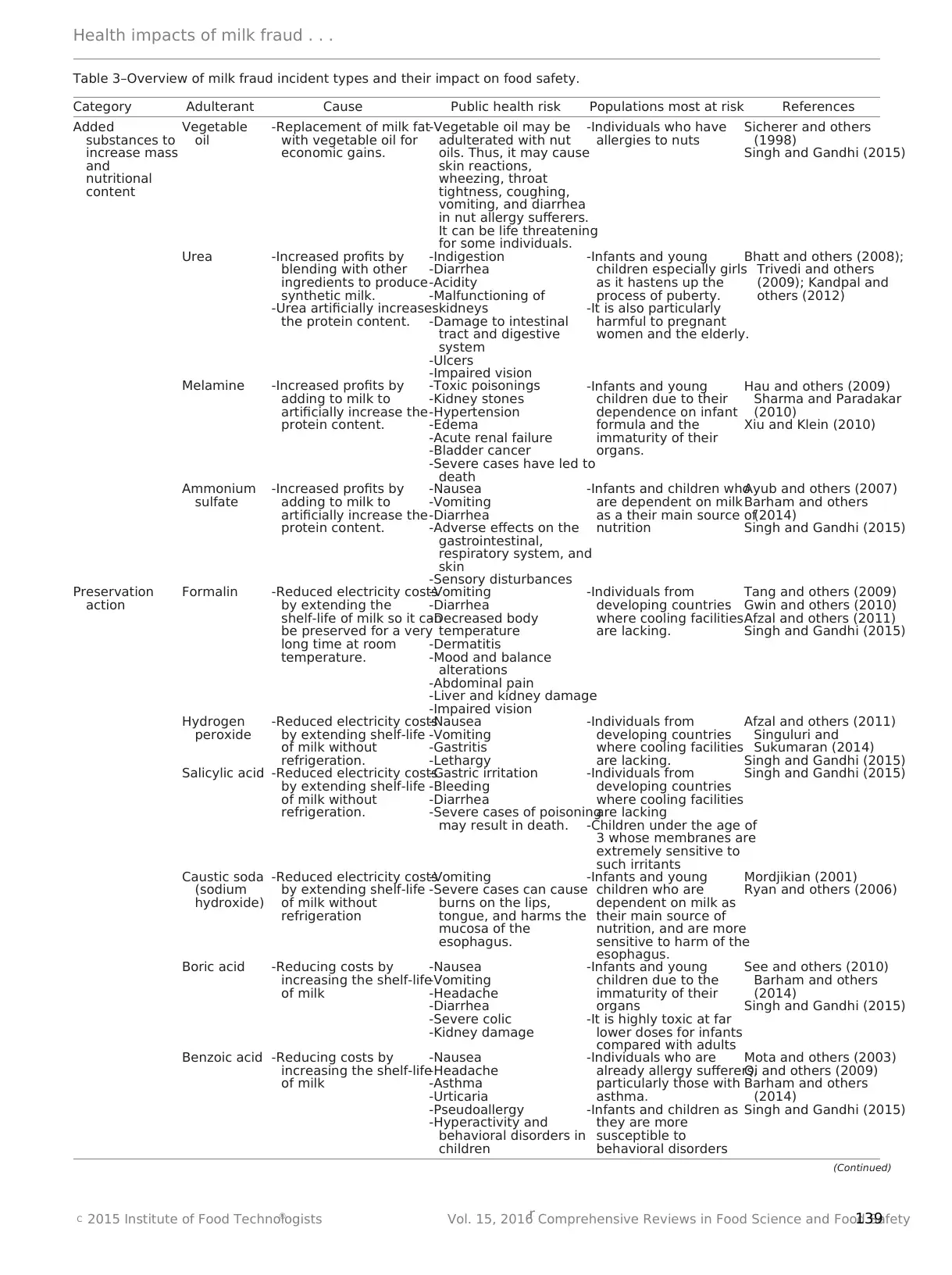
Health impacts of milk fraud . . .
Table 3–Overview of milk fraud incident types and their impact on food safety.
Category Adulterant Cause Public health risk Populations most at risk References
Added
substances to
increase mass
and
nutritional
content
Vegetable
oil
-Replacement of milk fat
with vegetable oil for
economic gains.
-Vegetable oil may be
adulterated with nut
oils. Thus, it may cause
skin reactions,
wheezing, throat
tightness, coughing,
vomiting, and diarrhea
in nut allergy sufferers.
It can be life threatening
for some individuals.
-Individuals who have
allergies to nuts
Sicherer and others
(1998)
Singh and Gandhi (2015)
Urea -Increased profits by
blending with other
ingredients to produce
synthetic milk.
-Urea artificially increases
the protein content.
-Indigestion
-Diarrhea
-Acidity
-Malfunctioning of
kidneys
-Damage to intestinal
tract and digestive
system
-Ulcers
-Impaired vision
-Infants and young
children especially girls
as it hastens up the
process of puberty.
-It is also particularly
harmful to pregnant
women and the elderly.
Bhatt and others (2008);
Trivedi and others
(2009); Kandpal and
others (2012)
Melamine -Increased profits by
adding to milk to
artificially increase the
protein content.
-Toxic poisonings
-Kidney stones
-Hypertension
-Edema
-Acute renal failure
-Bladder cancer
-Severe cases have led to
death
-Infants and young
children due to their
dependence on infant
formula and the
immaturity of their
organs.
Hau and others (2009)
Sharma and Paradakar
(2010)
Xiu and Klein (2010)
Ammonium
sulfate
-Increased profits by
adding to milk to
artificially increase the
protein content.
-Nausea
-Vomiting
-Diarrhea
-Adverse effects on the
gastrointestinal,
respiratory system, and
skin
-Sensory disturbances
-Infants and children who
are dependent on milk
as a their main source of
nutrition
Ayub and others (2007)
Barham and others
(2014)
Singh and Gandhi (2015)
Preservation
action
Formalin -Reduced electricity costs
by extending the
shelf-life of milk so it can
be preserved for a very
long time at room
temperature.
-Vomiting
-Diarrhea
-Decreased body
temperature
-Dermatitis
-Mood and balance
alterations
-Abdominal pain
-Liver and kidney damage
-Impaired vision
-Individuals from
developing countries
where cooling facilities
are lacking.
Tang and others (2009)
Gwin and others (2010)
Afzal and others (2011)
Singh and Gandhi (2015)
Hydrogen
peroxide
-Reduced electricity costs
by extending shelf-life
of milk without
refrigeration.
-Nausea
-Vomiting
-Gastritis
-Lethargy
-Individuals from
developing countries
where cooling facilities
are lacking.
Afzal and others (2011)
Singuluri and
Sukumaran (2014)
Singh and Gandhi (2015)
Salicylic acid -Reduced electricity costs
by extending shelf-life
of milk without
refrigeration.
-Gastric irritation
-Bleeding
-Diarrhea
-Severe cases of poisoning
may result in death.
-Individuals from
developing countries
where cooling facilities
are lacking
-Children under the age of
3 whose membranes are
extremely sensitive to
such irritants
Singh and Gandhi (2015)
Caustic soda
(sodium
hydroxide)
-Reduced electricity costs
by extending shelf-life
of milk without
refrigeration
-Vomiting
-Severe cases can cause
burns on the lips,
tongue, and harms the
mucosa of the
esophagus.
-Infants and young
children who are
dependent on milk as
their main source of
nutrition, and are more
sensitive to harm of the
esophagus.
Mordjikian (2001)
Ryan and others (2006)
Boric acid -Reducing costs by
increasing the shelf-life
of milk
-Nausea
-Vomiting
-Headache
-Diarrhea
-Severe colic
-Kidney damage
-Infants and young
children due to the
immaturity of their
organs
-It is highly toxic at far
lower doses for infants
compared with adults
See and others (2010)
Barham and others
(2014)
Singh and Gandhi (2015)
Benzoic acid -Reducing costs by
increasing the shelf-life
of milk
-Nausea
-Headache
-Asthma
-Urticaria
-Pseudoallergy
-Hyperactivity and
behavioral disorders in
children
-Individuals who are
already allergy sufferers,
particularly those with
asthma.
-Infants and children as
they are more
susceptible to
behavioral disorders
Mota and others (2003)
Qi and others (2009)
Barham and others
(2014)
Singh and Gandhi (2015)
(Continued)
C 2015 Institute of Food Technologists® Vol. 15, 2016r Comprehensive Reviews in Food Science and Food Safety139
Table 3–Overview of milk fraud incident types and their impact on food safety.
Category Adulterant Cause Public health risk Populations most at risk References
Added
substances to
increase mass
and
nutritional
content
Vegetable
oil
-Replacement of milk fat
with vegetable oil for
economic gains.
-Vegetable oil may be
adulterated with nut
oils. Thus, it may cause
skin reactions,
wheezing, throat
tightness, coughing,
vomiting, and diarrhea
in nut allergy sufferers.
It can be life threatening
for some individuals.
-Individuals who have
allergies to nuts
Sicherer and others
(1998)
Singh and Gandhi (2015)
Urea -Increased profits by
blending with other
ingredients to produce
synthetic milk.
-Urea artificially increases
the protein content.
-Indigestion
-Diarrhea
-Acidity
-Malfunctioning of
kidneys
-Damage to intestinal
tract and digestive
system
-Ulcers
-Impaired vision
-Infants and young
children especially girls
as it hastens up the
process of puberty.
-It is also particularly
harmful to pregnant
women and the elderly.
Bhatt and others (2008);
Trivedi and others
(2009); Kandpal and
others (2012)
Melamine -Increased profits by
adding to milk to
artificially increase the
protein content.
-Toxic poisonings
-Kidney stones
-Hypertension
-Edema
-Acute renal failure
-Bladder cancer
-Severe cases have led to
death
-Infants and young
children due to their
dependence on infant
formula and the
immaturity of their
organs.
Hau and others (2009)
Sharma and Paradakar
(2010)
Xiu and Klein (2010)
Ammonium
sulfate
-Increased profits by
adding to milk to
artificially increase the
protein content.
-Nausea
-Vomiting
-Diarrhea
-Adverse effects on the
gastrointestinal,
respiratory system, and
skin
-Sensory disturbances
-Infants and children who
are dependent on milk
as a their main source of
nutrition
Ayub and others (2007)
Barham and others
(2014)
Singh and Gandhi (2015)
Preservation
action
Formalin -Reduced electricity costs
by extending the
shelf-life of milk so it can
be preserved for a very
long time at room
temperature.
-Vomiting
-Diarrhea
-Decreased body
temperature
-Dermatitis
-Mood and balance
alterations
-Abdominal pain
-Liver and kidney damage
-Impaired vision
-Individuals from
developing countries
where cooling facilities
are lacking.
Tang and others (2009)
Gwin and others (2010)
Afzal and others (2011)
Singh and Gandhi (2015)
Hydrogen
peroxide
-Reduced electricity costs
by extending shelf-life
of milk without
refrigeration.
-Nausea
-Vomiting
-Gastritis
-Lethargy
-Individuals from
developing countries
where cooling facilities
are lacking.
Afzal and others (2011)
Singuluri and
Sukumaran (2014)
Singh and Gandhi (2015)
Salicylic acid -Reduced electricity costs
by extending shelf-life
of milk without
refrigeration.
-Gastric irritation
-Bleeding
-Diarrhea
-Severe cases of poisoning
may result in death.
-Individuals from
developing countries
where cooling facilities
are lacking
-Children under the age of
3 whose membranes are
extremely sensitive to
such irritants
Singh and Gandhi (2015)
Caustic soda
(sodium
hydroxide)
-Reduced electricity costs
by extending shelf-life
of milk without
refrigeration
-Vomiting
-Severe cases can cause
burns on the lips,
tongue, and harms the
mucosa of the
esophagus.
-Infants and young
children who are
dependent on milk as
their main source of
nutrition, and are more
sensitive to harm of the
esophagus.
Mordjikian (2001)
Ryan and others (2006)
Boric acid -Reducing costs by
increasing the shelf-life
of milk
-Nausea
-Vomiting
-Headache
-Diarrhea
-Severe colic
-Kidney damage
-Infants and young
children due to the
immaturity of their
organs
-It is highly toxic at far
lower doses for infants
compared with adults
See and others (2010)
Barham and others
(2014)
Singh and Gandhi (2015)
Benzoic acid -Reducing costs by
increasing the shelf-life
of milk
-Nausea
-Headache
-Asthma
-Urticaria
-Pseudoallergy
-Hyperactivity and
behavioral disorders in
children
-Individuals who are
already allergy sufferers,
particularly those with
asthma.
-Infants and children as
they are more
susceptible to
behavioral disorders
Mota and others (2003)
Qi and others (2009)
Barham and others
(2014)
Singh and Gandhi (2015)
(Continued)
C 2015 Institute of Food Technologists® Vol. 15, 2016r Comprehensive Reviews in Food Science and Food Safety139
Paraphrase This Document
Need a fresh take? Get an instant paraphrase of this document with our AI Paraphraser
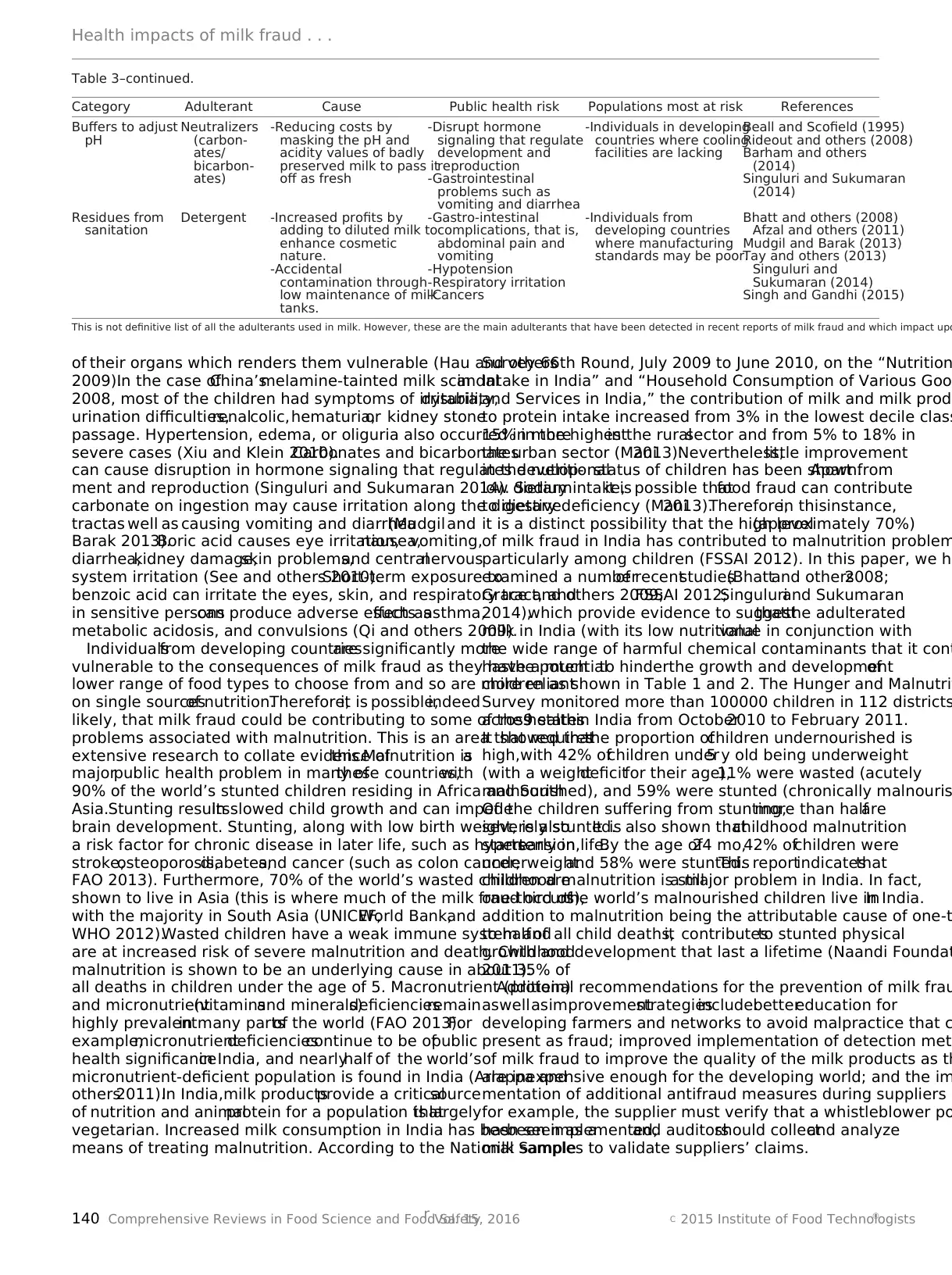
Health impacts of milk fraud . . .
Table 3–continued.
Category Adulterant Cause Public health risk Populations most at risk References
Buffers to adjust
pH
Neutralizers
(carbon-
ates/
bicarbon-
ates)
-Reducing costs by
masking the pH and
acidity values of badly
preserved milk to pass it
off as fresh
-Disrupt hormone
signaling that regulate
development and
reproduction
-Gastrointestinal
problems such as
vomiting and diarrhea
-Individuals in developing
countries where cooling
facilities are lacking
Beall and Scofield (1995)
Rideout and others (2008)
Barham and others
(2014)
Singuluri and Sukumaran
(2014)
Residues from
sanitation Detergent -Increased profits by
adding to diluted milk to
enhance cosmetic
nature.
-Accidental
contamination through
low maintenance of milk
tanks.
-Gastro-intestinal
complications, that is,
abdominal pain and
vomiting
-Hypotension
-Respiratory irritation
-Cancers
-Individuals from
developing countries
where manufacturing
standards may be poor.
Bhatt and others (2008)
Afzal and others (2011)
Mudgil and Barak (2013)
Tay and others (2013)
Singuluri and
Sukumaran (2014)
Singh and Gandhi (2015)
This is not definitive list of all the adulterants used in milk. However, these are the main adulterants that have been detected in recent reports of milk fraud and which impact upo
of their organs which renders them vulnerable (Hau and others
2009).In the case ofChina’smelamine-tainted milk scandalin
2008, most of the children had symptoms of irritability,dysuria,
urination difficulties,renalcolic,hematuria,or kidney stone
passage. Hypertension, edema, or oliguria also occurred in more
severe cases (Xiu and Klein 2010).Carbonates and bicarbonates
can cause disruption in hormone signaling that regulates develop-
ment and reproduction (Singuluri and Sukumaran 2014). Sodium
carbonate on ingestion may cause irritation along the digestive
tractas well as causing vomiting and diarrhea(Mudgil and
Barak 2013).Boric acid causes eye irritation,nausea,vomiting,
diarrhea,kidney damage,skin problems,and centralnervous
system irritation (See and others 2010).Short-term exposure to
benzoic acid can irritate the eyes, skin, and respiratory tract, and
in sensitive personscan produce adverse effectssuch asasthma,
metabolic acidosis, and convulsions (Qi and others 2009).
Individualsfrom developing countriesare significantly more
vulnerable to the consequences of milk fraud as they have a much
lower range of food types to choose from and so are more reliant
on single sourcesof nutrition.Therefore,it is possible,indeed
likely, that milk fraud could be contributing to some of the health
problems associated with malnutrition. This is an area that requires
extensive research to collate evidence ofthis.Malnutrition isa
majorpublic health problem in many ofthese countries,with
90% of the world’s stunted children residing in Africa and South
Asia.Stunting resultsin slowed child growth and can impede
brain development. Stunting, along with low birth weight, is also
a risk factor for chronic disease in later life, such as hypertension,
stroke,osteoporosis,diabetes,and cancer (such as colon cancer;
FAO 2013). Furthermore, 70% of the world’s wasted children are
shown to live in Asia (this is where much of the milk fraud occurs),
with the majority in South Asia (UNICEF,World Bank,and
WHO 2012).Wasted children have a weak immune system and
are at increased risk of severe malnutrition and death. Childhood
malnutrition is shown to be an underlying cause in about 35% of
all deaths in children under the age of 5. Macronutrient (protein)
and micronutrient(vitaminsand minerals)deficienciesremain
highly prevalentin many partsof the world (FAO 2013).For
example,micronutrientdeficienciescontinue to be ofpublic
health significancein India, and nearlyhalf of the world’s
micronutrient-deficient population is found in India (Arlappa and
others2011).In India,milk productsprovide a criticalsource
of nutrition and animalprotein for a population thatis largely
vegetarian. Increased milk consumption in India has been seen as a
means of treating malnutrition. According to the National Sample
Survey 66th Round, July 2009 to June 2010, on the “Nutrition
Intake in India” and “Household Consumption of Various Goo
and Services in India,” the contribution of milk and milk produ
to protein intake increased from 3% in the lowest decile class
15% in the highestin the ruralsector and from 5% to 18% in
the urban sector (Mani2013).Nevertheless,little improvement
in the nutritionalstatus of children has been shown.Apart from
low dietary intake,it is possible thatfood fraud can contribute
to dietary deficiency (Mani2013).Therefore,in thisinstance,
it is a distinct possibility that the high level(approximately 70%)
of milk fraud in India has contributed to malnutrition problem
particularly among children (FSSAI 2012). In this paper, we ha
examined a numberof recentstudies(Bhattand others2008;
Grace and others 2009;FSSAI 2012;Singuluriand Sukumaran
2014),which provide evidence to suggestthatthe adulterated
milk in India (with its low nutritionalvalue in conjunction with
the wide range of harmful chemical contaminants that it cont
hasthe potentialto hinderthe growth and developmentof
children as shown in Table 1 and 2. The Hunger and Malnutrit
Survey monitored more than 100000 children in 112 districts
across9 statesin India from October2010 to February 2011.
It showed thatthe proportion ofchildren undernourished is
high,with 42% ofchildren under5 y old being underweight
(with a weightdeficitfor their age),11% were wasted (acutely
malnourished), and 59% were stunted (chronically malnouris
Of the children suffering from stunting,more than halfare
severely stunted.It is also shown thatchildhood malnutrition
startsearly in life.By the age of24 mo,42% ofchildren were
underweightand 58% were stunted.This reportindicatesthat
childhood malnutrition is stilla major problem in India. In fact,
one-third ofthe world’s malnourished children live in India.In
addition to malnutrition being the attributable cause of one-t
to half of all child deaths,it contributesto stunted physical
growth and development that last a lifetime (Naandi Foundat
2011).
Additional recommendations for the prevention of milk frau
aswellasimprovementstrategiesinclude:bettereducation for
developing farmers and networks to avoid malpractice that c
present as fraud; improved implementation of detection met
of milk fraud to improve the quality of the milk products as th
are inexpensive enough for the developing world; and the im
mentation of additional antifraud measures during suppliers a
for example, the supplier must verify that a whistleblower po
hasbeen implemented,and auditorsshould collectand analyze
milk samples to validate suppliers’ claims.
140 Comprehensive Reviews in Food Science and Food Safetyr Vol. 15, 2016 C 2015 Institute of Food Technologists®
Table 3–continued.
Category Adulterant Cause Public health risk Populations most at risk References
Buffers to adjust
pH
Neutralizers
(carbon-
ates/
bicarbon-
ates)
-Reducing costs by
masking the pH and
acidity values of badly
preserved milk to pass it
off as fresh
-Disrupt hormone
signaling that regulate
development and
reproduction
-Gastrointestinal
problems such as
vomiting and diarrhea
-Individuals in developing
countries where cooling
facilities are lacking
Beall and Scofield (1995)
Rideout and others (2008)
Barham and others
(2014)
Singuluri and Sukumaran
(2014)
Residues from
sanitation Detergent -Increased profits by
adding to diluted milk to
enhance cosmetic
nature.
-Accidental
contamination through
low maintenance of milk
tanks.
-Gastro-intestinal
complications, that is,
abdominal pain and
vomiting
-Hypotension
-Respiratory irritation
-Cancers
-Individuals from
developing countries
where manufacturing
standards may be poor.
Bhatt and others (2008)
Afzal and others (2011)
Mudgil and Barak (2013)
Tay and others (2013)
Singuluri and
Sukumaran (2014)
Singh and Gandhi (2015)
This is not definitive list of all the adulterants used in milk. However, these are the main adulterants that have been detected in recent reports of milk fraud and which impact upo
of their organs which renders them vulnerable (Hau and others
2009).In the case ofChina’smelamine-tainted milk scandalin
2008, most of the children had symptoms of irritability,dysuria,
urination difficulties,renalcolic,hematuria,or kidney stone
passage. Hypertension, edema, or oliguria also occurred in more
severe cases (Xiu and Klein 2010).Carbonates and bicarbonates
can cause disruption in hormone signaling that regulates develop-
ment and reproduction (Singuluri and Sukumaran 2014). Sodium
carbonate on ingestion may cause irritation along the digestive
tractas well as causing vomiting and diarrhea(Mudgil and
Barak 2013).Boric acid causes eye irritation,nausea,vomiting,
diarrhea,kidney damage,skin problems,and centralnervous
system irritation (See and others 2010).Short-term exposure to
benzoic acid can irritate the eyes, skin, and respiratory tract, and
in sensitive personscan produce adverse effectssuch asasthma,
metabolic acidosis, and convulsions (Qi and others 2009).
Individualsfrom developing countriesare significantly more
vulnerable to the consequences of milk fraud as they have a much
lower range of food types to choose from and so are more reliant
on single sourcesof nutrition.Therefore,it is possible,indeed
likely, that milk fraud could be contributing to some of the health
problems associated with malnutrition. This is an area that requires
extensive research to collate evidence ofthis.Malnutrition isa
majorpublic health problem in many ofthese countries,with
90% of the world’s stunted children residing in Africa and South
Asia.Stunting resultsin slowed child growth and can impede
brain development. Stunting, along with low birth weight, is also
a risk factor for chronic disease in later life, such as hypertension,
stroke,osteoporosis,diabetes,and cancer (such as colon cancer;
FAO 2013). Furthermore, 70% of the world’s wasted children are
shown to live in Asia (this is where much of the milk fraud occurs),
with the majority in South Asia (UNICEF,World Bank,and
WHO 2012).Wasted children have a weak immune system and
are at increased risk of severe malnutrition and death. Childhood
malnutrition is shown to be an underlying cause in about 35% of
all deaths in children under the age of 5. Macronutrient (protein)
and micronutrient(vitaminsand minerals)deficienciesremain
highly prevalentin many partsof the world (FAO 2013).For
example,micronutrientdeficienciescontinue to be ofpublic
health significancein India, and nearlyhalf of the world’s
micronutrient-deficient population is found in India (Arlappa and
others2011).In India,milk productsprovide a criticalsource
of nutrition and animalprotein for a population thatis largely
vegetarian. Increased milk consumption in India has been seen as a
means of treating malnutrition. According to the National Sample
Survey 66th Round, July 2009 to June 2010, on the “Nutrition
Intake in India” and “Household Consumption of Various Goo
and Services in India,” the contribution of milk and milk produ
to protein intake increased from 3% in the lowest decile class
15% in the highestin the ruralsector and from 5% to 18% in
the urban sector (Mani2013).Nevertheless,little improvement
in the nutritionalstatus of children has been shown.Apart from
low dietary intake,it is possible thatfood fraud can contribute
to dietary deficiency (Mani2013).Therefore,in thisinstance,
it is a distinct possibility that the high level(approximately 70%)
of milk fraud in India has contributed to malnutrition problem
particularly among children (FSSAI 2012). In this paper, we ha
examined a numberof recentstudies(Bhattand others2008;
Grace and others 2009;FSSAI 2012;Singuluriand Sukumaran
2014),which provide evidence to suggestthatthe adulterated
milk in India (with its low nutritionalvalue in conjunction with
the wide range of harmful chemical contaminants that it cont
hasthe potentialto hinderthe growth and developmentof
children as shown in Table 1 and 2. The Hunger and Malnutrit
Survey monitored more than 100000 children in 112 districts
across9 statesin India from October2010 to February 2011.
It showed thatthe proportion ofchildren undernourished is
high,with 42% ofchildren under5 y old being underweight
(with a weightdeficitfor their age),11% were wasted (acutely
malnourished), and 59% were stunted (chronically malnouris
Of the children suffering from stunting,more than halfare
severely stunted.It is also shown thatchildhood malnutrition
startsearly in life.By the age of24 mo,42% ofchildren were
underweightand 58% were stunted.This reportindicatesthat
childhood malnutrition is stilla major problem in India. In fact,
one-third ofthe world’s malnourished children live in India.In
addition to malnutrition being the attributable cause of one-t
to half of all child deaths,it contributesto stunted physical
growth and development that last a lifetime (Naandi Foundat
2011).
Additional recommendations for the prevention of milk frau
aswellasimprovementstrategiesinclude:bettereducation for
developing farmers and networks to avoid malpractice that c
present as fraud; improved implementation of detection met
of milk fraud to improve the quality of the milk products as th
are inexpensive enough for the developing world; and the im
mentation of additional antifraud measures during suppliers a
for example, the supplier must verify that a whistleblower po
hasbeen implemented,and auditorsshould collectand analyze
milk samples to validate suppliers’ claims.
140 Comprehensive Reviews in Food Science and Food Safetyr Vol. 15, 2016 C 2015 Institute of Food Technologists®
Health impacts of milk fraud . . .
Conclusions
The high nutritionalvalue ofmilk and itsrelative low cost
compared with other protein sources has made it form a signif-
icant part of the diet of many populations worldwide. However,
increased demand globally has made milk prone to massive levels
of fraudulent activity. Milk is a high-risk commodity of concern
for fraudulentactivitiesfor financialgain whereby perpetrators
may increase food safety hazards and diminish nutritionalquality
through intentionaladulteration and/or malpractice under poor
hygiene conditions,a lack of preservation,and no cooling facil-
ities.Such typesof fraud are becoming a common problem in
many regions worldwide, particularly in developing countries like
India and Pakistan, which have largely unregulated practices. Milk
used for human consumption can be adulterated with inferior,
cheaper materials or hazardous chemicals, including pond water,
reconstituted milk powder,cane sugar,urea,melamine,glucose,
and detergents.Milk may be adulterated to such an extent that
there is significantly less nutritional value and it may also be toxic
for public health,as shown in recent milk fraud scandals.Thus,
more analysis is essential to generate awareness among the public
about malpractices or negligence in milk production.
Acknowledgment
The research was funded in part through a PhD studentship by
the Department of Education and Learning for Northern Ireland
and the EU FP7 project Collab4safety “Towards Sustainable Global
Food Safety Collaboration” Grant agreement no: 311611.
Authors Contributions
C.H. drafted the manuscript and was involved in the design of
the study. C.E. designed the study and assisted in the manuscript
drafting. K.C. was involved in the study design and drafting.
References
Afzal A, Mahmood MS, Hussain I, Akhtar M. 2011. Adulteration and
microbiological quality of milk. Pakistan J Nutr 10(12):1195–202.
Akhtar S. 2015. Food safety challenges—a Pakistan’s perspective. Crit Rev
Food Sci Nutr 55(2):219–26.
Arlappa N, Laxmaiah A, Balakrishna N, Harikumar R, Kodavanti MR,
Reddy CG. 2011. Micronutrient deficiency disorders among the rural
children of West Bengal, India. Ann Hum Biol 38(3):281–9.
Armstrong DJ. 2009. Food chemistry and U.S. food regulations. J Agric Food
Chem 57:8180–6.
Ayub M, Ahmed Q, Abbas M, Qasi IM, Hattak IA. 2007. Composition and
adulteration analysis of milk samples. Sarhad J Agric 23(4):1127–30
Ayza A, Yilma Z. 2014. Patterns of milk and milk products adulteration in
Boditti town and its surrounding, South Ethiopia. J Agric Sci 4(10):512–6.
Barham GS, Khaskheli M, Soomro AH, Nizamani ZA. 2014. Extent of
extraneous water and detection of various adulterants in market milk at
Mirpurkhas, Pakistan. J Agric Vet Sci 7(3):83–9.
Barham GS, Khaskheli M, Soomro AH, Nizamani ZA. 2015. Risk of
adulteration in milk consumed at Shaheed Benazirabad District of Sindh.
Intl J Adulteration 1:31–7.
BBC NEWS. 22nd April 2004. China ‘fake milk’ scandal deepens. Available
from:http://news.bbc.co.uk/1/hi/world/asia-pacific/3648583.stm.
Accessed November 11, 2014.
BBC NEWS. 22nd January 2009. Chinese fake milk duo face death. Available
from: http://news.bbc.co.uk/1/hi/world/asia-pacific/7843972.stm.
Accessed December 11, 2014.
Beall DP, Scofield RH. 1995. Milk-alkali syndrome associated with Calcium
carbonate consumption. Reports of seven patients with parathyroid
hormone levels and an estimate of prevalence among patients hospitalized
with hypocalcaemia. Medicine 74(2):89–96.
Bhatt SR, Singh A, Bhatt SM. 2008. Assessment of synthetic milk exposure
to children of selected population in Uttar Pradesh, India. Indian J Med Res
7:22–34.
Campos Motta TM, Hoff RB, Barreto F, Andrade RBS, Lorenzini DM,
Meneghini LZ, Pizzolato TM. 2014. Detection and confirmation of milk
adulteration with cheese whey using proteomic-like sample preparation
liquid chromatography–electrospray–tandem mass spectrometry analys
Talanta 120:498–505.
Canadian Dairy Information Centre. 2013. Global consumption of dairy
products. Available from:http://www.dairyinfo.gc.ca/index_e.php?s1=
dff-fcil&s2=cons&s3=consglo. Accessed April 09, 2015.
Center for Food Safety. March 2011. Food safety focus. Abuse of hydroly
leather protein in milk products. Available from: http://www.cfs.gov.hk/
english/multimedia/multimedia_pub/files/FSF56_2011-03-16.pdf.
Accessed April 20, 2015.
Chen J. 2009. A worldwide food safety concern in 2008—melamine
contaminated infant formula in China caused urinary tract stones in
290,000 children in China. Chinese Med J 122:243–4.
Department of Animal Husbandry, Dairying & Fisheries. 2014. Annual
report 2013–2014. Chapter 4: Dairy development. New Delhi, India:
Ministry of Agriculture, Government of India. p 41–54.
European Commission. 2015. RASFF-Food and feed safety alerts. Availab
from: http://ec.europa.eu/food/safety/rasff/index_en.htm. Accessed
February 27, 2015.
FAO. 2012. FAO statistics yearbook 2012. Rome: Food and Agriculture
Organization.
FAO. 2013. Milk and dairy products in human nutrition. Rome: Food and
Agriculture Organization of the United Nations. p 1–376. Available from:
http://www.fao.org/docrep/018/i3396e/i3396e.pdf. Accessed September
30, 2014.
FAO. January 2015. Milk facts. Rome: Food and Agriculture Organization
of the United Nations. Available from: http://www.fao.org/assets/
infographics/FAO-Infographic-milk-facts-en.pdf. Accessed April 20, 2015
FAOSTAT. 2014. FAO statistical database. Food supply quantity. Available
from: http://faostat.fao.org/site/610/DesktopDefault.aspx?PageID=
610#ancor. Accessed December 11, 2014.
Faraz A, Lateef M, Mustafa MI, Akhtar P, Yaqoob M, Rehman S. 2013.
Detection of adulteration, chemical composition and hygenic status of m
supplied to various canteens of educational institutes and public places
Faisalabad. J Animal Plant Sci 23(1):119–24.
Fawell J, Nieuwenhuijsen MJ. 2003. Contaminants in drinking water. Brit
Med Bull 68:199–208.
Faye B, Konuspayeva G. 2012. The sustainability challenge to the dairy
sector—the growing importance of non-cattle milk production worldwide
Intl Dairy J 24(2):50–6.
FDA. 2009. Public meeting on economically motivated adulteration.
Available from:http://www.gpo.gov/fdsys/pkg/FR-2009-04-06/pdf/
E9-7843.pdf. Accessed June 3, 2015.
Fern´andez-Luque˜no F, L´opez-Valdez F, Gamero-Melo P, Luna-Su´arez S,
Aguilera-Gonz´alez EN, Mart´ınez AI. 2013. Heavy metal pollution in
drinking water - a global risk for human health: a review. Afr J Environ S
Technol 7(7):567–84.
Ferreira G. 2014. The Brazilian milk fraud scandal involving the Italian foo
conglomerate Parmalat. A brief case study on a transnational corporatio
your home country. International Public Relations – PUR6608 class.
Univ. of Florida. p 1–12. Available from: https://www.scribd.com/
doc/235456313/The-Brazilian-Milk-Fraud-Scandal-Involving-the-Italian-
Food-Conglomerate-Parmalat. Accessed December 10,
2014.
Food Safety and Standards Authority of India (FSSAI). 2012. Executive
summary on national survey on milk adulteration. Available from: http:/
www.fssai.gov.in/Portals/0/Pdf/sample_analysed(02-01-2012).pdf. Acces
November 10, 2014.
Grace D, Baker D, Radolph T. 17–22 August 2009. Innovative and
participatory risk-based approaches to assess milk safety in
developing countries: a case study in North East India. Paper Presented
the International Association of Agricultural Economists
(IAAE).
Grace F. 10th May 2004. Arrests in fake baby formula case. Available from
http://www.cbsnews.com/news/arrests-in-fake-baby-formula-case/.
Accessed June 23, 2015.
Gwin MC, Lienert G, Kennedy J. 2010. Formaldehyde exposure and asthm
in children: a systematic review. Environ Health Perspect 118:313–7.
Hattersley JG. 2000. The negative health effects of chlorine. J Orthomol
Med 15:89–95.
Hau AK, Kwan TH, Li PK. 2009. Melamine toxicity and the kidney. J Am
Soc Nephrol 20:245–50.
C 2015 Institute of Food Technologists® Vol. 15, 2016r Comprehensive Reviews in Food Science and Food Safety141
Conclusions
The high nutritionalvalue ofmilk and itsrelative low cost
compared with other protein sources has made it form a signif-
icant part of the diet of many populations worldwide. However,
increased demand globally has made milk prone to massive levels
of fraudulent activity. Milk is a high-risk commodity of concern
for fraudulentactivitiesfor financialgain whereby perpetrators
may increase food safety hazards and diminish nutritionalquality
through intentionaladulteration and/or malpractice under poor
hygiene conditions,a lack of preservation,and no cooling facil-
ities.Such typesof fraud are becoming a common problem in
many regions worldwide, particularly in developing countries like
India and Pakistan, which have largely unregulated practices. Milk
used for human consumption can be adulterated with inferior,
cheaper materials or hazardous chemicals, including pond water,
reconstituted milk powder,cane sugar,urea,melamine,glucose,
and detergents.Milk may be adulterated to such an extent that
there is significantly less nutritional value and it may also be toxic
for public health,as shown in recent milk fraud scandals.Thus,
more analysis is essential to generate awareness among the public
about malpractices or negligence in milk production.
Acknowledgment
The research was funded in part through a PhD studentship by
the Department of Education and Learning for Northern Ireland
and the EU FP7 project Collab4safety “Towards Sustainable Global
Food Safety Collaboration” Grant agreement no: 311611.
Authors Contributions
C.H. drafted the manuscript and was involved in the design of
the study. C.E. designed the study and assisted in the manuscript
drafting. K.C. was involved in the study design and drafting.
References
Afzal A, Mahmood MS, Hussain I, Akhtar M. 2011. Adulteration and
microbiological quality of milk. Pakistan J Nutr 10(12):1195–202.
Akhtar S. 2015. Food safety challenges—a Pakistan’s perspective. Crit Rev
Food Sci Nutr 55(2):219–26.
Arlappa N, Laxmaiah A, Balakrishna N, Harikumar R, Kodavanti MR,
Reddy CG. 2011. Micronutrient deficiency disorders among the rural
children of West Bengal, India. Ann Hum Biol 38(3):281–9.
Armstrong DJ. 2009. Food chemistry and U.S. food regulations. J Agric Food
Chem 57:8180–6.
Ayub M, Ahmed Q, Abbas M, Qasi IM, Hattak IA. 2007. Composition and
adulteration analysis of milk samples. Sarhad J Agric 23(4):1127–30
Ayza A, Yilma Z. 2014. Patterns of milk and milk products adulteration in
Boditti town and its surrounding, South Ethiopia. J Agric Sci 4(10):512–6.
Barham GS, Khaskheli M, Soomro AH, Nizamani ZA. 2014. Extent of
extraneous water and detection of various adulterants in market milk at
Mirpurkhas, Pakistan. J Agric Vet Sci 7(3):83–9.
Barham GS, Khaskheli M, Soomro AH, Nizamani ZA. 2015. Risk of
adulteration in milk consumed at Shaheed Benazirabad District of Sindh.
Intl J Adulteration 1:31–7.
BBC NEWS. 22nd April 2004. China ‘fake milk’ scandal deepens. Available
from:http://news.bbc.co.uk/1/hi/world/asia-pacific/3648583.stm.
Accessed November 11, 2014.
BBC NEWS. 22nd January 2009. Chinese fake milk duo face death. Available
from: http://news.bbc.co.uk/1/hi/world/asia-pacific/7843972.stm.
Accessed December 11, 2014.
Beall DP, Scofield RH. 1995. Milk-alkali syndrome associated with Calcium
carbonate consumption. Reports of seven patients with parathyroid
hormone levels and an estimate of prevalence among patients hospitalized
with hypocalcaemia. Medicine 74(2):89–96.
Bhatt SR, Singh A, Bhatt SM. 2008. Assessment of synthetic milk exposure
to children of selected population in Uttar Pradesh, India. Indian J Med Res
7:22–34.
Campos Motta TM, Hoff RB, Barreto F, Andrade RBS, Lorenzini DM,
Meneghini LZ, Pizzolato TM. 2014. Detection and confirmation of milk
adulteration with cheese whey using proteomic-like sample preparation
liquid chromatography–electrospray–tandem mass spectrometry analys
Talanta 120:498–505.
Canadian Dairy Information Centre. 2013. Global consumption of dairy
products. Available from:http://www.dairyinfo.gc.ca/index_e.php?s1=
dff-fcil&s2=cons&s3=consglo. Accessed April 09, 2015.
Center for Food Safety. March 2011. Food safety focus. Abuse of hydroly
leather protein in milk products. Available from: http://www.cfs.gov.hk/
english/multimedia/multimedia_pub/files/FSF56_2011-03-16.pdf.
Accessed April 20, 2015.
Chen J. 2009. A worldwide food safety concern in 2008—melamine
contaminated infant formula in China caused urinary tract stones in
290,000 children in China. Chinese Med J 122:243–4.
Department of Animal Husbandry, Dairying & Fisheries. 2014. Annual
report 2013–2014. Chapter 4: Dairy development. New Delhi, India:
Ministry of Agriculture, Government of India. p 41–54.
European Commission. 2015. RASFF-Food and feed safety alerts. Availab
from: http://ec.europa.eu/food/safety/rasff/index_en.htm. Accessed
February 27, 2015.
FAO. 2012. FAO statistics yearbook 2012. Rome: Food and Agriculture
Organization.
FAO. 2013. Milk and dairy products in human nutrition. Rome: Food and
Agriculture Organization of the United Nations. p 1–376. Available from:
http://www.fao.org/docrep/018/i3396e/i3396e.pdf. Accessed September
30, 2014.
FAO. January 2015. Milk facts. Rome: Food and Agriculture Organization
of the United Nations. Available from: http://www.fao.org/assets/
infographics/FAO-Infographic-milk-facts-en.pdf. Accessed April 20, 2015
FAOSTAT. 2014. FAO statistical database. Food supply quantity. Available
from: http://faostat.fao.org/site/610/DesktopDefault.aspx?PageID=
610#ancor. Accessed December 11, 2014.
Faraz A, Lateef M, Mustafa MI, Akhtar P, Yaqoob M, Rehman S. 2013.
Detection of adulteration, chemical composition and hygenic status of m
supplied to various canteens of educational institutes and public places
Faisalabad. J Animal Plant Sci 23(1):119–24.
Fawell J, Nieuwenhuijsen MJ. 2003. Contaminants in drinking water. Brit
Med Bull 68:199–208.
Faye B, Konuspayeva G. 2012. The sustainability challenge to the dairy
sector—the growing importance of non-cattle milk production worldwide
Intl Dairy J 24(2):50–6.
FDA. 2009. Public meeting on economically motivated adulteration.
Available from:http://www.gpo.gov/fdsys/pkg/FR-2009-04-06/pdf/
E9-7843.pdf. Accessed June 3, 2015.
Fern´andez-Luque˜no F, L´opez-Valdez F, Gamero-Melo P, Luna-Su´arez S,
Aguilera-Gonz´alez EN, Mart´ınez AI. 2013. Heavy metal pollution in
drinking water - a global risk for human health: a review. Afr J Environ S
Technol 7(7):567–84.
Ferreira G. 2014. The Brazilian milk fraud scandal involving the Italian foo
conglomerate Parmalat. A brief case study on a transnational corporatio
your home country. International Public Relations – PUR6608 class.
Univ. of Florida. p 1–12. Available from: https://www.scribd.com/
doc/235456313/The-Brazilian-Milk-Fraud-Scandal-Involving-the-Italian-
Food-Conglomerate-Parmalat. Accessed December 10,
2014.
Food Safety and Standards Authority of India (FSSAI). 2012. Executive
summary on national survey on milk adulteration. Available from: http:/
www.fssai.gov.in/Portals/0/Pdf/sample_analysed(02-01-2012).pdf. Acces
November 10, 2014.
Grace D, Baker D, Radolph T. 17–22 August 2009. Innovative and
participatory risk-based approaches to assess milk safety in
developing countries: a case study in North East India. Paper Presented
the International Association of Agricultural Economists
(IAAE).
Grace F. 10th May 2004. Arrests in fake baby formula case. Available from
http://www.cbsnews.com/news/arrests-in-fake-baby-formula-case/.
Accessed June 23, 2015.
Gwin MC, Lienert G, Kennedy J. 2010. Formaldehyde exposure and asthm
in children: a systematic review. Environ Health Perspect 118:313–7.
Hattersley JG. 2000. The negative health effects of chlorine. J Orthomol
Med 15:89–95.
Hau AK, Kwan TH, Li PK. 2009. Melamine toxicity and the kidney. J Am
Soc Nephrol 20:245–50.
C 2015 Institute of Food Technologists® Vol. 15, 2016r Comprehensive Reviews in Food Science and Food Safety141
⊘ This is a preview!⊘
Do you want full access?
Subscribe today to unlock all pages.
Trusted by 1+ million students worldwide

1 out of 13


Your All-in-One AI-Powered Toolkit for Academic Success.
+13062052269
info@desklib.com
Available 24*7 on WhatsApp / Email
![[object Object]](/_next/static/media/star-bottom.7253800d.svg)
Unlock your academic potential
Copyright © 2020–2026 A2Z Services. All Rights Reserved. Developed and managed by ZUCOL.