Network Optimization Assignment: Kruskal, Dijkstra, and Routing Tables

Verified

Added on  2022/09/28

|6
|614
|23
Homework Assignment
AI Summary
This assignment addresses network optimization problems, focusing on the application of Kruskal's and Dijkstra's algorithms. The solution begins by explaining the concept of a minimum spanning tree and the utility of Kruskal's algorithm in finding it, emphasizing its efficiency in minimizing edge lengths. It then outlines the steps of Kruskal's algorithm, illustrating how it constructs a minimum spanning tree. The assignment also includes the analysis of a network using Dijkstra's algorithm to determine the shortest paths from a specific node to all others and to construct a routing table. Further, it explores the limitations of Kruskal's algorithm. The assignment also includes a cost analysis for a network upgrade scenario to assess the financial implications of network improvements. The provided solution offers a comprehensive understanding of network optimization techniques and their practical applications.
Document Page
1
Network
Student’s Name:
Institution Affiliation:
tabler-icon-diamond-filled.svg

Paraphrase This Document

Need a fresh take? Get an instant paraphrase of this document with our AI Paraphraser
Document Page
2
Introduction
A minimum spanning tree is a common sort of tree that limits the lengths (or "loads") of the edges of
the tree. A model is a link organization needing to lay line to different neighborhoods; by limiting the
measure of link laid, the link organization will set aside cash. As you can most likely envision, bigger
diagrams have more hubs and a lot more potential outcomes for subgraphs. The quantity of subgraphs
can rapidly venture into the millions, or billions, making it extremely troublesome (and at times difficult)
to locate the base spreading over tree. Furthermore, the lengths typically have various loads; one 5m
long edge may be given a load of 5, one more of a similar length may be given a load of 7. Overhauling
systems can be precarious because of the way that a system contacts each part of a business' general IT
framework and effects a wide scope of clients.
Since the system is the fundamental part for all PC capacities past neighborhood applications, arrange
redesigns can possibly cause more business interruptions contrasted with other IT updates.
Question 1
Minimum spanning tree using Kruskal’s algorithm
Kruskal’s algorithm creates forest of trees. In the start of the algorithm, the mention forest has n node.
In every step that we will be following, we will be adding an edge. The added edges joins the trees
together in the forest. The connections forms something like a cycle. Here are the steps for constructing
Kruskal’s algorithm;
Step 1: Create a forest having separate nodes.
Step 2: Put the edges in a priority queues.
Step 3: After the edges have been added into the tree follow the accompanying steps;
a) Select the cheapest edges in the forest.
Document Page
3
b) If it has formed a cycle reject it, else continue adding the edges.
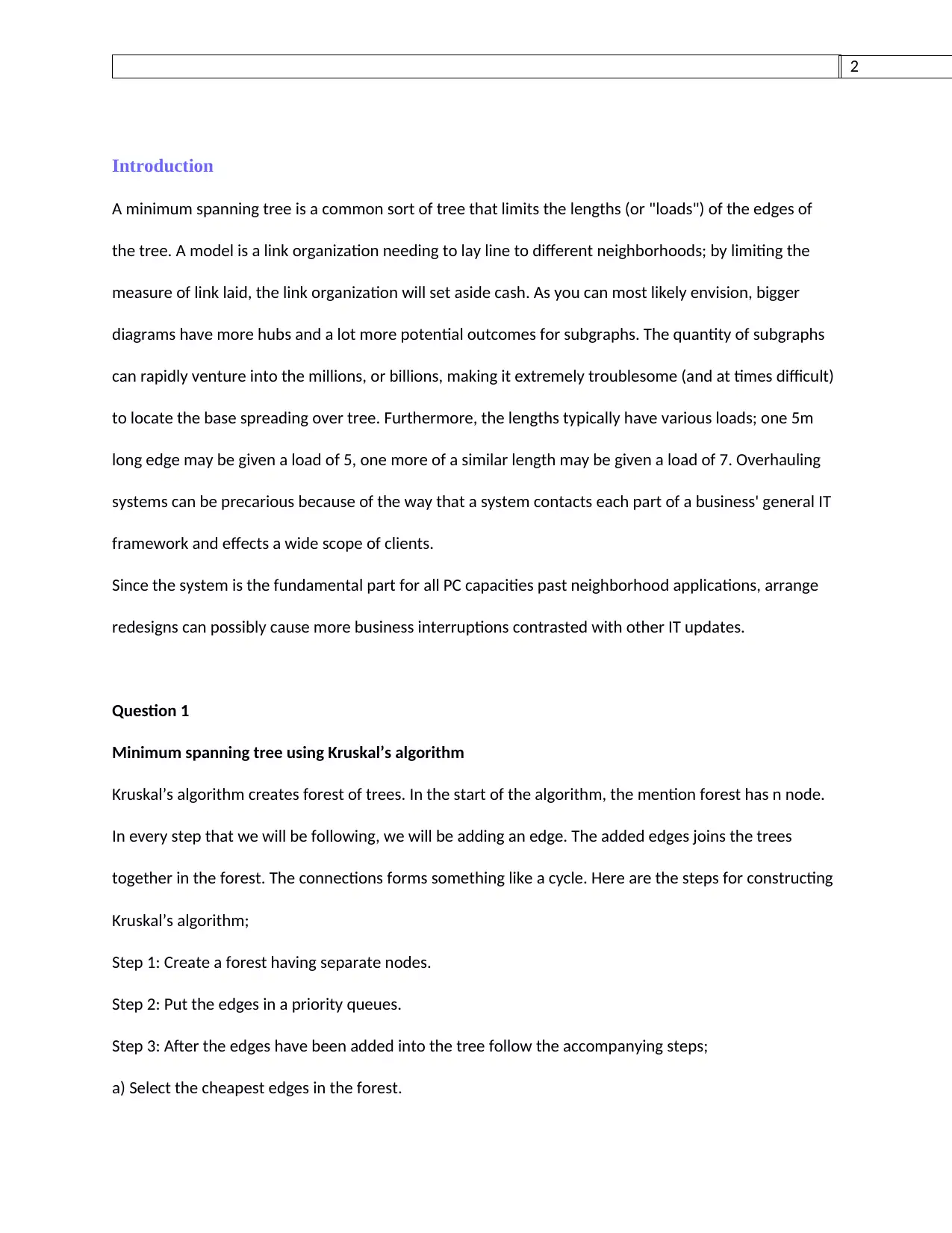
Iteration 1:
Here we are constructing the forest with separate nodes
Document Page
4
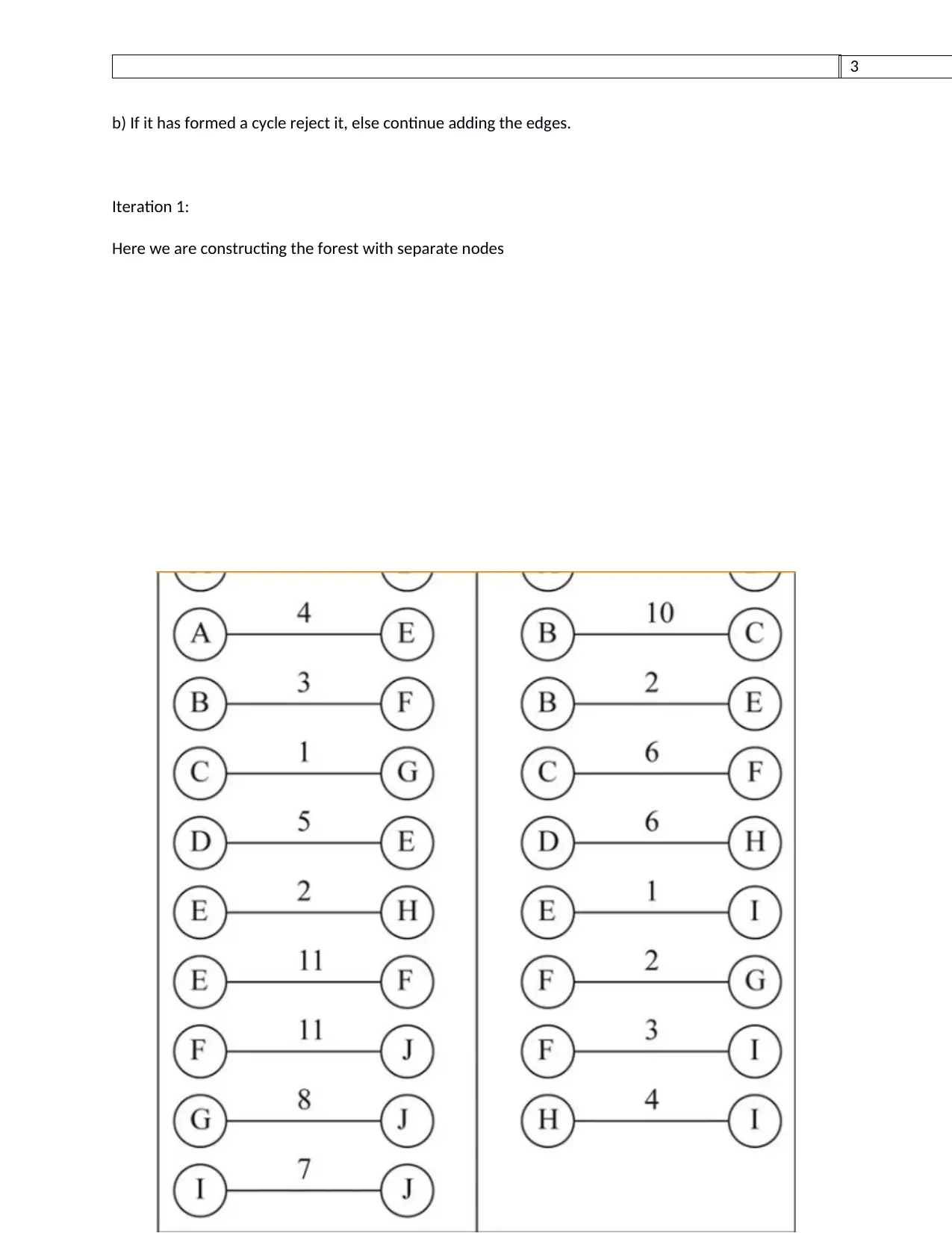
Iteration 2:
Organize the edges based on priority ques
tabler-icon-diamond-filled.svg

Paraphrase This Document

Need a fresh take? Get an instant paraphrase of this document with our AI Paraphraser
Document Page
5
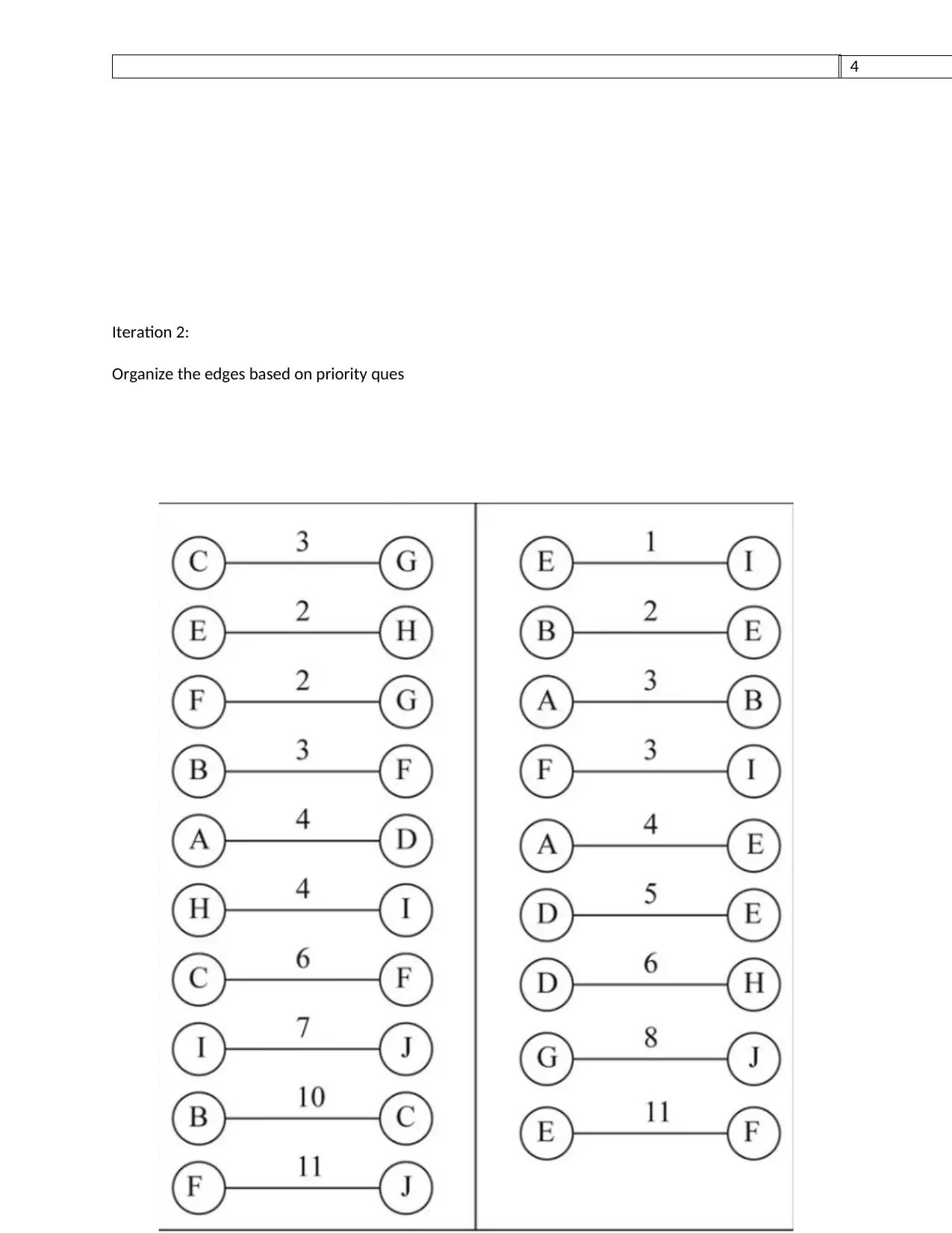
Iteration 3:
Make an asumption that there are no edges
Iteration 4:
Connect all edges together
The minimum spanning tree that is created here is not unique tree.
Minimum spanning tree can be obtained from other algorithms.
Document Page
6
b) We cannot use Kruskal’s or Prim’s algorithm to find the minimum spanning tree in the figure 2.
Limitations
Time taken to check for littlest weight circular segment makes it delayed for enormous
quantities of hubs
Hard to program, however it tends to be customized in framework structure.
Question 2
Cost of upgrade = 5000
Revenue increase = 400
All household upgrade = 4000
Discount = 10%
Making an assumption that the use of 8hrs a day 240 days a year
Total traffic will be = 100 * 8 * 240 * 3600 * 200 = 1.3824E + 11 bits
Gbyte conversion = 1.3824E + 11 bits / 8E +9 = 47998
Cost per year = $47,998
Conclusion
That is the reason it's completely important that a redesign plan be set up that utilizations best
practices. Regardless of whether you are updating system switches at a remote office, supplanting a
maturing remote system or actualizing the most recent system foundation advancements in your server
farm, each overhaul ought to pursue the equivalent dependable accepted procedures.
chevron_up_icon
1 out of 6
circle_padding
hide_on_mobile
zoom_out_icon
[object Object]