Assessment 2: Critical Review of Evidence Informed Health Practice
VerifiedAdded on 2023/06/07
|9
|2954
|217
Report
AI Summary
This report presents a critical review of a research paper within the context of CMHL1005 Evidence Informed Health Practice. The review summarizes the primary results of the study, focusing on the statistical significance of group scores and baseline similarities, while addressing potential biases in participant allocation. It evaluates the study's design and methods, including the operational definition of the intervention, measurement/detection bias, performance bias, and intervention bias, further considering ethical considerations such as informed consent, ethics approval, and potential conflicts of interest. The report concludes with a clinical recommendation, translating the study's findings into practical advice for a patient regarding hydroxychloroquine treatment, evaluating the study design's strengths and weaknesses, and highlighting the key finding that hydroxychloroquine's benefits are not relevant compared to usual care in COVID-19 patients. Desklib provides a platform for students to access similar solved assignments and past papers.
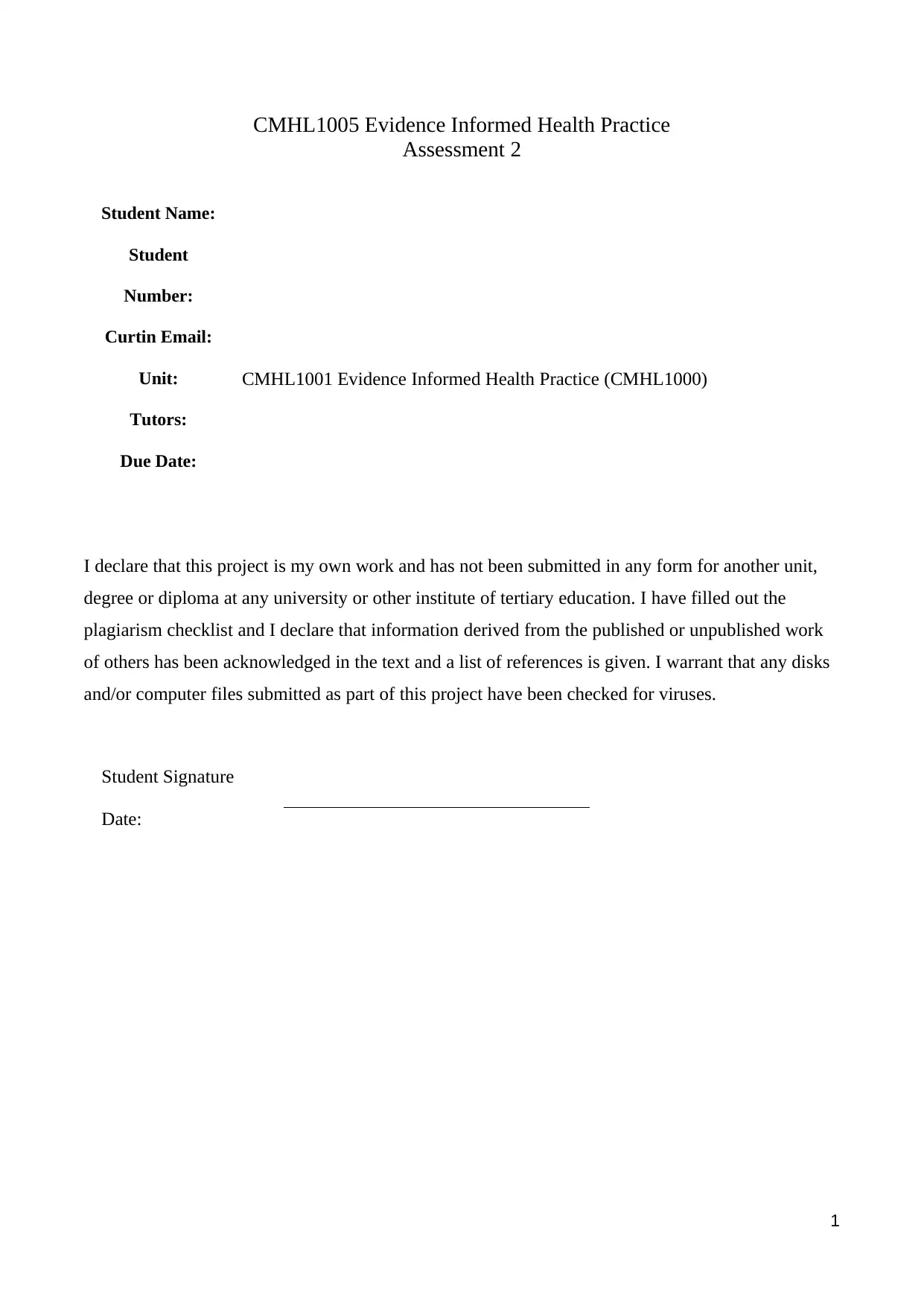
CMHL1005 Evidence Informed Health Practice
Assessment 2
Student Name:
Student
Number:
Curtin Email:
Unit: CMHL1001 Evidence Informed Health Practice (CMHL1000)
Tutors:
Due Date:
I declare that this project is my own work and has not been submitted in any form for another unit,
degree or diploma at any university or other institute of tertiary education. I have filled out the
plagiarism checklist and I declare that information derived from the published or unpublished work
of others has been acknowledged in the text and a list of references is given. I warrant that any disks
and/or computer files submitted as part of this project have been checked for viruses.
Student Signature
Date:
1
Assessment 2
Student Name:
Student
Number:
Curtin Email:
Unit: CMHL1001 Evidence Informed Health Practice (CMHL1000)
Tutors:
Due Date:
I declare that this project is my own work and has not been submitted in any form for another unit,
degree or diploma at any university or other institute of tertiary education. I have filled out the
plagiarism checklist and I declare that information derived from the published or unpublished work
of others has been acknowledged in the text and a list of references is given. I warrant that any disks
and/or computer files submitted as part of this project have been checked for viruses.
Student Signature
Date:
1

Paraphrase This Document
Need a fresh take? Get an instant paraphrase of this document with our AI Paraphraser
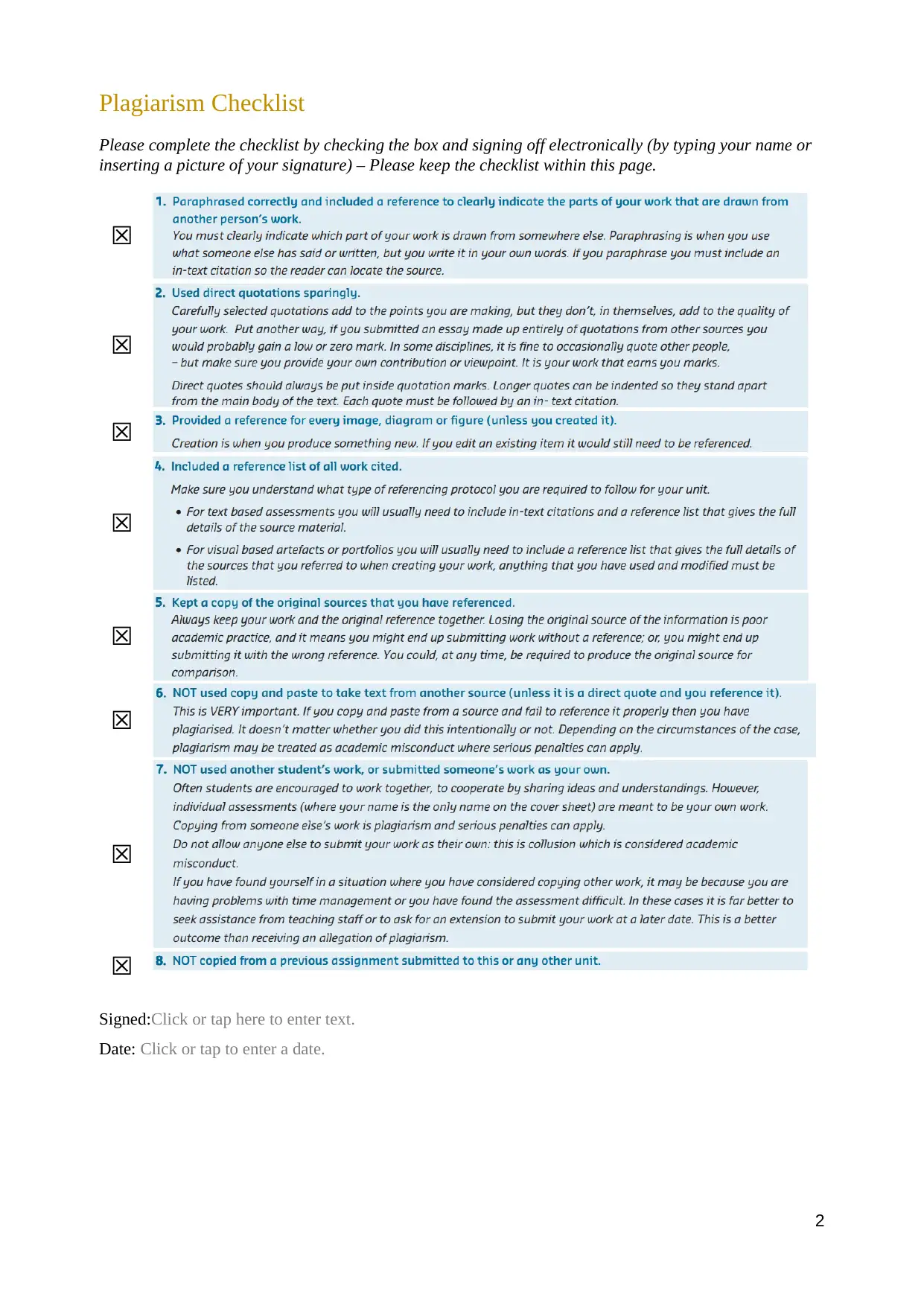
Plagiarism Checklist
Please complete the checklist by checking the box and signing off electronically (by typing your name or
inserting a picture of your signature) – Please keep the checklist within this page.
☒
☒
☒
☒
☒
☒
☒
☒
Signed:Click or tap here to enter text.
Date: Click or tap to enter a date.
2
Please complete the checklist by checking the box and signing off electronically (by typing your name or
inserting a picture of your signature) – Please keep the checklist within this page.
☒
☒
☒
☒
☒
☒
☒
☒
Signed:Click or tap here to enter text.
Date: Click or tap to enter a date.
2
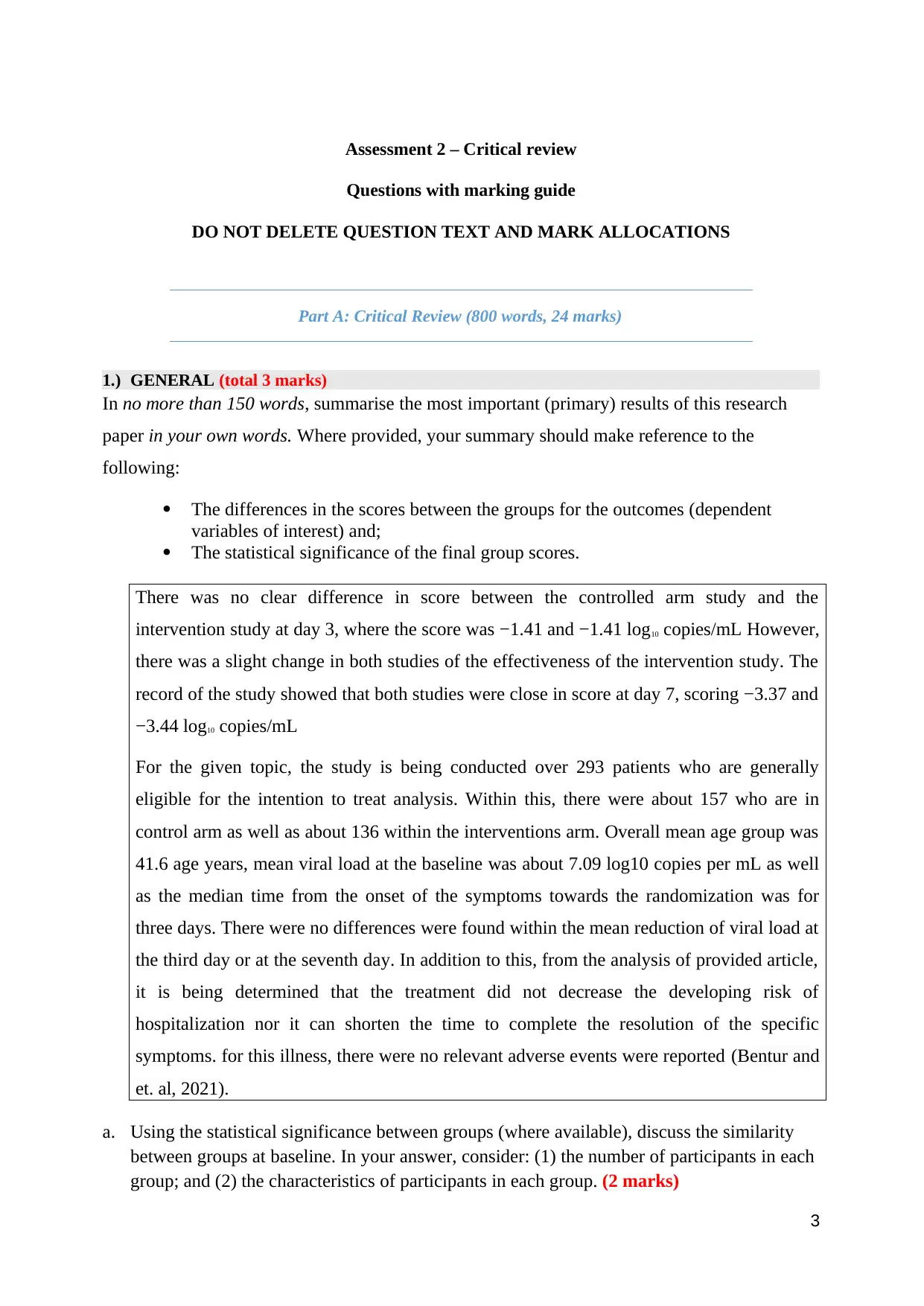
Assessment 2 – Critical review
Questions with marking guide
DO NOT DELETE QUESTION TEXT AND MARK ALLOCATIONS
Part A: Critical Review (800 words, 24 marks)
1.) GENERAL (total 3 marks)
In no more than 150 words, summarise the most important (primary) results of this research
paper in your own words. Where provided, your summary should make reference to the
following:
The differences in the scores between the groups for the outcomes (dependent
variables of interest) and;
The statistical significance of the final group scores.
There was no clear difference in score between the controlled arm study and the
intervention study at day 3, where the score was −1.41 and −1.41 log10 copies/mL However,
there was a slight change in both studies of the effectiveness of the intervention study. The
record of the study showed that both studies were close in score at day 7, scoring −3.37 and
−3.44 log10 copies/mL
For the given topic, the study is being conducted over 293 patients who are generally
eligible for the intention to treat analysis. Within this, there were about 157 who are in
control arm as well as about 136 within the interventions arm. Overall mean age group was
41.6 age years, mean viral load at the baseline was about 7.09 log10 copies per mL as well
as the median time from the onset of the symptoms towards the randomization was for
three days. There were no differences were found within the mean reduction of viral load at
the third day or at the seventh day. In addition to this, from the analysis of provided article,
it is being determined that the treatment did not decrease the developing risk of
hospitalization nor it can shorten the time to complete the resolution of the specific
symptoms. for this illness, there were no relevant adverse events were reported (Bentur and
et. al, 2021).
a. Using the statistical significance between groups (where available), discuss the similarity
between groups at baseline. In your answer, consider: (1) the number of participants in each
group; and (2) the characteristics of participants in each group. (2 marks)
3
Questions with marking guide
DO NOT DELETE QUESTION TEXT AND MARK ALLOCATIONS
Part A: Critical Review (800 words, 24 marks)
1.) GENERAL (total 3 marks)
In no more than 150 words, summarise the most important (primary) results of this research
paper in your own words. Where provided, your summary should make reference to the
following:
The differences in the scores between the groups for the outcomes (dependent
variables of interest) and;
The statistical significance of the final group scores.
There was no clear difference in score between the controlled arm study and the
intervention study at day 3, where the score was −1.41 and −1.41 log10 copies/mL However,
there was a slight change in both studies of the effectiveness of the intervention study. The
record of the study showed that both studies were close in score at day 7, scoring −3.37 and
−3.44 log10 copies/mL
For the given topic, the study is being conducted over 293 patients who are generally
eligible for the intention to treat analysis. Within this, there were about 157 who are in
control arm as well as about 136 within the interventions arm. Overall mean age group was
41.6 age years, mean viral load at the baseline was about 7.09 log10 copies per mL as well
as the median time from the onset of the symptoms towards the randomization was for
three days. There were no differences were found within the mean reduction of viral load at
the third day or at the seventh day. In addition to this, from the analysis of provided article,
it is being determined that the treatment did not decrease the developing risk of
hospitalization nor it can shorten the time to complete the resolution of the specific
symptoms. for this illness, there were no relevant adverse events were reported (Bentur and
et. al, 2021).
a. Using the statistical significance between groups (where available), discuss the similarity
between groups at baseline. In your answer, consider: (1) the number of participants in each
group; and (2) the characteristics of participants in each group. (2 marks)
3
⊘ This is a preview!⊘
Do you want full access?
Subscribe today to unlock all pages.

Trusted by 1+ million students worldwide
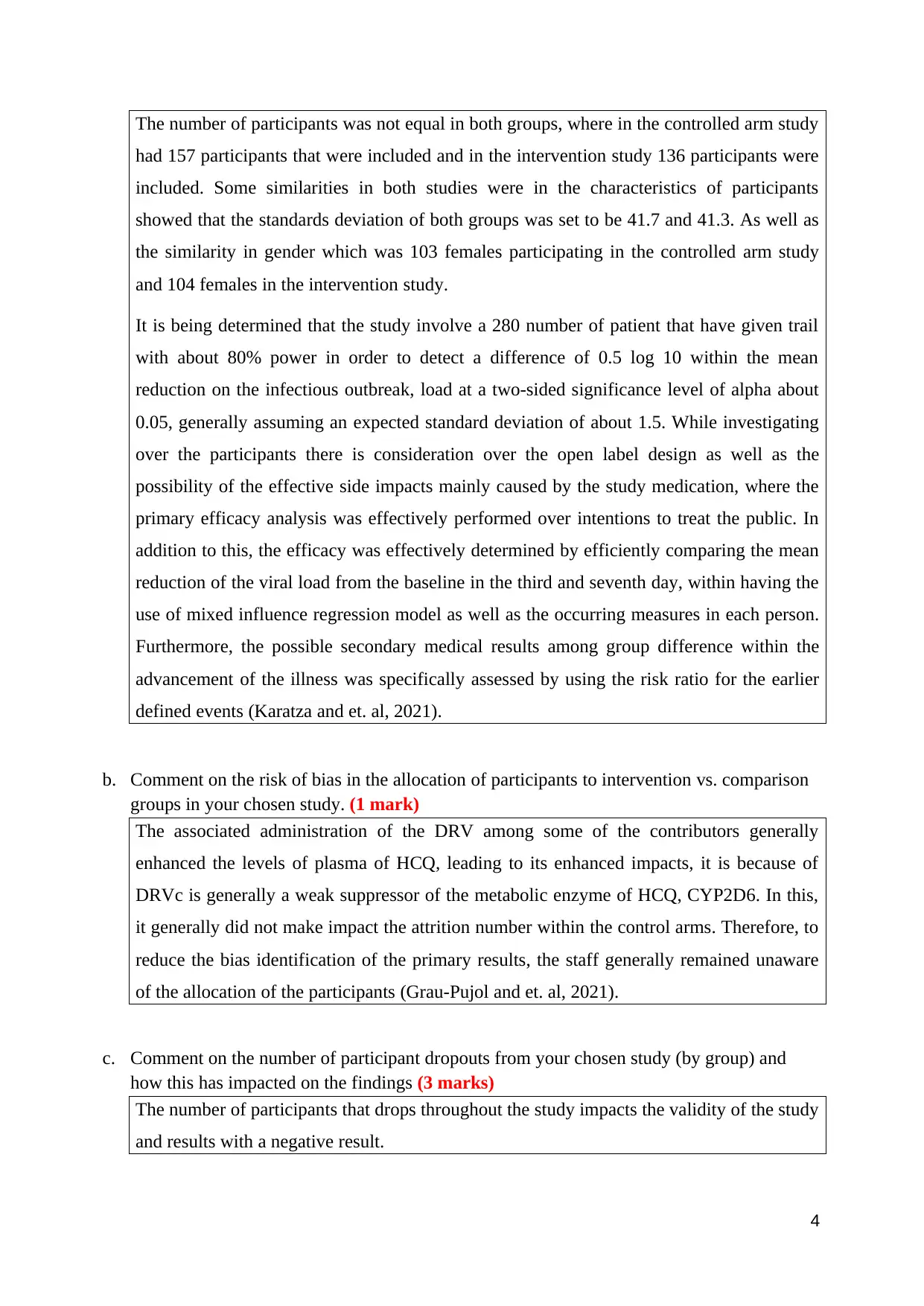
The number of participants was not equal in both groups, where in the controlled arm study
had 157 participants that were included and in the intervention study 136 participants were
included. Some similarities in both studies were in the characteristics of participants
showed that the standards deviation of both groups was set to be 41.7 and 41.3. As well as
the similarity in gender which was 103 females participating in the controlled arm study
and 104 females in the intervention study.
It is being determined that the study involve a 280 number of patient that have given trail
with about 80% power in order to detect a difference of 0.5 log 10 within the mean
reduction on the infectious outbreak, load at a two-sided significance level of alpha about
0.05, generally assuming an expected standard deviation of about 1.5. While investigating
over the participants there is consideration over the open label design as well as the
possibility of the effective side impacts mainly caused by the study medication, where the
primary efficacy analysis was effectively performed over intentions to treat the public. In
addition to this, the efficacy was effectively determined by efficiently comparing the mean
reduction of the viral load from the baseline in the third and seventh day, within having the
use of mixed influence regression model as well as the occurring measures in each person.
Furthermore, the possible secondary medical results among group difference within the
advancement of the illness was specifically assessed by using the risk ratio for the earlier
defined events (Karatza and et. al, 2021).
b. Comment on the risk of bias in the allocation of participants to intervention vs. comparison
groups in your chosen study. (1 mark)
The associated administration of the DRV among some of the contributors generally
enhanced the levels of plasma of HCQ, leading to its enhanced impacts, it is because of
DRVc is generally a weak suppressor of the metabolic enzyme of HCQ, CYP2D6. In this,
it generally did not make impact the attrition number within the control arms. Therefore, to
reduce the bias identification of the primary results, the staff generally remained unaware
of the allocation of the participants (Grau-Pujol and et. al, 2021).
c. Comment on the number of participant dropouts from your chosen study (by group) and
how this has impacted on the findings (3 marks)
The number of participants that drops throughout the study impacts the validity of the study
and results with a negative result.
4
had 157 participants that were included and in the intervention study 136 participants were
included. Some similarities in both studies were in the characteristics of participants
showed that the standards deviation of both groups was set to be 41.7 and 41.3. As well as
the similarity in gender which was 103 females participating in the controlled arm study
and 104 females in the intervention study.
It is being determined that the study involve a 280 number of patient that have given trail
with about 80% power in order to detect a difference of 0.5 log 10 within the mean
reduction on the infectious outbreak, load at a two-sided significance level of alpha about
0.05, generally assuming an expected standard deviation of about 1.5. While investigating
over the participants there is consideration over the open label design as well as the
possibility of the effective side impacts mainly caused by the study medication, where the
primary efficacy analysis was effectively performed over intentions to treat the public. In
addition to this, the efficacy was effectively determined by efficiently comparing the mean
reduction of the viral load from the baseline in the third and seventh day, within having the
use of mixed influence regression model as well as the occurring measures in each person.
Furthermore, the possible secondary medical results among group difference within the
advancement of the illness was specifically assessed by using the risk ratio for the earlier
defined events (Karatza and et. al, 2021).
b. Comment on the risk of bias in the allocation of participants to intervention vs. comparison
groups in your chosen study. (1 mark)
The associated administration of the DRV among some of the contributors generally
enhanced the levels of plasma of HCQ, leading to its enhanced impacts, it is because of
DRVc is generally a weak suppressor of the metabolic enzyme of HCQ, CYP2D6. In this,
it generally did not make impact the attrition number within the control arms. Therefore, to
reduce the bias identification of the primary results, the staff generally remained unaware
of the allocation of the participants (Grau-Pujol and et. al, 2021).
c. Comment on the number of participant dropouts from your chosen study (by group) and
how this has impacted on the findings (3 marks)
The number of participants that drops throughout the study impacts the validity of the study
and results with a negative result.
4
Paraphrase This Document
Need a fresh take? Get an instant paraphrase of this document with our AI Paraphraser
2.) DESIGN & METHODS (total 12 marks)
a. Describe the authors’ operational definition of the intervention (3 marks). Comment on its
replicability in a future study based on the description given (1 mark). (4 marks)
The operational interventions which is being discussed in the article is all the participants
were mainly performed for the randomized control trail in which among 293, about 157 are
in the control arm and the rest of the participants were in the intervention arm.
b. Measurement/Detection Bias
Using all the points below, discuss the risk of measurement/detection bias that may have
been present in your chosen research paper (2 marks)
Blinding of researchers to the outcome assessment (1 mark)
Recall bias (if applicable) (1 mark)
There were two observational studies of the patients with infection mainly treated with the
HCQ at the healthcare professionals’ discretion mainly found that no specific decrease in
the risk of intubation or death as compared with no significant care treatment.
c. Performance bias
Using all the points below, discuss the risk of intervention/performance bias that may have
been present in your chosen research paper (2 marks)
Contamination & blinding of participants (1 mark)
Co-intervention (1 mark)
The medical results of the possible risk of the hospitalization was generally same within the
control arms as well as the intervention arms. There is no patient needed the mechanical
ventilation or the died during the study time period. Within this, the median time for
randomization towards the resolution of the possible symptoms of infectious illness which
was not specifically different in the control arms and the interventions arms (Dabbous and
et. al, 2020).
d. Intervention bias (4 marks)
Timing of intervention (Discuss the appropriateness of: (1) length of the
intervention, (2) the frequency of the measurements) (2 marks)
Site of treatment (1 mark)
Different examiners/therapists (1 mark)
From the provided research article, it is being analysed that the participants were generally
randomized using the generated random number list in order to either control the arm or the
effective interventions arm such as HCQ Dolquine, 800 mg on the day 1 mainly followed
by the 400 mg once in a day for about six days. At the beginning, the care treatment was
included the use of HCQ and a cobicistat-boosted darunavir (DRVc) joined care treatment.
5
a. Describe the authors’ operational definition of the intervention (3 marks). Comment on its
replicability in a future study based on the description given (1 mark). (4 marks)
The operational interventions which is being discussed in the article is all the participants
were mainly performed for the randomized control trail in which among 293, about 157 are
in the control arm and the rest of the participants were in the intervention arm.
b. Measurement/Detection Bias
Using all the points below, discuss the risk of measurement/detection bias that may have
been present in your chosen research paper (2 marks)
Blinding of researchers to the outcome assessment (1 mark)
Recall bias (if applicable) (1 mark)
There were two observational studies of the patients with infection mainly treated with the
HCQ at the healthcare professionals’ discretion mainly found that no specific decrease in
the risk of intubation or death as compared with no significant care treatment.
c. Performance bias
Using all the points below, discuss the risk of intervention/performance bias that may have
been present in your chosen research paper (2 marks)
Contamination & blinding of participants (1 mark)
Co-intervention (1 mark)
The medical results of the possible risk of the hospitalization was generally same within the
control arms as well as the intervention arms. There is no patient needed the mechanical
ventilation or the died during the study time period. Within this, the median time for
randomization towards the resolution of the possible symptoms of infectious illness which
was not specifically different in the control arms and the interventions arms (Dabbous and
et. al, 2020).
d. Intervention bias (4 marks)
Timing of intervention (Discuss the appropriateness of: (1) length of the
intervention, (2) the frequency of the measurements) (2 marks)
Site of treatment (1 mark)
Different examiners/therapists (1 mark)
From the provided research article, it is being analysed that the participants were generally
randomized using the generated random number list in order to either control the arm or the
effective interventions arm such as HCQ Dolquine, 800 mg on the day 1 mainly followed
by the 400 mg once in a day for about six days. At the beginning, the care treatment was
included the use of HCQ and a cobicistat-boosted darunavir (DRVc) joined care treatment.
5
Therefore, it was mainly adapted to the HCQ alone after the recommendation from the
pharma organization to not to use cobicistat-boosted darunavir (DRVc) for the care
treatment of COVID patients, it is because due to the absence of activity in vitro. as well as
the negative outcomes among the clinical trials of the participants of closely associated
HIV protease suppressors (Lyngbakken and et. al, 2020).
The site of treatment within the provided article is In-vitro.
In addition to this, the article involves HCQ and chloroquine as a possible therapeutic agent
generally following an inconclusive medical trails within the combination or not with
azithromycin.
3.) ETHICS (total 3 marks)
Comment on any ethical considerations from your chosen paper. In your answer touch on all
the points below:
informed consent;
ethics approval; and
any potential conflicts of interest
Within the provided research, the participants selected are signed the informed consent. As
it is the procedure of the communication among the participant and the professionals which
can often lead towards an agreement or the permission for effective care treatment or the
services within organization. It is because, every person has the right to get effective
information as well as can ask questions about the care treatment. In this, there is no
possible conflicts of interest created by the other authors within the study. Furthermore,
there has been received an ethical approval from the participants for the use of chloroquine
and the HCQ among the infectious patients.
Word Count for Part A: Should be no more than 880 words
(not including 347 words from questions)
PART B Clinical Recommendation (300 words, 9 marks)
Answer the following question in relation to your chosen journal
article:
You are a newly graduated evidence-based practitioner that works in
primary health care. Rachel has had COVID and spent time in the
6
pharma organization to not to use cobicistat-boosted darunavir (DRVc) for the care
treatment of COVID patients, it is because due to the absence of activity in vitro. as well as
the negative outcomes among the clinical trials of the participants of closely associated
HIV protease suppressors (Lyngbakken and et. al, 2020).
The site of treatment within the provided article is In-vitro.
In addition to this, the article involves HCQ and chloroquine as a possible therapeutic agent
generally following an inconclusive medical trails within the combination or not with
azithromycin.
3.) ETHICS (total 3 marks)
Comment on any ethical considerations from your chosen paper. In your answer touch on all
the points below:
informed consent;
ethics approval; and
any potential conflicts of interest
Within the provided research, the participants selected are signed the informed consent. As
it is the procedure of the communication among the participant and the professionals which
can often lead towards an agreement or the permission for effective care treatment or the
services within organization. It is because, every person has the right to get effective
information as well as can ask questions about the care treatment. In this, there is no
possible conflicts of interest created by the other authors within the study. Furthermore,
there has been received an ethical approval from the participants for the use of chloroquine
and the HCQ among the infectious patients.
Word Count for Part A: Should be no more than 880 words
(not including 347 words from questions)
PART B Clinical Recommendation (300 words, 9 marks)
Answer the following question in relation to your chosen journal
article:
You are a newly graduated evidence-based practitioner that works in
primary health care. Rachel has had COVID and spent time in the
6
⊘ This is a preview!⊘
Do you want full access?
Subscribe today to unlock all pages.
Trusted by 1+ million students worldwide
intensive care unit. Rachel’s son heard on a podcast that hydroxychloroquine will fix her. You work for
a community nursing group and need to visit Rachel twice daily for the initial week she is discharged
from hospital to home. Rachel wants to know whether she should listen to her son and order some
hydroxychloroquine?
In a language that is understandable to them, write a 300-word answer to these 5 questions:
1. What type of study design is Mitja et al. and how did you know? (2 marks)
In this study, as per the review of article, it is well analysed that the study design within the
research article is well related with descriptive and follow the context of randomised
control trial that is appropriate and also state about the interventional approach where HCQ
is taking under observation with aim to analyse the benefits of HCQ in Covid-19 patient.
As per this, patient diagnosed with <5 day of sign and symptoms which is based on onset
that is assigned to receive the HCQ which is well about 800 mg on day that is followed by
400 mg once daily for the 6 days with the usual care. The outcome shows the reduction of
viral load which is well related about the nasopharyngeal swabs which is about 7 days after
the treatment start, disease progression up to 28 days and the time which is showing the
complete resolution of sign and symptoms. These all information is well review which
show that the study design that is randomised control trial with descriptive analysis (Singh
and et. al., 2020).
2. What is one strength (1 mark) and one weakness (1 mark) of this study design or study?
The strength is that the HCQ is undertaken for randomised control trail where feasibility is also
applicable which provide outcome which is appropriate. In addition, weakness is also derived
that show the study is taken longer time and also the outcome is not accurate as much (Patrì,
and Fabbrocini, 2020).
3. What is the key finding of this study? (1 mark)
The key finding of the study is well state that in the covid-19, the benefits of HCQ is not
relevant as comparison with usual care (Torjesen, 2020).
4. Will hydroxychloroquine be appropriate for Rachel? Think of the sample, the findings of the
study, and how generalisable these findings are to Rachel (2 marks)
Rachel is admitted in ICU and as per the review of article, it is clearly analysed that
HCQ is not benefited for patient with mild covid-19. The finding of study is well
7
a community nursing group and need to visit Rachel twice daily for the initial week she is discharged
from hospital to home. Rachel wants to know whether she should listen to her son and order some
hydroxychloroquine?
In a language that is understandable to them, write a 300-word answer to these 5 questions:
1. What type of study design is Mitja et al. and how did you know? (2 marks)
In this study, as per the review of article, it is well analysed that the study design within the
research article is well related with descriptive and follow the context of randomised
control trial that is appropriate and also state about the interventional approach where HCQ
is taking under observation with aim to analyse the benefits of HCQ in Covid-19 patient.
As per this, patient diagnosed with <5 day of sign and symptoms which is based on onset
that is assigned to receive the HCQ which is well about 800 mg on day that is followed by
400 mg once daily for the 6 days with the usual care. The outcome shows the reduction of
viral load which is well related about the nasopharyngeal swabs which is about 7 days after
the treatment start, disease progression up to 28 days and the time which is showing the
complete resolution of sign and symptoms. These all information is well review which
show that the study design that is randomised control trial with descriptive analysis (Singh
and et. al., 2020).
2. What is one strength (1 mark) and one weakness (1 mark) of this study design or study?
The strength is that the HCQ is undertaken for randomised control trail where feasibility is also
applicable which provide outcome which is appropriate. In addition, weakness is also derived
that show the study is taken longer time and also the outcome is not accurate as much (Patrì,
and Fabbrocini, 2020).
3. What is the key finding of this study? (1 mark)
The key finding of the study is well state that in the covid-19, the benefits of HCQ is not
relevant as comparison with usual care (Torjesen, 2020).
4. Will hydroxychloroquine be appropriate for Rachel? Think of the sample, the findings of the
study, and how generalisable these findings are to Rachel (2 marks)
Rachel is admitted in ICU and as per the review of article, it is clearly analysed that
HCQ is not benefited for patient with mild covid-19. The finding of study is well
7
Paraphrase This Document
Need a fresh take? Get an instant paraphrase of this document with our AI Paraphraser
articulate and provide the brief summary where patient was chosen and it is well
observed that the patient with mild covid-19 is not getting merit form HCQ using as
drug. So, Rachel with critical condition has not get any benefit with HCQ (Colson and
et. al., 2020).
5. What risks would there be to Rachel taking a medicine not prescribed by her doctor but
bought online and self-administered? (2 marks)
In the scenario of Rachel, if self-medication is used to done, then there are various of
potential risk is determined that is related with the incorrect self-diagnosis, delay in
medical advice if required, infrequent but severe adverse reaction is evaluated and
dangerous drug interaction are seen which is life threatening for patient (Rachel).
Therefore, it is also analysed that patient with critical condition does not take medication as
per self or without prescription (Sachdeva and et. al., 2020).
Word Count for Part B (including intext citations): 330 words (minus 93 from questions)
8
observed that the patient with mild covid-19 is not getting merit form HCQ using as
drug. So, Rachel with critical condition has not get any benefit with HCQ (Colson and
et. al., 2020).
5. What risks would there be to Rachel taking a medicine not prescribed by her doctor but
bought online and self-administered? (2 marks)
In the scenario of Rachel, if self-medication is used to done, then there are various of
potential risk is determined that is related with the incorrect self-diagnosis, delay in
medical advice if required, infrequent but severe adverse reaction is evaluated and
dangerous drug interaction are seen which is life threatening for patient (Rachel).
Therefore, it is also analysed that patient with critical condition does not take medication as
per self or without prescription (Sachdeva and et. al., 2020).
Word Count for Part B (including intext citations): 330 words (minus 93 from questions)
8
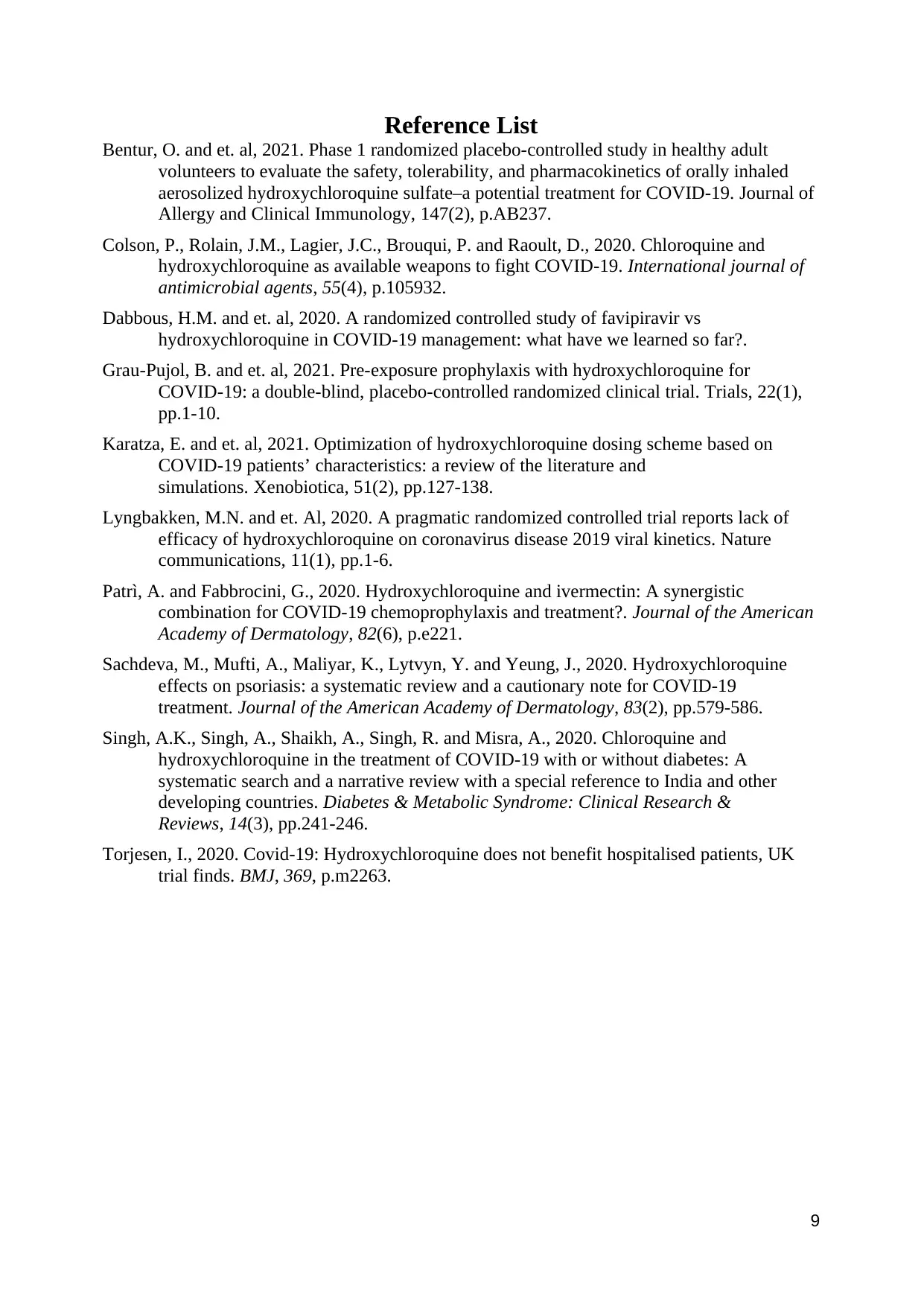
Reference List
Bentur, O. and et. al, 2021. Phase 1 randomized placebo-controlled study in healthy adult
volunteers to evaluate the safety, tolerability, and pharmacokinetics of orally inhaled
aerosolized hydroxychloroquine sulfate–a potential treatment for COVID-19. Journal of
Allergy and Clinical Immunology, 147(2), p.AB237.
Colson, P., Rolain, J.M., Lagier, J.C., Brouqui, P. and Raoult, D., 2020. Chloroquine and
hydroxychloroquine as available weapons to fight COVID-19. International journal of
antimicrobial agents, 55(4), p.105932.
Dabbous, H.M. and et. al, 2020. A randomized controlled study of favipiravir vs
hydroxychloroquine in COVID-19 management: what have we learned so far?.
Grau-Pujol, B. and et. al, 2021. Pre-exposure prophylaxis with hydroxychloroquine for
COVID-19: a double-blind, placebo-controlled randomized clinical trial. Trials, 22(1),
pp.1-10.
Karatza, E. and et. al, 2021. Optimization of hydroxychloroquine dosing scheme based on
COVID-19 patients’ characteristics: a review of the literature and
simulations. Xenobiotica, 51(2), pp.127-138.
Lyngbakken, M.N. and et. Al, 2020. A pragmatic randomized controlled trial reports lack of
efficacy of hydroxychloroquine on coronavirus disease 2019 viral kinetics. Nature
communications, 11(1), pp.1-6.
Patrì, A. and Fabbrocini, G., 2020. Hydroxychloroquine and ivermectin: A synergistic
combination for COVID-19 chemoprophylaxis and treatment?. Journal of the American
Academy of Dermatology, 82(6), p.e221.
Sachdeva, M., Mufti, A., Maliyar, K., Lytvyn, Y. and Yeung, J., 2020. Hydroxychloroquine
effects on psoriasis: a systematic review and a cautionary note for COVID-19
treatment. Journal of the American Academy of Dermatology, 83(2), pp.579-586.
Singh, A.K., Singh, A., Shaikh, A., Singh, R. and Misra, A., 2020. Chloroquine and
hydroxychloroquine in the treatment of COVID-19 with or without diabetes: A
systematic search and a narrative review with a special reference to India and other
developing countries. Diabetes & Metabolic Syndrome: Clinical Research &
Reviews, 14(3), pp.241-246.
Torjesen, I., 2020. Covid-19: Hydroxychloroquine does not benefit hospitalised patients, UK
trial finds. BMJ, 369, p.m2263.
9
Bentur, O. and et. al, 2021. Phase 1 randomized placebo-controlled study in healthy adult
volunteers to evaluate the safety, tolerability, and pharmacokinetics of orally inhaled
aerosolized hydroxychloroquine sulfate–a potential treatment for COVID-19. Journal of
Allergy and Clinical Immunology, 147(2), p.AB237.
Colson, P., Rolain, J.M., Lagier, J.C., Brouqui, P. and Raoult, D., 2020. Chloroquine and
hydroxychloroquine as available weapons to fight COVID-19. International journal of
antimicrobial agents, 55(4), p.105932.
Dabbous, H.M. and et. al, 2020. A randomized controlled study of favipiravir vs
hydroxychloroquine in COVID-19 management: what have we learned so far?.
Grau-Pujol, B. and et. al, 2021. Pre-exposure prophylaxis with hydroxychloroquine for
COVID-19: a double-blind, placebo-controlled randomized clinical trial. Trials, 22(1),
pp.1-10.
Karatza, E. and et. al, 2021. Optimization of hydroxychloroquine dosing scheme based on
COVID-19 patients’ characteristics: a review of the literature and
simulations. Xenobiotica, 51(2), pp.127-138.
Lyngbakken, M.N. and et. Al, 2020. A pragmatic randomized controlled trial reports lack of
efficacy of hydroxychloroquine on coronavirus disease 2019 viral kinetics. Nature
communications, 11(1), pp.1-6.
Patrì, A. and Fabbrocini, G., 2020. Hydroxychloroquine and ivermectin: A synergistic
combination for COVID-19 chemoprophylaxis and treatment?. Journal of the American
Academy of Dermatology, 82(6), p.e221.
Sachdeva, M., Mufti, A., Maliyar, K., Lytvyn, Y. and Yeung, J., 2020. Hydroxychloroquine
effects on psoriasis: a systematic review and a cautionary note for COVID-19
treatment. Journal of the American Academy of Dermatology, 83(2), pp.579-586.
Singh, A.K., Singh, A., Shaikh, A., Singh, R. and Misra, A., 2020. Chloroquine and
hydroxychloroquine in the treatment of COVID-19 with or without diabetes: A
systematic search and a narrative review with a special reference to India and other
developing countries. Diabetes & Metabolic Syndrome: Clinical Research &
Reviews, 14(3), pp.241-246.
Torjesen, I., 2020. Covid-19: Hydroxychloroquine does not benefit hospitalised patients, UK
trial finds. BMJ, 369, p.m2263.
9
⊘ This is a preview!⊘
Do you want full access?
Subscribe today to unlock all pages.
Trusted by 1+ million students worldwide

1 out of 9


Related Documents


Your All-in-One AI-Powered Toolkit for Academic Success.
+13062052269
info@desklib.com
Available 24*7 on WhatsApp / Email
![[object Object]](/_next/static/media/star-bottom.7253800d.svg)
Unlock your academic potential
Copyright © 2020–2026 A2Z Services. All Rights Reserved. Developed and managed by ZUCOL.