Mobile Phone Ownership & Use: A Business Research Methodology
VerifiedAdded on 2023/06/03
|13
|3224
|321
Report
AI Summary
This business research report investigates the relationship between mobile phone ownership and usage, exploring factors that influence both. It begins with an introduction highlighting the increasing prevalence of mobile phones due to technological advancements. The project objectives include comparing ownership and usage, identifying factors driving mobile phone use, and investigating elements affecting both ownership and usage. The literature review covers comparative studies of ownership and usage, factors influencing consumer purchase decisions (price, social factors, brand, features), and factors affecting user behavior (age, connectivity). Research questions address the drivers of increased ownership, differences between ownership and usage, disadvantages of mobile phone use, and factors affecting ownership and usage. Hypotheses focus on increasing ownership, electromagnetic field exposure, and the impact of social networking on purchasing decisions. The methodology includes both qualitative (identifying problems, literature review, data collection, analysis) and quantitative (theory, hypothesis, research design, data collection, analysis) approaches, using observation and questionnaire methods, respectively. The research acknowledges limitations such as limited available papers, time constraints, and unspecified costs.
Running head: BUSINESS RESEARCH METHODOLOGY
Business Research Methodology
Name of Student-
Name of University
Author’s Note-
Business Research Methodology
Name of Student-
Name of University
Author’s Note-

Paraphrase This Document
Need a fresh take? Get an instant paraphrase of this document with our AI Paraphraser
1BUSINESS RESEARCH METHODOLOGY
Title: Relationship between mobile phone ownership & use and the factors
affecting ownership & use
1. Introduction
With the technological developments growing fast in last 10 years, there are many
electromagnetic waves transmitting devices which includes base stations, mobile phones, and
microwave ovens (Milward et al. 2015). These devices have become an important part of our
daily lives. Easy availability of mobile phones have increases the usage of internet and there are
different options available for mobile phone operators. This provokes all individuals to opt for
more than one type of mobile phone (Bhatt and Bhatt 2016). The availability of mobile phones
among people has started from the age of 12 years. The technology of mobile phone has made
the world closer. Mobile phones provides the user a convenient way of communication between
the people through calling or through texting (Shoaib et al. 2015). Maximum of the users who
uses mobile phones are between age group of 15 to 25 years (Zayim and Ozel 2016). There are
many features that are included in mobile phones such as accessing the internet, games,
accessing the social network such as Facebook, and also listening music, playing radio, accessing
e-mails, reading books and many more
2. Project Objective
The objective behind carrying out this research proposal are stated below:
To study a detailed comparison in between the ownership of mobile phone and the usage
of mobile phone by a user.
To find the factors that lies behind increasing rate of using mobile phones.
To investigate the factors that affects the ownership as well as usage of mobile phones.
Title: Relationship between mobile phone ownership & use and the factors
affecting ownership & use
1. Introduction
With the technological developments growing fast in last 10 years, there are many
electromagnetic waves transmitting devices which includes base stations, mobile phones, and
microwave ovens (Milward et al. 2015). These devices have become an important part of our
daily lives. Easy availability of mobile phones have increases the usage of internet and there are
different options available for mobile phone operators. This provokes all individuals to opt for
more than one type of mobile phone (Bhatt and Bhatt 2016). The availability of mobile phones
among people has started from the age of 12 years. The technology of mobile phone has made
the world closer. Mobile phones provides the user a convenient way of communication between
the people through calling or through texting (Shoaib et al. 2015). Maximum of the users who
uses mobile phones are between age group of 15 to 25 years (Zayim and Ozel 2016). There are
many features that are included in mobile phones such as accessing the internet, games,
accessing the social network such as Facebook, and also listening music, playing radio, accessing
e-mails, reading books and many more
2. Project Objective
The objective behind carrying out this research proposal are stated below:
To study a detailed comparison in between the ownership of mobile phone and the usage
of mobile phone by a user.
To find the factors that lies behind increasing rate of using mobile phones.
To investigate the factors that affects the ownership as well as usage of mobile phones.
2BUSINESS RESEARCH METHODOLOGY
3. Project Scope
The scope of the project is to carry out a comparative study between ownership of mobile
phone and using of mobile phones for a user. This project also scopes to find out the factors that
are also responsible for affecting the ownership and usage of mobile phones.
4. Literature Review
4.1 Comparative study of Owning a Mobile Phone and using a mobile phone
In the recent world of technology, it has become a norm to own a cell phone. People from
young age group of 12 to old age usually carries a mobile phone with them (Potnis 2016). There
was a society before where the people worked without cell phones but in the present world
people finds themselves lost if they do not carry a mobile phone.
Using a mobile phone with all facilities of internet and video calling and getting
connected with the whole world has increased the importance of mobile phone much more (Katz
2017). The results of using mobile phones has increased a lot with the involvement of internet
availability in mobile phones.
According the study, owning a mobile phone not always results in using a mobile phone
properly (Kay et al. 2015). A person owning a mobile phone cannot always use the phone
properly. About 95 % of the people in America owns a mobile phone out of which 77% of them
uses a smart phone and 35% of them uses basic phones (Haddon 2017). Dependency of smart
phones are decreasing day by day as because people also own other devices that are connected
with internet. Broadband services adoption has lessen the use of broadband services in the recent
years.
3. Project Scope
The scope of the project is to carry out a comparative study between ownership of mobile
phone and using of mobile phones for a user. This project also scopes to find out the factors that
are also responsible for affecting the ownership and usage of mobile phones.
4. Literature Review
4.1 Comparative study of Owning a Mobile Phone and using a mobile phone
In the recent world of technology, it has become a norm to own a cell phone. People from
young age group of 12 to old age usually carries a mobile phone with them (Potnis 2016). There
was a society before where the people worked without cell phones but in the present world
people finds themselves lost if they do not carry a mobile phone.
Using a mobile phone with all facilities of internet and video calling and getting
connected with the whole world has increased the importance of mobile phone much more (Katz
2017). The results of using mobile phones has increased a lot with the involvement of internet
availability in mobile phones.
According the study, owning a mobile phone not always results in using a mobile phone
properly (Kay et al. 2015). A person owning a mobile phone cannot always use the phone
properly. About 95 % of the people in America owns a mobile phone out of which 77% of them
uses a smart phone and 35% of them uses basic phones (Haddon 2017). Dependency of smart
phones are decreasing day by day as because people also own other devices that are connected
with internet. Broadband services adoption has lessen the use of broadband services in the recent
years.
⊘ This is a preview!⊘
Do you want full access?
Subscribe today to unlock all pages.

Trusted by 1+ million students worldwide
3BUSINESS RESEARCH METHODOLOGY
4.2 Factors affecting the consumer owning a mobile phone
There are many factors that are involved when a consumer buys a mobile phone for their
usage (Liu et al. 2016). The price of the mobile phone, the social factors involved, the durability,
the brand name of the mobile phone, the features that the mobile phone proves them and also the
service they get after they buy the product (Blumenstock, Cadamuro and On 2015). The factors
also involves the demographics, the knowledge of the customer, the perception, motivation,
beliefs as well the life style of the consumer who is buying the mobile.
4.3 Factors affecting the use of mobile phone by a user
There are several studies that includes that shows using of mobile phones have become
operational as well as tactical (Saeb et al. 2015). The age of the user has also become a decisive
factor. User uses mobile phones from very small age.
From the analysis, about 17.3 % of the users from the age group between 20 years to 24
years uses smartphones (Gravenhorst et al. 2015). The mobile phones helps them to track
everything they want to and helps to stay connected with the entire world.
5. Research Question and Research Hypothesis
5. 1 Research Question
The research questions that are to be addressed for this research paper are:
Primary Question
1. What are the factors that leads to increase the ownership of mobile phone over the world?
Secondary Questions
2. What is the difference between ownership of a mobile phone and using a mobile phone?
4.2 Factors affecting the consumer owning a mobile phone
There are many factors that are involved when a consumer buys a mobile phone for their
usage (Liu et al. 2016). The price of the mobile phone, the social factors involved, the durability,
the brand name of the mobile phone, the features that the mobile phone proves them and also the
service they get after they buy the product (Blumenstock, Cadamuro and On 2015). The factors
also involves the demographics, the knowledge of the customer, the perception, motivation,
beliefs as well the life style of the consumer who is buying the mobile.
4.3 Factors affecting the use of mobile phone by a user
There are several studies that includes that shows using of mobile phones have become
operational as well as tactical (Saeb et al. 2015). The age of the user has also become a decisive
factor. User uses mobile phones from very small age.
From the analysis, about 17.3 % of the users from the age group between 20 years to 24
years uses smartphones (Gravenhorst et al. 2015). The mobile phones helps them to track
everything they want to and helps to stay connected with the entire world.
5. Research Question and Research Hypothesis
5. 1 Research Question
The research questions that are to be addressed for this research paper are:
Primary Question
1. What are the factors that leads to increase the ownership of mobile phone over the world?
Secondary Questions
2. What is the difference between ownership of a mobile phone and using a mobile phone?
Paraphrase This Document
Need a fresh take? Get an instant paraphrase of this document with our AI Paraphraser
4BUSINESS RESEARCH METHODOLOGY
3. What are the disadvantages of using a mobile phone?
4. What are the factors that affects ownership of mobile phones and use of mobile phones?
5.2 Research Hypothesis
H0: Ownership of mobile phones is increasing among people.
H1: Excess use of mobile phones leads to more exposure to electromagnetic fields.
H2: Usage of social networking sites has increased the buying factor of mobile phones.
6. Research Design and Research Methodology
6.1 Qualitative Research
The main steps that are involved in carrying out the Qualitative Research are:
Identify the problem associated with the research study.
Review the literature.
Specify the purpose of carrying out the research, stated research question and research
hypothesis.
Collect data from other research papers.
Analyze them according to research question.
Report the research that is being carried out.
The Approaches to Reliability and Validity are defined as follows in qualitative
research study:
Reliability in qualitative research is the progress and result replicability. The definition of
reliability is a challenging one and is also epistemologically. Reliability essence for this research
3. What are the disadvantages of using a mobile phone?
4. What are the factors that affects ownership of mobile phones and use of mobile phones?
5.2 Research Hypothesis
H0: Ownership of mobile phones is increasing among people.
H1: Excess use of mobile phones leads to more exposure to electromagnetic fields.
H2: Usage of social networking sites has increased the buying factor of mobile phones.
6. Research Design and Research Methodology
6.1 Qualitative Research
The main steps that are involved in carrying out the Qualitative Research are:
Identify the problem associated with the research study.
Review the literature.
Specify the purpose of carrying out the research, stated research question and research
hypothesis.
Collect data from other research papers.
Analyze them according to research question.
Report the research that is being carried out.
The Approaches to Reliability and Validity are defined as follows in qualitative
research study:
Reliability in qualitative research is the progress and result replicability. The definition of
reliability is a challenging one and is also epistemologically. Reliability essence for this research
5BUSINESS RESEARCH METHODOLOGY
methodology comes with consistency (Zhang and Wildemuth 2016). Reliability includes
inclusive as well as comprehensive data analysis.
Validity of qualitative research states the appropriateness of the research that is being
carried out. This states whether the research question that is taken for this research study is valid
or not. If desired outcome is achieved after the research study, then validity of the research is
satisfied.
There are mainly three types of sampling possible for qualitative research. The three
types of sampling includes purposeful sampling, quota sampling, and snowball sampling.
Purposeful sampling is common sampling strategy. The study carried out through purposeful
sampling are attempted through collected data (Smith 2015). Quota sampling is a type of
sampling in which the quota for the participants are set before carrying out the sampling. The
researcher carrying out this type of sampling attempts to gather data for some particular
participants to meet some certain criteria. The third sampling is the snowball sampling which is a
chain referral sampling. This research study is carried by snowball sampling.
The sample size of a research is done only after the sampling is done. For qualitative
research, sampling happens until the information saturation and information saturation occurs
(Radulescu and Repovs 2015). This happens when there is no new information is involved in the
study, thus the sampling frame is narrowed by the researcher, the saturation point of the research
may occur prematurely. So, the research question should be stated carefully by the researcher.
The Data Collection Methods that are involved in qualitative research are individual
interviews, observations, focus groups, and action researches. Interviews are carried out through
structured, semi-structured, as well as unstructured interviews that are done with interviewee.
methodology comes with consistency (Zhang and Wildemuth 2016). Reliability includes
inclusive as well as comprehensive data analysis.
Validity of qualitative research states the appropriateness of the research that is being
carried out. This states whether the research question that is taken for this research study is valid
or not. If desired outcome is achieved after the research study, then validity of the research is
satisfied.
There are mainly three types of sampling possible for qualitative research. The three
types of sampling includes purposeful sampling, quota sampling, and snowball sampling.
Purposeful sampling is common sampling strategy. The study carried out through purposeful
sampling are attempted through collected data (Smith 2015). Quota sampling is a type of
sampling in which the quota for the participants are set before carrying out the sampling. The
researcher carrying out this type of sampling attempts to gather data for some particular
participants to meet some certain criteria. The third sampling is the snowball sampling which is a
chain referral sampling. This research study is carried by snowball sampling.
The sample size of a research is done only after the sampling is done. For qualitative
research, sampling happens until the information saturation and information saturation occurs
(Radulescu and Repovs 2015). This happens when there is no new information is involved in the
study, thus the sampling frame is narrowed by the researcher, the saturation point of the research
may occur prematurely. So, the research question should be stated carefully by the researcher.
The Data Collection Methods that are involved in qualitative research are individual
interviews, observations, focus groups, and action researches. Interviews are carried out through
structured, semi-structured, as well as unstructured interviews that are done with interviewee.
⊘ This is a preview!⊘
Do you want full access?
Subscribe today to unlock all pages.
Trusted by 1+ million students worldwide
6BUSINESS RESEARCH METHODOLOGY
Focus groups are done through limited resources that includes limited time, finance as well as
manpower. Observation comes through natural settings as well as involvement of researcher in
lengthy as well as descriptive notes about what is happening (Gaber and Gaber 2018). The
changes involves the behavior of people because they know that all the files are being observed.
The data collection method that are being used for this research paper is observation method. All
data that are collected by the researcher are done through observation method.
The Variables Specifications are the characteristics of observation or the participant in
the member of the group. The categories that are fixed for the research study are expressed as
variable specification in a research study.
6.2 Quantitative Research
The main steps that are involved in quantitative research are stated below:
The first step is carrying out the theory related to the research study.
Finding out hypothesis for the research study.
The research design is to be specified for the research study.
All the operational concepts are to be specified for the research.
The research site where the research study will be carried out are to be specified.
The respondents who will participate in the research study are to be selected.
Data collection procedure is carried out next.
The data collection procedure is followed by data processing as well as data analyzing
method respectively.
The finding or the conclusion from the data analysis is done after all the step stated
above.
At last the results are published that are gained from the research study.
Focus groups are done through limited resources that includes limited time, finance as well as
manpower. Observation comes through natural settings as well as involvement of researcher in
lengthy as well as descriptive notes about what is happening (Gaber and Gaber 2018). The
changes involves the behavior of people because they know that all the files are being observed.
The data collection method that are being used for this research paper is observation method. All
data that are collected by the researcher are done through observation method.
The Variables Specifications are the characteristics of observation or the participant in
the member of the group. The categories that are fixed for the research study are expressed as
variable specification in a research study.
6.2 Quantitative Research
The main steps that are involved in quantitative research are stated below:
The first step is carrying out the theory related to the research study.
Finding out hypothesis for the research study.
The research design is to be specified for the research study.
All the operational concepts are to be specified for the research.
The research site where the research study will be carried out are to be specified.
The respondents who will participate in the research study are to be selected.
Data collection procedure is carried out next.
The data collection procedure is followed by data processing as well as data analyzing
method respectively.
The finding or the conclusion from the data analysis is done after all the step stated
above.
At last the results are published that are gained from the research study.
Paraphrase This Document
Need a fresh take? Get an instant paraphrase of this document with our AI Paraphraser
7BUSINESS RESEARCH METHODOLOGY
The Research Instrument that are involved in the research study include Tests as well as
Questionnaires that are being carried out for this research paper. There should be validity of tests
and the researcher should also ensure the reliability of tests that are involved in the research
study (Gaber and Gaber 2018). Questionnaire consists of different questions that are ti be asked
to the respondents for collecting the data. The test involves research which ensure the
knowledge, feeling, intelligence, skill as well as aptitude. The research instrument that will be
carried out for this research paper is questionnaire form of research.
Analyzing process of qualitative research identifies all the level of scales that are being
measured for nominal, ordinal, ratio, as well as interval. The measurement scales involves
module for collecting more information for measurement scaling (Radulescu and Repovs 2015).
There are frequencies, percentages, mean, median, mode as well as the range of the variable are
involved in analyzing the process. The process of analyzing this research paper frequency is
frequency analyzing process.
Sampling in quantitative research includes probability sampling as well as non-
probability sampling. The probability sampling uses randomization and also takes the necessary
steps for ensuring the members of the group that are involved in the research. The Sample Size
includes the number of participants who are involved in the research study. For this research
study 50 sample size is required for carrying out the research survey.
Interviewing involves interviews that are carried out with the participants. The interview
process are done as face to face communication where the interviewees are asked for based on
the study. Questioner Design involves set of questions that are to be asked to a group of people
(Smith 2015). The respondents has the reliability to answer the questions according to their will.
The Research Instrument that are involved in the research study include Tests as well as
Questionnaires that are being carried out for this research paper. There should be validity of tests
and the researcher should also ensure the reliability of tests that are involved in the research
study (Gaber and Gaber 2018). Questionnaire consists of different questions that are ti be asked
to the respondents for collecting the data. The test involves research which ensure the
knowledge, feeling, intelligence, skill as well as aptitude. The research instrument that will be
carried out for this research paper is questionnaire form of research.
Analyzing process of qualitative research identifies all the level of scales that are being
measured for nominal, ordinal, ratio, as well as interval. The measurement scales involves
module for collecting more information for measurement scaling (Radulescu and Repovs 2015).
There are frequencies, percentages, mean, median, mode as well as the range of the variable are
involved in analyzing the process. The process of analyzing this research paper frequency is
frequency analyzing process.
Sampling in quantitative research includes probability sampling as well as non-
probability sampling. The probability sampling uses randomization and also takes the necessary
steps for ensuring the members of the group that are involved in the research. The Sample Size
includes the number of participants who are involved in the research study. For this research
study 50 sample size is required for carrying out the research survey.
Interviewing involves interviews that are carried out with the participants. The interview
process are done as face to face communication where the interviewees are asked for based on
the study. Questioner Design involves set of questions that are to be asked to a group of people
(Smith 2015). The respondents has the reliability to answer the questions according to their will.
8BUSINESS RESEARCH METHODOLOGY
This research paper involves the process of carrying out questionnaire for data collection
method.
Reliability and Validity of Data in qualitative data collection are related to the
researcher. The data that are collected by the researcher should be reliable as well as valid
(Zhang and Wildemuth 2016). There should be validity of data that are collected.
7. Research Limitations
The limitations that are found while carrying out this research paper is that there is no
proper papers found for the selected topic. The time frame for carrying out this research was also
very less due to which proper research was not being carried out. The cost of conducting this
research study is also not specified for this research paper which leaves the researcher in trouble
about how to carry out the research study.
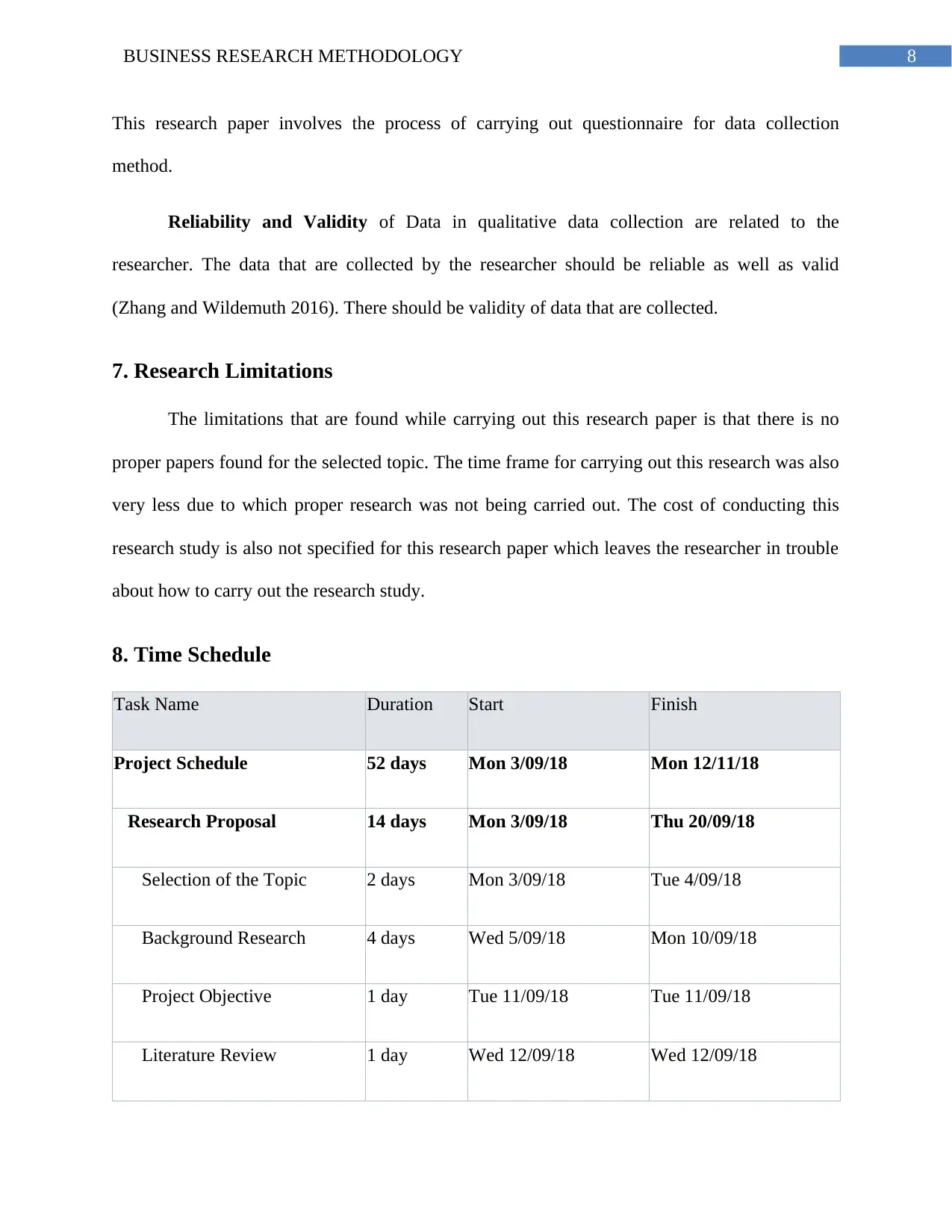
8. Time Schedule
Task Name Duration Start Finish
Project Schedule 52 days Mon 3/09/18 Mon 12/11/18
Research Proposal 14 days Mon 3/09/18 Thu 20/09/18
Selection of the Topic 2 days Mon 3/09/18 Tue 4/09/18
Background Research 4 days Wed 5/09/18 Mon 10/09/18
Project Objective 1 day Tue 11/09/18 Tue 11/09/18
Literature Review 1 day Wed 12/09/18 Wed 12/09/18
This research paper involves the process of carrying out questionnaire for data collection
method.
Reliability and Validity of Data in qualitative data collection are related to the
researcher. The data that are collected by the researcher should be reliable as well as valid
(Zhang and Wildemuth 2016). There should be validity of data that are collected.
7. Research Limitations
The limitations that are found while carrying out this research paper is that there is no
proper papers found for the selected topic. The time frame for carrying out this research was also
very less due to which proper research was not being carried out. The cost of conducting this
research study is also not specified for this research paper which leaves the researcher in trouble
about how to carry out the research study.
8. Time Schedule
Task Name Duration Start Finish
Project Schedule 52 days Mon 3/09/18 Mon 12/11/18
Research Proposal 14 days Mon 3/09/18 Thu 20/09/18
Selection of the Topic 2 days Mon 3/09/18 Tue 4/09/18
Background Research 4 days Wed 5/09/18 Mon 10/09/18
Project Objective 1 day Tue 11/09/18 Tue 11/09/18
Literature Review 1 day Wed 12/09/18 Wed 12/09/18
⊘ This is a preview!⊘
Do you want full access?
Subscribe today to unlock all pages.
Trusted by 1+ million students worldwide
9BUSINESS RESEARCH METHODOLOGY
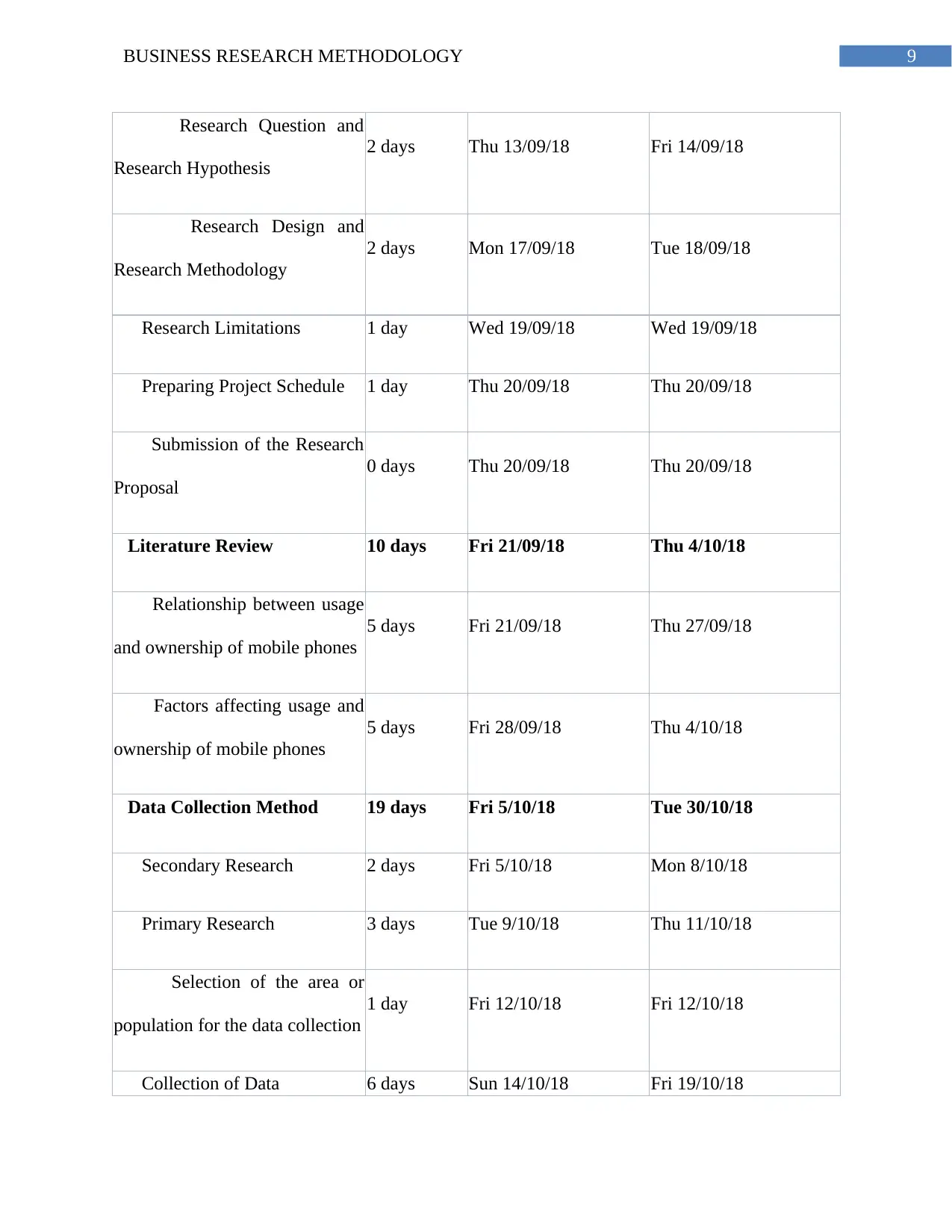
Research Question and
Research Hypothesis
2 days Thu 13/09/18 Fri 14/09/18
Research Design and
Research Methodology
2 days Mon 17/09/18 Tue 18/09/18
Research Limitations 1 day Wed 19/09/18 Wed 19/09/18
Preparing Project Schedule 1 day Thu 20/09/18 Thu 20/09/18
Submission of the Research
Proposal
0 days Thu 20/09/18 Thu 20/09/18
Literature Review 10 days Fri 21/09/18 Thu 4/10/18
Relationship between usage
and ownership of mobile phones
5 days Fri 21/09/18 Thu 27/09/18
Factors affecting usage and
ownership of mobile phones
5 days Fri 28/09/18 Thu 4/10/18
Data Collection Method 19 days Fri 5/10/18 Tue 30/10/18
Secondary Research 2 days Fri 5/10/18 Mon 8/10/18
Primary Research 3 days Tue 9/10/18 Thu 11/10/18
Selection of the area or
population for the data collection
1 day Fri 12/10/18 Fri 12/10/18
Collection of Data 6 days Sun 14/10/18 Fri 19/10/18
Research Question and
Research Hypothesis
2 days Thu 13/09/18 Fri 14/09/18
Research Design and
Research Methodology
2 days Mon 17/09/18 Tue 18/09/18
Research Limitations 1 day Wed 19/09/18 Wed 19/09/18
Preparing Project Schedule 1 day Thu 20/09/18 Thu 20/09/18
Submission of the Research
Proposal
0 days Thu 20/09/18 Thu 20/09/18
Literature Review 10 days Fri 21/09/18 Thu 4/10/18
Relationship between usage
and ownership of mobile phones
5 days Fri 21/09/18 Thu 27/09/18
Factors affecting usage and
ownership of mobile phones
5 days Fri 28/09/18 Thu 4/10/18
Data Collection Method 19 days Fri 5/10/18 Tue 30/10/18
Secondary Research 2 days Fri 5/10/18 Mon 8/10/18
Primary Research 3 days Tue 9/10/18 Thu 11/10/18
Selection of the area or
population for the data collection
1 day Fri 12/10/18 Fri 12/10/18
Collection of Data 6 days Sun 14/10/18 Fri 19/10/18
Paraphrase This Document
Need a fresh take? Get an instant paraphrase of this document with our AI Paraphraser
10BUSINESS RESEARCH METHODOLOGY
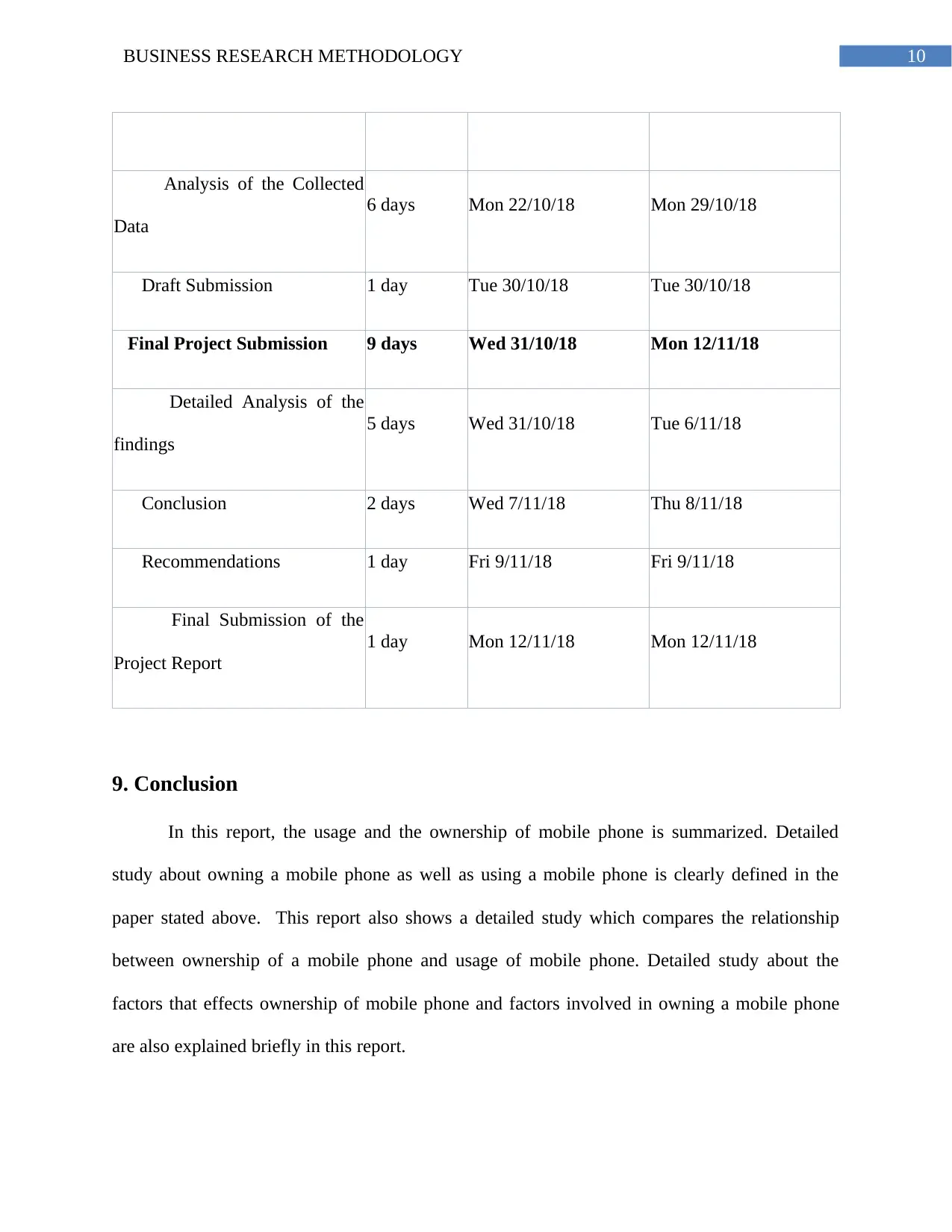
Analysis of the Collected
Data
6 days Mon 22/10/18 Mon 29/10/18
Draft Submission 1 day Tue 30/10/18 Tue 30/10/18
Final Project Submission 9 days Wed 31/10/18 Mon 12/11/18
Detailed Analysis of the
findings
5 days Wed 31/10/18 Tue 6/11/18
Conclusion 2 days Wed 7/11/18 Thu 8/11/18
Recommendations 1 day Fri 9/11/18 Fri 9/11/18
Final Submission of the
Project Report
1 day Mon 12/11/18 Mon 12/11/18
9. Conclusion
In this report, the usage and the ownership of mobile phone is summarized. Detailed
study about owning a mobile phone as well as using a mobile phone is clearly defined in the
paper stated above. This report also shows a detailed study which compares the relationship
between ownership of a mobile phone and usage of mobile phone. Detailed study about the
factors that effects ownership of mobile phone and factors involved in owning a mobile phone
are also explained briefly in this report.
Analysis of the Collected
Data
6 days Mon 22/10/18 Mon 29/10/18
Draft Submission 1 day Tue 30/10/18 Tue 30/10/18
Final Project Submission 9 days Wed 31/10/18 Mon 12/11/18
Detailed Analysis of the
findings
5 days Wed 31/10/18 Tue 6/11/18
Conclusion 2 days Wed 7/11/18 Thu 8/11/18
Recommendations 1 day Fri 9/11/18 Fri 9/11/18
Final Submission of the
Project Report
1 day Mon 12/11/18 Mon 12/11/18
9. Conclusion
In this report, the usage and the ownership of mobile phone is summarized. Detailed
study about owning a mobile phone as well as using a mobile phone is clearly defined in the
paper stated above. This report also shows a detailed study which compares the relationship
between ownership of a mobile phone and usage of mobile phone. Detailed study about the
factors that effects ownership of mobile phone and factors involved in owning a mobile phone
are also explained briefly in this report.
11BUSINESS RESEARCH METHODOLOGY
10. References
Bhatt, A. and Bhatt, S., 2016. Factors affecting customer’s adoption of mobile banking
services. The Journal of Internet Banking and Commerce, 21(1).
Blumenstock, J., Cadamuro, G. and On, R., 2015. Predicting poverty and wealth from mobile
phone metadata. Science, 350(6264), pp.1073-1076.
Gaber, J. and Gaber, S., 2018. Qualitative analysis for planning & policy: Beyond the numbers.
Routledge.
Gravenhorst, F., Muaremi, A., Bardram, J., Grünerbl, A., Mayora, O., Wurzer, G., Frost, M.,
Osmani, V., Arnrich, B., Lukowicz, P. and Tröster, G., 2015. Mobile phones as medical devices
in mental disorder treatment: an overview. Personal and Ubiquitous Computing, 19(2), pp.335-
353.
Haddon, L., 2017. Domestication and mobile telephony. In Machines that become us (pp. 43-55).
Routledge.
Katz, J.E., 2017. Mobile phones in educational settings. In Magic in the Air (pp. 101-116).
Routledge.
Kay, D., Van Meurs, P., Unruh, E., Sharan, S., Kessler, G., Agarwal, M. and Sigel, G., Nuance
Communications Inc, 2015. Multimodal text input system, such as for use with touch screens on
mobile phones. U.S. Patent 9,104,312.
Liu, Y., Ren, W., Qiu, Y., Liu, J., Yin, P. and Ren, J., 2016. The use of mobile phone and
medical apps among general practitioners in Hangzhou City, Eastern China. JMIR mHealth and
uHealth, 4(2).
10. References
Bhatt, A. and Bhatt, S., 2016. Factors affecting customer’s adoption of mobile banking
services. The Journal of Internet Banking and Commerce, 21(1).
Blumenstock, J., Cadamuro, G. and On, R., 2015. Predicting poverty and wealth from mobile
phone metadata. Science, 350(6264), pp.1073-1076.
Gaber, J. and Gaber, S., 2018. Qualitative analysis for planning & policy: Beyond the numbers.
Routledge.
Gravenhorst, F., Muaremi, A., Bardram, J., Grünerbl, A., Mayora, O., Wurzer, G., Frost, M.,
Osmani, V., Arnrich, B., Lukowicz, P. and Tröster, G., 2015. Mobile phones as medical devices
in mental disorder treatment: an overview. Personal and Ubiquitous Computing, 19(2), pp.335-
353.
Haddon, L., 2017. Domestication and mobile telephony. In Machines that become us (pp. 43-55).
Routledge.
Katz, J.E., 2017. Mobile phones in educational settings. In Magic in the Air (pp. 101-116).
Routledge.
Kay, D., Van Meurs, P., Unruh, E., Sharan, S., Kessler, G., Agarwal, M. and Sigel, G., Nuance
Communications Inc, 2015. Multimodal text input system, such as for use with touch screens on
mobile phones. U.S. Patent 9,104,312.
Liu, Y., Ren, W., Qiu, Y., Liu, J., Yin, P. and Ren, J., 2016. The use of mobile phone and
medical apps among general practitioners in Hangzhou City, Eastern China. JMIR mHealth and
uHealth, 4(2).
⊘ This is a preview!⊘
Do you want full access?
Subscribe today to unlock all pages.
Trusted by 1+ million students worldwide

1 out of 13


Related Documents


Your All-in-One AI-Powered Toolkit for Academic Success.
+13062052269
info@desklib.com
Available 24*7 on WhatsApp / Email
![[object Object]](/_next/static/media/star-bottom.7253800d.svg)
Unlock your academic potential
Copyright © 2020–2026 A2Z Services. All Rights Reserved. Developed and managed by ZUCOL.