ZEBS CEO Business School: Leadership and Strategic Management Report
VerifiedAdded on 2021/07/20
|39
|11646
|110
Report
AI Summary
This report, prepared by Mohamed Badr Abdelrahman Gad for the CEO Business School, examines the critical role of leadership in strategic management. It delves into the skills and knowledge required to support the creation and achievement of organizational vision and strategy. The report defines strategic leadership and differentiates between a leader and a manager. It analyzes essential leadership qualities, including communication, passion, positivity, innovation, collaboration, honesty, and diplomacy. The report also explores the link between leadership and strategic management, emphasizing the leader's role in creating an environment for change, forming a leadership team, formulating vision and strategy, establishing an evaluation system, and changing organizational culture. The report highlights how effective leadership is the foundation for successfully employing the strategic management process, driving strategic activities, and ensuring higher-average outcomes and strategic competitiveness. It also covers the technical knowledge and personal skills a leader needs to lead the achievement of organizational vision and strategy. The report concludes by emphasizing the importance of constant commitment from top leadership for successful strategy enactment and determining the actions that can positively influence effective strategy enactment.
MOHAMED GAD MBA-ZEBS CEO BUSINESS SCHOLL
Assignment No.2
On
Personal Development for leadership and
Strategic Management
MBA-ZEBS 2021
Due Date:25/06/2021
By: Mohamed Badr Abdelrahman Gad
CEO Business school
1
Assignment No.2
On
Personal Development for leadership and
Strategic Management
MBA-ZEBS 2021
Due Date:25/06/2021
By: Mohamed Badr Abdelrahman Gad
CEO Business school
1

Paraphrase This Document
Need a fresh take? Get an instant paraphrase of this document with our AI Paraphraser
MOHAMED GAD MBA-ZEBS CEO BUSINESS SCHOLL
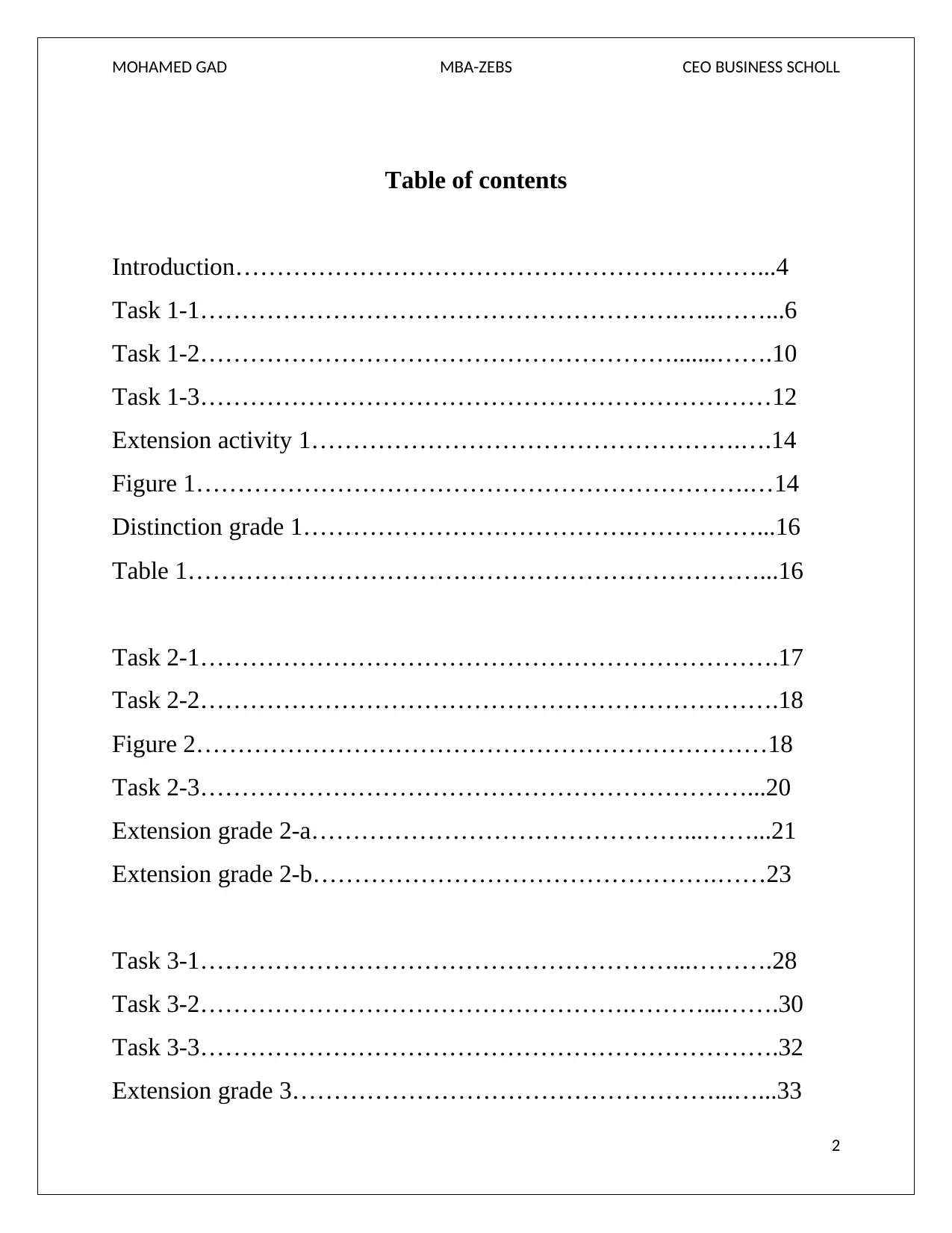
Table of contents
Introduction………………………………………………………...4
Task 1-1………………………………………………….…..……...6
Task 1-2………………………………………………….......…….10
Task 1-3……………………………………………………………12
Extension activity 1…………………………………………….….14
Figure 1………………………………………………………….…14
Distinction grade 1………………………………….……………...16
Table 1……………………………………………………………...16
Task 2-1…………………………………………………………….17
Task 2-2…………………………………………………………….18
Figure 2……………………………………………………………18
Task 2-3…………………………………………………………...20
Extension grade 2-a………………………………………...……...21
Extension grade 2-b………………………………………….……23
Task 3-1…………………………………………………...……….28
Task 3-2…………………………………………….………...…….30
Task 3-3…………………………………………………………….32
Extension grade 3……………………………………………...…...33
2
Table of contents
Introduction………………………………………………………...4
Task 1-1………………………………………………….…..……...6
Task 1-2………………………………………………….......…….10
Task 1-3……………………………………………………………12
Extension activity 1…………………………………………….….14
Figure 1………………………………………………………….…14
Distinction grade 1………………………………….……………...16
Table 1……………………………………………………………...16
Task 2-1…………………………………………………………….17
Task 2-2…………………………………………………………….18
Figure 2……………………………………………………………18
Task 2-3…………………………………………………………...20
Extension grade 2-a………………………………………...……...21
Extension grade 2-b………………………………………….……23
Task 3-1…………………………………………………...……….28
Task 3-2…………………………………………….………...…….30
Task 3-3…………………………………………………………….32
Extension grade 3……………………………………………...…...33
2

MOHAMED GAD MBA-ZEBS CEO BUSINESS SCHOLL
Task 4-1………………………………………………………....…36
Task 4-2…………………………………………………….……...37
Task 5………………………………………………………………38
3
Task 4-1………………………………………………………....…36
Task 4-2…………………………………………………….……...37
Task 5………………………………………………………………38
3
⊘ This is a preview!⊘
Do you want full access?
Subscribe today to unlock all pages.

Trusted by 1+ million students worldwide
MOHAMED GAD MBA-ZEBS CEO BUSINESS SCHOLL
Introduction
Leadership has significant impact on strategic management process. Especially it helps to
determine the vision and mission of the organization. Further, it facilitates the organization to
execute effective strategies to achieve that vision. leadership serves as a link between the soul
and the body of an organization. For the successful implementation of strategies, the challenge of
leadership is to be strong but not rude, be kind but not weak, be humble but not timid, be proud
but not arrogant, have humor but without folly. Leadership has to have the evaluation process to
ensure the effectiveness of the whole process, and this aspect will facilitate to identify the
drawbacks and to make fresh the strategies in line with the change as well. Moreover, this
evaluation process is able to help and sustain the constant growth of the organization. Thus, it
can be said that leadership is known as the nucleus of the organization, and it should have the
pivotal role like the role of blood and brain; as a result, the outcomes of the success can be
guaranteed and be shared.
Irrespective of time as well as position, leaders are able to contribute significantly in the way
how a firm functions its activities. Leadership which has effective strategies can work as the
fundamental basis for fruitfully employing the strategic management process. Leaders who
follow strategies are able to expedite the growth of suitable strategic activities, and they specify
the ways to enforce them. These actions work as gateways to higher-average outcomes and
strategic competitiveness. Leaders who work in different organizations are fully conscious about
the requirement to chalk out the plan strategically for the future of their organizations and take
part in the effective enactment regarding these well-planned schemes.
In strategic management leader perform the various roles. First introduces the environment for
change. Secondly it creates the leadership team by selecting key players from the organization by
breaking down the current hierarchy at third stage it formulates the vision and strategy by the
help of a visionary process that clarify the strategy for understanding of whole organization.
Then leadership creates an evaluation system that evaluates the strategy at every stage of the
work within the organization. Finally, it helps to change the culture which facilitates the strategic
management. Generically leader in an organization provide the vision, he strategically thinks and
plan, administrate the operational activities. Further it tries to fit organization according to the
requirement of situation. Leaders spread energy boost the morale by spirit. It develops the
relationships with all the stakeholders. And most importantly it ensures teaching and learning in
the organization. Leadership is responsible to direct the subordinates to perform the
organizational tasks effectively . We can say that strategic leadership is a process that transforms
organization into successful organization by proper strategies. It is the responsibility of
leadership to motivate and inspire the peoples in the organization to work jointly so that
organization’s vision can be translated into reality. Mostly in the organizations efficient leaders
perform the common tasks in the strategy making and executing process. They develop a
strategic vision and mission, sets goals and objectives, craft the strategies, execute it and then
4
Introduction
Leadership has significant impact on strategic management process. Especially it helps to
determine the vision and mission of the organization. Further, it facilitates the organization to
execute effective strategies to achieve that vision. leadership serves as a link between the soul
and the body of an organization. For the successful implementation of strategies, the challenge of
leadership is to be strong but not rude, be kind but not weak, be humble but not timid, be proud
but not arrogant, have humor but without folly. Leadership has to have the evaluation process to
ensure the effectiveness of the whole process, and this aspect will facilitate to identify the
drawbacks and to make fresh the strategies in line with the change as well. Moreover, this
evaluation process is able to help and sustain the constant growth of the organization. Thus, it
can be said that leadership is known as the nucleus of the organization, and it should have the
pivotal role like the role of blood and brain; as a result, the outcomes of the success can be
guaranteed and be shared.
Irrespective of time as well as position, leaders are able to contribute significantly in the way
how a firm functions its activities. Leadership which has effective strategies can work as the
fundamental basis for fruitfully employing the strategic management process. Leaders who
follow strategies are able to expedite the growth of suitable strategic activities, and they specify
the ways to enforce them. These actions work as gateways to higher-average outcomes and
strategic competitiveness. Leaders who work in different organizations are fully conscious about
the requirement to chalk out the plan strategically for the future of their organizations and take
part in the effective enactment regarding these well-planned schemes.
In strategic management leader perform the various roles. First introduces the environment for
change. Secondly it creates the leadership team by selecting key players from the organization by
breaking down the current hierarchy at third stage it formulates the vision and strategy by the
help of a visionary process that clarify the strategy for understanding of whole organization.
Then leadership creates an evaluation system that evaluates the strategy at every stage of the
work within the organization. Finally, it helps to change the culture which facilitates the strategic
management. Generically leader in an organization provide the vision, he strategically thinks and
plan, administrate the operational activities. Further it tries to fit organization according to the
requirement of situation. Leaders spread energy boost the morale by spirit. It develops the
relationships with all the stakeholders. And most importantly it ensures teaching and learning in
the organization. Leadership is responsible to direct the subordinates to perform the
organizational tasks effectively . We can say that strategic leadership is a process that transforms
organization into successful organization by proper strategies. It is the responsibility of
leadership to motivate and inspire the peoples in the organization to work jointly so that
organization’s vision can be translated into reality. Mostly in the organizations efficient leaders
perform the common tasks in the strategy making and executing process. They develop a
strategic vision and mission, sets goals and objectives, craft the strategies, execute it and then
4
Paraphrase This Document
Need a fresh take? Get an instant paraphrase of this document with our AI Paraphraser
MOHAMED GAD MBA-ZEBS CEO BUSINESS SCHOLL
evaluate the performance. The achievement of attaining strategic business objectives, directing
the organizations for the sake of viable development, and being competitive globally in different
sectors has positioned a novel requirement over institutions. There remains a challenge which is
to specify the roles of leadership, and those roles are able to differentiate significantly in terms of
organizational performance. The crucial concern is the role of leadership which needs to be acted
on. The successful growth related to the formation of strategy, and its enactment and assessment
necessitate a constant and corresponding pledge from uppermost leadership, so likely successful
enactment of strategy differs.
There are many recognizable actions which determine strategic leadership that can proffer
positively towards effective strategy enactment, and they are in the following:
Determining strategic direction
Establishing balanced organizational controls
Effectively managing the organization’s resource portfolio
Sustaining an effective organizational culture
Emphasizing ethical practices organizational controls
5
evaluate the performance. The achievement of attaining strategic business objectives, directing
the organizations for the sake of viable development, and being competitive globally in different
sectors has positioned a novel requirement over institutions. There remains a challenge which is
to specify the roles of leadership, and those roles are able to differentiate significantly in terms of
organizational performance. The crucial concern is the role of leadership which needs to be acted
on. The successful growth related to the formation of strategy, and its enactment and assessment
necessitate a constant and corresponding pledge from uppermost leadership, so likely successful
enactment of strategy differs.
There are many recognizable actions which determine strategic leadership that can proffer
positively towards effective strategy enactment, and they are in the following:
Determining strategic direction
Establishing balanced organizational controls
Effectively managing the organization’s resource portfolio
Sustaining an effective organizational culture
Emphasizing ethical practices organizational controls
5
MOHAMED GAD MBA-ZEBS CEO BUSINESS SCHOLL
Task 1-1
Analyze the knowledge and skills in leadership and strategic management which are
required to support the creation and achievement of organizational vision and strategy.
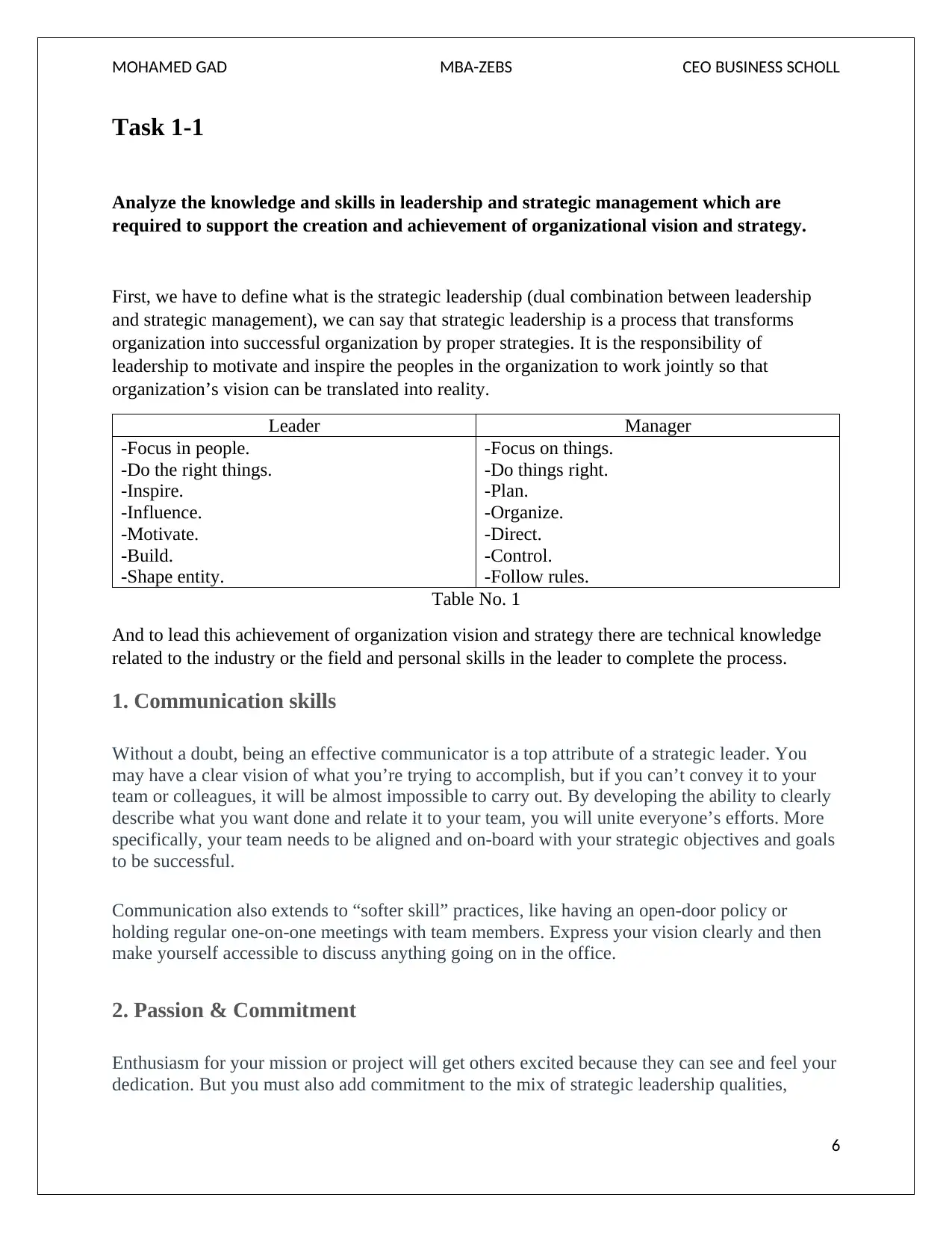
First, we have to define what is the strategic leadership (dual combination between leadership
and strategic management), we can say that strategic leadership is a process that transforms
organization into successful organization by proper strategies. It is the responsibility of
leadership to motivate and inspire the peoples in the organization to work jointly so that
organization’s vision can be translated into reality.
Leader Manager
-Focus in people.
-Do the right things.
-Inspire.
-Influence.
-Motivate.
-Build.
-Shape entity.
-Focus on things.
-Do things right.
-Plan.
-Organize.
-Direct.
-Control.
-Follow rules.
Table No. 1
And to lead this achievement of organization vision and strategy there are technical knowledge
related to the industry or the field and personal skills in the leader to complete the process.
1. Communication skills
Without a doubt, being an effective communicator is a top attribute of a strategic leader. You
may have a clear vision of what you’re trying to accomplish, but if you can’t convey it to your
team or colleagues, it will be almost impossible to carry out. By developing the ability to clearly
describe what you want done and relate it to your team, you will unite everyone’s efforts. More
specifically, your team needs to be aligned and on-board with your strategic objectives and goals
to be successful.
Communication also extends to “softer skill” practices, like having an open-door policy or
holding regular one-on-one meetings with team members. Express your vision clearly and then
make yourself accessible to discuss anything going on in the office.
2. Passion & Commitment
Enthusiasm for your mission or project will get others excited because they can see and feel your
dedication. But you must also add commitment to the mix of strategic leadership qualities,
6
Task 1-1
Analyze the knowledge and skills in leadership and strategic management which are
required to support the creation and achievement of organizational vision and strategy.
First, we have to define what is the strategic leadership (dual combination between leadership
and strategic management), we can say that strategic leadership is a process that transforms
organization into successful organization by proper strategies. It is the responsibility of
leadership to motivate and inspire the peoples in the organization to work jointly so that
organization’s vision can be translated into reality.
Leader Manager
-Focus in people.
-Do the right things.
-Inspire.
-Influence.
-Motivate.
-Build.
-Shape entity.
-Focus on things.
-Do things right.
-Plan.
-Organize.
-Direct.
-Control.
-Follow rules.
Table No. 1
And to lead this achievement of organization vision and strategy there are technical knowledge
related to the industry or the field and personal skills in the leader to complete the process.
1. Communication skills
Without a doubt, being an effective communicator is a top attribute of a strategic leader. You
may have a clear vision of what you’re trying to accomplish, but if you can’t convey it to your
team or colleagues, it will be almost impossible to carry out. By developing the ability to clearly
describe what you want done and relate it to your team, you will unite everyone’s efforts. More
specifically, your team needs to be aligned and on-board with your strategic objectives and goals
to be successful.
Communication also extends to “softer skill” practices, like having an open-door policy or
holding regular one-on-one meetings with team members. Express your vision clearly and then
make yourself accessible to discuss anything going on in the office.
2. Passion & Commitment
Enthusiasm for your mission or project will get others excited because they can see and feel your
dedication. But you must also add commitment to the mix of strategic leadership qualities,
6
⊘ This is a preview!⊘
Do you want full access?
Subscribe today to unlock all pages.
Trusted by 1+ million students worldwide
MOHAMED GAD MBA-ZEBS CEO BUSINESS SCHOLL
because passion doesn’t always get the job done. Commitment is the ability to stay focused on
what will make you successful.
One simple way to convey your passion and commitment is to lead by example. You expect your
team to work hard and produce quality results, so roll up your sleeves and join them. Team
motivation significantly increases when people see their boss working alongside them, putting in
the same level of effort (or more) than everyone else. When you show that hard work is being
done on every level of the organization, you prove your commitment and earn the respect of your
team as a leader.
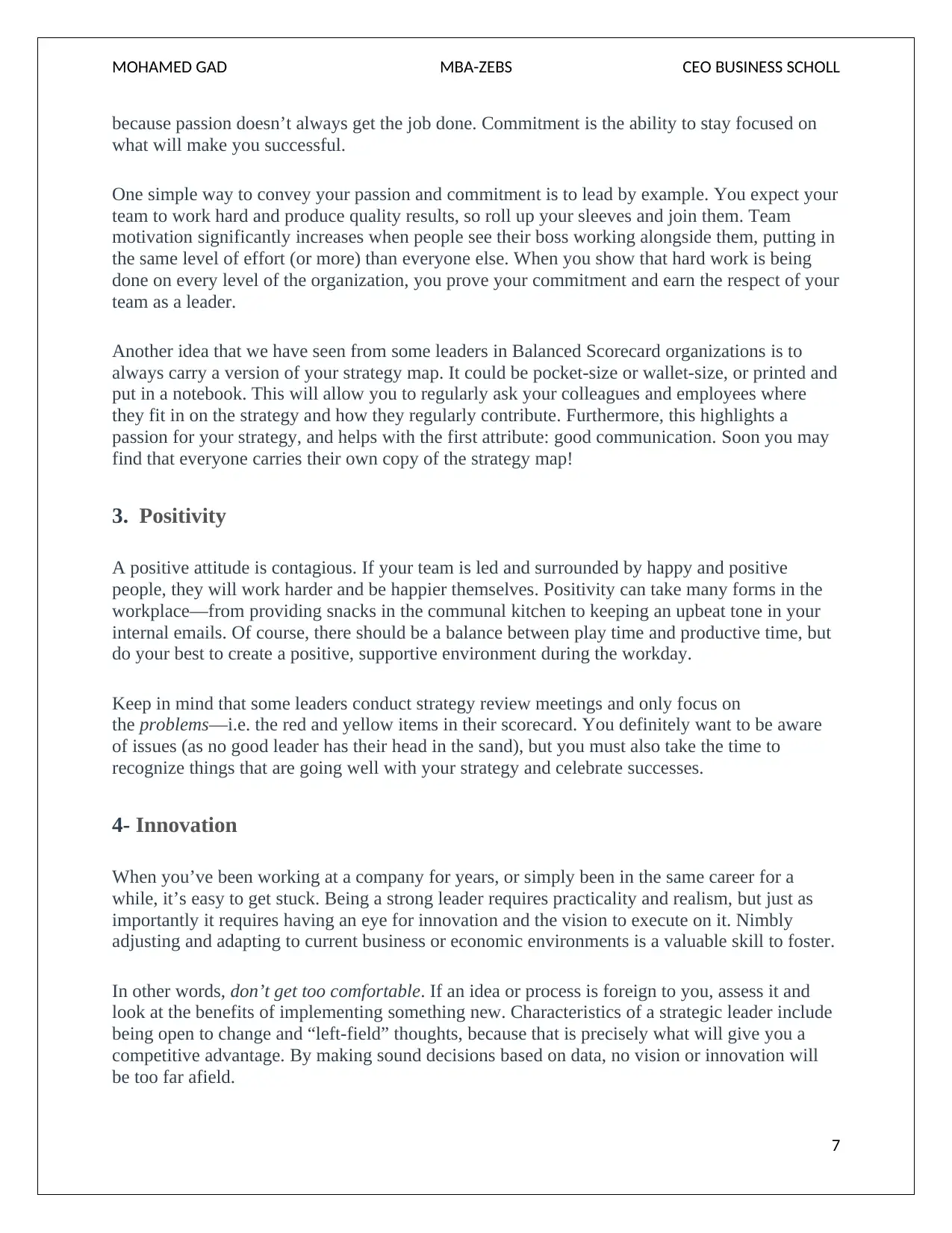
Another idea that we have seen from some leaders in Balanced Scorecard organizations is to
always carry a version of your strategy map. It could be pocket-size or wallet-size, or printed and
put in a notebook. This will allow you to regularly ask your colleagues and employees where
they fit in on the strategy and how they regularly contribute. Furthermore, this highlights a
passion for your strategy, and helps with the first attribute: good communication. Soon you may
find that everyone carries their own copy of the strategy map!
3. Positivity
A positive attitude is contagious. If your team is led and surrounded by happy and positive
people, they will work harder and be happier themselves. Positivity can take many forms in the
workplace—from providing snacks in the communal kitchen to keeping an upbeat tone in your
internal emails. Of course, there should be a balance between play time and productive time, but
do your best to create a positive, supportive environment during the workday.
Keep in mind that some leaders conduct strategy review meetings and only focus on
the problems—i.e. the red and yellow items in their scorecard. You definitely want to be aware
of issues (as no good leader has their head in the sand), but you must also take the time to
recognize things that are going well with your strategy and celebrate successes.
4- Innovation
When you’ve been working at a company for years, or simply been in the same career for a
while, it’s easy to get stuck. Being a strong leader requires practicality and realism, but just as
importantly it requires having an eye for innovation and the vision to execute on it. Nimbly
adjusting and adapting to current business or economic environments is a valuable skill to foster.
In other words, don’t get too comfortable. If an idea or process is foreign to you, assess it and
look at the benefits of implementing something new. Characteristics of a strategic leader include
being open to change and “left-field” thoughts, because that is precisely what will give you a
competitive advantage. By making sound decisions based on data, no vision or innovation will
be too far afield.
7
because passion doesn’t always get the job done. Commitment is the ability to stay focused on
what will make you successful.
One simple way to convey your passion and commitment is to lead by example. You expect your
team to work hard and produce quality results, so roll up your sleeves and join them. Team
motivation significantly increases when people see their boss working alongside them, putting in
the same level of effort (or more) than everyone else. When you show that hard work is being
done on every level of the organization, you prove your commitment and earn the respect of your
team as a leader.
Another idea that we have seen from some leaders in Balanced Scorecard organizations is to
always carry a version of your strategy map. It could be pocket-size or wallet-size, or printed and
put in a notebook. This will allow you to regularly ask your colleagues and employees where
they fit in on the strategy and how they regularly contribute. Furthermore, this highlights a
passion for your strategy, and helps with the first attribute: good communication. Soon you may
find that everyone carries their own copy of the strategy map!
3. Positivity
A positive attitude is contagious. If your team is led and surrounded by happy and positive
people, they will work harder and be happier themselves. Positivity can take many forms in the
workplace—from providing snacks in the communal kitchen to keeping an upbeat tone in your
internal emails. Of course, there should be a balance between play time and productive time, but
do your best to create a positive, supportive environment during the workday.
Keep in mind that some leaders conduct strategy review meetings and only focus on
the problems—i.e. the red and yellow items in their scorecard. You definitely want to be aware
of issues (as no good leader has their head in the sand), but you must also take the time to
recognize things that are going well with your strategy and celebrate successes.
4- Innovation
When you’ve been working at a company for years, or simply been in the same career for a
while, it’s easy to get stuck. Being a strong leader requires practicality and realism, but just as
importantly it requires having an eye for innovation and the vision to execute on it. Nimbly
adjusting and adapting to current business or economic environments is a valuable skill to foster.
In other words, don’t get too comfortable. If an idea or process is foreign to you, assess it and
look at the benefits of implementing something new. Characteristics of a strategic leader include
being open to change and “left-field” thoughts, because that is precisely what will give you a
competitive advantage. By making sound decisions based on data, no vision or innovation will
be too far afield.
7
Paraphrase This Document
Need a fresh take? Get an instant paraphrase of this document with our AI Paraphraser
MOHAMED GAD MBA-ZEBS CEO BUSINESS SCHOLL
Remember that you may not be the most innovative person in the room—but you still need to
foster innovation amongst your team. Be sure to have sessions or days where you encourage
ideas about innovating around your strategy, and give some of the ideas the resources they need
to be tested or expanded. If you never allow team members to innovate, they will have no
examples inside of the organization to point to in order to make suggestions in the future.
5- Collaboration
Having a collaborative approach to leadership is powerful because it naturally creates
transparency in your organization. If you’re connected to your team and genuinely interested in
collaborating with them, they will know what you’re thinking and vice versa. Collaboration leads
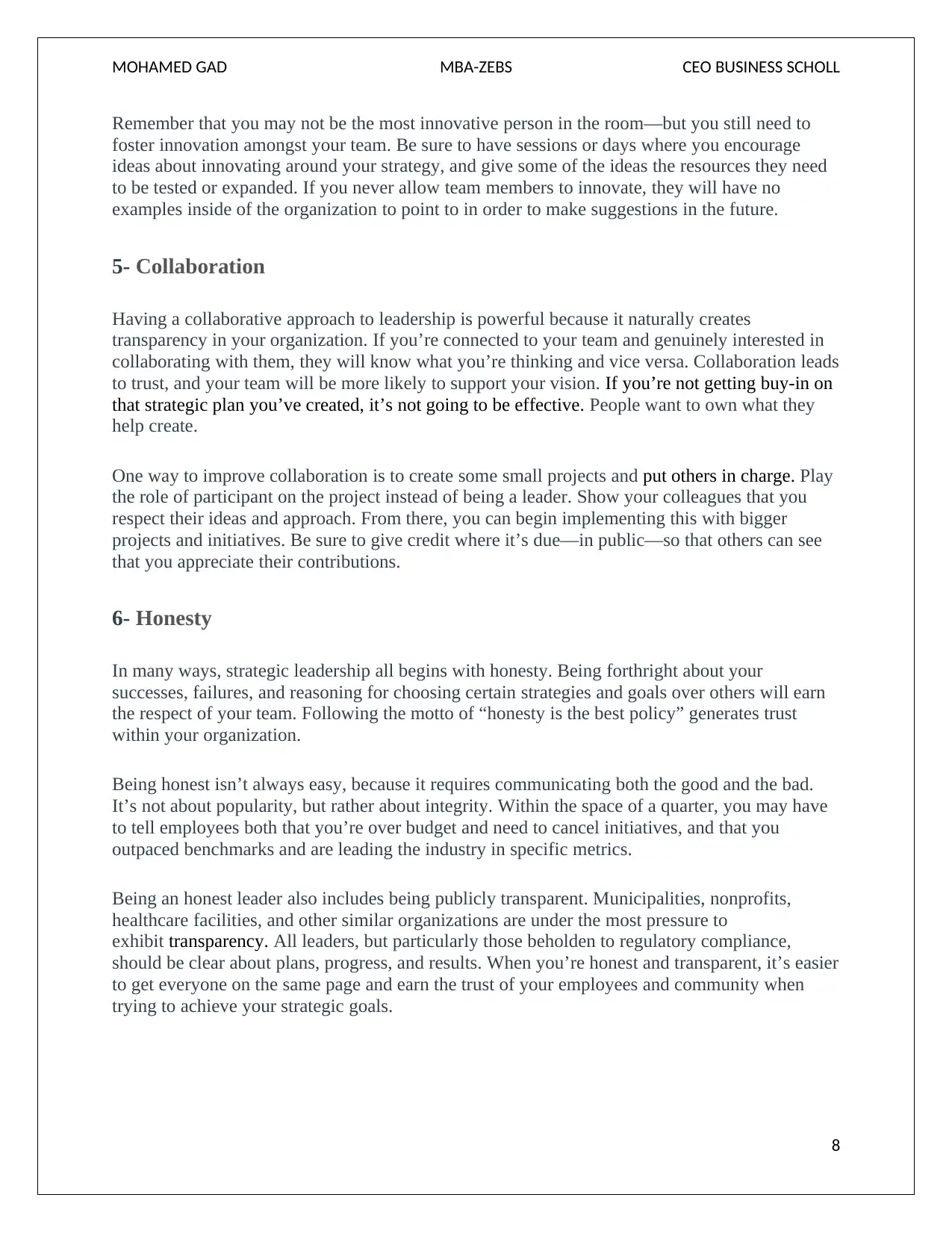
to trust, and your team will be more likely to support your vision. If you’re not getting buy-in on
that strategic plan you’ve created, it’s not going to be effective. People want to own what they
help create.
One way to improve collaboration is to create some small projects and put others in charge. Play
the role of participant on the project instead of being a leader. Show your colleagues that you
respect their ideas and approach. From there, you can begin implementing this with bigger
projects and initiatives. Be sure to give credit where it’s due—in public—so that others can see
that you appreciate their contributions.
6- Honesty
In many ways, strategic leadership all begins with honesty. Being forthright about your
successes, failures, and reasoning for choosing certain strategies and goals over others will earn
the respect of your team. Following the motto of “honesty is the best policy” generates trust
within your organization.
Being honest isn’t always easy, because it requires communicating both the good and the bad.
It’s not about popularity, but rather about integrity. Within the space of a quarter, you may have
to tell employees both that you’re over budget and need to cancel initiatives, and that you
outpaced benchmarks and are leading the industry in specific metrics.
Being an honest leader also includes being publicly transparent. Municipalities, nonprofits,
healthcare facilities, and other similar organizations are under the most pressure to
exhibit transparency. All leaders, but particularly those beholden to regulatory compliance,
should be clear about plans, progress, and results. When you’re honest and transparent, it’s easier
to get everyone on the same page and earn the trust of your employees and community when
trying to achieve your strategic goals.
8
Remember that you may not be the most innovative person in the room—but you still need to
foster innovation amongst your team. Be sure to have sessions or days where you encourage
ideas about innovating around your strategy, and give some of the ideas the resources they need
to be tested or expanded. If you never allow team members to innovate, they will have no
examples inside of the organization to point to in order to make suggestions in the future.
5- Collaboration
Having a collaborative approach to leadership is powerful because it naturally creates
transparency in your organization. If you’re connected to your team and genuinely interested in
collaborating with them, they will know what you’re thinking and vice versa. Collaboration leads
to trust, and your team will be more likely to support your vision. If you’re not getting buy-in on
that strategic plan you’ve created, it’s not going to be effective. People want to own what they
help create.
One way to improve collaboration is to create some small projects and put others in charge. Play
the role of participant on the project instead of being a leader. Show your colleagues that you
respect their ideas and approach. From there, you can begin implementing this with bigger
projects and initiatives. Be sure to give credit where it’s due—in public—so that others can see
that you appreciate their contributions.
6- Honesty
In many ways, strategic leadership all begins with honesty. Being forthright about your
successes, failures, and reasoning for choosing certain strategies and goals over others will earn
the respect of your team. Following the motto of “honesty is the best policy” generates trust
within your organization.
Being honest isn’t always easy, because it requires communicating both the good and the bad.
It’s not about popularity, but rather about integrity. Within the space of a quarter, you may have
to tell employees both that you’re over budget and need to cancel initiatives, and that you
outpaced benchmarks and are leading the industry in specific metrics.
Being an honest leader also includes being publicly transparent. Municipalities, nonprofits,
healthcare facilities, and other similar organizations are under the most pressure to
exhibit transparency. All leaders, but particularly those beholden to regulatory compliance,
should be clear about plans, progress, and results. When you’re honest and transparent, it’s easier
to get everyone on the same page and earn the trust of your employees and community when
trying to achieve your strategic goals.
8
MOHAMED GAD MBA-ZEBS CEO BUSINESS SCHOLL
7- Diplomacy
Honesty is always the best policy, but strategic leadership often requires you to be tactful.
Diplomacy is a learned skill that helps leaders effectively manage conflict using negotiation and
sensitivity. It requires an unbiased, strategic approach to problem solving. As Henry Kissinger
defined it, diplomacy is “the art of restraining power.”
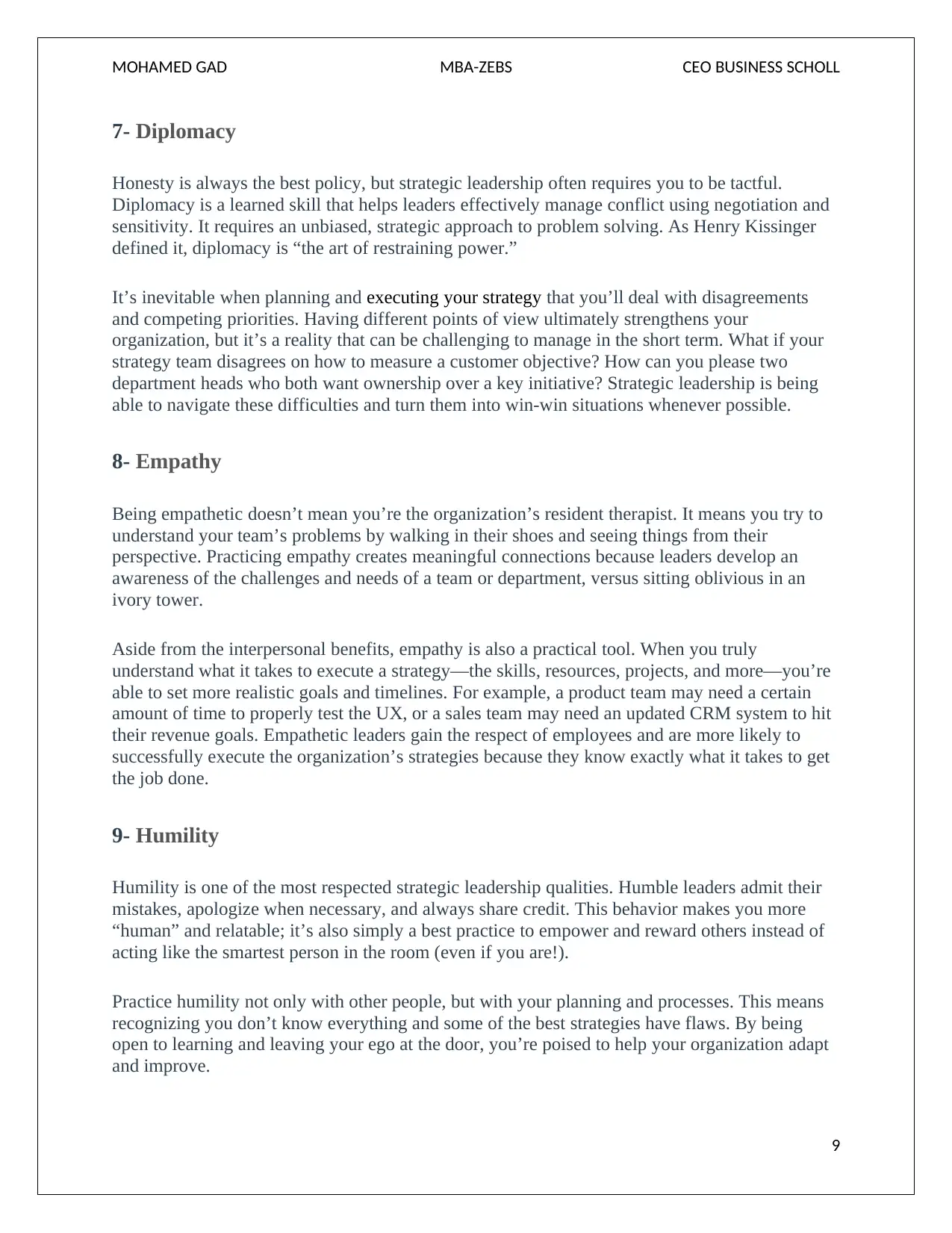
It’s inevitable when planning and executing your strategy that you’ll deal with disagreements
and competing priorities. Having different points of view ultimately strengthens your
organization, but it’s a reality that can be challenging to manage in the short term. What if your
strategy team disagrees on how to measure a customer objective? How can you please two
department heads who both want ownership over a key initiative? Strategic leadership is being
able to navigate these difficulties and turn them into win-win situations whenever possible.
8- Empathy
Being empathetic doesn’t mean you’re the organization’s resident therapist. It means you try to
understand your team’s problems by walking in their shoes and seeing things from their
perspective. Practicing empathy creates meaningful connections because leaders develop an
awareness of the challenges and needs of a team or department, versus sitting oblivious in an
ivory tower.
Aside from the interpersonal benefits, empathy is also a practical tool. When you truly
understand what it takes to execute a strategy—the skills, resources, projects, and more—you’re
able to set more realistic goals and timelines. For example, a product team may need a certain
amount of time to properly test the UX, or a sales team may need an updated CRM system to hit
their revenue goals. Empathetic leaders gain the respect of employees and are more likely to
successfully execute the organization’s strategies because they know exactly what it takes to get
the job done.
9- Humility
Humility is one of the most respected strategic leadership qualities. Humble leaders admit their
mistakes, apologize when necessary, and always share credit. This behavior makes you more
“human” and relatable; it’s also simply a best practice to empower and reward others instead of
acting like the smartest person in the room (even if you are!).
Practice humility not only with other people, but with your planning and processes. This means
recognizing you don’t know everything and some of the best strategies have flaws. By being
open to learning and leaving your ego at the door, you’re poised to help your organization adapt
and improve.
9
7- Diplomacy
Honesty is always the best policy, but strategic leadership often requires you to be tactful.
Diplomacy is a learned skill that helps leaders effectively manage conflict using negotiation and
sensitivity. It requires an unbiased, strategic approach to problem solving. As Henry Kissinger
defined it, diplomacy is “the art of restraining power.”
It’s inevitable when planning and executing your strategy that you’ll deal with disagreements
and competing priorities. Having different points of view ultimately strengthens your
organization, but it’s a reality that can be challenging to manage in the short term. What if your
strategy team disagrees on how to measure a customer objective? How can you please two
department heads who both want ownership over a key initiative? Strategic leadership is being
able to navigate these difficulties and turn them into win-win situations whenever possible.
8- Empathy
Being empathetic doesn’t mean you’re the organization’s resident therapist. It means you try to
understand your team’s problems by walking in their shoes and seeing things from their
perspective. Practicing empathy creates meaningful connections because leaders develop an
awareness of the challenges and needs of a team or department, versus sitting oblivious in an
ivory tower.
Aside from the interpersonal benefits, empathy is also a practical tool. When you truly
understand what it takes to execute a strategy—the skills, resources, projects, and more—you’re
able to set more realistic goals and timelines. For example, a product team may need a certain
amount of time to properly test the UX, or a sales team may need an updated CRM system to hit
their revenue goals. Empathetic leaders gain the respect of employees and are more likely to
successfully execute the organization’s strategies because they know exactly what it takes to get
the job done.
9- Humility
Humility is one of the most respected strategic leadership qualities. Humble leaders admit their
mistakes, apologize when necessary, and always share credit. This behavior makes you more
“human” and relatable; it’s also simply a best practice to empower and reward others instead of
acting like the smartest person in the room (even if you are!).
Practice humility not only with other people, but with your planning and processes. This means
recognizing you don’t know everything and some of the best strategies have flaws. By being
open to learning and leaving your ego at the door, you’re poised to help your organization adapt
and improve.
9
⊘ This is a preview!⊘
Do you want full access?
Subscribe today to unlock all pages.
Trusted by 1+ million students worldwide
MOHAMED GAD MBA-ZEBS CEO BUSINESS SCHOLL
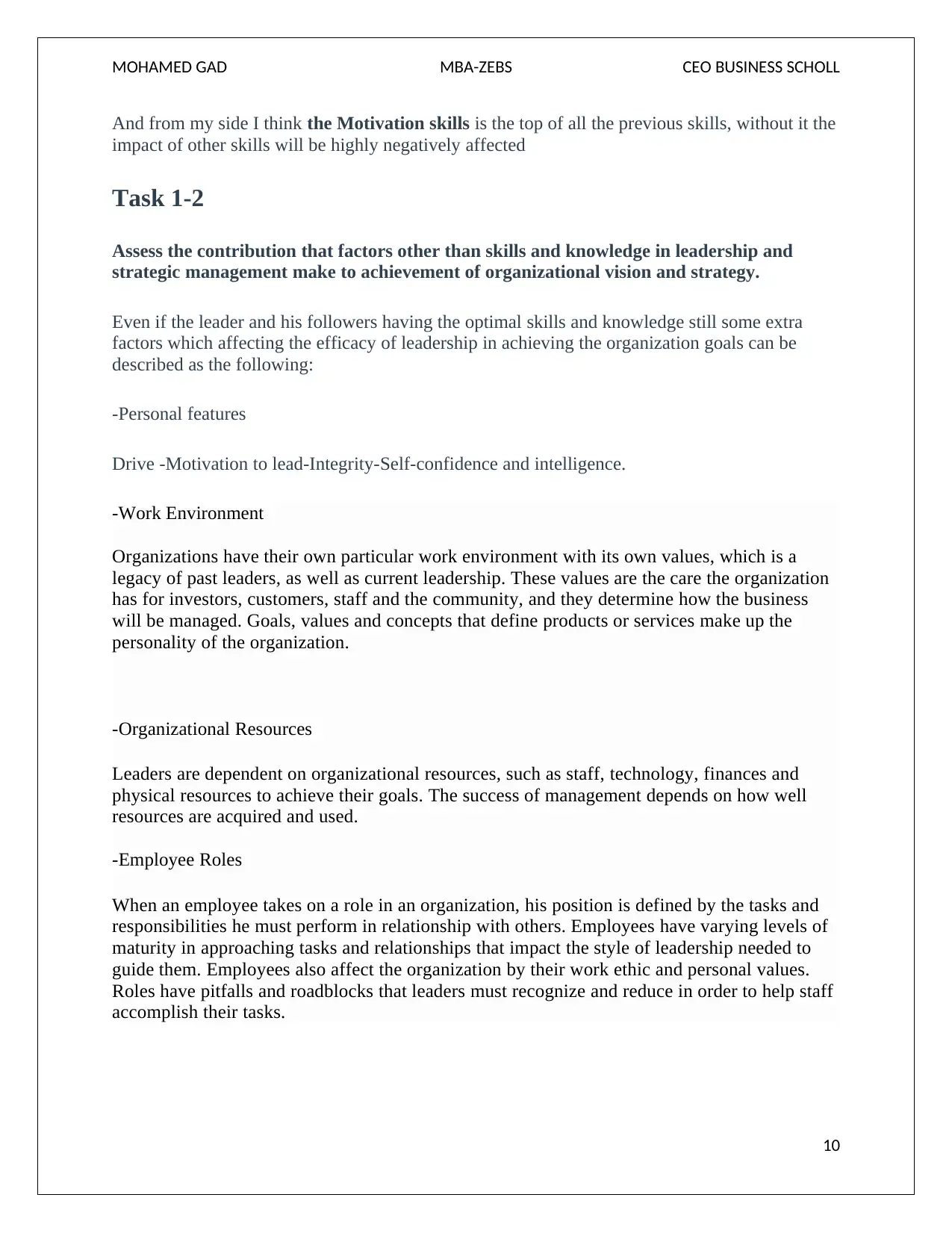
And from my side I think the Motivation skills is the top of all the previous skills, without it the
impact of other skills will be highly negatively affected
Task 1-2
Assess the contribution that factors other than skills and knowledge in leadership and
strategic management make to achievement of organizational vision and strategy.
Even if the leader and his followers having the optimal skills and knowledge still some extra
factors which affecting the efficacy of leadership in achieving the organization goals can be
described as the following:
-Personal features
Drive -Motivation to lead-Integrity-Self-confidence and intelligence.
-Work Environment
Organizations have their own particular work environment with its own values, which is a
legacy of past leaders, as well as current leadership. These values are the care the organization
has for investors, customers, staff and the community, and they determine how the business
will be managed. Goals, values and concepts that define products or services make up the
personality of the organization.
-Organizational Resources
Leaders are dependent on organizational resources, such as staff, technology, finances and
physical resources to achieve their goals. The success of management depends on how well
resources are acquired and used.
-Employee Roles
When an employee takes on a role in an organization, his position is defined by the tasks and
responsibilities he must perform in relationship with others. Employees have varying levels of
maturity in approaching tasks and relationships that impact the style of leadership needed to
guide them. Employees also affect the organization by their work ethic and personal values.
Roles have pitfalls and roadblocks that leaders must recognize and reduce in order to help staff
accomplish their tasks.
10
And from my side I think the Motivation skills is the top of all the previous skills, without it the
impact of other skills will be highly negatively affected
Task 1-2
Assess the contribution that factors other than skills and knowledge in leadership and
strategic management make to achievement of organizational vision and strategy.
Even if the leader and his followers having the optimal skills and knowledge still some extra
factors which affecting the efficacy of leadership in achieving the organization goals can be
described as the following:
-Personal features
Drive -Motivation to lead-Integrity-Self-confidence and intelligence.
-Work Environment
Organizations have their own particular work environment with its own values, which is a
legacy of past leaders, as well as current leadership. These values are the care the organization
has for investors, customers, staff and the community, and they determine how the business
will be managed. Goals, values and concepts that define products or services make up the
personality of the organization.
-Organizational Resources
Leaders are dependent on organizational resources, such as staff, technology, finances and
physical resources to achieve their goals. The success of management depends on how well
resources are acquired and used.
-Employee Roles
When an employee takes on a role in an organization, his position is defined by the tasks and
responsibilities he must perform in relationship with others. Employees have varying levels of
maturity in approaching tasks and relationships that impact the style of leadership needed to
guide them. Employees also affect the organization by their work ethic and personal values.
Roles have pitfalls and roadblocks that leaders must recognize and reduce in order to help staff
accomplish their tasks.
10
Paraphrase This Document
Need a fresh take? Get an instant paraphrase of this document with our AI Paraphraser
MOHAMED GAD MBA-ZEBS CEO BUSINESS SCHOLL
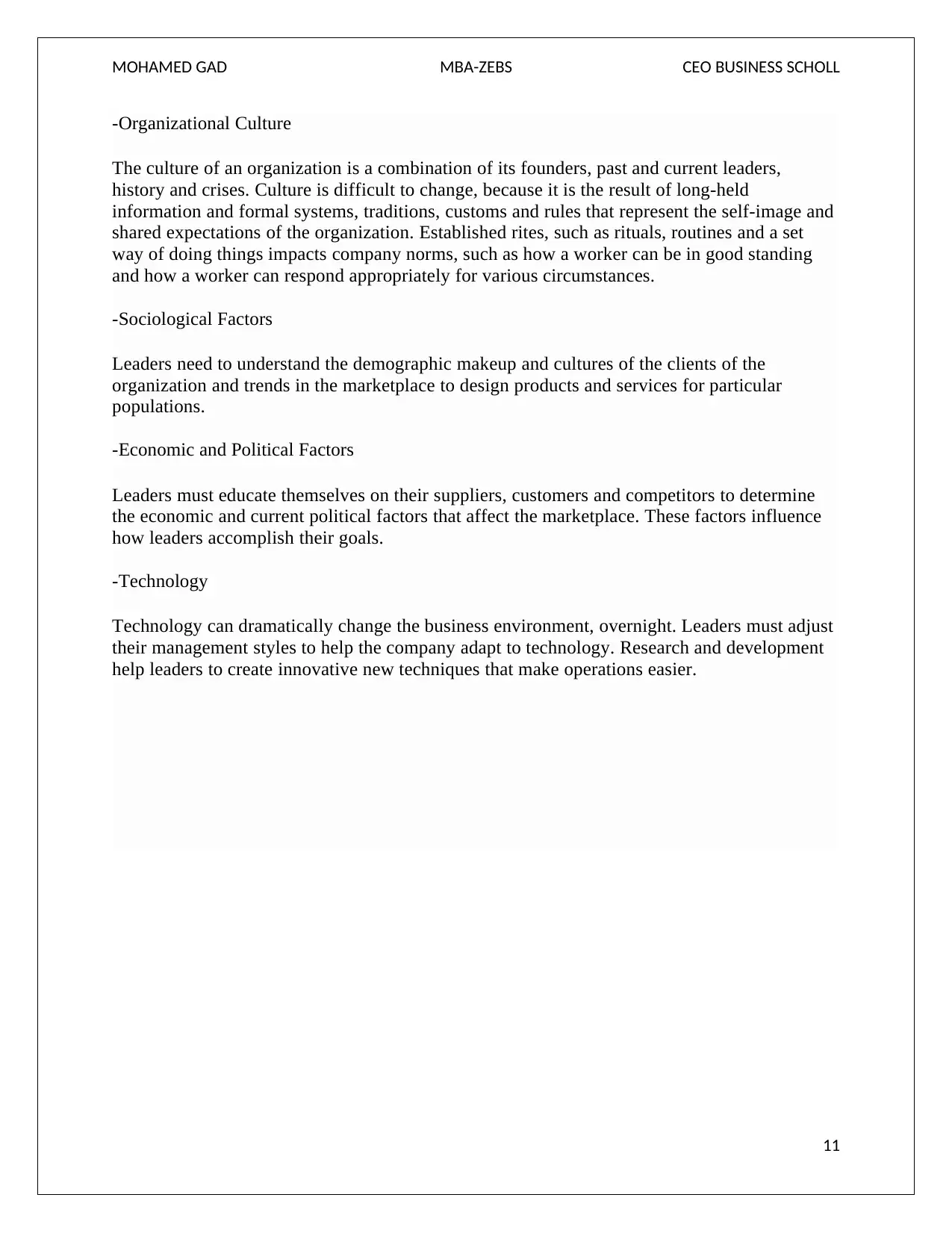
-Organizational Culture
The culture of an organization is a combination of its founders, past and current leaders,
history and crises. Culture is difficult to change, because it is the result of long-held
information and formal systems, traditions, customs and rules that represent the self-image and
shared expectations of the organization. Established rites, such as rituals, routines and a set
way of doing things impacts company norms, such as how a worker can be in good standing
and how a worker can respond appropriately for various circumstances.
-Sociological Factors
Leaders need to understand the demographic makeup and cultures of the clients of the
organization and trends in the marketplace to design products and services for particular
populations.
-Economic and Political Factors
Leaders must educate themselves on their suppliers, customers and competitors to determine
the economic and current political factors that affect the marketplace. These factors influence
how leaders accomplish their goals.
-Technology
Technology can dramatically change the business environment, overnight. Leaders must adjust
their management styles to help the company adapt to technology. Research and development
help leaders to create innovative new techniques that make operations easier.
11
-Organizational Culture
The culture of an organization is a combination of its founders, past and current leaders,
history and crises. Culture is difficult to change, because it is the result of long-held
information and formal systems, traditions, customs and rules that represent the self-image and
shared expectations of the organization. Established rites, such as rituals, routines and a set
way of doing things impacts company norms, such as how a worker can be in good standing
and how a worker can respond appropriately for various circumstances.
-Sociological Factors
Leaders need to understand the demographic makeup and cultures of the clients of the
organization and trends in the marketplace to design products and services for particular
populations.
-Economic and Political Factors
Leaders must educate themselves on their suppliers, customers and competitors to determine
the economic and current political factors that affect the marketplace. These factors influence
how leaders accomplish their goals.
-Technology
Technology can dramatically change the business environment, overnight. Leaders must adjust
their management styles to help the company adapt to technology. Research and development
help leaders to create innovative new techniques that make operations easier.
11
MOHAMED GAD MBA-ZEBS CEO BUSINESS SCHOLL
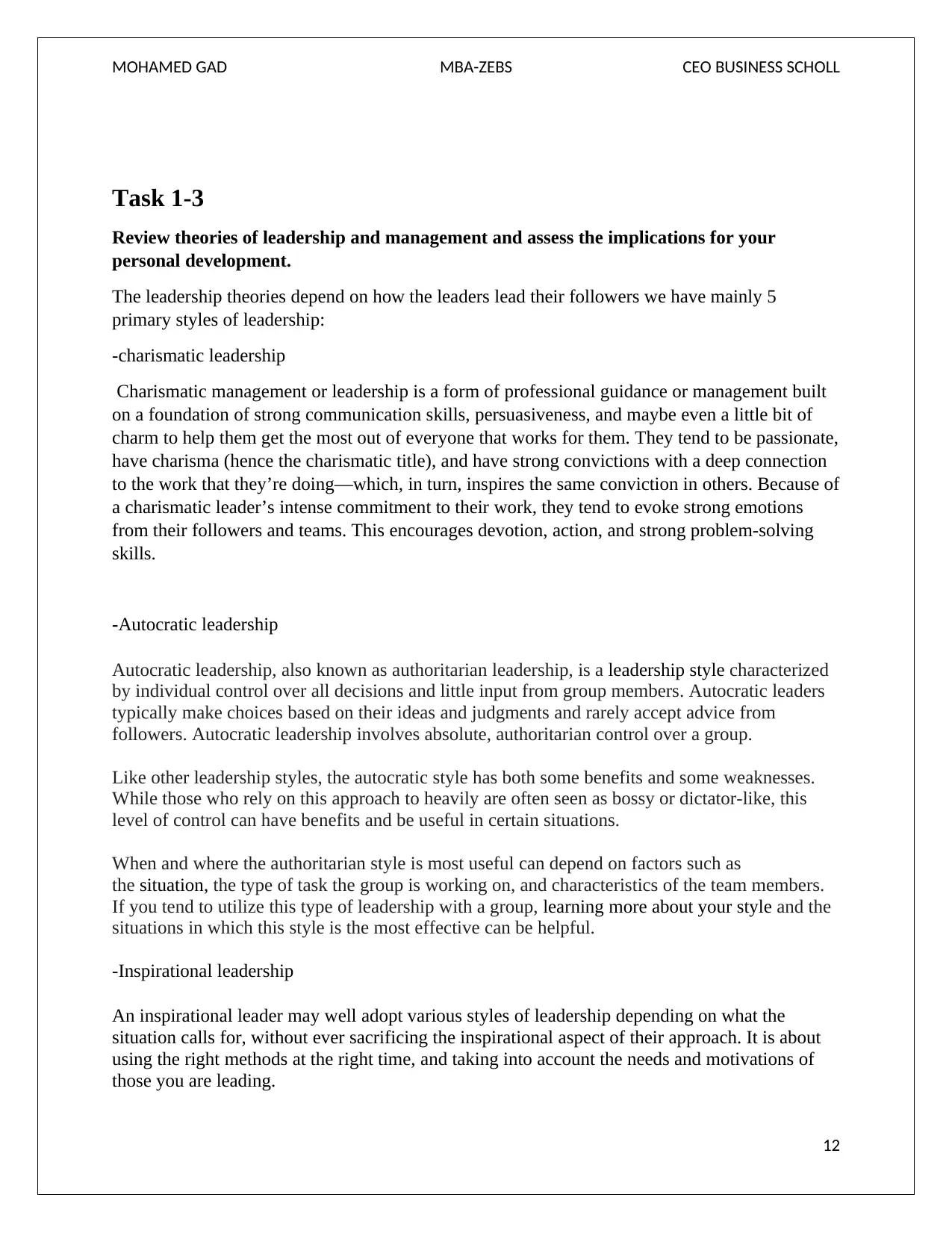
Task 1-3
Review theories of leadership and management and assess the implications for your
personal development.
The leadership theories depend on how the leaders lead their followers we have mainly 5
primary styles of leadership:
-charismatic leadership
Charismatic management or leadership is a form of professional guidance or management built
on a foundation of strong communication skills, persuasiveness, and maybe even a little bit of
charm to help them get the most out of everyone that works for them. They tend to be passionate,
have charisma (hence the charismatic title), and have strong convictions with a deep connection
to the work that they’re doing—which, in turn, inspires the same conviction in others. Because of
a charismatic leader’s intense commitment to their work, they tend to evoke strong emotions
from their followers and teams. This encourages devotion, action, and strong problem-solving
skills.
-Autocratic leadership
Autocratic leadership, also known as authoritarian leadership, is a leadership style characterized
by individual control over all decisions and little input from group members. Autocratic leaders
typically make choices based on their ideas and judgments and rarely accept advice from
followers. Autocratic leadership involves absolute, authoritarian control over a group.
Like other leadership styles, the autocratic style has both some benefits and some weaknesses.
While those who rely on this approach to heavily are often seen as bossy or dictator-like, this
level of control can have benefits and be useful in certain situations.
When and where the authoritarian style is most useful can depend on factors such as
the situation, the type of task the group is working on, and characteristics of the team members.
If you tend to utilize this type of leadership with a group, learning more about your style and the
situations in which this style is the most effective can be helpful.
-Inspirational leadership
An inspirational leader may well adopt various styles of leadership depending on what the
situation calls for, without ever sacrificing the inspirational aspect of their approach. It is about
using the right methods at the right time, and taking into account the needs and motivations of
those you are leading.
12
Task 1-3
Review theories of leadership and management and assess the implications for your
personal development.
The leadership theories depend on how the leaders lead their followers we have mainly 5
primary styles of leadership:
-charismatic leadership
Charismatic management or leadership is a form of professional guidance or management built
on a foundation of strong communication skills, persuasiveness, and maybe even a little bit of
charm to help them get the most out of everyone that works for them. They tend to be passionate,
have charisma (hence the charismatic title), and have strong convictions with a deep connection
to the work that they’re doing—which, in turn, inspires the same conviction in others. Because of
a charismatic leader’s intense commitment to their work, they tend to evoke strong emotions
from their followers and teams. This encourages devotion, action, and strong problem-solving
skills.
-Autocratic leadership
Autocratic leadership, also known as authoritarian leadership, is a leadership style characterized
by individual control over all decisions and little input from group members. Autocratic leaders
typically make choices based on their ideas and judgments and rarely accept advice from
followers. Autocratic leadership involves absolute, authoritarian control over a group.
Like other leadership styles, the autocratic style has both some benefits and some weaknesses.
While those who rely on this approach to heavily are often seen as bossy or dictator-like, this
level of control can have benefits and be useful in certain situations.
When and where the authoritarian style is most useful can depend on factors such as
the situation, the type of task the group is working on, and characteristics of the team members.
If you tend to utilize this type of leadership with a group, learning more about your style and the
situations in which this style is the most effective can be helpful.
-Inspirational leadership
An inspirational leader may well adopt various styles of leadership depending on what the
situation calls for, without ever sacrificing the inspirational aspect of their approach. It is about
using the right methods at the right time, and taking into account the needs and motivations of
those you are leading.
12
⊘ This is a preview!⊘
Do you want full access?
Subscribe today to unlock all pages.
Trusted by 1+ million students worldwide

1 out of 39


Related Documents


Your All-in-One AI-Powered Toolkit for Academic Success.
+13062052269
info@desklib.com
Available 24*7 on WhatsApp / Email
![[object Object]](/_next/static/media/star-bottom.7253800d.svg)
Unlock your academic potential
Copyright © 2020–2026 A2Z Services. All Rights Reserved. Developed and managed by ZUCOL.