Money Management Assignment: Coca-Cola, Investment Strategy, & Bonds
VerifiedAdded on 2019/09/20
|19
|5350
|284
Homework Assignment
AI Summary
This assignment delves into the realm of money management, encompassing the analysis of potential investments and the development of personalized investment strategies. The first part of the assignment centers on a detailed evaluation of the Coca-Cola Company, assessing its financial performance, market position, and potential as a long-term investment. The analysis considers various financial ratios, market trends, and the company's global presence to provide an informed investment recommendation. The second section focuses on the creation of an individual investment strategy, beginning with a self-assessment to determine the author's risk profile. This involves understanding different risk profiles and identifying where the author fits, considering factors like financial goals, time horizon, and risk tolerance. The assignment then explores asset allocation based on the identified risk profile. The third section explores bond investments.
Money Management
(Question #1, #2, and #3)
Student Name:
Student ID:
Course Name:
Course ID:
Faculty Name:
University Name:
(Question #1, #2, and #3)
Student Name:
Student ID:
Course Name:
Course ID:
Faculty Name:
University Name:

Paraphrase This Document
Need a fresh take? Get an instant paraphrase of this document with our AI Paraphraser
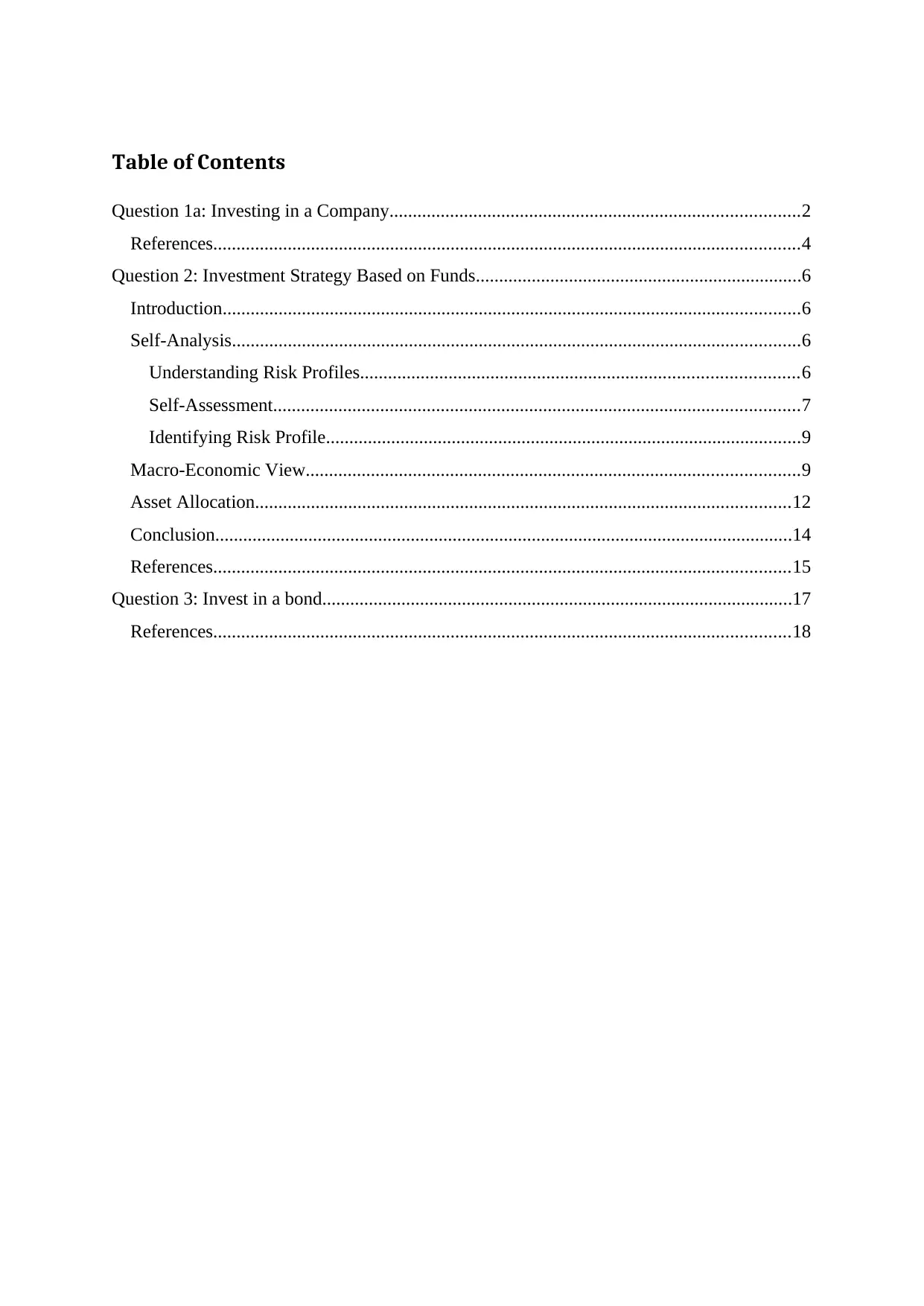
Table of Contents
Question 1a: Investing in a Company........................................................................................2
References..............................................................................................................................4
Question 2: Investment Strategy Based on Funds......................................................................6
Introduction............................................................................................................................6
Self-Analysis..........................................................................................................................6
Understanding Risk Profiles..............................................................................................6
Self-Assessment.................................................................................................................7
Identifying Risk Profile......................................................................................................9
Macro-Economic View..........................................................................................................9
Asset Allocation...................................................................................................................12
Conclusion............................................................................................................................14
References............................................................................................................................15
Question 3: Invest in a bond.....................................................................................................17
References............................................................................................................................18
Question 1a: Investing in a Company........................................................................................2
References..............................................................................................................................4
Question 2: Investment Strategy Based on Funds......................................................................6
Introduction............................................................................................................................6
Self-Analysis..........................................................................................................................6
Understanding Risk Profiles..............................................................................................6
Self-Assessment.................................................................................................................7
Identifying Risk Profile......................................................................................................9
Macro-Economic View..........................................................................................................9
Asset Allocation...................................................................................................................12
Conclusion............................................................................................................................14
References............................................................................................................................15
Question 3: Invest in a bond.....................................................................................................17
References............................................................................................................................18
Question 1a: Investing in a Company
The company that has been selected for assessment is Coca Cola Company. Coca Cola is a
beverage company. At present the company has more than 500 non-alcoholic beverages
under its brand. There are various forms of beverages that are supplied by the company
around the world. Most of them are sparkling and others belong to still beverages. The
company came into existence in the year 1886. After the purchase of the company Ernest
Woodruff in the year 1919, the company has made many innovations. The company was
purchased by Ernest at the valuation of $25million (Pendergrast, 2000). Some of the
innovative elements of Coca Cola are twelve ounce cans, standardizing carton having six
bottles, and others. The product of the company is present in most of the countries around the
world and it is functioning appreciably well (Miller, 1998). Around 130 years of service of
the company is appreciable and it shows that people from around the world has shown faith
in the company as it has continuously grown in value since its inception. In the year 2012, the
company announced that it will be entering Burma with its distribution of products.
Considering this announcement, it can be stated that the company is now present in almost all
the countries around the world except Cuba and North Korea.
The company is listed on the New York Stock Exchange. There are multiple competitors for
the company in the local market and at the global market the company has some bigger
competitors such as PepsiCo and others. The market in which the company is operating is
global in nature and therefore the changes in the economic situation of any country makes
substantial impact on the company’s profitability. However, due to its wide presence, most of
the times loss generated in one location are mitigated with the profits from others. Therefore,
considering the size of the company, its wide presence, and the future intention of the global
economy, the investment in this company can be suggested. However, the size of the
The company that has been selected for assessment is Coca Cola Company. Coca Cola is a
beverage company. At present the company has more than 500 non-alcoholic beverages
under its brand. There are various forms of beverages that are supplied by the company
around the world. Most of them are sparkling and others belong to still beverages. The
company came into existence in the year 1886. After the purchase of the company Ernest
Woodruff in the year 1919, the company has made many innovations. The company was
purchased by Ernest at the valuation of $25million (Pendergrast, 2000). Some of the
innovative elements of Coca Cola are twelve ounce cans, standardizing carton having six
bottles, and others. The product of the company is present in most of the countries around the
world and it is functioning appreciably well (Miller, 1998). Around 130 years of service of
the company is appreciable and it shows that people from around the world has shown faith
in the company as it has continuously grown in value since its inception. In the year 2012, the
company announced that it will be entering Burma with its distribution of products.
Considering this announcement, it can be stated that the company is now present in almost all
the countries around the world except Cuba and North Korea.
The company is listed on the New York Stock Exchange. There are multiple competitors for
the company in the local market and at the global market the company has some bigger
competitors such as PepsiCo and others. The market in which the company is operating is
global in nature and therefore the changes in the economic situation of any country makes
substantial impact on the company’s profitability. However, due to its wide presence, most of
the times loss generated in one location are mitigated with the profits from others. Therefore,
considering the size of the company, its wide presence, and the future intention of the global
economy, the investment in this company can be suggested. However, the size of the
⊘ This is a preview!⊘
Do you want full access?
Subscribe today to unlock all pages.

Trusted by 1+ million students worldwide
company should not be the selection criteria always. While moving ahead with the discussion
it should be stated here that the US Market has been considered in general to understand the
relationship of various factors if encountered.
As per the US market is concerned, the beverage industry has two categories in general, they
are alcoholic and non-alcoholic. The products of Coca Cola Company come under the non-
alcoholic category. The overall beverage industry of the United States is generating around
more than $140 billion per year in revenue. The pricing strategies, packaging and other
marketing elements are the key to master if a company is willing to operate in this industry
(Kim and Zheng, 2017). At present, the non-alcoholic market of US is around 60%. One of
the key aspect that has come up as per the US market is concerned, that the market has gained
greater degree of saturation and this has impacted the growth aspects. Considering this, one
can state that the developing markets outside United States is still an option, even for Coca
Cola, which there is no doubt company is willingly pursuing.
The gross profit margin for the company is high. At present it is at 64.61% (Stock Analysis
on Net, 2017). However, the profit margin should not be the indication of appreciation as in
comparison to the last year, the profit margin has decreased. Even if the profit margin is
showing fluctuation, if the overall industry is considered then it can be stated that the
company’s profit margin trend has diligently followed the trend of the industry. Interestingly,
the major change can be witnessed in the net income of the company. In the previous year,
the net income of the company was $1237.00 million however in the current year the net
income fell to $550.00 million. The 55.5% decrease in the net income can be witnessed
which is indicating towards some major challenges (Ycharts.com, 2017). At present, the
company’s debt to equity ratio is 1.98. The debt to equity ratio is high in an unprecedented
manner and it can be stated that there is the need of some improvement in the management of
it should be stated here that the US Market has been considered in general to understand the
relationship of various factors if encountered.
As per the US market is concerned, the beverage industry has two categories in general, they
are alcoholic and non-alcoholic. The products of Coca Cola Company come under the non-
alcoholic category. The overall beverage industry of the United States is generating around
more than $140 billion per year in revenue. The pricing strategies, packaging and other
marketing elements are the key to master if a company is willing to operate in this industry
(Kim and Zheng, 2017). At present, the non-alcoholic market of US is around 60%. One of
the key aspect that has come up as per the US market is concerned, that the market has gained
greater degree of saturation and this has impacted the growth aspects. Considering this, one
can state that the developing markets outside United States is still an option, even for Coca
Cola, which there is no doubt company is willingly pursuing.
The gross profit margin for the company is high. At present it is at 64.61% (Stock Analysis
on Net, 2017). However, the profit margin should not be the indication of appreciation as in
comparison to the last year, the profit margin has decreased. Even if the profit margin is
showing fluctuation, if the overall industry is considered then it can be stated that the
company’s profit margin trend has diligently followed the trend of the industry. Interestingly,
the major change can be witnessed in the net income of the company. In the previous year,
the net income of the company was $1237.00 million however in the current year the net
income fell to $550.00 million. The 55.5% decrease in the net income can be witnessed
which is indicating towards some major challenges (Ycharts.com, 2017). At present, the
company’s debt to equity ratio is 1.98. The debt to equity ratio is high in an unprecedented
manner and it can be stated that there is the need of some improvement in the management of
Paraphrase This Document
Need a fresh take? Get an instant paraphrase of this document with our AI Paraphraser

the company. Added to that, the company has 0.98 as the quick ratio. This states that the
company is not appreciable well positioned to handle the short-term cash issues.
The share price of the company in the year 2012 was $36.25 and the annual dividend paid to
the investors was $10.2. The recent share split of the company took place on July 27, 2012
and the total number of share went to 9,216 from 4,608. In the year 2013, the share price
increased to $41.31 and the dividend paid was $1.12. Added to that, the share price in the
year 2014, 2015, and 2016 was $42.22, $42.96, and $41.96, and the dividend paid was $1.22,
$1.32, and $1.40. As visible, the dividend payment increased with the increase in the overall
share price in the past five years. This is an attractive point to be considered by an investor.
For the consideration of discounted cash flow, the growth rate of 5% was considered for the
five years and at the terminal growth rate of 4 and discount rate of 12%. It has been found
that the growth value has been $6.16.
Considering the overall assessment of the Coca-Coal company, it can be stated that the
company is doing well in the market. Though there are certain issues that have been reflected
when the debt equity ratio was calculated. However, as per dividends being received by the
shareholders and the return on investment, it can be stated that the investment should be made
in the company, but for the longer term.
References
Kim, G. and Zheng, Y., 2017. US Nonalcoholic Beverage Demand: Evidence from AIDS
Model with Dynamic Effect.
Miller, D., 1998. Coca-Cola: a black sweet drink from Trinidad. Material cultures: Why some
things matter, pp.169-87.
company is not appreciable well positioned to handle the short-term cash issues.
The share price of the company in the year 2012 was $36.25 and the annual dividend paid to
the investors was $10.2. The recent share split of the company took place on July 27, 2012
and the total number of share went to 9,216 from 4,608. In the year 2013, the share price
increased to $41.31 and the dividend paid was $1.12. Added to that, the share price in the
year 2014, 2015, and 2016 was $42.22, $42.96, and $41.96, and the dividend paid was $1.22,
$1.32, and $1.40. As visible, the dividend payment increased with the increase in the overall
share price in the past five years. This is an attractive point to be considered by an investor.
For the consideration of discounted cash flow, the growth rate of 5% was considered for the
five years and at the terminal growth rate of 4 and discount rate of 12%. It has been found
that the growth value has been $6.16.
Considering the overall assessment of the Coca-Coal company, it can be stated that the
company is doing well in the market. Though there are certain issues that have been reflected
when the debt equity ratio was calculated. However, as per dividends being received by the
shareholders and the return on investment, it can be stated that the investment should be made
in the company, but for the longer term.
References
Kim, G. and Zheng, Y., 2017. US Nonalcoholic Beverage Demand: Evidence from AIDS
Model with Dynamic Effect.
Miller, D., 1998. Coca-Cola: a black sweet drink from Trinidad. Material cultures: Why some
things matter, pp.169-87.
Pendergrast, M., 2000. For God, country and Coca-Cola: the definitive history of the great
American soft drink and the company that makes it. Basic Books.
Stock Analysis on Net. (2017). Coca-Cola Co. (KO) | Profitability. [online] Available at:
https://www.stock-analysis-on.net/NYSE/Company/Coca-Cola-Co/Ratios/Profitability
[Accessed 31 Mar. 2017].
Ycharts.com. (2017). Coca-Cola Profit Margin (Quarterly) (KO). [online] Available at:
https://ycharts.com/companies/KO/profit_margin [Accessed 31 Mar. 2017].
American soft drink and the company that makes it. Basic Books.
Stock Analysis on Net. (2017). Coca-Cola Co. (KO) | Profitability. [online] Available at:
https://www.stock-analysis-on.net/NYSE/Company/Coca-Cola-Co/Ratios/Profitability
[Accessed 31 Mar. 2017].
Ycharts.com. (2017). Coca-Cola Profit Margin (Quarterly) (KO). [online] Available at:
https://ycharts.com/companies/KO/profit_margin [Accessed 31 Mar. 2017].
⊘ This is a preview!⊘
Do you want full access?
Subscribe today to unlock all pages.
Trusted by 1+ million students worldwide
Question 2: Investment Strategy Based on Funds
Introduction
The current paper is concerned with the development of the investment strategy for self. The
development of personal investment strategy is very tricky considering the challenges that are
attached with the assessment process (Sease, 2001). In the development of investment
strategy for the self, it is important that the self-analysis is conducted as clearly as possible.
Here, the self-analysis means the development of risk profile based on which the asset
allocation will be done for the investment purposes. The important thing is that the
investment decisions are not made in isolation and the consideration of the external
environment is necessary as they have major role to play in the gains received from the
investment. Therefore for this reason, the macro-economic aspects have been considered for
the study. Here, the macro-economic view and the self-analysis view together will help in
making the right asset allocation decision.
Self-Analysis
This chapter consists of two sections, first is to understand the various risk profiles and the
second is the assessment of the author for one of these profiles.
Understanding Risk Profiles
The risk profile development consists of various elements such as character, life-style, time
horizon, objectives, and others. The combined assessment of these aspects will help
understand that whether the profile is aggressive, cautious, assertive, or others (Reilly and
Brown, 2012). Here, for the assessment, five risk profiles have been considered based on
which the decisions will be made. The first risk profile is Conservative. The conservative
individuals are those who are not willing to take any kind of risks in the market. The initial
Introduction
The current paper is concerned with the development of the investment strategy for self. The
development of personal investment strategy is very tricky considering the challenges that are
attached with the assessment process (Sease, 2001). In the development of investment
strategy for the self, it is important that the self-analysis is conducted as clearly as possible.
Here, the self-analysis means the development of risk profile based on which the asset
allocation will be done for the investment purposes. The important thing is that the
investment decisions are not made in isolation and the consideration of the external
environment is necessary as they have major role to play in the gains received from the
investment. Therefore for this reason, the macro-economic aspects have been considered for
the study. Here, the macro-economic view and the self-analysis view together will help in
making the right asset allocation decision.
Self-Analysis
This chapter consists of two sections, first is to understand the various risk profiles and the
second is the assessment of the author for one of these profiles.
Understanding Risk Profiles
The risk profile development consists of various elements such as character, life-style, time
horizon, objectives, and others. The combined assessment of these aspects will help
understand that whether the profile is aggressive, cautious, assertive, or others (Reilly and
Brown, 2012). Here, for the assessment, five risk profiles have been considered based on
which the decisions will be made. The first risk profile is Conservative. The conservative
individuals are those who are not willing to take any kind of risks in the market. The initial
Paraphrase This Document
Need a fresh take? Get an instant paraphrase of this document with our AI Paraphraser
and the final priority of such investor are to ensure that their capital is safe. Such individuals
can willingly leave high returns if they are getting stability in other investments. The second
risk profile is that of Balanced. The Individuals falling under this category are somewhat
oriented towards the growth of their funds from the market (Weidig et al, 2005). Therefore
they usually try to bring balance between their approach in investing in the certain areas for
growth and then placing certain number of amounts in safe zone. These individuals or the
investors are willing to accept the short term risks if there is exists good return in the future.
The investors of the third form are assertive in nature. These individuals are growth oriented
and they keep some appetite for the market risks. They also have some understanding of the
market condition and they focus towards increasing the long term growth. However, they
prefer to shy away from making decisions that are unbalanced. These individuals willing take
risks, but not before calculating those risk appropriately. The fourth kind of investor is the
one who is Aggressive in nature. These individuals are more oriented towards increasing the
potential of their investments. They invest in elements that depict increased level of
fluctuations but also have the potential to bring in increased return. These individuals also
largely focus on tax savings and aggressively utilized their assets for the improvement of
their capitals. The fifth and the last kind of risk profile are Very-Aggressive. These
individuals are very experienced investors in the market. They have ample understanding of
the ups and downs of the market and are willing to put their money in the area where returns
are very without major consideration towards risks. They focus largely on growth assets and
willingly accept increased level of risks.
Self-Assessment
After understanding the various risk profile, the author will be conducting the self-assessment
on various parameters that will help in understanding in which the category from above the
author falls in.
can willingly leave high returns if they are getting stability in other investments. The second
risk profile is that of Balanced. The Individuals falling under this category are somewhat
oriented towards the growth of their funds from the market (Weidig et al, 2005). Therefore
they usually try to bring balance between their approach in investing in the certain areas for
growth and then placing certain number of amounts in safe zone. These individuals or the
investors are willing to accept the short term risks if there is exists good return in the future.
The investors of the third form are assertive in nature. These individuals are growth oriented
and they keep some appetite for the market risks. They also have some understanding of the
market condition and they focus towards increasing the long term growth. However, they
prefer to shy away from making decisions that are unbalanced. These individuals willing take
risks, but not before calculating those risk appropriately. The fourth kind of investor is the
one who is Aggressive in nature. These individuals are more oriented towards increasing the
potential of their investments. They invest in elements that depict increased level of
fluctuations but also have the potential to bring in increased return. These individuals also
largely focus on tax savings and aggressively utilized their assets for the improvement of
their capitals. The fifth and the last kind of risk profile are Very-Aggressive. These
individuals are very experienced investors in the market. They have ample understanding of
the ups and downs of the market and are willing to put their money in the area where returns
are very without major consideration towards risks. They focus largely on growth assets and
willingly accept increased level of risks.
Self-Assessment
After understanding the various risk profile, the author will be conducting the self-assessment
on various parameters that will help in understanding in which the category from above the
author falls in.
As per the family situation is concerned, the author has no family and present and is single
with limited financial loads. At present, it can be stated that the author is prepared for the
accumulation of the wealth for the short and the long term duration. There are no goals such
as having a home, mortgage payment, or other such financial burdens. Added to that, the
author is somewhat familiar with the investment aspects. The author willingly conducts
researches prior to making decisions related to the investments and has good understanding
of factors that impact the investment performance. However, it should be stated here that as
per the investment in the market is concerned, the author does not hold any practical hands on
experience. Therefore the decisions made after the assessment will be the first financial
investment decision (Callaghan, Fribbance and Higginson, 2012). The author’s willingness
for the duration of the investment in market is around more than ten years. The reason is that
there are no such obligations that are to be fulfilled in the near future and therefore longer
investment duration can be considered.
The author is willing to invest in the areas from where the taxes can be saved to a higher
degree. However, it is understandable that that the consideration of tax saving is likely to
bring in more requirement for risk tolerance. Here, it can be stated that the author is ready to
get the higher returns from the unstable assets and increase the tax savings. As per the
response to the market is concerned from the author, it can be stated that if at a certain point
of time the author loses 20% of the principle amount invested in the market, then the goal
would be to increase the investment to ensure that cost of average investment is reduced
instead of moving away from the market. Added to that if the fall in the investment value is
down by 40% for the same amount in a year, then, the decision would be to make more
investments as the focus is on the long run rather than the shorter wins (Goldsmith, 2001).
Moreover, if there are four portfolios from which the first one provides lowest return and
with limited financial loads. At present, it can be stated that the author is prepared for the
accumulation of the wealth for the short and the long term duration. There are no goals such
as having a home, mortgage payment, or other such financial burdens. Added to that, the
author is somewhat familiar with the investment aspects. The author willingly conducts
researches prior to making decisions related to the investments and has good understanding
of factors that impact the investment performance. However, it should be stated here that as
per the investment in the market is concerned, the author does not hold any practical hands on
experience. Therefore the decisions made after the assessment will be the first financial
investment decision (Callaghan, Fribbance and Higginson, 2012). The author’s willingness
for the duration of the investment in market is around more than ten years. The reason is that
there are no such obligations that are to be fulfilled in the near future and therefore longer
investment duration can be considered.
The author is willing to invest in the areas from where the taxes can be saved to a higher
degree. However, it is understandable that that the consideration of tax saving is likely to
bring in more requirement for risk tolerance. Here, it can be stated that the author is ready to
get the higher returns from the unstable assets and increase the tax savings. As per the
response to the market is concerned from the author, it can be stated that if at a certain point
of time the author loses 20% of the principle amount invested in the market, then the goal
would be to increase the investment to ensure that cost of average investment is reduced
instead of moving away from the market. Added to that if the fall in the investment value is
down by 40% for the same amount in a year, then, the decision would be to make more
investments as the focus is on the long run rather than the shorter wins (Goldsmith, 2001).
Moreover, if there are four portfolios from which the first one provides lowest return and
⊘ This is a preview!⊘
Do you want full access?
Subscribe today to unlock all pages.
Trusted by 1+ million students worldwide

lowest loss among the four and fourth being highest on both the front, then the author will be
willing to select the fourth portfolio for the investment.
As per the author’s orientation towards volatility in the market is concerned, it can be stated
that the author is not afraid of the higher fluctuations in the market. The reason is the desire
to earn higher returns in the longer run. The author can willingly accept any kind of negative
returns that are coming once in three or four years. The reason is that the income sources of
the author are very secure and as stated earlier there are no major obligations that can impact
the investment decisions.
Identifying Risk Profile
Here, considering the overall understanding of the various risk profiles and the self-
assessments above, it can be stated that the author falls in the category of an Aggressive
investor. The author is willing to take increased amount of risks and is oriented towards better
growth potential. The author can handle the risks existing in the market if in the longer run
there is the chance of high return. Added to that, the author is willing to save taxes to a
greater degree by investing in areas that provide tax advantages. Moreover, the increased
assets can be reinvested to increase the potential of overall growth. The author has sufficient
income source and the volatile market is less likely to impact the personal life style. In terms
of percentage, only 15-20% of the amount should be invested in the bonds, and the rest
should go into stocks. However, this is not the final decision for asset allocation as the macro-
economic view has not been considered.
Macro-Economic View
The current chapter discusses the various macro-economic scenarios that will give the clear
picture on the current situation of the economy around the world and of the country and the
impact of the same on the stock fluctuations. The global economy has tried to improve after
willing to select the fourth portfolio for the investment.
As per the author’s orientation towards volatility in the market is concerned, it can be stated
that the author is not afraid of the higher fluctuations in the market. The reason is the desire
to earn higher returns in the longer run. The author can willingly accept any kind of negative
returns that are coming once in three or four years. The reason is that the income sources of
the author are very secure and as stated earlier there are no major obligations that can impact
the investment decisions.
Identifying Risk Profile
Here, considering the overall understanding of the various risk profiles and the self-
assessments above, it can be stated that the author falls in the category of an Aggressive
investor. The author is willing to take increased amount of risks and is oriented towards better
growth potential. The author can handle the risks existing in the market if in the longer run
there is the chance of high return. Added to that, the author is willing to save taxes to a
greater degree by investing in areas that provide tax advantages. Moreover, the increased
assets can be reinvested to increase the potential of overall growth. The author has sufficient
income source and the volatile market is less likely to impact the personal life style. In terms
of percentage, only 15-20% of the amount should be invested in the bonds, and the rest
should go into stocks. However, this is not the final decision for asset allocation as the macro-
economic view has not been considered.
Macro-Economic View
The current chapter discusses the various macro-economic scenarios that will give the clear
picture on the current situation of the economy around the world and of the country and the
impact of the same on the stock fluctuations. The global economy has tried to improve after
Paraphrase This Document
Need a fresh take? Get an instant paraphrase of this document with our AI Paraphraser

the fall out in the financial crisis of 2008. However, there are limited to no improvements and
the market has disappointed most of the investors. In the past, the forecasters rated the global
economic growth very poorly. However, the growth expectation for the year 2017 has been
kept at 3%. If the global economic Real GDP is considered, then the following trend can be
witnessed:
Figure 1: Global Economic Growth (Vanguard, 2017)
As visible from the graph above, the lower growth is being observed in the global economy.
Moreover, it has been identified that the debt level at the global scale has increased
dramatically, that is, from around 65% of the global GDP in the year 2000, it has went up to
around 85% in the current year. These situations depict that the overall economic picture is
gloomy. It is expected that in the time to come, the global growth will pick up gradually
however staying cautious is the key (Personal.vanguard.com, 2017). The investors, in this
current scenario, should be able to get fair compensation for their right approach to saving
and investing. Overall, the economy is moving towards a situation when the increase in the
expenditures from the people around the world can be witnessed. This spending spree is
likely to increase the economic activities further. The graph given below shows the trend in
the savers and the spenders:
the market has disappointed most of the investors. In the past, the forecasters rated the global
economic growth very poorly. However, the growth expectation for the year 2017 has been
kept at 3%. If the global economic Real GDP is considered, then the following trend can be
witnessed:
Figure 1: Global Economic Growth (Vanguard, 2017)
As visible from the graph above, the lower growth is being observed in the global economy.
Moreover, it has been identified that the debt level at the global scale has increased
dramatically, that is, from around 65% of the global GDP in the year 2000, it has went up to
around 85% in the current year. These situations depict that the overall economic picture is
gloomy. It is expected that in the time to come, the global growth will pick up gradually
however staying cautious is the key (Personal.vanguard.com, 2017). The investors, in this
current scenario, should be able to get fair compensation for their right approach to saving
and investing. Overall, the economy is moving towards a situation when the increase in the
expenditures from the people around the world can be witnessed. This spending spree is
likely to increase the economic activities further. The graph given below shows the trend in
the savers and the spenders:

Figure 2: Global Savers and Spenders (Vanguard, 2017)
As visible from the graph, the savers falling in the age group of 24 and 65 years of age are
slowing down the rate with which they were saving and the increase in the activity from the
spenders can be viewed. Added to that, this trend has shown change after the year 2010 and
as visible from the projected value, it is likely to continue on the same pattern. As per the
global economic growth is concerned, 3% to 4% is the expected growth level
(Personal.vanguard.com, 2017). This value has been considered while taking in concern the
geopolitical challenges that are coming in different parts of the world. The Britain has
decided to leave the European Union by invoking Article 50. The Chinese Economy is trying
to restructure itself and the change in the political scenario of India has witnessed increased
orientation of this country towards attracting more investment from the foreign. The United
States has selected Donald Trump as the president which is showing major changing impact
on the global political scenario.
Here it would be right to bring the aspects of sentiment that guide most part of the investment
situation. The changes in the political scenario are most likely to impact the global
investment spree to the substantial level. Therefore, staying cautious at this point can be the
most important step for an investor. As stated earlier that the market shows the low interest
rate and the low earnings yield, here the orientation towards the consideration of balanced
As visible from the graph, the savers falling in the age group of 24 and 65 years of age are
slowing down the rate with which they were saving and the increase in the activity from the
spenders can be viewed. Added to that, this trend has shown change after the year 2010 and
as visible from the projected value, it is likely to continue on the same pattern. As per the
global economic growth is concerned, 3% to 4% is the expected growth level
(Personal.vanguard.com, 2017). This value has been considered while taking in concern the
geopolitical challenges that are coming in different parts of the world. The Britain has
decided to leave the European Union by invoking Article 50. The Chinese Economy is trying
to restructure itself and the change in the political scenario of India has witnessed increased
orientation of this country towards attracting more investment from the foreign. The United
States has selected Donald Trump as the president which is showing major changing impact
on the global political scenario.
Here it would be right to bring the aspects of sentiment that guide most part of the investment
situation. The changes in the political scenario are most likely to impact the global
investment spree to the substantial level. Therefore, staying cautious at this point can be the
most important step for an investor. As stated earlier that the market shows the low interest
rate and the low earnings yield, here the orientation towards the consideration of balanced
⊘ This is a preview!⊘
Do you want full access?
Subscribe today to unlock all pages.
Trusted by 1+ million students worldwide

1 out of 19


Related Documents


Your All-in-One AI-Powered Toolkit for Academic Success.
+13062052269
info@desklib.com
Available 24*7 on WhatsApp / Email
![[object Object]](/_next/static/media/star-bottom.7253800d.svg)
Unlock your academic potential
Copyright © 2020–2026 A2Z Services. All Rights Reserved. Developed and managed by ZUCOL.