An Analysis of Moral Dilemmas, Theories, and Healthcare Practices
VerifiedAdded on 2020/01/23
|11
|4089
|175
Essay
AI Summary
This essay delves into the multifaceted nature of moral dilemmas in healthcare, examining their origins and impact on nursing practice. It explores the core concepts of moral dilemmas, highlighting the conflicts that arise from conflicting values, professional duties, and personal convictions. The essay then evaluates various moral theories, including consequentialism, deontology, moral subjectivism, and virtue ethics, analyzing their strengths and limitations in the context of healthcare decision-making. Furthermore, it investigates the significant influence of an individual's moral values and beliefs on healthcare practices, emphasizing the role of these factors in shaping patient care and ethical considerations. The essay concludes by critically analyzing the value of moral decision-making tools and their practical application within the healthcare setting, providing a comprehensive overview of ethical considerations and their implications for healthcare professionals.
Moral
dilemma
1
dilemma
1

Paraphrase This Document
Need a fresh take? Get an instant paraphrase of this document with our AI Paraphraser
TABLE OF CONTENTS
Introduction ..................................................................................................................... 3
The nature of morale dilemmas .......................................................................................3
Evaluate the strengths and limitations of a range of moral theories ...............................5
influence of one’s moral values and beliefs on healthcare practice.................................6
Critically analyse the value of moral decision-making tools in relation to their practical
application........................................................................................................................ 8
Conclusion ...................................................................................................................... 9
References..................................................................................................................... 10
2
Introduction ..................................................................................................................... 3
The nature of morale dilemmas .......................................................................................3
Evaluate the strengths and limitations of a range of moral theories ...............................5
influence of one’s moral values and beliefs on healthcare practice.................................6
Critically analyse the value of moral decision-making tools in relation to their practical
application........................................................................................................................ 8
Conclusion ...................................................................................................................... 9
References..................................................................................................................... 10
2
INTRODUCTION
In the present scenario, morale dilemmas plays very important role in growth and
development of an individual. In simpler terms, it is defined as a situation in which individuals
makes morally right decision and it results in wrong outcomes. On the other side, it can be
stated that sometimes people makes decision which are morally wrong and it produces the most
favourable outcomes (Zuzelo, 2007). Furthermore, it can be better understood by example of
Shipwreck in which the captain of ship experienced a situation where he was required to make
decision regrading whether he should throw weak passenger or should let the all the people
drown. The present research depicts the nature of morale dilemmas along with the strengths
and limitations of different moral theories.
THE NATURE OF MORALE DILEMMAS
In the modern era, professional accountability and litigations in healthcare organizations
are increasing with a very good pace. This means that it has become very common for nurses
to encounter a situations in which they face legal and ethical conflicts at the time of providing
care to patients. Further, Nurse can be termed as the one of the most important member of
healthcare organizations. The rationale behind this is that they are the one which comes in
direct contact with the patients (Hamric and Blackhall, 2007). During situations of morale
conflicts, it becomes almost impossible to react in effective manner. Morale dilemmas are the
defined as an argument or conflict which results in opponent between two or more choices or
alternatives.
It can be stated that sometimes nurses are not able to determine the difference between
right and wrong because of their personal convictions and professional duties. This can be
understood by example that there is a nurse who has been asked to terminate pregnancy by
health care organization. Such situations result in conflict between professional duties and
person convictions of a nurse. It can be expressed that in such situation morale dilemmas plays
a very crucial role in providing guidance to nurse in terms of how she/he is required to react. As
per the view of, Cohen, and Erickson, (2006) the job and role played by nurse can be
considered as one of the most crucial one in healthcare organization. This is because at the
time of dealing with patients, nurse are required to act according to situations and instructions
provided by their employer.
This means that they need to completely neglect their personal norms and values. The
results of this is that quality of care provided by nurse is affected in negative sense. Along with
3
In the present scenario, morale dilemmas plays very important role in growth and
development of an individual. In simpler terms, it is defined as a situation in which individuals
makes morally right decision and it results in wrong outcomes. On the other side, it can be
stated that sometimes people makes decision which are morally wrong and it produces the most
favourable outcomes (Zuzelo, 2007). Furthermore, it can be better understood by example of
Shipwreck in which the captain of ship experienced a situation where he was required to make
decision regrading whether he should throw weak passenger or should let the all the people
drown. The present research depicts the nature of morale dilemmas along with the strengths
and limitations of different moral theories.
THE NATURE OF MORALE DILEMMAS
In the modern era, professional accountability and litigations in healthcare organizations
are increasing with a very good pace. This means that it has become very common for nurses
to encounter a situations in which they face legal and ethical conflicts at the time of providing
care to patients. Further, Nurse can be termed as the one of the most important member of
healthcare organizations. The rationale behind this is that they are the one which comes in
direct contact with the patients (Hamric and Blackhall, 2007). During situations of morale
conflicts, it becomes almost impossible to react in effective manner. Morale dilemmas are the
defined as an argument or conflict which results in opponent between two or more choices or
alternatives.
It can be stated that sometimes nurses are not able to determine the difference between
right and wrong because of their personal convictions and professional duties. This can be
understood by example that there is a nurse who has been asked to terminate pregnancy by
health care organization. Such situations result in conflict between professional duties and
person convictions of a nurse. It can be expressed that in such situation morale dilemmas plays
a very crucial role in providing guidance to nurse in terms of how she/he is required to react. As
per the view of, Cohen, and Erickson, (2006) the job and role played by nurse can be
considered as one of the most crucial one in healthcare organization. This is because at the
time of dealing with patients, nurse are required to act according to situations and instructions
provided by their employer.
This means that they need to completely neglect their personal norms and values. The
results of this is that quality of care provided by nurse is affected in negative sense. Along with
3
⊘ This is a preview!⊘
Do you want full access?
Subscribe today to unlock all pages.

Trusted by 1+ million students worldwide
this, it also leads to increase in the level of frustration, anger and sadness among them.
Nowadays, the operations and activities of healthcare has become very complex because of
enhancement in technology of medical (Schluter and et.al. 2008). Further, laws and legislations
related to nursing practises has also become very complex. In such situations, morale dilemmas
are important as they result in providing support and guidelines to nurses in terms of how they
can carry out their practises and duties in the best possible manner. However, Sporrong,
Höglund and Arnetz, 2006) has argued that irrespective of location and nature of organization,
nurses face morale dilemmas which has a direct of impact on nurse as well as to their patients
(Sporrong, Höglund and Arnetz, 2006). People are not able to determine what is right and what
is wrong and this results in creating high level of confusion. Sometimes, nurses needs to deal
with highly critical situations where they are required to demonstrate their effectiveness and
quality of care.
They need to make sure that they can save life of people by making the best utilization
of the available resources. Morale dilemmas are also linked with situations when nurses are
required to make choices between control and freedom (Esterhuizen, 2006). This can be
justified by an example when a nurse encounter a situation in which the patient is required to
consume a lot of fruits and juices in order to overcome weakness but he refused to do the
same. Now the dilemma here is that the nurse is not able to decide whether he/she should
provide freedom to patient or to take control over the same. It can be also expressed that the
nurse also get confused to defining whether he/she has authority or right to force the patient or
not. Kain, (2007) has explained that as per the nature of morale dilemmas, people or individuals
are required to make choices between two or more available alternatives (Kain, 2007).
Another example of morale dilemmas is that without signing or providing any kind of
acceptances, nurses are bound with confidentiality because of their profession. Furthermore, it
can be stated that irrespective of whatever the situation is, the profession of nurse do not allow
him/ her to disclose confidential information or the existing condition of clients (patients) to
person which are not associated with the same (Virtue ethics: an approach to moral dilemmas in
nursing, 2005). The concept of morale dilemmas revolve around the situation where sometimes
nurses do not go beyond their professional obligations at the time of providing care services. On
the other hand, the dilemmas are also associated with situations in which their morale belief
allows them to provide care to patients by breaking all obligations.
4
Nowadays, the operations and activities of healthcare has become very complex because of
enhancement in technology of medical (Schluter and et.al. 2008). Further, laws and legislations
related to nursing practises has also become very complex. In such situations, morale dilemmas
are important as they result in providing support and guidelines to nurses in terms of how they
can carry out their practises and duties in the best possible manner. However, Sporrong,
Höglund and Arnetz, 2006) has argued that irrespective of location and nature of organization,
nurses face morale dilemmas which has a direct of impact on nurse as well as to their patients
(Sporrong, Höglund and Arnetz, 2006). People are not able to determine what is right and what
is wrong and this results in creating high level of confusion. Sometimes, nurses needs to deal
with highly critical situations where they are required to demonstrate their effectiveness and
quality of care.
They need to make sure that they can save life of people by making the best utilization
of the available resources. Morale dilemmas are also linked with situations when nurses are
required to make choices between control and freedom (Esterhuizen, 2006). This can be
justified by an example when a nurse encounter a situation in which the patient is required to
consume a lot of fruits and juices in order to overcome weakness but he refused to do the
same. Now the dilemma here is that the nurse is not able to decide whether he/she should
provide freedom to patient or to take control over the same. It can be also expressed that the
nurse also get confused to defining whether he/she has authority or right to force the patient or
not. Kain, (2007) has explained that as per the nature of morale dilemmas, people or individuals
are required to make choices between two or more available alternatives (Kain, 2007).
Another example of morale dilemmas is that without signing or providing any kind of
acceptances, nurses are bound with confidentiality because of their profession. Furthermore, it
can be stated that irrespective of whatever the situation is, the profession of nurse do not allow
him/ her to disclose confidential information or the existing condition of clients (patients) to
person which are not associated with the same (Virtue ethics: an approach to moral dilemmas in
nursing, 2005). The concept of morale dilemmas revolve around the situation where sometimes
nurses do not go beyond their professional obligations at the time of providing care services. On
the other hand, the dilemmas are also associated with situations in which their morale belief
allows them to provide care to patients by breaking all obligations.
4
Paraphrase This Document
Need a fresh take? Get an instant paraphrase of this document with our AI Paraphraser
EVALUATE THE STRENGTHS AND LIMITATIONS OF A RANGE OF
MORAL THEORIES
In the current scenario, there are set of different morale theories which can be used by
people or employees in healthcare organization in order to carry out their practises. The main
purpose behind the use of morale theories is to enhance thinking of individuals and provide
assistances to their decision making process. In context of healthcare, consequentialism,
Deontology, Moral Subjectivism, Utilitarianism etc. are some key moral theories. However, it can
be stated that before carrying out the practical application of any theory, one is required to
become aware of their key strengths and limitations (Huffman and Rittenmeyer, 2012). The
morale theory of consequentialism lays emphasis on the fact that it is the consequences or
outcomes of an act on the basis of which morale response can be determined.
One of the key strengths of consequentialism morale theory is that it can be universally
applied to each and every healthcare organization (Armstrong, 2006). The rationale behind this
is that every decision has its own set of measurable consequences which can be easily
evaluated. Another strength of this morale theory is that it is very systematic in nature and this
allows people to make most effective decision regrading the selection of choices available.
However, it can be argued that one of the major drawback or limitation of this theory is that it
can consume lots of time and its application in terms of practicality can be very complicated.
Sometimes employees in healthcare organization are required to make very quick decisions in
order to save life of their respective patients (Rice and et.al. 2008). Therefore, in such
situations, Consequentialism morale theory cannot be used as it is very time consuming.
Another morale theory linked with healthcare is Deontology which lays emphasis on the
fact that employees or individuals are required to make decisions and carry out their activities
on the basis of their professional obligations and duties. This theory provides more value and
preferences to the intention of people at the time of making decision instead of focusing upon
outcomes of the decision made (Grad and et.al. 2008). The key strength of this theory is that it
concentrate on carrying out professional duties and obligations in the best possible manner.
This directly results in enhancing the quality of care services which are provided to patients.
Another strength of this theory is that people are able to obtain desired outcomes of their
decisions because their intention is good. In terms of limitation, it can be stated that this theory
encourages people to tell the truth irrespective of whatever the situation is. In simpler terms,
practitioners using this theory are morally obligated to tell the truth in every situation and this is
5
MORAL THEORIES
In the current scenario, there are set of different morale theories which can be used by
people or employees in healthcare organization in order to carry out their practises. The main
purpose behind the use of morale theories is to enhance thinking of individuals and provide
assistances to their decision making process. In context of healthcare, consequentialism,
Deontology, Moral Subjectivism, Utilitarianism etc. are some key moral theories. However, it can
be stated that before carrying out the practical application of any theory, one is required to
become aware of their key strengths and limitations (Huffman and Rittenmeyer, 2012). The
morale theory of consequentialism lays emphasis on the fact that it is the consequences or
outcomes of an act on the basis of which morale response can be determined.
One of the key strengths of consequentialism morale theory is that it can be universally
applied to each and every healthcare organization (Armstrong, 2006). The rationale behind this
is that every decision has its own set of measurable consequences which can be easily
evaluated. Another strength of this morale theory is that it is very systematic in nature and this
allows people to make most effective decision regrading the selection of choices available.
However, it can be argued that one of the major drawback or limitation of this theory is that it
can consume lots of time and its application in terms of practicality can be very complicated.
Sometimes employees in healthcare organization are required to make very quick decisions in
order to save life of their respective patients (Rice and et.al. 2008). Therefore, in such
situations, Consequentialism morale theory cannot be used as it is very time consuming.
Another morale theory linked with healthcare is Deontology which lays emphasis on the
fact that employees or individuals are required to make decisions and carry out their activities
on the basis of their professional obligations and duties. This theory provides more value and
preferences to the intention of people at the time of making decision instead of focusing upon
outcomes of the decision made (Grad and et.al. 2008). The key strength of this theory is that it
concentrate on carrying out professional duties and obligations in the best possible manner.
This directly results in enhancing the quality of care services which are provided to patients.
Another strength of this theory is that people are able to obtain desired outcomes of their
decisions because their intention is good. In terms of limitation, it can be stated that this theory
encourages people to tell the truth irrespective of whatever the situation is. In simpler terms,
practitioners using this theory are morally obligated to tell the truth in every situation and this is
5
not practically possible in all circumstances (Austin and Mekechuk, 2009). On the other hand,
moral subjectivism is another theory linked with morality which is used by workers and
professionals in healthcare.
The theory explains that right and wrong of decision completely depends on their feeling related
to wrong and right. It can be expressed that the key strength of this theory is that it depicts a
very close relationship between feeling of individuals and their morality. This results in taking
most effective decisions and getting favourable outcomes (Understanding and Addressing Moral
Distress, 2016) Along with this, moral subjectivism strength is that it makes individuals clear
about the things or topic upon which they are arguing. However, it can be argued that its
limitation is that it is not necessary that what people feels is always good. Other than this, virtue
ethics is another effective theory which can be linked with morality.
According to this theory, good and effective decisions are made only by individuals
which are good in nature (Rushton and Penticuff, 2007). Therefore, in order to become moral it
is required by people to seek and implement the ways through which they can improve
themselves. The major strength of this theory is that it focuses on examination of moral agent
and this is not carried out in any other morality theory. Another strength of Virtue Ethics theory is
that it gives value to human emotions which is not provided by any other theory of morality. In
terms of limitations, it can be expressed that Virtue Ethics theory only focuses on individualism
and this means that the solution to moral dilemmas at large level is not possible with the use of
this theory. Along with this, the theory do not take relativist dilemmas into consideration and this
is another major limitation of Virtue Ethics theory.
INFLUENCE OF ONE’S MORAL VALUES AND BELIEFS ON
HEALTHCARE PRACTICE
In last few years, the medical practise has started to give more emphasis on belief and
values of an individual. The rationale behind this is that quality of care and healthcare practices
are directly influenced by the values and beliefs of an individual. It can be stated that belief of a
person plays very important role in determining the cause and treatment of illness. Along with
this, values and beliefs also supports in making decisions regrading the persons which needs to
be involved in the entire process of care. In the present scenario, the practises of nursing are
getting affected by the rise in ethical and morale dilemmas (Goethals, Gastmans and de
Casterlé, 2010). It can be expressed that these dilemmas arises in situation where values and
beliefs of individuals restrict their ability of doing right things. Each and every nurse has some
6
moral subjectivism is another theory linked with morality which is used by workers and
professionals in healthcare.
The theory explains that right and wrong of decision completely depends on their feeling related
to wrong and right. It can be expressed that the key strength of this theory is that it depicts a
very close relationship between feeling of individuals and their morality. This results in taking
most effective decisions and getting favourable outcomes (Understanding and Addressing Moral
Distress, 2016) Along with this, moral subjectivism strength is that it makes individuals clear
about the things or topic upon which they are arguing. However, it can be argued that its
limitation is that it is not necessary that what people feels is always good. Other than this, virtue
ethics is another effective theory which can be linked with morality.
According to this theory, good and effective decisions are made only by individuals
which are good in nature (Rushton and Penticuff, 2007). Therefore, in order to become moral it
is required by people to seek and implement the ways through which they can improve
themselves. The major strength of this theory is that it focuses on examination of moral agent
and this is not carried out in any other morality theory. Another strength of Virtue Ethics theory is
that it gives value to human emotions which is not provided by any other theory of morality. In
terms of limitations, it can be expressed that Virtue Ethics theory only focuses on individualism
and this means that the solution to moral dilemmas at large level is not possible with the use of
this theory. Along with this, the theory do not take relativist dilemmas into consideration and this
is another major limitation of Virtue Ethics theory.
INFLUENCE OF ONE’S MORAL VALUES AND BELIEFS ON
HEALTHCARE PRACTICE
In last few years, the medical practise has started to give more emphasis on belief and
values of an individual. The rationale behind this is that quality of care and healthcare practices
are directly influenced by the values and beliefs of an individual. It can be stated that belief of a
person plays very important role in determining the cause and treatment of illness. Along with
this, values and beliefs also supports in making decisions regrading the persons which needs to
be involved in the entire process of care. In the present scenario, the practises of nursing are
getting affected by the rise in ethical and morale dilemmas (Goethals, Gastmans and de
Casterlé, 2010). It can be expressed that these dilemmas arises in situation where values and
beliefs of individuals restrict their ability of doing right things. Each and every nurse has some
6
⊘ This is a preview!⊘
Do you want full access?
Subscribe today to unlock all pages.
Trusted by 1+ million students worldwide
sort of commitment towards their patients which needs to be accomplished in the best possible
manner. Therefore, healthcare organizations are required to lay emphasis on providing morale
courage to nurses. As per the view of Holmström and Höglund, (2007) at the time of carrying
out their practices nurses often encounter situations when they witness difference between their
core value develop during learning and practical applicability of the same. This difference
resulted in effecting the overall practises which has been carried out by a particular healthcare
organization or practitioner (Holmström and Höglund, 2007).
Furthermore, workplace resistance or constraints is considered as the biggest factor
which hinder nurses to apply core values in their working practise. In order to cope up with such
situations, the practitioners are available with three main options which are innovation, rejection
or acceptance. On the other side of this, it can be expressed that at the time of doing their work,
sometimes nurses are also required to develop relationship with people they do not like in order
to treat a patient. Thus, they are bound to provide healthcare services whether their values and
beliefs allows them or not.
Range and Rotherham (2010) has asserted that each and every person has its own set
of beliefs and values which can be completely differ form another individuals. The services
provided by a person are directly affected by their core values and beliefs (Range, and
Rotherham, 2010. However, has argued that when the belief of individuals are not agreed by
other people working in healthcare, situations of conflicts or disagreement arises. Each and
every nurse is responsible to act morally at the time of providing care practises. Along with this,
their belief and value should be capable enough to carry out difference between what is right
and what is wrong. The practises of nursing are determined by different type of Acts and
guidelines which needs to be take care of. Furthermore, nurses are also required to get familiar
with all major documents related to code of out, acts and procedures. This supports them to find
answer of the practises which are completely wrong according to their values and beliefs.
It can be also stated that each and every professional health care worker is required to
make sure that their values and beliefs do not contradict with their respective roles and
responsibilities. This means that they are required to treat each and every care seeker with
equality irrespective of their colour, religion or any other factor. Furthermore, carrying out
discrimination among patients on the basis of their demographic or any other factor will be
against code of practise and conduct. Nurse are also required to take care of the fact that no
prefer should be provided to the service user on the basis of thier personal belief and values.
7
manner. Therefore, healthcare organizations are required to lay emphasis on providing morale
courage to nurses. As per the view of Holmström and Höglund, (2007) at the time of carrying
out their practices nurses often encounter situations when they witness difference between their
core value develop during learning and practical applicability of the same. This difference
resulted in effecting the overall practises which has been carried out by a particular healthcare
organization or practitioner (Holmström and Höglund, 2007).
Furthermore, workplace resistance or constraints is considered as the biggest factor
which hinder nurses to apply core values in their working practise. In order to cope up with such
situations, the practitioners are available with three main options which are innovation, rejection
or acceptance. On the other side of this, it can be expressed that at the time of doing their work,
sometimes nurses are also required to develop relationship with people they do not like in order
to treat a patient. Thus, they are bound to provide healthcare services whether their values and
beliefs allows them or not.
Range and Rotherham (2010) has asserted that each and every person has its own set
of beliefs and values which can be completely differ form another individuals. The services
provided by a person are directly affected by their core values and beliefs (Range, and
Rotherham, 2010. However, has argued that when the belief of individuals are not agreed by
other people working in healthcare, situations of conflicts or disagreement arises. Each and
every nurse is responsible to act morally at the time of providing care practises. Along with this,
their belief and value should be capable enough to carry out difference between what is right
and what is wrong. The practises of nursing are determined by different type of Acts and
guidelines which needs to be take care of. Furthermore, nurses are also required to get familiar
with all major documents related to code of out, acts and procedures. This supports them to find
answer of the practises which are completely wrong according to their values and beliefs.
It can be also stated that each and every professional health care worker is required to
make sure that their values and beliefs do not contradict with their respective roles and
responsibilities. This means that they are required to treat each and every care seeker with
equality irrespective of their colour, religion or any other factor. Furthermore, carrying out
discrimination among patients on the basis of their demographic or any other factor will be
against code of practise and conduct. Nurse are also required to take care of the fact that no
prefer should be provided to the service user on the basis of thier personal belief and values.
7
Paraphrase This Document
Need a fresh take? Get an instant paraphrase of this document with our AI Paraphraser
CRITICALLY ANALYSE THE VALUE OF MORAL DECISION-MAKING
TOOLS IN RELATION TO THEIR PRACTICAL APPLICATION
As per the view of......ethical decision making is the process in which the best and most
suitable alternative is selected among all available alternative. Furthermore, the decision making
is completely based on moral principles. It can be stated that moral decision making consists of
three major components which are competency, commitment and consciousness. Moral
decision making is very valuable in terms of the best care to patient and enhancing quality of
services. Along with this, moral decision are also considered as ethical decision. McClendon
and Buckner, (2007) has explained that the process of morale decision cannot be carried out
on the basis of particular or specific set of rules. Further, analysis of situation and consideration
of morale values are the two most important tools which are used for making moral decision
(McClendon and Buckner, (2007). This means that first people are required to analysis the
situations and become aware of all its key elements. People needs to make sure that they
collect all the relevant facts and information which are associated with situation. On the other
side of this, individuals are also required to aware about their core principles and values on the
basis of which decisions will be drawn. According to the view point of Esterhuizen, (2006) moral
sensitivity is the most crucial element which is required in order to make morale decisions.
Sometimes people also make the most effective and morale decision on the basis of their
intuition (Esterhuizen, 2006).
Another important tool which is required to be used at the time of moral decision making
is the experience of people. The rationale behind this is that experience helps person to analyse
situations in effective manner and integrate moral values in the same. Moral decision usually
consists of issues or conflicts between two or more belief and values. Other than this, all
dimensions regrading morality are required to be taken into consideration. It can be argued that
making moral decision is not an easy task and healthcare practitioner are required to be very
careful regrading the same (Huffman and Rittenmeyer, 2012). Therefore, they are required to
considered intention of parties, nature of act and all circumstances linked with the same.
Individuals also need to carry out inquiry and investigation of all the moral norms which can
affect entire process of decision making. However, it can be argued that before making
decision, people should perceive favourable consequences or outcomes of the same (Cohen
and Erickson, 2006). The value of moral decision making can be witnessed by the fact that at
8
TOOLS IN RELATION TO THEIR PRACTICAL APPLICATION
As per the view of......ethical decision making is the process in which the best and most
suitable alternative is selected among all available alternative. Furthermore, the decision making
is completely based on moral principles. It can be stated that moral decision making consists of
three major components which are competency, commitment and consciousness. Moral
decision making is very valuable in terms of the best care to patient and enhancing quality of
services. Along with this, moral decision are also considered as ethical decision. McClendon
and Buckner, (2007) has explained that the process of morale decision cannot be carried out
on the basis of particular or specific set of rules. Further, analysis of situation and consideration
of morale values are the two most important tools which are used for making moral decision
(McClendon and Buckner, (2007). This means that first people are required to analysis the
situations and become aware of all its key elements. People needs to make sure that they
collect all the relevant facts and information which are associated with situation. On the other
side of this, individuals are also required to aware about their core principles and values on the
basis of which decisions will be drawn. According to the view point of Esterhuizen, (2006) moral
sensitivity is the most crucial element which is required in order to make morale decisions.
Sometimes people also make the most effective and morale decision on the basis of their
intuition (Esterhuizen, 2006).
Another important tool which is required to be used at the time of moral decision making
is the experience of people. The rationale behind this is that experience helps person to analyse
situations in effective manner and integrate moral values in the same. Moral decision usually
consists of issues or conflicts between two or more belief and values. Other than this, all
dimensions regrading morality are required to be taken into consideration. It can be argued that
making moral decision is not an easy task and healthcare practitioner are required to be very
careful regrading the same (Huffman and Rittenmeyer, 2012). Therefore, they are required to
considered intention of parties, nature of act and all circumstances linked with the same.
Individuals also need to carry out inquiry and investigation of all the moral norms which can
affect entire process of decision making. However, it can be argued that before making
decision, people should perceive favourable consequences or outcomes of the same (Cohen
and Erickson, 2006). The value of moral decision making can be witnessed by the fact that at
8
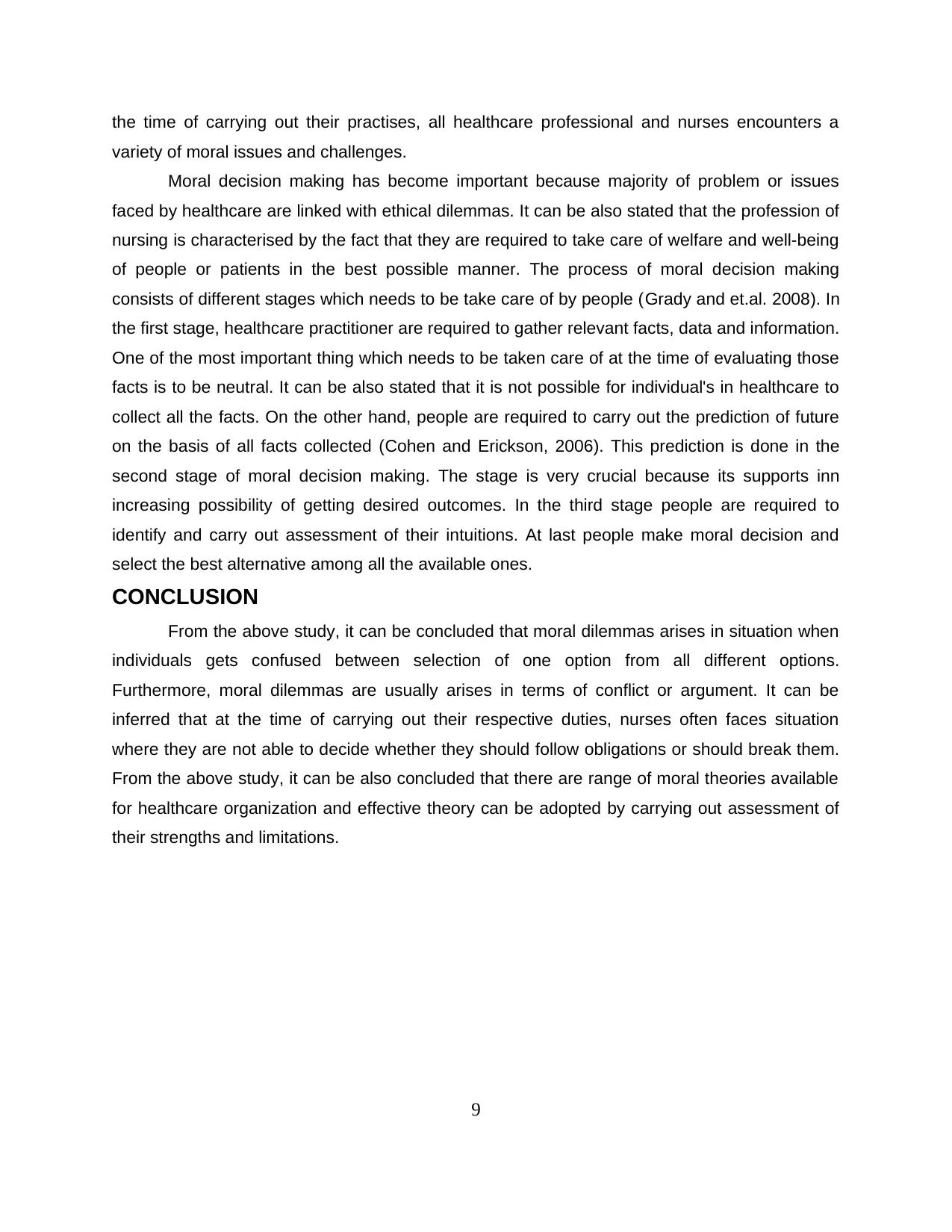
the time of carrying out their practises, all healthcare professional and nurses encounters a
variety of moral issues and challenges.
Moral decision making has become important because majority of problem or issues
faced by healthcare are linked with ethical dilemmas. It can be also stated that the profession of
nursing is characterised by the fact that they are required to take care of welfare and well-being
of people or patients in the best possible manner. The process of moral decision making
consists of different stages which needs to be take care of by people (Grady and et.al. 2008). In
the first stage, healthcare practitioner are required to gather relevant facts, data and information.
One of the most important thing which needs to be taken care of at the time of evaluating those
facts is to be neutral. It can be also stated that it is not possible for individual's in healthcare to
collect all the facts. On the other hand, people are required to carry out the prediction of future
on the basis of all facts collected (Cohen and Erickson, 2006). This prediction is done in the
second stage of moral decision making. The stage is very crucial because its supports inn
increasing possibility of getting desired outcomes. In the third stage people are required to
identify and carry out assessment of their intuitions. At last people make moral decision and
select the best alternative among all the available ones.
CONCLUSION
From the above study, it can be concluded that moral dilemmas arises in situation when
individuals gets confused between selection of one option from all different options.
Furthermore, moral dilemmas are usually arises in terms of conflict or argument. It can be
inferred that at the time of carrying out their respective duties, nurses often faces situation
where they are not able to decide whether they should follow obligations or should break them.
From the above study, it can be also concluded that there are range of moral theories available
for healthcare organization and effective theory can be adopted by carrying out assessment of
their strengths and limitations.
9
variety of moral issues and challenges.
Moral decision making has become important because majority of problem or issues
faced by healthcare are linked with ethical dilemmas. It can be also stated that the profession of
nursing is characterised by the fact that they are required to take care of welfare and well-being
of people or patients in the best possible manner. The process of moral decision making
consists of different stages which needs to be take care of by people (Grady and et.al. 2008). In
the first stage, healthcare practitioner are required to gather relevant facts, data and information.
One of the most important thing which needs to be taken care of at the time of evaluating those
facts is to be neutral. It can be also stated that it is not possible for individual's in healthcare to
collect all the facts. On the other hand, people are required to carry out the prediction of future
on the basis of all facts collected (Cohen and Erickson, 2006). This prediction is done in the
second stage of moral decision making. The stage is very crucial because its supports inn
increasing possibility of getting desired outcomes. In the third stage people are required to
identify and carry out assessment of their intuitions. At last people make moral decision and
select the best alternative among all the available ones.
CONCLUSION
From the above study, it can be concluded that moral dilemmas arises in situation when
individuals gets confused between selection of one option from all different options.
Furthermore, moral dilemmas are usually arises in terms of conflict or argument. It can be
inferred that at the time of carrying out their respective duties, nurses often faces situation
where they are not able to decide whether they should follow obligations or should break them.
From the above study, it can be also concluded that there are range of moral theories available
for healthcare organization and effective theory can be adopted by carrying out assessment of
their strengths and limitations.
9
⊘ This is a preview!⊘
Do you want full access?
Subscribe today to unlock all pages.
Trusted by 1+ million students worldwide
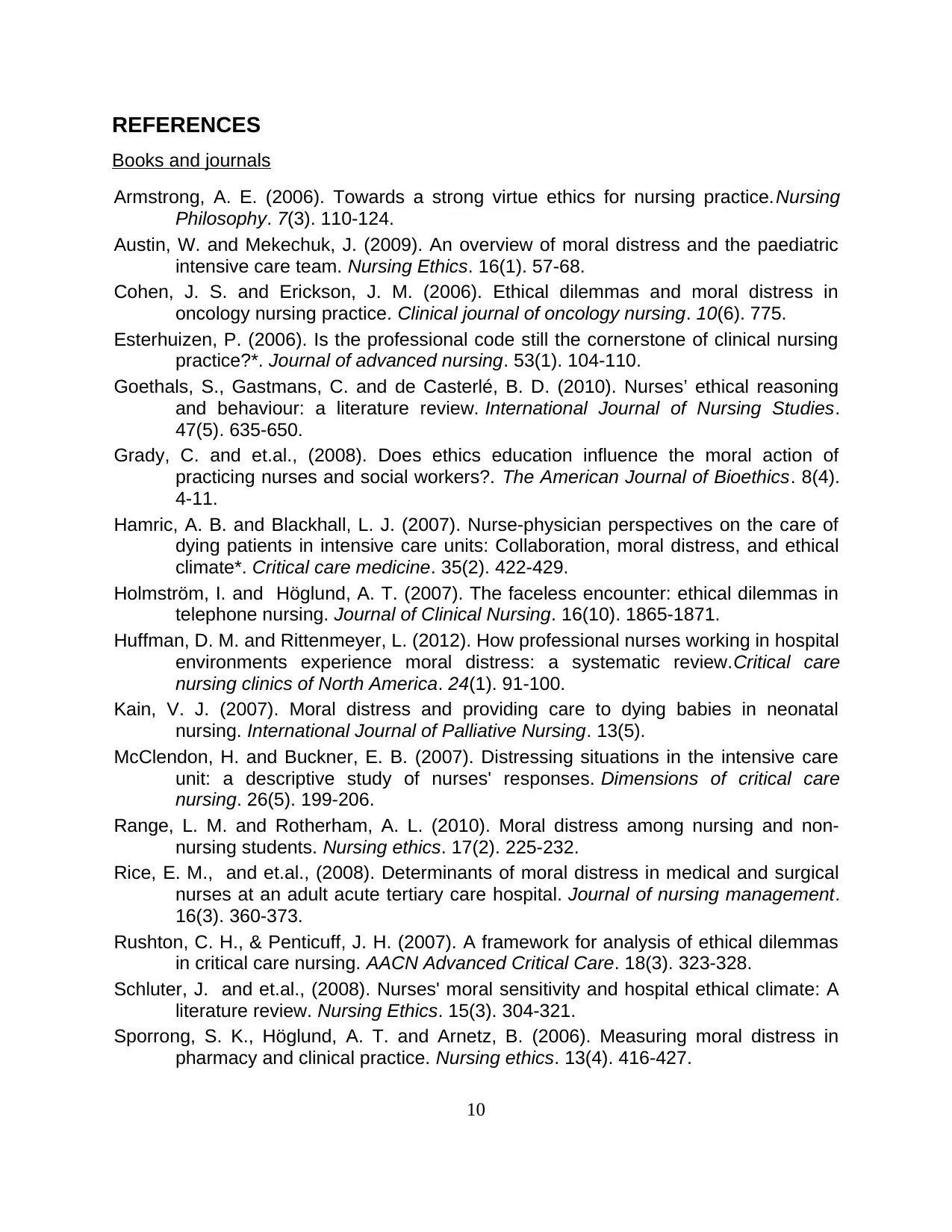
REFERENCES
Books and journals
Armstrong, A. E. (2006). Towards a strong virtue ethics for nursing practice.Nursing
Philosophy. 7(3). 110-124.
Austin, W. and Mekechuk, J. (2009). An overview of moral distress and the paediatric
intensive care team. Nursing Ethics. 16(1). 57-68.
Cohen, J. S. and Erickson, J. M. (2006). Ethical dilemmas and moral distress in
oncology nursing practice. Clinical journal of oncology nursing. 10(6). 775.
Esterhuizen, P. (2006). Is the professional code still the cornerstone of clinical nursing
practice?*. Journal of advanced nursing. 53(1). 104-110.
Goethals, S., Gastmans, C. and de Casterlé, B. D. (2010). Nurses’ ethical reasoning
and behaviour: a literature review. International Journal of Nursing Studies.
47(5). 635-650.
Grady, C. and et.al., (2008). Does ethics education influence the moral action of
practicing nurses and social workers?. The American Journal of Bioethics. 8(4).
4-11.
Hamric, A. B. and Blackhall, L. J. (2007). Nurse-physician perspectives on the care of
dying patients in intensive care units: Collaboration, moral distress, and ethical
climate*. Critical care medicine. 35(2). 422-429.
Holmström, I. and Höglund, A. T. (2007). The faceless encounter: ethical dilemmas in
telephone nursing. Journal of Clinical Nursing. 16(10). 1865-1871.
Huffman, D. M. and Rittenmeyer, L. (2012). How professional nurses working in hospital
environments experience moral distress: a systematic review.Critical care
nursing clinics of North America. 24(1). 91-100.
Kain, V. J. (2007). Moral distress and providing care to dying babies in neonatal
nursing. International Journal of Palliative Nursing. 13(5).
McClendon, H. and Buckner, E. B. (2007). Distressing situations in the intensive care
unit: a descriptive study of nurses' responses. Dimensions of critical care
nursing. 26(5). 199-206.
Range, L. M. and Rotherham, A. L. (2010). Moral distress among nursing and non-
nursing students. Nursing ethics. 17(2). 225-232.
Rice, E. M., and et.al., (2008). Determinants of moral distress in medical and surgical
nurses at an adult acute tertiary care hospital. Journal of nursing management.
16(3). 360-373.
Rushton, C. H., & Penticuff, J. H. (2007). A framework for analysis of ethical dilemmas
in critical care nursing. AACN Advanced Critical Care. 18(3). 323-328.
Schluter, J. and et.al., (2008). Nurses' moral sensitivity and hospital ethical climate: A
literature review. Nursing Ethics. 15(3). 304-321.
Sporrong, S. K., Höglund, A. T. and Arnetz, B. (2006). Measuring moral distress in
pharmacy and clinical practice. Nursing ethics. 13(4). 416-427.
10
Books and journals
Armstrong, A. E. (2006). Towards a strong virtue ethics for nursing practice.Nursing
Philosophy. 7(3). 110-124.
Austin, W. and Mekechuk, J. (2009). An overview of moral distress and the paediatric
intensive care team. Nursing Ethics. 16(1). 57-68.
Cohen, J. S. and Erickson, J. M. (2006). Ethical dilemmas and moral distress in
oncology nursing practice. Clinical journal of oncology nursing. 10(6). 775.
Esterhuizen, P. (2006). Is the professional code still the cornerstone of clinical nursing
practice?*. Journal of advanced nursing. 53(1). 104-110.
Goethals, S., Gastmans, C. and de Casterlé, B. D. (2010). Nurses’ ethical reasoning
and behaviour: a literature review. International Journal of Nursing Studies.
47(5). 635-650.
Grady, C. and et.al., (2008). Does ethics education influence the moral action of
practicing nurses and social workers?. The American Journal of Bioethics. 8(4).
4-11.
Hamric, A. B. and Blackhall, L. J. (2007). Nurse-physician perspectives on the care of
dying patients in intensive care units: Collaboration, moral distress, and ethical
climate*. Critical care medicine. 35(2). 422-429.
Holmström, I. and Höglund, A. T. (2007). The faceless encounter: ethical dilemmas in
telephone nursing. Journal of Clinical Nursing. 16(10). 1865-1871.
Huffman, D. M. and Rittenmeyer, L. (2012). How professional nurses working in hospital
environments experience moral distress: a systematic review.Critical care
nursing clinics of North America. 24(1). 91-100.
Kain, V. J. (2007). Moral distress and providing care to dying babies in neonatal
nursing. International Journal of Palliative Nursing. 13(5).
McClendon, H. and Buckner, E. B. (2007). Distressing situations in the intensive care
unit: a descriptive study of nurses' responses. Dimensions of critical care
nursing. 26(5). 199-206.
Range, L. M. and Rotherham, A. L. (2010). Moral distress among nursing and non-
nursing students. Nursing ethics. 17(2). 225-232.
Rice, E. M., and et.al., (2008). Determinants of moral distress in medical and surgical
nurses at an adult acute tertiary care hospital. Journal of nursing management.
16(3). 360-373.
Rushton, C. H., & Penticuff, J. H. (2007). A framework for analysis of ethical dilemmas
in critical care nursing. AACN Advanced Critical Care. 18(3). 323-328.
Schluter, J. and et.al., (2008). Nurses' moral sensitivity and hospital ethical climate: A
literature review. Nursing Ethics. 15(3). 304-321.
Sporrong, S. K., Höglund, A. T. and Arnetz, B. (2006). Measuring moral distress in
pharmacy and clinical practice. Nursing ethics. 13(4). 416-427.
10
Paraphrase This Document
Need a fresh take? Get an instant paraphrase of this document with our AI Paraphraser
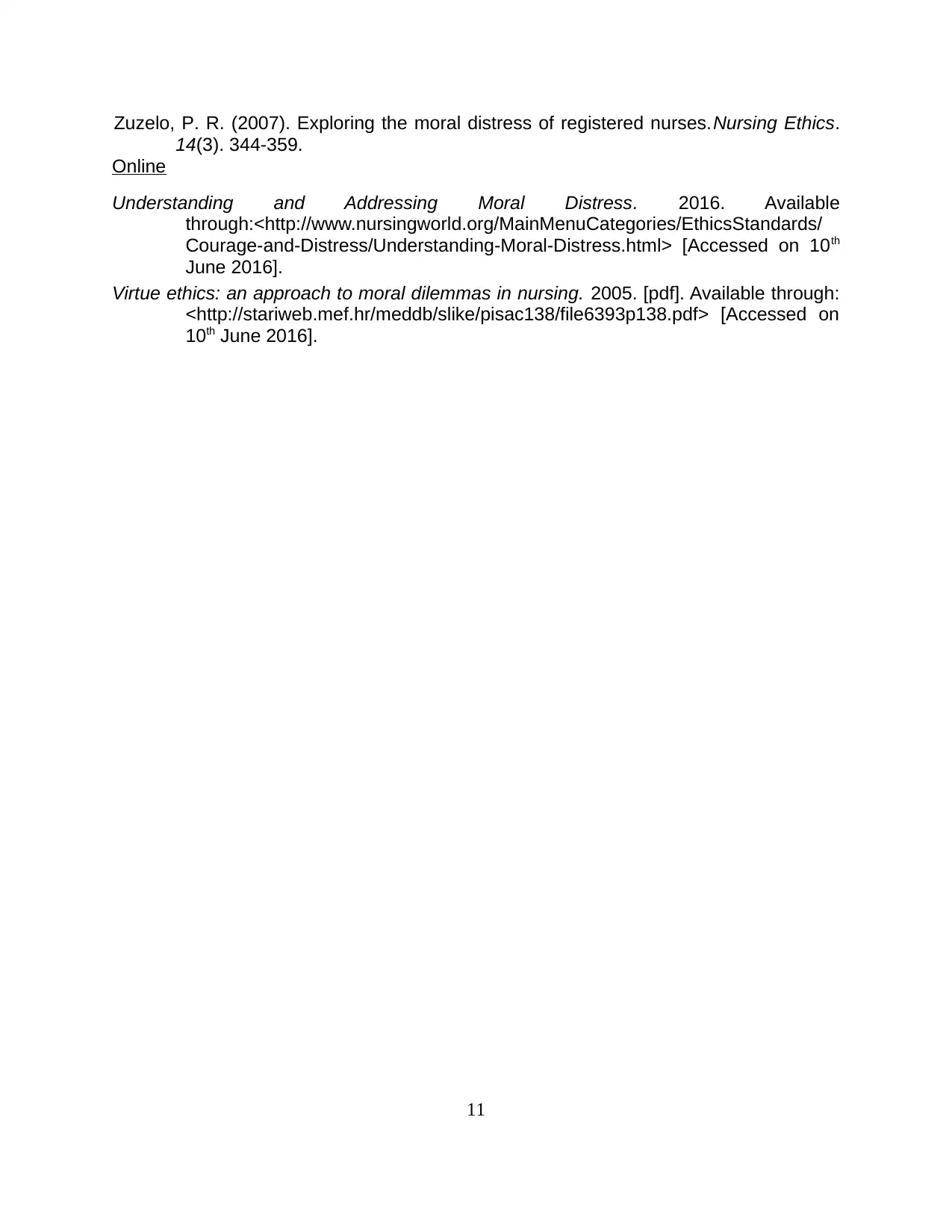
Zuzelo, P. R. (2007). Exploring the moral distress of registered nurses.Nursing Ethics.
14(3). 344-359.
Online
Understanding and Addressing Moral Distress. 2016. Available
through:<http://www.nursingworld.org/MainMenuCategories/EthicsStandards/
Courage-and-Distress/Understanding-Moral-Distress.html> [Accessed on 10th
June 2016].
Virtue ethics: an approach to moral dilemmas in nursing. 2005. [pdf]. Available through:
<http://stariweb.mef.hr/meddb/slike/pisac138/file6393p138.pdf> [Accessed on
10th June 2016].
11
14(3). 344-359.
Online
Understanding and Addressing Moral Distress. 2016. Available
through:<http://www.nursingworld.org/MainMenuCategories/EthicsStandards/
Courage-and-Distress/Understanding-Moral-Distress.html> [Accessed on 10th
June 2016].
Virtue ethics: an approach to moral dilemmas in nursing. 2005. [pdf]. Available through:
<http://stariweb.mef.hr/meddb/slike/pisac138/file6393p138.pdf> [Accessed on
10th June 2016].
11

1 out of 11


Related Documents


Your All-in-One AI-Powered Toolkit for Academic Success.
+13062052269
info@desklib.com
Available 24*7 on WhatsApp / Email
![[object Object]](/_next/static/media/star-bottom.7253800d.svg)
Unlock your academic potential
Copyright © 2020–2026 A2Z Services. All Rights Reserved. Developed and managed by ZUCOL.