Moral and Legal Obligations to Refugees: An Australian Perspective

Verified

Added on  2021/02/19

|7
|1894
|133
Essay
AI Summary
This essay examines the moral and legal obligations towards refugees, particularly within the context of Australia. It explores whether ethical responsibilities extend beyond national borders and analyzes the impact of international law, including the 1951 Refugee Convention and subsequent protocols. The essay discusses the legal obligations of Australia, such as non-refoulement, and the practical considerations of refugee resettlement, including the balance between moral values and national security. It references various sources to highlight the complexities of providing sanctuary, the challenges faced by refugees, and the ongoing debate about the extent of obligations to these vulnerable populations. The conclusion emphasizes that while moral obligations may begin at home, they are not confined by borders and that countries like Australia have a legal and moral responsibility to refugees.
Document Page
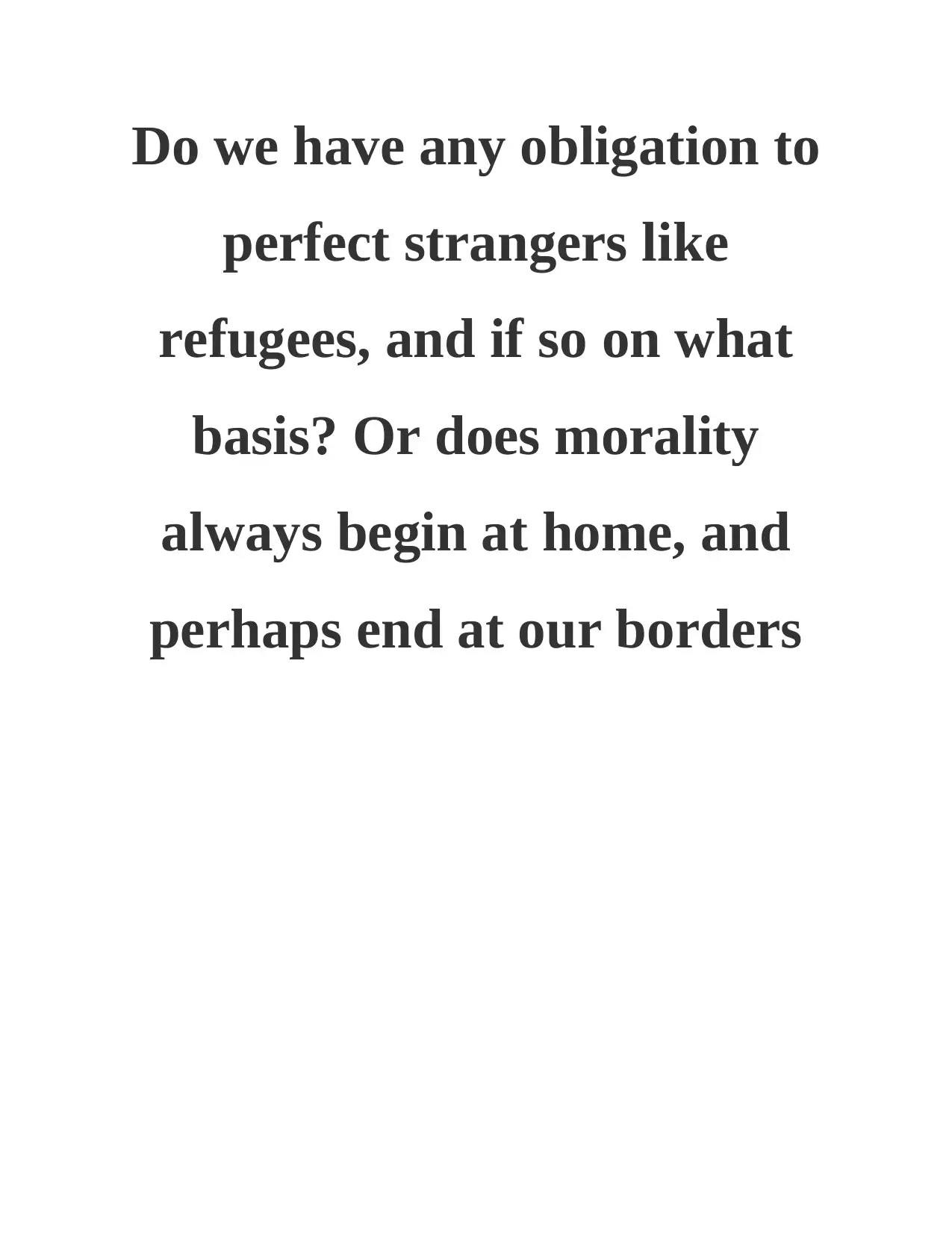
Do we have any obligation to
perfect strangers like
refugees, and if so on what
basis? Or does morality
always begin at home, and
perhaps end at our borders
tabler-icon-diamond-filled.svg

Paraphrase This Document

Need a fresh take? Get an instant paraphrase of this document with our AI Paraphraser
Document Page
Table of Contents
INTRODUCTION...........................................................................................................................1
MAIN BODY...................................................................................................................................1
CONCLUSION................................................................................................................................4
REFERENCES................................................................................................................................5
Document Page
INTRODUCTION
The present essay is based on the topic that is related with people's obligation or perfect
strangers like refugees. Refugees are the displaced people who has been forced to cross national
borders due to various reasons. They also stated as a perfect stranger that move to the new
country forcefully. The present philosophical essay aims to evaluate responsibilities of the local
community of any country towards the strange people like refugees and will also explain various
arguments from the various authors and will state that if person are responsible then what are
their responsibilities or obligations.
MAIN BODY
There are million of refugees in the world today, around 80% of those fleeing their
countries as refugees find protection in neighbouring one1. Refugees are the perfect stranger that
force to leave their country due to various reason such as disaster. For example; if an individual
or a group of refugees refers to the person who seeks safety from religious persecution by going
to a new country. what moral claims do these refugees have? Are the country is obligated to
provide them space and new home? At what basis? Or does the ethic and morality always begin
at home and perhaps end at the boundaries?
According to2 we as a community are responsible and have obligation towards the
refugees. There are many countries that are obligated to take in refugees and also developed
several laws that are made with the purpose to protect them and their rights. According to3
refugee law and international human right legislation are closely intertwined. Obligations refers
to course of action to which an individual is morally or legally bound. In this context, Australia
is legally bound to refugees as per the laws and legislations that somewhere affect the morality.
1 Crock, M., 2018, April. The Refugees Convention at 50: mid-life crisis or terminal
inadequacy? An Australian perspective. In The Refugees Convention 50 Years On:
Globalisation and International Law. (pp. 47-90). Routledge.
2 Fozdar, F. and Banki, S., 2017. Settling refugees in Australia: achievements and
challenges. International Journal of Migration and Border Studies. 3(1). pp.43-66.
3 Guide to Refugee Law in Australia. 2019. [Online]. Available
Through:<https://www.aat.gov.au/guide-to-refugee-law-in-australia>.
1
Document Page
The basic principle of refugee law refers to the obligation of States not to return or
refoulement. On the other hand at regional level, the right to seek freedom of movement can be
found in the article and law in which refugees are free to choose their residence and place within
the territory to move freely within the state. But in Australia, refugees are settled and move as
per the legal individuals analyse the resources and ensure that refugees are safe there and them
settled them. Another obligation is providing right to liberty and security of the person that stated
that liberty and security to person is essential in the context of how refugees are treated within
the intended country of refuge. The detention of refugees is a contentious issue due to the
condition found in the detention facilities of several countries.
It has been analysed by4 that the number of refugees and humanitarian entrants are
accepted by Australia. As of 2016-17, Australia accepted 17,555 refugees in total. There are
various countries from where refugees come from; around 4358 from Iraq, around 4261 from
Syria. Thus it has been stated that the country are obligated to refugees, 1174 from Afghanistan.
The country have proper norms as well as laws that are implied with the perfect strangers like
refugees that can create a gap between the moral values and ethics in regarding the humanity.
The obligations are based on various laws, legislation and policies under Australian Law.
As per the knowledge of5 International Law has been stated and it was mentioned that Australia
is a signatory to the United Nations 1951 Convention relating to the Status of Refugees that is
The refugees convention and to the subsequent 1967 protocol. This means that Australia is
legally obligated to develop policies and laws in the spirit of Refugees Convention, in both state
and federal jurisdictions. The protocol has to followed by the person who come from outside of
the country. The convention have a status of customary international law which means that
Australia cannot escape its commitment and obligations. The convention establish a definition of
a refugee as well as non-refoulement principle and the rights afforded to those granted refugee
status. Under this law, Refugee is defined under Article 1(A)(2) of the 1951 convention as an
individual who is outside of their country of habitual or nationality residence and who is
unwilling or unable to return because of a well-founded fear of persecutions that is based on their
race, nationality, membership, religion or political opinion in a specific social group.
4 Hayes, A., 2016. Introduction. Towards Sanctuary: Securing Refugees and Forced
Migrants in Multicultural Australia. In Cultures in Refuge. (pp. 18-29). Routledge.
5 Legrain, P., 2016. Refugees are not a burden but an opportunity.
2
tabler-icon-diamond-filled.svg

Paraphrase This Document

Need a fresh take? Get an instant paraphrase of this document with our AI Paraphraser
Document Page
On the other hand, according to other Australian government law, the principal Federal
Act is the Migration Act 1958 that is a law basis of all the migration forms and visa applications
in Australia involving refugees and humanitarian assistance. The Department of Immigration and
Border Protection administers the humanitarian program that contains two components; offshore
resettlement application, offshore protection application. It has been analysed that this is the best
way to enable the people human centred and to introduce specific programs regarding the moral
values.
6mentioned that the obligations are not only to protect the refugees, it also implemented
and strictly followed in order to follow the governmental rules to protect the country all above.
Along with it the obligations are also focusing on considering that who arrive in Australia,
regardless of how or where they arrive and whether they arrive with or without a visa. The
obligations in regarding is under different international treaties such as; the Convention against
torture and other cruel, International Covenant on civil and political rights, etc.
In contrast of respect and protection, Australia also has obligation not to return people
back to the country where people face risk of violation of the human rights. Treaties are not
automatically adopted into Australian Law- they must be incorporated into domestic legislations.
It might be appear strict but7 mentioned that it is necessary to have an understanding of the
background of refugees and their criminal record as well. Australia itself is extremely diverse,
and its native population have a wide spectrum of thoughts and opinions, values and habits. This
makes the country strong and vibrant. The morality create a gap between obligations. It has been
stated by8 there is no obligation under international law to grant refugees
Australian Government also introduced an enhanced screening process for the individuals
who came in the country unauthorised by boat to from Sri Lanka to Australia. All the refugees
are not accepted by the country they have their norms and rules. Australia has 4 off shore refugee
6 Miller, D., 2019. Our Responsibilities to Refugees.
7 Stats, K., 2015. Welcome to Australia? A reappraisal of the Fraser government's
approach to refugees, 1975–83. Australian Journal of International Affairs. 69(1). pp.69-
87.
8 Crock, M., 2018, April. The Refugees Convention at 50: mid-life crisis or terminal
inadequacy? An Australian perspective. In The Refugees Convention 50 Years On:
Globalisation and International Law. (pp. 47-90). Routledge.
3
Document Page
category visas; Women at risk, Refugee, Emergency rescue and In-Country Special
Humanitarian. The two key issue of this debate are the disagreement about the obligation base
and morality. As per the analysis, in my opinion Australia have several obligation to refugees
and I am disagree with the morality does not end at border, it is across the border or every people
but the limitation and strictness of accepting the obligation is also essential.
CONCLUSION
From the present essay it has been clear that people live in Australia is obligated on legal
basis to refugees as the country has been accepting many refugees every year. It also has been
summarised that the ethics and morality begin at home but not end at the border. The Australian
government has obligations to refugees under various international treaties to ensure that their
human rights are protected and respected. Along with it it also has been observed that, refugees
were already suffered from many situational crises and they need people who support morally
and home. There are various laws are developed and introduced by Australian government as
well as international laws for refugee protection are accepted by the country.
4
Document Page
REFERENCES
Books and Journals
Crock, M., 2018, April. The Refugees Convention at 50: mid-life crisis or terminal inadequacy?
An Australian perspective. In The Refugees Convention 50 Years On: Globalisation and
International Law. (pp. 47-90). Routledge.
Fozdar, F. and Banki, S., 2017. Settling refugees in Australia: achievements and
challenges. International Journal of Migration and Border Studies. 3(1). pp.43-66.
Hayes, A., 2016. Introduction. Towards Sanctuary: Securing Refugees and Forced Migrants in
Multicultural Australia. In Cultures in Refuge. (pp. 18-29). Routledge.
Legrain, P., 2016. Refugees are not a burden but an opportunity.
Miller, D., 2019. Our Responsibilities to Refugees.
Stats, K., 2015. Welcome to Australia? A reappraisal of the Fraser government's approach to
refugees, 1975–83. Australian Journal of International Affairs. 69(1). pp.69-87.
Online
Guide to Refugee Law in Australia. 2019. [Online]. Available
Through:<https://www.aat.gov.au/guide-to-refugee-law-in-australia>.
5
chevron_up_icon
1 out of 7
circle_padding
hide_on_mobile
zoom_out_icon
[object Object]