NAME 3160 Report: Experimental Analysis of Platform Motion

Verified

Added on  2021/05/31

|7
|1152
|129
Report
AI Summary
This report details an experimental analysis of the motion of a semisubmersible platform, focusing on its heave response in wave conditions. The study involves a model of the Jolliet tension-leg platform (TLP) moored to the sea floor, with experiments conducted to determine hydrostatic stiffness, natural period, and the response amplitude operator (RAO). The procedure includes calibrating instruments, setting test conditions, and recording the model's acceleration in regular waves. Data analysis involves calculating heave motion amplitude, phase lag, and comparing measured and computed values. The report also discusses potential sources of error and methods to improve accuracy. The results are then compared to the computed heave RAO from a NAME 3160 homework assignment. References to relevant research papers support the findings.
Document Page
Motion Of Semisubmersible Platform 1
MOTION OF A SEMISUBMERSIBLE PLATFORM
By Name
Course
Instructor
Institution
Location
Date
tabler-icon-diamond-filled.svg

Paraphrase This Document

Need a fresh take? Get an instant paraphrase of this document with our AI Paraphraser
Document Page
Motion Of Semisubmersible Platform 2
A Semisubmersible Platform refers to a specified naval vessel which is particularly used in a
variety of offshore activities including safety vessels, lifting of heavy cranes, drilling of offshore
rigs as well as the production of oil platforms. Usually, these marine vessels are made with
desirable sea keeping and stability characteristics. It can as well be described as semi-sub or
submersible. The main Objective of the test is to confirm some of the calculated characteristics
of the TLP heave response (Goncalves et al, 2012)
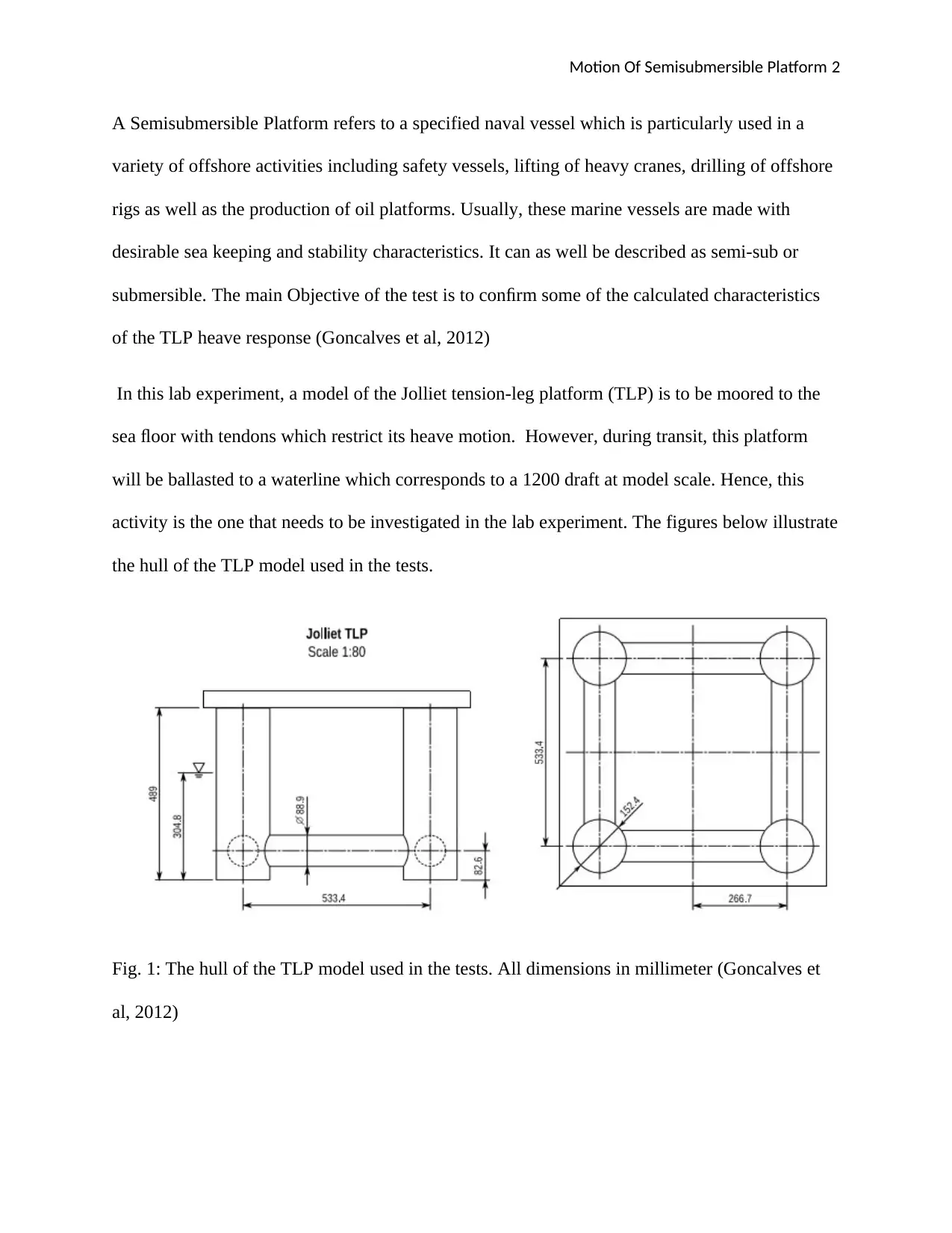
In this lab experiment, a model of the Jolliet tension-leg platform (TLP) is to be moored to the
sea floor with tendons which restrict its heave motion. However, during transit, this platform
will be ballasted to a waterline which corresponds to a 1200 draft at model scale. Hence, this
activity is the one that needs to be investigated in the lab experiment. The figures below illustrate
the hull of the TLP model used in the tests.
Fig. 1: The hull of the TLP model used in the tests. All dimensions in millimeter (Goncalves et
al, 2012)
Document Page
Motion Of Semisubmersible Platform 3
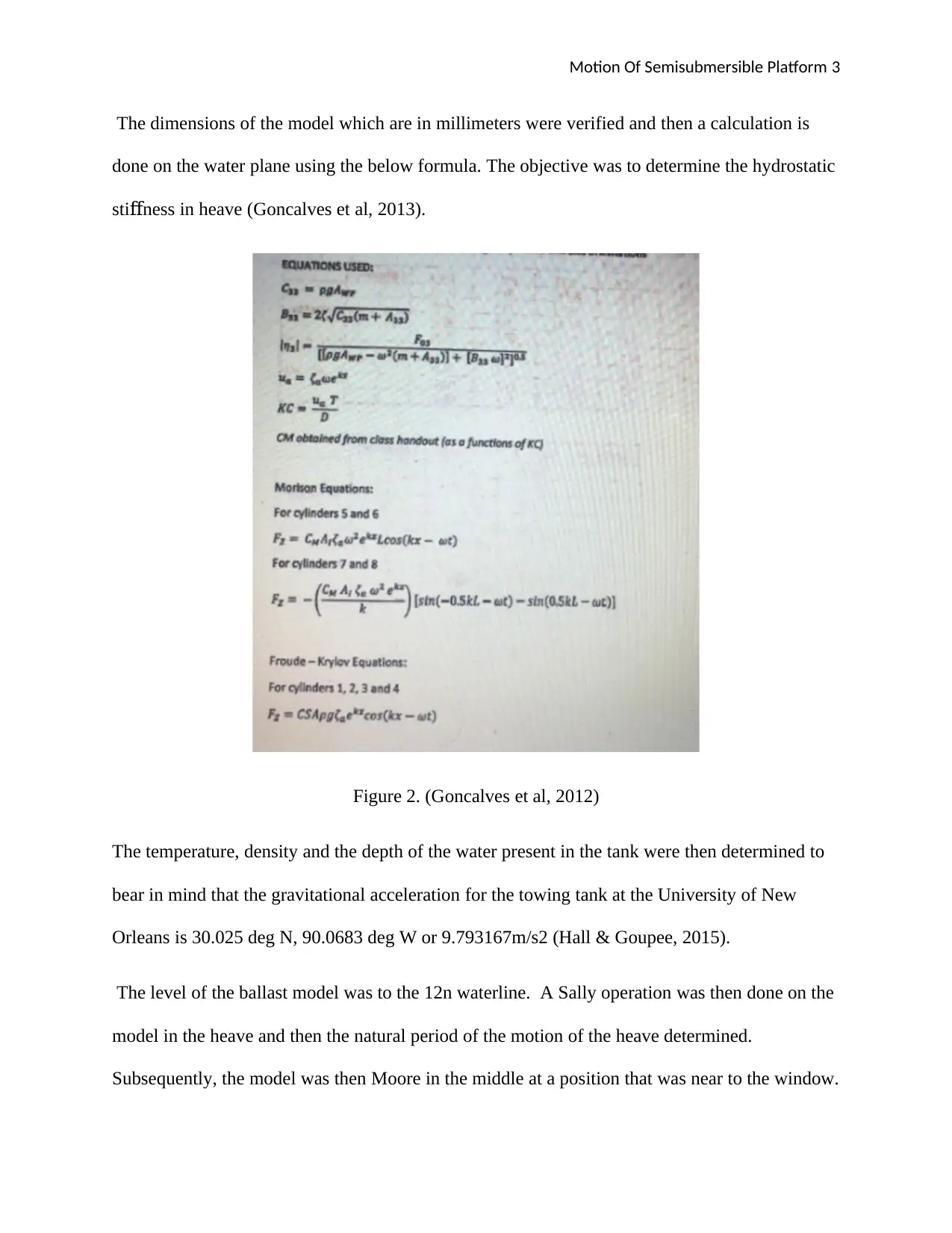
The dimensions of the model which are in millimeters were verified and then a calculation is
done on the water plane using the below formula. The objective was to determine the hydrostatic
sti ness in heave (Goncalves et al, 2013).ff
Figure 2. (Goncalves et al, 2012)
The temperature, density and the depth of the water present in the tank were then determined to
bear in mind that the gravitational acceleration for the towing tank at the University of New
Orleans is 30.025 deg N, 90.0683 deg W or 9.793167m/s2 (Hall & Goupee, 2015).
The level of the ballast model was to the 12n waterline. A Sally operation was then done on the
model in the heave and then the natural period of the motion of the heave determined.
Subsequently, the model was then Moore in the middle at a position that was near to the window.
Document Page
Motion Of Semisubmersible Platform 4
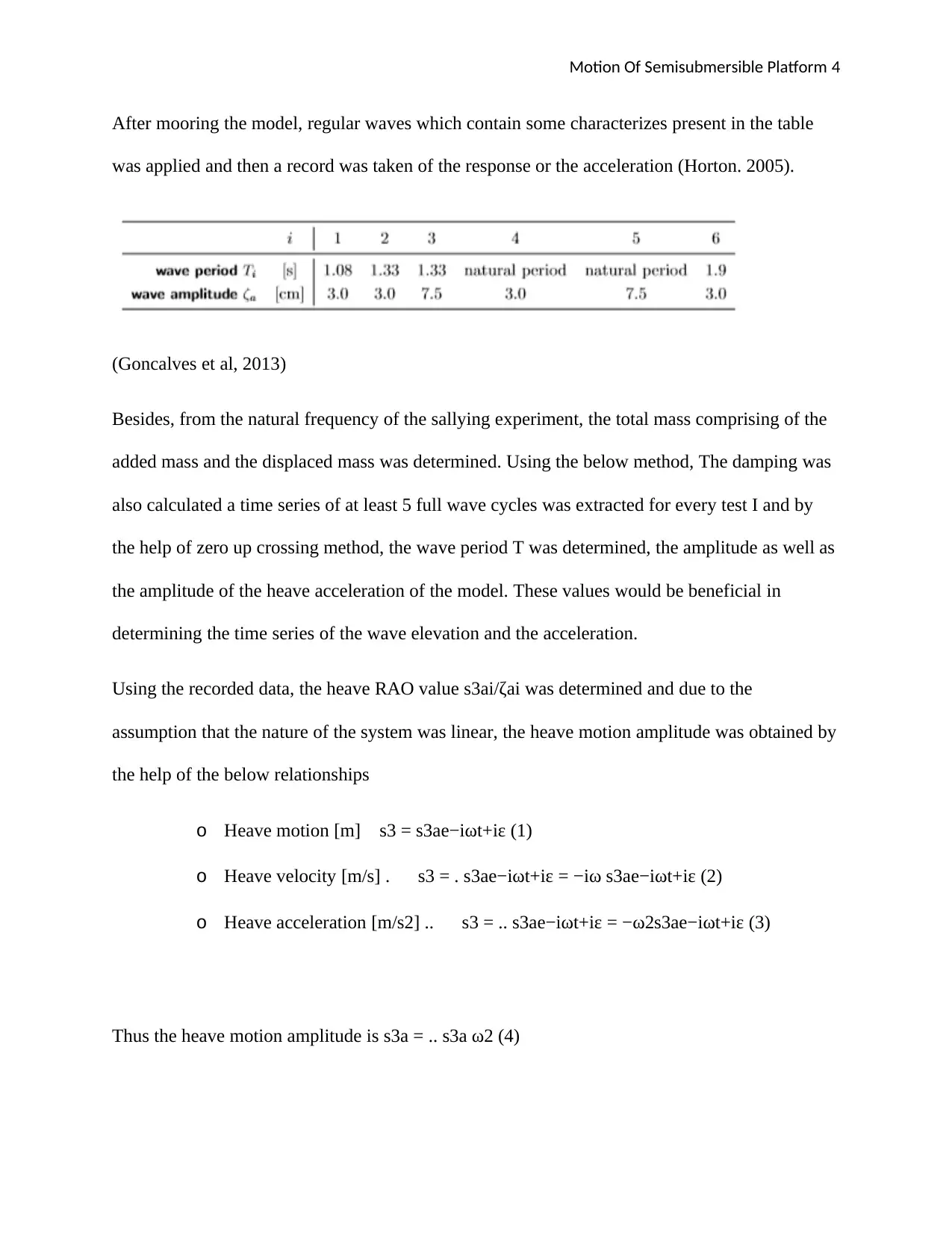
After mooring the model, regular waves which contain some characterizes present in the table
was applied and then a record was taken of the response or the acceleration (Horton. 2005).
(Goncalves et al, 2013)
Besides, from the natural frequency of the sallying experiment, the total mass comprising of the
added mass and the displaced mass was determined. Using the below method, The damping was
also calculated a time series of at least 5 full wave cycles was extracted for every test I and by
the help of zero up crossing method, the wave period T was determined, the amplitude as well as
the amplitude of the heave acceleration of the model. These values would be beneficial in
determining the time series of the wave elevation and the acceleration.
Using the recorded data, the heave RAO value s3ai/ζai was determined and due to the
assumption that the nature of the system was linear, the heave motion amplitude was obtained by
the help of the below relationships
o Heave motion [m] s3 = s3ae−iωt+iε (1)
o Heave velocity [m/s] . s3 = . s3ae−iωt+iε = −iω s3ae−iωt+iε (2)
o Heave acceleration [m/s2] .. s3 = .. s3ae−iωt+iε = −ω2s3ae−iωt+iε (3)
Thus the heave motion amplitude is s3a = .. s3a ω2 (4)
tabler-icon-diamond-filled.svg

Paraphrase This Document

Need a fresh take? Get an instant paraphrase of this document with our AI Paraphraser
Document Page
Motion Of Semisubmersible Platform 5
After performing the above experiment, we proceeded to compute the relative deviation between
the measured heave amplitude and the computed heave amplitude. Since the accelerating and the
heave motion lies in opposite phases, the phase lag, which is ε3 can be easily obtained by
utilizing the time lag between the minimum heave acceleration −.. s3a and maximum wave
elevation +ζa
i.e ε3 = 2π∆t/ T (Wybro et al, 2016)
Finally, the computed heave RAO from NAME 3160 homework was plotted and the results from
the experiments aggregated. Time permitting, a test was conducted with a transient wave packet
and a time series that encompasses the actual test from some seconds before the waves hit the
model and before significant wave reflections returned from the beach and the data stored in a
text file with three columns, time, wave elevation, and heave acceleration.
The Procedure portion of this lab report designates the experimental setup, calibration of
instruments and puts down the test conditions. The following part of the lab report, Data
Analysis: defines the procedure o the test and data acquisition which forms the key part of this
report task. Hence, this segment, all the data is expanded to full-scale dimensions then the values
tabulated and plotted. Finally, the conclusion section of the report discusses the results of Data
analysis as well as explaining the sources of inaccuracies and probable methods to avoid it
(Yamoto & Morooka, 2015).
Document Page
Motion Of Semisubmersible Platform 6
References
Gonçalves, R.T., Rosetti, G.F., Fujarra, A.L. and Oliveira, A.C., 2012. Experimental study on
vortex-induced motions of a semi-submersible platform with four square columns, Part I: Effects
of current incidence angle and hull appendages. Ocean engineering, 54, pp.150-
169.https://www.sciencedirect.com/science/article/pii/S2092678216300309
Gonçalves, R.T., Rosetti, G.F., Fujarra, A.L. and Oliveira, A.C., 2013. Experimental study on
vortex-induced motions of a semi-submersible platform with four square columns, Part II:
Effects of surface waves, external damping and draft condition. Ocean engineering, 62, pp.10-
24. https://www.slideshare.net/ratifero/omae20104910-experimental-study-on-vor
Hall, M. and Goupee, A., 2015. Validation of a lumped-mass mooring line model with
DeepCwind semisubmersible model test data. Ocean Engineering, 104, pp.590-603.
https://www.sciencedirect.com/journal/ocean-engineering/vol/104
Horton III, E.E., Deepwater Tech Inc, 2005. Semi-submersible multicolumn floating offshore
platform. U.S. Patent 6,935,810. https://www.nrel.gov/docs/fy14osti/60601.pdf
Ludwigson, R., GVA Consultants AB, 2011. Low heave motion semi-submersible vessel. U.S.
Patent Application 09/789,688.
https://www.sciencedirect.com/science/article/pii/S1877705817332769/pdf?
Wybro, P.G., Wu, C. and Zhang, D., CPSP Ltd, 2016. Central pontoon semisubmersible floating
platform. U.S. Patent 7,140,317. http://www.modec.com/fps/semi_sub/index.html
Document Page
Motion Of Semisubmersible Platform 7
Yamamoto, M. and Morooka, C.K., 2015. Dynamic positioning system of semi-submersible
platform using fuzzy control. Journal of the Brazilian Society of Mechanical Sciences and
Engineering, 27(4), pp.449-455. http://www.scielo.br/pdf/jbsmse/v27n4/26961.pdf
chevron_up_icon
1 out of 7
circle_padding
hide_on_mobile
zoom_out_icon
[object Object]