Motivation Management Report - University Name, Semester X

Verified

Added on  2021/10/06

|7
|1137
|74
Report
AI Summary
This report delves into the crucial aspects of motivation management within organizations. It begins by exploring reward preferences, including communication, leadership influence, increased responsibilities, recognition, incentives, teamwork, and compensation. The report then examines prominent motivational concepts and theories such as Maslow's Need Hierarchy Theory, Herzberg's Motivation-Hygiene Theory, and McClelland's Need Theory, providing a comprehensive understanding of the psychological underpinnings of employee motivation. Finally, the report evaluates the implementation of motivational practices within LukOil Company, highlighting the importance of recognition, training, development, non-partiality, collaborative frameworks, and continuous change management. This analysis provides valuable insights into fostering a motivated and productive workforce.
Document Page
Running head: MOTIVATION MANAGEMENT
Motivation Management
Name of the Student:
Name of the University:
Author Note
tabler-icon-diamond-filled.svg

Paraphrase This Document

Need a fresh take? Get an instant paraphrase of this document with our AI Paraphraser
Document Page
1
Table of Contents
Introduction.................................................................................................................................................2
Reward Preferences.....................................................................................................................................2
Motivational Concepts and Theories...........................................................................................................3
Organizational Evaluation...........................................................................................................................4
References...................................................................................................................................................5
Document Page
2
Introduction
The long -term sustainability of any firm is dependent upon the strategies and principles
implemented and practiced by the managers. The strategies should be such that they help in
reaching the objectives facing the firm in a shorter period of time along with the cooperation of
the employees. The cooperation on part of the employees is best obtained when they are
motivated to the highest level (Griffin 2013). Motivation is an integral component of company
and employee development and the methods of doing this are usually intrinsic. Some of the
processes are also traditional. There are three important methods of bringing about motivation in
the employees of any corporate organisation. These include autonomous needs (wherein the
employee is able to create a sense of self belief), mastery (to develop the best skills for a
particular process such that the level of problem solving is the highest) and finally purpose
driven approaches (wherein the employees are motivated to take up responsibilities outside of
their position or roles in the organisation).
Reward Preferences
Motivation is directly linked to the expectancy based on the effort and performance of the
employees most common methods by which managers are able to motivate me include the
following:
The first method used is that of increased and better means of communication. I
personally feel that this option of obtaining or providing motivation is often overlooked but is
very important at least in my case. Conversing directly with my supervisors and managers helps
Document Page
3
me identify my goals and align the same with their goals. This in turn helps in self-assessment
and building of greater amounts of self confidence.
The next most important of motivation that works in my case includes the following of
the leader in terms of the fact that I tend to follow the personality and decision making skills of
the leader. It is very important to now the benchmark as to what I should become and so my
leader’s behavior ad accountability handling methods helps me pave myself into the same.
I also think that regular increase in the number of responsibilities and duties helps me to
gain self confidence and increases the sense of accountability even more. I have felt empowered
when such instances have occurred.
The provisions of recognition and incentives greatly increases the extent of self
motivation and I think that this method of motivation building is the strongest and has the
greatest impact.
I also think that it is important to provide similar recognitions for team-work. I feel
connected to my team when our collaborated efforts pay off. Even feeling responsible for
another employee instills a sense of motivation personally for me.
It is equally motivating to take part in activities where the employees from different
departments and working at different positions are able to work together and get to know each
other better.
One of the most important motivational rewards personally for me is the increase in the
amount of compensation because of the increase in the amount of profits for the firm. It increases
both the amount of transparency as well as motivation.
tabler-icon-diamond-filled.svg

Paraphrase This Document

Need a fresh take? Get an instant paraphrase of this document with our AI Paraphraser
Document Page
4
The other forms of informal rewards that help in motivating employees according to me
includes initiatives like team lunches and organizing parties where peope can meet and gel with
each other in an informal way.
Motivational Concepts and Theories
The most traditional and well known theory used in the context of motivation in a
corporate firm includes the psychological concept of the employer employee relationship which
helps in framing the amount of effort put in by the employees to perform better (Griffin 2013).
One theory that has been given a lot of importance includes Maslow’s Need Hierarchy Theory
which states that there are various levels in terms of a hierarchy which are important for
motivation among the employees (Li, Chen & Hui, 2018). The levels in this hierarchy includes
self-assessment, esteem needs, social needs, safety needs and physiological needs and one need
after the other should be fulfilled by the firm in order for the employees to stay motivated.
Another well known theory of motivation includes Herzberg’s Motivation Hygiene Theory. This
theory asserts that the notions of growth, recognition, responsibility, love for the job role and
achievements are very important for promoting and retaining motivation amongst the employees
of the firm (Yeboah & Abdulai, 2016). Another theory that is equally renowned in the concept of
McClelland’s Need Theory which states that the amount of motivation working for a particular
employee includes the level of satisfaction and dissatisfaction that the employee feels based on
the achievements and increased level of performance (Güss, Burger & Dörner, 2017).
Organizational Evaluation
Document Page
5
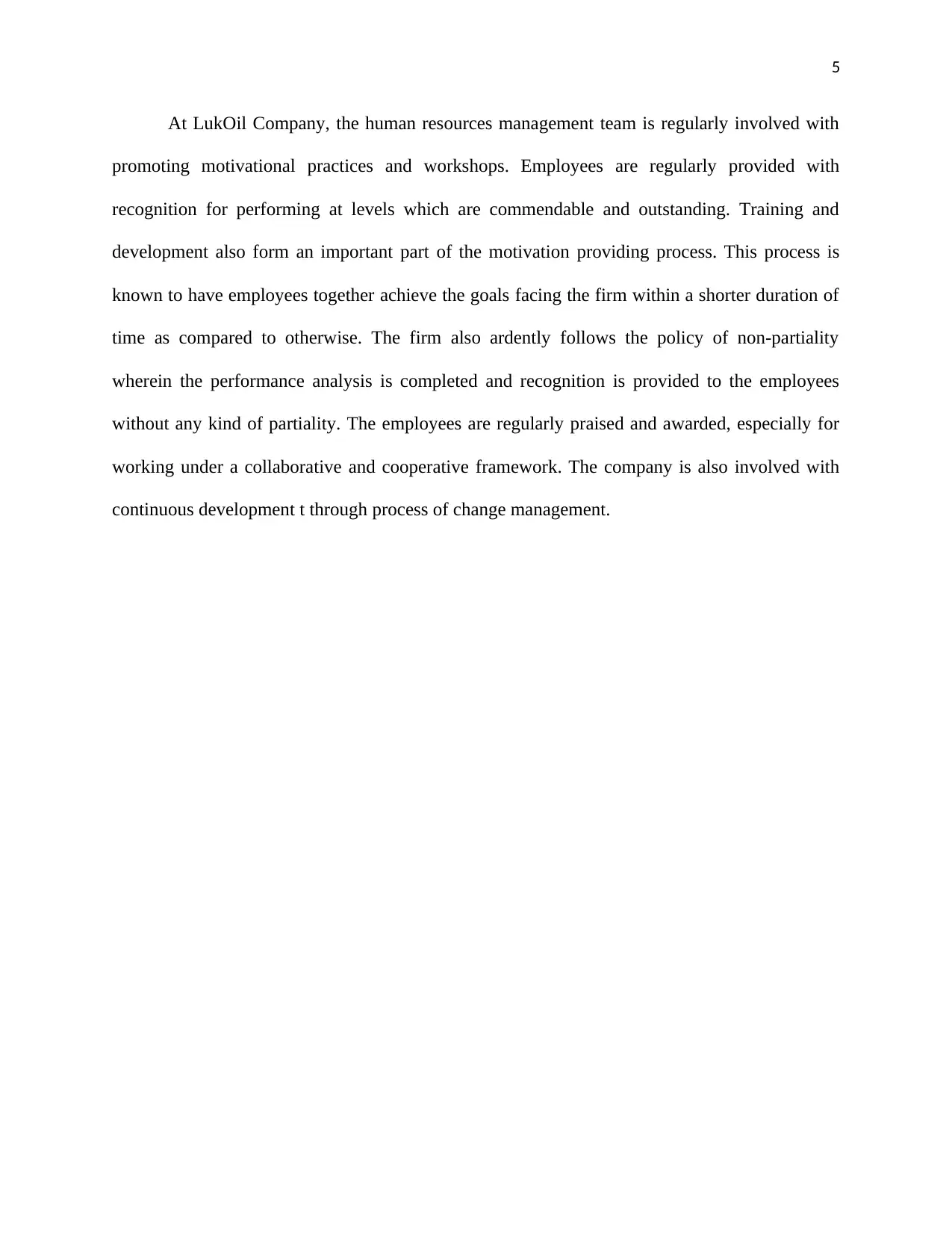
At LukOil Company, the human resources management team is regularly involved with
promoting motivational practices and workshops. Employees are regularly provided with
recognition for performing at levels which are commendable and outstanding. Training and
development also form an important part of the motivation providing process. This process is
known to have employees together achieve the goals facing the firm within a shorter duration of
time as compared to otherwise. The firm also ardently follows the policy of non-partiality
wherein the performance analysis is completed and recognition is provided to the employees
without any kind of partiality. The employees are regularly praised and awarded, especially for
working under a collaborative and cooperative framework. The company is also involved with
continuous development t through process of change management.
Document Page
6
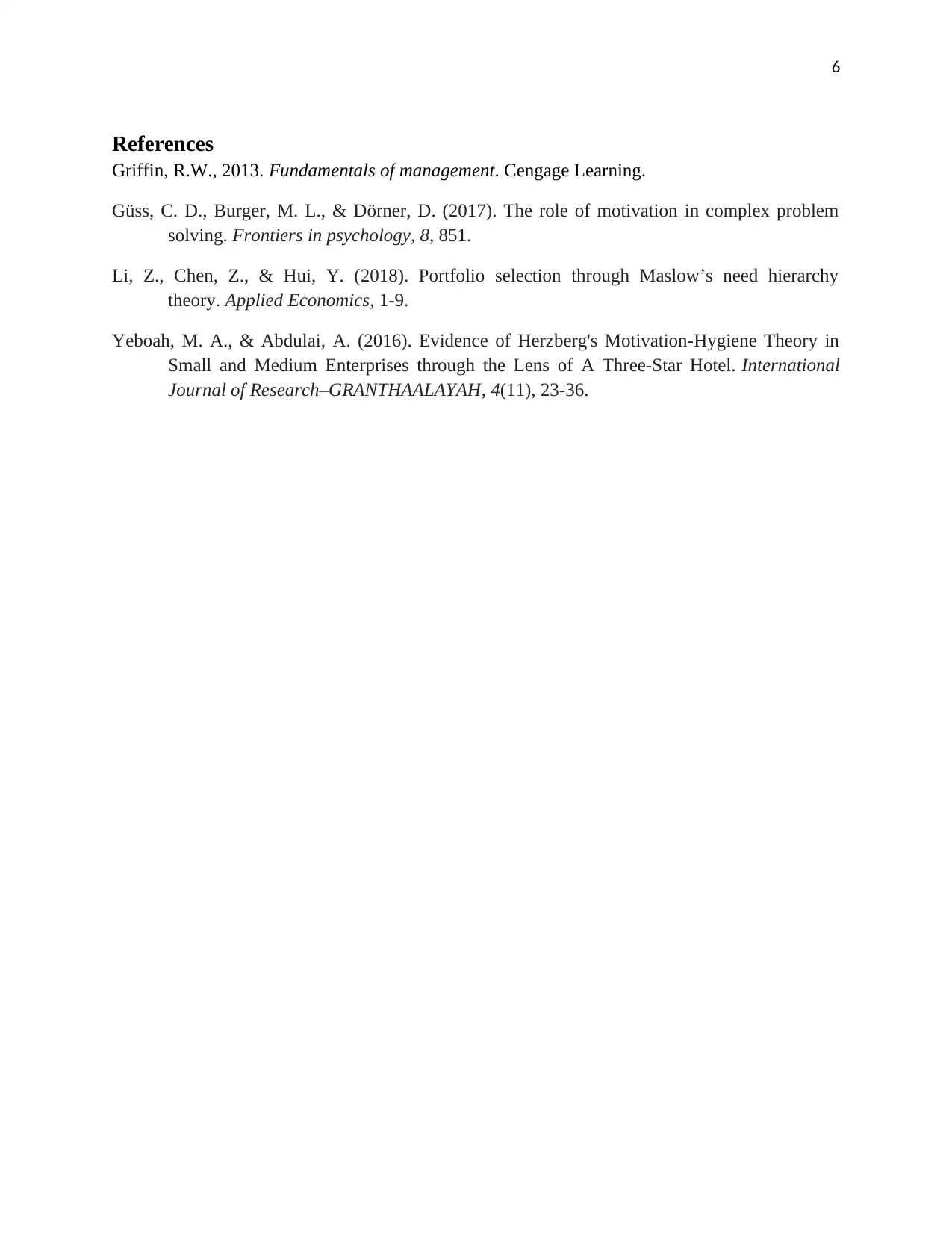
References
Griffin, R.W., 2013. Fundamentals of management. Cengage Learning.
Güss, C. D., Burger, M. L., & Dörner, D. (2017). The role of motivation in complex problem
solving. Frontiers in psychology, 8, 851.
Li, Z., Chen, Z., & Hui, Y. (2018). Portfolio selection through Maslow’s need hierarchy
theory. Applied Economics, 1-9.
Yeboah, M. A., & Abdulai, A. (2016). Evidence of Herzberg's Motivation-Hygiene Theory in
Small and Medium Enterprises through the Lens of A Three-Star Hotel. International
Journal of Research–GRANTHAALAYAH, 4(11), 23-36.
chevron_up_icon
1 out of 7
circle_padding
hide_on_mobile
zoom_out_icon
[object Object]