Multithreaded Pizza Cafe Simulation

Verified

Added on  2019/09/16

|2
|606
|131
Practical Assignment
AI Summary
This practical assignment requires students to simulate a pizza cafe using multithreading. The simulation involves a chef thread that makes pizzas and multiple customer threads that buy and eat pizzas. The program must manage resources such as the number of unsold pizzas and available seats, ensuring that the chef doesn't make too many pizzas and that customers don't exceed the seating capacity. The simulation should end when all customers have finished eating and no pizzas are left. Students are free to choose any programming language for implementation and must synchronize the threads to avoid race conditions and ensure correct simulation behavior.
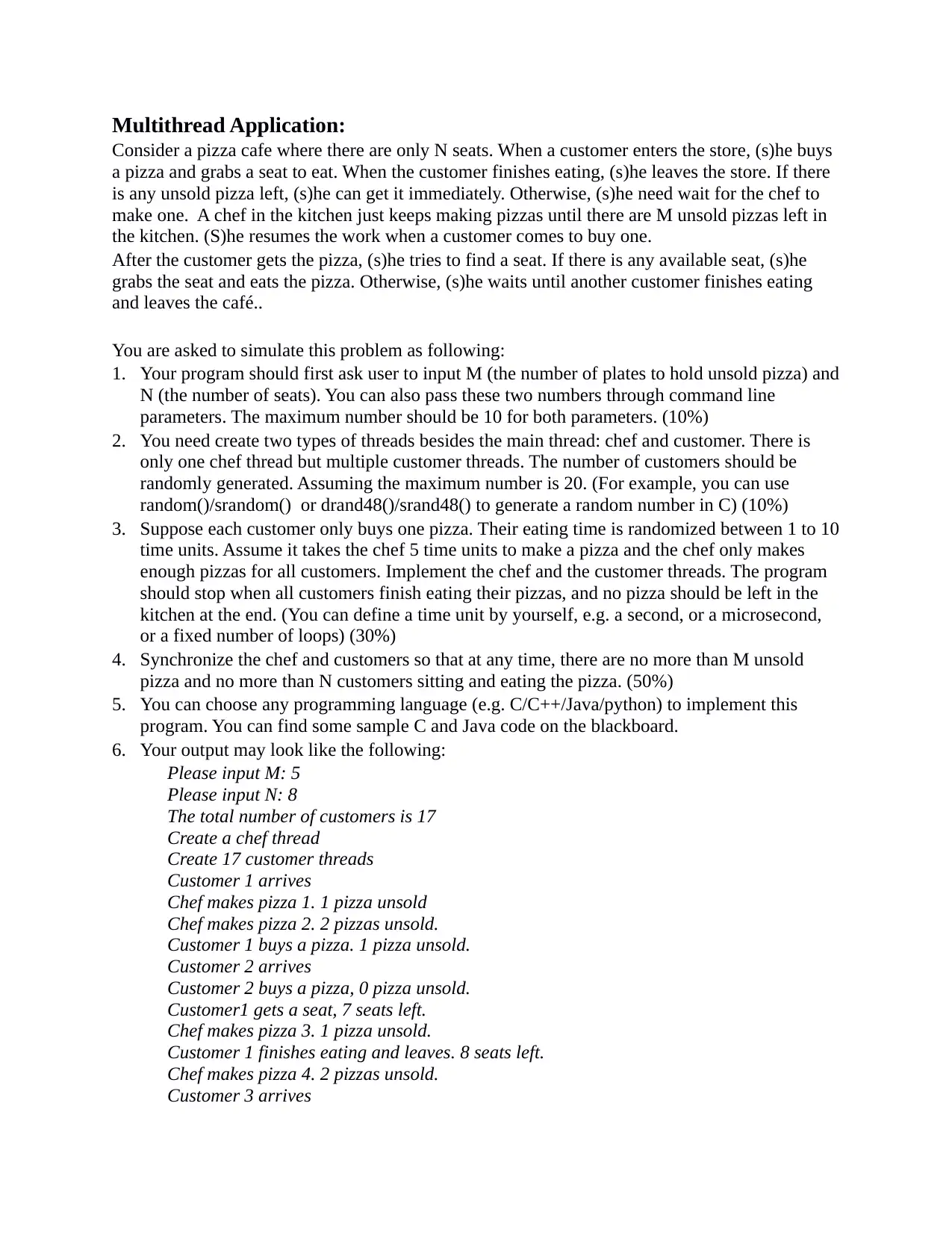
Document Page
Multithread Application:
Consider a pizza cafe where there are only N seats. When a customer enters the store, (s)he buys
a pizza and grabs a seat to eat. When the customer finishes eating, (s)he leaves the store. If there
is any unsold pizza left, (s)he can get it immediately. Otherwise, (s)he need wait for the chef to
make one. A chef in the kitchen just keeps making pizzas until there are M unsold pizzas left in
the kitchen. (S)he resumes the work when a customer comes to buy one.
After the customer gets the pizza, (s)he tries to find a seat. If there is any available seat, (s)he
grabs the seat and eats the pizza. Otherwise, (s)he waits until another customer finishes eating
and leaves the café..
You are asked to simulate this problem as following:
1. Your program should first ask user to input M (the number of plates to hold unsold pizza) and
N (the number of seats). You can also pass these two numbers through command line
parameters. The maximum number should be 10 for both parameters. (10%)
2. You need create two types of threads besides the main thread: chef and customer. There is
only one chef thread but multiple customer threads. The number of customers should be
randomly generated. Assuming the maximum number is 20. (For example, you can use
random()/srandom() or drand48()/srand48() to generate a random number in C) (10%)
3. Suppose each customer only buys one pizza. Their eating time is randomized between 1 to 10
time units. Assume it takes the chef 5 time units to make a pizza and the chef only makes
enough pizzas for all customers. Implement the chef and the customer threads. The program
should stop when all customers finish eating their pizzas, and no pizza should be left in the
kitchen at the end. (You can define a time unit by yourself, e.g. a second, or a microsecond,
or a fixed number of loops) (30%)
4. Synchronize the chef and customers so that at any time, there are no more than M unsold
pizza and no more than N customers sitting and eating the pizza. (50%)
5. You can choose any programming language (e.g. C/C++/Java/python) to implement this
program. You can find some sample C and Java code on the blackboard.
6. Your output may look like the following:
Please input M: 5
Please input N: 8
The total number of customers is 17
Create a chef thread
Create 17 customer threads
Customer 1 arrives
Chef makes pizza 1. 1 pizza unsold
Chef makes pizza 2. 2 pizzas unsold.
Customer 1 buys a pizza. 1 pizza unsold.
Customer 2 arrives
Customer 2 buys a pizza, 0 pizza unsold.
Customer1 gets a seat, 7 seats left.
Chef makes pizza 3. 1 pizza unsold.
Customer 1 finishes eating and leaves. 8 seats left.
Chef makes pizza 4. 2 pizzas unsold.
Customer 3 arrives
tabler-icon-diamond-filled.svg

Paraphrase This Document

Need a fresh take? Get an instant paraphrase of this document with our AI Paraphraser
Document Page
Customer 3 buys a pizza, 1 pizza unsold.
....
chevron_up_icon
1 out of 2
circle_padding
hide_on_mobile
zoom_out_icon
[object Object]