Creative Arts in Early Childhood: Supporting Children's Musicking
VerifiedAdded on 2023/06/07
|6
|937
|482
Journal and Reflective Writing
AI Summary
This journal entry reflects on the author's musical identity, highlighting the role of music in expressing emotions, cultural understanding, and stress relief. It explores the impact of early musical experiences, such as lullabies and musicals, on shaping personal identity. Furthermore, it discusses learnings from workshops and lectures on supporting children's 'musicking' in early childhood education. The journal emphasizes the importance of music in enhancing spatial awareness, concentration, language literacy, and mathematical skills. It also underscores the role of diverse musical beats in supporting cultural identities and creating inclusive learning environments. The author concludes that musical education is essential for children's mental development and engaging teaching practices. Desklib provides access to similar solved assignments and past papers for students.
Creative Arts in Early
Childhood
1
Childhood
1
Paraphrase This Document
Need a fresh take? Get an instant paraphrase of this document with our AI Paraphraser

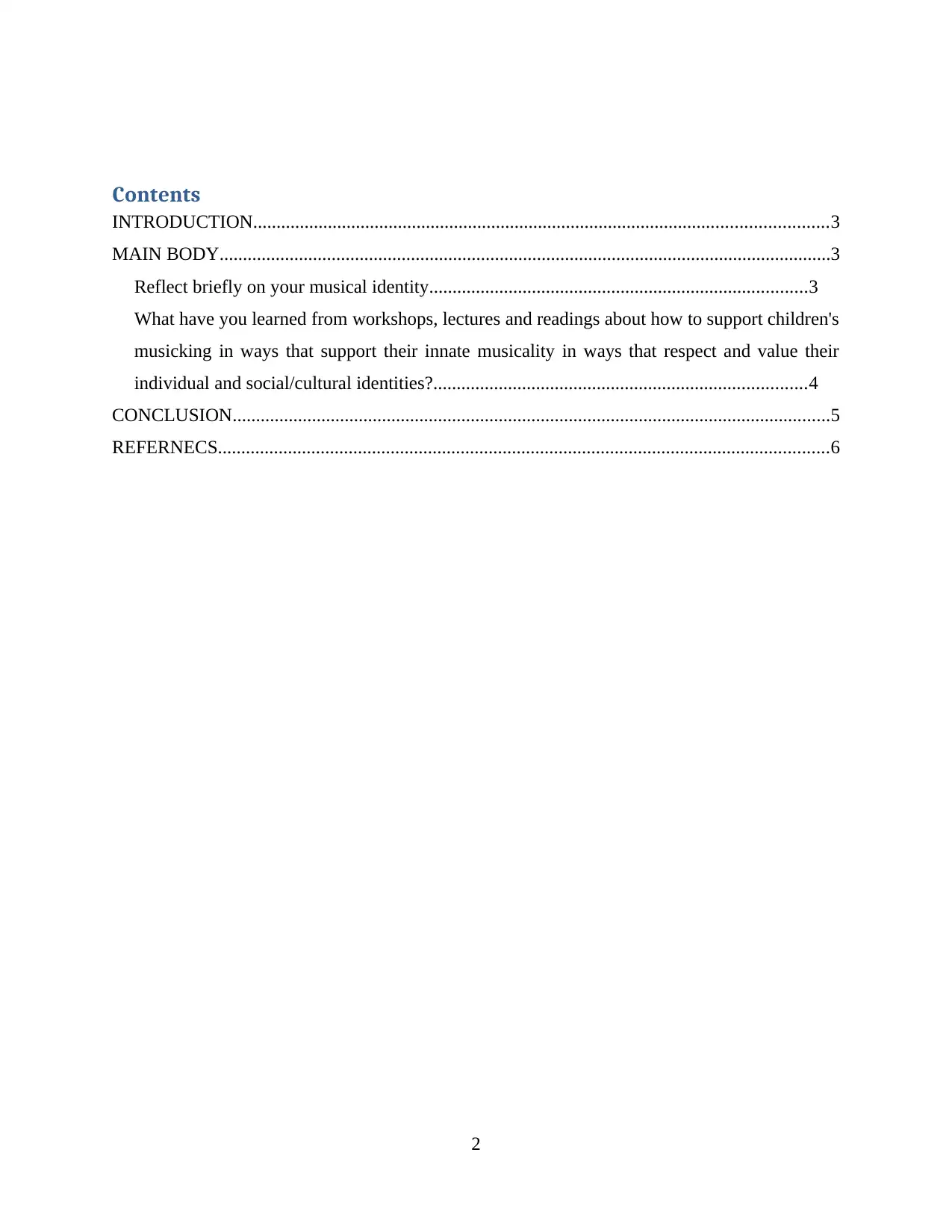
Contents
INTRODUCTION...........................................................................................................................3
MAIN BODY...................................................................................................................................3
Reflect briefly on your musical identity.................................................................................3
What have you learned from workshops, lectures and readings about how to support children's
musicking in ways that support their innate musicality in ways that respect and value their
individual and social/cultural identities?................................................................................4
CONCLUSION................................................................................................................................5
REFERNECS...................................................................................................................................6
2
INTRODUCTION...........................................................................................................................3
MAIN BODY...................................................................................................................................3
Reflect briefly on your musical identity.................................................................................3
What have you learned from workshops, lectures and readings about how to support children's
musicking in ways that support their innate musicality in ways that respect and value their
individual and social/cultural identities?................................................................................4
CONCLUSION................................................................................................................................5
REFERNECS...................................................................................................................................6
2

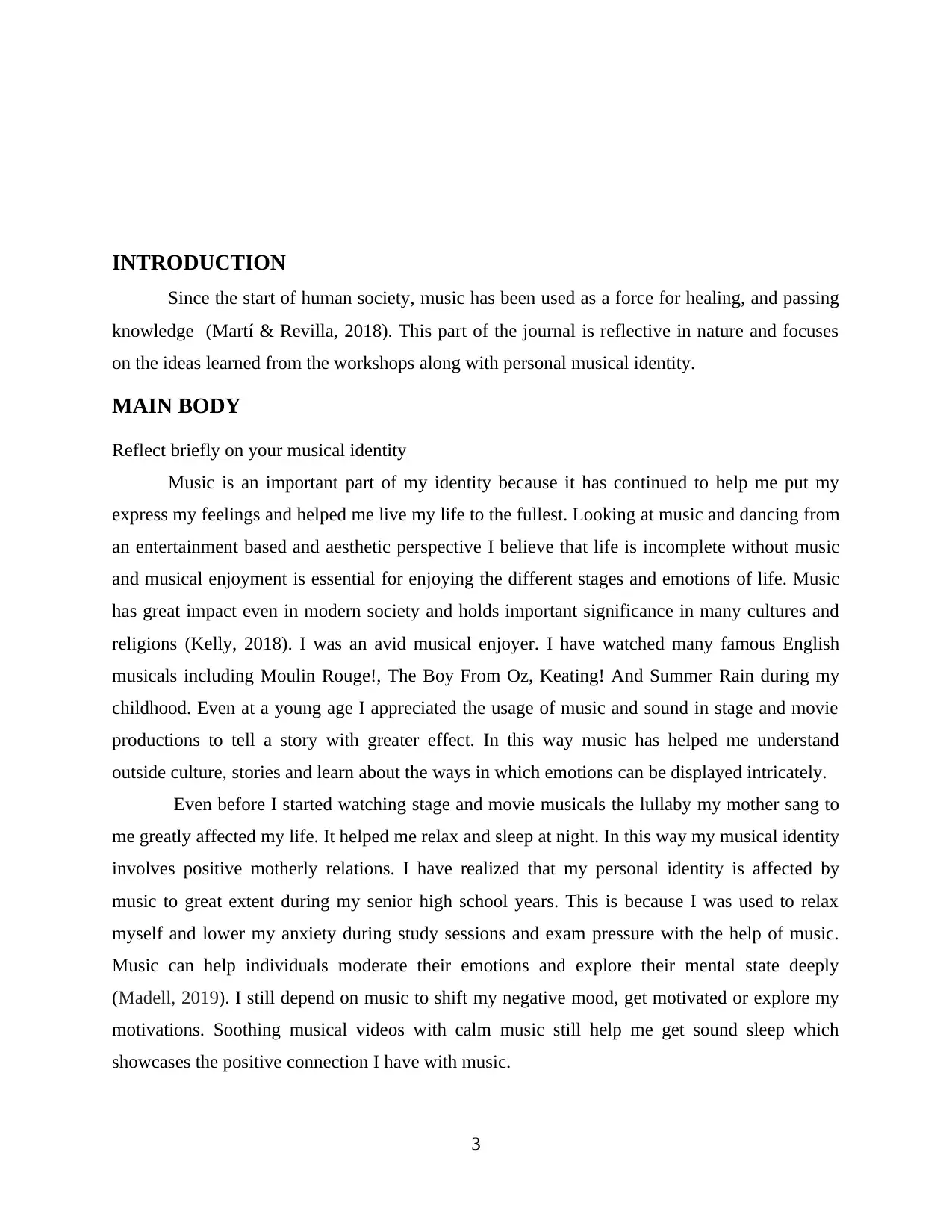
INTRODUCTION
Since the start of human society, music has been used as a force for healing, and passing
knowledge (Martí & Revilla, 2018). This part of the journal is reflective in nature and focuses
on the ideas learned from the workshops along with personal musical identity.
MAIN BODY
Reflect briefly on your musical identity
Music is an important part of my identity because it has continued to help me put my
express my feelings and helped me live my life to the fullest. Looking at music and dancing from
an entertainment based and aesthetic perspective I believe that life is incomplete without music
and musical enjoyment is essential for enjoying the different stages and emotions of life. Music
has great impact even in modern society and holds important significance in many cultures and
religions (Kelly, 2018). I was an avid musical enjoyer. I have watched many famous English
musicals including Moulin Rouge!, The Boy From Oz, Keating! And Summer Rain during my
childhood. Even at a young age I appreciated the usage of music and sound in stage and movie
productions to tell a story with greater effect. In this way music has helped me understand
outside culture, stories and learn about the ways in which emotions can be displayed intricately.
Even before I started watching stage and movie musicals the lullaby my mother sang to
me greatly affected my life. It helped me relax and sleep at night. In this way my musical identity
involves positive motherly relations. I have realized that my personal identity is affected by
music to great extent during my senior high school years. This is because I was used to relax
myself and lower my anxiety during study sessions and exam pressure with the help of music.
Music can help individuals moderate their emotions and explore their mental state deeply
(Madell, 2019). I still depend on music to shift my negative mood, get motivated or explore my
motivations. Soothing musical videos with calm music still help me get sound sleep which
showcases the positive connection I have with music.
3
Since the start of human society, music has been used as a force for healing, and passing
knowledge (Martí & Revilla, 2018). This part of the journal is reflective in nature and focuses
on the ideas learned from the workshops along with personal musical identity.
MAIN BODY
Reflect briefly on your musical identity
Music is an important part of my identity because it has continued to help me put my
express my feelings and helped me live my life to the fullest. Looking at music and dancing from
an entertainment based and aesthetic perspective I believe that life is incomplete without music
and musical enjoyment is essential for enjoying the different stages and emotions of life. Music
has great impact even in modern society and holds important significance in many cultures and
religions (Kelly, 2018). I was an avid musical enjoyer. I have watched many famous English
musicals including Moulin Rouge!, The Boy From Oz, Keating! And Summer Rain during my
childhood. Even at a young age I appreciated the usage of music and sound in stage and movie
productions to tell a story with greater effect. In this way music has helped me understand
outside culture, stories and learn about the ways in which emotions can be displayed intricately.
Even before I started watching stage and movie musicals the lullaby my mother sang to
me greatly affected my life. It helped me relax and sleep at night. In this way my musical identity
involves positive motherly relations. I have realized that my personal identity is affected by
music to great extent during my senior high school years. This is because I was used to relax
myself and lower my anxiety during study sessions and exam pressure with the help of music.
Music can help individuals moderate their emotions and explore their mental state deeply
(Madell, 2019). I still depend on music to shift my negative mood, get motivated or explore my
motivations. Soothing musical videos with calm music still help me get sound sleep which
showcases the positive connection I have with music.
3
⊘ This is a preview!⊘
Do you want full access?
Subscribe today to unlock all pages.

Trusted by 1+ million students worldwide

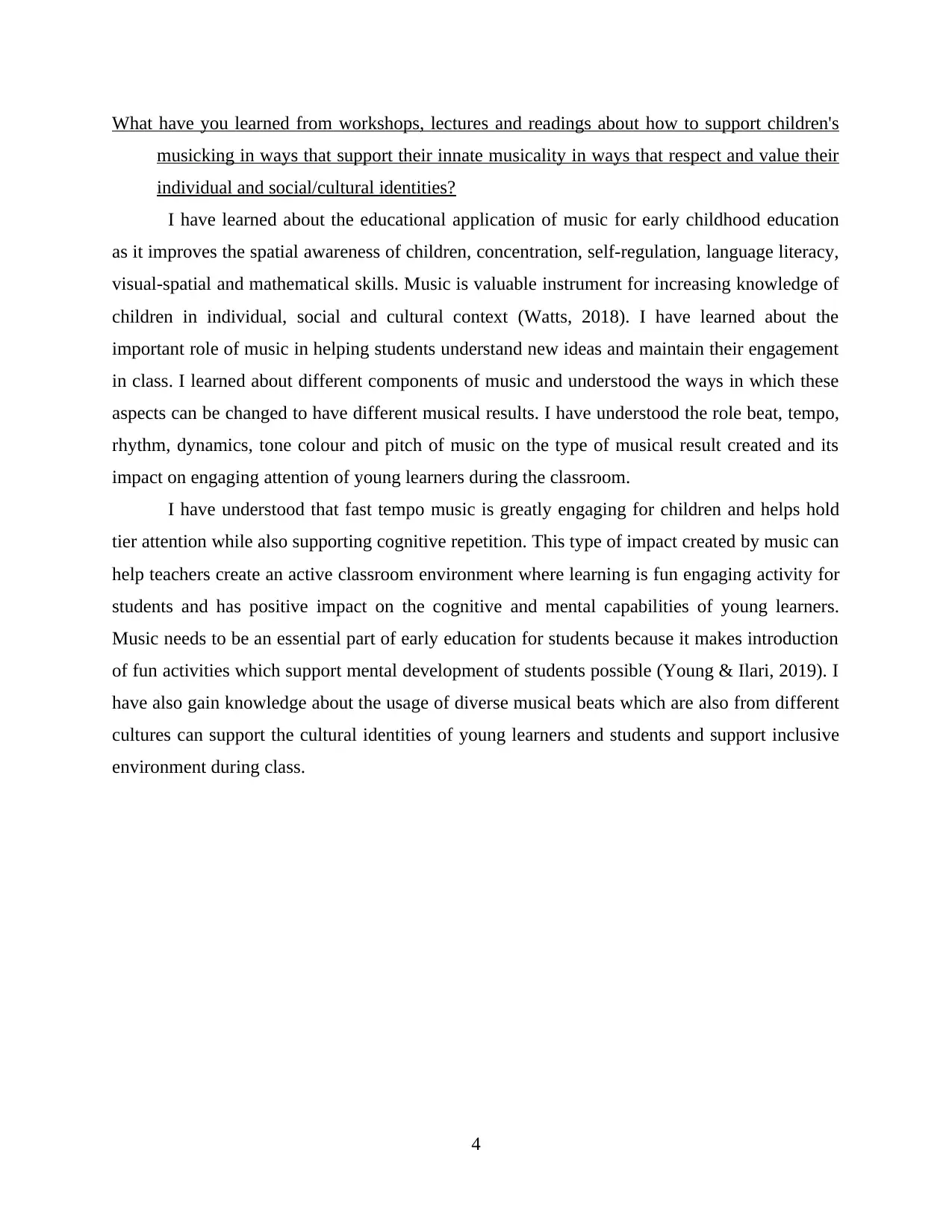
What have you learned from workshops, lectures and readings about how to support children's
musicking in ways that support their innate musicality in ways that respect and value their
individual and social/cultural identities?
I have learned about the educational application of music for early childhood education
as it improves the spatial awareness of children, concentration, self-regulation, language literacy,
visual-spatial and mathematical skills. Music is valuable instrument for increasing knowledge of
children in individual, social and cultural context (Watts, 2018). I have learned about the
important role of music in helping students understand new ideas and maintain their engagement
in class. I learned about different components of music and understood the ways in which these
aspects can be changed to have different musical results. I have understood the role beat, tempo,
rhythm, dynamics, tone colour and pitch of music on the type of musical result created and its
impact on engaging attention of young learners during the classroom.
I have understood that fast tempo music is greatly engaging for children and helps hold
tier attention while also supporting cognitive repetition. This type of impact created by music can
help teachers create an active classroom environment where learning is fun engaging activity for
students and has positive impact on the cognitive and mental capabilities of young learners.
Music needs to be an essential part of early education for students because it makes introduction
of fun activities which support mental development of students possible (Young & Ilari, 2019). I
have also gain knowledge about the usage of diverse musical beats which are also from different
cultures can support the cultural identities of young learners and students and support inclusive
environment during class.
4
musicking in ways that support their innate musicality in ways that respect and value their
individual and social/cultural identities?
I have learned about the educational application of music for early childhood education
as it improves the spatial awareness of children, concentration, self-regulation, language literacy,
visual-spatial and mathematical skills. Music is valuable instrument for increasing knowledge of
children in individual, social and cultural context (Watts, 2018). I have learned about the
important role of music in helping students understand new ideas and maintain their engagement
in class. I learned about different components of music and understood the ways in which these
aspects can be changed to have different musical results. I have understood the role beat, tempo,
rhythm, dynamics, tone colour and pitch of music on the type of musical result created and its
impact on engaging attention of young learners during the classroom.
I have understood that fast tempo music is greatly engaging for children and helps hold
tier attention while also supporting cognitive repetition. This type of impact created by music can
help teachers create an active classroom environment where learning is fun engaging activity for
students and has positive impact on the cognitive and mental capabilities of young learners.
Music needs to be an essential part of early education for students because it makes introduction
of fun activities which support mental development of students possible (Young & Ilari, 2019). I
have also gain knowledge about the usage of diverse musical beats which are also from different
cultures can support the cultural identities of young learners and students and support inclusive
environment during class.
4
Paraphrase This Document
Need a fresh take? Get an instant paraphrase of this document with our AI Paraphraser

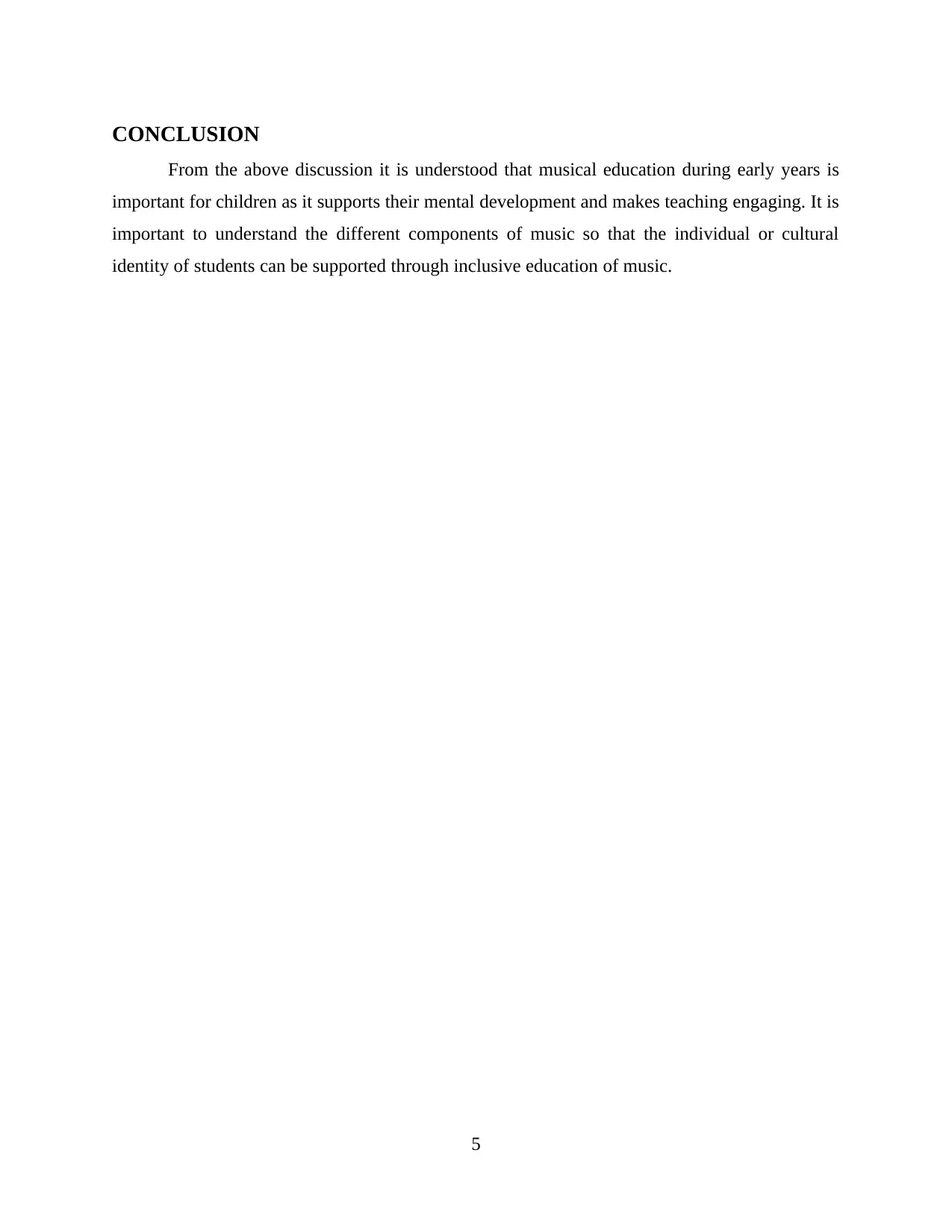
CONCLUSION
From the above discussion it is understood that musical education during early years is
important for children as it supports their mental development and makes teaching engaging. It is
important to understand the different components of music so that the individual or cultural
identity of students can be supported through inclusive education of music.
5
From the above discussion it is understood that musical education during early years is
important for children as it supports their mental development and makes teaching engaging. It is
important to understand the different components of music so that the individual or cultural
identity of students can be supported through inclusive education of music.
5

REFERNECS
Books and Journals
Kelly, S. N. (2018). Teaching music in American society: A social and cultural understanding of
teaching music. Routledge.
Madell, G. (2019). Philosophy, music and emotion. Edinburgh University Press.
Martí, J., & Revilla, S. (Eds.). (2018). Making Music, Making Society. Cambridge Scholars
Publishing.
Watts, S. H. (2018). World music pedagogy: Early childhood education. Routledge.
Young, S., & Ilari, B. (Eds.). (2019). Music in early childhood: Multi-disciplinary perspectives
and inter-disciplinary exchanges (Vol. 27). Springer.
6
Books and Journals
Kelly, S. N. (2018). Teaching music in American society: A social and cultural understanding of
teaching music. Routledge.
Madell, G. (2019). Philosophy, music and emotion. Edinburgh University Press.
Martí, J., & Revilla, S. (Eds.). (2018). Making Music, Making Society. Cambridge Scholars
Publishing.
Watts, S. H. (2018). World music pedagogy: Early childhood education. Routledge.
Young, S., & Ilari, B. (Eds.). (2019). Music in early childhood: Multi-disciplinary perspectives
and inter-disciplinary exchanges (Vol. 27). Springer.
6
⊘ This is a preview!⊘
Do you want full access?
Subscribe today to unlock all pages.

Trusted by 1+ million students worldwide
1 out of 6
Related Documents
Your All-in-One AI-Powered Toolkit for Academic Success.
+13062052269
info@desklib.com
Available 24*7 on WhatsApp / Email
Unlock your academic potential
Copyright © 2020–2026 A2Z Services. All Rights Reserved. Developed and managed by ZUCOL.