Business Environment Analysis: McKinsey & Company Report
VerifiedAdded on 2023/01/18
|14
|3522
|28
Report
AI Summary
This report delves into the intricacies of the business environment, exploring different organizational types such as public limited companies, private limited companies, and voluntary sectors, along with their respective purposes. It examines how stakeholder objectives impact business operations, using McKinsey & Company as a case study to analyze the influence of primary and secondary stakeholders. The report further investigates the effects of micro and macro factors, including competitors, economic conditions, and political landscapes, on business decisions and activities. It provides a comprehensive analysis of McKinsey & Company's competitive environment using Porter's Five Forces, alongside PESTEL and SWOT analyses to evaluate its strengths, weaknesses, opportunities, and threats. The report concludes by highlighting the importance of strategic adaptation and understanding the complex interplay of internal and external factors for business success.
Name of the university
Business Environment
Business Environment

Paraphrase This Document
Need a fresh take? Get an instant paraphrase of this document with our AI Paraphraser
Contents
Introduction...........................................................................................................................................1
Type and Purpose of the companies......................................................................................................2
Effect of Stakeholders of Private Limited Company on its Business.....................................................3
Conclusion...........................................................................................................................................11
Reference............................................................................................................................................12
Introduction...........................................................................................................................................1
Type and Purpose of the companies......................................................................................................2
Effect of Stakeholders of Private Limited Company on its Business.....................................................3
Conclusion...........................................................................................................................................11
Reference............................................................................................................................................12
Introduction
In this paper we will figure out the different types of organisation and what is there purpose
of operation. We will also analyse up to what extent the objectives of stakeholders affect the
business and the extent of which the business meets them .This will help us in analysing the
role of companies toward their stakeholders and role of the stake holders towards the
company and how this affect each other’s objective and decision. Lastly, we will analyse
how the micro and macro business environment affects the decisions and activities of
business. This will allow us to figure out how companies should tackle the micro and macro
factors
Type and Purpose of the companies
Public Limited Company
It is a lawful assignment of a limited liability company (LLC) that advertise shares to general
public. The shares of public company are traded in stock market (Legalraasta. n.d.).
Purpose
The objective of a Public Company is to sell shares to general public through Stock
exchange, So that the general public could also have the ownership (Legalraasta. n.d.).
BBC a public company in London, the purpose of this company could be understood by its
mission (Bbc, n.d.).
The purpose is "to act within the public intrigued, serving all gatherings of people through the
arrangement of fair-minded, high-quality and unmistakable yield and administrations which
illuminate instruction and engage" (Bbc, n.d.).
Private Limited Company
It is an organisation which is privately held for micro businesses. The obligation of the
individuals of a Company is constrained to the sum of shares individually held by them.
Offers of Private Restricted Company cannot be publically exchanged (Legalraasta. n.d.).
In this paper we will figure out the different types of organisation and what is there purpose
of operation. We will also analyse up to what extent the objectives of stakeholders affect the
business and the extent of which the business meets them .This will help us in analysing the
role of companies toward their stakeholders and role of the stake holders towards the
company and how this affect each other’s objective and decision. Lastly, we will analyse
how the micro and macro business environment affects the decisions and activities of
business. This will allow us to figure out how companies should tackle the micro and macro
factors
Type and Purpose of the companies
Public Limited Company
It is a lawful assignment of a limited liability company (LLC) that advertise shares to general
public. The shares of public company are traded in stock market (Legalraasta. n.d.).
Purpose
The objective of a Public Company is to sell shares to general public through Stock
exchange, So that the general public could also have the ownership (Legalraasta. n.d.).
BBC a public company in London, the purpose of this company could be understood by its
mission (Bbc, n.d.).
The purpose is "to act within the public intrigued, serving all gatherings of people through the
arrangement of fair-minded, high-quality and unmistakable yield and administrations which
illuminate instruction and engage" (Bbc, n.d.).
Private Limited Company
It is an organisation which is privately held for micro businesses. The obligation of the
individuals of a Company is constrained to the sum of shares individually held by them.
Offers of Private Restricted Company cannot be publically exchanged (Legalraasta. n.d.).
⊘ This is a preview!⊘
Do you want full access?
Subscribe today to unlock all pages.

Trusted by 1+ million students worldwide
Purpose
On the off chance that there's one range where, open and private companies cover, it is in
their need to maximize benefits for their shareholders. In a private company, these benefits
are confined to the company's centre set of proprietors, which may be fair one individual or a
group of interested partners who have contributed within the company (Smallbusiness, n.d.).
McKinsey & Company is a private company; the purpose of this company could be
understood by its mission
Our mission is to assist our clients make unmistakable, enduring, and considerable
advancements in their execution and to construct an extraordinary firm that pulls in, creates,
energizes, and holds remarkable individuals (Mckinsey, n.d.).
Voluntary sector
It is an organization whose reason is to advantage and enhance society, frequently without
benefit as a rationale and with small or no government mediation (Open, n.d.).
Purpose
Its purpose is to fulfil political or social objectives of their members. Illustrations making
strides the state of the common environment, empowering the recognition of human rights,
etc (Open, n.d.).
NCVO is a Voluntary company; the purpose of this company could be understood by its
mission.
Its purpose is to work for the betterment of the society. The vision is to have a society where
we all can make a difference by the causes that we trust (Ncvo, (n.d.).
Effect of Stakeholders of Private Limited Company on its Business
McKinsey & Company is a private organisation through which we will analyse, how the
objective of stakeholders affects the business (Marie. s, 2016).
A company has to cater different type of stake holders which are generally of four types of
stakeholders.
On the off chance that there's one range where, open and private companies cover, it is in
their need to maximize benefits for their shareholders. In a private company, these benefits
are confined to the company's centre set of proprietors, which may be fair one individual or a
group of interested partners who have contributed within the company (Smallbusiness, n.d.).
McKinsey & Company is a private company; the purpose of this company could be
understood by its mission
Our mission is to assist our clients make unmistakable, enduring, and considerable
advancements in their execution and to construct an extraordinary firm that pulls in, creates,
energizes, and holds remarkable individuals (Mckinsey, n.d.).
Voluntary sector
It is an organization whose reason is to advantage and enhance society, frequently without
benefit as a rationale and with small or no government mediation (Open, n.d.).
Purpose
Its purpose is to fulfil political or social objectives of their members. Illustrations making
strides the state of the common environment, empowering the recognition of human rights,
etc (Open, n.d.).
NCVO is a Voluntary company; the purpose of this company could be understood by its
mission.
Its purpose is to work for the betterment of the society. The vision is to have a society where
we all can make a difference by the causes that we trust (Ncvo, (n.d.).
Effect of Stakeholders of Private Limited Company on its Business
McKinsey & Company is a private organisation through which we will analyse, how the
objective of stakeholders affects the business (Marie. s, 2016).
A company has to cater different type of stake holders which are generally of four types of
stakeholders.
Paraphrase This Document
Need a fresh take? Get an instant paraphrase of this document with our AI Paraphraser
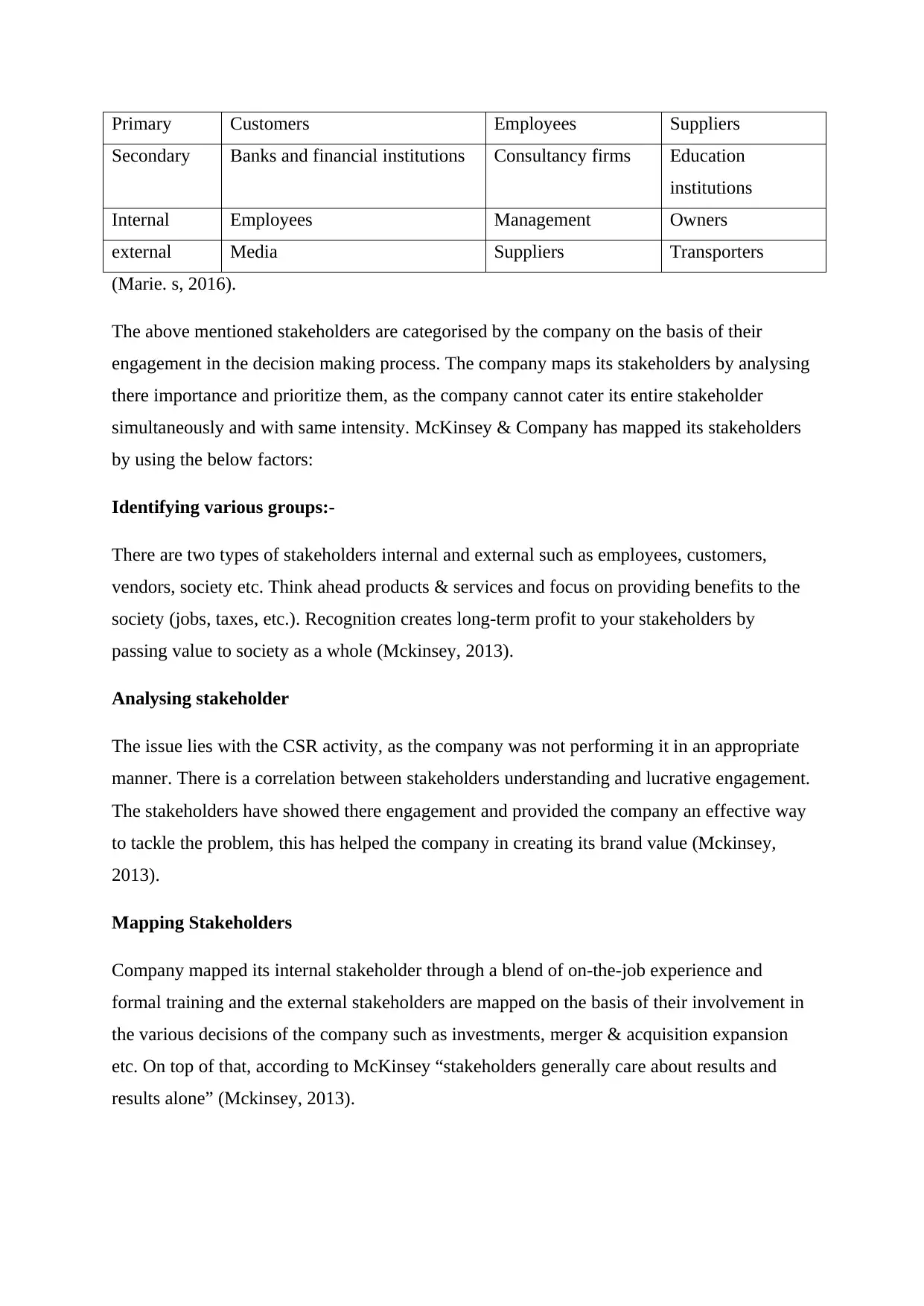
Primary Customers Employees Suppliers
Secondary Banks and financial institutions Consultancy firms Education
institutions
Internal Employees Management Owners
external Media Suppliers Transporters
(Marie. s, 2016).
The above mentioned stakeholders are categorised by the company on the basis of their
engagement in the decision making process. The company maps its stakeholders by analysing
there importance and prioritize them, as the company cannot cater its entire stakeholder
simultaneously and with same intensity. McKinsey & Company has mapped its stakeholders
by using the below factors:
Identifying various groups:-
There are two types of stakeholders internal and external such as employees, customers,
vendors, society etc. Think ahead products & services and focus on providing benefits to the
society (jobs, taxes, etc.). Recognition creates long-term profit to your stakeholders by
passing value to society as a whole (Mckinsey, 2013).
Analysing stakeholder
The issue lies with the CSR activity, as the company was not performing it in an appropriate
manner. There is a correlation between stakeholders understanding and lucrative engagement.
The stakeholders have showed there engagement and provided the company an effective way
to tackle the problem, this has helped the company in creating its brand value (Mckinsey,
2013).
Mapping Stakeholders
Company mapped its internal stakeholder through a blend of on-the-job experience and
formal training and the external stakeholders are mapped on the basis of their involvement in
the various decisions of the company such as investments, merger & acquisition expansion
etc. On top of that, according to McKinsey “stakeholders generally care about results and
results alone” (Mckinsey, 2013).
Secondary Banks and financial institutions Consultancy firms Education
institutions
Internal Employees Management Owners
external Media Suppliers Transporters
(Marie. s, 2016).
The above mentioned stakeholders are categorised by the company on the basis of their
engagement in the decision making process. The company maps its stakeholders by analysing
there importance and prioritize them, as the company cannot cater its entire stakeholder
simultaneously and with same intensity. McKinsey & Company has mapped its stakeholders
by using the below factors:
Identifying various groups:-
There are two types of stakeholders internal and external such as employees, customers,
vendors, society etc. Think ahead products & services and focus on providing benefits to the
society (jobs, taxes, etc.). Recognition creates long-term profit to your stakeholders by
passing value to society as a whole (Mckinsey, 2013).
Analysing stakeholder
The issue lies with the CSR activity, as the company was not performing it in an appropriate
manner. There is a correlation between stakeholders understanding and lucrative engagement.
The stakeholders have showed there engagement and provided the company an effective way
to tackle the problem, this has helped the company in creating its brand value (Mckinsey,
2013).
Mapping Stakeholders
Company mapped its internal stakeholder through a blend of on-the-job experience and
formal training and the external stakeholders are mapped on the basis of their involvement in
the various decisions of the company such as investments, merger & acquisition expansion
etc. On top of that, according to McKinsey “stakeholders generally care about results and
results alone” (Mckinsey, 2013).
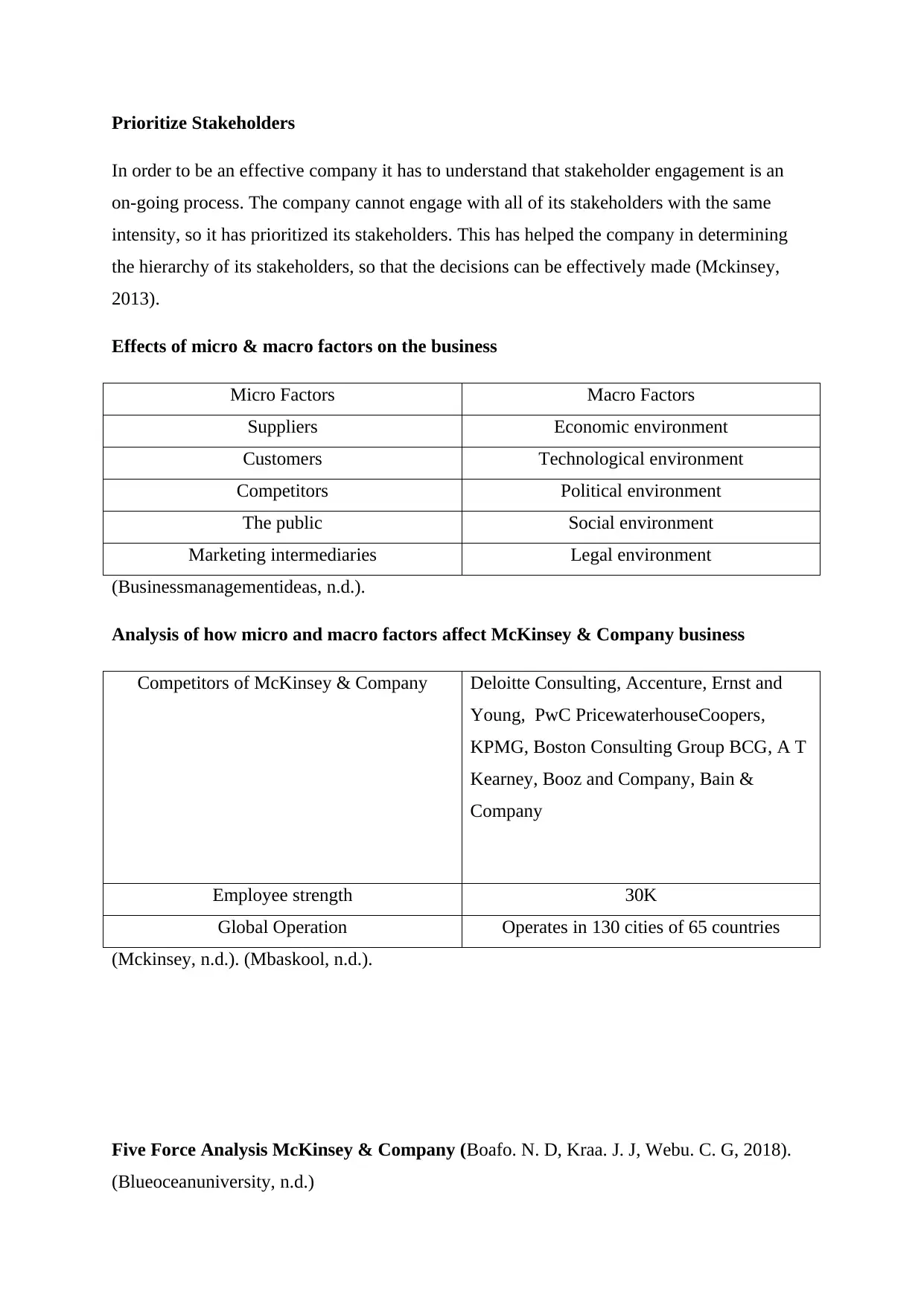
Prioritize Stakeholders
In order to be an effective company it has to understand that stakeholder engagement is an
on-going process. The company cannot engage with all of its stakeholders with the same
intensity, so it has prioritized its stakeholders. This has helped the company in determining
the hierarchy of its stakeholders, so that the decisions can be effectively made (Mckinsey,
2013).
Effects of micro & macro factors on the business
Micro Factors Macro Factors
Suppliers Economic environment
Customers Technological environment
Competitors Political environment
The public Social environment
Marketing intermediaries Legal environment
(Businessmanagementideas, n.d.).
Analysis of how micro and macro factors affect McKinsey & Company business
Competitors of McKinsey & Company Deloitte Consulting, Accenture, Ernst and
Young, PwC PricewaterhouseCoopers,
KPMG, Boston Consulting Group BCG, A T
Kearney, Booz and Company, Bain &
Company
Employee strength 30K
Global Operation Operates in 130 cities of 65 countries
(Mckinsey, n.d.). (Mbaskool, n.d.).
Five Force Analysis McKinsey & Company (Boafo. N. D, Kraa. J. J, Webu. C. G, 2018).
(Blueoceanuniversity, n.d.)
In order to be an effective company it has to understand that stakeholder engagement is an
on-going process. The company cannot engage with all of its stakeholders with the same
intensity, so it has prioritized its stakeholders. This has helped the company in determining
the hierarchy of its stakeholders, so that the decisions can be effectively made (Mckinsey,
2013).
Effects of micro & macro factors on the business
Micro Factors Macro Factors
Suppliers Economic environment
Customers Technological environment
Competitors Political environment
The public Social environment
Marketing intermediaries Legal environment
(Businessmanagementideas, n.d.).
Analysis of how micro and macro factors affect McKinsey & Company business
Competitors of McKinsey & Company Deloitte Consulting, Accenture, Ernst and
Young, PwC PricewaterhouseCoopers,
KPMG, Boston Consulting Group BCG, A T
Kearney, Booz and Company, Bain &
Company
Employee strength 30K
Global Operation Operates in 130 cities of 65 countries
(Mckinsey, n.d.). (Mbaskool, n.d.).
Five Force Analysis McKinsey & Company (Boafo. N. D, Kraa. J. J, Webu. C. G, 2018).
(Blueoceanuniversity, n.d.)
⊘ This is a preview!⊘
Do you want full access?
Subscribe today to unlock all pages.
Trusted by 1+ million students worldwide
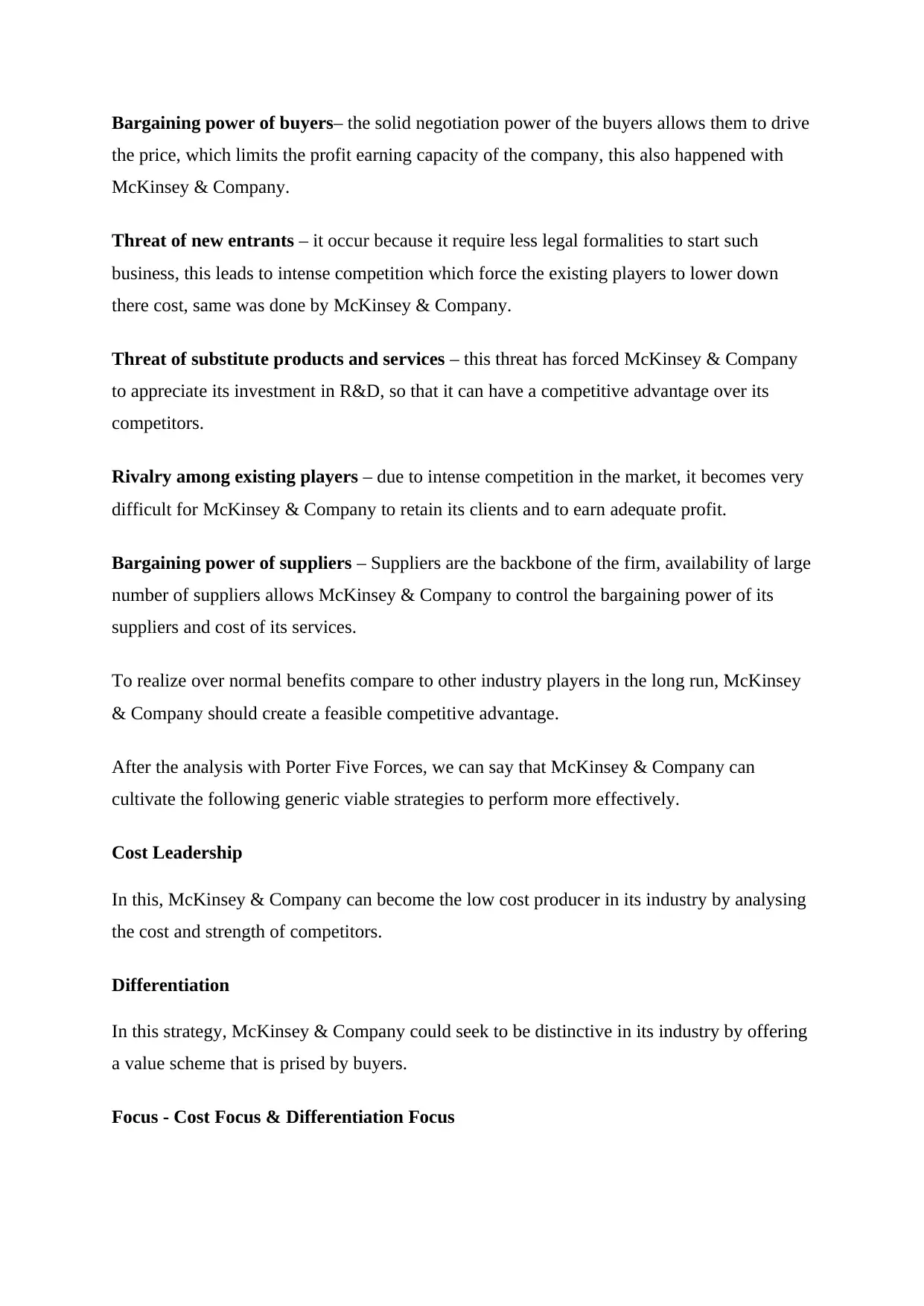
Bargaining power of buyers– the solid negotiation power of the buyers allows them to drive
the price, which limits the profit earning capacity of the company, this also happened with
McKinsey & Company.
Threat of new entrants – it occur because it require less legal formalities to start such
business, this leads to intense competition which force the existing players to lower down
there cost, same was done by McKinsey & Company.
Threat of substitute products and services – this threat has forced McKinsey & Company
to appreciate its investment in R&D, so that it can have a competitive advantage over its
competitors.
Rivalry among existing players – due to intense competition in the market, it becomes very
difficult for McKinsey & Company to retain its clients and to earn adequate profit.
Bargaining power of suppliers – Suppliers are the backbone of the firm, availability of large
number of suppliers allows McKinsey & Company to control the bargaining power of its
suppliers and cost of its services.
To realize over normal benefits compare to other industry players in the long run, McKinsey
& Company should create a feasible competitive advantage.
After the analysis with Porter Five Forces, we can say that McKinsey & Company can
cultivate the following generic viable strategies to perform more effectively.
Cost Leadership
In this, McKinsey & Company can become the low cost producer in its industry by analysing
the cost and strength of competitors.
Differentiation
In this strategy, McKinsey & Company could seek to be distinctive in its industry by offering
a value scheme that is prised by buyers.
Focus - Cost Focus & Differentiation Focus
the price, which limits the profit earning capacity of the company, this also happened with
McKinsey & Company.
Threat of new entrants – it occur because it require less legal formalities to start such
business, this leads to intense competition which force the existing players to lower down
there cost, same was done by McKinsey & Company.
Threat of substitute products and services – this threat has forced McKinsey & Company
to appreciate its investment in R&D, so that it can have a competitive advantage over its
competitors.
Rivalry among existing players – due to intense competition in the market, it becomes very
difficult for McKinsey & Company to retain its clients and to earn adequate profit.
Bargaining power of suppliers – Suppliers are the backbone of the firm, availability of large
number of suppliers allows McKinsey & Company to control the bargaining power of its
suppliers and cost of its services.
To realize over normal benefits compare to other industry players in the long run, McKinsey
& Company should create a feasible competitive advantage.
After the analysis with Porter Five Forces, we can say that McKinsey & Company can
cultivate the following generic viable strategies to perform more effectively.
Cost Leadership
In this, McKinsey & Company can become the low cost producer in its industry by analysing
the cost and strength of competitors.
Differentiation
In this strategy, McKinsey & Company could seek to be distinctive in its industry by offering
a value scheme that is prised by buyers.
Focus - Cost Focus & Differentiation Focus
Paraphrase This Document
Need a fresh take? Get an instant paraphrase of this document with our AI Paraphraser
In this strategy, McKinsey & Company has to emphasis on the selection of competitive scope
in the industry.
PESTEL Analysis of McKinsey & Company (Perera. R. 2017), (Blueoceanuniversity,
n.d.), (Essay48, n.d.),
Political
Political framework, Political stability of the country affects the business, as the company has
to perform its activities as per the rules and regulations of the government, which differs from
country to country. The laws that the nation implement particularly with respects to
commerce such as contract law, which decide what McKinsey & Company is and is not
permitted to do.
Taxation policy, a high amount of tax assessment would demotivate McKinsey & Company
from maximizing its benefits.
Economic
The interest rates within the nation influence, how much people are willing to borrow and
invest. Competitive rates would result in more prominent investments that would enhance the
growth of McKinsey & Company.
The trade rate of the nation McKinsey & Company works in would affect its profitability,
especially if it engages in international trade. The steadiness of the currency is additionally
important- an unsteady currency debilitates universal investors.
Unemployment in the nation implies more prominent supply of jobs than request. Individuals
would be willing to work for a lower wage, which would lower the costs of McKinsey &
Company
Social
in the industry.
PESTEL Analysis of McKinsey & Company (Perera. R. 2017), (Blueoceanuniversity,
n.d.), (Essay48, n.d.),
Political
Political framework, Political stability of the country affects the business, as the company has
to perform its activities as per the rules and regulations of the government, which differs from
country to country. The laws that the nation implement particularly with respects to
commerce such as contract law, which decide what McKinsey & Company is and is not
permitted to do.
Taxation policy, a high amount of tax assessment would demotivate McKinsey & Company
from maximizing its benefits.
Economic
The interest rates within the nation influence, how much people are willing to borrow and
invest. Competitive rates would result in more prominent investments that would enhance the
growth of McKinsey & Company.
The trade rate of the nation McKinsey & Company works in would affect its profitability,
especially if it engages in international trade. The steadiness of the currency is additionally
important- an unsteady currency debilitates universal investors.
Unemployment in the nation implies more prominent supply of jobs than request. Individuals
would be willing to work for a lower wage, which would lower the costs of McKinsey &
Company
Social
The course dispersion among the population is of vital significance, McKinsey & Company
would be incapable to advertise its premium service to the common people in case the
maximum population belongs to lower class.
The norms of the country regarding health standards, harassment claims and environmental
protection, affects the working of the company as it comes under the laws of business ethics
and CSR.
Technological
In the event that McKinsey & Company experiences an unused innovation that's gaining
ubiquity within the industry, at that point it is imperative to screen the level of ubiquity and
how rapidly it is developing and disturbing its competitors’ incomes
The technological factor of the country affects the decision of going overseas, as the
technology varies from nation to nation. If the company decides to go for technological
change then the company must look over the following popularity of the technology & how
effectively it has affected the competitors.
The effect of the innovation on the companies working in the industry is subject to have the
potential to extend or diminish the resulting profits incredibly. If the profit is high, then a part
of it may be reinvested into R&D department, so that regular improvement in technology
could be ensured with innovation.
Environmental
The climate conditions may essentially affect the capacity of McKinsey & Company to
oversee the transportation of both the assets and the services. This, in turn, would influence
the conveyance dates of the ultimate service within the case of, say, an unforeseen rainstorm.
Availability of resources act as a major decision when it comes to expansion, relying on
renewable energy may be expensive, but it is the best to carry out the business operations. As
it receives backing not only from the law maker but also from the customer base, who has the
would be incapable to advertise its premium service to the common people in case the
maximum population belongs to lower class.
The norms of the country regarding health standards, harassment claims and environmental
protection, affects the working of the company as it comes under the laws of business ethics
and CSR.
Technological
In the event that McKinsey & Company experiences an unused innovation that's gaining
ubiquity within the industry, at that point it is imperative to screen the level of ubiquity and
how rapidly it is developing and disturbing its competitors’ incomes
The technological factor of the country affects the decision of going overseas, as the
technology varies from nation to nation. If the company decides to go for technological
change then the company must look over the following popularity of the technology & how
effectively it has affected the competitors.
The effect of the innovation on the companies working in the industry is subject to have the
potential to extend or diminish the resulting profits incredibly. If the profit is high, then a part
of it may be reinvested into R&D department, so that regular improvement in technology
could be ensured with innovation.
Environmental
The climate conditions may essentially affect the capacity of McKinsey & Company to
oversee the transportation of both the assets and the services. This, in turn, would influence
the conveyance dates of the ultimate service within the case of, say, an unforeseen rainstorm.
Availability of resources act as a major decision when it comes to expansion, relying on
renewable energy may be expensive, but it is the best to carry out the business operations. As
it receives backing not only from the law maker but also from the customer base, who has the
⊘ This is a preview!⊘
Do you want full access?
Subscribe today to unlock all pages.
Trusted by 1+ million students worldwide
potential and the willingness to pay a premium price for the services of McKinsey &
Company.
Legal
Laws related to data protection and intellectual property is one of the significant factors that
affect the business decisions. It is done by the company to protect its unique idea or
information which provides a sustainable profit. There is always a possibility of “Data Theft”
which results in the loss of competitive advantage and may often leads to failure of the
company.
The discrimination laws of the country affect the internal environment of the company. These
laws are framed to look after the employees and to make sure that everyone in the company is
treated equally and being provided with the same opportunities ignoring the gender,
disability, religion, sexual orientation, age etc.
Laws related to safety and health also affect the business decision, this law force the company
to perform its social responsibility towards the stakeholders and also force them to perform
the business ethically
SWOT Analysis of McKinsey & Company (Gurel, E., Tat, M. 2017), (Blueoceanuniversity,
n.d.), ( Fernfortuniversity, n.d.), Mbaskool, (n.d.).
Strengths
Customer satisfaction, the CRM department of the company has the ability to maintain
balance between the customers and brand equity of the company by providing satisfaction to
the potential customers.
Extensive geographic presence, McKinsey & Company has a wide dealer’s chain and
associates linkage that not only supports in delivering well-organized services to the clients
but also support in managing modest challenges in Organizational Development industry.
Market Leader, McKinsey & Company has a robust market leadership spot in the Organizational
Development industry. It has assisted the company to quickly scale the success of new products.
Company.
Legal
Laws related to data protection and intellectual property is one of the significant factors that
affect the business decisions. It is done by the company to protect its unique idea or
information which provides a sustainable profit. There is always a possibility of “Data Theft”
which results in the loss of competitive advantage and may often leads to failure of the
company.
The discrimination laws of the country affect the internal environment of the company. These
laws are framed to look after the employees and to make sure that everyone in the company is
treated equally and being provided with the same opportunities ignoring the gender,
disability, religion, sexual orientation, age etc.
Laws related to safety and health also affect the business decision, this law force the company
to perform its social responsibility towards the stakeholders and also force them to perform
the business ethically
SWOT Analysis of McKinsey & Company (Gurel, E., Tat, M. 2017), (Blueoceanuniversity,
n.d.), ( Fernfortuniversity, n.d.), Mbaskool, (n.d.).
Strengths
Customer satisfaction, the CRM department of the company has the ability to maintain
balance between the customers and brand equity of the company by providing satisfaction to
the potential customers.
Extensive geographic presence, McKinsey & Company has a wide dealer’s chain and
associates linkage that not only supports in delivering well-organized services to the clients
but also support in managing modest challenges in Organizational Development industry.
Market Leader, McKinsey & Company has a robust market leadership spot in the Organizational
Development industry. It has assisted the company to quickly scale the success of new products.
Paraphrase This Document
Need a fresh take? Get an instant paraphrase of this document with our AI Paraphraser
Robust Brand Portfolio, the brand portfolio could be very valuable if the organization wants
to grow into a new product segment or category.
Weakness
High operational cost, the day to day operational cost of the company is high which impacts
the profitability of McKinsey & Company
Limited growth outside core business, the company has always been at the top in its industry,
but still McKinsey & Company has tackled a lot of challenges in shifting to other product
sections with its existing culture.
The company could not tackle the challenges thrown by the start-ups in the niche market
because of which it has to lose a part of small market segment, which turned out to be a
weakness for McKinsey & Company.
Opportunities
New environmental policies, the innovative opportunities will generate a level playing arena
for all the companies in the industry. It signify abundant opportunity for McKinsey &
Company to gain competitive advantage over its competitors by opting new advanced
technology, which allow it to gain market share in the new product category.
Customer likings are fluctuating in nature, Motivated by increasing disposable incomes,
stress-free access to data and fast acceptance of technical products, has made todays
customers more willing to test / try new products in the market. This is what McKinsey &
Company is good at providing new products and services.
customers migrating to premium services, It signifies ample amount of opportunity for
McKinsey & Company, as the organisation has robust brand recognition in the high-end
service division, customers have familiarity with outstanding customer services offered by
McKinsey & Company. It offers a win-win situation for the organisation and provides an
opportunity to escalate the profitability.
to grow into a new product segment or category.
Weakness
High operational cost, the day to day operational cost of the company is high which impacts
the profitability of McKinsey & Company
Limited growth outside core business, the company has always been at the top in its industry,
but still McKinsey & Company has tackled a lot of challenges in shifting to other product
sections with its existing culture.
The company could not tackle the challenges thrown by the start-ups in the niche market
because of which it has to lose a part of small market segment, which turned out to be a
weakness for McKinsey & Company.
Opportunities
New environmental policies, the innovative opportunities will generate a level playing arena
for all the companies in the industry. It signify abundant opportunity for McKinsey &
Company to gain competitive advantage over its competitors by opting new advanced
technology, which allow it to gain market share in the new product category.
Customer likings are fluctuating in nature, Motivated by increasing disposable incomes,
stress-free access to data and fast acceptance of technical products, has made todays
customers more willing to test / try new products in the market. This is what McKinsey &
Company is good at providing new products and services.
customers migrating to premium services, It signifies ample amount of opportunity for
McKinsey & Company, as the organisation has robust brand recognition in the high-end
service division, customers have familiarity with outstanding customer services offered by
McKinsey & Company. It offers a win-win situation for the organisation and provides an
opportunity to escalate the profitability.
Threats
Intense competition, In recent years it has been noticed that there has been a rise in the
number of companies in the industry, because of which the companies has put downward
burden not only on profitability but also on complete sales.
Lack of skilled staff, there are certain international market where the McKinsey & Company
is operating in which they are facing such problems. The basic threat in such market is that
there is lack of availability of skilled and knowledgeable workforce which is the major
requirement of the company to sustain in market.
Unstable Foreign exchange, as the company operates in several nations it is unprotected to
currency fluctuations, particularly given the unstable political climate in number of markets
across the globe.
Conclusion
After the complete study of the topics we came to a conclusion that there are different types
of organisations which differentiate themselves on the basis of their purpose. The purpose
and decision of the companies are partly or sometimes completely affected by the
involvement of the stakeholders and in the same manner the objective of the stakeholders is
affected by the decisions of the firms, because of which the company maps its stakeholders.
The company work in two different environments such as internal and external which affect
the decisions and operations of the business. The same has been analysed above by using the
PESTEL, SWOT and five forces analysis, in which we figured out that each and very factor
that is involved in the running of the business affect the business decisions either directly or
indirectly
Intense competition, In recent years it has been noticed that there has been a rise in the
number of companies in the industry, because of which the companies has put downward
burden not only on profitability but also on complete sales.
Lack of skilled staff, there are certain international market where the McKinsey & Company
is operating in which they are facing such problems. The basic threat in such market is that
there is lack of availability of skilled and knowledgeable workforce which is the major
requirement of the company to sustain in market.
Unstable Foreign exchange, as the company operates in several nations it is unprotected to
currency fluctuations, particularly given the unstable political climate in number of markets
across the globe.
Conclusion
After the complete study of the topics we came to a conclusion that there are different types
of organisations which differentiate themselves on the basis of their purpose. The purpose
and decision of the companies are partly or sometimes completely affected by the
involvement of the stakeholders and in the same manner the objective of the stakeholders is
affected by the decisions of the firms, because of which the company maps its stakeholders.
The company work in two different environments such as internal and external which affect
the decisions and operations of the business. The same has been analysed above by using the
PESTEL, SWOT and five forces analysis, in which we figured out that each and very factor
that is involved in the running of the business affect the business decisions either directly or
indirectly
⊘ This is a preview!⊘
Do you want full access?
Subscribe today to unlock all pages.
Trusted by 1+ million students worldwide

1 out of 14


Related Documents


Your All-in-One AI-Powered Toolkit for Academic Success.
+13062052269
info@desklib.com
Available 24*7 on WhatsApp / Email
![[object Object]](/_next/static/media/star-bottom.7253800d.svg)
Unlock your academic potential
Copyright © 2020–2026 A2Z Services. All Rights Reserved. Developed and managed by ZUCOL.