Research: IFRS Implementation and Competitive Advantage for Company X

Verified

Added on  2023/03/31

|10
|1702
|484
Report
AI Summary
This report investigates the potential advantages of implementing International Financial Reporting Standards (IFRS) for Company X, an accounting and auditing firm operating in the Solomon Islands. The research addresses the company's challenges in a small market, the lack of IFRS adoption in the region, and competition from multinational companies. The study aims to determine how IFRS adoption can enhance Company X's competitiveness, increase revenue, and facilitate access to foreign markets. The report includes a literature review analyzing existing research on IFRS, discussing the impact on corporate value, net income, and market reach. The research design utilizes a qualitative approach, employing semi-structured interviews to gather insights from experts. Ethical considerations, including informed consent and privacy protection, are also addressed. The findings are expected to provide valuable insights into the benefits of IFRS implementation for Company X, offering strategies for market expansion and competitive advantage.

Document Page
NARRATIVE TRANSCRIPT 1
Narrative Transcript
Author’s Name
Institution
Professor’s Name
Code +Course
City and State
Date
tabler-icon-diamond-filled.svg

Paraphrase This Document

Need a fresh take? Get an instant paraphrase of this document with our AI Paraphraser
Document Page
NARRATIVE TRANSCRIPT 2
Narrative Transcript
Globally, the use of International Financial Reporting Standards (IFRS) is gaining
momentum. According to Boolaky, & Omoteso (2016, p.727) IFRS are international auditing
standards and it offers common international language for business affairs. The standards allow
companies worldwide to use similar standards. However, some countries including Solomon
Islands have not adopted IFRS. As a result, I am conducting research to establish if IFRS indeed
are beneficial to accounting and auditing firms. Hence, the title of my research is as follows:
Title: Investigation of how implementation of International Financial Reporting Standards
(IFRS) can help Company X
Industry Partner
For the purpose of your understanding, Company X is an accounting and auditing firm
owned by an Australian and Canadian. The company operates in Solomon Islands and offers a
wide range of accounting and audit services. Its services include IT consulting, data processing,
accounting, taxation, audit, insolvency among others. The broad range of services offered by
company X portrays it as an organization with great potential. This is a company with goals and
objectives; however, its market is being threatened by competitors like KPMG that use IFRS.
Belleflamme and Peitz (2019, p.5) indicate that a business should strategize always to manage
competition for survival. Thus, Company X is seeking survival and competitive advantage and
perhaps IFRS adoption can help the company. I believe that it crystal clear to you that Company
X is just an accounting and auditing firm that is considering adopting IFRS to bolster its
competitiveness and profitability.
Document Page
NARRATIVE TRANSCRIPT 3
Besides, this is a small company with a lean workforce. As at now, it only has one
director. However, the company’s operations are run by 14 professional staff who are supported
by two managers and 5 support staff. In total Company X has a total of 22 employees. This is a
small number given that the company offers a wide range of services.
Research Problem
Company X is considering adopting IFRS on account of the threats it is facing in its
market. Company X has not been operating as it should be due to the fact that Solomon Islands
offer it a small market. The global market is liberalized and therefore any business that thinks its
domestic market is unable to help it grow, it is reasonable to consider investing in foreign
markets. However, this cannot be done blindly. That is why Company X is keen on
understanding what it can do to be a competitive accounting and audit firm beyond the borders of
Solomon Islands.
Apart from the small market in the Islands, companies there have not adopted IFRS.
Companies have not been on their auditing standards as some just use company acts. However,
in 2010 Solomon Islands passed an Accountants Act of 2010 to guide accounting and audit
services in the Islands. However, there are other companies in the Islands that hiring services of
companies such as Deloitte which use IFRS. This has significantly posed a threat to Company X,
denying it an opportunity to operate optimally. In addition, the demand for accounting and audit
services has slumped. This indicates that Company X is operating in an unreliable market and
therefore, it has to look beyond Solomon Islands. This will require it to adopt international
standards of auditing for it to be competitive.
Document Page
NARRATIVE TRANSCRIPT 4
Also, the regulatory authority of accounting, Institute of Solomon Islands Accountants is
at budding stages. The authority has not yet matured and this implies that it is not likely to make
radical changes in accounting and audit in Solomon Islands. Also, Solomon Islands has not yet
ratified the use of IFRS, however companies such as Deloitte audit its firms.
Research Aim
In general, Company X has to strategize on how to it can increase its competitiveness.
The company is losing revenues to MNCs like KPMG, PWC, and Deloitte. These multinational
companies use IFRS. This shows that IFRS is what gives them a competitive advantage in the
accounting and auditing market. On that basis, this research aims:
-to establish how adoption of IFRS can help Company X to be competitive like MNCs such as
PWC
-to investigate the benefits of IFRS and its connection to competitive advantage
- to find if IFRS adoption will increase Company X’s revenue and access to foreign markets
Literature review
This section seeks to analyze existing information about IFRS. From this analysis, the
researcher will gain insight into how Company X is likely to benefit from IFRS adoption.
Research conducted by Ahalik, Murwaningsari, Mayangsari, and Aryati (2019, p.51) to ascertain
the development of IFRS implementation index and the likely influence on the value of
Indonesian businesses. The research used 45 companies that already use IFRS, which in
Indonesians regard as PSAK (Financial accounting standard statements). From these companies,
tabler-icon-diamond-filled.svg

Paraphrase This Document

Need a fresh take? Get an instant paraphrase of this document with our AI Paraphraser
Document Page
NARRATIVE TRANSCRIPT 5
it was established that IFRS implementation variable has a negative, though there is an important
relationship to the value of the company through economic value added. This is to imply that
corporate value does not affect IFRS implementation in companies in Indonesia. In other words,
what this research implies is that IFRS implementation does not have any relationship with
corporate value. Hence, Company X IFRS implementation will not reflect its corporate values.
Another finding from Ahalik’s et al. (2019, p.51) study is that IFRS implementation index does
not influence net income. What this means is that Company X is not likely to increase its net
income or raise its revenue just by implementing IFRS. This insinuates that IFRS
implementation alone is not a guarantee that Company X will generate more revenues. Thus, the
company will entirely rely on IFRS to compete. Already, in some countries, IFRS has been
adopted and that is to mean that Company X is a late adopter of these global auditing standards.
All in all, from Ahalik’s et al. (2019, p.51) study what can be construed is that Company X is not
automatically guaranteed that IFRS implementation will generate it more revenues.
In another research, Ball (2016, p.545) in 2005 100 nations pledged to adopt IFRS. The
adoption was in the spirit of globalization and desire to have global accounting standards. Hence,
the research by Ball (2016, p. 545) informs that IFRS adoption was a result of globalization
where countries wanted uniform rules for accounting. This is to indicate that if Company X
adopts IFRS, it will practice accounting in any country that has adopted it. According to the
researcher over 100 countries adopted IFRS, this means that Company X can be hired for
accounting and audit services in a number of countries. As a result, the company will generate
revenue not only in Solomon Islands but also in other countries. Essentially, what this means is
that Company X will have a bigger market share that will allow it to compete with MNCs such
as PWC and Deloitte. From the research problem, it was mentioned that Solomon Islands offers
Document Page
NARRATIVE TRANSCRIPT 6
a small market for Company X. However, based on this author this is expected to change
because Company X will access many markets that will allow it to generate more revenue.
Nonetheless, this Ball (2016) research is a complete contrast to Ahalik’s et al. (2019) that
believes that IFRS adoption does not increase the net income or revenues to a company that
adopts IFRS. Market analysts believe that an organization that enjoys a huge market share has a
great opportunity to increase its profits due to a huge client base. Therefore, from the literature
review, one can deduce that IFRS adoption has the ability to expand an organization’s market
reach/share.
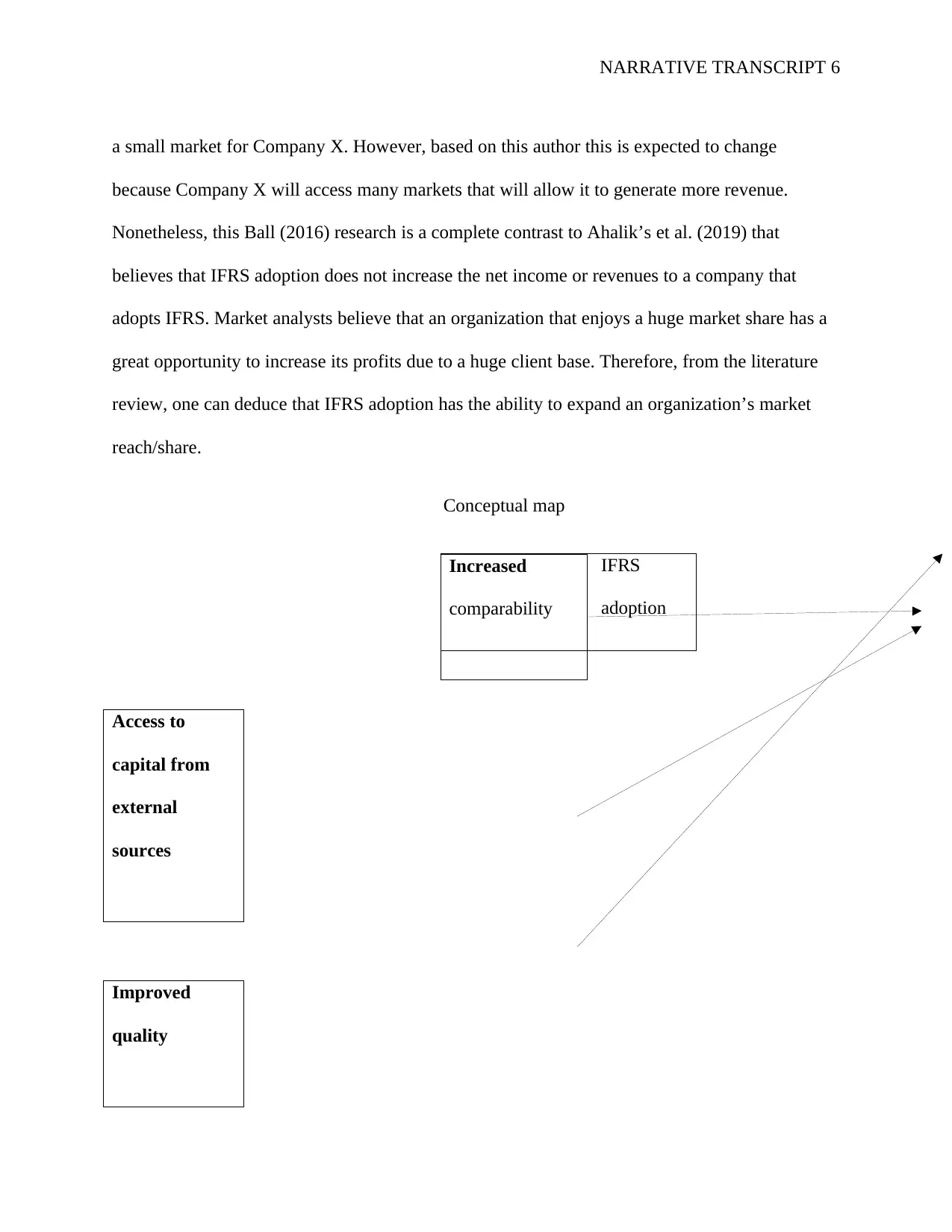
Conceptual map
IFRS
adoption
Access to
capital from
external
sources
Improved
quality
Increased
comparability
Document Page
NARRATIVE TRANSCRIPT 7
Research questions
Will Company X guarantee high quality in its accounting and audit services if it
implements IFRS?
How will IFRS make Company X competitive and generate revenues beyond Solomon
Islands?
Research design
In this research, I intend to use a qualitative research design. The research will focus on
constructing a meaning regarding the implementation of IFRS by Company X by exploring
benefits that Company X can accrue once it adopts IFRS. Essentially, a qualitative research
design is appropriate for this research because the data I intend to gather is not quantitative.
Hence, using qualitative research, the study will investigate through interviews the benefits and
competitiveness that Company X stands to gain from IFRS adoption.
Research tools
This study will use a survey interview. The interview will be face-to-face. Also, a video-
link shall be used for the participants who will not be reachable physically. Semi-structured
interview shall be used due to its flexibility. I also intend to use purposive sampling because I
intend to reach only a few people with an in-depth understanding of IFRS. Purposive sampling
will help me reach out to experts or companies that use IFRS for an interview. Also, I intend to
use a sample size of five people with experience or in-depth understanding of IFRS.
Ethical considerations
tabler-icon-diamond-filled.svg

Paraphrase This Document

Need a fresh take? Get an instant paraphrase of this document with our AI Paraphraser
Document Page
NARRATIVE TRANSCRIPT 8
All participants in this research will be entitled to informed consent. Ethically, a
researcher is required to obtain consent from all parties that will participate in the research.
Hence, I will inform my interviewees about the objectives of the research and will also protect
their privacy. The participants of the research deserved to be furnished with all important details
of the study. Respecting the privacy of the participants will also be my core business while
undertaking this important research that will eventually show how IFRS adoption will benefit
Company X.
.
Document Page
NARRATIVE TRANSCRIPT 9
References
Ahalik, A., Murwaningsari, E., Mayangsari, S. and Aryati, T., 2019. The Development of IFRS
Implementation Index and its Effect on Corporate Values in Indonesia in 2015. Journal of
Accounting, Business and Finance Research, 5(2), pp.51-59.
Ball, R., 2016. IFRS–10 years later. Accounting and Business Research, 46(5), pp.545-571
Boolaky, P. and Omoteso, K., 2016. International standards on auditing in the international
financial services centres: What matters?. Managerial Auditing Journal, 31(6/7), pp.727-747.
Belleflamme, P. and Peitz, M., 2019. Managing competition on a twosided platform. Journal of
Economics & Management Strategy, 28(1), pp.5-22.
Document Page
NARRATIVE TRANSCRIPT 10
chevron_up_icon
1 out of 10
circle_padding
hide_on_mobile
zoom_out_icon
[object Object]