Negligence and Employer's Duty of Care: A Detailed Case Study Analysis
VerifiedAdded on 2023/02/01
|15
|3054
|95
Case Study
AI Summary
This case study analyzes the negligence case of Castro v Transfield (Qld) Pty Ltd, focusing on employer liability for workplace injuries. The assignment explores the legal principles of negligence, including duty of care, breach of duty, causation, and damages. It examines the facts of the case, where an employee sustained back injuries while carrying a heavy oxygen bottle, and evaluates the employer's responsibility in providing a safe working environment. The analysis delves into the concepts of due diligence and risk management, assessing whether the employer took reasonable steps to prevent harm. The document supports the plaintiff's argument by establishing the employer's duty of care, highlighting the breach of this duty through the lack of safe transport for the oxygen bottle, and demonstrating the causal link between the employer's negligence and the employee's injuries. The analysis also considers the foreseeability of the harm and the application of the 'but for' test in determining causation, concluding that the employer was negligent in failing to provide a safe working environment. This case study provides a comprehensive overview of negligence law in the context of employer-employee relationships, emphasizing the importance of workplace safety and the legal consequences of failing to meet the duty of care.

NEGLIGENCE
Negligence
Student’s Name
Institution
Negligence
Student’s Name
Institution
Paraphrase This Document
Need a fresh take? Get an instant paraphrase of this document with our AI Paraphraser

NEGLIGENCE 2
Case 2. Whether the employer is negligent.
Introduction
The main issue in this case is whether the employer was negligent in his actions or omissions,
hence, leading to the subsequent injuries to the employee (Buckley, 2017). An employer is
expected to act diligently by providing a safe and conducive working environment for all
workers. Negligence is a failure to take reasonable care to prevent causing harm to other persons
(Horsey & Rackley, 2015).
In order for an employee to sustain a negligence suit against an employer, he must prove the
following four elements i) employers’ duty to care for employees; ii) breaching the duty of care;
iii) the employee got injure since the employer breach his duty; iv) the occasioned harm was not
too remote and that the employer foresaw the consequences of his acts or omissions. Once there
is proof of the four elements listed above leading to employee injury, the court may award
compensation for the injuries sustained. In determining the culpability of the defendant, courts
have to establish the objective and subjective basis of the defendant’s actions (Bermingham &
Brennan, 2018).
Due Diligence
This involves taking reasonable steps in the process of avoiding committing an offence or tort.
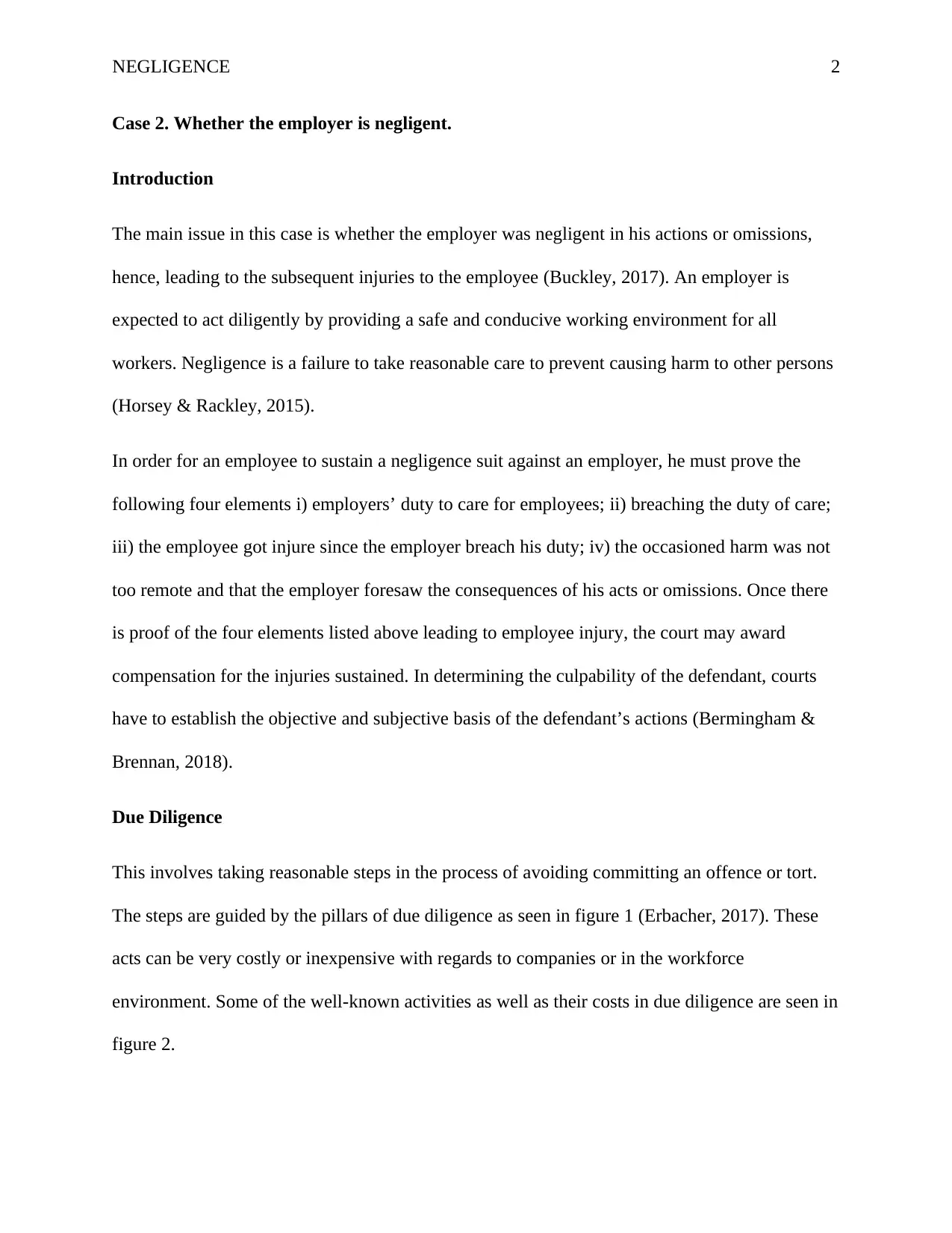
The steps are guided by the pillars of due diligence as seen in figure 1 (Erbacher, 2017). These
acts can be very costly or inexpensive with regards to companies or in the workforce
environment. Some of the well-known activities as well as their costs in due diligence are seen in
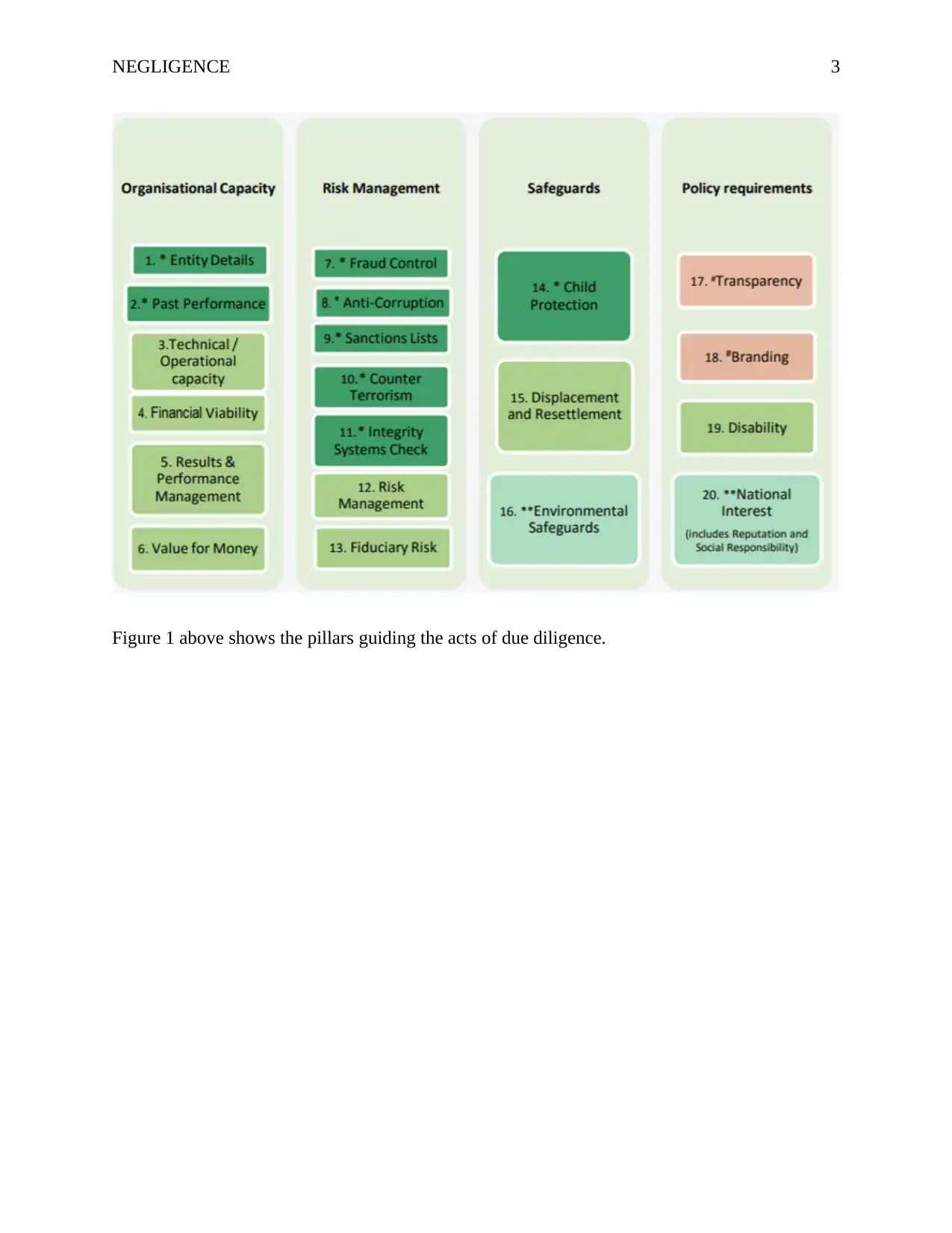
figure 2.
Case 2. Whether the employer is negligent.
Introduction
The main issue in this case is whether the employer was negligent in his actions or omissions,
hence, leading to the subsequent injuries to the employee (Buckley, 2017). An employer is
expected to act diligently by providing a safe and conducive working environment for all
workers. Negligence is a failure to take reasonable care to prevent causing harm to other persons
(Horsey & Rackley, 2015).
In order for an employee to sustain a negligence suit against an employer, he must prove the
following four elements i) employers’ duty to care for employees; ii) breaching the duty of care;
iii) the employee got injure since the employer breach his duty; iv) the occasioned harm was not
too remote and that the employer foresaw the consequences of his acts or omissions. Once there
is proof of the four elements listed above leading to employee injury, the court may award
compensation for the injuries sustained. In determining the culpability of the defendant, courts
have to establish the objective and subjective basis of the defendant’s actions (Bermingham &
Brennan, 2018).
Due Diligence
This involves taking reasonable steps in the process of avoiding committing an offence or tort.
The steps are guided by the pillars of due diligence as seen in figure 1 (Erbacher, 2017). These
acts can be very costly or inexpensive with regards to companies or in the workforce
environment. Some of the well-known activities as well as their costs in due diligence are seen in
figure 2.

NEGLIGENCE 3
Figure 1 above shows the pillars guiding the acts of due diligence.
⊘ This is a preview!⊘
Do you want full access?
Subscribe today to unlock all pages.

Trusted by 1+ million students worldwide

NEGLIGENCE 4
Figure 2 above shows the due diligence costs related to its activities.
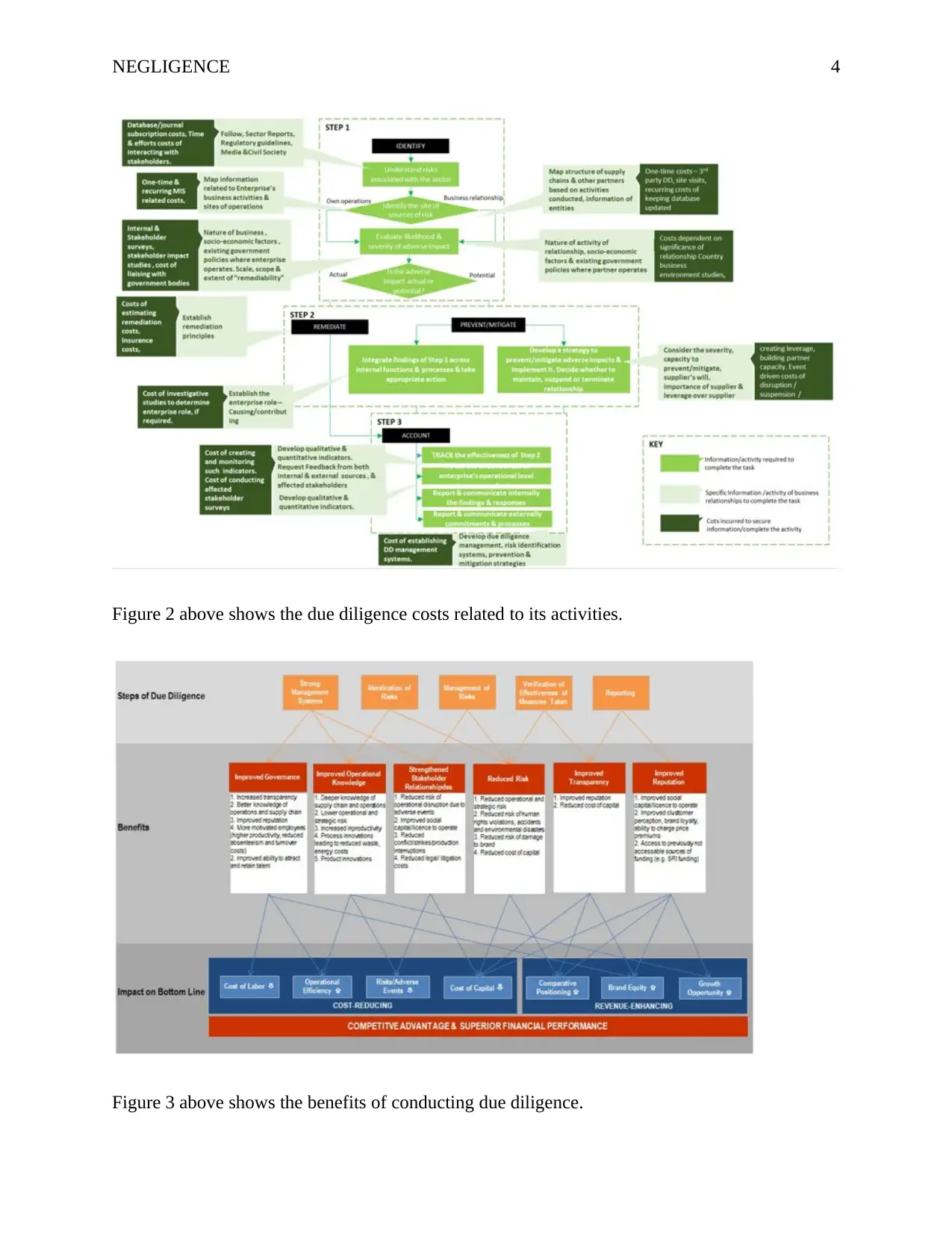
Figure 3 above shows the benefits of conducting due diligence.
Figure 2 above shows the due diligence costs related to its activities.
Figure 3 above shows the benefits of conducting due diligence.
Paraphrase This Document
Need a fresh take? Get an instant paraphrase of this document with our AI Paraphraser

NEGLIGENCE 5
The above diagrams show the inconvenience, time consuming, expensiveness or tediousness as
well as the benefits in conducting due diligence. Due diligence does go beyond what people
normally make and perceive that it only lies in health safety.
Risk Management
This is the act of evaluating and forecasting risks as well as defining procedures that help
minimize or avoid the impacts coming from possible risks (Hutchins, 2018). The process of
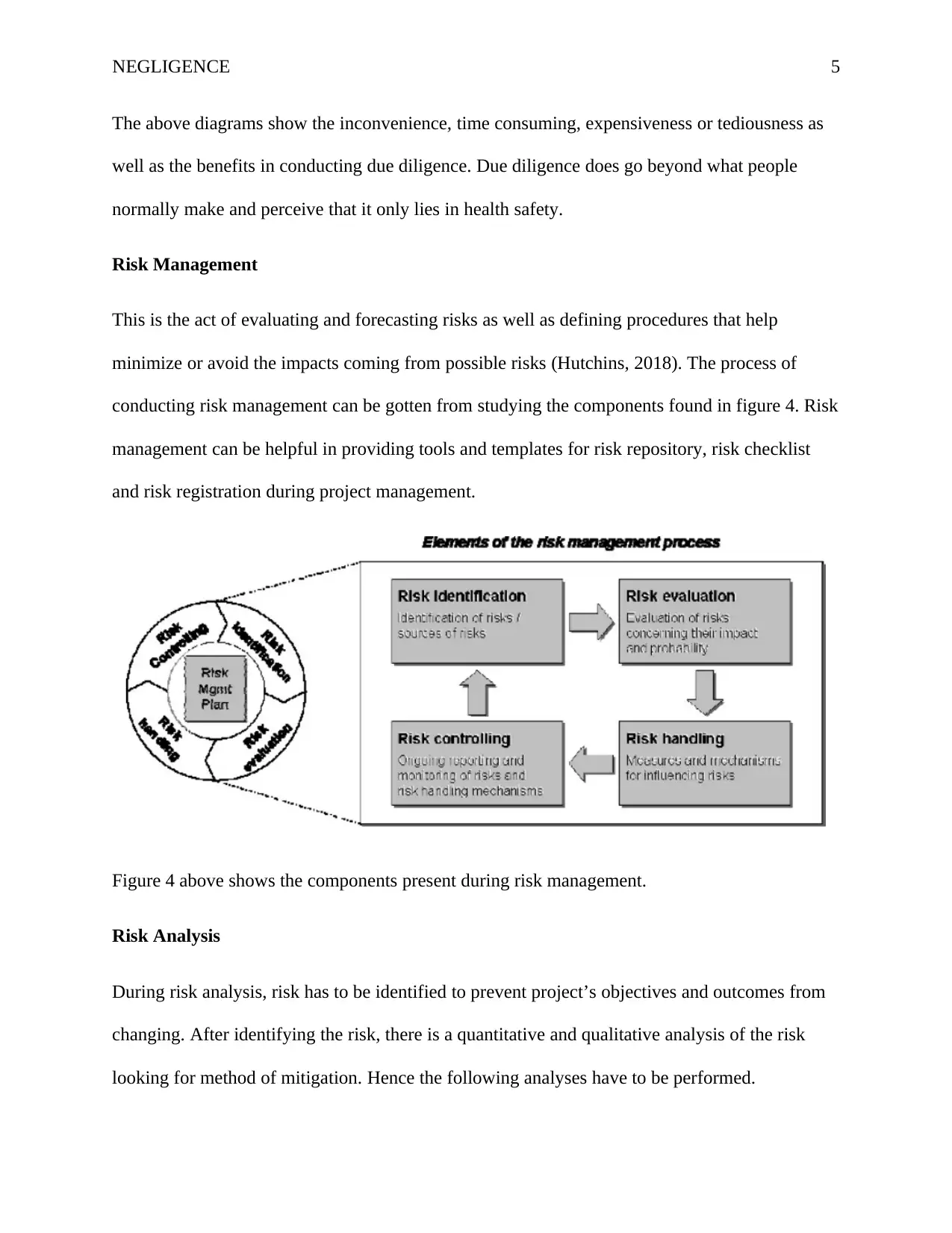
conducting risk management can be gotten from studying the components found in figure 4. Risk
management can be helpful in providing tools and templates for risk repository, risk checklist
and risk registration during project management.
Figure 4 above shows the components present during risk management.
Risk Analysis
During risk analysis, risk has to be identified to prevent project’s objectives and outcomes from
changing. After identifying the risk, there is a quantitative and qualitative analysis of the risk
looking for method of mitigation. Hence the following analyses have to be performed.
The above diagrams show the inconvenience, time consuming, expensiveness or tediousness as
well as the benefits in conducting due diligence. Due diligence does go beyond what people
normally make and perceive that it only lies in health safety.
Risk Management
This is the act of evaluating and forecasting risks as well as defining procedures that help
minimize or avoid the impacts coming from possible risks (Hutchins, 2018). The process of
conducting risk management can be gotten from studying the components found in figure 4. Risk
management can be helpful in providing tools and templates for risk repository, risk checklist
and risk registration during project management.
Figure 4 above shows the components present during risk management.
Risk Analysis
During risk analysis, risk has to be identified to prevent project’s objectives and outcomes from
changing. After identifying the risk, there is a quantitative and qualitative analysis of the risk
looking for method of mitigation. Hence the following analyses have to be performed.

NEGLIGENCE 6
Risk Occurrence probabilities
These probabilities are categorized into three as listed below:
1. Highly probable (percentage between 80 to 100)
2. Possibly medium (percentage between 60 to 80).
3. Possibly low (percentage between 30 to 60).
Risk Impact
The following are the impacts that risk may cause to organizations.
Highly catastrophic (This is given an A rating of 100 points).
Medium-Critical (This is given a B rating of 50 points).
Low-Marginal (This is given a C rating of 10 points).
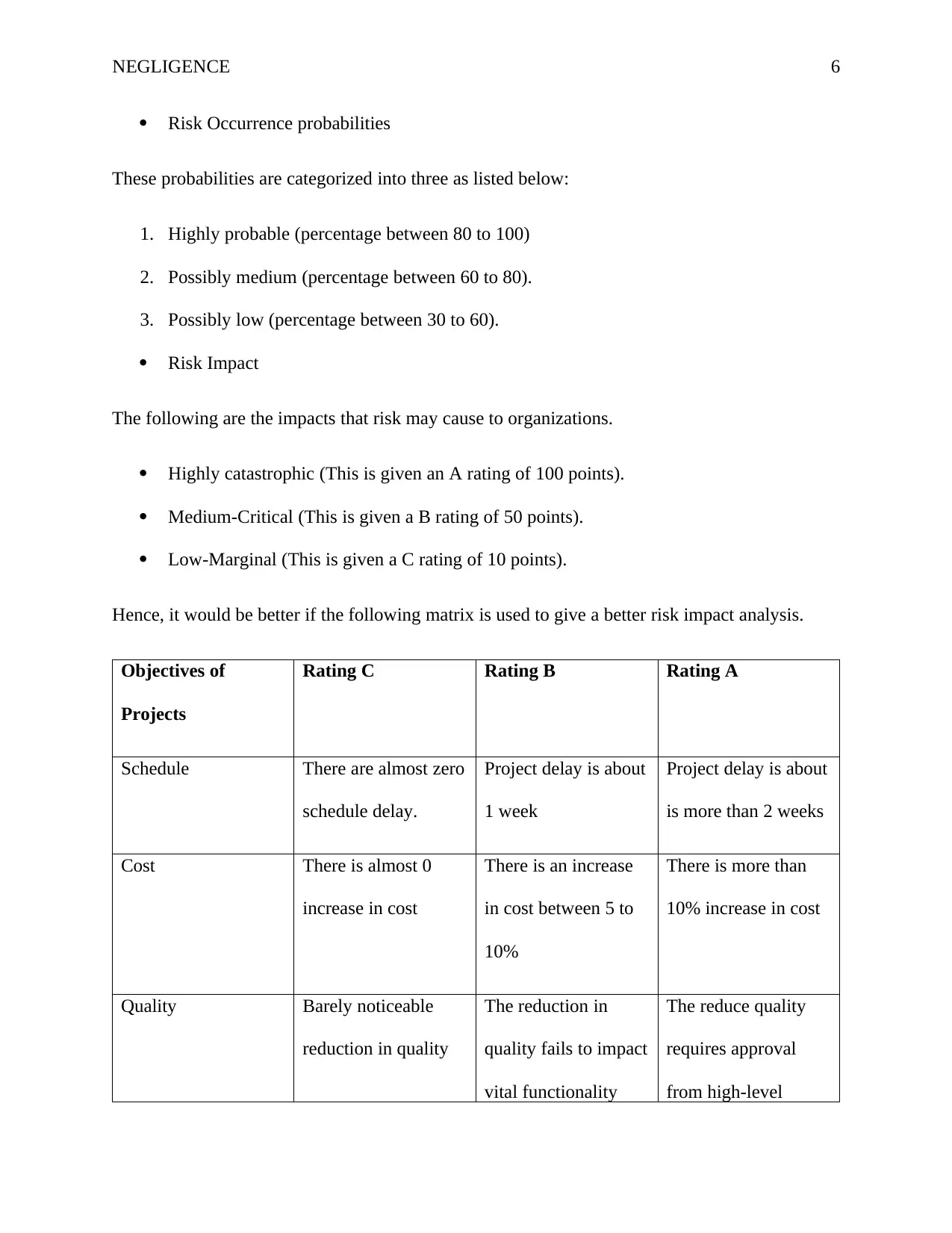
Hence, it would be better if the following matrix is used to give a better risk impact analysis.
Objectives of
Projects
Rating C Rating B Rating A
Schedule There are almost zero
schedule delay.
Project delay is about
1 week
Project delay is about
is more than 2 weeks
Cost There is almost 0
increase in cost
There is an increase
in cost between 5 to
10%
There is more than
10% increase in cost
Quality Barely noticeable
reduction in quality
The reduction in
quality fails to impact
vital functionality
The reduce quality
requires approval
from high-level
Risk Occurrence probabilities
These probabilities are categorized into three as listed below:
1. Highly probable (percentage between 80 to 100)
2. Possibly medium (percentage between 60 to 80).
3. Possibly low (percentage between 30 to 60).
Risk Impact
The following are the impacts that risk may cause to organizations.
Highly catastrophic (This is given an A rating of 100 points).
Medium-Critical (This is given a B rating of 50 points).
Low-Marginal (This is given a C rating of 10 points).
Hence, it would be better if the following matrix is used to give a better risk impact analysis.
Objectives of
Projects
Rating C Rating B Rating A
Schedule There are almost zero
schedule delay.
Project delay is about
1 week
Project delay is about
is more than 2 weeks
Cost There is almost 0
increase in cost
There is an increase
in cost between 5 to
10%
There is more than
10% increase in cost
Quality Barely noticeable
reduction in quality
The reduction in
quality fails to impact
vital functionality
The reduce quality
requires approval
from high-level
⊘ This is a preview!⊘
Do you want full access?
Subscribe today to unlock all pages.

Trusted by 1+ million students worldwide

NEGLIGENCE 7
management.
Scope Barely noticeable
scope decrease
There are minor
scope areas affected
There are major
affected areas of
scope to unacceptable
functioning.
Risk exposure
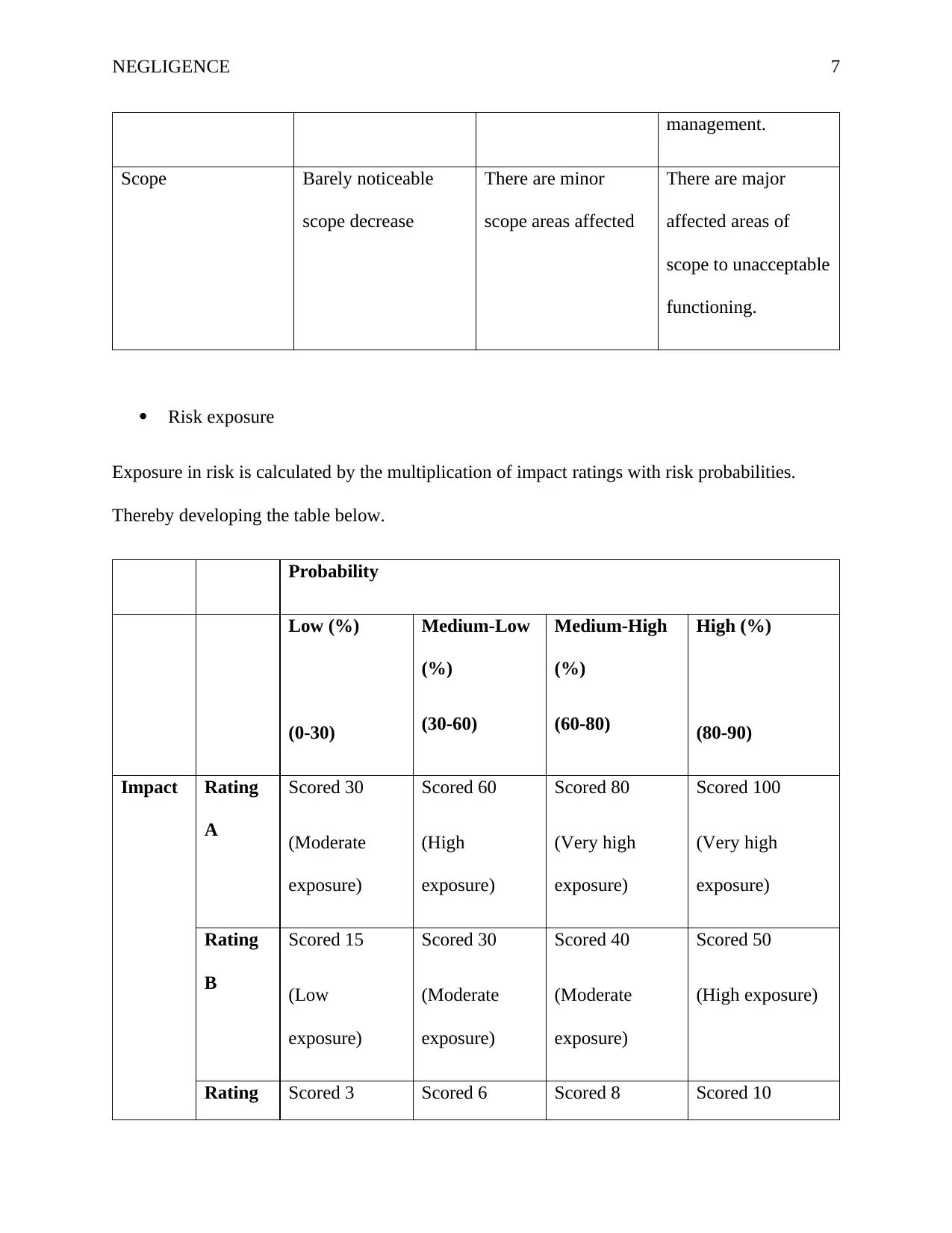
Exposure in risk is calculated by the multiplication of impact ratings with risk probabilities.
Thereby developing the table below.
Probability
Low (%)
(0-30)
Medium-Low
(%)
(30-60)
Medium-High
(%)
(60-80)
High (%)
(80-90)
Impact Rating
A
Scored 30
(Moderate
exposure)
Scored 60
(High
exposure)
Scored 80
(Very high
exposure)
Scored 100
(Very high
exposure)
Rating
B
Scored 15
(Low
exposure)
Scored 30
(Moderate
exposure)
Scored 40
(Moderate
exposure)
Scored 50
(High exposure)
Rating Scored 3 Scored 6 Scored 8 Scored 10
management.
Scope Barely noticeable
scope decrease
There are minor
scope areas affected
There are major
affected areas of
scope to unacceptable
functioning.
Risk exposure
Exposure in risk is calculated by the multiplication of impact ratings with risk probabilities.
Thereby developing the table below.
Probability
Low (%)
(0-30)
Medium-Low
(%)
(30-60)
Medium-High
(%)
(60-80)
High (%)
(80-90)
Impact Rating
A
Scored 30
(Moderate
exposure)
Scored 60
(High
exposure)
Scored 80
(Very high
exposure)
Scored 100
(Very high
exposure)
Rating
B
Scored 15
(Low
exposure)
Scored 30
(Moderate
exposure)
Scored 40
(Moderate
exposure)
Scored 50
(High exposure)
Rating Scored 3 Scored 6 Scored 8 Scored 10
Paraphrase This Document
Need a fresh take? Get an instant paraphrase of this document with our AI Paraphraser

NEGLIGENCE 8
C (Exposure is
low)
(Exposure is
low)
(Exposure is
low)
(Exposure is low)
Timeframe in Risk Occurrence
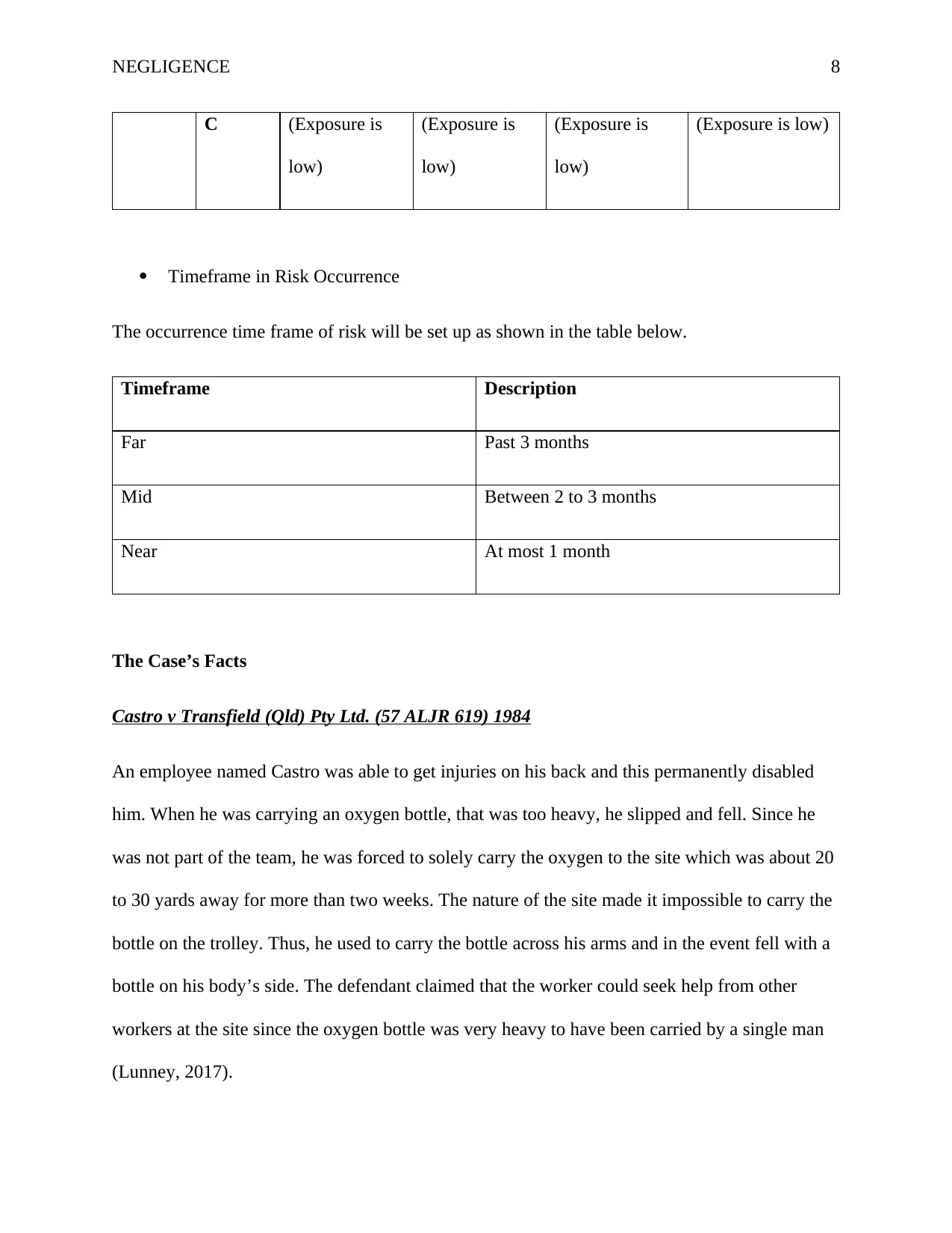
The occurrence time frame of risk will be set up as shown in the table below.
Timeframe Description
Far Past 3 months
Mid Between 2 to 3 months
Near At most 1 month
The Case’s Facts
Castro v Transfield (Qld) Pty Ltd. (57 ALJR 619) 1984
An employee named Castro was able to get injuries on his back and this permanently disabled
him. When he was carrying an oxygen bottle, that was too heavy, he slipped and fell. Since he
was not part of the team, he was forced to solely carry the oxygen to the site which was about 20
to 30 yards away for more than two weeks. The nature of the site made it impossible to carry the
bottle on the trolley. Thus, he used to carry the bottle across his arms and in the event fell with a
bottle on his body’s side. The defendant claimed that the worker could seek help from other
workers at the site since the oxygen bottle was very heavy to have been carried by a single man
(Lunney, 2017).
C (Exposure is
low)
(Exposure is
low)
(Exposure is
low)
(Exposure is low)
Timeframe in Risk Occurrence
The occurrence time frame of risk will be set up as shown in the table below.
Timeframe Description
Far Past 3 months
Mid Between 2 to 3 months
Near At most 1 month
The Case’s Facts
Castro v Transfield (Qld) Pty Ltd. (57 ALJR 619) 1984
An employee named Castro was able to get injuries on his back and this permanently disabled
him. When he was carrying an oxygen bottle, that was too heavy, he slipped and fell. Since he
was not part of the team, he was forced to solely carry the oxygen to the site which was about 20
to 30 yards away for more than two weeks. The nature of the site made it impossible to carry the
bottle on the trolley. Thus, he used to carry the bottle across his arms and in the event fell with a
bottle on his body’s side. The defendant claimed that the worker could seek help from other
workers at the site since the oxygen bottle was very heavy to have been carried by a single man
(Lunney, 2017).

NEGLIGENCE 9
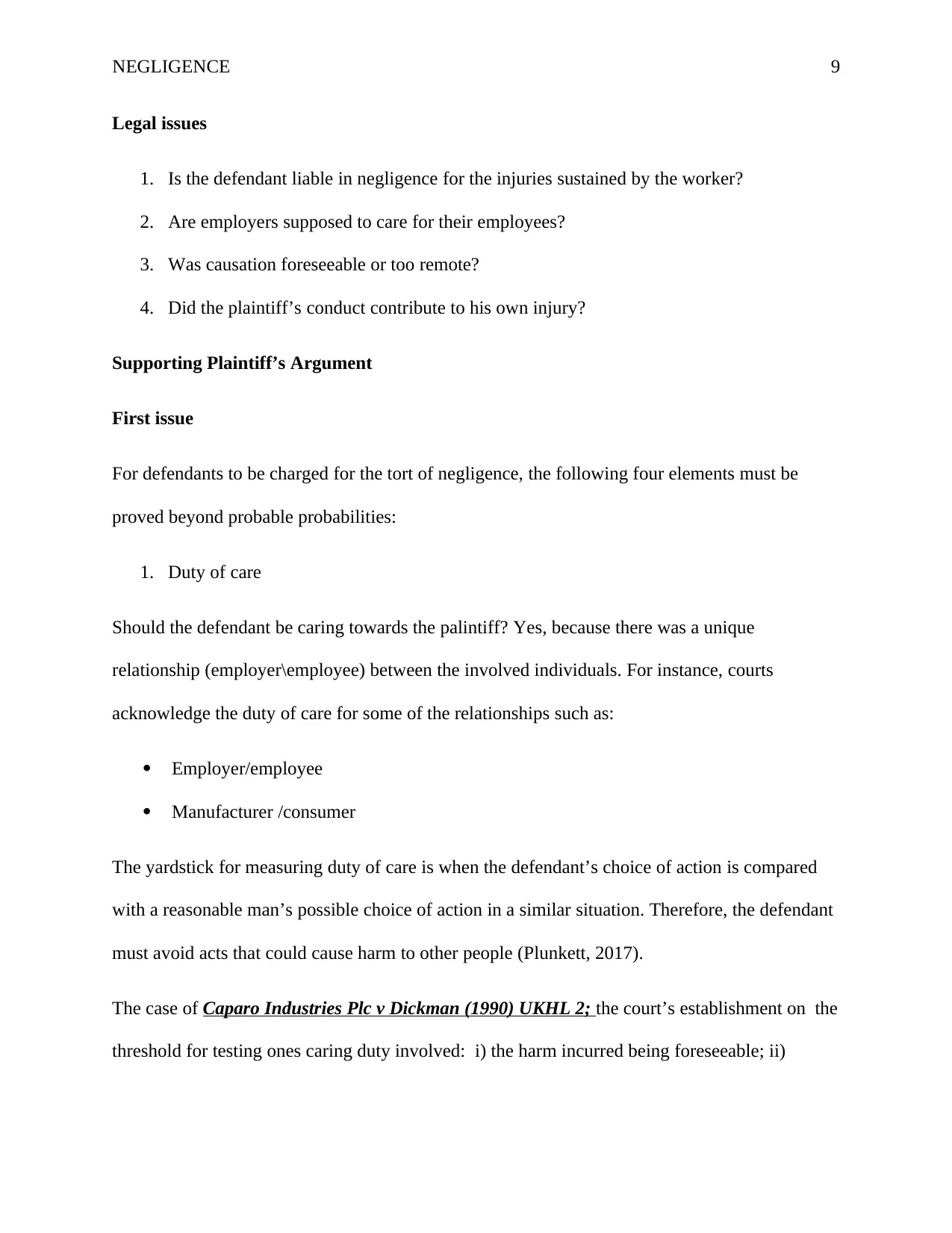
Legal issues
1. Is the defendant liable in negligence for the injuries sustained by the worker?
2. Are employers supposed to care for their employees?
3. Was causation foreseeable or too remote?
4. Did the plaintiff’s conduct contribute to his own injury?
Supporting Plaintiff’s Argument
First issue
For defendants to be charged for the tort of negligence, the following four elements must be
proved beyond probable probabilities:
1. Duty of care
Should the defendant be caring towards the palintiff? Yes, because there was a unique
relationship (employer\employee) between the involved individuals. For instance, courts
acknowledge the duty of care for some of the relationships such as:
Employer/employee
Manufacturer /consumer
The yardstick for measuring duty of care is when the defendant’s choice of action is compared
with a reasonable man’s possible choice of action in a similar situation. Therefore, the defendant
must avoid acts that could cause harm to other people (Plunkett, 2017).
The case of Caparo Industries Plc v Dickman (1990) UKHL 2; the court’s establishment on the
threshold for testing ones caring duty involved: i) the harm incurred being foreseeable; ii)
Legal issues
1. Is the defendant liable in negligence for the injuries sustained by the worker?
2. Are employers supposed to care for their employees?
3. Was causation foreseeable or too remote?
4. Did the plaintiff’s conduct contribute to his own injury?
Supporting Plaintiff’s Argument
First issue
For defendants to be charged for the tort of negligence, the following four elements must be
proved beyond probable probabilities:
1. Duty of care
Should the defendant be caring towards the palintiff? Yes, because there was a unique
relationship (employer\employee) between the involved individuals. For instance, courts
acknowledge the duty of care for some of the relationships such as:
Employer/employee
Manufacturer /consumer
The yardstick for measuring duty of care is when the defendant’s choice of action is compared
with a reasonable man’s possible choice of action in a similar situation. Therefore, the defendant
must avoid acts that could cause harm to other people (Plunkett, 2017).
The case of Caparo Industries Plc v Dickman (1990) UKHL 2; the court’s establishment on the
threshold for testing ones caring duty involved: i) the harm incurred being foreseeable; ii)
⊘ This is a preview!⊘
Do you want full access?
Subscribe today to unlock all pages.

Trusted by 1+ million students worldwide

NEGLIGENCE 10
existence of proximity relationship between the defendant and the plaintiff iii) it must be
reasonable, just and fair to impose liability.
In this context, the defendant was supposed to care for the plaintiff to ensure a safe and secure
working environment for all workers at the site.
2. Breaching the duty of care
Defendants breach their duty of care if his/her actions falls below the expected standard of a
reasonable man. In determining whether there is a breach in such duty, courts set the caring
standard expected in these scenarios, whereby, there must be a linkage between the conduct
exhibited by the dfendant and the harm occasioned (Mulheron, 2016).
The test is if a reasonable person in the similar position of the defendant could have predicted
that the consequences of his actions may have resulted to injuries to the plaintiff. A reasonable
person is expected to do due diligence in order to avoid harm. The courts do not require the
plaintiff to prove the precise manner in which harm occasioned was foreseeable, but it is enough
to prove that it was foreseeably reasonable that the defendant's carelessness could have resulted
to the plaintiff's injury. However, In the case of Australian Traineeship System and Colchester
GR Pty Ltd (Shell Service Station Waverley) V Wafta (2004) NSWCA 230; a worker got
injuries to the back while carrying a corner of a refrigerator’s cabinet display in order to place a
clean mat under the refrigerator. The trial court held the defendant liable for negligence since the
defendant failed to notify employees against lifting the refrigerator’s corners, leading to injuries
sustained by the employee. The injuries were reasonably foreseeable. Upon appeal, the Court of
Appeal overruled the verdict produced in the trial court and clearly defined that the reasonable
employer in the defendant’s state in life could not have predicted that his worker could attempt to
existence of proximity relationship between the defendant and the plaintiff iii) it must be
reasonable, just and fair to impose liability.
In this context, the defendant was supposed to care for the plaintiff to ensure a safe and secure
working environment for all workers at the site.
2. Breaching the duty of care
Defendants breach their duty of care if his/her actions falls below the expected standard of a
reasonable man. In determining whether there is a breach in such duty, courts set the caring
standard expected in these scenarios, whereby, there must be a linkage between the conduct
exhibited by the dfendant and the harm occasioned (Mulheron, 2016).
The test is if a reasonable person in the similar position of the defendant could have predicted
that the consequences of his actions may have resulted to injuries to the plaintiff. A reasonable
person is expected to do due diligence in order to avoid harm. The courts do not require the
plaintiff to prove the precise manner in which harm occasioned was foreseeable, but it is enough
to prove that it was foreseeably reasonable that the defendant's carelessness could have resulted
to the plaintiff's injury. However, In the case of Australian Traineeship System and Colchester
GR Pty Ltd (Shell Service Station Waverley) V Wafta (2004) NSWCA 230; a worker got
injuries to the back while carrying a corner of a refrigerator’s cabinet display in order to place a
clean mat under the refrigerator. The trial court held the defendant liable for negligence since the
defendant failed to notify employees against lifting the refrigerator’s corners, leading to injuries
sustained by the employee. The injuries were reasonably foreseeable. Upon appeal, the Court of
Appeal overruled the verdict produced in the trial court and clearly defined that the reasonable
employer in the defendant’s state in life could not have predicted that his worker could attempt to
Paraphrase This Document
Need a fresh take? Get an instant paraphrase of this document with our AI Paraphraser

NEGLIGENCE 11
lift the refrigerator’s corner without any assistance. The court agreed that is was reasonably
foreseeable that a worker might put back the mat under the refrigerator at an angle in the same
position it was after cleaning it. However, the court held that any reasonable employer could not
have predicted with reason that employees may opt to solely try replacing the mat under the
refrigerator. The court observed that it was fanciful and far-fetched that a reasonable employer
would have foreseen that an experienced worker could try to lift the refrigerator’s corner. The
court held that the risk was too obvious and the employer was not held liable (Horsey & Rackley,
2015).
The calculus of negligence is used to determine the due diligence a reasonable man would have
undertaken to avoid foreseeable risks. A reasonable man will weigh the probable risk and
possible seriousness of the damage against the existing inconveniences and in implementing
specific due diligence measures. It is important to note that the risk must be substantial not too
obvious and that the defendant must have foreseen the risks involved but failed to take
reasonable due diligence to avoid causing harm. Therefore, the defendant, in this case, breached
the responsibility to care when there lacked provision of safe means of transporting the bottle
machine to the site. Also, the defendant failed to warn the employee against carrying it without
assistance (Bermingham & Brennan, 2018).
3. The plaintiff suffering injuries
The plaintiff is supposed to be suffering injuries due to the failure of the defendant to offer care.
The harm must be linked with the defendant’s conduct. Damages may include the following;
Death or personal injuries
Loss of future earnings;
lift the refrigerator’s corner without any assistance. The court agreed that is was reasonably
foreseeable that a worker might put back the mat under the refrigerator at an angle in the same
position it was after cleaning it. However, the court held that any reasonable employer could not
have predicted with reason that employees may opt to solely try replacing the mat under the
refrigerator. The court observed that it was fanciful and far-fetched that a reasonable employer
would have foreseen that an experienced worker could try to lift the refrigerator’s corner. The
court held that the risk was too obvious and the employer was not held liable (Horsey & Rackley,
2015).
The calculus of negligence is used to determine the due diligence a reasonable man would have
undertaken to avoid foreseeable risks. A reasonable man will weigh the probable risk and
possible seriousness of the damage against the existing inconveniences and in implementing
specific due diligence measures. It is important to note that the risk must be substantial not too
obvious and that the defendant must have foreseen the risks involved but failed to take
reasonable due diligence to avoid causing harm. Therefore, the defendant, in this case, breached
the responsibility to care when there lacked provision of safe means of transporting the bottle
machine to the site. Also, the defendant failed to warn the employee against carrying it without
assistance (Bermingham & Brennan, 2018).
3. The plaintiff suffering injuries
The plaintiff is supposed to be suffering injuries due to the failure of the defendant to offer care.
The harm must be linked with the defendant’s conduct. Damages may include the following;
Death or personal injuries
Loss of future earnings;

NEGLIGENCE 12
Loss of expectation of life
4. Causation
It is derived from the word ‘cause’ which implies that liability cannot be imposed on the
defendant unless the claimant proves on a balance of probability that the injuries sustained are
directly or indirectly connected with the defendant’s conduct. It is very important to establish a
link that ties the actions leading to the wrong committed as well as the harm incurred. Where
there is no causal connection then the damage will be too remote and the suit cannot be
sustained. The established test is the ‘but for test’. For instance, injuries would not have been
incurred were it not for the lack of action or omission by the defendant (Green, 2015). There are
two types of causation:
i) Factual
ii) Proximate cause
However, the test cannot be used where there are many causal agents because it would lead to
injustice. Factual causation involves an action that makes it possible to establish causation.
Proximate cause in law is where there exists ways a defendant might have foreseen danger
(Horsey & Rackley, 2015).
Second Issue
Employers are supposed to offer caring acts towards their employees. They should be providing
a safe, clean and secure environment for working. In this scenario, a reasonable employer would
have implemented safer mechanisms of transporting the bottle to the site. The nature of the site
made it impossible to implement better transportation methods such as a trolley. The defendant’s
failure to implement due diligence measures caused harm to the employee (Green, 2015).
Loss of expectation of life
4. Causation
It is derived from the word ‘cause’ which implies that liability cannot be imposed on the
defendant unless the claimant proves on a balance of probability that the injuries sustained are
directly or indirectly connected with the defendant’s conduct. It is very important to establish a
link that ties the actions leading to the wrong committed as well as the harm incurred. Where
there is no causal connection then the damage will be too remote and the suit cannot be
sustained. The established test is the ‘but for test’. For instance, injuries would not have been
incurred were it not for the lack of action or omission by the defendant (Green, 2015). There are
two types of causation:
i) Factual
ii) Proximate cause
However, the test cannot be used where there are many causal agents because it would lead to
injustice. Factual causation involves an action that makes it possible to establish causation.
Proximate cause in law is where there exists ways a defendant might have foreseen danger
(Horsey & Rackley, 2015).
Second Issue
Employers are supposed to offer caring acts towards their employees. They should be providing
a safe, clean and secure environment for working. In this scenario, a reasonable employer would
have implemented safer mechanisms of transporting the bottle to the site. The nature of the site
made it impossible to implement better transportation methods such as a trolley. The defendant’s
failure to implement due diligence measures caused harm to the employee (Green, 2015).
⊘ This is a preview!⊘
Do you want full access?
Subscribe today to unlock all pages.

Trusted by 1+ million students worldwide
1 out of 15
Related Documents
Your All-in-One AI-Powered Toolkit for Academic Success.
+13062052269
info@desklib.com
Available 24*7 on WhatsApp / Email
Unlock your academic potential
Copyright © 2020–2026 A2Z Services. All Rights Reserved. Developed and managed by ZUCOL.