Presentation on Neurobiology of Autism: Current Issues in Biology

Verified

Added on  2023/01/16

|17
|1565
|32
Presentation
AI Summary
This presentation provides an overview of the neurobiology of autism, also known as Autism Spectrum Disorder (ASD). It begins with background information on ASD, including its prevalence, genetic and environmental factors, and heterogeneity. The presentation then analyzes two research articles. The first article investigates the impact of biological sex on the neurobiology of autism, using voxel-based morphometry to identify neuroanatomical differences between males and females with autism. The second article explores the intrinsic brain architecture in autism using the Autism Brain Imaging Data Exchange (ABIDE), focusing on the application of R-fMRI and standardized phenotyping to accelerate discoveries in ASD research. The presentation concludes by discussing the overall biological differences in ASD, the potential of ABIDE for future research, and the need for further investigation into the genetic heterogeneity of the disorder. References include key research papers on the neurobiology of autism.
Document Page
NEUROBIOLOGY
OF
AUTISM
Name of the Student:
Name of the Subject: Current Issues in Biology
Date: 2019
tabler-icon-diamond-filled.svg

Paraphrase This Document

Need a fresh take? Get an instant paraphrase of this document with our AI Paraphraser
Document Page
Presentation Outline
Background Information about the
Current Issue: Neurobiology of Autism
Research Overview of article 1,
Purpose,
Hypothesis,
Methods and
Conclusion
Research Overview of article 2
Purpose,
Hypothesis,
Methods and
Conclusion
Over all Conclusion
Discussion
References
Document Page
Background Information
Introduction:
About Autism: Autism is also known as the autism spectrum
disorder or ASD, it is regarded on the basis of social impairment
in children and adults.
According World Health Organization (2019), the epidemiological
survey 1 in 160 children has AHD. This disorder is observable
during first five years of life. The causes of ASD has been found
in genetic factors as well as environmental factors. However,
more research is required to understand detail of the ASD.
Heterogeneity in case of ASD is an important factor when it
comes to genetic inventions (Willsey & State,2015). According to
Document Page
Background Information
Heterogeneity in case of ASD is an important factor when it comes to genetic
inventions (Willsey & State,2015).
According to Kleijer et al. (2014), inheritance contribute to 40 to 90 % of
ASD, but there are genetic mutations and negative feedback system that
may lead to differences neurobiology o ASD.
tabler-icon-diamond-filled.svg

Paraphrase This Document

Need a fresh take? Get an instant paraphrase of this document with our AI Paraphraser
Document Page
Biological Sex affects the neurobiology of the
brain
(Lai et al. 2013)
Research Overview of article 1:
Purpose: The purpose is to understand the heterogeneity in the
biological sex when it comes to Autism. To understand the
neuroanatomical difference in males and females with respect to
autism.
Hypothesis: Neuroanatomical differences in males and
females, Autism may be different in relation with biological sex.
Document Page
Biological Sex affects the neurobiology of
the brain
(Lai et al. 2013)
Methods
Voxel based morphometry method, for measuring the volumetric difference in
brain and mass in to statistical framework.
Total number of participants: 120 (Age around: 18-49 years)
Autistic : 30 males and 30 females (right-handed pre-menopausal)
Neurotypical: 30 males and 30 females
All the participants were scanned by the MRI scanner
Document Page
Lai, M. C., Lombardo, M. V., Suckling, J., Ruigrok, A. N., Chakrabarti, B., Ecker, C., ... & MRC AIMS Consortium. (2013). Biological sex affects the
neurobiology of autism. Brain, 136(9), 2799-2815.
The content of this slide may be subject to copyright: please see the slide notes for details.
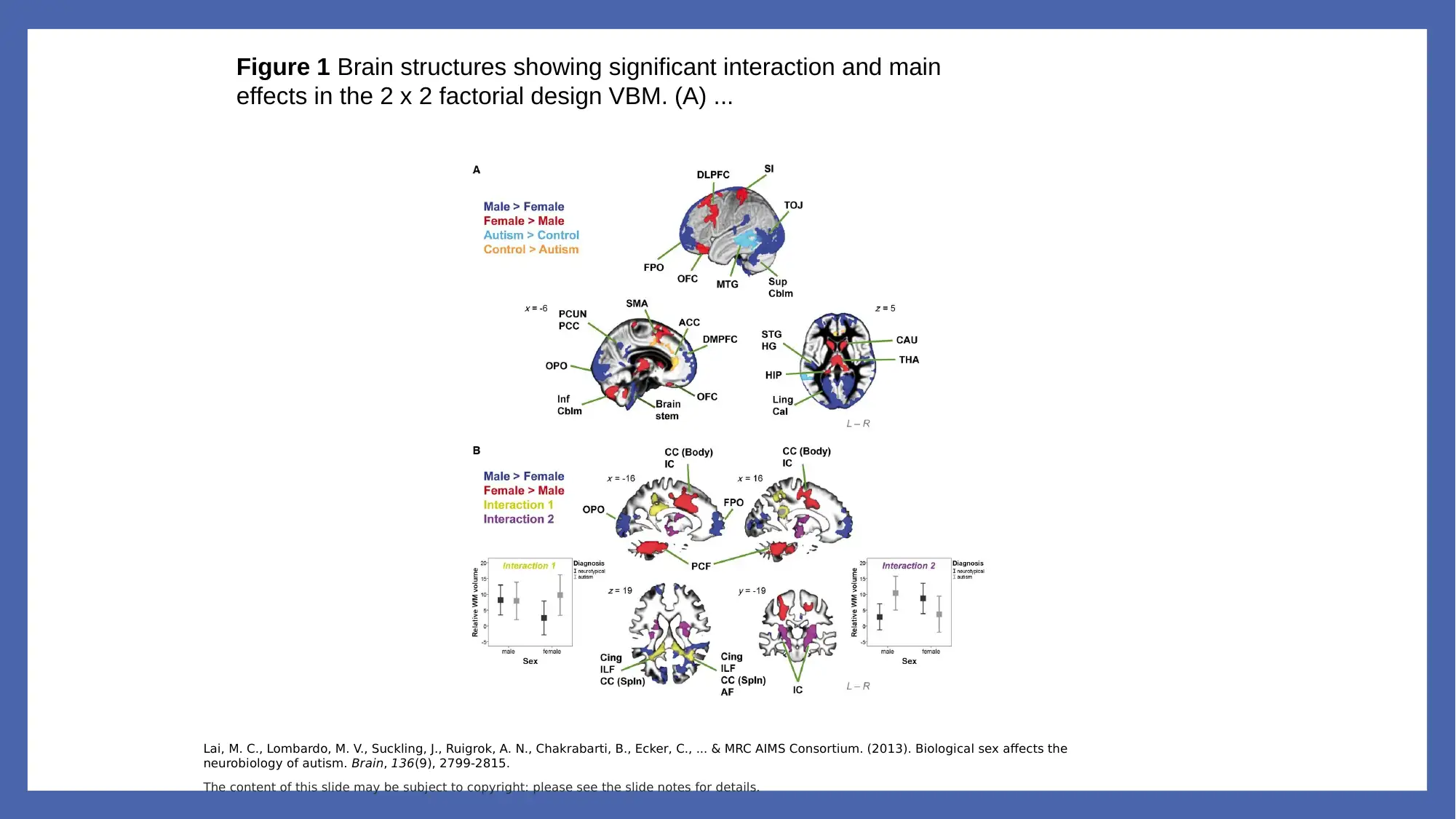
Figure 1 Brain structures showing significant interaction and main
effects in the 2 x 2 factorial design VBM. (A) ...
tabler-icon-diamond-filled.svg

Paraphrase This Document

Need a fresh take? Get an instant paraphrase of this document with our AI Paraphraser
Document Page
Biological Sex affects the neurobiology of
the brain
(Lai et al. 2013)
Conclusion: From the findings it was revealed that females has fewer behavioral
characteristics of autism, observed in interpersonal interaction, however slightly,
higher when self-report autistic traits were observed. It can be further observed
form the diagram that the EMB theory about autism were observable in females.
However, future study needs to be conducted to understand the influence of sex
chromosomes on the neurobiological changes when it comes to autism.
Document Page
The Autism Brain Imaging Data Exchange: Towards
Large-Scale Evaluation of the Intrinsic Brain
Architecture in Autism (Di Martino et al., 2013)
Research Overview of article 2:
Purpose: To understand the intrinsic architecture in Autism, when it comes to
autism a by using (Autism Brain Imaging Data Exchange) or ABIDE.
Hypothesis: To conceptualize, ABIDE and reflect on the applicability and adoption of
standardized protocols. It is expected that ABIDE would be able to accelerated the
process of analyzing and discovering in terms of future next generation ASD studies.
Document Page
The Autism Brain Imaging Data Exchange:
Towards Large-Scale Evaluation of the
Intrinsic Brain Architecture in Autism (Di
Martino et al., 2013)
Methods
R-MRI (Functional Magnetic Resonance Imaging)
Phenotypic information from: 539 people with Autism Spectrum Disorder
Age matched typical control or TC: 573 people Age around: 7-64 years old
All the participants were scanned by the MRI scanner
tabler-icon-diamond-filled.svg

Paraphrase This Document

Need a fresh take? Get an instant paraphrase of this document with our AI Paraphraser
Document Page
The Autism Brain Imaging Data Exchange: Towards Large-Scale
Evaluation of the Intrinsic Brain Architecture in Autism (Di Martino
et al., 2013)
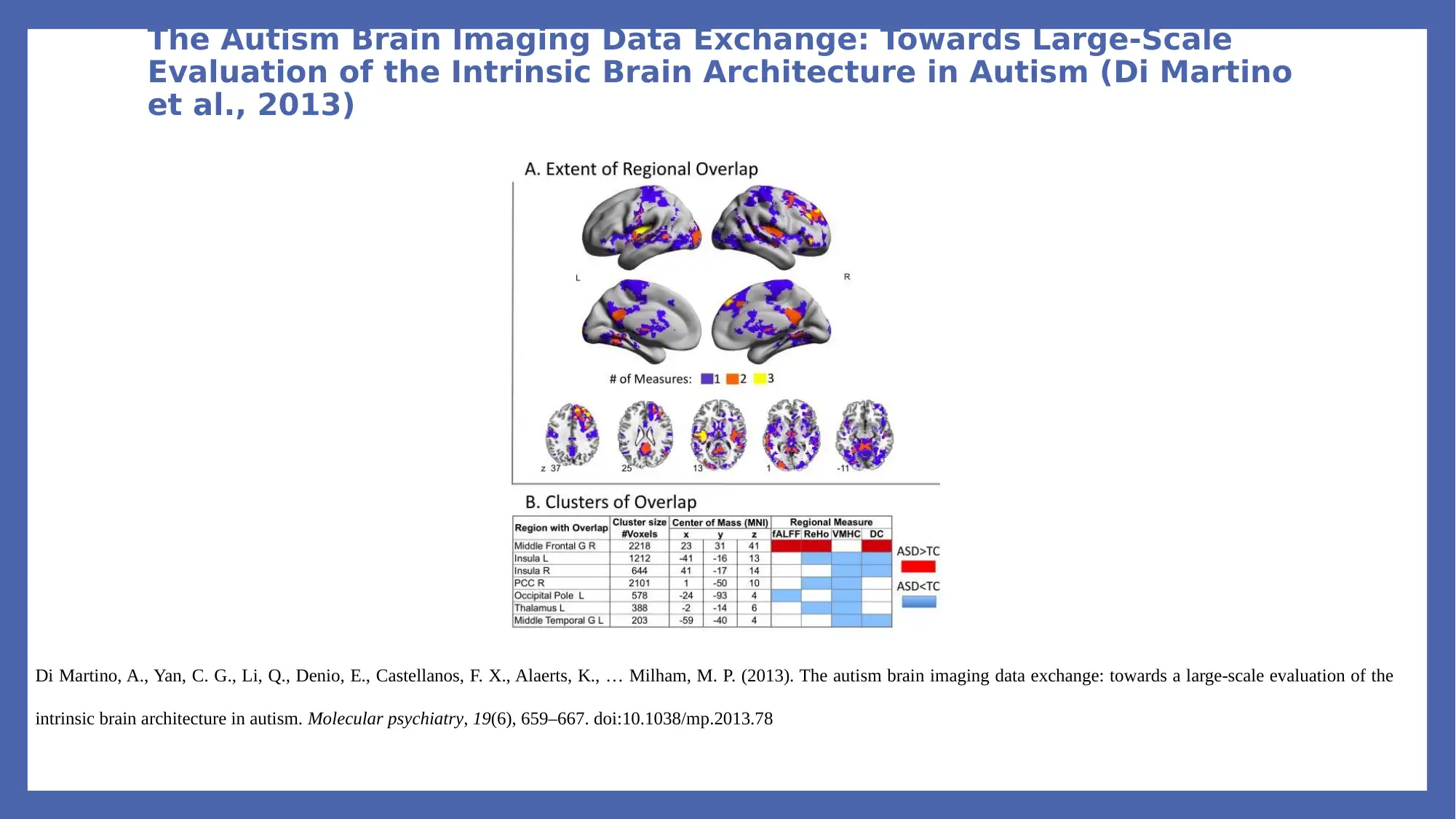
Di Martino, A., Yan, C. G., Li, Q., Denio, E., Castellanos, F. X., Alaerts, K., … Milham, M. P. (2013). The autism brain imaging data exchange: towards a large-scale evaluation of the
intrinsic brain architecture in autism. Molecular psychiatry, 19(6), 659–667. doi:10.1038/mp.2013.78
Document Page
The Autism Brain Imaging Data Exchange:
Towards Large-Scale Evaluation of the
Intrinsic Brain Architecture in Autism (Di
Martino et al., 2013)
Conclusion: The application of ABIDE, would enable accelerated
discovery effort in terms of R-fMRI, along with standardized
phenotyping. The findings suggest that there are intrinsic functional
architecture, which are the neural signs of ASD remains unchanged.
This will provide extended diagnostic assessment in terms of ASD.
chevron_up_icon
1 out of 17
circle_padding
hide_on_mobile
zoom_out_icon
[object Object]