New Public Management: Birmingham Community NHS Foundation Trust
VerifiedAdded on 2023/05/29
|15
|4168
|466
Essay
AI Summary
This essay examines the application of New Public Management (NPM) theory within Birmingham Community NHS Foundation Trust, focusing on its objectives, benefits, and shortcomings. NPM, designed to make the public sector more efficient by adopting private-sector management practices, is analyzed in the context of the healthcare sector. The essay discusses how Birmingham Community NHS Foundation Trust has implemented NPM principles such as decentralization, performance management, and output control to improve customer service and organizational efficiency. It highlights the use of performance appraisals, employee training, and flexible work arrangements to enhance employee motivation and retention. The essay also touches on the challenges and policy reforms necessary for successful NPM implementation in the healthcare sector, emphasizing the importance of aligning employee goals with organizational objectives and addressing work-life balance to maintain a competitive edge.

Name 1
Application of New Public Management Theory in Birmingham Community NHS Foundation
Trust
Student’s Name
University
Date
Instructor
Application of New Public Management Theory in Birmingham Community NHS Foundation
Trust
Student’s Name
University
Date
Instructor

Paraphrase This Document
Need a fresh take? Get an instant paraphrase of this document with our AI Paraphraser
Name 2
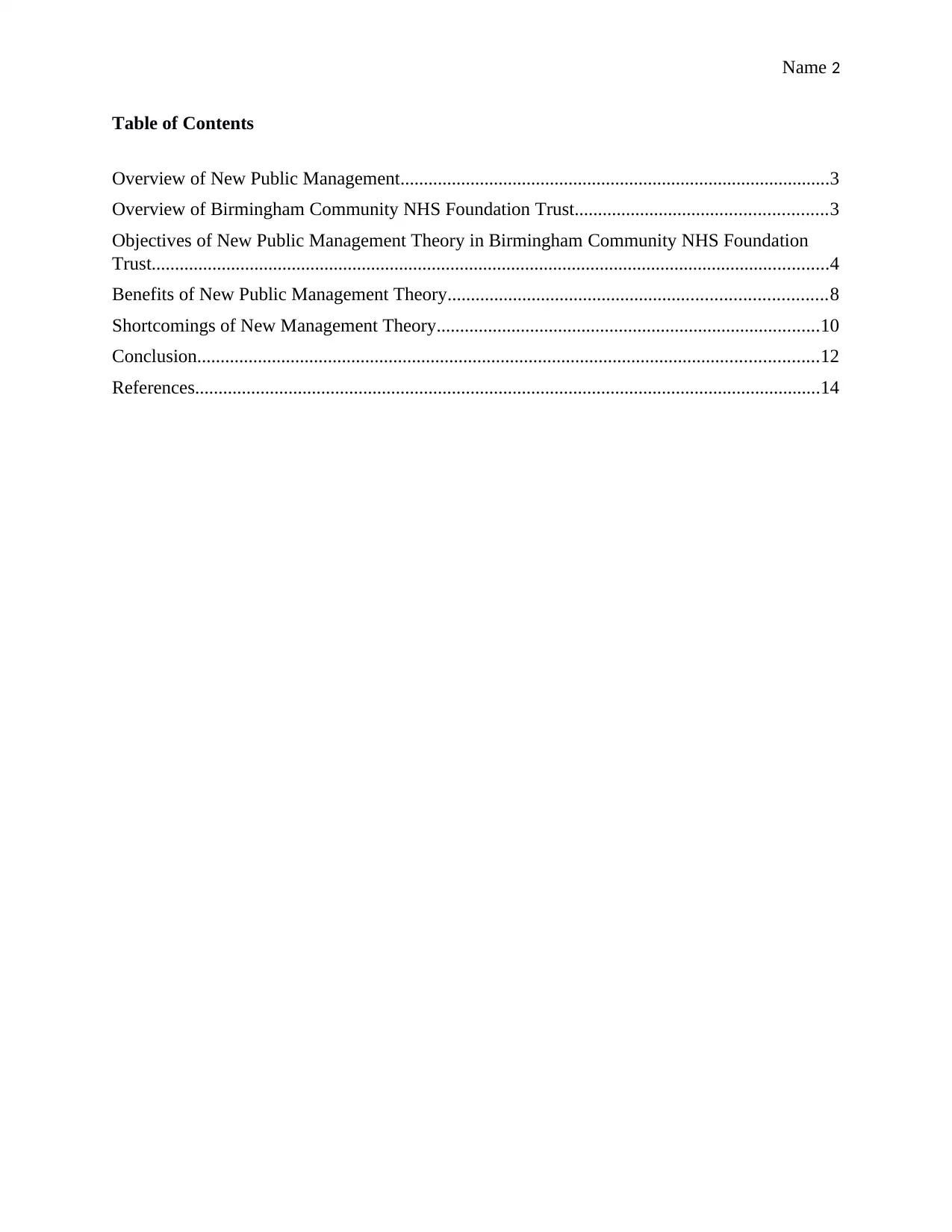
Table of Contents
Overview of New Public Management............................................................................................3
Overview of Birmingham Community NHS Foundation Trust......................................................3
Objectives of New Public Management Theory in Birmingham Community NHS Foundation
Trust.................................................................................................................................................4
Benefits of New Public Management Theory.................................................................................8
Shortcomings of New Management Theory..................................................................................10
Conclusion.....................................................................................................................................12
References......................................................................................................................................14
Table of Contents
Overview of New Public Management............................................................................................3
Overview of Birmingham Community NHS Foundation Trust......................................................3
Objectives of New Public Management Theory in Birmingham Community NHS Foundation
Trust.................................................................................................................................................4
Benefits of New Public Management Theory.................................................................................8
Shortcomings of New Management Theory..................................................................................10
Conclusion.....................................................................................................................................12
References......................................................................................................................................14
Name 3
Application of New Public Management Theory in Birmingham Community NHS
Foundation Trust
Overview of New Public Management
New public management theory was conceived as an approach for running the public
service organizations as an effort to make the public sector more productive through a
businesslike nature where models are applied to increase efficiency as seen in the private sector
agencies. This was developed at a time when the public was losing interest due to competition
from the private sector which seemed to offer better services. This means that the theory can be
applied both at the national and lower level government to increase service delivery in the public
sector (Khademian 1998, p. 271). The origins of this theory can be traced back to the 1980s
where academicians in the UK and Australia developed strategies to reform the public sector
from the management challenges being faced at that time. According to Cameron (2009), the
theory was applied in the form of reforms that on increased service delivery through a shift in
perceptions that sought to ensure public servants are more accountable to the duties that they
perform and the results that they deliver. The outcome of this theory, therefore, was to offer
practical solutions to the challenges faced by government agencies. The outcome was an
effective and efficient public system achieved through the principles of management,
performance, and output control, decentralization, adopting the private sector style of
management, cost, and competition.
Overview of Birmingham Community NHS Foundation Trust
The healthcare sector is one of the challenging sectors in the public sector to manage.
This is because performance is far beyond the indicators of life expectancy and infant mortality
cannot be used to assess the level of performance in public healthcare agencies. This is because
Application of New Public Management Theory in Birmingham Community NHS
Foundation Trust
Overview of New Public Management
New public management theory was conceived as an approach for running the public
service organizations as an effort to make the public sector more productive through a
businesslike nature where models are applied to increase efficiency as seen in the private sector
agencies. This was developed at a time when the public was losing interest due to competition
from the private sector which seemed to offer better services. This means that the theory can be
applied both at the national and lower level government to increase service delivery in the public
sector (Khademian 1998, p. 271). The origins of this theory can be traced back to the 1980s
where academicians in the UK and Australia developed strategies to reform the public sector
from the management challenges being faced at that time. According to Cameron (2009), the
theory was applied in the form of reforms that on increased service delivery through a shift in
perceptions that sought to ensure public servants are more accountable to the duties that they
perform and the results that they deliver. The outcome of this theory, therefore, was to offer
practical solutions to the challenges faced by government agencies. The outcome was an
effective and efficient public system achieved through the principles of management,
performance, and output control, decentralization, adopting the private sector style of
management, cost, and competition.
Overview of Birmingham Community NHS Foundation Trust
The healthcare sector is one of the challenging sectors in the public sector to manage.
This is because performance is far beyond the indicators of life expectancy and infant mortality
cannot be used to assess the level of performance in public healthcare agencies. This is because
⊘ This is a preview!⊘
Do you want full access?
Subscribe today to unlock all pages.

Trusted by 1+ million students worldwide
Name 4
the government used to see efficiency in healthcare as a budget discipline, while the private
sector sees this as market expansion while on the other hand patients see efficiency in waiting
time (Greve 2006, p. 163). Therefore, when applying new public management theory in
healthcare, the reforms in the UK government were organized in a political manner through new
policies that sought to change the way the sector functioned and increase customer satisfaction.
This is because the healthcare system is defined as a rapidly changing environment where the
needs of clients keeps on changing. Birmingham Community NHS Foundation Trust is one of
the leading community hospitals that have applied the new public management theory in
improving customer service and creating efficiency in the workplace (Birmingham Community
Healthcare NHS Foundation Trust 2018, pp.3). The hospital has especially included this theory
in meeting its needs by ensuring that performance management is implemented in different ways
within the organization.
Objectives of New Public Management Theory in Birmingham Community NHS
Foundation Trust
The reason why the new public management was developed was to change the public
healthcare system to make it competitive. This means that several objectives had to be set based
on the principle of the theory (Newman & Lawler 2009, 425). The first objective of the theory
was to decentralize the healthcare system as a way of reducing the level of bureaucracy and
hierarchies that existed. Since the theory relies heavily on applying the strategies at both the
national and local level, thus allowing healthcare decisions to be handled at the local level to
meet the specific needs of the clients that they serve. Saltman, Bankauskaite & Vrangbaek (2007,
p. 11) suggests that through decentralizing the healthcare system, the UK government reduced
the width and depth of the decision space to allow increased outcomes. By decentralizing
the government used to see efficiency in healthcare as a budget discipline, while the private
sector sees this as market expansion while on the other hand patients see efficiency in waiting
time (Greve 2006, p. 163). Therefore, when applying new public management theory in
healthcare, the reforms in the UK government were organized in a political manner through new
policies that sought to change the way the sector functioned and increase customer satisfaction.
This is because the healthcare system is defined as a rapidly changing environment where the
needs of clients keeps on changing. Birmingham Community NHS Foundation Trust is one of
the leading community hospitals that have applied the new public management theory in
improving customer service and creating efficiency in the workplace (Birmingham Community
Healthcare NHS Foundation Trust 2018, pp.3). The hospital has especially included this theory
in meeting its needs by ensuring that performance management is implemented in different ways
within the organization.
Objectives of New Public Management Theory in Birmingham Community NHS
Foundation Trust
The reason why the new public management was developed was to change the public
healthcare system to make it competitive. This means that several objectives had to be set based
on the principle of the theory (Newman & Lawler 2009, 425). The first objective of the theory
was to decentralize the healthcare system as a way of reducing the level of bureaucracy and
hierarchies that existed. Since the theory relies heavily on applying the strategies at both the
national and local level, thus allowing healthcare decisions to be handled at the local level to
meet the specific needs of the clients that they serve. Saltman, Bankauskaite & Vrangbaek (2007,
p. 11) suggests that through decentralizing the healthcare system, the UK government reduced
the width and depth of the decision space to allow increased outcomes. By decentralizing
Paraphrase This Document
Need a fresh take? Get an instant paraphrase of this document with our AI Paraphraser
Name 5
nursing, in the UK, most acute hospitals have been given the opportunity to meet the needs of
employees and achieve government healthcare targets thus meeting the best results for the
organization. In such case, Birmingham Community NHS Foundation Trust has been able to
carry out several community and health-related functions that previously required permissions
from the ministry. This reduces the bottlenecks and the level of the hierarchy that exists in the
sector.
Another objective of the new public management theory is the performance which is seen
in the continuous monitoring of employee performance through key indicators. Anon (2010, p.
131) suggests that performance management is used in the organization to align employees with
the business strategy. This means that employees work practices have to be designed in a way
that meets the requirements of the new public management theory. In performance management,
managers and employees work together to develop strategies that can be used to meet the needs
of the organization and at the same time create conditions that increase employee performance.
In most cases, employees require strategies that can be used to improve their performance
through ways that address employee development. To find the requirement of performance
management, employees are appraised to set their goals and at the same time work with
management to ensure that the goals are aligned with organizational processes (Hakulinen,
Rissanen &Lammintakanen 2011, p. 15). Since indicators are used to measure how the employee
had performed and any challenges that may be faced by the employee. It is important that
management use performance management to work on employee areas that need improvement.
Explicit standards and measures of performance have to be set through defined indicators that are
set at the beginning of the year and analyzed at the end of the year.
nursing, in the UK, most acute hospitals have been given the opportunity to meet the needs of
employees and achieve government healthcare targets thus meeting the best results for the
organization. In such case, Birmingham Community NHS Foundation Trust has been able to
carry out several community and health-related functions that previously required permissions
from the ministry. This reduces the bottlenecks and the level of the hierarchy that exists in the
sector.
Another objective of the new public management theory is the performance which is seen
in the continuous monitoring of employee performance through key indicators. Anon (2010, p.
131) suggests that performance management is used in the organization to align employees with
the business strategy. This means that employees work practices have to be designed in a way
that meets the requirements of the new public management theory. In performance management,
managers and employees work together to develop strategies that can be used to meet the needs
of the organization and at the same time create conditions that increase employee performance.
In most cases, employees require strategies that can be used to improve their performance
through ways that address employee development. To find the requirement of performance
management, employees are appraised to set their goals and at the same time work with
management to ensure that the goals are aligned with organizational processes (Hakulinen,
Rissanen &Lammintakanen 2011, p. 15). Since indicators are used to measure how the employee
had performed and any challenges that may be faced by the employee. It is important that
management use performance management to work on employee areas that need improvement.
Explicit standards and measures of performance have to be set through defined indicators that are
set at the beginning of the year and analyzed at the end of the year.
Name 6
In Birmingham, Community Healthcare NHS Foundation Trust staff are required to sign
appraisal forms where they set goals that reflect the needs of the organization. This means that
each employee must sign a form that will be assessed at the end of the working year. Employee
needs will be determined from the appraisal tools since they will have areas where the employee
justifies why the results have not been achieved and how the organization can assist the
employee to improve. This forms the performance improvement plan that the organization
develops to improve employee performance. This process is mostly achieved through the role of
the medical director who is in charge of advising the organization on performance management
issues, appraisal, and development of employees. This role also includes workforce planning
that defines the resources that the organization needs and understanding the right mix of
employees based on the requirements of the organization.
According to the Birmingham Community Healthcare NHS Foundation Trust, 2018) the
human resource department in the hospital uses the employee survey results to develop plans for
retaining staff and at the same time develop specific reward packages through developing a
capacity and capability matrix that ensures employees are adequately trained. The organization
uses training and development as a tool for developing a competitive advantage by ensuring that
employees develop the required competencies. The core concern of new public management
theory is to increase customer service by ensuring that staff understand customer requirements
and then aligning them with customer goals. For the facility, training and development is
achieved through quality priority one which seeks to train employees as a way of empowering
them to achieve organizational goals and at the same time sole organizational challenges that are
derived from previously evaluated reports (Birmingham Community Healthcare, 2018).
In Birmingham, Community Healthcare NHS Foundation Trust staff are required to sign
appraisal forms where they set goals that reflect the needs of the organization. This means that
each employee must sign a form that will be assessed at the end of the working year. Employee
needs will be determined from the appraisal tools since they will have areas where the employee
justifies why the results have not been achieved and how the organization can assist the
employee to improve. This forms the performance improvement plan that the organization
develops to improve employee performance. This process is mostly achieved through the role of
the medical director who is in charge of advising the organization on performance management
issues, appraisal, and development of employees. This role also includes workforce planning
that defines the resources that the organization needs and understanding the right mix of
employees based on the requirements of the organization.
According to the Birmingham Community Healthcare NHS Foundation Trust, 2018) the
human resource department in the hospital uses the employee survey results to develop plans for
retaining staff and at the same time develop specific reward packages through developing a
capacity and capability matrix that ensures employees are adequately trained. The organization
uses training and development as a tool for developing a competitive advantage by ensuring that
employees develop the required competencies. The core concern of new public management
theory is to increase customer service by ensuring that staff understand customer requirements
and then aligning them with customer goals. For the facility, training and development is
achieved through quality priority one which seeks to train employees as a way of empowering
them to achieve organizational goals and at the same time sole organizational challenges that are
derived from previously evaluated reports (Birmingham Community Healthcare, 2018).
⊘ This is a preview!⊘
Do you want full access?
Subscribe today to unlock all pages.
Trusted by 1+ million students worldwide
Name 7
Another objective of the theory in the hospital is hands-on professional management that
focusses on developing better ways of addressing issues that affect the organization. this means
that the managers have to be free to lead and manage through engaging with employees in an
active, visible and discretionary manner that allows them to control through a clear assignment
of responsibilities. For example, the quality management department is charged with the
responsibility of gathering employee related data to be used in determining the best way to
improve quality. To meet quality standards under performance management, the hospital has
established the Care Quality Commission inspection teams that use a set of five domains that
focus on safety, effectiveness, caring, responsiveness, and well leadership which is abbreviated
as “CREWS”. Questions asked around these domains are used to establish best practices for
implementing performance management and improvement. These domains are used to identify
quality improvement areas for the organization that can be applied to ensure challenges and
barriers to implementation are addressed. The findings and issues raised by employees are used
to develop quality improvement strategies in the organization. As such Birmingham has achieved
quality standards through the use of the domains and applying the basis of the new public
management theory.
Output control strategy of the theory is also used in the organization to increase
organizational performance. This entails allocating resource to high performing areas and using
them to motivate employees to work harder. This means that the hospital invests heavily in the
human resource team since this is part of achieving the intended results. In most cases, the public
sector has been criticized due to the lack of incentives that make people interested in the jobs that
they offer. To address this challenge Birmingham Community NHS Foundation Trust offers staff
benefits that increase the work-life balance benefits that employees receive from the
Another objective of the theory in the hospital is hands-on professional management that
focusses on developing better ways of addressing issues that affect the organization. this means
that the managers have to be free to lead and manage through engaging with employees in an
active, visible and discretionary manner that allows them to control through a clear assignment
of responsibilities. For example, the quality management department is charged with the
responsibility of gathering employee related data to be used in determining the best way to
improve quality. To meet quality standards under performance management, the hospital has
established the Care Quality Commission inspection teams that use a set of five domains that
focus on safety, effectiveness, caring, responsiveness, and well leadership which is abbreviated
as “CREWS”. Questions asked around these domains are used to establish best practices for
implementing performance management and improvement. These domains are used to identify
quality improvement areas for the organization that can be applied to ensure challenges and
barriers to implementation are addressed. The findings and issues raised by employees are used
to develop quality improvement strategies in the organization. As such Birmingham has achieved
quality standards through the use of the domains and applying the basis of the new public
management theory.
Output control strategy of the theory is also used in the organization to increase
organizational performance. This entails allocating resource to high performing areas and using
them to motivate employees to work harder. This means that the hospital invests heavily in the
human resource team since this is part of achieving the intended results. In most cases, the public
sector has been criticized due to the lack of incentives that make people interested in the jobs that
they offer. To address this challenge Birmingham Community NHS Foundation Trust offers staff
benefits that increase the work-life balance benefits that employees receive from the
Paraphrase This Document
Need a fresh take? Get an instant paraphrase of this document with our AI Paraphraser
Name 8
organization. For example, a range of flexible work practices are provided through childcare
vouchers, cycle to work scheme, season tickets, holidays, flexible working and Birmingham
Hospital Saturday Fund.
According to Hall (2018, PP. 2), study, only a third of employees in the UK are happy
with work-life balance which means that most organizations and agencies are not addressing this
issues. Work-life-balance is an important element of employee motivation since it addressed the
intrinsic issues that revolve around the job. Most scholars have argued that intrinsic elements of
the job like work-life-balance and flexibility are important since they motivate the employee
more as compared to extrinsic elements like reward system (Lee, Gerhart, Weller & Trevor
2008, p. 663). This is because rewards are based on something tangible while intrinsic
motivators seek to create conditions that make work more appropriate, enjoyable and
meaningful.
The role of all these flexible work arrangements is to ensure that the organization
remains competitive and is able to retain employees. In the UK the public sector has had little
preference by most young professionals since it lacks work flexibility patterns ideal for the
millennial workforce (Pritchard 2008, p. 16). Unlike the baby boomers and generation group,
employees who fall under the millennial category require flexible work arrangements that make
it easy to achieve work-life balance. As such the hospital has also adopted this strategy to create
a public environment that is as competitive as the public sector. This reduces employee turnover
and increases talent attraction.
Benefits of New Public Management Theory
The application of the theory in the healthcare sector has been argued by most people as
political thus requiring adequate policy reforms to meet the needs of the theory. Haynes (2018, p.
organization. For example, a range of flexible work practices are provided through childcare
vouchers, cycle to work scheme, season tickets, holidays, flexible working and Birmingham
Hospital Saturday Fund.
According to Hall (2018, PP. 2), study, only a third of employees in the UK are happy
with work-life balance which means that most organizations and agencies are not addressing this
issues. Work-life-balance is an important element of employee motivation since it addressed the
intrinsic issues that revolve around the job. Most scholars have argued that intrinsic elements of
the job like work-life-balance and flexibility are important since they motivate the employee
more as compared to extrinsic elements like reward system (Lee, Gerhart, Weller & Trevor
2008, p. 663). This is because rewards are based on something tangible while intrinsic
motivators seek to create conditions that make work more appropriate, enjoyable and
meaningful.
The role of all these flexible work arrangements is to ensure that the organization
remains competitive and is able to retain employees. In the UK the public sector has had little
preference by most young professionals since it lacks work flexibility patterns ideal for the
millennial workforce (Pritchard 2008, p. 16). Unlike the baby boomers and generation group,
employees who fall under the millennial category require flexible work arrangements that make
it easy to achieve work-life balance. As such the hospital has also adopted this strategy to create
a public environment that is as competitive as the public sector. This reduces employee turnover
and increases talent attraction.
Benefits of New Public Management Theory
The application of the theory in the healthcare sector has been argued by most people as
political thus requiring adequate policy reforms to meet the needs of the theory. Haynes (2018, p.
Name 9
5) adds that to implement the theory, the government had to develop policies reforms that have
seen the implementation of the theory. These policies were used to meet the needs of the sector
since they allowed healthcare agencies to implement sector-specific reforms and policies that
have seen improved service delivery. Since the public sector is known for a certain set of
principles that the employees regard, then it means that this could only be achieved through
specific sector reforms to meet the requirements of the theory.
Maor (1999, p. 7) suggests that the major benefit of New Public Management theory is
increased efficiency and effectiveness of the healthcare system in Birmingham Community NHS
Foundation Trust. This is due to the decentralization element of the healthcare that allows real-
time decision making in the sector. This means that hospitals have been empowered to make
healthcare decisions that relate to the services that they offer and the type of clients they serve.
Since hospitals have different departments, managers are required to make real-time decisions
that can improve the quality of healthcare that patients receive. The next galaxy.com (2018) adds
that decentralized systems reduce unnecessary bottlenecks which make it easy to achieve the
intended benefits and at the same time reduce public spending. Since NHS is facing funding
challenges, then it becomes tricky for the organization to implement most elements of the theory
due to financial challenges.
For Birmingham, Community NHS Foundation Trust implementing the strategies of the
theory have increased organizational performance and efficiency. Kowalczyk (2002, p. 121)
suggests that through the use of a performance management system, the hospital has been able to
set targets with employees that are aligned with organizational goals. This calls for the need to
ensure that quality standards are maintained through quality assessment to identify the specific
areas that employees require development. With this, training and development are used to
5) adds that to implement the theory, the government had to develop policies reforms that have
seen the implementation of the theory. These policies were used to meet the needs of the sector
since they allowed healthcare agencies to implement sector-specific reforms and policies that
have seen improved service delivery. Since the public sector is known for a certain set of
principles that the employees regard, then it means that this could only be achieved through
specific sector reforms to meet the requirements of the theory.
Maor (1999, p. 7) suggests that the major benefit of New Public Management theory is
increased efficiency and effectiveness of the healthcare system in Birmingham Community NHS
Foundation Trust. This is due to the decentralization element of the healthcare that allows real-
time decision making in the sector. This means that hospitals have been empowered to make
healthcare decisions that relate to the services that they offer and the type of clients they serve.
Since hospitals have different departments, managers are required to make real-time decisions
that can improve the quality of healthcare that patients receive. The next galaxy.com (2018) adds
that decentralized systems reduce unnecessary bottlenecks which make it easy to achieve the
intended benefits and at the same time reduce public spending. Since NHS is facing funding
challenges, then it becomes tricky for the organization to implement most elements of the theory
due to financial challenges.
For Birmingham, Community NHS Foundation Trust implementing the strategies of the
theory have increased organizational performance and efficiency. Kowalczyk (2002, p. 121)
suggests that through the use of a performance management system, the hospital has been able to
set targets with employees that are aligned with organizational goals. This calls for the need to
ensure that quality standards are maintained through quality assessment to identify the specific
areas that employees require development. With this, training and development are used to
⊘ This is a preview!⊘
Do you want full access?
Subscribe today to unlock all pages.
Trusted by 1+ million students worldwide
Name 10
increase employee performance and customer service since employees are empowered on how
they can create better service delivery (Behn 1995, p. 313). The theory success in the public
sector has been highly attributed to the increase in pressure for management which has reformed
most public sector areas in the UK. The use of performance appraisal and management tools
have led to increased customer delivery since public servants are assessed based on their
delivery.
Another benefit of the theory is its ability to be tailored towards the needs of the
healthcare sector. Due to the pressure for public sector reforms, the theory offers room for
tailoring the public sector industries like healthcare agencies with the theory to increase
effectiveness (Hood 2015, p. 189). This means that some aspects of the theory can be applied at
the national level while other reforms can be employed at the local level which makes it easy for
the organization to achieve the intended benefits. For Birmingham Community NHS Foundation
Trust, this has been seen through the “CREWS” strategy that seeks to achieve quality standards
in the organization thus making it easy for management to monitor quality issues in the
organization
Shortcomings of New Management Theory
One major shortcoming of implementing new public management theory is the fact that it
faces the challenge of externally imposed structures in the healthcare sector. Despite the fact that
healthcare has been decentralized, there are challenges in implementing the strategy because
structures are externally imposed by the central government. This means that hospitals have a
structure that is restricted from above on how they need to meet healthcare needs (Fryer, Anthiny
& Ogden 2009, p. 481). Although it is easy to implement the theory in some aspects of the
organization, there are hierarchy challenges that are presented by most organizations since they
increase employee performance and customer service since employees are empowered on how
they can create better service delivery (Behn 1995, p. 313). The theory success in the public
sector has been highly attributed to the increase in pressure for management which has reformed
most public sector areas in the UK. The use of performance appraisal and management tools
have led to increased customer delivery since public servants are assessed based on their
delivery.
Another benefit of the theory is its ability to be tailored towards the needs of the
healthcare sector. Due to the pressure for public sector reforms, the theory offers room for
tailoring the public sector industries like healthcare agencies with the theory to increase
effectiveness (Hood 2015, p. 189). This means that some aspects of the theory can be applied at
the national level while other reforms can be employed at the local level which makes it easy for
the organization to achieve the intended benefits. For Birmingham Community NHS Foundation
Trust, this has been seen through the “CREWS” strategy that seeks to achieve quality standards
in the organization thus making it easy for management to monitor quality issues in the
organization
Shortcomings of New Management Theory
One major shortcoming of implementing new public management theory is the fact that it
faces the challenge of externally imposed structures in the healthcare sector. Despite the fact that
healthcare has been decentralized, there are challenges in implementing the strategy because
structures are externally imposed by the central government. This means that hospitals have a
structure that is restricted from above on how they need to meet healthcare needs (Fryer, Anthiny
& Ogden 2009, p. 481). Although it is easy to implement the theory in some aspects of the
organization, there are hierarchy challenges that are presented by most organizations since they
Paraphrase This Document
Need a fresh take? Get an instant paraphrase of this document with our AI Paraphraser
Name 11
do not allow full implementation of the theory. Through decentralization, the theory required
organizations to run independently thus the freedom to make their own structures that allow them
to implement the theory (Walle 2011, p. 199). Thus for the theory to be effectively implemented
in the hospital, there is a need to allow structures to be developed by the facility rather than being
imposed from above.
Another challenge in implementing the theory is its inability to meeting the employment
needs of the public sector. In most cases, people have preferred the public sector due to
intangible benefits like stability, peace order and security which are not common in the private
sector. This means that aligning these employee needs with the requirements of the theory like
increased customer service require a lot of employee motivation (Simonet 2015, p. 7). This
means that in implementing the theory, management in Birmingham Community Hospital have
to highly motivate employees which means that there is a need to restructure the current
programs. As such, this may be expensive for the organization due to the increased number of
resources. The resource-based view of the organization sees employees as resources that have to
produce the resources pumped in them by the organization. This presents challenges such as pay
for performance where the organization may lack adequate resources to meet the needs of the
organization. On the other hand, (Simonet 2014, p. 23) hospitals are not required to set fees for
their services thus making it impossible to implement the performance-based pay, since to
implement this they also have to address the issue of activity-based pay for staff which becomes
expensive for the government since it is the one that facilitates the health sector through health
insurance.
The challenge of performance management in healthcare has been criticized since it is
difficult to have uniform performance indicators for patients. Nursing theories recognize the
do not allow full implementation of the theory. Through decentralization, the theory required
organizations to run independently thus the freedom to make their own structures that allow them
to implement the theory (Walle 2011, p. 199). Thus for the theory to be effectively implemented
in the hospital, there is a need to allow structures to be developed by the facility rather than being
imposed from above.
Another challenge in implementing the theory is its inability to meeting the employment
needs of the public sector. In most cases, people have preferred the public sector due to
intangible benefits like stability, peace order and security which are not common in the private
sector. This means that aligning these employee needs with the requirements of the theory like
increased customer service require a lot of employee motivation (Simonet 2015, p. 7). This
means that in implementing the theory, management in Birmingham Community Hospital have
to highly motivate employees which means that there is a need to restructure the current
programs. As such, this may be expensive for the organization due to the increased number of
resources. The resource-based view of the organization sees employees as resources that have to
produce the resources pumped in them by the organization. This presents challenges such as pay
for performance where the organization may lack adequate resources to meet the needs of the
organization. On the other hand, (Simonet 2014, p. 23) hospitals are not required to set fees for
their services thus making it impossible to implement the performance-based pay, since to
implement this they also have to address the issue of activity-based pay for staff which becomes
expensive for the government since it is the one that facilitates the health sector through health
insurance.
The challenge of performance management in healthcare has been criticized since it is
difficult to have uniform performance indicators for patients. Nursing theories recognize the

Name 12
uniqueness of individual patients thus there is no need to generalize since the diagnosis and
treatment of health conditions differs from patient to patient. (Hood 2015, p. 189). This means
that the theory has been ill-adapted to healthcare thus creating challenges in understanding how
the measures can be applied to define performance. For example, the healthcare needs of patients
vary since patients only see efficiency in terms of reduced waiting time rather than the kind of
service that they receive. This creates the challenge of meeting the organizational needs by
aligning them with the objectives of the theory. Despite Birmingham community hospital having
implemented the basics of the theory, there are challenges in performance management
especially reward based pay which is difficult to achieve in healthcare. The hospital is also
constrained by limited resources due to the funding challenges in faced by the NHS. This means
that the national pay is slowly decreasing thus making it difficult for providers to reflect the
needs of the theory, especially in performance-based pay.
Conclusion
The importance of New Public Management theory has been felt in the UK healthcare
system through several reforms that have been done. This is seen in decentralization and
introduction of performance management systems that seek to ensure healthcare professionals set
clear targets that are aligned to the organizational and government goals. These standards form
the basis for quality and performance assessment to develop ways of improving the healthcare.
Birmingham Community NHS Foundation Trust has applied the basics of the theory in creating a
better place that meets the needs of patients through increased efficiency and effectiveness which
lead to better customer service experience. The hospital has applied several aspects of the theory
and realized benefits such have been highlighted in the way the hospital has transformed its
workforce to meet employee needs. Therefore, despite the challenges of implementing the theory
uniqueness of individual patients thus there is no need to generalize since the diagnosis and
treatment of health conditions differs from patient to patient. (Hood 2015, p. 189). This means
that the theory has been ill-adapted to healthcare thus creating challenges in understanding how
the measures can be applied to define performance. For example, the healthcare needs of patients
vary since patients only see efficiency in terms of reduced waiting time rather than the kind of
service that they receive. This creates the challenge of meeting the organizational needs by
aligning them with the objectives of the theory. Despite Birmingham community hospital having
implemented the basics of the theory, there are challenges in performance management
especially reward based pay which is difficult to achieve in healthcare. The hospital is also
constrained by limited resources due to the funding challenges in faced by the NHS. This means
that the national pay is slowly decreasing thus making it difficult for providers to reflect the
needs of the theory, especially in performance-based pay.
Conclusion
The importance of New Public Management theory has been felt in the UK healthcare
system through several reforms that have been done. This is seen in decentralization and
introduction of performance management systems that seek to ensure healthcare professionals set
clear targets that are aligned to the organizational and government goals. These standards form
the basis for quality and performance assessment to develop ways of improving the healthcare.
Birmingham Community NHS Foundation Trust has applied the basics of the theory in creating a
better place that meets the needs of patients through increased efficiency and effectiveness which
lead to better customer service experience. The hospital has applied several aspects of the theory
and realized benefits such have been highlighted in the way the hospital has transformed its
workforce to meet employee needs. Therefore, despite the challenges of implementing the theory
⊘ This is a preview!⊘
Do you want full access?
Subscribe today to unlock all pages.
Trusted by 1+ million students worldwide

1 out of 15


Related Documents


Your All-in-One AI-Powered Toolkit for Academic Success.
+13062052269
info@desklib.com
Available 24*7 on WhatsApp / Email
![[object Object]](/_next/static/media/star-bottom.7253800d.svg)
Unlock your academic potential
Copyright © 2020–2025 A2Z Services. All Rights Reserved. Developed and managed by ZUCOL.