SOC10236 - Multicultural Teams: A Non-Consequentialist Analysis

Verified

Added on  2024/05/29

|5
|1271
|451
Essay
AI Summary
This essay provides a non-consequential ethical analysis of whether multicultural teams are behind ineffective working in Australian organizations and if cultural conflicts are the basic problem. It discusses virtues like sociability, mutual affirmation, and openness, and explores morality through recognizing cultural differences, self-awareness, and respect for diverse beliefs. The essay applies Kant's categorical imperative, focusing on universality and freedom, and argues for a code of ethics promoting cultural sensitivity to prevent bullying and partiality. It emphasizes that general rules of freedom and autonomy align with the fundamental purpose of fostering cultural understanding within organizations. Desklib offers a platform to explore this and many other solved assignments.
Document Page
Non-consequential ethical analysis
Student Name and ID: Mandeep Kaur, 22694744
Unit code: SOC10236-2018-1
Assignment no.: 2
1
tabler-icon-diamond-filled.svg

Paraphrase This Document

Need a fresh take? Get an instant paraphrase of this document with our AI Paraphraser
Document Page
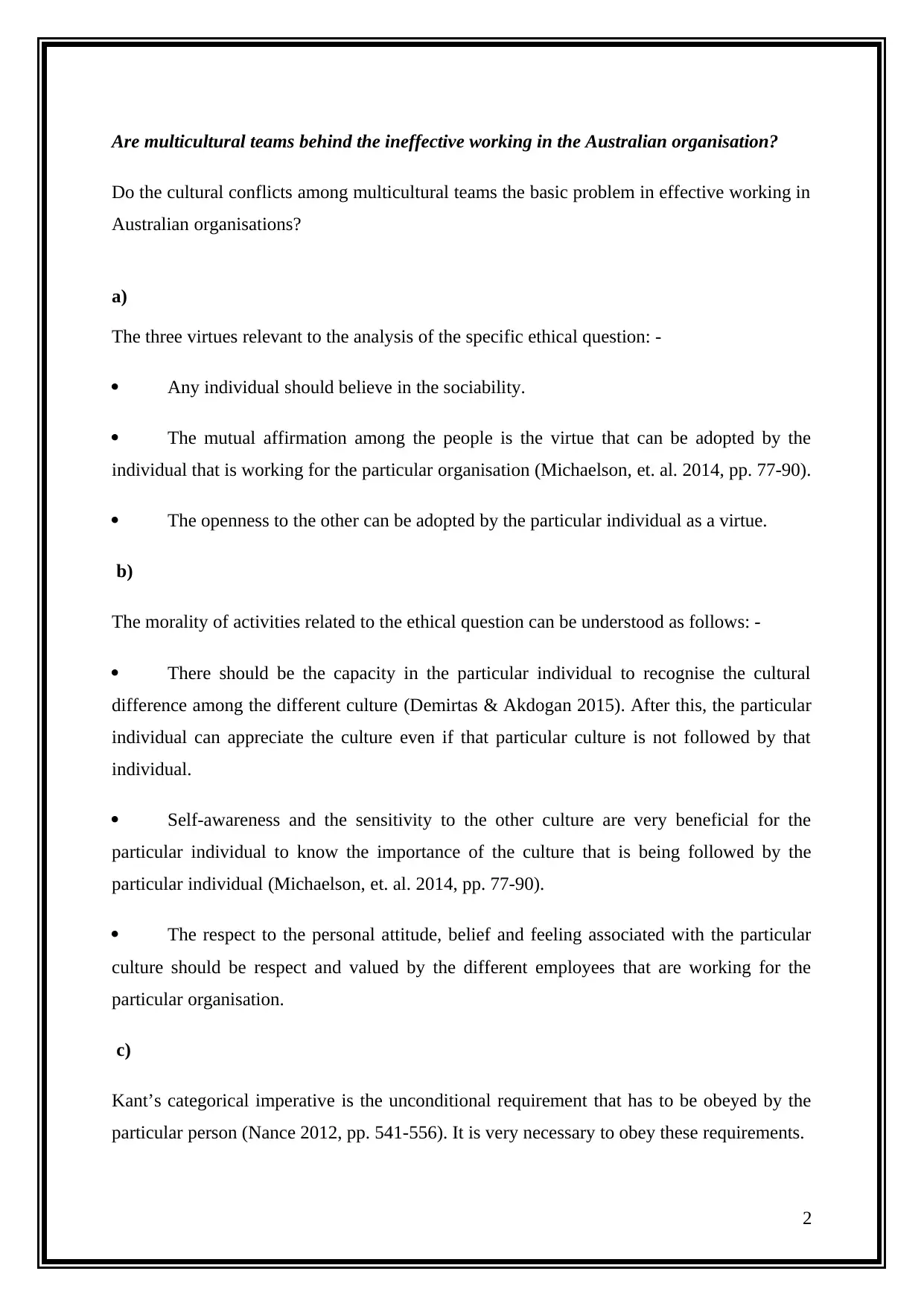
Are multicultural teams behind the ineffective working in the Australian organisation?
Do the cultural conflicts among multicultural teams the basic problem in effective working in
Australian organisations?
a)
The three virtues relevant to the analysis of the specific ethical question: -
Any individual should believe in the sociability.
The mutual affirmation among the people is the virtue that can be adopted by the
individual that is working for the particular organisation (Michaelson, et. al. 2014, pp. 77-90).
The openness to the other can be adopted by the particular individual as a virtue.
b)
The morality of activities related to the ethical question can be understood as follows: -
There should be the capacity in the particular individual to recognise the cultural
difference among the different culture (Demirtas & Akdogan 2015). After this, the particular
individual can appreciate the culture even if that particular culture is not followed by that
individual.
Self-awareness and the sensitivity to the other culture are very beneficial for the
particular individual to know the importance of the culture that is being followed by the
particular individual (Michaelson, et. al. 2014, pp. 77-90).
The respect to the personal attitude, belief and feeling associated with the particular
culture should be respect and valued by the different employees that are working for the
particular organisation.
c)
Kant’s categorical imperative is the unconditional requirement that has to be obeyed by the
particular person (Nance 2012, pp. 541-556). It is very necessary to obey these requirements.
2
Document Page
i)
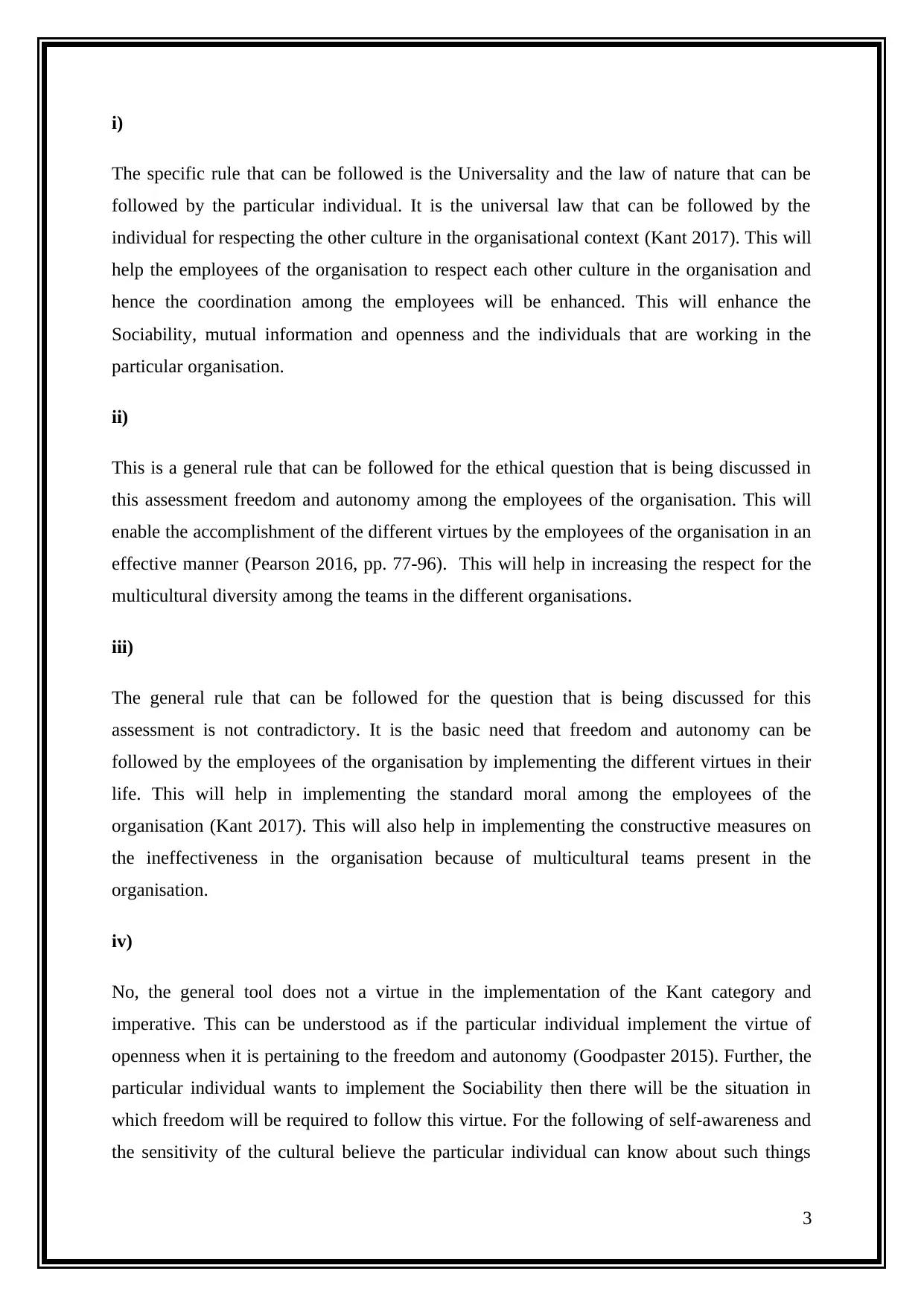
The specific rule that can be followed is the Universality and the law of nature that can be
followed by the particular individual. It is the universal law that can be followed by the
individual for respecting the other culture in the organisational context (Kant 2017). This will
help the employees of the organisation to respect each other culture in the organisation and
hence the coordination among the employees will be enhanced. This will enhance the
Sociability, mutual information and openness and the individuals that are working in the
particular organisation.
ii)
This is a general rule that can be followed for the ethical question that is being discussed in
this assessment freedom and autonomy among the employees of the organisation. This will
enable the accomplishment of the different virtues by the employees of the organisation in an
effective manner (Pearson 2016, pp. 77-96). This will help in increasing the respect for the
multicultural diversity among the teams in the different organisations.
iii)
The general rule that can be followed for the question that is being discussed for this
assessment is not contradictory. It is the basic need that freedom and autonomy can be
followed by the employees of the organisation by implementing the different virtues in their
life. This will help in implementing the standard moral among the employees of the
organisation (Kant 2017). This will also help in implementing the constructive measures on
the ineffectiveness in the organisation because of multicultural teams present in the
organisation.
iv)
No, the general tool does not a virtue in the implementation of the Kant category and
imperative. This can be understood as if the particular individual implement the virtue of
openness when it is pertaining to the freedom and autonomy (Goodpaster 2015). Further, the
particular individual wants to implement the Sociability then there will be the situation in
which freedom will be required to follow this virtue. For the following of self-awareness and
the sensitivity of the cultural believe the particular individual can know about such things
3
Document Page
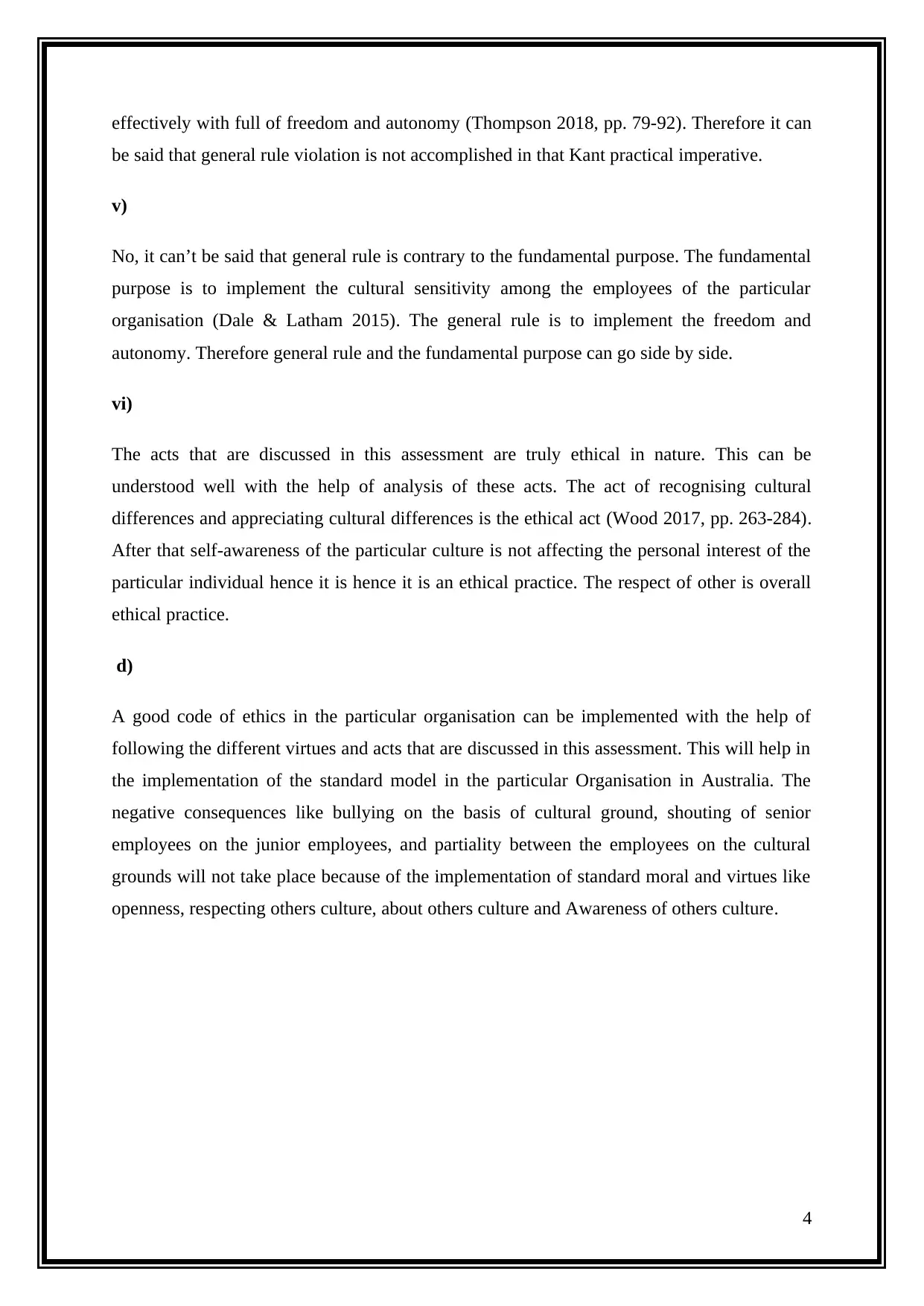
effectively with full of freedom and autonomy (Thompson 2018, pp. 79-92). Therefore it can
be said that general rule violation is not accomplished in that Kant practical imperative.
v)
No, it can’t be said that general rule is contrary to the fundamental purpose. The fundamental
purpose is to implement the cultural sensitivity among the employees of the particular
organisation (Dale & Latham 2015). The general rule is to implement the freedom and
autonomy. Therefore general rule and the fundamental purpose can go side by side.
vi)
The acts that are discussed in this assessment are truly ethical in nature. This can be
understood well with the help of analysis of these acts. The act of recognising cultural
differences and appreciating cultural differences is the ethical act (Wood 2017, pp. 263-284).
After that self-awareness of the particular culture is not affecting the personal interest of the
particular individual hence it is hence it is an ethical practice. The respect of other is overall
ethical practice.
d)
A good code of ethics in the particular organisation can be implemented with the help of
following the different virtues and acts that are discussed in this assessment. This will help in
the implementation of the standard model in the particular Organisation in Australia. The
negative consequences like bullying on the basis of cultural ground, shouting of senior
employees on the junior employees, and partiality between the employees on the cultural
grounds will not take place because of the implementation of standard moral and virtues like
openness, respecting others culture, about others culture and Awareness of others culture.
4
tabler-icon-diamond-filled.svg

Paraphrase This Document

Need a fresh take? Get an instant paraphrase of this document with our AI Paraphraser
Document Page
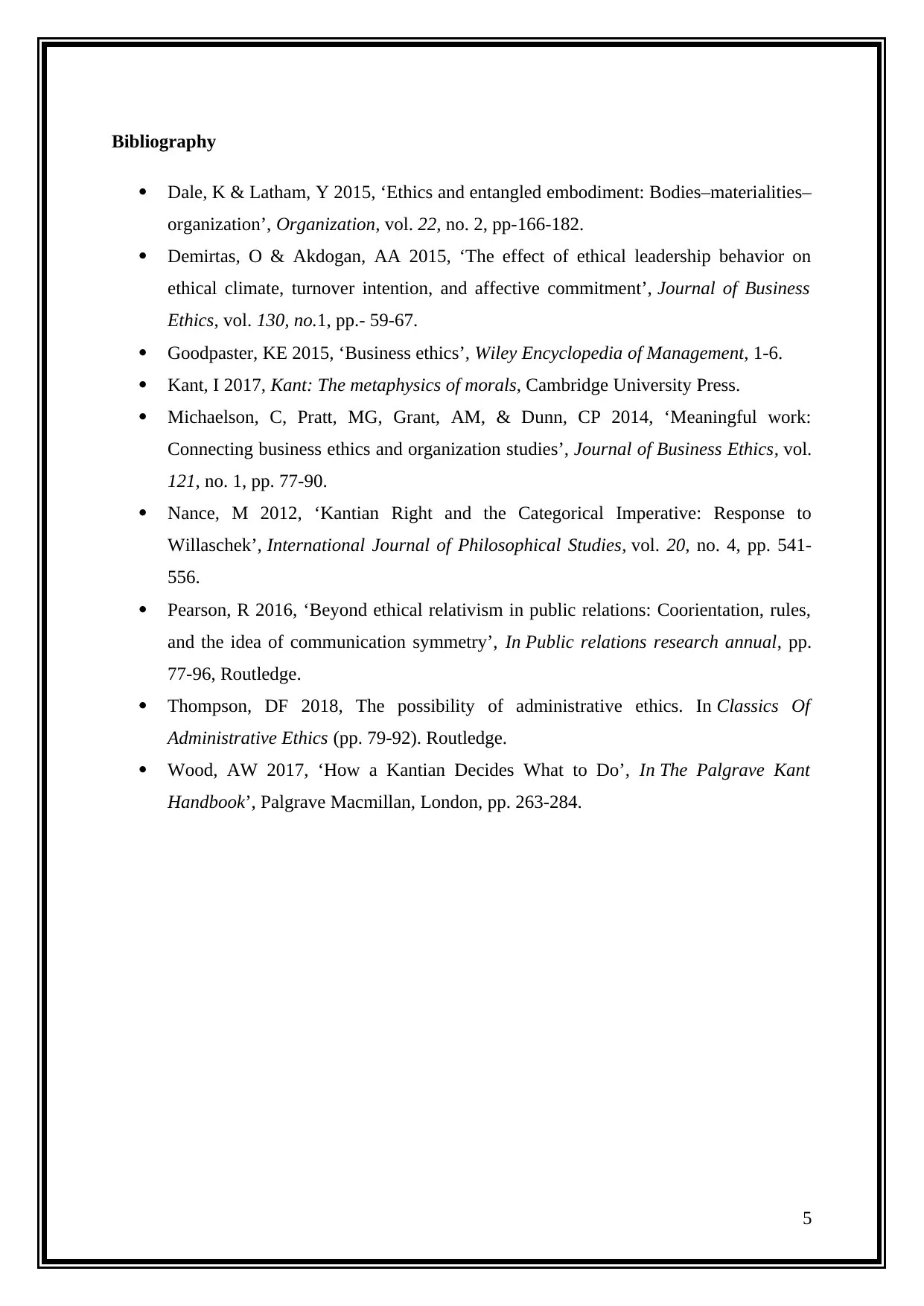
Bibliography
Dale, K & Latham, Y 2015, ‘Ethics and entangled embodiment: Bodies–materialities–
organization’, Organization, vol. 22, no. 2, pp-166-182.
Demirtas, O & Akdogan, AA 2015, ‘The effect of ethical leadership behavior on
ethical climate, turnover intention, and affective commitment’, Journal of Business
Ethics, vol. 130, no.1, pp.- 59-67.
Goodpaster, KE 2015, ‘Business ethics’, Wiley Encyclopedia of Management, 1-6.
Kant, I 2017, Kant: The metaphysics of morals, Cambridge University Press.
Michaelson, C, Pratt, MG, Grant, AM, & Dunn, CP 2014, ‘Meaningful work:
Connecting business ethics and organization studies’, Journal of Business Ethics, vol.
121, no. 1, pp. 77-90.
Nance, M 2012, ‘Kantian Right and the Categorical Imperative: Response to
Willaschek’, International Journal of Philosophical Studies, vol. 20, no. 4, pp. 541-
556.
Pearson, R 2016, ‘Beyond ethical relativism in public relations: Coorientation, rules,
and the idea of communication symmetry’, In Public relations research annual, pp.
77-96, Routledge.
Thompson, DF 2018, The possibility of administrative ethics. In Classics Of
Administrative Ethics (pp. 79-92). Routledge.
Wood, AW 2017, ‘How a Kantian Decides What to Do’, In The Palgrave Kant
Handbook’, Palgrave Macmillan, London, pp. 263-284.
5
chevron_up_icon
1 out of 5
circle_padding
hide_on_mobile
zoom_out_icon
[object Object]