NRSG353: Health Impacts of Diet: Asthma and Dietary Factors

Verified

Added on  2023/03/23

|4
|793
|54
Report
AI Summary
This report, prepared for NRSG353, investigates the significant health impacts of diet, with a specific focus on its role in asthma. The student supports the view that certain dietary factors increase the risk of asthma exacerbation. The report highlights that consumption of allergic foods, fast food, and high soft drinks can lead to an increase in asthma, while a diet lacking fresh fruits also poses risks. Factors like low levels of antioxidants, a high omega-6 to omega-3 ratio, and low vitamin D levels are identified as contributors. The report also emphasizes that food allergies can be a major risk factor and concludes by suggesting preventative measures such as recognizing food allergy triggers and following appropriate medications.
Document Page
Running head: NRSG353
Role of Diet
Student’s Name:
Student’s Id:
Subject:
tabler-icon-diamond-filled.svg

Paraphrase This Document

Need a fresh take? Get an instant paraphrase of this document with our AI Paraphraser
Document Page
1
NRSG353
Table of Contents
Health Impacts of diet.................................................................................................................................2
References...................................................................................................................................................3
Document Page
2
NRSG353
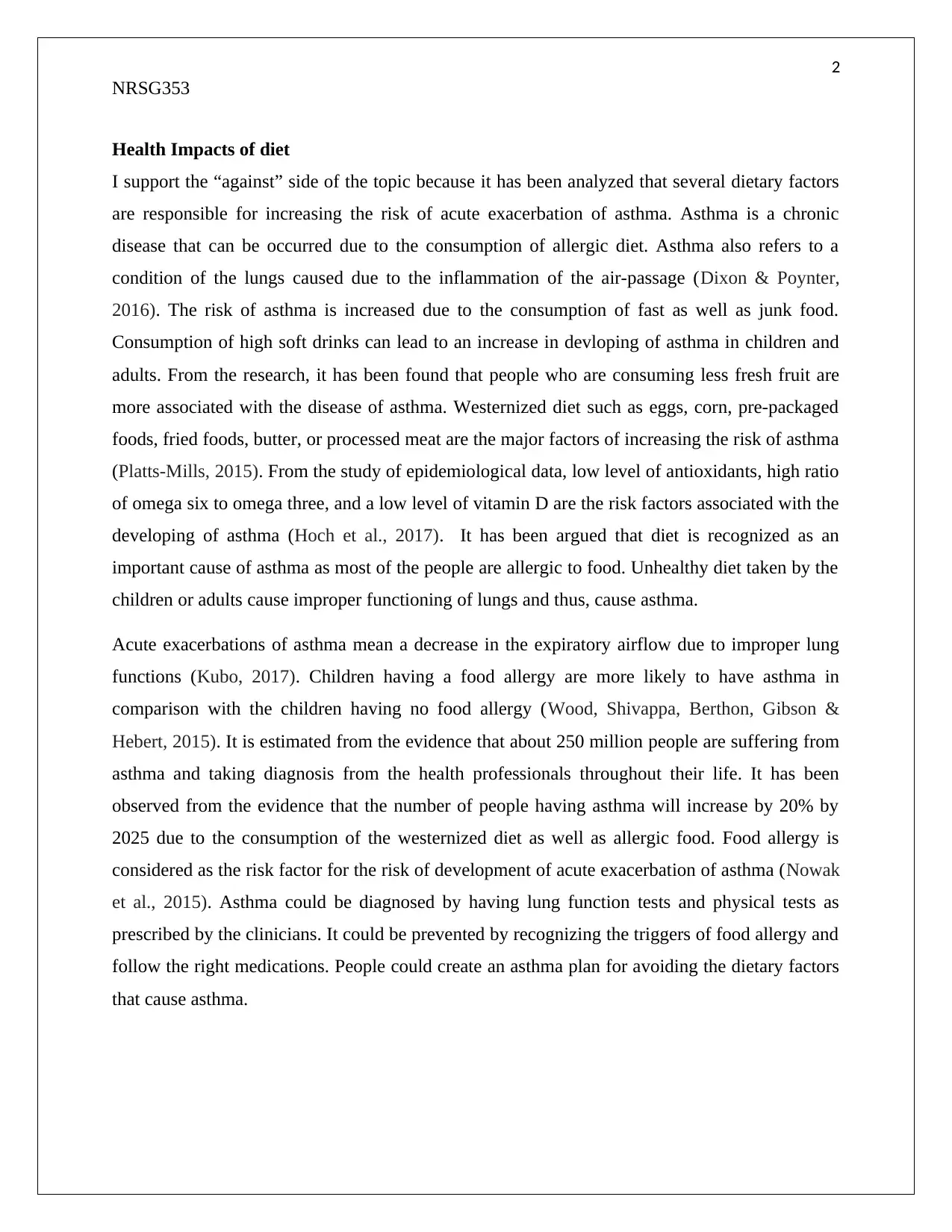
Health Impacts of diet
I support the “against” side of the topic because it has been analyzed that several dietary factors
are responsible for increasing the risk of acute exacerbation of asthma. Asthma is a chronic
disease that can be occurred due to the consumption of allergic diet. Asthma also refers to a
condition of the lungs caused due to the inflammation of the air-passage (Dixon & Poynter,
2016). The risk of asthma is increased due to the consumption of fast as well as junk food.
Consumption of high soft drinks can lead to an increase in devloping of asthma in children and
adults. From the research, it has been found that people who are consuming less fresh fruit are
more associated with the disease of asthma. Westernized diet such as eggs, corn, pre-packaged
foods, fried foods, butter, or processed meat are the major factors of increasing the risk of asthma
(Platts-Mills, 2015). From the study of epidemiological data, low level of antioxidants, high ratio
of omega six to omega three, and a low level of vitamin D are the risk factors associated with the
developing of asthma (Hoch et al., 2017). It has been argued that diet is recognized as an
important cause of asthma as most of the people are allergic to food. Unhealthy diet taken by the
children or adults cause improper functioning of lungs and thus, cause asthma.
Acute exacerbations of asthma mean a decrease in the expiratory airflow due to improper lung
functions (Kubo, 2017). Children having a food allergy are more likely to have asthma in
comparison with the children having no food allergy (Wood, Shivappa, Berthon, Gibson &
Hebert, 2015). It is estimated from the evidence that about 250 million people are suffering from
asthma and taking diagnosis from the health professionals throughout their life. It has been
observed from the evidence that the number of people having asthma will increase by 20% by
2025 due to the consumption of the westernized diet as well as allergic food. Food allergy is
considered as the risk factor for the risk of development of acute exacerbation of asthma (Nowak
et al., 2015). Asthma could be diagnosed by having lung function tests and physical tests as
prescribed by the clinicians. It could be prevented by recognizing the triggers of food allergy and
follow the right medications. People could create an asthma plan for avoiding the dietary factors
that cause asthma.
Document Page
3
NRSG353
References
Dixon, A. E., & Poynter, M. E. (2016). Mechanisms of asthma in obesity. Pleiotropic aspects of
obesity produce distinct asthma phenotypes. American journal of respiratory cell and
molecular biology, 54(5), 601-608.
Hoch, H. E., Calatroni, A., West, J. B., Liu, A. H., Gergen, P. J., Gruchalla, R. S., ... & Makhija,
M. M. (2017). Can we predict fall asthma exacerbations? Validation of the seasonal
asthma exacerbation index. Journal of Allergy and Clinical Immunology, 140(4), 1130-
1137.
Kubo, M. (2017). Innate and adaptive type 2 immunity in lung allergic
inflammation. Immunological reviews, 278(1), 162-172.
Nowak, R. M., Parker, J. M., Silverman, R. A., Rowe, B. H., Smithline, H., Khan, F., ... &
Molfino, N. A. (2015). A randomized trial of benralizumab, an antiinterleukin 5 receptor
α monoclonal antibody, after acute asthma. The American journal of emergency
medicine, 33(1), 14-20.
Platts-Mills, T. A. (2015). The allergy epidemics: 1870-2010. Journal of Allergy and Clinical
Immunology, 136(1), 3-13.
Wood, L. G., Shivappa, N., Berthon, B. S., Gibson, P. G., & Hebert, J. R. (2015). Dietary
inflammatory index is related to asthma risk, lung function and systemic inflammation in
asthma. Clinical & Experimental Allergy, 45(1), 177-183.
chevron_up_icon
1 out of 4
circle_padding
hide_on_mobile
zoom_out_icon
[object Object]