EUN107 Workbook: Designing Number Sequence Lessons for Year 2
VerifiedAdded on 2023/06/18
|10
|3295
|315
Practical Assignment
AI Summary
This assignment consists of three sequenced learning experiences designed for Year 2 students, focusing on the topic of number sequences. The first lesson introduces number sense and identification, teaching students to recognize and differentiate numbers through visual aids, videos, and creative artwork. The second lesson explores the relationships between numbers, including addition, subtraction, and multiplication, using projectors to enhance visual learning and engaging students in practical exercises. The third lesson focuses on determining number sequences based on increasing and decreasing factors, emphasizing the importance of identifying the rule governing the sequence. Each lesson incorporates formative assessments, differentiation strategies, and feedback mechanisms to ensure student understanding and engagement. The assignment leverages resources like pictures, videos, and interactive activities to facilitate effective learning and build a strong foundation in mathematical concepts. Desklib is a great platform to find similar assignments contributed by students.
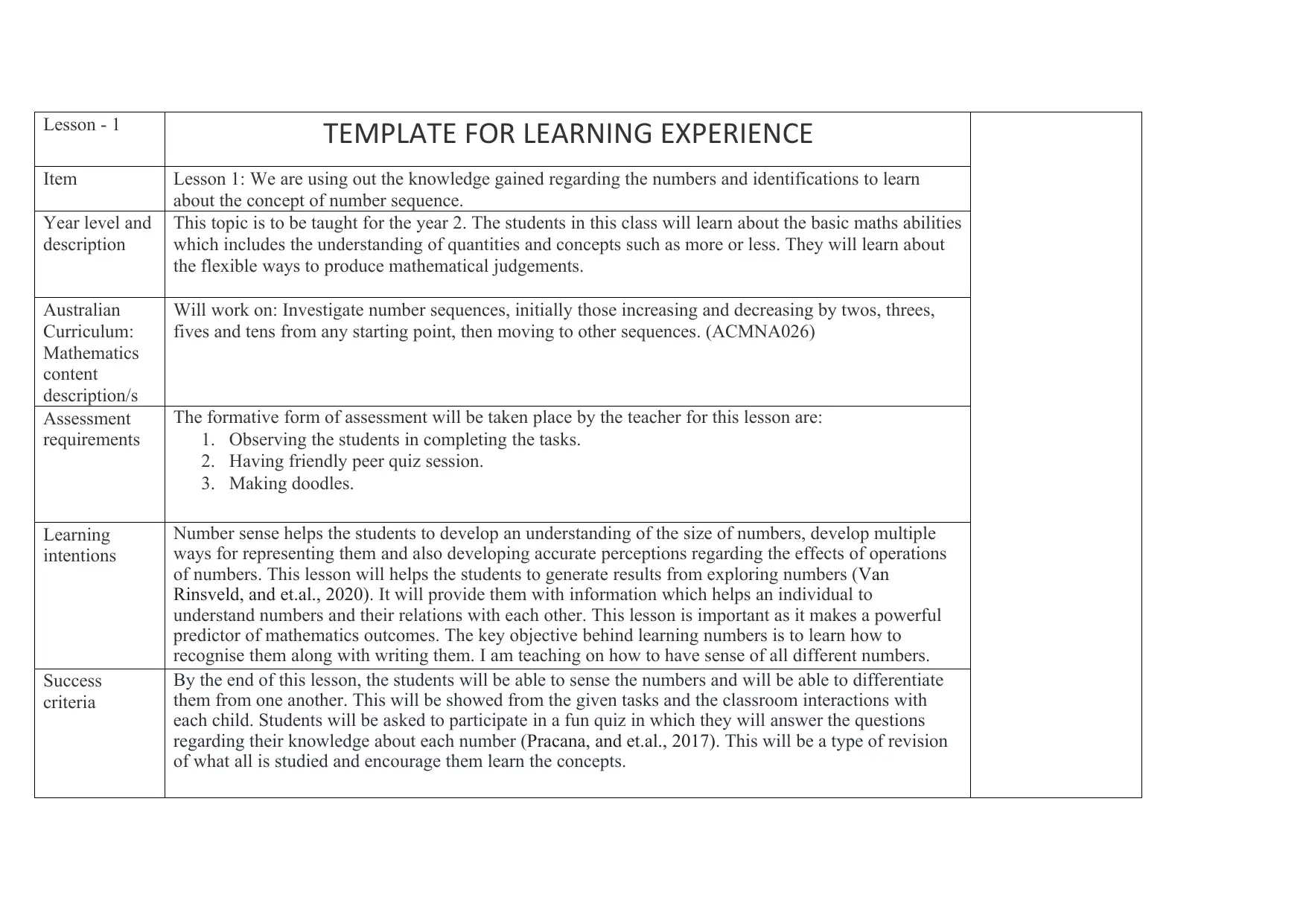
Lesson - 1 TEMPLATE FOR LEARNING EXPERIENCE
Item Lesson 1: We are using out the knowledge gained regarding the numbers and identifications to learn
about the concept of number sequence.
Year level and
description
This topic is to be taught for the year 2. The students in this class will learn about the basic maths abilities
which includes the understanding of quantities and concepts such as more or less. They will learn about
the flexible ways to produce mathematical judgements.
Australian
Curriculum:
Mathematics
content
description/s
Will work on: Investigate number sequences, initially those increasing and decreasing by twos, threes,
fives and tens from any starting point, then moving to other sequences. (ACMNA026)
Assessment
requirements
The formative form of assessment will be taken place by the teacher for this lesson are:
1. Observing the students in completing the tasks.
2. Having friendly peer quiz session.
3. Making doodles.
Learning
intentions
Number sense helps the students to develop an understanding of the size of numbers, develop multiple
ways for representing them and also developing accurate perceptions regarding the effects of operations
of numbers. This lesson will helps the students to generate results from exploring numbers (Van
Rinsveld, and et.al., 2020). It will provide them with information which helps an individual to
understand numbers and their relations with each other. This lesson is important as it makes a powerful
predictor of mathematics outcomes. The key objective behind learning numbers is to learn how to
recognise them along with writing them. I am teaching on how to have sense of all different numbers.
Success
criteria
By the end of this lesson, the students will be able to sense the numbers and will be able to differentiate
them from one another. This will be showed from the given tasks and the classroom interactions with
each child. Students will be asked to participate in a fun quiz in which they will answer the questions
regarding their knowledge about each number (Pracana, and et.al., 2017). This will be a type of revision
of what all is studied and encourage them learn the concepts.
Item Lesson 1: We are using out the knowledge gained regarding the numbers and identifications to learn
about the concept of number sequence.
Year level and
description
This topic is to be taught for the year 2. The students in this class will learn about the basic maths abilities
which includes the understanding of quantities and concepts such as more or less. They will learn about
the flexible ways to produce mathematical judgements.
Australian
Curriculum:
Mathematics
content
description/s
Will work on: Investigate number sequences, initially those increasing and decreasing by twos, threes,
fives and tens from any starting point, then moving to other sequences. (ACMNA026)
Assessment
requirements
The formative form of assessment will be taken place by the teacher for this lesson are:
1. Observing the students in completing the tasks.
2. Having friendly peer quiz session.
3. Making doodles.
Learning
intentions
Number sense helps the students to develop an understanding of the size of numbers, develop multiple
ways for representing them and also developing accurate perceptions regarding the effects of operations
of numbers. This lesson will helps the students to generate results from exploring numbers (Van
Rinsveld, and et.al., 2020). It will provide them with information which helps an individual to
understand numbers and their relations with each other. This lesson is important as it makes a powerful
predictor of mathematics outcomes. The key objective behind learning numbers is to learn how to
recognise them along with writing them. I am teaching on how to have sense of all different numbers.
Success
criteria
By the end of this lesson, the students will be able to sense the numbers and will be able to differentiate
them from one another. This will be showed from the given tasks and the classroom interactions with
each child. Students will be asked to participate in a fun quiz in which they will answer the questions
regarding their knowledge about each number (Pracana, and et.al., 2017). This will be a type of revision
of what all is studied and encourage them learn the concepts.

Paraphrase This Document
Need a fresh take? Get an instant paraphrase of this document with our AI Paraphraser
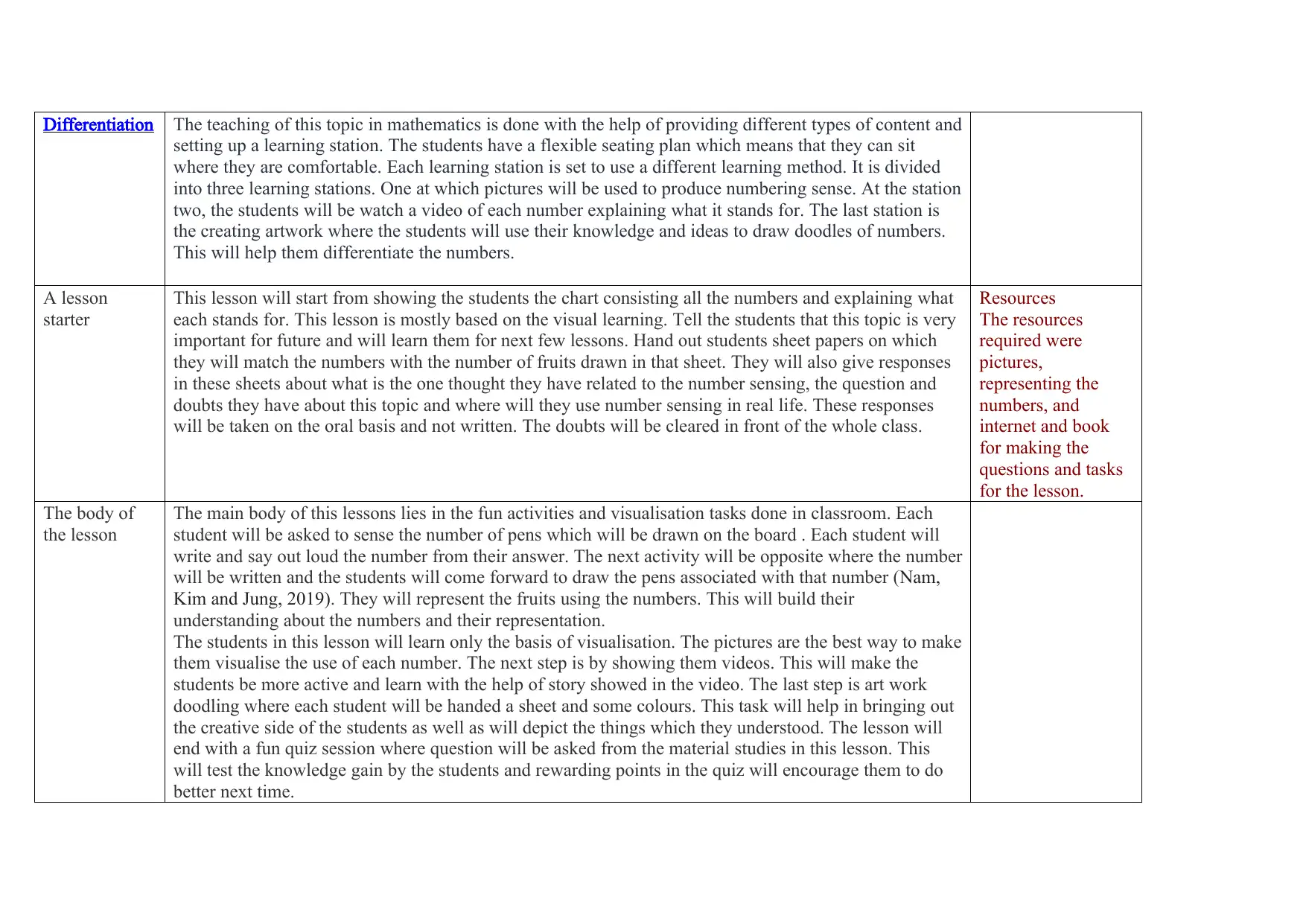
Differentiation The teaching of this topic in mathematics is done with the help of providing different types of content and
setting up a learning station. The students have a flexible seating plan which means that they can sit
where they are comfortable. Each learning station is set to use a different learning method. It is divided
into three learning stations. One at which pictures will be used to produce numbering sense. At the station
two, the students will be watch a video of each number explaining what it stands for. The last station is
the creating artwork where the students will use their knowledge and ideas to draw doodles of numbers.
This will help them differentiate the numbers.
A lesson
starter
This lesson will start from showing the students the chart consisting all the numbers and explaining what
each stands for. This lesson is mostly based on the visual learning. Tell the students that this topic is very
important for future and will learn them for next few lessons. Hand out students sheet papers on which
they will match the numbers with the number of fruits drawn in that sheet. They will also give responses
in these sheets about what is the one thought they have related to the number sensing, the question and
doubts they have about this topic and where will they use number sensing in real life. These responses
will be taken on the oral basis and not written. The doubts will be cleared in front of the whole class.
Resources
The resources
required were
pictures,
representing the
numbers, and
internet and book
for making the
questions and tasks
for the lesson.
The body of
the lesson
The main body of this lessons lies in the fun activities and visualisation tasks done in classroom. Each
student will be asked to sense the number of pens which will be drawn on the board . Each student will
write and say out loud the number from their answer. The next activity will be opposite where the number
will be written and the students will come forward to draw the pens associated with that number (Nam,
Kim and Jung, 2019). They will represent the fruits using the numbers. This will build their
understanding about the numbers and their representation.
The students in this lesson will learn only the basis of visualisation. The pictures are the best way to make
them visualise the use of each number. The next step is by showing them videos. This will make the
students be more active and learn with the help of story showed in the video. The last step is art work
doodling where each student will be handed a sheet and some colours. This task will help in bringing out
the creative side of the students as well as will depict the things which they understood. The lesson will
end with a fun quiz session where question will be asked from the material studies in this lesson. This
will test the knowledge gain by the students and rewarding points in the quiz will encourage them to do
better next time.
setting up a learning station. The students have a flexible seating plan which means that they can sit
where they are comfortable. Each learning station is set to use a different learning method. It is divided
into three learning stations. One at which pictures will be used to produce numbering sense. At the station
two, the students will be watch a video of each number explaining what it stands for. The last station is
the creating artwork where the students will use their knowledge and ideas to draw doodles of numbers.
This will help them differentiate the numbers.
A lesson
starter
This lesson will start from showing the students the chart consisting all the numbers and explaining what
each stands for. This lesson is mostly based on the visual learning. Tell the students that this topic is very
important for future and will learn them for next few lessons. Hand out students sheet papers on which
they will match the numbers with the number of fruits drawn in that sheet. They will also give responses
in these sheets about what is the one thought they have related to the number sensing, the question and
doubts they have about this topic and where will they use number sensing in real life. These responses
will be taken on the oral basis and not written. The doubts will be cleared in front of the whole class.
Resources
The resources
required were
pictures,
representing the
numbers, and
internet and book
for making the
questions and tasks
for the lesson.
The body of
the lesson
The main body of this lessons lies in the fun activities and visualisation tasks done in classroom. Each
student will be asked to sense the number of pens which will be drawn on the board . Each student will
write and say out loud the number from their answer. The next activity will be opposite where the number
will be written and the students will come forward to draw the pens associated with that number (Nam,
Kim and Jung, 2019). They will represent the fruits using the numbers. This will build their
understanding about the numbers and their representation.
The students in this lesson will learn only the basis of visualisation. The pictures are the best way to make
them visualise the use of each number. The next step is by showing them videos. This will make the
students be more active and learn with the help of story showed in the video. The last step is art work
doodling where each student will be handed a sheet and some colours. This task will help in bringing out
the creative side of the students as well as will depict the things which they understood. The lesson will
end with a fun quiz session where question will be asked from the material studies in this lesson. This
will test the knowledge gain by the students and rewarding points in the quiz will encourage them to do
better next time.
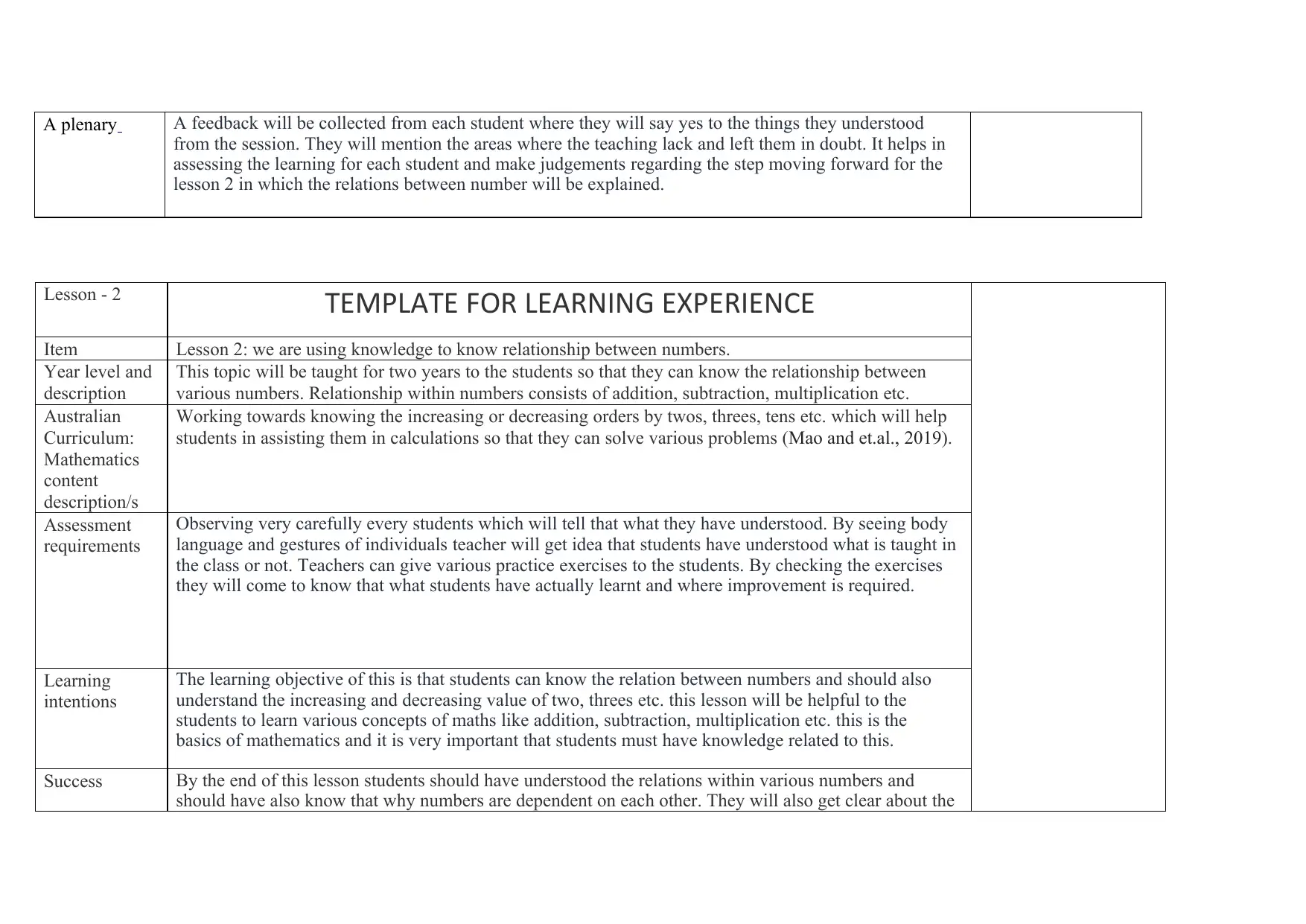
A plenary A feedback will be collected from each student where they will say yes to the things they understood
from the session. They will mention the areas where the teaching lack and left them in doubt. It helps in
assessing the learning for each student and make judgements regarding the step moving forward for the
lesson 2 in which the relations between number will be explained.
Lesson - 2 TEMPLATE FOR LEARNING EXPERIENCE
Item Lesson 2: we are using knowledge to know relationship between numbers.
Year level and
description
This topic will be taught for two years to the students so that they can know the relationship between
various numbers. Relationship within numbers consists of addition, subtraction, multiplication etc.
Australian
Curriculum:
Mathematics
content
description/s
Working towards knowing the increasing or decreasing orders by twos, threes, tens etc. which will help
students in assisting them in calculations so that they can solve various problems (Mao and et.al., 2019).
Assessment
requirements
Observing very carefully every students which will tell that what they have understood. By seeing body
language and gestures of individuals teacher will get idea that students have understood what is taught in
the class or not. Teachers can give various practice exercises to the students. By checking the exercises
they will come to know that what students have actually learnt and where improvement is required.
Learning
intentions
The learning objective of this is that students can know the relation between numbers and should also
understand the increasing and decreasing value of two, threes etc. this lesson will be helpful to the
students to learn various concepts of maths like addition, subtraction, multiplication etc. this is the
basics of mathematics and it is very important that students must have knowledge related to this.
Success By the end of this lesson students should have understood the relations within various numbers and
should have also know that why numbers are dependent on each other. They will also get clear about the
from the session. They will mention the areas where the teaching lack and left them in doubt. It helps in
assessing the learning for each student and make judgements regarding the step moving forward for the
lesson 2 in which the relations between number will be explained.
Lesson - 2 TEMPLATE FOR LEARNING EXPERIENCE
Item Lesson 2: we are using knowledge to know relationship between numbers.
Year level and
description
This topic will be taught for two years to the students so that they can know the relationship between
various numbers. Relationship within numbers consists of addition, subtraction, multiplication etc.
Australian
Curriculum:
Mathematics
content
description/s
Working towards knowing the increasing or decreasing orders by twos, threes, tens etc. which will help
students in assisting them in calculations so that they can solve various problems (Mao and et.al., 2019).
Assessment
requirements
Observing very carefully every students which will tell that what they have understood. By seeing body
language and gestures of individuals teacher will get idea that students have understood what is taught in
the class or not. Teachers can give various practice exercises to the students. By checking the exercises
they will come to know that what students have actually learnt and where improvement is required.
Learning
intentions
The learning objective of this is that students can know the relation between numbers and should also
understand the increasing and decreasing value of two, threes etc. this lesson will be helpful to the
students to learn various concepts of maths like addition, subtraction, multiplication etc. this is the
basics of mathematics and it is very important that students must have knowledge related to this.
Success By the end of this lesson students should have understood the relations within various numbers and
should have also know that why numbers are dependent on each other. They will also get clear about the
⊘ This is a preview!⊘
Do you want full access?
Subscribe today to unlock all pages.

Trusted by 1+ million students worldwide
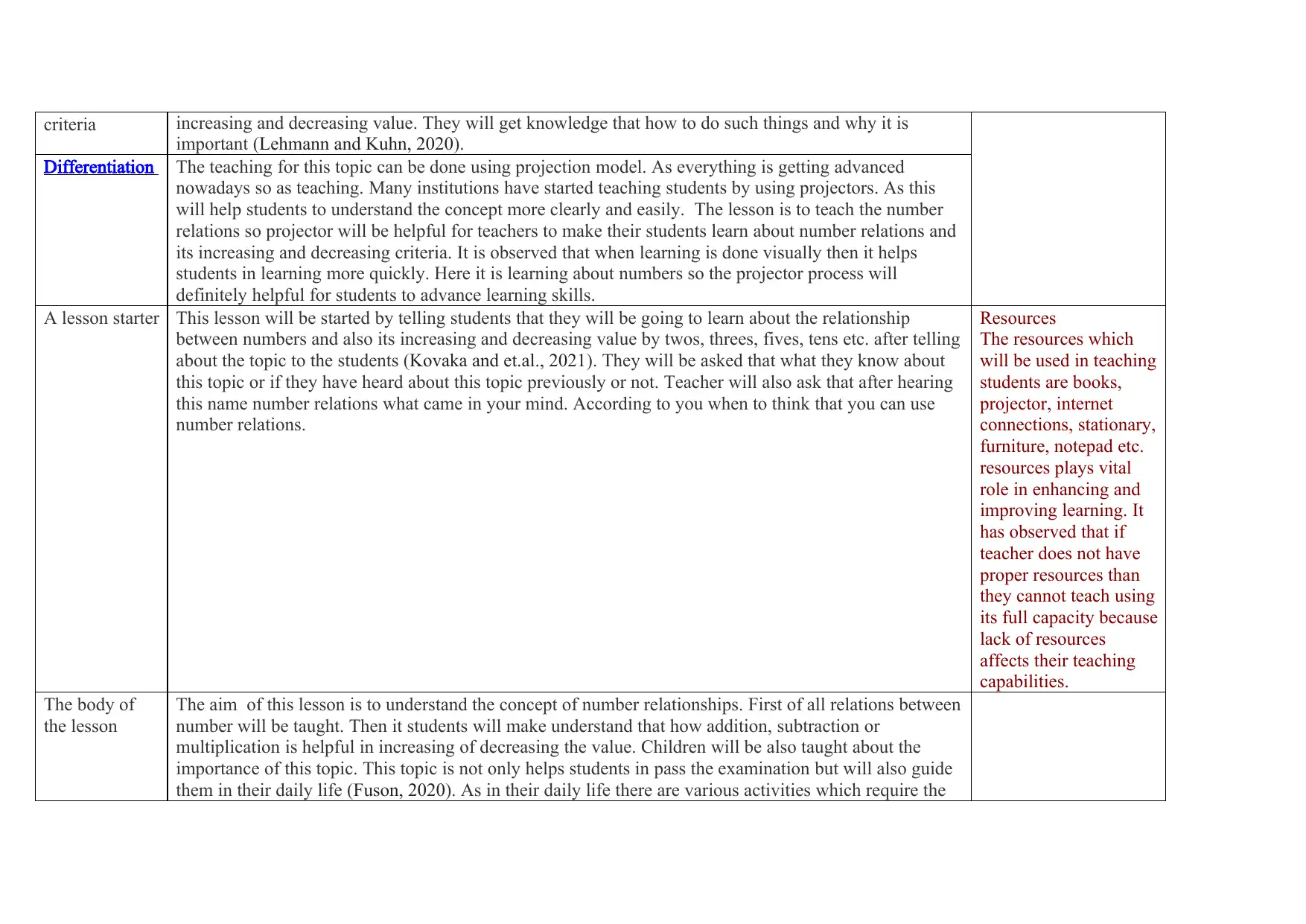
criteria increasing and decreasing value. They will get knowledge that how to do such things and why it is
important (Lehmann and Kuhn, 2020).
Differentiation The teaching for this topic can be done using projection model. As everything is getting advanced
nowadays so as teaching. Many institutions have started teaching students by using projectors. As this
will help students to understand the concept more clearly and easily. The lesson is to teach the number
relations so projector will be helpful for teachers to make their students learn about number relations and
its increasing and decreasing criteria. It is observed that when learning is done visually then it helps
students in learning more quickly. Here it is learning about numbers so the projector process will
definitely helpful for students to advance learning skills.
A lesson starter This lesson will be started by telling students that they will be going to learn about the relationship
between numbers and also its increasing and decreasing value by twos, threes, fives, tens etc. after telling
about the topic to the students (Kovaka and et.al., 2021). They will be asked that what they know about
this topic or if they have heard about this topic previously or not. Teacher will also ask that after hearing
this name number relations what came in your mind. According to you when to think that you can use
number relations.
Resources
The resources which
will be used in teaching
students are books,
projector, internet
connections, stationary,
furniture, notepad etc.
resources plays vital
role in enhancing and
improving learning. It
has observed that if
teacher does not have
proper resources than
they cannot teach using
its full capacity because
lack of resources
affects their teaching
capabilities.
The body of
the lesson
The aim of this lesson is to understand the concept of number relationships. First of all relations between
number will be taught. Then it students will make understand that how addition, subtraction or
multiplication is helpful in increasing of decreasing the value. Children will be also taught about the
importance of this topic. This topic is not only helps students in pass the examination but will also guide
them in their daily life (Fuson, 2020). As in their daily life there are various activities which require the
important (Lehmann and Kuhn, 2020).
Differentiation The teaching for this topic can be done using projection model. As everything is getting advanced
nowadays so as teaching. Many institutions have started teaching students by using projectors. As this
will help students to understand the concept more clearly and easily. The lesson is to teach the number
relations so projector will be helpful for teachers to make their students learn about number relations and
its increasing and decreasing criteria. It is observed that when learning is done visually then it helps
students in learning more quickly. Here it is learning about numbers so the projector process will
definitely helpful for students to advance learning skills.
A lesson starter This lesson will be started by telling students that they will be going to learn about the relationship
between numbers and also its increasing and decreasing value by twos, threes, fives, tens etc. after telling
about the topic to the students (Kovaka and et.al., 2021). They will be asked that what they know about
this topic or if they have heard about this topic previously or not. Teacher will also ask that after hearing
this name number relations what came in your mind. According to you when to think that you can use
number relations.
Resources
The resources which
will be used in teaching
students are books,
projector, internet
connections, stationary,
furniture, notepad etc.
resources plays vital
role in enhancing and
improving learning. It
has observed that if
teacher does not have
proper resources than
they cannot teach using
its full capacity because
lack of resources
affects their teaching
capabilities.
The body of
the lesson
The aim of this lesson is to understand the concept of number relationships. First of all relations between
number will be taught. Then it students will make understand that how addition, subtraction or
multiplication is helpful in increasing of decreasing the value. Children will be also taught about the
importance of this topic. This topic is not only helps students in pass the examination but will also guide
them in their daily life (Fuson, 2020). As in their daily life there are various activities which require the
Paraphrase This Document
Need a fresh take? Get an instant paraphrase of this document with our AI Paraphraser
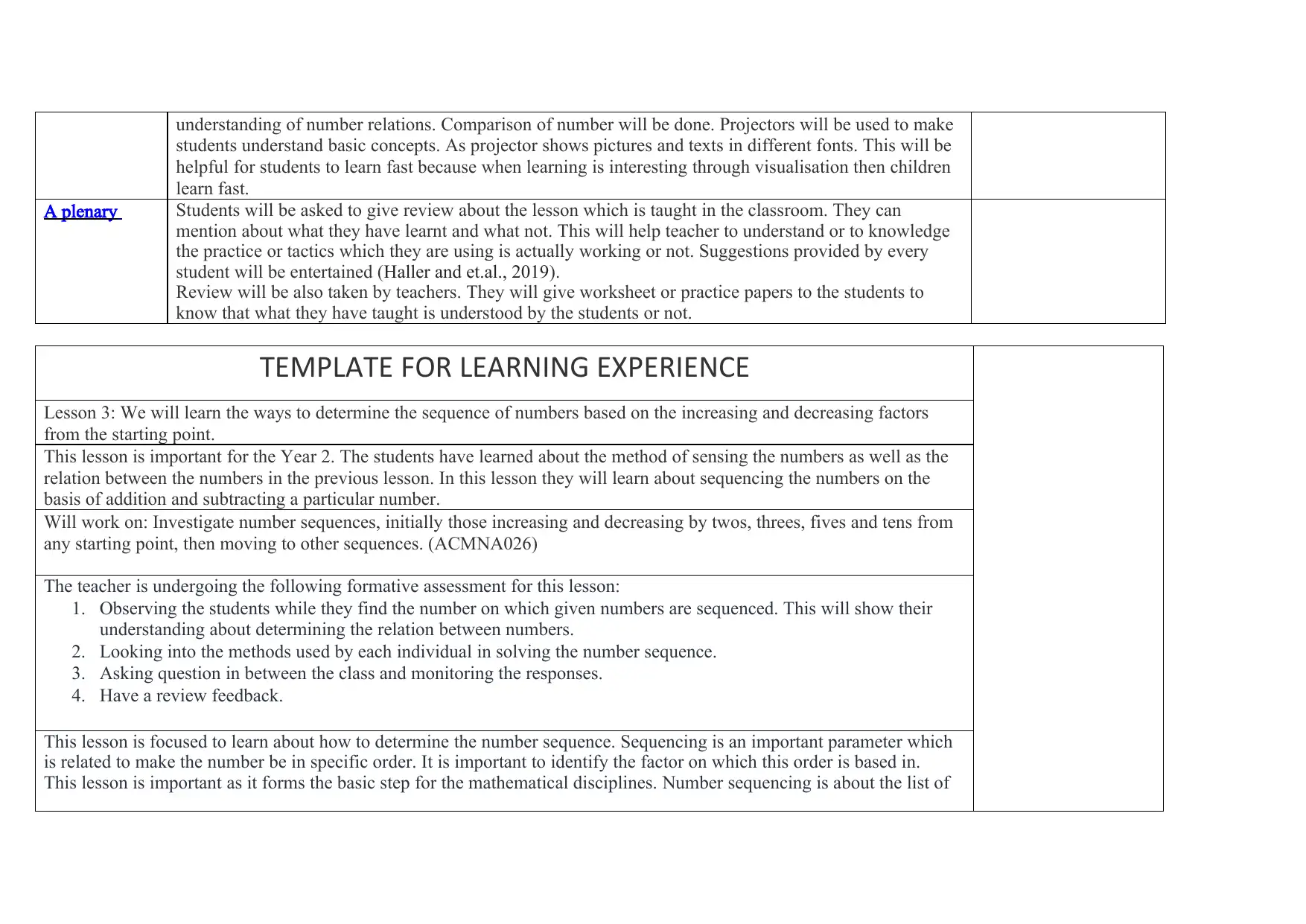
understanding of number relations. Comparison of number will be done. Projectors will be used to make
students understand basic concepts. As projector shows pictures and texts in different fonts. This will be
helpful for students to learn fast because when learning is interesting through visualisation then children
learn fast.
A plenary Students will be asked to give review about the lesson which is taught in the classroom. They can
mention about what they have learnt and what not. This will help teacher to understand or to knowledge
the practice or tactics which they are using is actually working or not. Suggestions provided by every
student will be entertained (Haller and et.al., 2019).
Review will be also taken by teachers. They will give worksheet or practice papers to the students to
know that what they have taught is understood by the students or not.
TEMPLATE FOR LEARNING EXPERIENCE
Lesson 3: We will learn the ways to determine the sequence of numbers based on the increasing and decreasing factors
from the starting point.
This lesson is important for the Year 2. The students have learned about the method of sensing the numbers as well as the
relation between the numbers in the previous lesson. In this lesson they will learn about sequencing the numbers on the
basis of addition and subtracting a particular number.
Will work on: Investigate number sequences, initially those increasing and decreasing by twos, threes, fives and tens from
any starting point, then moving to other sequences. (ACMNA026)
The teacher is undergoing the following formative assessment for this lesson:
1. Observing the students while they find the number on which given numbers are sequenced. This will show their
understanding about determining the relation between numbers.
2. Looking into the methods used by each individual in solving the number sequence.
3. Asking question in between the class and monitoring the responses.
4. Have a review feedback.
This lesson is focused to learn about how to determine the number sequence. Sequencing is an important parameter which
is related to make the number be in specific order. It is important to identify the factor on which this order is based in.
This lesson is important as it forms the basic step for the mathematical disciplines. Number sequencing is about the list of
students understand basic concepts. As projector shows pictures and texts in different fonts. This will be
helpful for students to learn fast because when learning is interesting through visualisation then children
learn fast.
A plenary Students will be asked to give review about the lesson which is taught in the classroom. They can
mention about what they have learnt and what not. This will help teacher to understand or to knowledge
the practice or tactics which they are using is actually working or not. Suggestions provided by every
student will be entertained (Haller and et.al., 2019).
Review will be also taken by teachers. They will give worksheet or practice papers to the students to
know that what they have taught is understood by the students or not.
TEMPLATE FOR LEARNING EXPERIENCE
Lesson 3: We will learn the ways to determine the sequence of numbers based on the increasing and decreasing factors
from the starting point.
This lesson is important for the Year 2. The students have learned about the method of sensing the numbers as well as the
relation between the numbers in the previous lesson. In this lesson they will learn about sequencing the numbers on the
basis of addition and subtracting a particular number.
Will work on: Investigate number sequences, initially those increasing and decreasing by twos, threes, fives and tens from
any starting point, then moving to other sequences. (ACMNA026)
The teacher is undergoing the following formative assessment for this lesson:
1. Observing the students while they find the number on which given numbers are sequenced. This will show their
understanding about determining the relation between numbers.
2. Looking into the methods used by each individual in solving the number sequence.
3. Asking question in between the class and monitoring the responses.
4. Have a review feedback.
This lesson is focused to learn about how to determine the number sequence. Sequencing is an important parameter which
is related to make the number be in specific order. It is important to identify the factor on which this order is based in.
This lesson is important as it forms the basic step for the mathematical disciplines. Number sequencing is about the list of
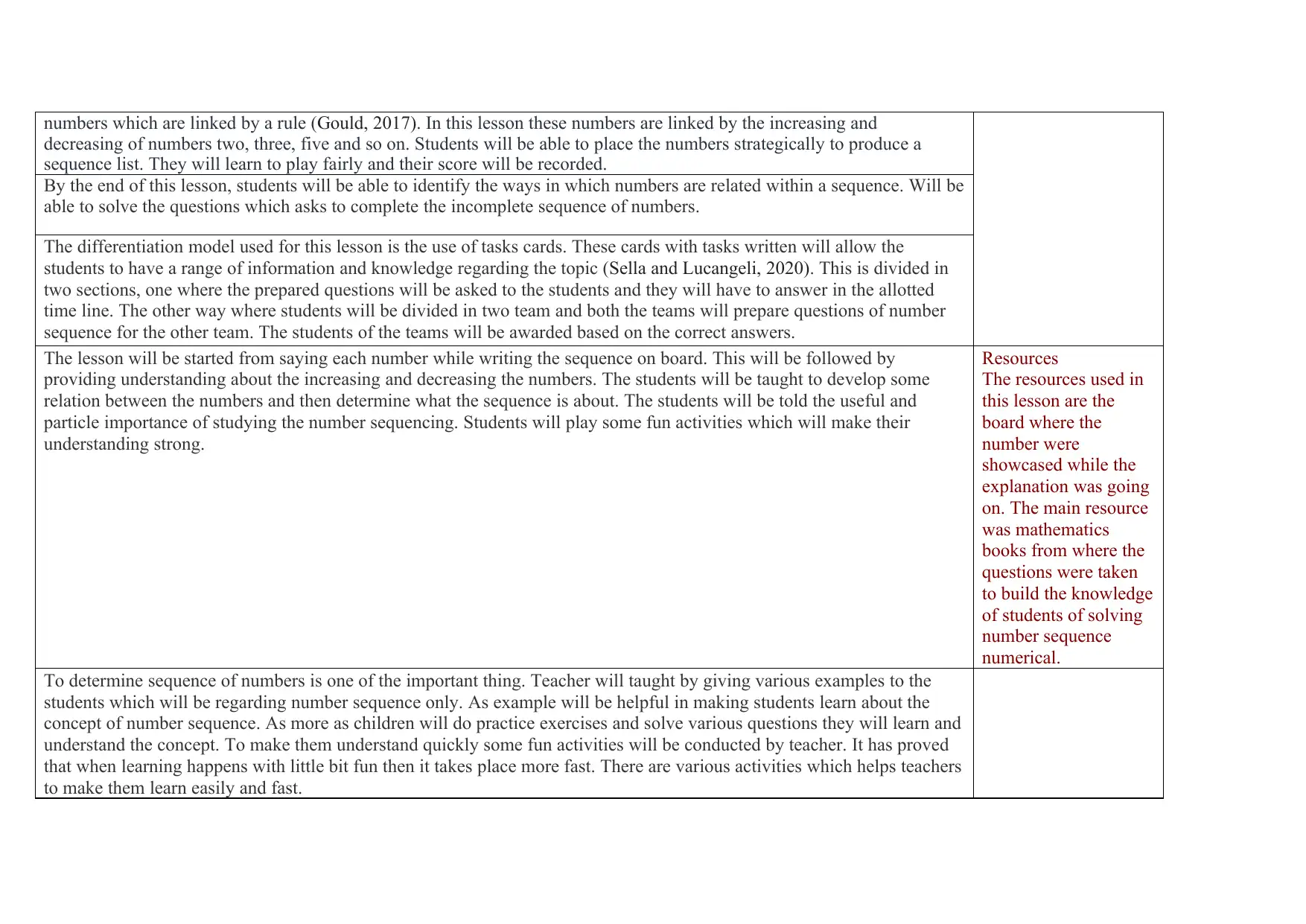
numbers which are linked by a rule (Gould, 2017). In this lesson these numbers are linked by the increasing and
decreasing of numbers two, three, five and so on. Students will be able to place the numbers strategically to produce a
sequence list. They will learn to play fairly and their score will be recorded.
By the end of this lesson, students will be able to identify the ways in which numbers are related within a sequence. Will be
able to solve the questions which asks to complete the incomplete sequence of numbers.
The differentiation model used for this lesson is the use of tasks cards. These cards with tasks written will allow the
students to have a range of information and knowledge regarding the topic (Sella and Lucangeli, 2020). This is divided in
two sections, one where the prepared questions will be asked to the students and they will have to answer in the allotted
time line. The other way where students will be divided in two team and both the teams will prepare questions of number
sequence for the other team. The students of the teams will be awarded based on the correct answers.
The lesson will be started from saying each number while writing the sequence on board. This will be followed by
providing understanding about the increasing and decreasing the numbers. The students will be taught to develop some
relation between the numbers and then determine what the sequence is about. The students will be told the useful and
particle importance of studying the number sequencing. Students will play some fun activities which will make their
understanding strong.
Resources
The resources used in
this lesson are the
board where the
number were
showcased while the
explanation was going
on. The main resource
was mathematics
books from where the
questions were taken
to build the knowledge
of students of solving
number sequence
numerical.
To determine sequence of numbers is one of the important thing. Teacher will taught by giving various examples to the
students which will be regarding number sequence only. As example will be helpful in making students learn about the
concept of number sequence. As more as children will do practice exercises and solve various questions they will learn and
understand the concept. To make them understand quickly some fun activities will be conducted by teacher. It has proved
that when learning happens with little bit fun then it takes place more fast. There are various activities which helps teachers
to make them learn easily and fast.
decreasing of numbers two, three, five and so on. Students will be able to place the numbers strategically to produce a
sequence list. They will learn to play fairly and their score will be recorded.
By the end of this lesson, students will be able to identify the ways in which numbers are related within a sequence. Will be
able to solve the questions which asks to complete the incomplete sequence of numbers.
The differentiation model used for this lesson is the use of tasks cards. These cards with tasks written will allow the
students to have a range of information and knowledge regarding the topic (Sella and Lucangeli, 2020). This is divided in
two sections, one where the prepared questions will be asked to the students and they will have to answer in the allotted
time line. The other way where students will be divided in two team and both the teams will prepare questions of number
sequence for the other team. The students of the teams will be awarded based on the correct answers.
The lesson will be started from saying each number while writing the sequence on board. This will be followed by
providing understanding about the increasing and decreasing the numbers. The students will be taught to develop some
relation between the numbers and then determine what the sequence is about. The students will be told the useful and
particle importance of studying the number sequencing. Students will play some fun activities which will make their
understanding strong.
Resources
The resources used in
this lesson are the
board where the
number were
showcased while the
explanation was going
on. The main resource
was mathematics
books from where the
questions were taken
to build the knowledge
of students of solving
number sequence
numerical.
To determine sequence of numbers is one of the important thing. Teacher will taught by giving various examples to the
students which will be regarding number sequence only. As example will be helpful in making students learn about the
concept of number sequence. As more as children will do practice exercises and solve various questions they will learn and
understand the concept. To make them understand quickly some fun activities will be conducted by teacher. It has proved
that when learning happens with little bit fun then it takes place more fast. There are various activities which helps teachers
to make them learn easily and fast.
⊘ This is a preview!⊘
Do you want full access?
Subscribe today to unlock all pages.
Trusted by 1+ million students worldwide
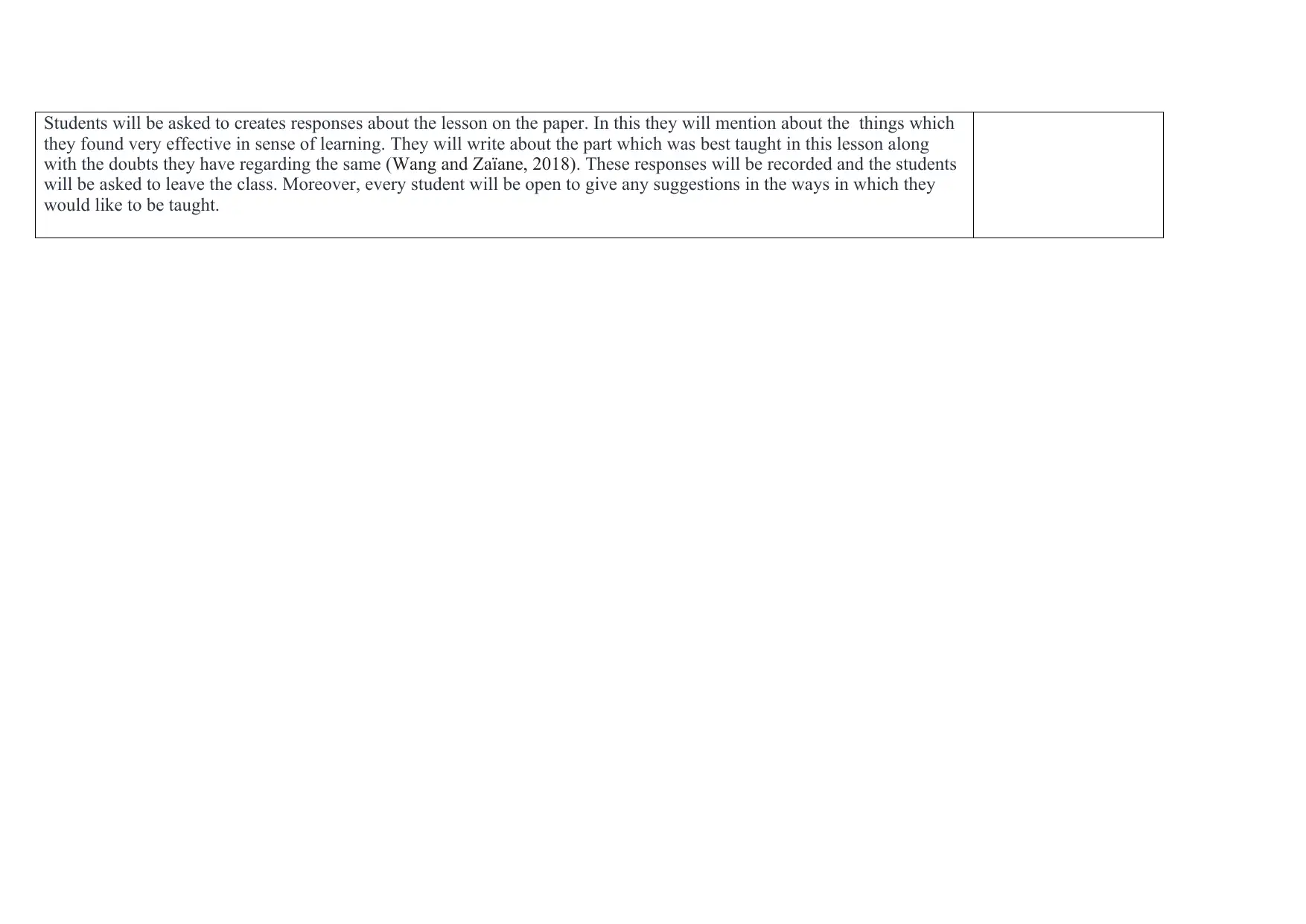
Students will be asked to creates responses about the lesson on the paper. In this they will mention about the things which
they found very effective in sense of learning. They will write about the part which was best taught in this lesson along
with the doubts they have regarding the same (Wang and Zaïane, 2018). These responses will be recorded and the students
will be asked to leave the class. Moreover, every student will be open to give any suggestions in the ways in which they
would like to be taught.
they found very effective in sense of learning. They will write about the part which was best taught in this lesson along
with the doubts they have regarding the same (Wang and Zaïane, 2018). These responses will be recorded and the students
will be asked to leave the class. Moreover, every student will be open to give any suggestions in the ways in which they
would like to be taught.
Paraphrase This Document
Need a fresh take? Get an instant paraphrase of this document with our AI Paraphraser
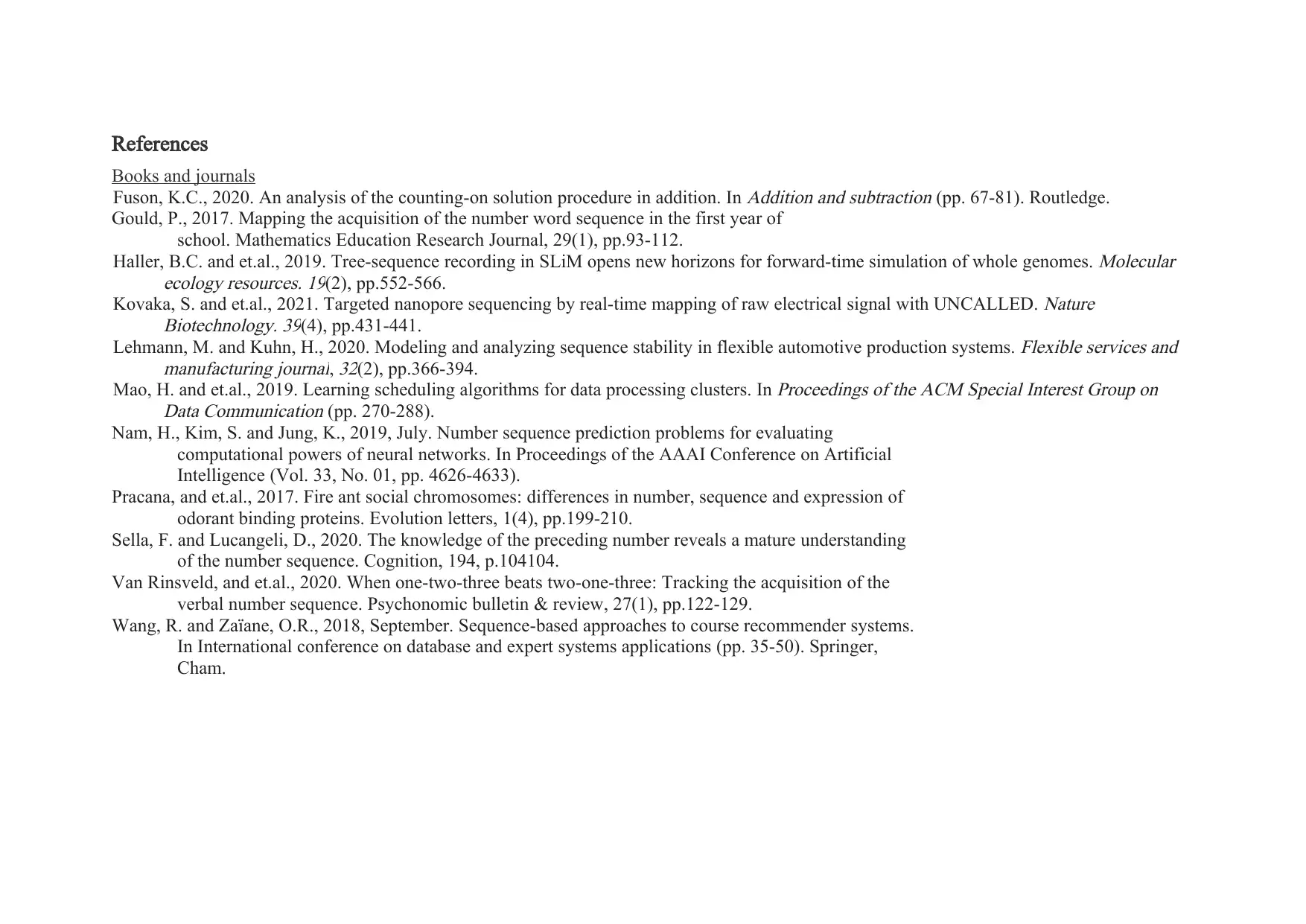
References
Books and journals
Fuson, K.C., 2020. An analysis of the counting-on solution procedure in addition. In
Addition and subtraction (pp. 67-81). Routledge.
Gould, P., 2017. Mapping the acquisition of the number word sequence in the first year of
school. Mathematics Education Research Journal, 29(1), pp.93-112.
Haller, B.C. and et.al., 2019. Tree‐sequence recording in SLiM opens new horizons for forward‐time simulation of whole genomes.
Molecular
ecology resources. 19(2), pp.552-566.
Kovaka, S. and et.al., 2021. Targeted nanopore sequencing by real-time mapping of raw electrical signal with UNCALLED.
Nature
Biotechnology. 39(4), pp.431-441.
Lehmann, M. and Kuhn, H., 2020. Modeling and analyzing sequence stability in flexible automotive production systems.
Flexible services and
manufacturing journal,
32(2), pp.366-394.
Mao, H. and et.al., 2019. Learning scheduling algorithms for data processing clusters. In
Proceedings of the ACM Special Interest Group on
Data Communication (pp. 270-288).
Nam, H., Kim, S. and Jung, K., 2019, July. Number sequence prediction problems for evaluating
computational powers of neural networks. In Proceedings of the AAAI Conference on Artificial
Intelligence (Vol. 33, No. 01, pp. 4626-4633).
Pracana, and et.al., 2017. Fire ant social chromosomes: differences in number, sequence and expression of
odorant binding proteins. Evolution letters, 1(4), pp.199-210.
Sella, F. and Lucangeli, D., 2020. The knowledge of the preceding number reveals a mature understanding
of the number sequence. Cognition, 194, p.104104.
Van Rinsveld, and et.al., 2020. When one-two-three beats two-one-three: Tracking the acquisition of the
verbal number sequence. Psychonomic bulletin & review, 27(1), pp.122-129.
Wang, R. and Zaïane, O.R., 2018, September. Sequence-based approaches to course recommender systems.
In International conference on database and expert systems applications (pp. 35-50). Springer,
Cham.
Books and journals
Fuson, K.C., 2020. An analysis of the counting-on solution procedure in addition. In
Addition and subtraction (pp. 67-81). Routledge.
Gould, P., 2017. Mapping the acquisition of the number word sequence in the first year of
school. Mathematics Education Research Journal, 29(1), pp.93-112.
Haller, B.C. and et.al., 2019. Tree‐sequence recording in SLiM opens new horizons for forward‐time simulation of whole genomes.
Molecular
ecology resources. 19(2), pp.552-566.
Kovaka, S. and et.al., 2021. Targeted nanopore sequencing by real-time mapping of raw electrical signal with UNCALLED.
Nature
Biotechnology. 39(4), pp.431-441.
Lehmann, M. and Kuhn, H., 2020. Modeling and analyzing sequence stability in flexible automotive production systems.
Flexible services and
manufacturing journal,
32(2), pp.366-394.
Mao, H. and et.al., 2019. Learning scheduling algorithms for data processing clusters. In
Proceedings of the ACM Special Interest Group on
Data Communication (pp. 270-288).
Nam, H., Kim, S. and Jung, K., 2019, July. Number sequence prediction problems for evaluating
computational powers of neural networks. In Proceedings of the AAAI Conference on Artificial
Intelligence (Vol. 33, No. 01, pp. 4626-4633).
Pracana, and et.al., 2017. Fire ant social chromosomes: differences in number, sequence and expression of
odorant binding proteins. Evolution letters, 1(4), pp.199-210.
Sella, F. and Lucangeli, D., 2020. The knowledge of the preceding number reveals a mature understanding
of the number sequence. Cognition, 194, p.104104.
Van Rinsveld, and et.al., 2020. When one-two-three beats two-one-three: Tracking the acquisition of the
verbal number sequence. Psychonomic bulletin & review, 27(1), pp.122-129.
Wang, R. and Zaïane, O.R., 2018, September. Sequence-based approaches to course recommender systems.
In International conference on database and expert systems applications (pp. 35-50). Springer,
Cham.
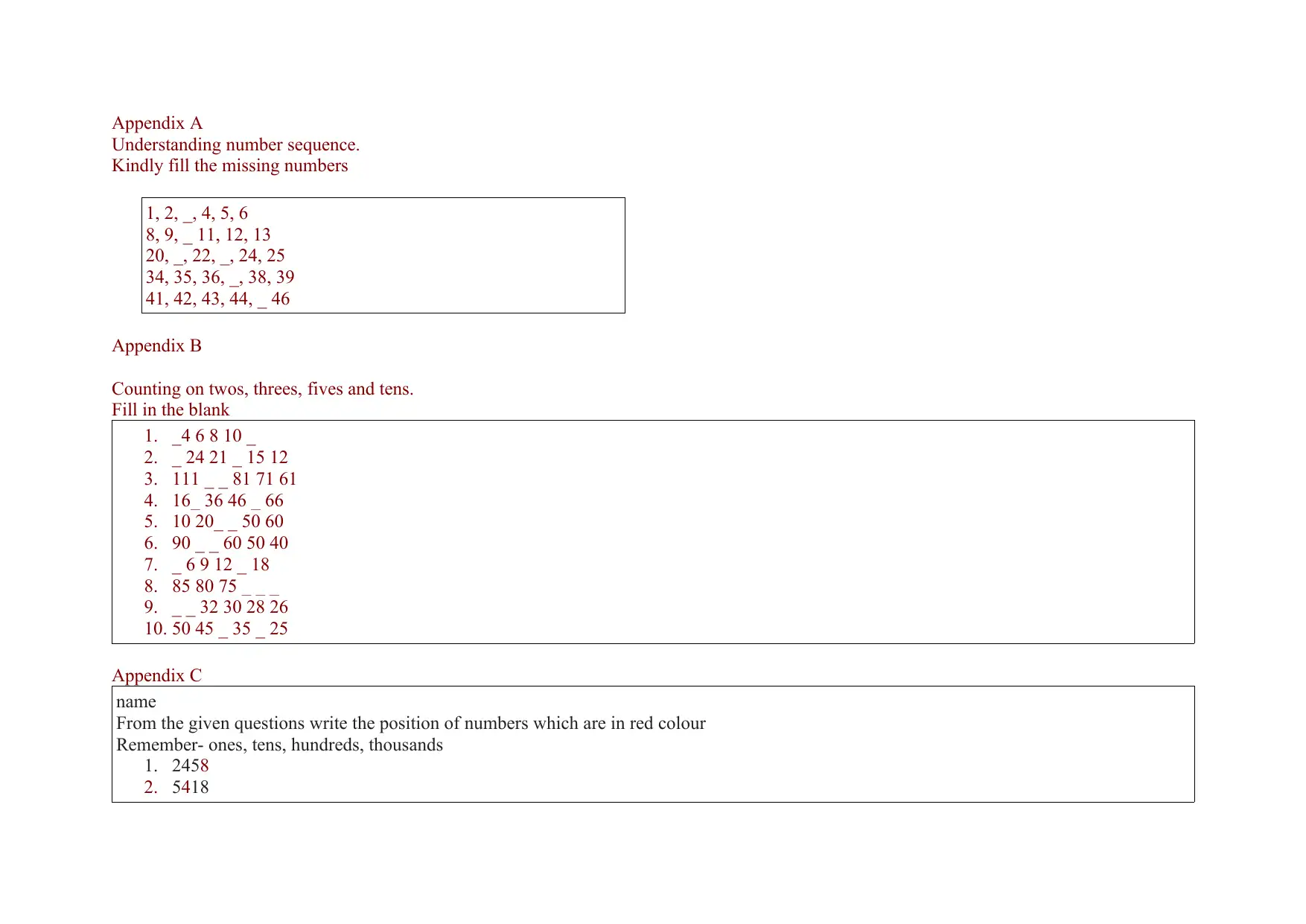
Appendix A
Understanding number sequence.
Kindly fill the missing numbers
1, 2, _, 4, 5, 6
8, 9, _ 11, 12, 13
20, _, 22, _, 24, 25
34, 35, 36, _, 38, 39
41, 42, 43, 44, _ 46
Appendix B
Counting on twos, threes, fives and tens.
Fill in the blank
1. _4 6 8 10 _
2. _ 24 21 _ 15 12
3. 111 _ _ 81 71 61
4. 16_ 36 46 _ 66
5. 10 20_ _ 50 60
6. 90 _ _ 60 50 40
7. _ 6 9 12 _ 18
8. 85 80 75 _ _ _
9. _ _ 32 30 28 26
10. 50 45 _ 35 _ 25
Appendix C
name
From the given questions write the position of numbers which are in red colour
Remember- ones, tens, hundreds, thousands
1. 2458
2. 5418
Understanding number sequence.
Kindly fill the missing numbers
1, 2, _, 4, 5, 6
8, 9, _ 11, 12, 13
20, _, 22, _, 24, 25
34, 35, 36, _, 38, 39
41, 42, 43, 44, _ 46
Appendix B
Counting on twos, threes, fives and tens.
Fill in the blank
1. _4 6 8 10 _
2. _ 24 21 _ 15 12
3. 111 _ _ 81 71 61
4. 16_ 36 46 _ 66
5. 10 20_ _ 50 60
6. 90 _ _ 60 50 40
7. _ 6 9 12 _ 18
8. 85 80 75 _ _ _
9. _ _ 32 30 28 26
10. 50 45 _ 35 _ 25
Appendix C
name
From the given questions write the position of numbers which are in red colour
Remember- ones, tens, hundreds, thousands
1. 2458
2. 5418
⊘ This is a preview!⊘
Do you want full access?
Subscribe today to unlock all pages.
Trusted by 1+ million students worldwide
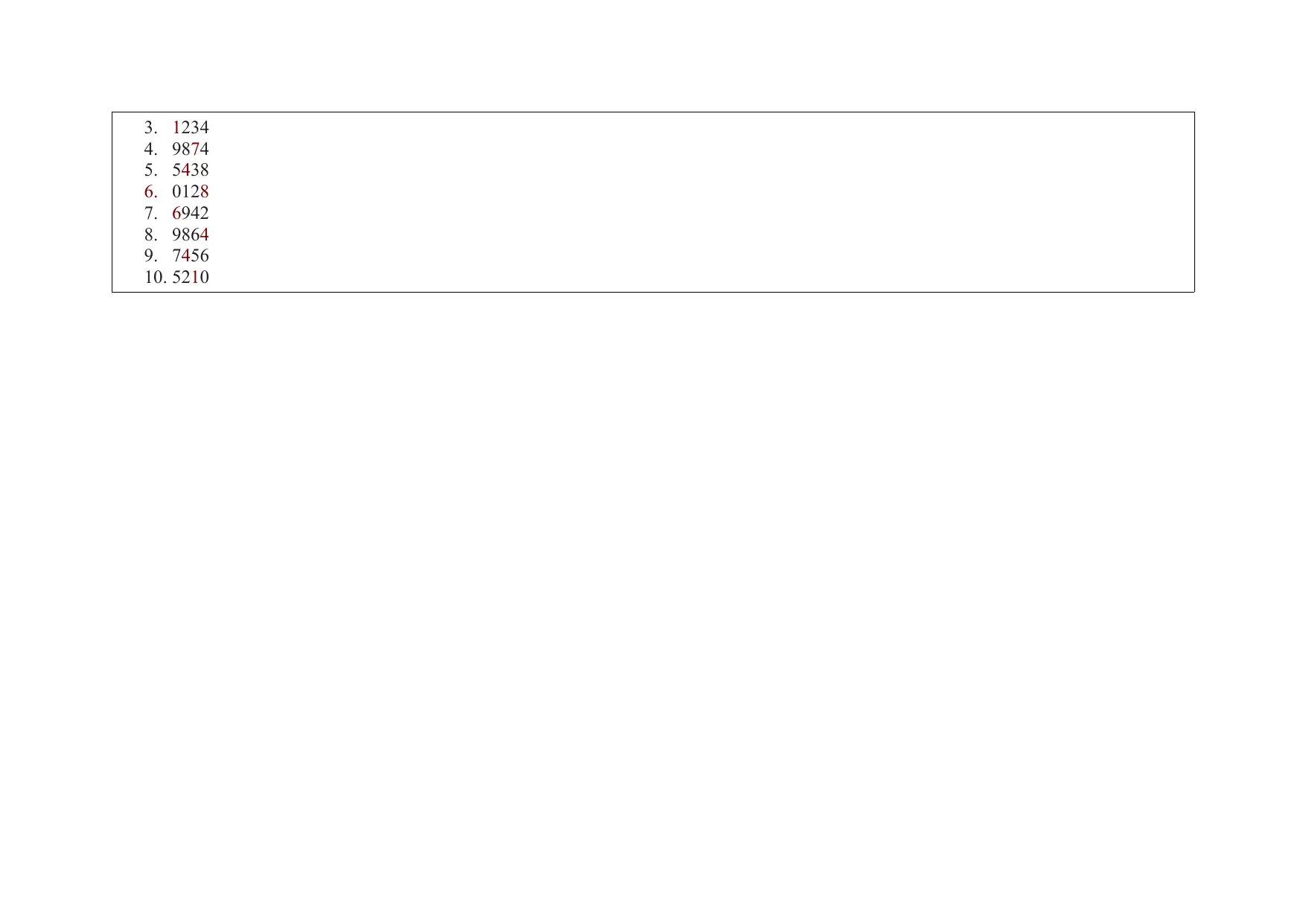
3. 1234
4. 9874
5. 5438
6. 0128
7. 6942
8. 9864
9. 7456
10. 5210
4. 9874
5. 5438
6. 0128
7. 6942
8. 9864
9. 7456
10. 5210

1 out of 10


Related Documents


Your All-in-One AI-Powered Toolkit for Academic Success.
+13062052269
info@desklib.com
Available 24*7 on WhatsApp / Email
![[object Object]](/_next/static/media/star-bottom.7253800d.svg)
Unlock your academic potential
Copyright © 2020–2025 A2Z Services. All Rights Reserved. Developed and managed by ZUCOL.