NURBN2009 Health Promotion: Healthy Kids Program Report

Verified

Added on  2023/01/18

|4
|1177
|93
Report
AI Summary
This report details the implementation of the "Healthy Kids Happy Kids" health promotion program designed to improve fruit and vegetable intake in kindergarten and primary school children within Donald, Australia. The program utilizes the Stages of Change model, aligning with the Ottawa Charter for health promotion, emphasizing the importance of creating supportive environments and individual health education. The report addresses the program's setting, emphasizing the involvement of parents and schools, and identifies knowledge gaps regarding the impact of vegetables on children's development. Key stakeholders include community members, teachers, and local authorities, with a focus on overcoming limitations such as limited resources and low socioeconomic factors. The report references relevant literature and includes a consent form for image and testimonial usage. The program aims to increase the vegetable intake among kids and their household. The program also addresses the parents and teachers about the effect of vegetable consumption on kids' growth.
Document Page
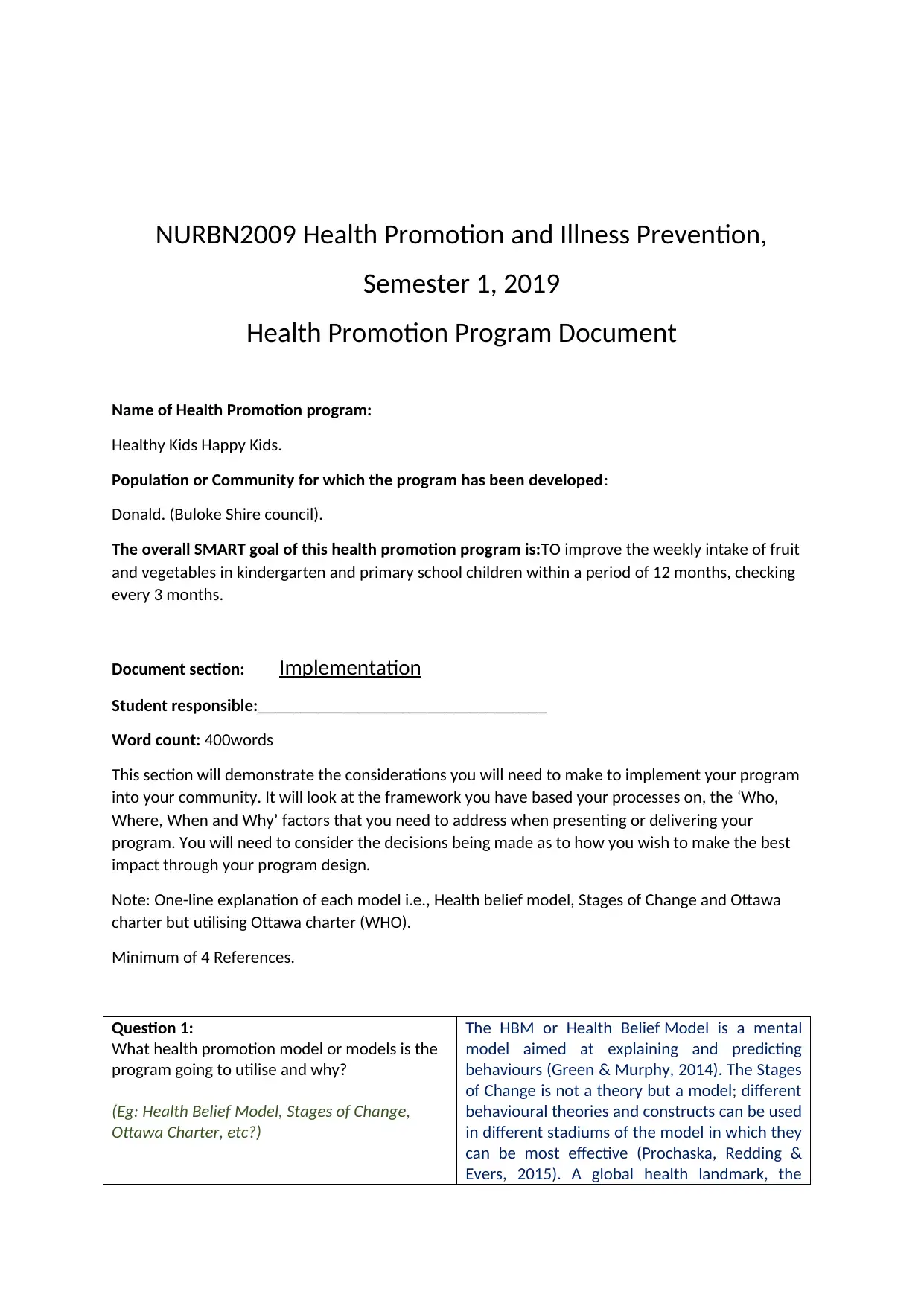
NURBN2009 Health Promotion and Illness Prevention,
Semester 1, 2019
Health Promotion Program Document
Name of Health Promotion program:
Healthy Kids Happy Kids.
Population or Community for which the program has been developed:
Donald. (Buloke Shire council).
The overall SMART goal of this health promotion program is:TO improve the weekly intake of fruit
and vegetables in kindergarten and primary school children within a period of 12 months, checking
every 3 months.
Document section: Implementation
Student responsible:__________________________________
Word count: 400words
This section will demonstrate the considerations you will need to make to implement your program
into your community. It will look at the framework you have based your processes on, the ‘Who,
Where, When and Why’ factors that you need to address when presenting or delivering your
program. You will need to consider the decisions being made as to how you wish to make the best
impact through your program design.
Note: One-line explanation of each model i.e., Health belief model, Stages of Change and Ottawa
charter but utilising Ottawa charter (WHO).
Minimum of 4 References.
Question 1:
What health promotion model or models is the
program going to utilise and why?
(Eg: Health Belief Model, Stages of Change,
Ottawa Charter, etc?)
The HBM or Health Belief Model is a mental
model aimed at explaining and predicting
behaviours (Green & Murphy, 2014). The Stages
of Change is not a theory but a model; different
behavioural theories and constructs can be used
in different stadiums of the model in which they
can be most effective (Prochaska, Redding &
Evers, 2015). A global health landmark, the
tabler-icon-diamond-filled.svg

Paraphrase This Document

Need a fresh take? Get an instant paraphrase of this document with our AI Paraphraser
Document Page
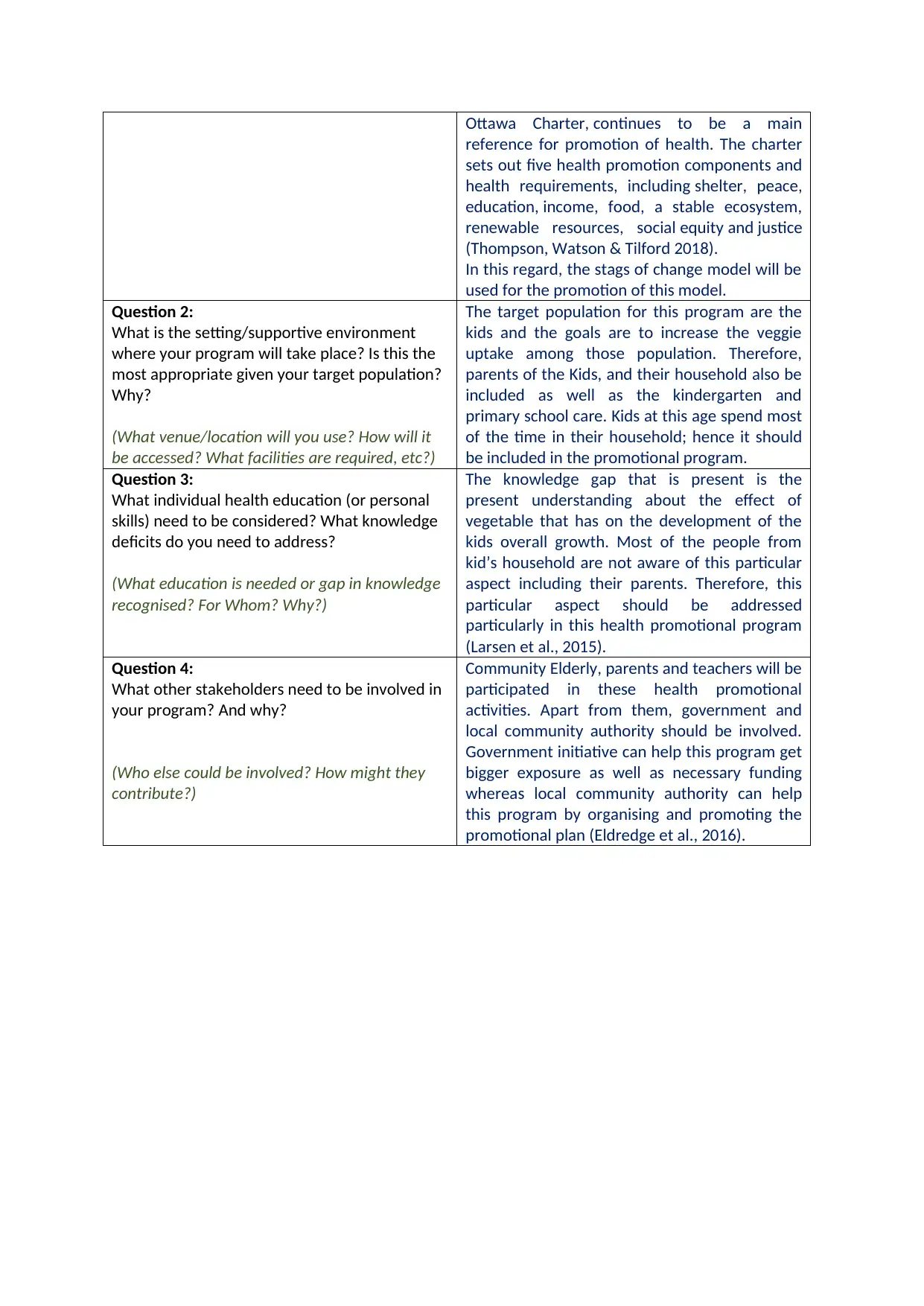
Ottawa Charter, continues to be a main
reference for promotion of health. The charter
sets out five health promotion components and
health requirements, including shelter, peace,
education, income, food, a stable ecosystem,
renewable resources, social equity and justice
(Thompson, Watson & Tilford 2018).
In this regard, the stags of change model will be
used for the promotion of this model.
Question 2:
What is the setting/supportive environment
where your program will take place? Is this the
most appropriate given your target population?
Why?
(What venue/location will you use? How will it
be accessed? What facilities are required, etc?)
The target population for this program are the
kids and the goals are to increase the veggie
uptake among those population. Therefore,
parents of the Kids, and their household also be
included as well as the kindergarten and
primary school care. Kids at this age spend most
of the time in their household; hence it should
be included in the promotional program.
Question 3:
What individual health education (or personal
skills) need to be considered? What knowledge
deficits do you need to address?
(What education is needed or gap in knowledge
recognised? For Whom? Why?)
The knowledge gap that is present is the
present understanding about the effect of
vegetable that has on the development of the
kids overall growth. Most of the people from
kid’s household are not aware of this particular
aspect including their parents. Therefore, this
particular aspect should be addressed
particularly in this health promotional program
(Larsen et al., 2015).
Question 4:
What other stakeholders need to be involved in
your program? And why?
(Who else could be involved? How might they
contribute?)
Community Elderly, parents and teachers will be
participated in these health promotional
activities. Apart from them, government and
local community authority should be involved.
Government initiative can help this program get
bigger exposure as well as necessary funding
whereas local community authority can help
this program by organising and promoting the
promotional plan (Eldredge et al., 2016).
Document Page
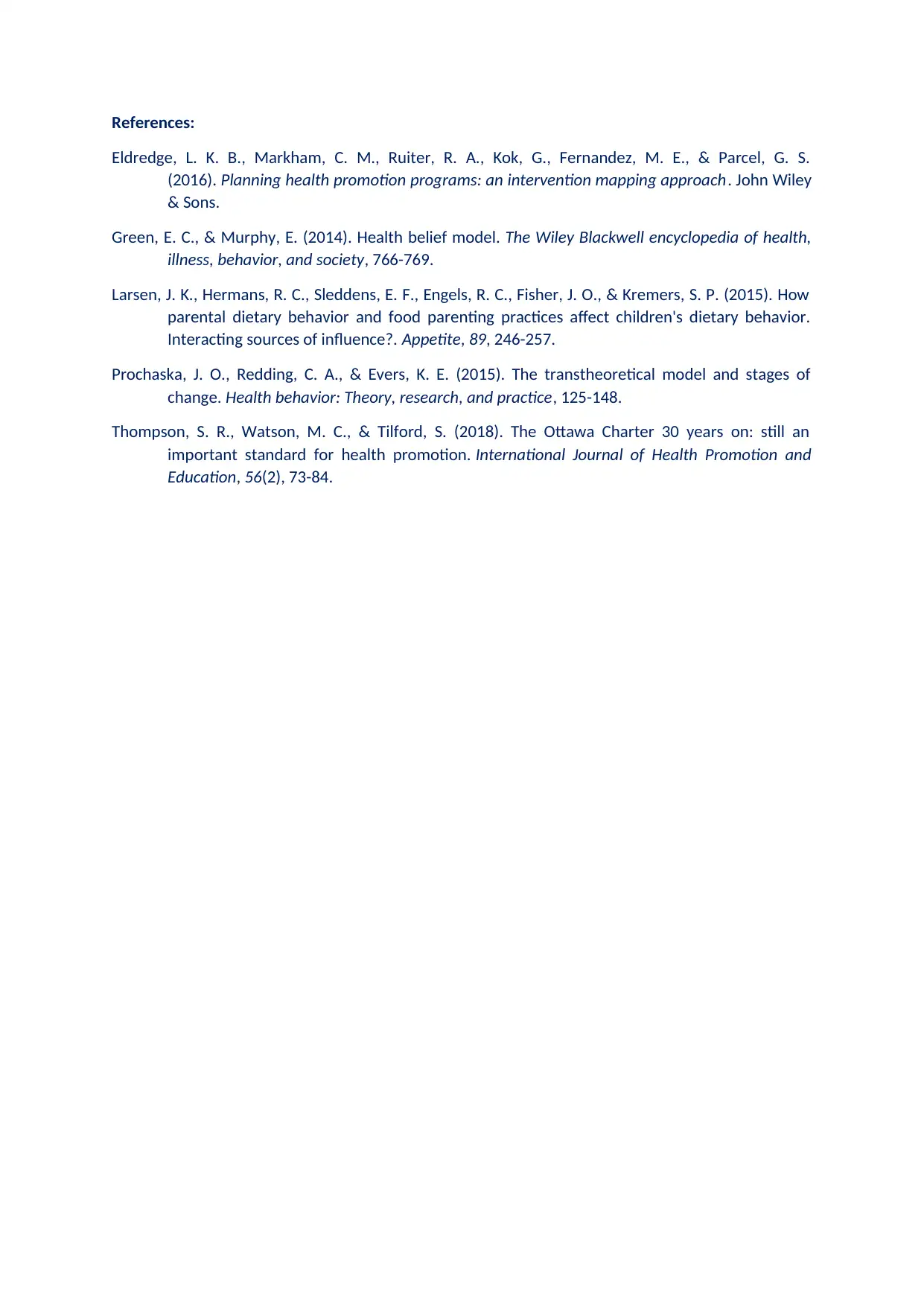
References:
Eldredge, L. K. B., Markham, C. M., Ruiter, R. A., Kok, G., Fernandez, M. E., & Parcel, G. S.
(2016). Planning health promotion programs: an intervention mapping approach. John Wiley
& Sons.
Green, E. C., & Murphy, E. (2014). Health belief model. The Wiley Blackwell encyclopedia of health,
illness, behavior, and society, 766-769.
Larsen, J. K., Hermans, R. C., Sleddens, E. F., Engels, R. C., Fisher, J. O., & Kremers, S. P. (2015). How
parental dietary behavior and food parenting practices affect children's dietary behavior.
Interacting sources of influence?. Appetite, 89, 246-257.
Prochaska, J. O., Redding, C. A., & Evers, K. E. (2015). The transtheoretical model and stages of
change. Health behavior: Theory, research, and practice, 125-148.
Thompson, S. R., Watson, M. C., & Tilford, S. (2018). The Ottawa Charter 30 years on: still an
important standard for health promotion. International Journal of Health Promotion and
Education, 56(2), 73-84.
Document Page
Images & Testimonials
Group Consent
Group Title: ________________________________________________________________________
I grant Federation University Australia (“FedUni”) my permission to use, copyright and publish all
photographs and/or footage taken of me for the purpose of promoting, marketing or publicising
FedUni. I also grant FedUni my permission to use and publish my name and all testimonials given by
me for the purpose of promoting, marketing or publicising FedUni.
I waive the right to inspect or approve versions of the photographs and/or footage and/or
testimonials used for publication by FedUni.
I release FedUni (and its officers, employees, agents, students and contractors) from any liability (to
the extent permitted by law) for any loss, injury or damage suffered in relation to the use of my
photographs, footage, name and/or testimonials, including but not limited to any claims of
defamation, invasion of privacy or infringement of copyright.
I have read this document and understand and agree to its content.
Executed as a deed by the persons named below or their parents or guardians if under 18 years of
age:
Name: ___________________________ Signature: ______________________ Date: ____________
chevron_up_icon
1 out of 4
circle_padding
hide_on_mobile
zoom_out_icon
[object Object]