Rehabilitation and Recovery Care Models: A Comparative Study

Verified

Added on  2020/05/04

|4
|352
|68
Report
AI Summary
This report delves into a comparative analysis of rehabilitation care and recovery care models. Rehabilitation care focuses on restoring functional abilities, aiding patients in overcoming illnesses, and promoting self-sufficiency. Conversely, the recovery model emphasizes mental health support, empowering individuals to manage their conditions. The report outlines ten standards of recovery, highlighting person-centered approaches, empowerment, and the integration of mental, physical, and spiritual needs. It also underscores the importance of peer support, managing fluctuations in the recovery process, building connections, and overcoming challenges. A case study of a 32-year-old woman with schizophrenia illustrates the practical application of these principles within a community mental health setting, emphasizing the patient's ability to manage their illness. The report cites the Substance Abuse and Mental Health Services Administration (SAMHSA) as a reference.

Document Page
Running head: NURSING
Nursing
Name of the student:
Name of the university:
Author note:
tabler-icon-diamond-filled.svg

Paraphrase This Document

Need a fresh take? Get an instant paraphrase of this document with our AI Paraphraser
Document Page
1NURSING
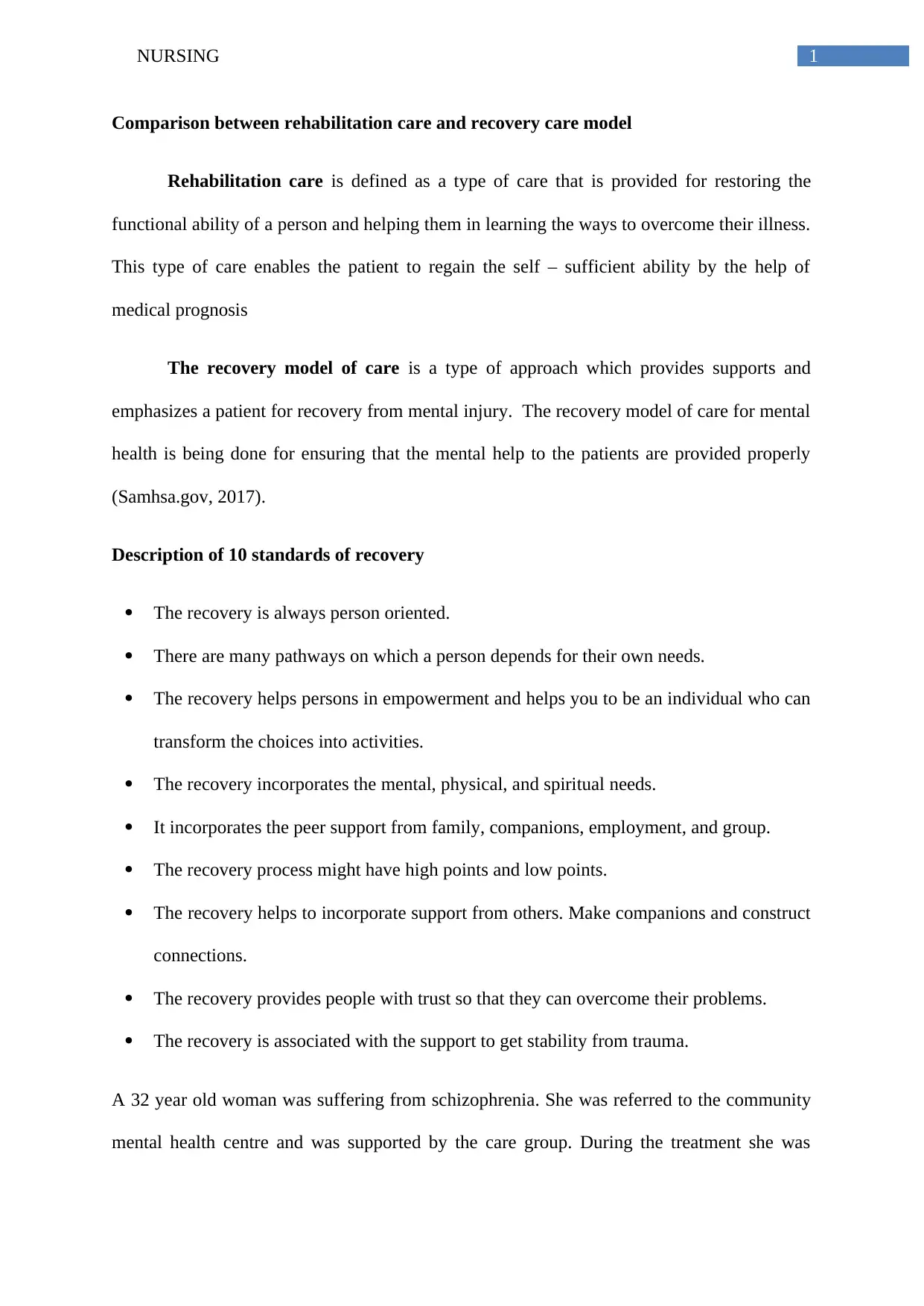
Comparison between rehabilitation care and recovery care model
Rehabilitation care is defined as a type of care that is provided for restoring the
functional ability of a person and helping them in learning the ways to overcome their illness.
This type of care enables the patient to regain the self – sufficient ability by the help of
medical prognosis
The recovery model of care is a type of approach which provides supports and
emphasizes a patient for recovery from mental injury. The recovery model of care for mental
health is being done for ensuring that the mental help to the patients are provided properly
(Samhsa.gov, 2017).
Description of 10 standards of recovery
The recovery is always person oriented.
There are many pathways on which a person depends for their own needs.
The recovery helps persons in empowerment and helps you to be an individual who can
transform the choices into activities.
The recovery incorporates the mental, physical, and spiritual needs.
It incorporates the peer support from family, companions, employment, and group.
The recovery process might have high points and low points.
The recovery helps to incorporate support from others. Make companions and construct
connections.
The recovery provides people with trust so that they can overcome their problems.
The recovery is associated with the support to get stability from trauma.
A 32 year old woman was suffering from schizophrenia. She was referred to the community
mental health centre and was supported by the care group. During the treatment she was
Document Page
2NURSING
interviewed and she told that she was able to control her mental illness and was stable to
maintain her condition.
Document Page
3NURSING
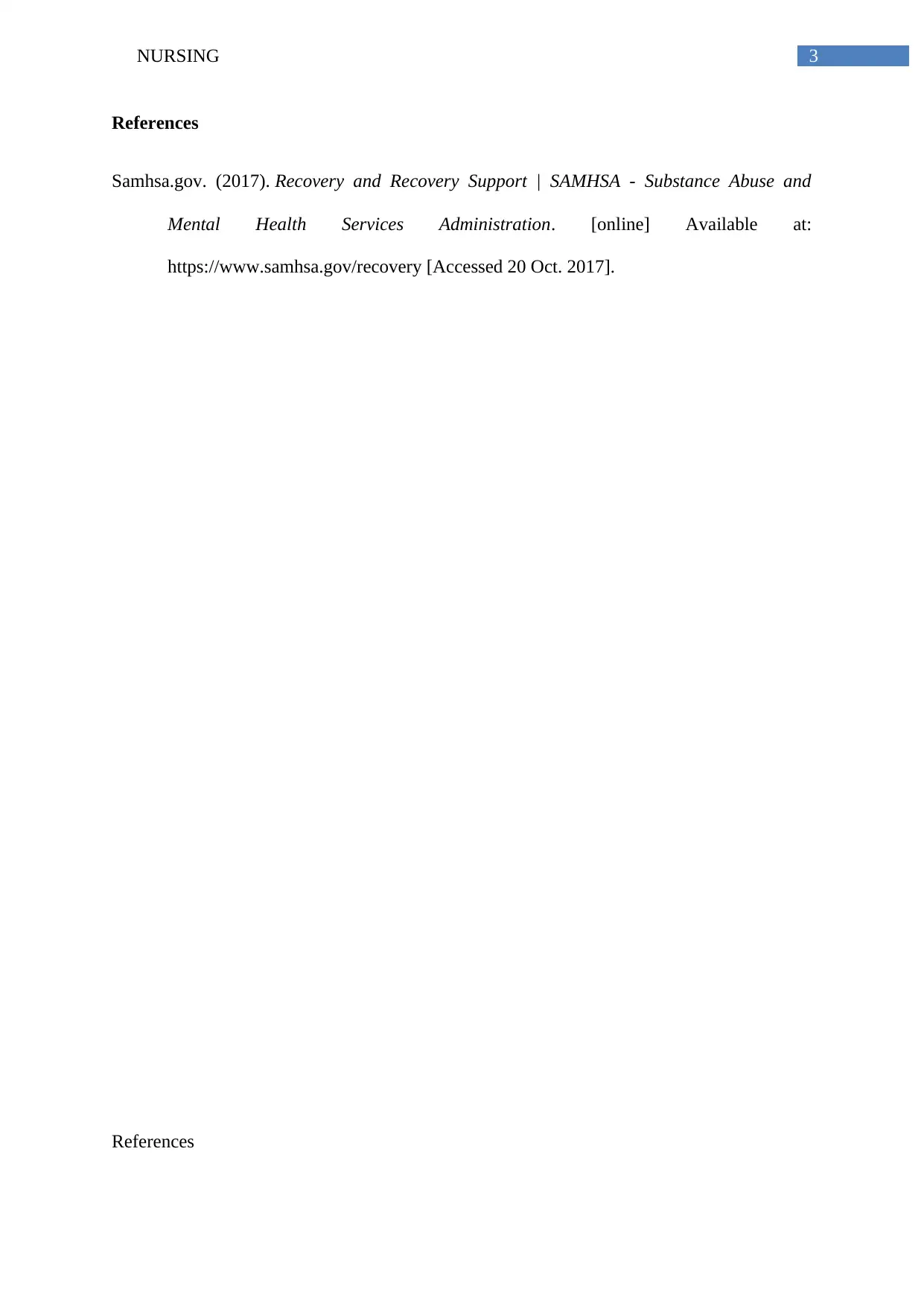
References
Samhsa.gov. (2017). Recovery and Recovery Support | SAMHSA - Substance Abuse and
Mental Health Services Administration. [online] Available at:
https://www.samhsa.gov/recovery [Accessed 20 Oct. 2017].
References
chevron_up_icon
1 out of 4
circle_padding
hide_on_mobile
zoom_out_icon
[object Object]