Cultural Safety in Nursing Practice: Reflective Assignment on Module 3

Verified

Added on  2023/03/17

|6
|1155
|85
Report
AI Summary
This nursing assignment presents a critical reflection on learning about culturally safe nursing practices for Aboriginal and Torres Strait Islander communities. The reflection is based on a scenario from Module 3, focusing on the importance of culture in healthcare. It discusses the evolution of understanding regarding the influence of culture on health beliefs and behaviors, particularly within Aboriginal societies. The assignment evaluates the shift from a standardized healthcare approach to recognizing the need for culturally sensitive care, emphasizing the importance of considering cultural beliefs in healthcare decisions. It assesses the initial assumption of uniform healthcare and the realization that culturally safe practices are essential for effective care. The conclusion highlights the importance of expanding understanding of culture and adhering to ethical guidelines, with an action plan to ensure culturally respectful interactions and the acquisition of knowledge about cultural groups to promote a safe and empathetic healthcare environment. The student emphasizes the need to avoid imposing cultural preferences and to formulate healthcare that addresses specific cultural health risks.
Document Page
0
Running Head: Nursing Assignment
NURSING ASSIGNMENT
tabler-icon-diamond-filled.svg

Paraphrase This Document

Need a fresh take? Get an instant paraphrase of this document with our AI Paraphraser
Document Page
1
Nursing Assignment
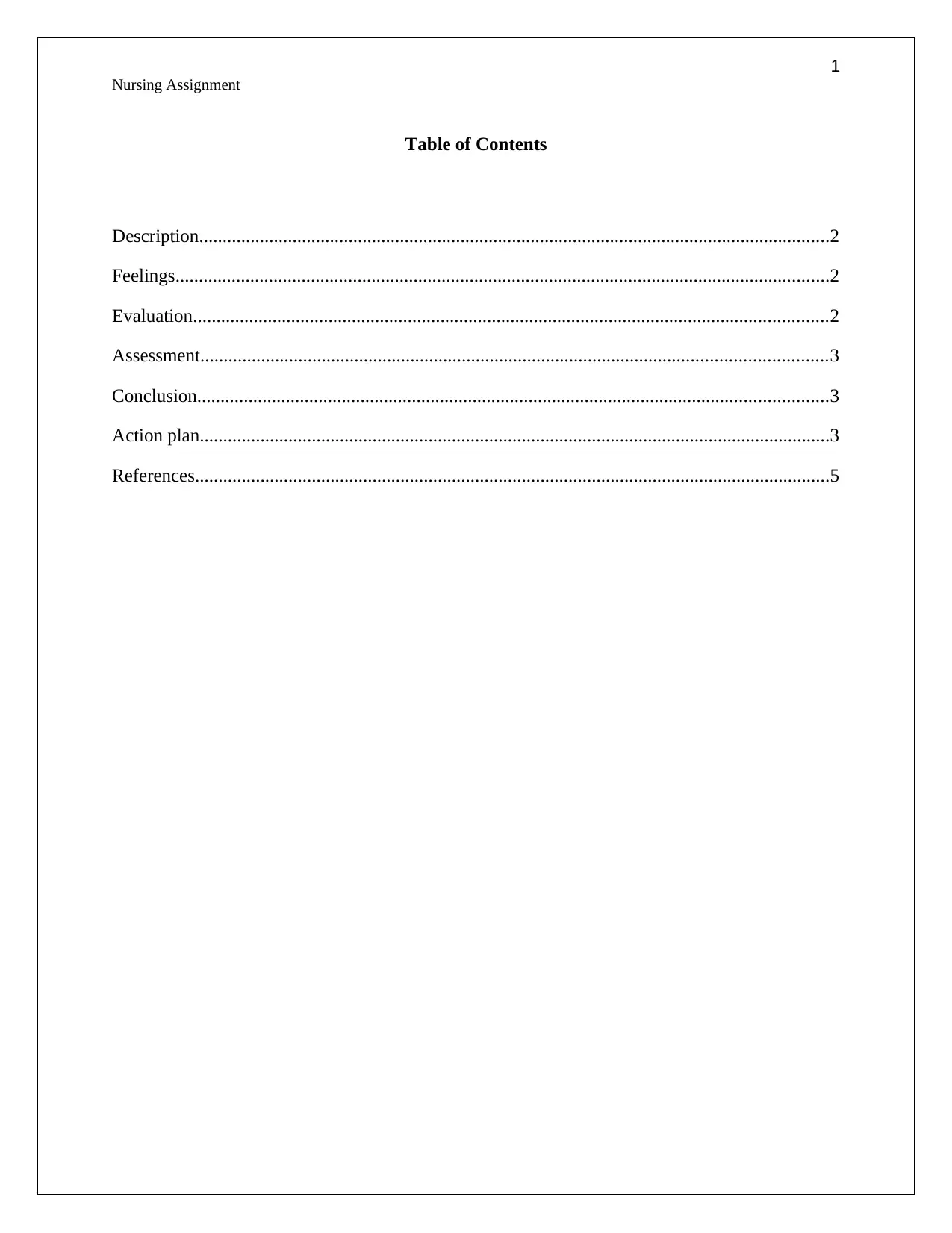
Table of Contents
Description.......................................................................................................................................2
Feelings............................................................................................................................................2
Evaluation........................................................................................................................................2
Assessment......................................................................................................................................3
Conclusion.......................................................................................................................................3
Action plan.......................................................................................................................................3
References........................................................................................................................................5
Document Page
2
Nursing Assignment
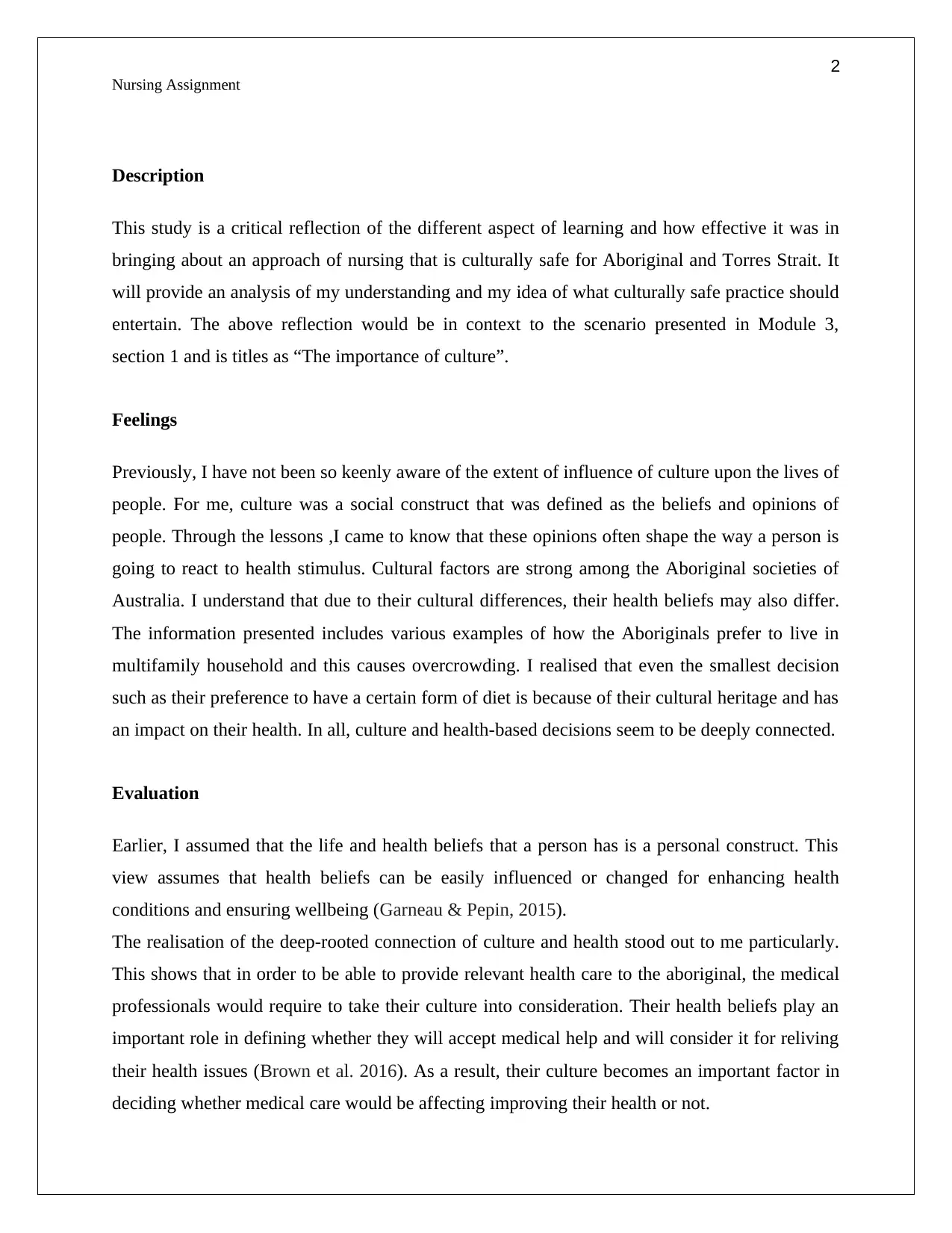
Description
This study is a critical reflection of the different aspect of learning and how effective it was in
bringing about an approach of nursing that is culturally safe for Aboriginal and Torres Strait. It
will provide an analysis of my understanding and my idea of what culturally safe practice should
entertain. The above reflection would be in context to the scenario presented in Module 3,
section 1 and is titles as “The importance of culture”.
Feelings
Previously, I have not been so keenly aware of the extent of influence of culture upon the lives of
people. For me, culture was a social construct that was defined as the beliefs and opinions of
people. Through the lessons ,I came to know that these opinions often shape the way a person is
going to react to health stimulus. Cultural factors are strong among the Aboriginal societies of
Australia. I understand that due to their cultural differences, their health beliefs may also differ.
The information presented includes various examples of how the Aboriginals prefer to live in
multifamily household and this causes overcrowding. I realised that even the smallest decision
such as their preference to have a certain form of diet is because of their cultural heritage and has
an impact on their health. In all, culture and health-based decisions seem to be deeply connected.
Evaluation
Earlier, I assumed that the life and health beliefs that a person has is a personal construct. This
view assumes that health beliefs can be easily influenced or changed for enhancing health
conditions and ensuring wellbeing (Garneau & Pepin, 2015).
The realisation of the deep-rooted connection of culture and health stood out to me particularly.
This shows that in order to be able to provide relevant health care to the aboriginal, the medical
professionals would require to take their culture into consideration. Their health beliefs play an
important role in defining whether they will accept medical help and will consider it for reliving
their health issues (Brown et al. 2016). As a result, their culture becomes an important factor in
deciding whether medical care would be affecting improving their health or not.
Document Page
3
Nursing Assignment
Assessment
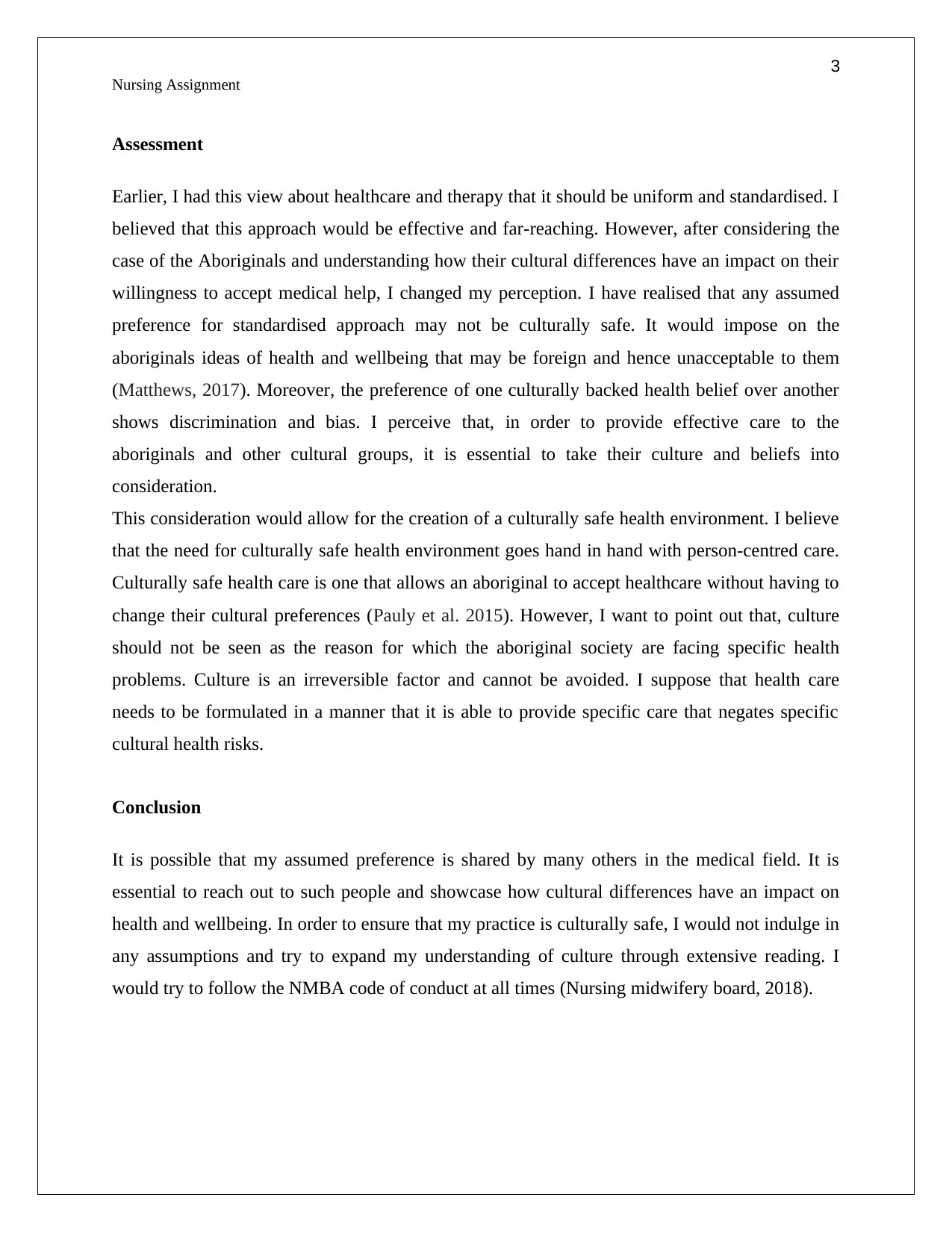
Earlier, I had this view about healthcare and therapy that it should be uniform and standardised. I
believed that this approach would be effective and far-reaching. However, after considering the
case of the Aboriginals and understanding how their cultural differences have an impact on their
willingness to accept medical help, I changed my perception. I have realised that any assumed
preference for standardised approach may not be culturally safe. It would impose on the
aboriginals ideas of health and wellbeing that may be foreign and hence unacceptable to them
(Matthews, 2017). Moreover, the preference of one culturally backed health belief over another
shows discrimination and bias. I perceive that, in order to provide effective care to the
aboriginals and other cultural groups, it is essential to take their culture and beliefs into
consideration.
This consideration would allow for the creation of a culturally safe health environment. I believe
that the need for culturally safe health environment goes hand in hand with person-centred care.
Culturally safe health care is one that allows an aboriginal to accept healthcare without having to
change their cultural preferences (Pauly et al. 2015). However, I want to point out that, culture
should not be seen as the reason for which the aboriginal society are facing specific health
problems. Culture is an irreversible factor and cannot be avoided. I suppose that health care
needs to be formulated in a manner that it is able to provide specific care that negates specific
cultural health risks.
Conclusion
It is possible that my assumed preference is shared by many others in the medical field. It is
essential to reach out to such people and showcase how cultural differences have an impact on
health and wellbeing. In order to ensure that my practice is culturally safe, I would not indulge in
any assumptions and try to expand my understanding of culture through extensive reading. I
would try to follow the NMBA code of conduct at all times (Nursing midwifery board, 2018).
tabler-icon-diamond-filled.svg

Paraphrase This Document

Need a fresh take? Get an instant paraphrase of this document with our AI Paraphraser
Document Page
4
Nursing Assignment
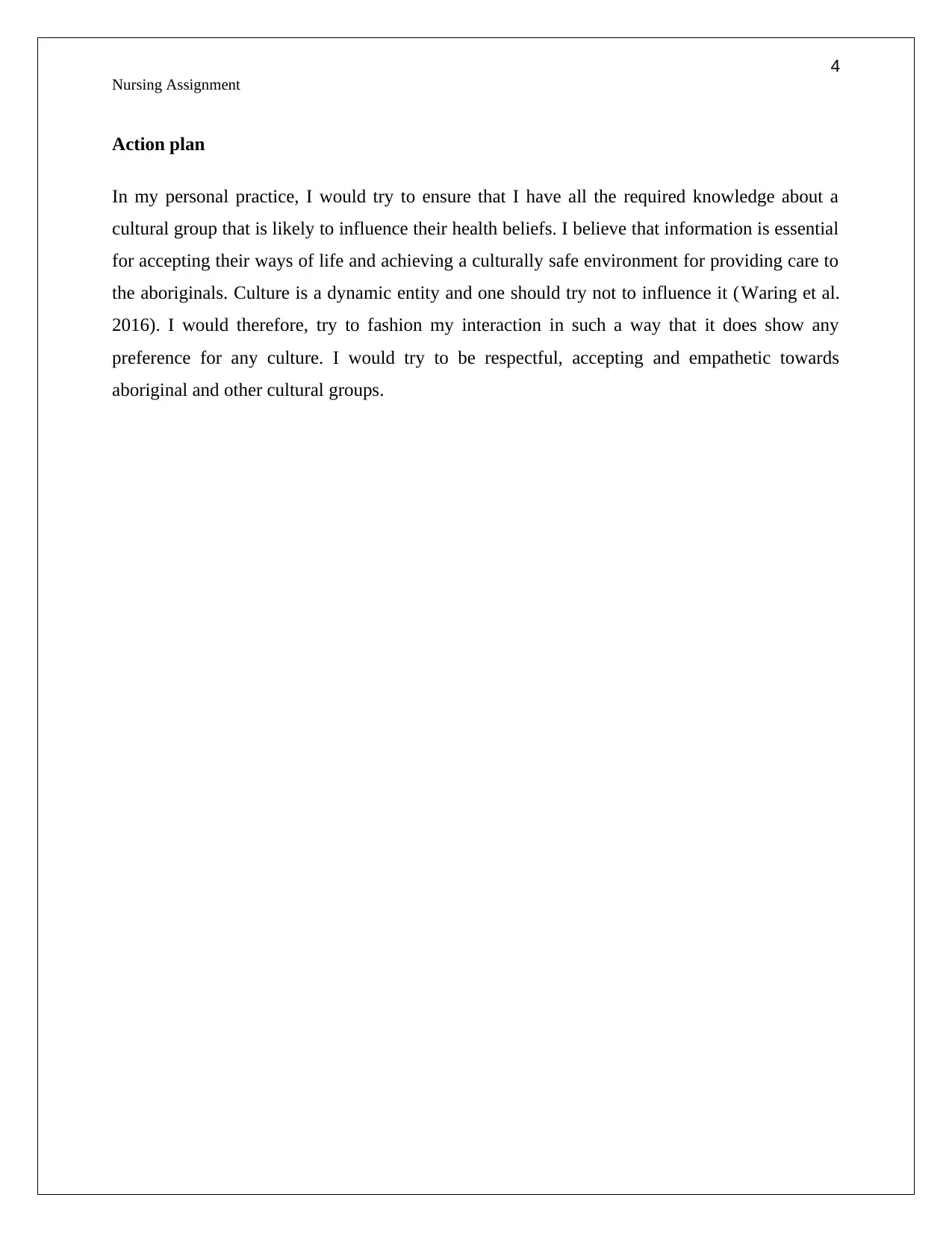
Action plan
In my personal practice, I would try to ensure that I have all the required knowledge about a
cultural group that is likely to influence their health beliefs. I believe that information is essential
for accepting their ways of life and achieving a culturally safe environment for providing care to
the aboriginals. Culture is a dynamic entity and one should try not to influence it (Waring et al.
2016). I would therefore, try to fashion my interaction in such a way that it does show any
preference for any culture. I would try to be respectful, accepting and empathetic towards
aboriginal and other cultural groups.
Document Page
5
Nursing Assignment
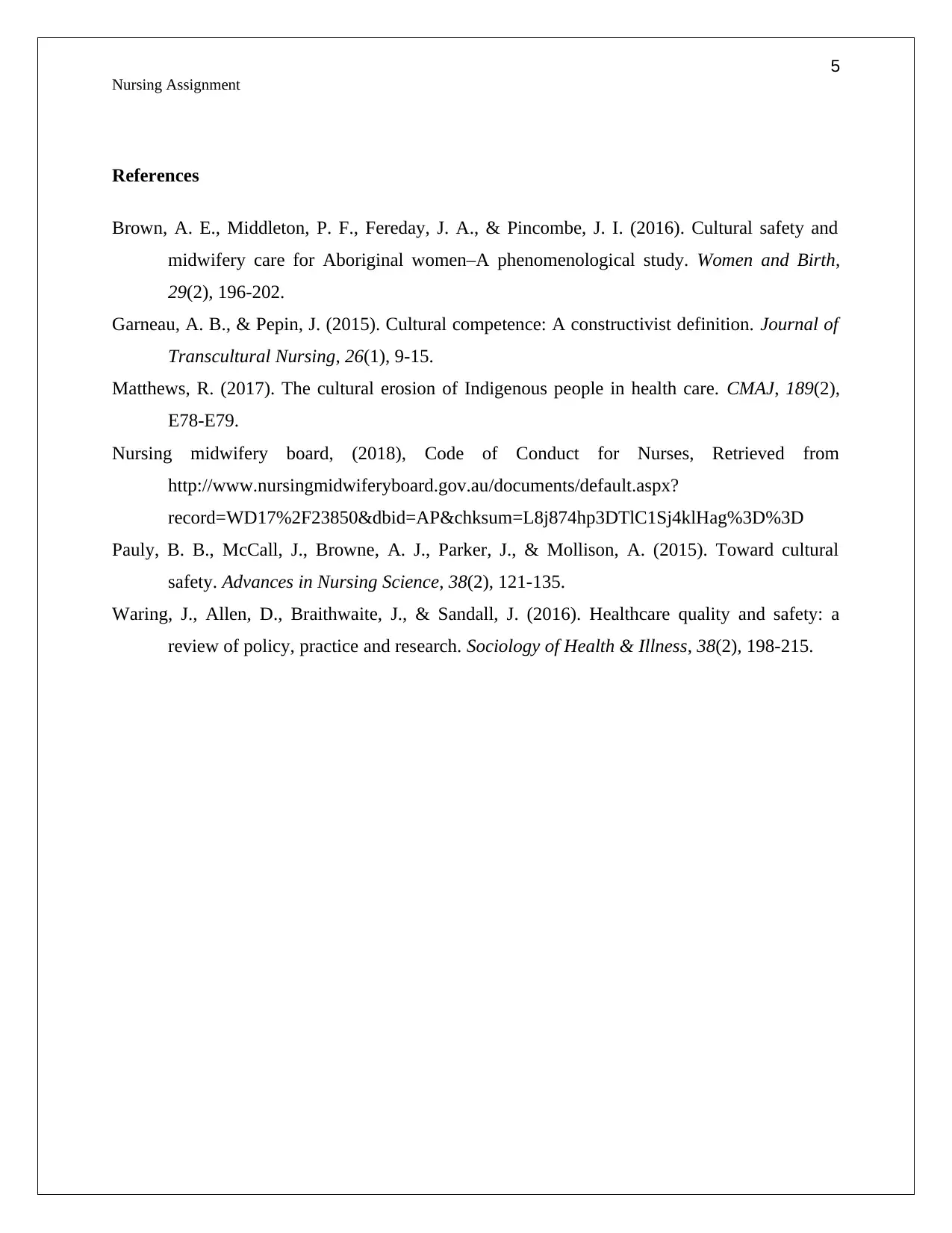
References
Brown, A. E., Middleton, P. F., Fereday, J. A., & Pincombe, J. I. (2016). Cultural safety and
midwifery care for Aboriginal women–A phenomenological study. Women and Birth,
29(2), 196-202.
Garneau, A. B., & Pepin, J. (2015). Cultural competence: A constructivist definition. Journal of
Transcultural Nursing, 26(1), 9-15.
Matthews, R. (2017). The cultural erosion of Indigenous people in health care. CMAJ, 189(2),
E78-E79.
Nursing midwifery board, (2018), Code of Conduct for Nurses, Retrieved from
http://www.nursingmidwiferyboard.gov.au/documents/default.aspx?
record=WD17%2F23850&dbid=AP&chksum=L8j874hp3DTlC1Sj4klHag%3D%3D
Pauly, B. B., McCall, J., Browne, A. J., Parker, J., & Mollison, A. (2015). Toward cultural
safety. Advances in Nursing Science, 38(2), 121-135.
Waring, J., Allen, D., Braithwaite, J., & Sandall, J. (2016). Healthcare quality and safety: a
review of policy, practice and research. Sociology of Health & Illness, 38(2), 198-215.
chevron_up_icon
1 out of 6
circle_padding
hide_on_mobile
zoom_out_icon
[object Object]