HLTENN004 Diploma of Nursing: Post-operative Vaginal Hysterectomy Care
VerifiedAdded on 2023/06/10
|13
|2460
|89
Report
AI Summary
This nursing care plan outlines the essential elements for managing a 54-year-old patient, Brenda Wilson, post-vaginal hysterectomy. The plan addresses potential issues such as urinary incompetence, acute pain, ineffective tissue perfusion, constipation, risk of deficient oral hygiene, and potential cognitive deficits. It details specific nursing goals, interventions, and rationales for each issue, including monitoring voiding patterns, pain assessment, vital sign monitoring, and bowel sounds. The plan emphasizes pharmacological and non-pharmacological interventions to ensure a comfortable and fast recovery, highlighting the importance of patient education and a holistic approach to care. The document is available on Desklib, which offers a variety of study resources, including past papers and solved assignments, to support nursing students.
Running head: NURSING CARE PLAN
Nursing care plan
Name of the student:
Name of the university:
Author note:
Nursing care plan
Name of the student:
Name of the university:
Author note:

Paraphrase This Document
Need a fresh take? Get an instant paraphrase of this document with our AI Paraphraser
1NURSING CARE PLAN
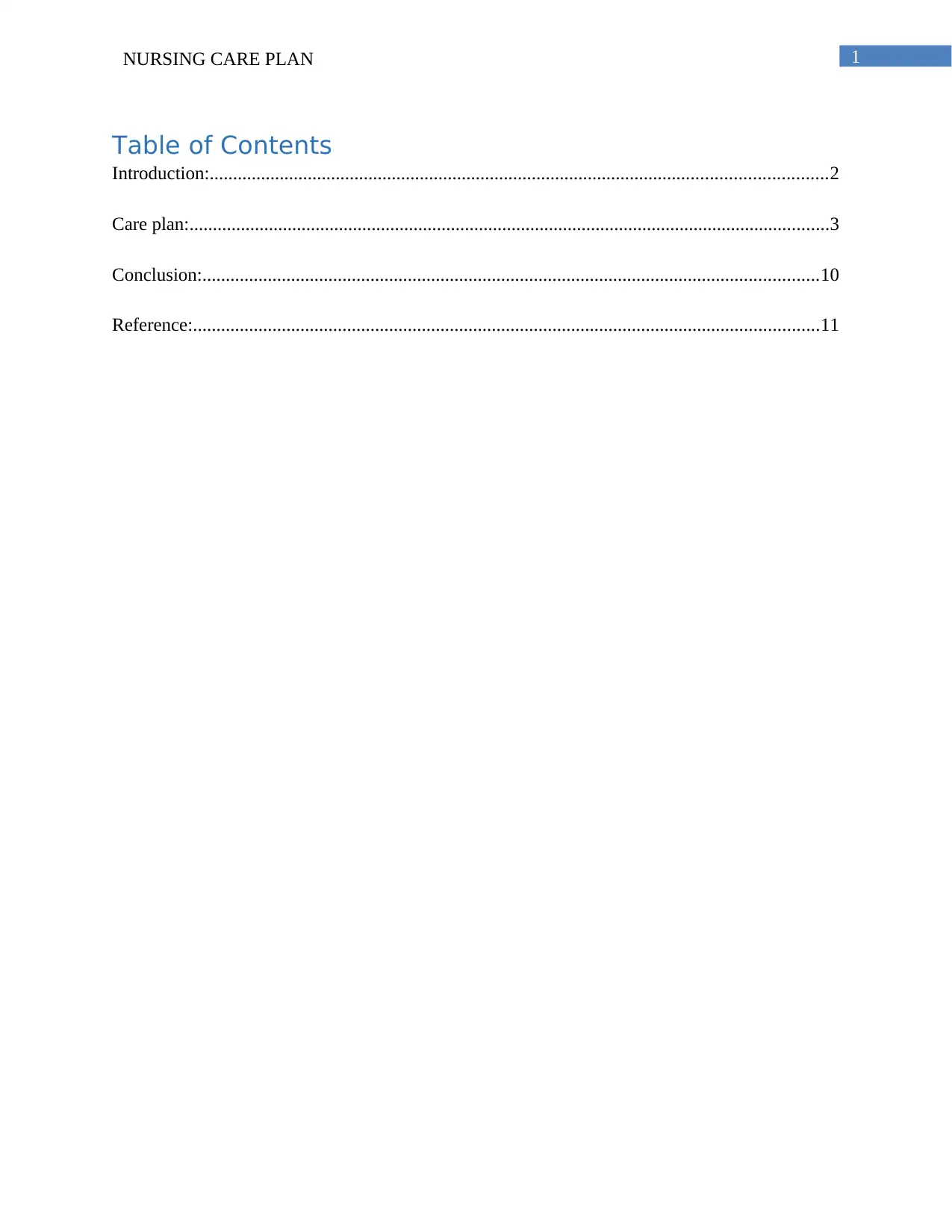
Table of Contents
Introduction:....................................................................................................................................2
Care plan:.........................................................................................................................................3
Conclusion:....................................................................................................................................10
Reference:......................................................................................................................................11
Table of Contents
Introduction:....................................................................................................................................2
Care plan:.........................................................................................................................................3
Conclusion:....................................................................................................................................10
Reference:......................................................................................................................................11
2NURSING CARE PLAN
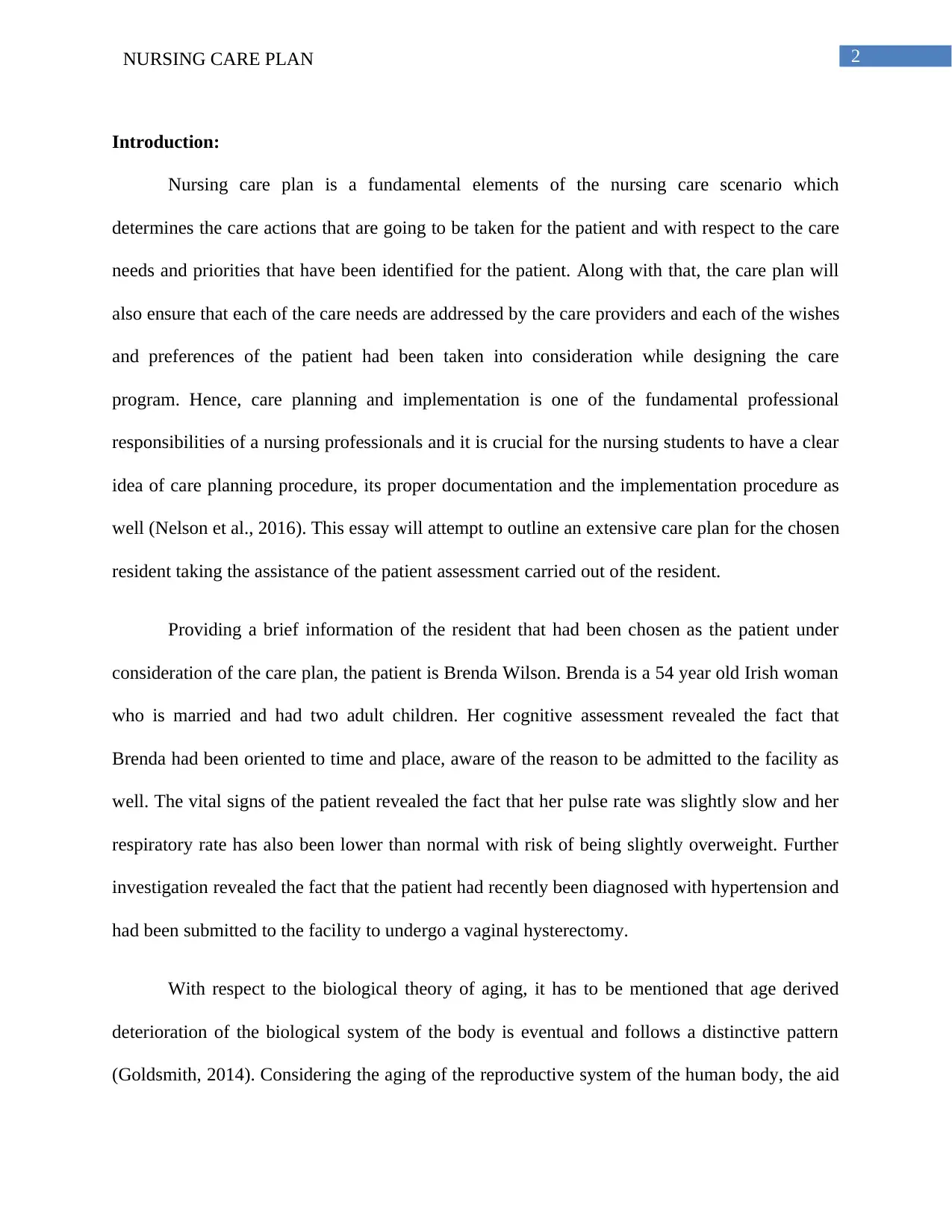
Introduction:
Nursing care plan is a fundamental elements of the nursing care scenario which
determines the care actions that are going to be taken for the patient and with respect to the care
needs and priorities that have been identified for the patient. Along with that, the care plan will
also ensure that each of the care needs are addressed by the care providers and each of the wishes
and preferences of the patient had been taken into consideration while designing the care
program. Hence, care planning and implementation is one of the fundamental professional
responsibilities of a nursing professionals and it is crucial for the nursing students to have a clear
idea of care planning procedure, its proper documentation and the implementation procedure as
well (Nelson et al., 2016). This essay will attempt to outline an extensive care plan for the chosen
resident taking the assistance of the patient assessment carried out of the resident.
Providing a brief information of the resident that had been chosen as the patient under
consideration of the care plan, the patient is Brenda Wilson. Brenda is a 54 year old Irish woman
who is married and had two adult children. Her cognitive assessment revealed the fact that
Brenda had been oriented to time and place, aware of the reason to be admitted to the facility as
well. The vital signs of the patient revealed the fact that her pulse rate was slightly slow and her
respiratory rate has also been lower than normal with risk of being slightly overweight. Further
investigation revealed the fact that the patient had recently been diagnosed with hypertension and
had been submitted to the facility to undergo a vaginal hysterectomy.
With respect to the biological theory of aging, it has to be mentioned that age derived
deterioration of the biological system of the body is eventual and follows a distinctive pattern
(Goldsmith, 2014). Considering the aging of the reproductive system of the human body, the aid
Introduction:
Nursing care plan is a fundamental elements of the nursing care scenario which
determines the care actions that are going to be taken for the patient and with respect to the care
needs and priorities that have been identified for the patient. Along with that, the care plan will
also ensure that each of the care needs are addressed by the care providers and each of the wishes
and preferences of the patient had been taken into consideration while designing the care
program. Hence, care planning and implementation is one of the fundamental professional
responsibilities of a nursing professionals and it is crucial for the nursing students to have a clear
idea of care planning procedure, its proper documentation and the implementation procedure as
well (Nelson et al., 2016). This essay will attempt to outline an extensive care plan for the chosen
resident taking the assistance of the patient assessment carried out of the resident.
Providing a brief information of the resident that had been chosen as the patient under
consideration of the care plan, the patient is Brenda Wilson. Brenda is a 54 year old Irish woman
who is married and had two adult children. Her cognitive assessment revealed the fact that
Brenda had been oriented to time and place, aware of the reason to be admitted to the facility as
well. The vital signs of the patient revealed the fact that her pulse rate was slightly slow and her
respiratory rate has also been lower than normal with risk of being slightly overweight. Further
investigation revealed the fact that the patient had recently been diagnosed with hypertension and
had been submitted to the facility to undergo a vaginal hysterectomy.
With respect to the biological theory of aging, it has to be mentioned that age derived
deterioration of the biological system of the body is eventual and follows a distinctive pattern
(Goldsmith, 2014). Considering the aging of the reproductive system of the human body, the aid
⊘ This is a preview!⊘
Do you want full access?
Subscribe today to unlock all pages.

Trusted by 1+ million students worldwide
3NURSING CARE PLAN
of modern non programmed aging theory can be taken. According to this particular theory, the
evolutionary value of further life and the reproductive power is effectively reduced to zero
beyond the species specific age. Hence, there is a significant deterioration and eventual loss of
function of the reproductive organs as well which leads to menopause in women. It has to be
mentioned that menopause is a very common phenomenon that women begin to experience over
the age of 40 when the ovaries no longer release an egg every month and the menstrual cycle of
the woman also stops (Mitnitski, Song & Rockwood, 2013). However, it has to be mentioned
that although it is a very common phenomenon, there are various complications that arise after
the post-menopausal period. Some of this complications are arise includes abnormal uterine
bleeding, cervical fibroids, in situ carcinoma, endometrial hyperplasia, and chronic pelvic pain.
Although, all of the mentioned diseases have separate etiologic trajectories, all of the diseases are
associated menopause or early onset of menopause (Levine et al., 2016). One of the treatment
measures that can be used for the above mentioned complications is vaginal hysterectomy, for
which the patent in the case study had been admitted to the facility as well.
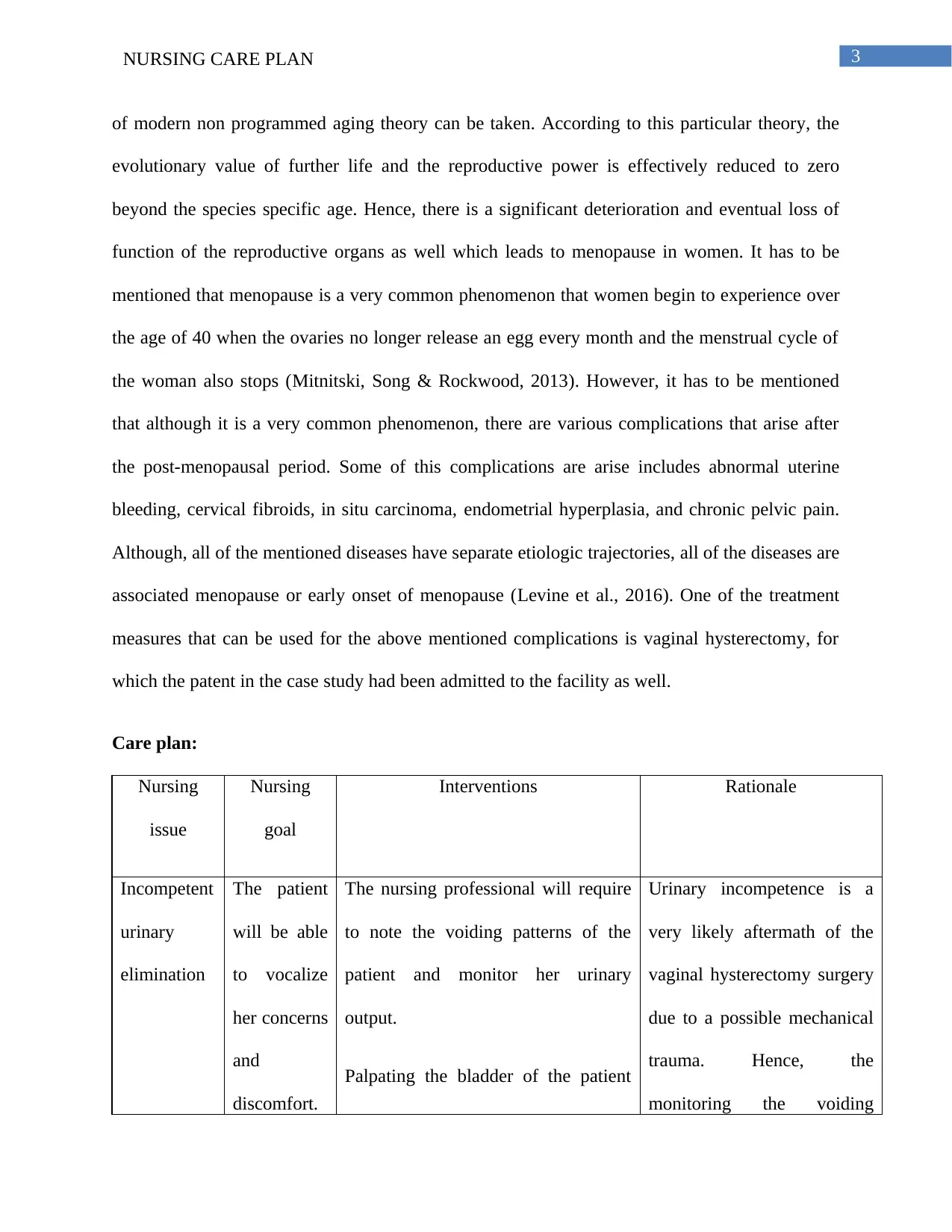
Care plan:
Nursing
issue
Nursing
goal
Interventions Rationale
Incompetent
urinary
elimination
The patient
will be able
to vocalize
her concerns
and
discomfort.
The nursing professional will require
to note the voiding patterns of the
patient and monitor her urinary
output.
Palpating the bladder of the patient
Urinary incompetence is a
very likely aftermath of the
vaginal hysterectomy surgery
due to a possible mechanical
trauma. Hence, the
monitoring the voiding
of modern non programmed aging theory can be taken. According to this particular theory, the
evolutionary value of further life and the reproductive power is effectively reduced to zero
beyond the species specific age. Hence, there is a significant deterioration and eventual loss of
function of the reproductive organs as well which leads to menopause in women. It has to be
mentioned that menopause is a very common phenomenon that women begin to experience over
the age of 40 when the ovaries no longer release an egg every month and the menstrual cycle of
the woman also stops (Mitnitski, Song & Rockwood, 2013). However, it has to be mentioned
that although it is a very common phenomenon, there are various complications that arise after
the post-menopausal period. Some of this complications are arise includes abnormal uterine
bleeding, cervical fibroids, in situ carcinoma, endometrial hyperplasia, and chronic pelvic pain.
Although, all of the mentioned diseases have separate etiologic trajectories, all of the diseases are
associated menopause or early onset of menopause (Levine et al., 2016). One of the treatment
measures that can be used for the above mentioned complications is vaginal hysterectomy, for
which the patent in the case study had been admitted to the facility as well.
Care plan:
Nursing
issue
Nursing
goal
Interventions Rationale
Incompetent
urinary
elimination
The patient
will be able
to vocalize
her concerns
and
discomfort.
The nursing professional will require
to note the voiding patterns of the
patient and monitor her urinary
output.
Palpating the bladder of the patient
Urinary incompetence is a
very likely aftermath of the
vaginal hysterectomy surgery
due to a possible mechanical
trauma. Hence, the
monitoring the voiding
Paraphrase This Document
Need a fresh take? Get an instant paraphrase of this document with our AI Paraphraser
4NURSING CARE PLAN
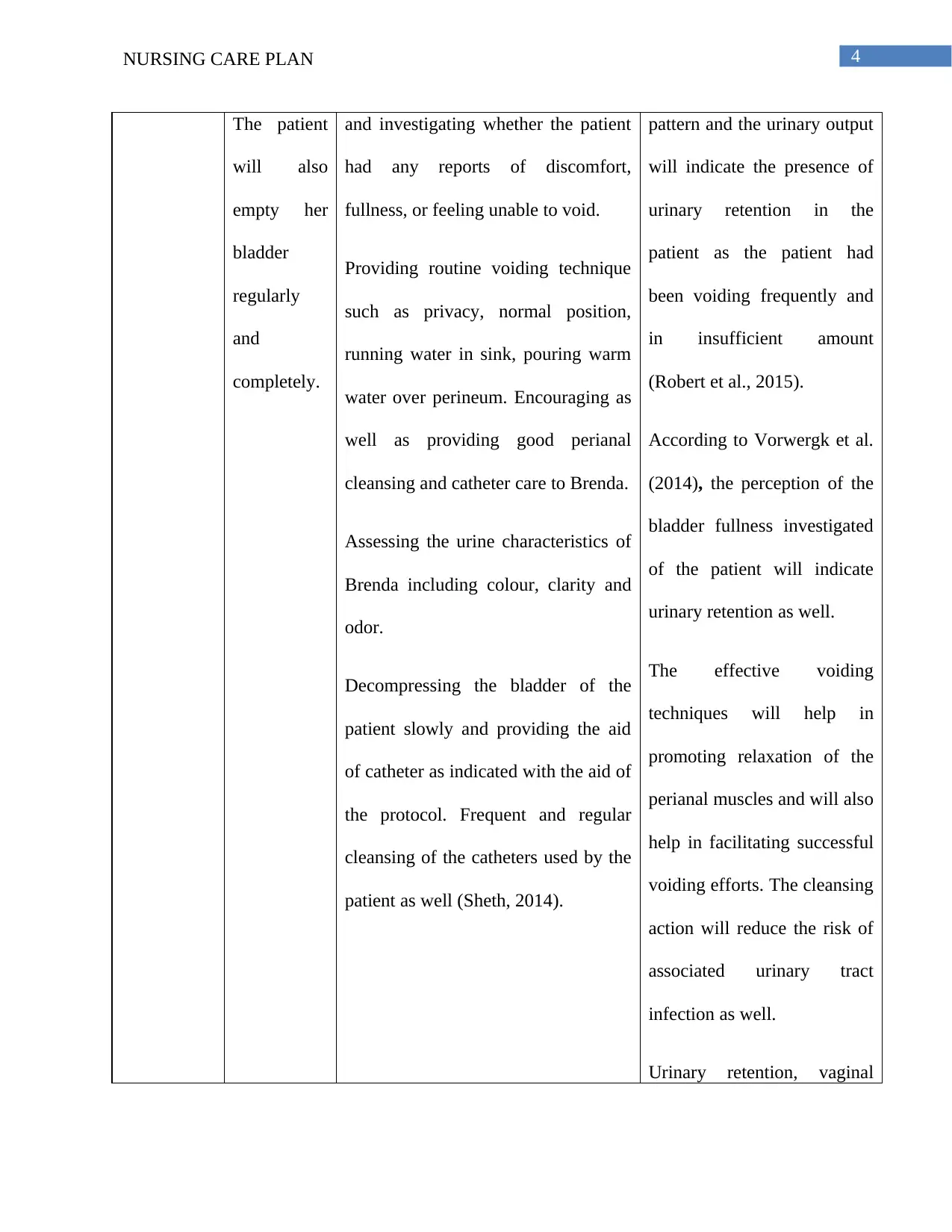
The patient
will also
empty her
bladder
regularly
and
completely.
and investigating whether the patient
had any reports of discomfort,
fullness, or feeling unable to void.
Providing routine voiding technique
such as privacy, normal position,
running water in sink, pouring warm
water over perineum. Encouraging as
well as providing good perianal
cleansing and catheter care to Brenda.
Assessing the urine characteristics of
Brenda including colour, clarity and
odor.
Decompressing the bladder of the
patient slowly and providing the aid
of catheter as indicated with the aid of
the protocol. Frequent and regular
cleansing of the catheters used by the
patient as well (Sheth, 2014).
pattern and the urinary output
will indicate the presence of
urinary retention in the
patient as the patient had
been voiding frequently and
in insufficient amount
(Robert et al., 2015).
According to Vorwergk et al.
(2014), the perception of the
bladder fullness investigated
of the patient will indicate
urinary retention as well.
The effective voiding
techniques will help in
promoting relaxation of the
perianal muscles and will also
help in facilitating successful
voiding efforts. The cleansing
action will reduce the risk of
associated urinary tract
infection as well.
Urinary retention, vaginal
The patient
will also
empty her
bladder
regularly
and
completely.
and investigating whether the patient
had any reports of discomfort,
fullness, or feeling unable to void.
Providing routine voiding technique
such as privacy, normal position,
running water in sink, pouring warm
water over perineum. Encouraging as
well as providing good perianal
cleansing and catheter care to Brenda.
Assessing the urine characteristics of
Brenda including colour, clarity and
odor.
Decompressing the bladder of the
patient slowly and providing the aid
of catheter as indicated with the aid of
the protocol. Frequent and regular
cleansing of the catheters used by the
patient as well (Sheth, 2014).
pattern and the urinary output
will indicate the presence of
urinary retention in the
patient as the patient had
been voiding frequently and
in insufficient amount
(Robert et al., 2015).
According to Vorwergk et al.
(2014), the perception of the
bladder fullness investigated
of the patient will indicate
urinary retention as well.
The effective voiding
techniques will help in
promoting relaxation of the
perianal muscles and will also
help in facilitating successful
voiding efforts. The cleansing
action will reduce the risk of
associated urinary tract
infection as well.
Urinary retention, vaginal
5NURSING CARE PLAN
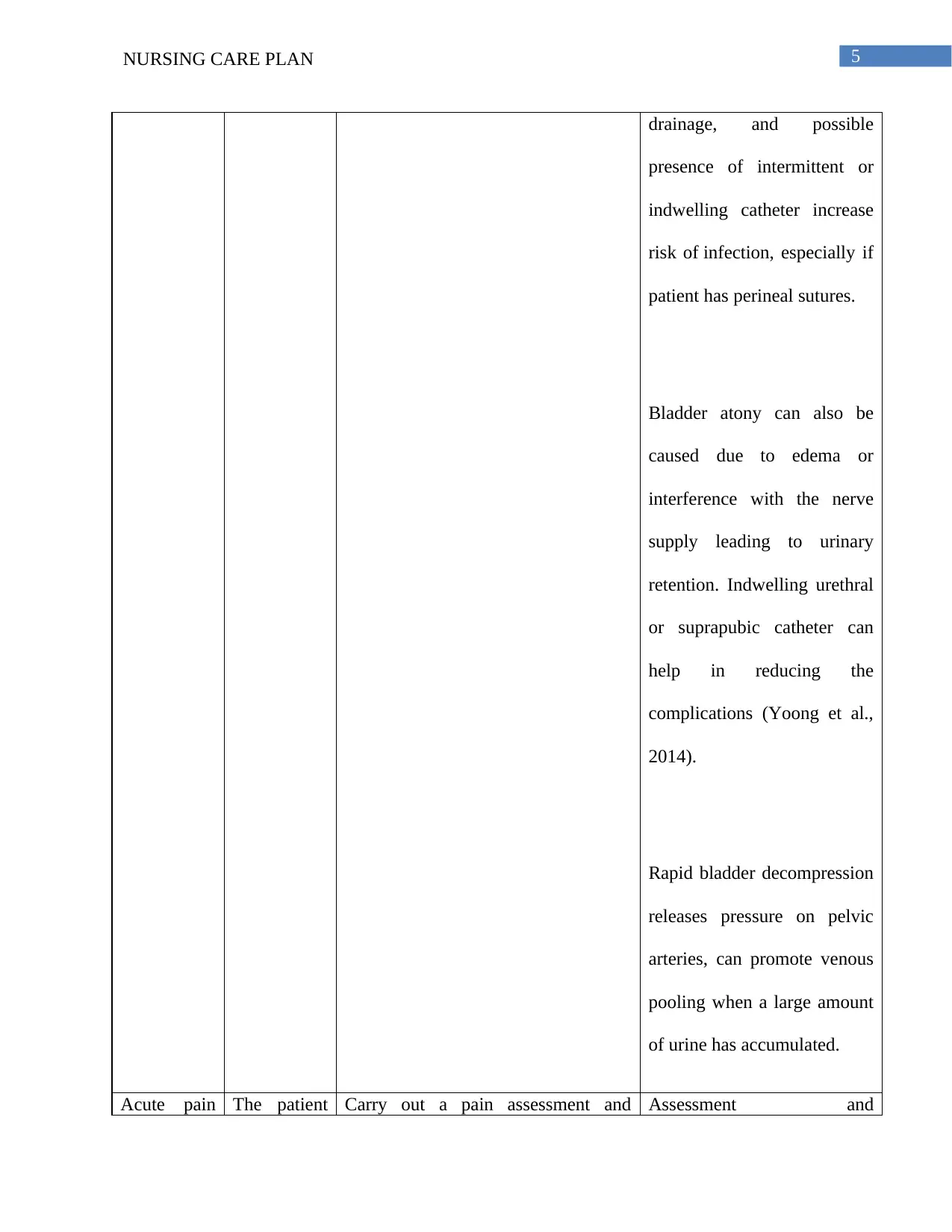
drainage, and possible
presence of intermittent or
indwelling catheter increase
risk of infection, especially if
patient has perineal sutures.
Bladder atony can also be
caused due to edema or
interference with the nerve
supply leading to urinary
retention. Indwelling urethral
or suprapubic catheter can
help in reducing the
complications (Yoong et al.,
2014).
Rapid bladder decompression
releases pressure on pelvic
arteries, can promote venous
pooling when a large amount
of urine has accumulated.
Acute pain The patient Carry out a pain assessment and Assessment and
drainage, and possible
presence of intermittent or
indwelling catheter increase
risk of infection, especially if
patient has perineal sutures.
Bladder atony can also be
caused due to edema or
interference with the nerve
supply leading to urinary
retention. Indwelling urethral
or suprapubic catheter can
help in reducing the
complications (Yoong et al.,
2014).
Rapid bladder decompression
releases pressure on pelvic
arteries, can promote venous
pooling when a large amount
of urine has accumulated.
Acute pain The patient Carry out a pain assessment and Assessment and
⊘ This is a preview!⊘
Do you want full access?
Subscribe today to unlock all pages.
Trusted by 1+ million students worldwide
6NURSING CARE PLAN
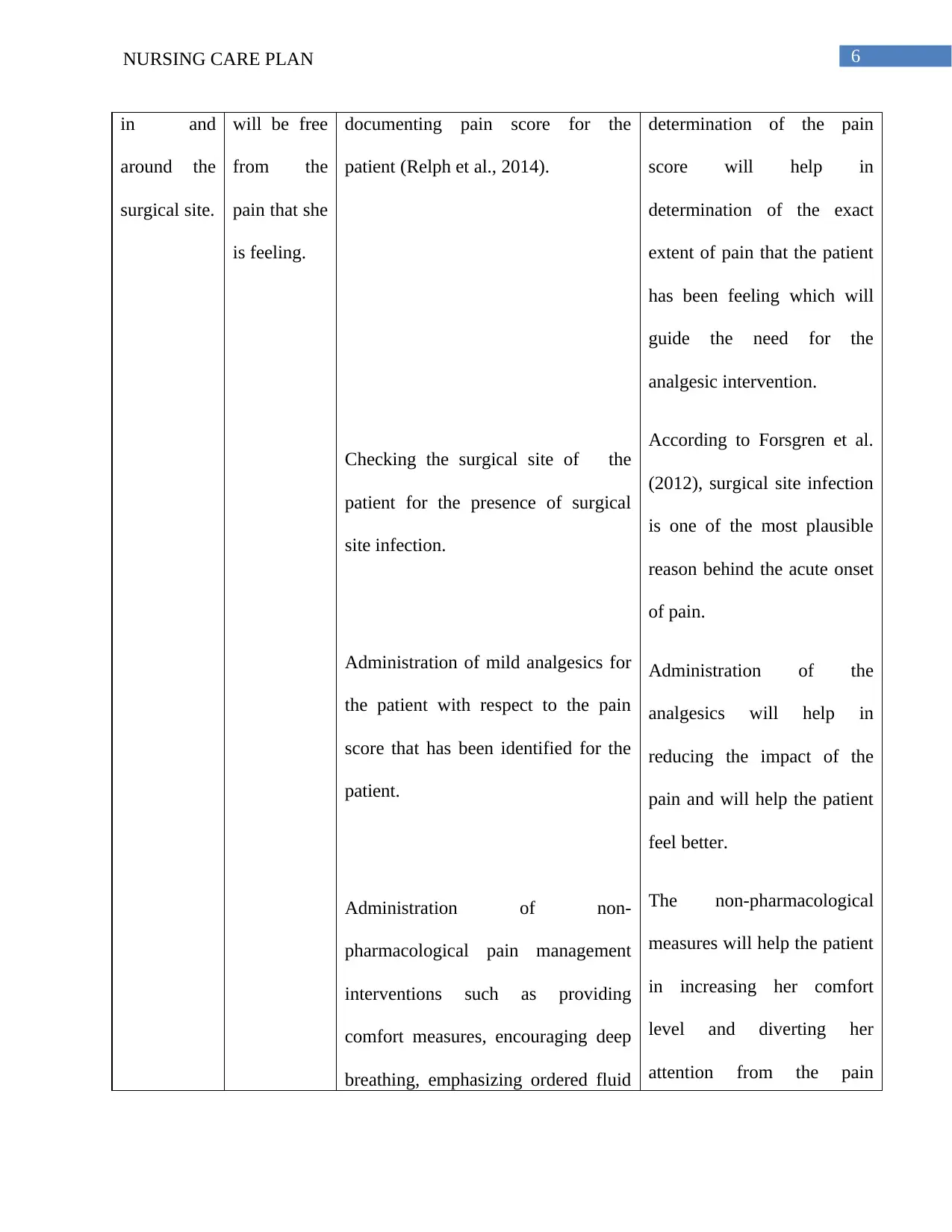
in and
around the
surgical site.
will be free
from the
pain that she
is feeling.
documenting pain score for the
patient (Relph et al., 2014).
Checking the surgical site of the
patient for the presence of surgical
site infection.
Administration of mild analgesics for
the patient with respect to the pain
score that has been identified for the
patient.
Administration of non-
pharmacological pain management
interventions such as providing
comfort measures, encouraging deep
breathing, emphasizing ordered fluid
determination of the pain
score will help in
determination of the exact
extent of pain that the patient
has been feeling which will
guide the need for the
analgesic intervention.
According to Forsgren et al.
(2012), surgical site infection
is one of the most plausible
reason behind the acute onset
of pain.
Administration of the
analgesics will help in
reducing the impact of the
pain and will help the patient
feel better.
The non-pharmacological
measures will help the patient
in increasing her comfort
level and diverting her
attention from the pain
in and
around the
surgical site.
will be free
from the
pain that she
is feeling.
documenting pain score for the
patient (Relph et al., 2014).
Checking the surgical site of the
patient for the presence of surgical
site infection.
Administration of mild analgesics for
the patient with respect to the pain
score that has been identified for the
patient.
Administration of non-
pharmacological pain management
interventions such as providing
comfort measures, encouraging deep
breathing, emphasizing ordered fluid
determination of the pain
score will help in
determination of the exact
extent of pain that the patient
has been feeling which will
guide the need for the
analgesic intervention.
According to Forsgren et al.
(2012), surgical site infection
is one of the most plausible
reason behind the acute onset
of pain.
Administration of the
analgesics will help in
reducing the impact of the
pain and will help the patient
feel better.
The non-pharmacological
measures will help the patient
in increasing her comfort
level and diverting her
attention from the pain
Paraphrase This Document
Need a fresh take? Get an instant paraphrase of this document with our AI Paraphraser
7NURSING CARE PLAN
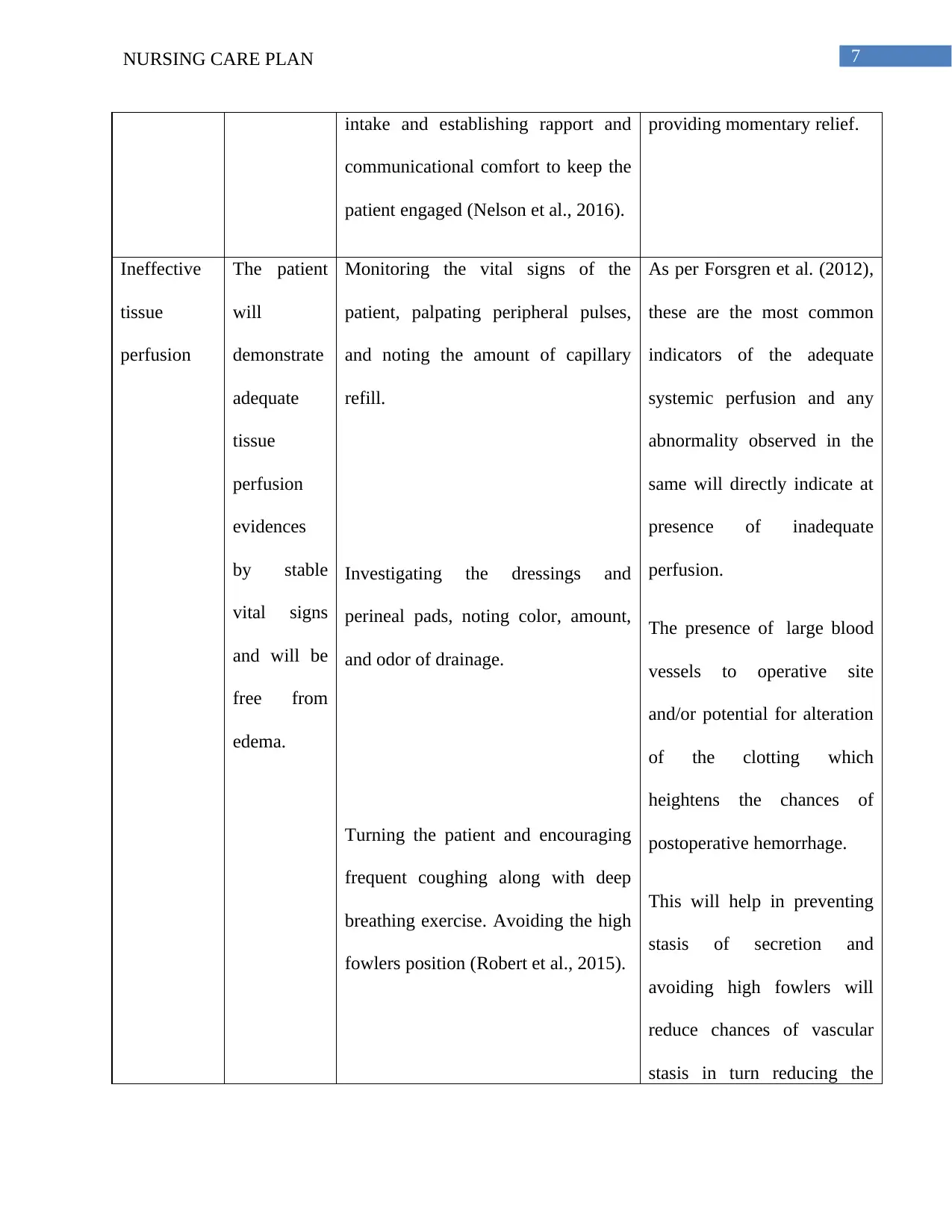
intake and establishing rapport and
communicational comfort to keep the
patient engaged (Nelson et al., 2016).
providing momentary relief.
Ineffective
tissue
perfusion
The patient
will
demonstrate
adequate
tissue
perfusion
evidences
by stable
vital signs
and will be
free from
edema.
Monitoring the vital signs of the
patient, palpating peripheral pulses,
and noting the amount of capillary
refill.
Investigating the dressings and
perineal pads, noting color, amount,
and odor of drainage.
Turning the patient and encouraging
frequent coughing along with deep
breathing exercise. Avoiding the high
fowlers position (Robert et al., 2015).
As per Forsgren et al. (2012),
these are the most common
indicators of the adequate
systemic perfusion and any
abnormality observed in the
same will directly indicate at
presence of inadequate
perfusion.
The presence of large blood
vessels to operative site
and/or potential for alteration
of the clotting which
heightens the chances of
postoperative hemorrhage.
This will help in preventing
stasis of secretion and
avoiding high fowlers will
reduce chances of vascular
stasis in turn reducing the
intake and establishing rapport and
communicational comfort to keep the
patient engaged (Nelson et al., 2016).
providing momentary relief.
Ineffective
tissue
perfusion
The patient
will
demonstrate
adequate
tissue
perfusion
evidences
by stable
vital signs
and will be
free from
edema.
Monitoring the vital signs of the
patient, palpating peripheral pulses,
and noting the amount of capillary
refill.
Investigating the dressings and
perineal pads, noting color, amount,
and odor of drainage.
Turning the patient and encouraging
frequent coughing along with deep
breathing exercise. Avoiding the high
fowlers position (Robert et al., 2015).
As per Forsgren et al. (2012),
these are the most common
indicators of the adequate
systemic perfusion and any
abnormality observed in the
same will directly indicate at
presence of inadequate
perfusion.
The presence of large blood
vessels to operative site
and/or potential for alteration
of the clotting which
heightens the chances of
postoperative hemorrhage.
This will help in preventing
stasis of secretion and
avoiding high fowlers will
reduce chances of vascular
stasis in turn reducing the
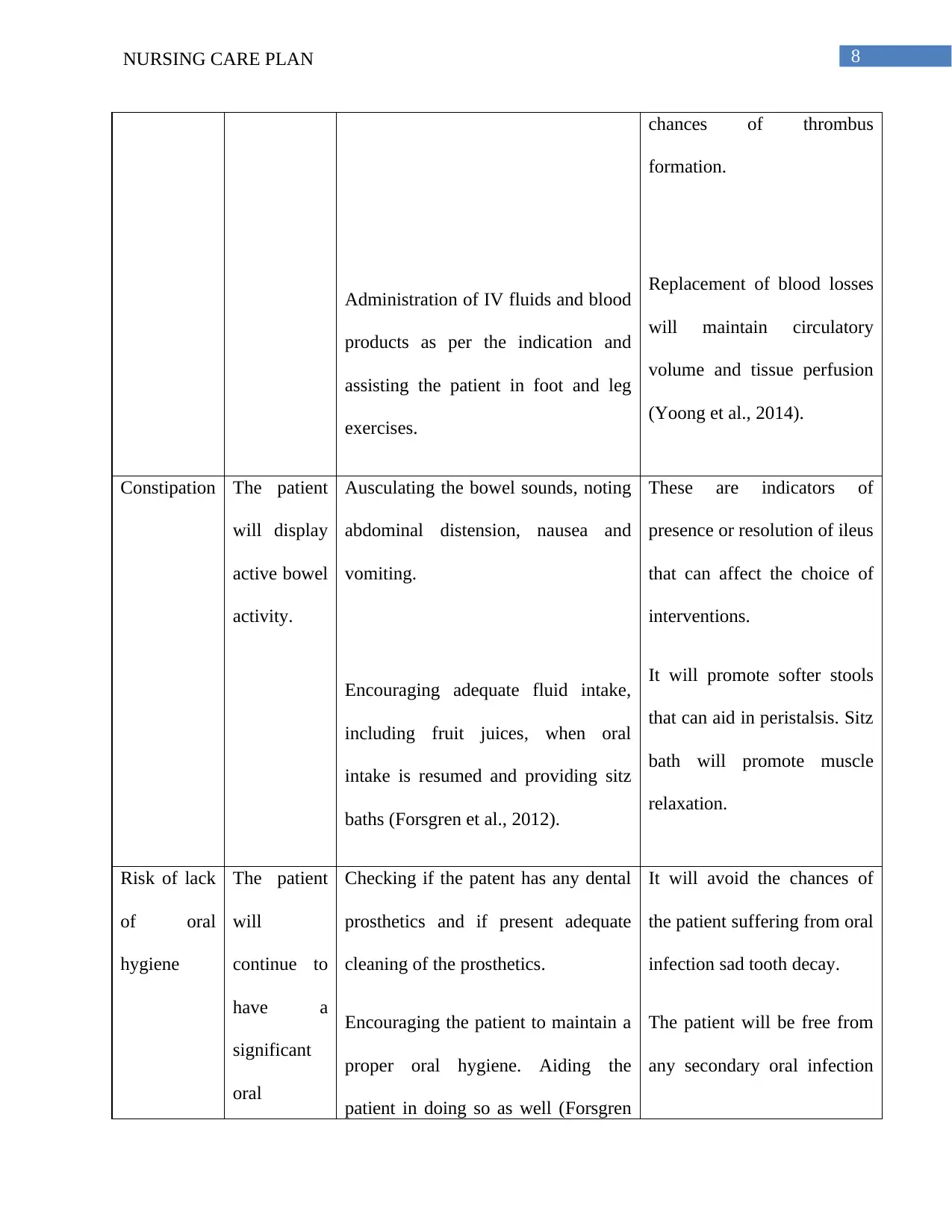
8NURSING CARE PLAN
Administration of IV fluids and blood
products as per the indication and
assisting the patient in foot and leg
exercises.
chances of thrombus
formation.
Replacement of blood losses
will maintain circulatory
volume and tissue perfusion
(Yoong et al., 2014).
Constipation The patient
will display
active bowel
activity.
Ausculating the bowel sounds, noting
abdominal distension, nausea and
vomiting.
Encouraging adequate fluid intake,
including fruit juices, when oral
intake is resumed and providing sitz
baths (Forsgren et al., 2012).
These are indicators of
presence or resolution of ileus
that can affect the choice of
interventions.
It will promote softer stools
that can aid in peristalsis. Sitz
bath will promote muscle
relaxation.
Risk of lack
of oral
hygiene
The patient
will
continue to
have a
significant
oral
Checking if the patent has any dental
prosthetics and if present adequate
cleaning of the prosthetics.
Encouraging the patient to maintain a
proper oral hygiene. Aiding the
patient in doing so as well (Forsgren
It will avoid the chances of
the patient suffering from oral
infection sad tooth decay.
The patient will be free from
any secondary oral infection
Administration of IV fluids and blood
products as per the indication and
assisting the patient in foot and leg
exercises.
chances of thrombus
formation.
Replacement of blood losses
will maintain circulatory
volume and tissue perfusion
(Yoong et al., 2014).
Constipation The patient
will display
active bowel
activity.
Ausculating the bowel sounds, noting
abdominal distension, nausea and
vomiting.
Encouraging adequate fluid intake,
including fruit juices, when oral
intake is resumed and providing sitz
baths (Forsgren et al., 2012).
These are indicators of
presence or resolution of ileus
that can affect the choice of
interventions.
It will promote softer stools
that can aid in peristalsis. Sitz
bath will promote muscle
relaxation.
Risk of lack
of oral
hygiene
The patient
will
continue to
have a
significant
oral
Checking if the patent has any dental
prosthetics and if present adequate
cleaning of the prosthetics.
Encouraging the patient to maintain a
proper oral hygiene. Aiding the
patient in doing so as well (Forsgren
It will avoid the chances of
the patient suffering from oral
infection sad tooth decay.
The patient will be free from
any secondary oral infection
⊘ This is a preview!⊘
Do you want full access?
Subscribe today to unlock all pages.
Trusted by 1+ million students worldwide
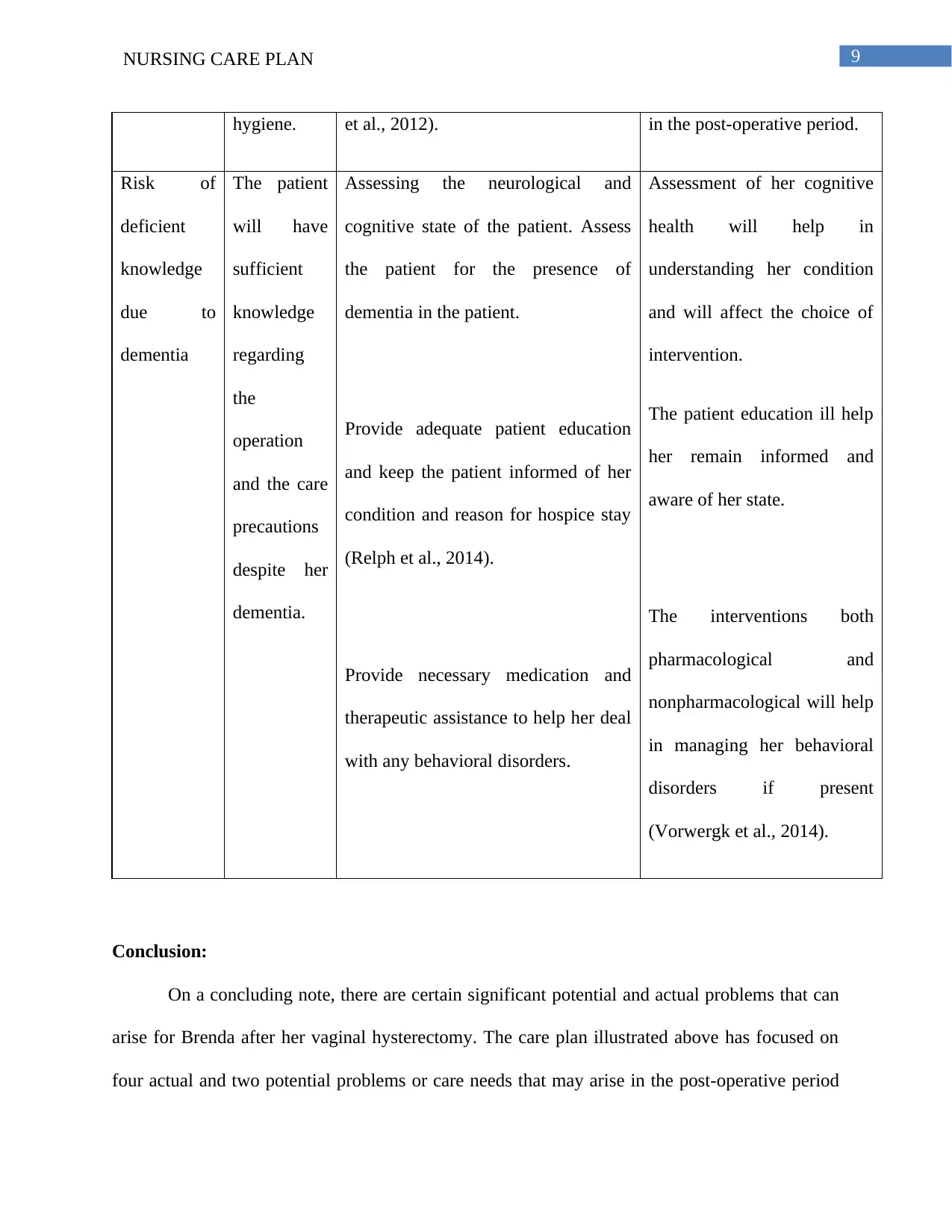
9NURSING CARE PLAN
hygiene. et al., 2012). in the post-operative period.
Risk of
deficient
knowledge
due to
dementia
The patient
will have
sufficient
knowledge
regarding
the
operation
and the care
precautions
despite her
dementia.
Assessing the neurological and
cognitive state of the patient. Assess
the patient for the presence of
dementia in the patient.
Provide adequate patient education
and keep the patient informed of her
condition and reason for hospice stay
(Relph et al., 2014).
Provide necessary medication and
therapeutic assistance to help her deal
with any behavioral disorders.
Assessment of her cognitive
health will help in
understanding her condition
and will affect the choice of
intervention.
The patient education ill help
her remain informed and
aware of her state.
The interventions both
pharmacological and
nonpharmacological will help
in managing her behavioral
disorders if present
(Vorwergk et al., 2014).
Conclusion:
On a concluding note, there are certain significant potential and actual problems that can
arise for Brenda after her vaginal hysterectomy. The care plan illustrated above has focused on
four actual and two potential problems or care needs that may arise in the post-operative period
hygiene. et al., 2012). in the post-operative period.
Risk of
deficient
knowledge
due to
dementia
The patient
will have
sufficient
knowledge
regarding
the
operation
and the care
precautions
despite her
dementia.
Assessing the neurological and
cognitive state of the patient. Assess
the patient for the presence of
dementia in the patient.
Provide adequate patient education
and keep the patient informed of her
condition and reason for hospice stay
(Relph et al., 2014).
Provide necessary medication and
therapeutic assistance to help her deal
with any behavioral disorders.
Assessment of her cognitive
health will help in
understanding her condition
and will affect the choice of
intervention.
The patient education ill help
her remain informed and
aware of her state.
The interventions both
pharmacological and
nonpharmacological will help
in managing her behavioral
disorders if present
(Vorwergk et al., 2014).
Conclusion:
On a concluding note, there are certain significant potential and actual problems that can
arise for Brenda after her vaginal hysterectomy. The care plan illustrated above has focused on
four actual and two potential problems or care needs that may arise in the post-operative period
Paraphrase This Document
Need a fresh take? Get an instant paraphrase of this document with our AI Paraphraser

10NURSING CARE PLAN
and has provided adequate treatment measures and interventions that can help in managing or
avoiding the occurrence of the issues effectively and helping the patient with as comfortable and
fast recovery as possible.
and has provided adequate treatment measures and interventions that can help in managing or
avoiding the occurrence of the issues effectively and helping the patient with as comfortable and
fast recovery as possible.
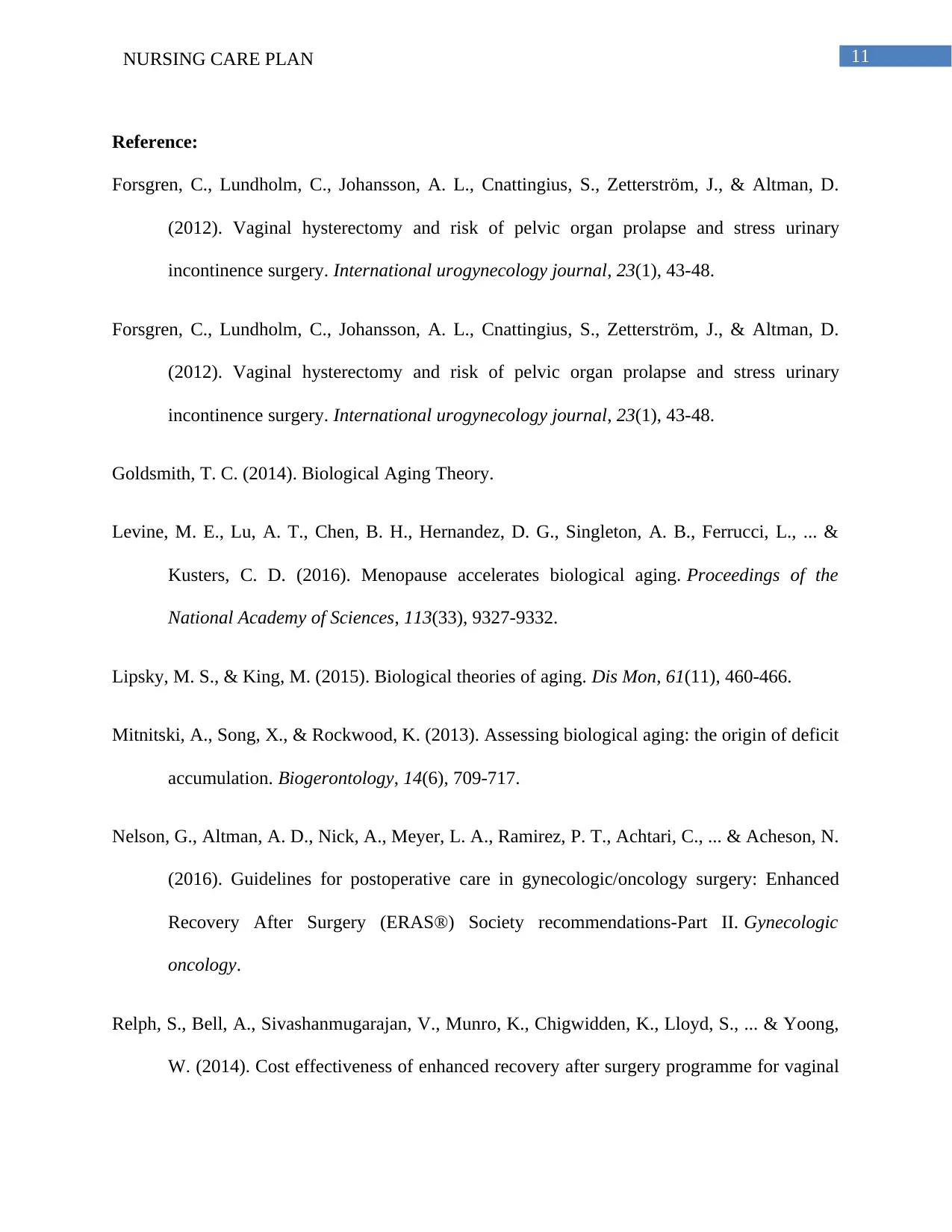
11NURSING CARE PLAN
Reference:
Forsgren, C., Lundholm, C., Johansson, A. L., Cnattingius, S., Zetterström, J., & Altman, D.
(2012). Vaginal hysterectomy and risk of pelvic organ prolapse and stress urinary
incontinence surgery. International urogynecology journal, 23(1), 43-48.
Forsgren, C., Lundholm, C., Johansson, A. L., Cnattingius, S., Zetterström, J., & Altman, D.
(2012). Vaginal hysterectomy and risk of pelvic organ prolapse and stress urinary
incontinence surgery. International urogynecology journal, 23(1), 43-48.
Goldsmith, T. C. (2014). Biological Aging Theory.
Levine, M. E., Lu, A. T., Chen, B. H., Hernandez, D. G., Singleton, A. B., Ferrucci, L., ... &
Kusters, C. D. (2016). Menopause accelerates biological aging. Proceedings of the
National Academy of Sciences, 113(33), 9327-9332.
Lipsky, M. S., & King, M. (2015). Biological theories of aging. Dis Mon, 61(11), 460-466.
Mitnitski, A., Song, X., & Rockwood, K. (2013). Assessing biological aging: the origin of deficit
accumulation. Biogerontology, 14(6), 709-717.
Nelson, G., Altman, A. D., Nick, A., Meyer, L. A., Ramirez, P. T., Achtari, C., ... & Acheson, N.
(2016). Guidelines for postoperative care in gynecologic/oncology surgery: Enhanced
Recovery After Surgery (ERAS®) Society recommendations-Part II. Gynecologic
oncology.
Relph, S., Bell, A., Sivashanmugarajan, V., Munro, K., Chigwidden, K., Lloyd, S., ... & Yoong,
W. (2014). Cost effectiveness of enhanced recovery after surgery programme for vaginal
Reference:
Forsgren, C., Lundholm, C., Johansson, A. L., Cnattingius, S., Zetterström, J., & Altman, D.
(2012). Vaginal hysterectomy and risk of pelvic organ prolapse and stress urinary
incontinence surgery. International urogynecology journal, 23(1), 43-48.
Forsgren, C., Lundholm, C., Johansson, A. L., Cnattingius, S., Zetterström, J., & Altman, D.
(2012). Vaginal hysterectomy and risk of pelvic organ prolapse and stress urinary
incontinence surgery. International urogynecology journal, 23(1), 43-48.
Goldsmith, T. C. (2014). Biological Aging Theory.
Levine, M. E., Lu, A. T., Chen, B. H., Hernandez, D. G., Singleton, A. B., Ferrucci, L., ... &
Kusters, C. D. (2016). Menopause accelerates biological aging. Proceedings of the
National Academy of Sciences, 113(33), 9327-9332.
Lipsky, M. S., & King, M. (2015). Biological theories of aging. Dis Mon, 61(11), 460-466.
Mitnitski, A., Song, X., & Rockwood, K. (2013). Assessing biological aging: the origin of deficit
accumulation. Biogerontology, 14(6), 709-717.
Nelson, G., Altman, A. D., Nick, A., Meyer, L. A., Ramirez, P. T., Achtari, C., ... & Acheson, N.
(2016). Guidelines for postoperative care in gynecologic/oncology surgery: Enhanced
Recovery After Surgery (ERAS®) Society recommendations-Part II. Gynecologic
oncology.
Relph, S., Bell, A., Sivashanmugarajan, V., Munro, K., Chigwidden, K., Lloyd, S., ... & Yoong,
W. (2014). Cost effectiveness of enhanced recovery after surgery programme for vaginal
⊘ This is a preview!⊘
Do you want full access?
Subscribe today to unlock all pages.
Trusted by 1+ million students worldwide

1 out of 13


Related Documents


Your All-in-One AI-Powered Toolkit for Academic Success.
+13062052269
info@desklib.com
Available 24*7 on WhatsApp / Email
![[object Object]](/_next/static/media/star-bottom.7253800d.svg)
Unlock your academic potential
Copyright © 2020–2026 A2Z Services. All Rights Reserved. Developed and managed by ZUCOL.