Reflective Journal: Contemporary Indigenous Health & Wellbeing
VerifiedAdded on 2023/04/21
|10
|2419
|346
Journal and Reflective Writing
AI Summary
This reflective journal delves into a nursing student's evolving understanding of Indigenous health and wellbeing. It explores the student's initial beliefs and values regarding Aboriginal and Torres Strait Islander peoples, and how these perceptions shifted through engagement with the Contemporary Indigenous Health & Wellbeing subject at UTS. The journal highlights the impact of yarning circle activities, including debates and a cultural assessment simulation with an Aboriginal patient named Judy, on the student's cultural sensitivity and future nursing practice. The student reflects on the importance of culturally safe communication, addressing biases, and promoting equality within healthcare, emphasizing the need for ongoing learning and advocacy for Indigenous health.
Running head: NURSING
NURSING
Name of the Student
Name of the university
Author’s note
NURSING
Name of the Student
Name of the university
Author’s note

Paraphrase This Document
Need a fresh take? Get an instant paraphrase of this document with our AI Paraphraser
1NURSING
Reflection essay
In this essay I would discuss about my beliefs and values about the aboriginals and the
Torres Strait Islanders and how that belief influenced my communication with the Aboriginal
people.
Before commencing this subject, I had a different belief about the aboriginal people. It
appeared that they have any fixed habitation and that they used to sleeping in a cave or rocks.
The relationship of smoking and drinking among the aboriginals, are prevalent from time
immemorial and I had a predetermined notion that most of the aboriginal adolescents are
addicted to drugs and alcohols without even knowing the predisposing factors. As per the
Alcohol and Drug foundation, the prevalence of alcohol consumption and drug addiction among
the aboriginals were much greater than that of the aboriginal counterparts. Hence, these data
findings also fuelled by conception about the aboriginal culture ( ADF. 2017).
I have felt that the aboriginal people are oppressed and had been discriminated in every
aspects of life.
Before participating in the activities, I did not have an idea that the problem of the
aboriginal people with alcohol began with the invasion. Furthermore, contrary to the perception,
only fewer aboriginals drink alcohol than the non- aboriginal counterparts. Aboriginal alcohol
consumption totally changed after the European invasion, as many of the aboriginal laborers
were paid in alcohols or tobacco instead of money(Reading and de Leeuw 2014).
I was unhappy that I still do not possess enough knowledge about the Australian
aboriginal history. It is not that, I have not learnt about their colonization history before and the
Reflection essay
In this essay I would discuss about my beliefs and values about the aboriginals and the
Torres Strait Islanders and how that belief influenced my communication with the Aboriginal
people.
Before commencing this subject, I had a different belief about the aboriginal people. It
appeared that they have any fixed habitation and that they used to sleeping in a cave or rocks.
The relationship of smoking and drinking among the aboriginals, are prevalent from time
immemorial and I had a predetermined notion that most of the aboriginal adolescents are
addicted to drugs and alcohols without even knowing the predisposing factors. As per the
Alcohol and Drug foundation, the prevalence of alcohol consumption and drug addiction among
the aboriginals were much greater than that of the aboriginal counterparts. Hence, these data
findings also fuelled by conception about the aboriginal culture ( ADF. 2017).
I have felt that the aboriginal people are oppressed and had been discriminated in every
aspects of life.
Before participating in the activities, I did not have an idea that the problem of the
aboriginal people with alcohol began with the invasion. Furthermore, contrary to the perception,
only fewer aboriginals drink alcohol than the non- aboriginal counterparts. Aboriginal alcohol
consumption totally changed after the European invasion, as many of the aboriginal laborers
were paid in alcohols or tobacco instead of money(Reading and de Leeuw 2014).
I was unhappy that I still do not possess enough knowledge about the Australian
aboriginal history. It is not that, I have not learnt about their colonization history before and the
2NURSING
how they have faced with racism and discrimination throughout the history. Since, I never had
any one-on one encounter with an aboriginal people or really lacked the inquisitiveness to learn
about aboriginal culture, I never had a true idea about the aboriginal life. In spite of knowing the
colonization history, I was drawn by the myths associated with the aboriginal people.
It is when I encountered them or participated in a debate where I get to know several
facts about the aboriginal culture from my peers participating in the debate, who were placing
their arguments for the Aboriginal people. The unemployment among the aboriginals varies
from community to community. Unemployment among the aboriginals and the Torres Strait
Islanders has been found to be four times than the national average. The more remote is the
aboriginal community, the higher is the rate of the employment. This reflects low market
opportunities. I have come to know about the different factors contributing to the high levels of
unemployment – the past limited educational and the lingering prejudices among the non-
aboriginal employers about the aboriginal employees.
Hence, my predetermined notion was changed after these activities and I really feel how
they have been deprived of their basic rights and to compensate them, the government is thriving
to close the gap.
I intend to study more and research more on the aboriginal culture and their colonization
history in order to understand the root cause of the discrimination, racism and deteriorated health
condition of the aboriginals.
The different yarning circle activities have actually changed my concept or perception
about the Aboriginal people.
how they have faced with racism and discrimination throughout the history. Since, I never had
any one-on one encounter with an aboriginal people or really lacked the inquisitiveness to learn
about aboriginal culture, I never had a true idea about the aboriginal life. In spite of knowing the
colonization history, I was drawn by the myths associated with the aboriginal people.
It is when I encountered them or participated in a debate where I get to know several
facts about the aboriginal culture from my peers participating in the debate, who were placing
their arguments for the Aboriginal people. The unemployment among the aboriginals varies
from community to community. Unemployment among the aboriginals and the Torres Strait
Islanders has been found to be four times than the national average. The more remote is the
aboriginal community, the higher is the rate of the employment. This reflects low market
opportunities. I have come to know about the different factors contributing to the high levels of
unemployment – the past limited educational and the lingering prejudices among the non-
aboriginal employers about the aboriginal employees.
Hence, my predetermined notion was changed after these activities and I really feel how
they have been deprived of their basic rights and to compensate them, the government is thriving
to close the gap.
I intend to study more and research more on the aboriginal culture and their colonization
history in order to understand the root cause of the discrimination, racism and deteriorated health
condition of the aboriginals.
The different yarning circle activities have actually changed my concept or perception
about the Aboriginal people.
⊘ This is a preview!⊘
Do you want full access?
Subscribe today to unlock all pages.

Trusted by 1+ million students worldwide
3NURSING
One of the yarning circle activity was a debate held between two groups and the main
topic of the debate was whether Australia was colonized or invaded. I was the first speaker of the
debate and thus had to do a lot of research about the colonization history of Australia.
I felt that it is necessary to recruit more aboriginal nurses in order to assimilate them in
every aspects of life. Although the government is taking many initiatives for “closing the gap” to
address the inequalities, the first nation community nurses are still facing discrimination just
because of their origin and are not judged by their talents (Schinke et al. 2015).
Due to the unavailability of the invasion history, was confused and failed to express my
ideas during the debate. I had very less knowledge of the colonization history.
While At the time of debate, about the aboriginals, I was surprised to know how the
British colonization affected the aboriginal people. Between 1788 and 1900, the aboriginal
people were reduced to about 90 % and these were due to the introduction of the new diseases,
loss of land and loss of people through direct fighting with the colonizers (Sherwood 2013).
Another consequence of the British settlement that I realized was the reduction in the access to
land and the water sources (hackrah and Thompson 2013). The settlers had the perception that
the aboriginal people lived a nomadic lifestyle and that they could be easily driven from their
land. While the debate was taking place I was very surprised to hear the history of introduction
of alcohol and in what way did the introduction of alcohol posed threat to the aboriginal people
(Sherwood 2013).
After hearing others discussion I came to know a lots of surprising facts about the
aboriginal history.
One of the yarning circle activity was a debate held between two groups and the main
topic of the debate was whether Australia was colonized or invaded. I was the first speaker of the
debate and thus had to do a lot of research about the colonization history of Australia.
I felt that it is necessary to recruit more aboriginal nurses in order to assimilate them in
every aspects of life. Although the government is taking many initiatives for “closing the gap” to
address the inequalities, the first nation community nurses are still facing discrimination just
because of their origin and are not judged by their talents (Schinke et al. 2015).
Due to the unavailability of the invasion history, was confused and failed to express my
ideas during the debate. I had very less knowledge of the colonization history.
While At the time of debate, about the aboriginals, I was surprised to know how the
British colonization affected the aboriginal people. Between 1788 and 1900, the aboriginal
people were reduced to about 90 % and these were due to the introduction of the new diseases,
loss of land and loss of people through direct fighting with the colonizers (Sherwood 2013).
Another consequence of the British settlement that I realized was the reduction in the access to
land and the water sources (hackrah and Thompson 2013). The settlers had the perception that
the aboriginal people lived a nomadic lifestyle and that they could be easily driven from their
land. While the debate was taking place I was very surprised to hear the history of introduction
of alcohol and in what way did the introduction of alcohol posed threat to the aboriginal people
(Sherwood 2013).
After hearing others discussion I came to know a lots of surprising facts about the
aboriginal history.
Paraphrase This Document
Need a fresh take? Get an instant paraphrase of this document with our AI Paraphraser
4NURSING
The second activity of the yarning circle is that we were divided in to groups and each of
the group were allocated with an articles where each of the group had to find a similar articles for
the main article. I felt that the experiences shared by the aboriginal nurses were much different
from that of their aboriginal counterparts.
The second activity of the learning is to search for evidences based papers, naturally I
have to brainstorm through a lot of databases in order to find suitable articles in relation to
articles supplied to us. Selection of the paper was quite time consuming as a large number of
papers came up in the first search. The papers before the year 2012 and those that were not in
English were excluded.
In the paper by Nielsen, Alice Stuart and Gorman (2014) it is stated that in spite of the
repeated efforts to remove racial discrimination, the whiteness of nursing still remains. In a
similar paper by Vukic et al. 2012). It can be seen that the aboriginal people are significantly less
represented in the health care profession. This is partly due to the biasness that they often witness
at the workplace (Gair et al. 2015).
As per the experiences of the nurses, blatant discrimination still exists and it was very
unfortunate to find that non- indigenous patients also thinks twice before receiving care from
these indigenous nurses. For this student, the indigenous nurses often develops their own sort of
network of support as very little support is obtained from the non- indigenous counterparts.
In order to improve my cultural sensitiveness and knowledge, I believe that I need to
study and research more, interact with the peers for developing suitable communication skills.
In the third yarning circle activity, we were conduct a patient safety simulation where we
interrogated an aboriginal patient named Judy. In this activity I had been an observer and
The second activity of the yarning circle is that we were divided in to groups and each of
the group were allocated with an articles where each of the group had to find a similar articles for
the main article. I felt that the experiences shared by the aboriginal nurses were much different
from that of their aboriginal counterparts.
The second activity of the learning is to search for evidences based papers, naturally I
have to brainstorm through a lot of databases in order to find suitable articles in relation to
articles supplied to us. Selection of the paper was quite time consuming as a large number of
papers came up in the first search. The papers before the year 2012 and those that were not in
English were excluded.
In the paper by Nielsen, Alice Stuart and Gorman (2014) it is stated that in spite of the
repeated efforts to remove racial discrimination, the whiteness of nursing still remains. In a
similar paper by Vukic et al. 2012). It can be seen that the aboriginal people are significantly less
represented in the health care profession. This is partly due to the biasness that they often witness
at the workplace (Gair et al. 2015).
As per the experiences of the nurses, blatant discrimination still exists and it was very
unfortunate to find that non- indigenous patients also thinks twice before receiving care from
these indigenous nurses. For this student, the indigenous nurses often develops their own sort of
network of support as very little support is obtained from the non- indigenous counterparts.
In order to improve my cultural sensitiveness and knowledge, I believe that I need to
study and research more, interact with the peers for developing suitable communication skills.
In the third yarning circle activity, we were conduct a patient safety simulation where we
interrogated an aboriginal patient named Judy. In this activity I had been an observer and
5NURSING
provided feedbacks about how inter-professional communication is necessary among the RNs to
deal with aboriginal patients. Initially, a visit was made to Judy’s place, for the conduction of a
cultural assessment. The process involved assessing Judy’s cultural beliefs and the values, Judy’s
previous life experiences. Judy was asked to provide feedback about the RN’s role in the verbal
communication and development of therapeutic relationship with Judy.
I was really thrilled to hear the aboriginal stories from Judy but was affected by the
biasness and the tortures that they face in every aspects of life. Being a nursing student, I
understand how it feels to be discriminated and secluded at your main workplace where you
want to work dedicatedly or want to chase your aspirations. However, I have learnt how the
aboriginal nurses talk about fitting in or belonging or being accepted. Some have found
acceptance with the peers while others might have been judged by the instructors (Freeman et al.
2015).
The simulation process was conducted successfully. Special attention was paid, such that
any question does not hurt her feelings and culture.
From the simulation process, I came to know about the real life experiences of the
aboriginal people, about their traditional healing procedure and how they still rely on them as
they often face discrimination in the westernized model of treatment or how they are still treated
badly by the non-indigenous health care workers.
During the simulation process, I have understood that it the Aboriginal people are
strongly rooted to their spiritual beliefs and hence their beliefs should be respected. The nurses
should try to establish care plans or collaborate with the spiritual healers for establishing care
plans for the aboriginal patients (Casey 2012). Analysing the answers of Judy, I have learnt
provided feedbacks about how inter-professional communication is necessary among the RNs to
deal with aboriginal patients. Initially, a visit was made to Judy’s place, for the conduction of a
cultural assessment. The process involved assessing Judy’s cultural beliefs and the values, Judy’s
previous life experiences. Judy was asked to provide feedback about the RN’s role in the verbal
communication and development of therapeutic relationship with Judy.
I was really thrilled to hear the aboriginal stories from Judy but was affected by the
biasness and the tortures that they face in every aspects of life. Being a nursing student, I
understand how it feels to be discriminated and secluded at your main workplace where you
want to work dedicatedly or want to chase your aspirations. However, I have learnt how the
aboriginal nurses talk about fitting in or belonging or being accepted. Some have found
acceptance with the peers while others might have been judged by the instructors (Freeman et al.
2015).
The simulation process was conducted successfully. Special attention was paid, such that
any question does not hurt her feelings and culture.
From the simulation process, I came to know about the real life experiences of the
aboriginal people, about their traditional healing procedure and how they still rely on them as
they often face discrimination in the westernized model of treatment or how they are still treated
badly by the non-indigenous health care workers.
During the simulation process, I have understood that it the Aboriginal people are
strongly rooted to their spiritual beliefs and hence their beliefs should be respected. The nurses
should try to establish care plans or collaborate with the spiritual healers for establishing care
plans for the aboriginal patients (Casey 2012). Analysing the answers of Judy, I have learnt
⊘ This is a preview!⊘
Do you want full access?
Subscribe today to unlock all pages.
Trusted by 1+ million students worldwide
6NURSING
about the legal and the ethical issue that arise. In most of the cases the codes of ethics are
breached while providing care to the aboriginal people.
However, in conclusion it can be said that this simulation has changed my perception
about the aboriginal, which I believe, would help me in my future nursing profession. The
cultural assessment done with Judy had arisen my cultural sensitiveness towards the aboriginals.
It is necessary that as an RN, I should always thrive to preserve the basic human rights
for the patient, irrespective of their case and creed.
The indigenous graduate attribute ensures that all the students develops indigenous
professional capacities. While working conducting the simulation with Judy I made it sure that
adhere to attributes of nursing, such as professional disposition where I had participated in the
activities to explore our personal values. While assessing Judy I made it sure that I adhere to the
professional practice, codes and the ethics. As per the standard 4 of the NMBA standard, a nurse
in liable to conduct an assessment comprehensively and provide an appropriate and responsive
quality of nursing. As a nurse I have actively participated in the activities, which I feel would
help me to develop the non – clinical skills like communication, teamwork and leadership. I
made it sure that I demonstrate my professional cultural competency contributing to the health
and the wellbeing of the aboriginal patients. These activities have made me understand that I
should Students having profound interest in the indigenous contents can apply for a role in the
Indigenous graduate attributes. The primary need is to provide all the Australian student with an
understanding of the aboriginal culture and traditions. They also provide a critical premise for
the development of the cultural competence of the future lawyers and the advocates for the
indigenous people.
about the legal and the ethical issue that arise. In most of the cases the codes of ethics are
breached while providing care to the aboriginal people.
However, in conclusion it can be said that this simulation has changed my perception
about the aboriginal, which I believe, would help me in my future nursing profession. The
cultural assessment done with Judy had arisen my cultural sensitiveness towards the aboriginals.
It is necessary that as an RN, I should always thrive to preserve the basic human rights
for the patient, irrespective of their case and creed.
The indigenous graduate attribute ensures that all the students develops indigenous
professional capacities. While working conducting the simulation with Judy I made it sure that
adhere to attributes of nursing, such as professional disposition where I had participated in the
activities to explore our personal values. While assessing Judy I made it sure that I adhere to the
professional practice, codes and the ethics. As per the standard 4 of the NMBA standard, a nurse
in liable to conduct an assessment comprehensively and provide an appropriate and responsive
quality of nursing. As a nurse I have actively participated in the activities, which I feel would
help me to develop the non – clinical skills like communication, teamwork and leadership. I
made it sure that I demonstrate my professional cultural competency contributing to the health
and the wellbeing of the aboriginal patients. These activities have made me understand that I
should Students having profound interest in the indigenous contents can apply for a role in the
Indigenous graduate attributes. The primary need is to provide all the Australian student with an
understanding of the aboriginal culture and traditions. They also provide a critical premise for
the development of the cultural competence of the future lawyers and the advocates for the
indigenous people.
Paraphrase This Document
Need a fresh take? Get an instant paraphrase of this document with our AI Paraphraser
7NURSING
Communicating with the aboriginals had always been a challenge for the non-indigenous
nurses, as most of them lack culturally safe communication skills (Hayden and Jalla 2015) I need
to learn more about communicating with the aboriginals in a more culturally sensitive way,
hence I need to conduct more evidence based research and seek feedback from my seniors to
improve my communication skills.
Communicating with the aboriginals had always been a challenge for the non-indigenous
nurses, as most of them lack culturally safe communication skills (Hayden and Jalla 2015) I need
to learn more about communicating with the aboriginals in a more culturally sensitive way,
hence I need to conduct more evidence based research and seek feedback from my seniors to
improve my communication skills.
8NURSING
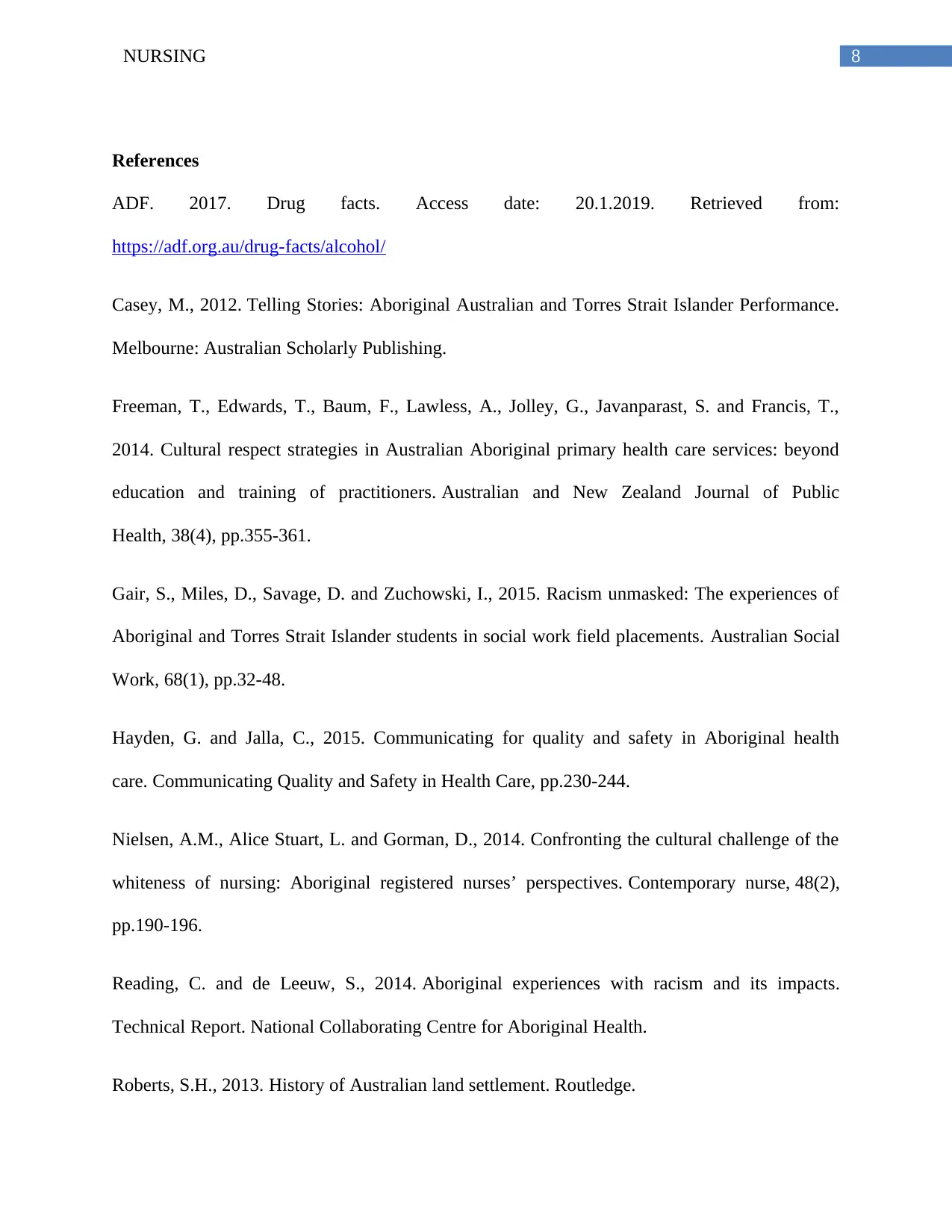
References
ADF. 2017. Drug facts. Access date: 20.1.2019. Retrieved from:
https://adf.org.au/drug-facts/alcohol/
Casey, M., 2012. Telling Stories: Aboriginal Australian and Torres Strait Islander Performance.
Melbourne: Australian Scholarly Publishing.
Freeman, T., Edwards, T., Baum, F., Lawless, A., Jolley, G., Javanparast, S. and Francis, T.,
2014. Cultural respect strategies in Australian Aboriginal primary health care services: beyond
education and training of practitioners. Australian and New Zealand Journal of Public
Health, 38(4), pp.355-361.
Gair, S., Miles, D., Savage, D. and Zuchowski, I., 2015. Racism unmasked: The experiences of
Aboriginal and Torres Strait Islander students in social work field placements. Australian Social
Work, 68(1), pp.32-48.
Hayden, G. and Jalla, C., 2015. Communicating for quality and safety in Aboriginal health
care. Communicating Quality and Safety in Health Care, pp.230-244.
Nielsen, A.M., Alice Stuart, L. and Gorman, D., 2014. Confronting the cultural challenge of the
whiteness of nursing: Aboriginal registered nurses’ perspectives. Contemporary nurse, 48(2),
pp.190-196.
Reading, C. and de Leeuw, S., 2014. Aboriginal experiences with racism and its impacts.
Technical Report. National Collaborating Centre for Aboriginal Health.
Roberts, S.H., 2013. History of Australian land settlement. Routledge.
References
ADF. 2017. Drug facts. Access date: 20.1.2019. Retrieved from:
https://adf.org.au/drug-facts/alcohol/
Casey, M., 2012. Telling Stories: Aboriginal Australian and Torres Strait Islander Performance.
Melbourne: Australian Scholarly Publishing.
Freeman, T., Edwards, T., Baum, F., Lawless, A., Jolley, G., Javanparast, S. and Francis, T.,
2014. Cultural respect strategies in Australian Aboriginal primary health care services: beyond
education and training of practitioners. Australian and New Zealand Journal of Public
Health, 38(4), pp.355-361.
Gair, S., Miles, D., Savage, D. and Zuchowski, I., 2015. Racism unmasked: The experiences of
Aboriginal and Torres Strait Islander students in social work field placements. Australian Social
Work, 68(1), pp.32-48.
Hayden, G. and Jalla, C., 2015. Communicating for quality and safety in Aboriginal health
care. Communicating Quality and Safety in Health Care, pp.230-244.
Nielsen, A.M., Alice Stuart, L. and Gorman, D., 2014. Confronting the cultural challenge of the
whiteness of nursing: Aboriginal registered nurses’ perspectives. Contemporary nurse, 48(2),
pp.190-196.
Reading, C. and de Leeuw, S., 2014. Aboriginal experiences with racism and its impacts.
Technical Report. National Collaborating Centre for Aboriginal Health.
Roberts, S.H., 2013. History of Australian land settlement. Routledge.
⊘ This is a preview!⊘
Do you want full access?
Subscribe today to unlock all pages.
Trusted by 1+ million students worldwide
9NURSING
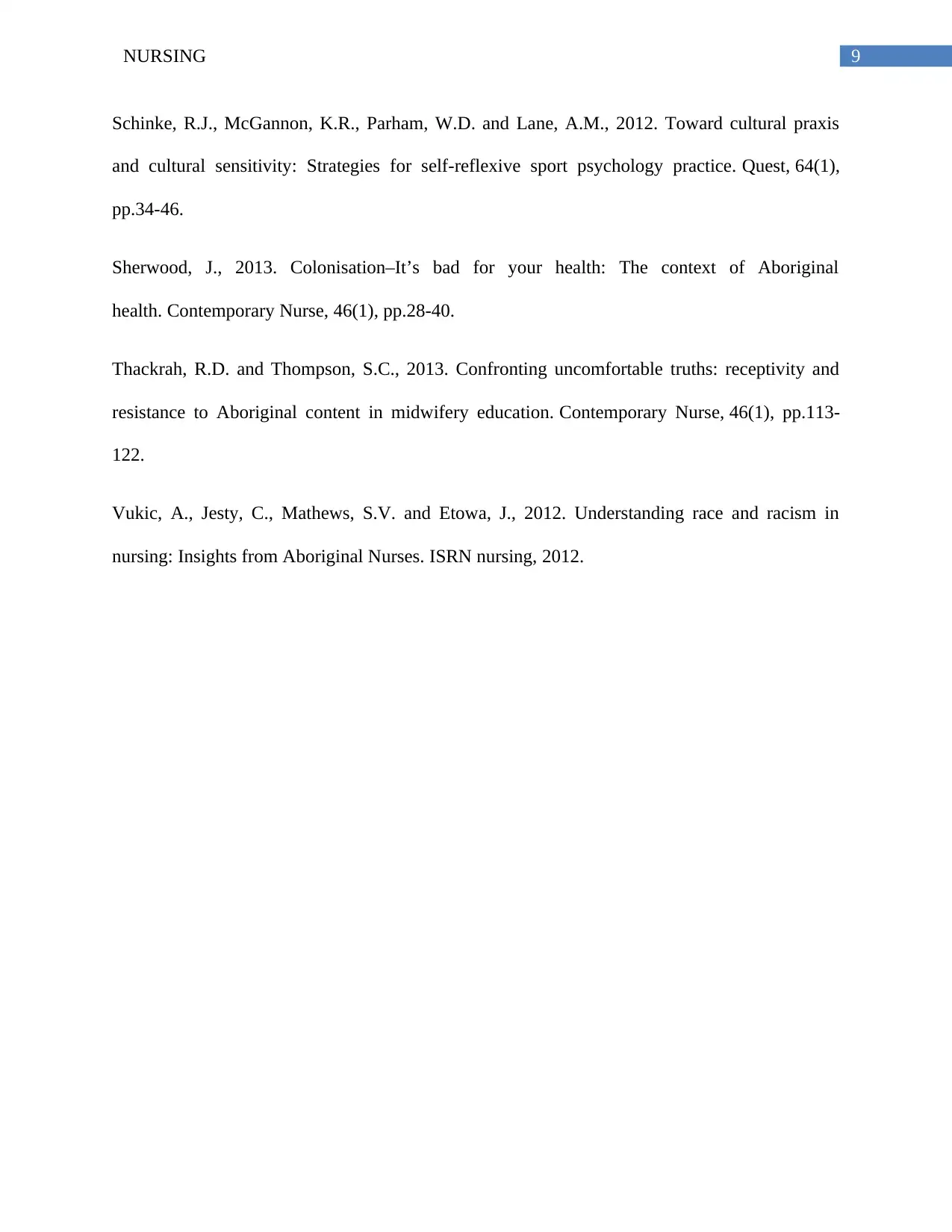
Schinke, R.J., McGannon, K.R., Parham, W.D. and Lane, A.M., 2012. Toward cultural praxis
and cultural sensitivity: Strategies for self-reflexive sport psychology practice. Quest, 64(1),
pp.34-46.
Sherwood, J., 2013. Colonisation–It’s bad for your health: The context of Aboriginal
health. Contemporary Nurse, 46(1), pp.28-40.
Thackrah, R.D. and Thompson, S.C., 2013. Confronting uncomfortable truths: receptivity and
resistance to Aboriginal content in midwifery education. Contemporary Nurse, 46(1), pp.113-
122.
Vukic, A., Jesty, C., Mathews, S.V. and Etowa, J., 2012. Understanding race and racism in
nursing: Insights from Aboriginal Nurses. ISRN nursing, 2012.
Schinke, R.J., McGannon, K.R., Parham, W.D. and Lane, A.M., 2012. Toward cultural praxis
and cultural sensitivity: Strategies for self-reflexive sport psychology practice. Quest, 64(1),
pp.34-46.
Sherwood, J., 2013. Colonisation–It’s bad for your health: The context of Aboriginal
health. Contemporary Nurse, 46(1), pp.28-40.
Thackrah, R.D. and Thompson, S.C., 2013. Confronting uncomfortable truths: receptivity and
resistance to Aboriginal content in midwifery education. Contemporary Nurse, 46(1), pp.113-
122.
Vukic, A., Jesty, C., Mathews, S.V. and Etowa, J., 2012. Understanding race and racism in
nursing: Insights from Aboriginal Nurses. ISRN nursing, 2012.

1 out of 10


Related Documents


Your All-in-One AI-Powered Toolkit for Academic Success.
+13062052269
info@desklib.com
Available 24*7 on WhatsApp / Email
![[object Object]](/_next/static/media/star-bottom.7253800d.svg)
Unlock your academic potential
Copyright © 2020–2026 A2Z Services. All Rights Reserved. Developed and managed by ZUCOL.