Nursing Project Management: Education Package and Implementation

Verified

Added on  2021/12/03

|8
|1451
|42
Project
AI Summary
This nursing project management assignment explores three key topics. The first focuses on developing and delivering an education package for a new ventilator, addressing risks, barriers, and resource management costs. The second topic examines implementing nurse-administered local anaesthetic, analyzing associated risks and identifying key stakeholders. The final topic centers on developing and delivering an education package on a specific element of care, outlining project team composition, project manager roles, and suitable timeframes for project evaluation. The project provides a comprehensive overview of project management principles within a nursing context, emphasizing risk assessment, stakeholder engagement, and practical implementation strategies.

Document Page
Running head: NURSING PROJECT MANAGEMENT
Nursing Project Management
Name of the Student
Name of the University
Author Note
tabler-icon-diamond-filled.svg

Paraphrase This Document

Need a fresh take? Get an instant paraphrase of this document with our AI Paraphraser
Document Page
1NURSING PROJECT MANAGEMENT
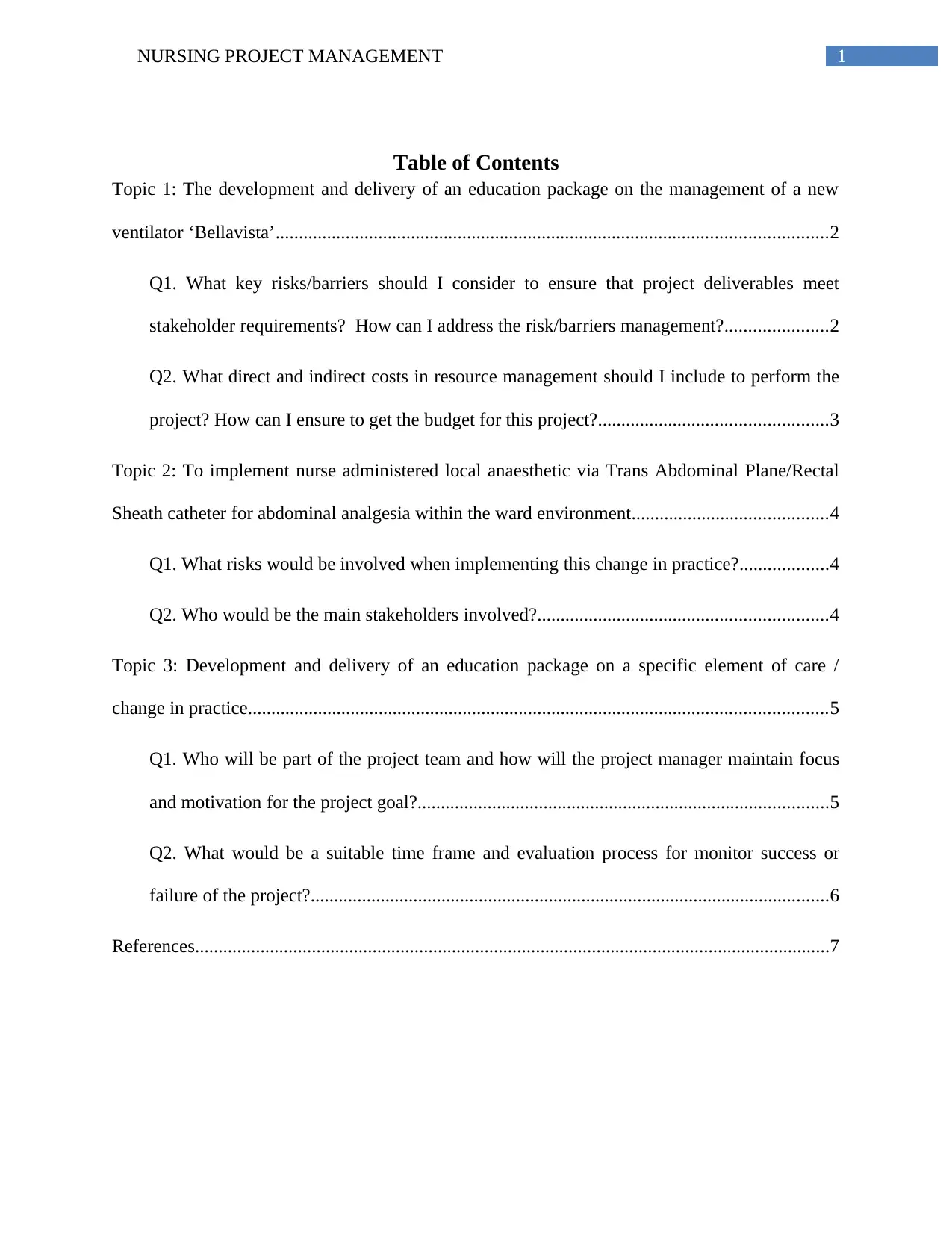
Table of Contents
Topic 1: The development and delivery of an education package on the management of a new
ventilator ‘Bellavista’......................................................................................................................2
Q1. What key risks/barriers should I consider to ensure that project deliverables meet
stakeholder requirements? How can I address the risk/barriers management?......................2
Q2. What direct and indirect costs in resource management should I include to perform the
project? How can I ensure to get the budget for this project?.................................................3
Topic 2: To implement nurse administered local anaesthetic via Trans Abdominal Plane/Rectal
Sheath catheter for abdominal analgesia within the ward environment..........................................4
Q1. What risks would be involved when implementing this change in practice?...................4
Q2. Who would be the main stakeholders involved?..............................................................4
Topic 3: Development and delivery of an education package on a specific element of care /
change in practice............................................................................................................................5
Q1. Who will be part of the project team and how will the project manager maintain focus
and motivation for the project goal?........................................................................................5
Q2. What would be a suitable time frame and evaluation process for monitor success or
failure of the project?...............................................................................................................6
References........................................................................................................................................7
Document Page
2NURSING PROJECT MANAGEMENT
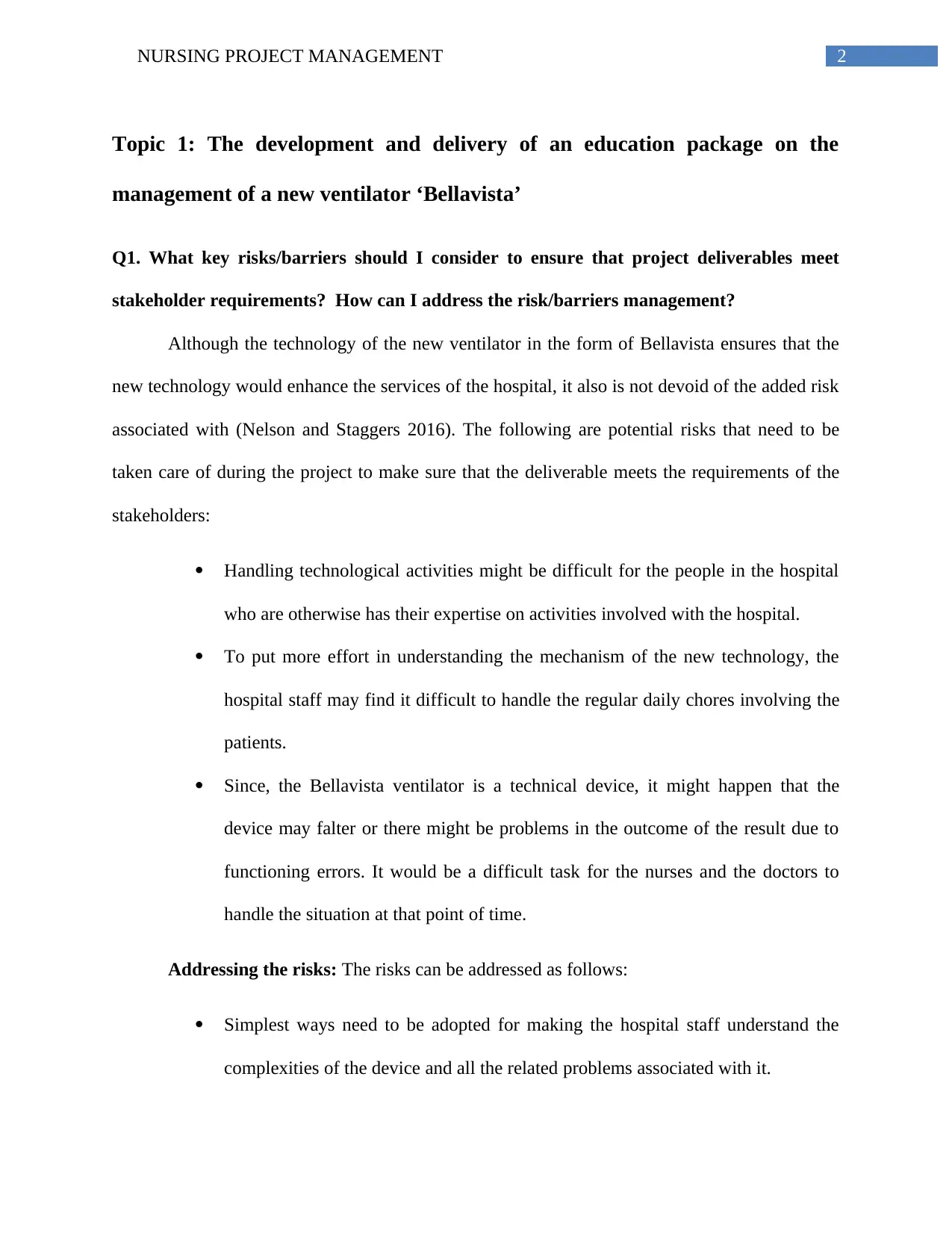
Topic 1: The development and delivery of an education package on the
management of a new ventilator ‘Bellavista’
Q1. What key risks/barriers should I consider to ensure that project deliverables meet
stakeholder requirements? How can I address the risk/barriers management?
Although the technology of the new ventilator in the form of Bellavista ensures that the
new technology would enhance the services of the hospital, it also is not devoid of the added risk
associated with (Nelson and Staggers 2016). The following are potential risks that need to be
taken care of during the project to make sure that the deliverable meets the requirements of the
stakeholders:
Handling technological activities might be difficult for the people in the hospital
who are otherwise has their expertise on activities involved with the hospital.
To put more effort in understanding the mechanism of the new technology, the
hospital staff may find it difficult to handle the regular daily chores involving the
patients.
Since, the Bellavista ventilator is a technical device, it might happen that the
device may falter or there might be problems in the outcome of the result due to
functioning errors. It would be a difficult task for the nurses and the doctors to
handle the situation at that point of time.
Addressing the risks: The risks can be addressed as follows:
Simplest ways need to be adopted for making the hospital staff understand the
complexities of the device and all the related problems associated with it.
Document Page
3NURSING PROJECT MANAGEMENT
Schedule would be prepared for allocating a particular time for educating the
hospital staff about the Bellavista device.
Technical support would always be provided to handle these situations at the
hospital.
Q2. What direct and indirect costs in resource management should I include to perform the
project? How can I ensure to get the budget for this project?
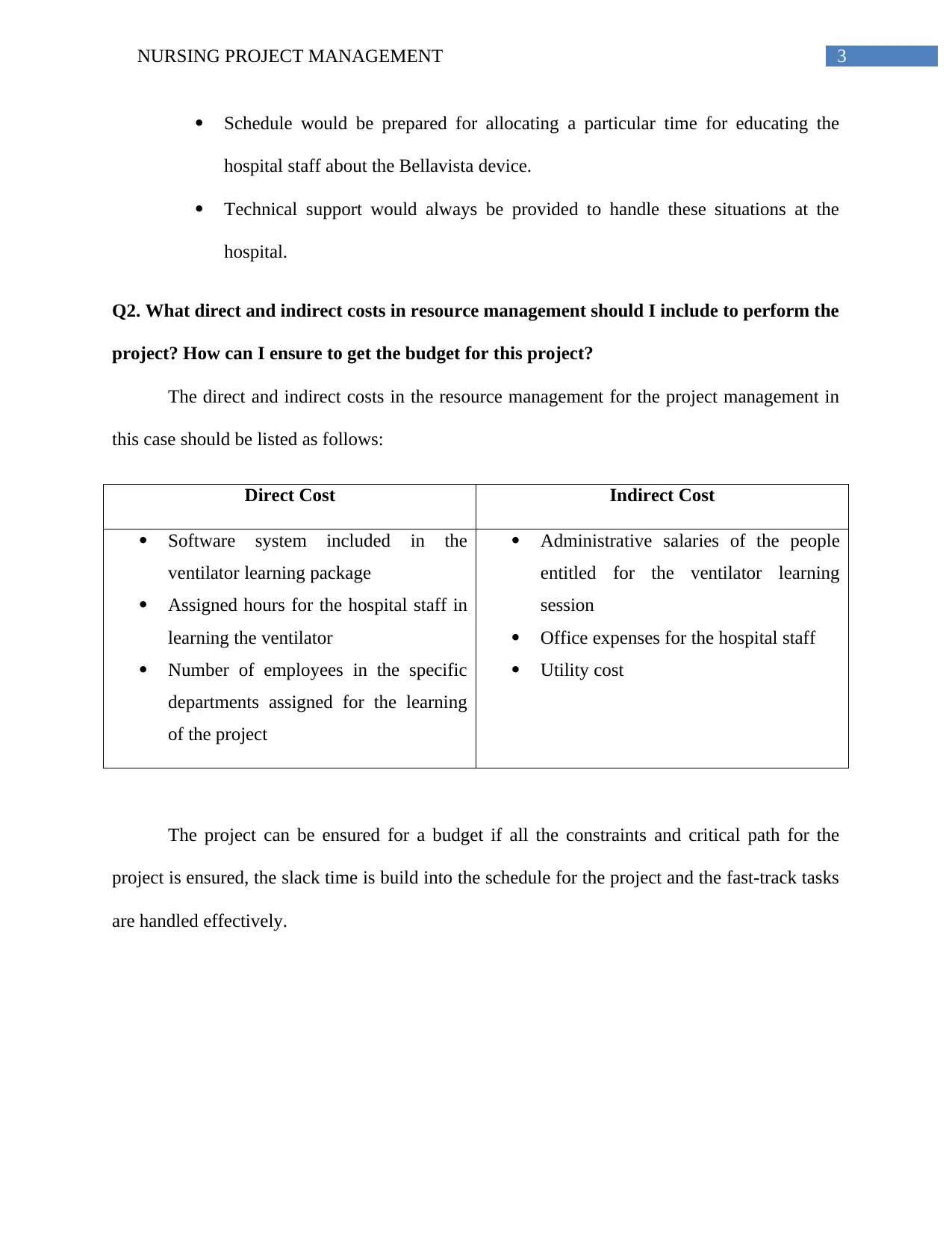
The direct and indirect costs in the resource management for the project management in
this case should be listed as follows:
Direct Cost Indirect Cost
Software system included in the
ventilator learning package
Assigned hours for the hospital staff in
learning the ventilator
Number of employees in the specific
departments assigned for the learning
of the project
Administrative salaries of the people
entitled for the ventilator learning
session
Office expenses for the hospital staff
Utility cost
The project can be ensured for a budget if all the constraints and critical path for the
project is ensured, the slack time is build into the schedule for the project and the fast-track tasks
are handled effectively.
tabler-icon-diamond-filled.svg

Paraphrase This Document

Need a fresh take? Get an instant paraphrase of this document with our AI Paraphraser
Document Page
4NURSING PROJECT MANAGEMENT
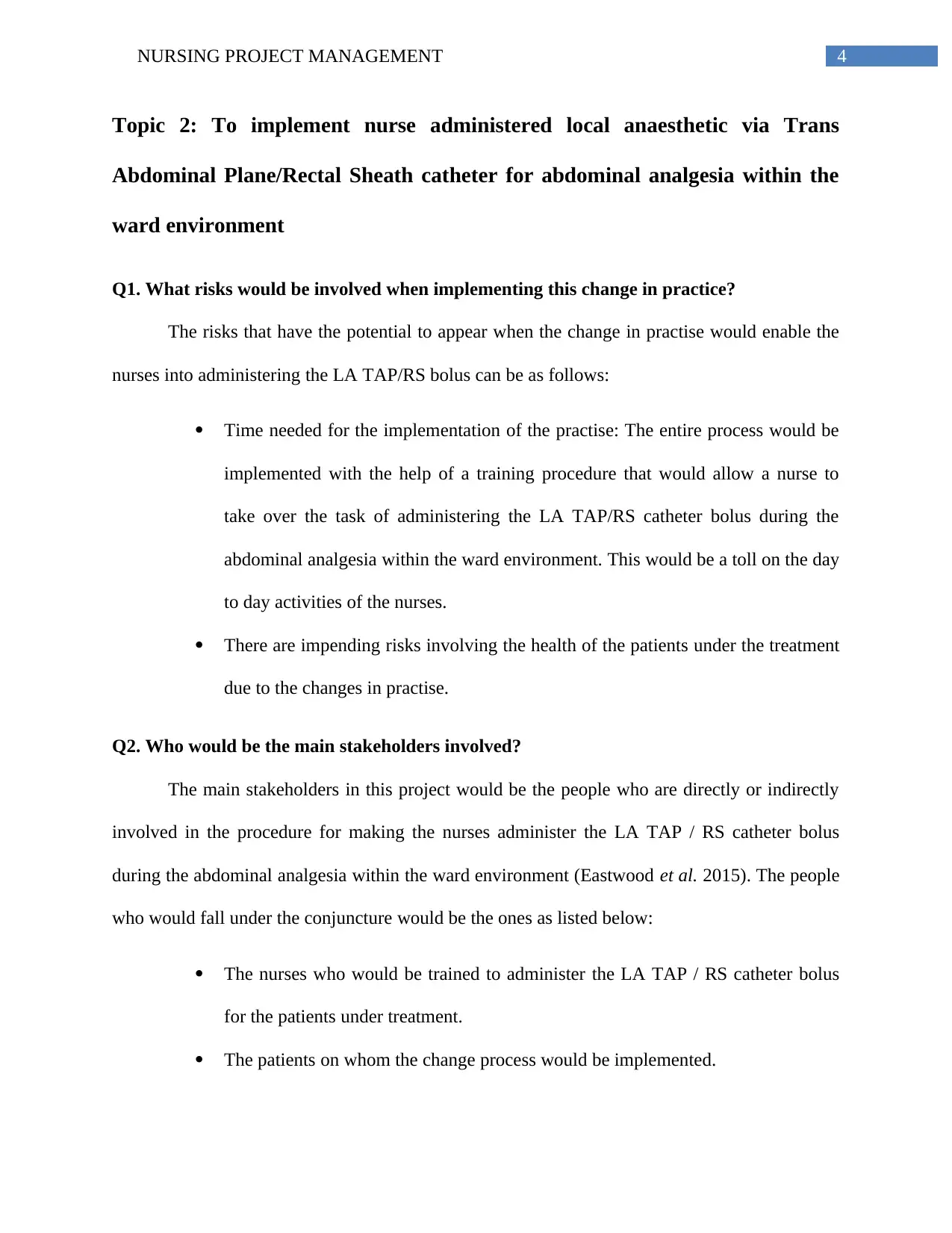
Topic 2: To implement nurse administered local anaesthetic via Trans
Abdominal Plane/Rectal Sheath catheter for abdominal analgesia within the
ward environment
Q1. What risks would be involved when implementing this change in practice?
The risks that have the potential to appear when the change in practise would enable the
nurses into administering the LA TAP/RS bolus can be as follows:
Time needed for the implementation of the practise: The entire process would be
implemented with the help of a training procedure that would allow a nurse to
take over the task of administering the LA TAP/RS catheter bolus during the
abdominal analgesia within the ward environment. This would be a toll on the day
to day activities of the nurses.
There are impending risks involving the health of the patients under the treatment
due to the changes in practise.
Q2. Who would be the main stakeholders involved?
The main stakeholders in this project would be the people who are directly or indirectly
involved in the procedure for making the nurses administer the LA TAP / RS catheter bolus
during the abdominal analgesia within the ward environment (Eastwood et al. 2015). The people
who would fall under the conjuncture would be the ones as listed below:
The nurses who would be trained to administer the LA TAP / RS catheter bolus
for the patients under treatment.
The patients on whom the change process would be implemented.
Document Page
5NURSING PROJECT MANAGEMENT
The doctors and trainers who would train the nurses to make them eligible for
administering the bolus instead of the assigned doctors effectively.
Topic 3: Development and delivery of an education package on a specific
element of care / change in practice
Q1. Who will be part of the project team and how will the project manager maintain focus
and motivation for the project goal?
The project taken up by the hospital team to engage the nurses and patients in the hospital
to educate the patients in Heart Failure support mechanisms so that risk of heart failure can be
reduced for preventable hospital admissions would include the following people as part of the
project team:
The project managers
The Doctors involved with the Heart Failure and Facilities department
Nurses in the hospital
Patients admitted in the hospital who are in the condition to ably take up the
education
The Project Managers should follow the steps discussed below to maintain the focus and
motivations towards the goal for setting up the project and reach the predestined goal:
Tapping into the energy of the people: In this way, the Project managers would
feasibly engage the people that are assigned to educate the patients further and
would make them be more inspired about the subject to further educate the
patients about them (Nelson and Staggers 2016).
Document Page
6NURSING PROJECT MANAGEMENT
Consistency: Nurses are usually very stressed about the day to day activities in
the course of their work; therefore the nurses should be motivated to take any of
the proactive activities that would help them moving towards the ultimate goal.
Q2. What would be a suitable time frame and evaluation process for monitor success or
failure of the project?
Since, the project has a lenient strategy of educating the patients at the time of their
admission in the hospital, the success or the failure of the project would only be justified with the
monitoring of the condition of the patient that would further be admitted for the cause of Heart
Failure or HF. Then the condition of the patient would be justified to find out if the condition of
the patient was serious enough or if the admission of the patient could have been avoided as a
result of the process (Nelson and Staggers 2016). Then the rate at which the patients are being
admitted and the causes behind the admission would be analysed to know if the project for
educating the patients for eliminating the risk of unnecessary hospital admission was a success or
a failure.
tabler-icon-diamond-filled.svg

Paraphrase This Document

Need a fresh take? Get an instant paraphrase of this document with our AI Paraphraser
Document Page
7NURSING PROJECT MANAGEMENT
References
Eastwood, G.M., Peck, L., Young, H., Paton, E., Glassford, N.J., Zhang, L., Zhu, G., Tanaka, A.
and Bellomo, R., 2015. Intensive care nurses’ self-reported practice of intravenous fluid bolus
therapy. Intensive and Critical Care Nursing, 31(6), pp.352-358.
Nelson, R. and Staggers, N., 2016. Health Informatics-E-Book: An Interprofessional Approach.
Elsevier Health Sciences.
chevron_up_icon
1 out of 8
circle_padding
hide_on_mobile
zoom_out_icon
[object Object]