Critical Appraisal of Research Evidence for Nursing Practice
VerifiedAdded on 2023/06/13
|8
|2266
|429
Report
AI Summary
This assignment presents a critical appraisal of a research article focusing on haemodialysis and its impact on patients and their families. The appraisal covers various aspects of the research, including the clarity of the title, the comprehensiveness of the abstract, the relevance of the introduction and literature review, the appropriateness of the research design, and the validity of the data analysis and discussion. The report also includes a personal reflection on the therapeutic relationship between nurses and patients, emphasizing the importance of patient education, support, and evidence-based practice in managing chronic conditions like renal failure. The critique highlights the study's strengths, such as its focus on a relevant clinical problem and the use of qualitative methods to explore patient experiences, while also noting limitations, such as the small sample size and lack of suggestions for future research. The student also reflects on how the research has influenced their understanding of nursing practice and their commitment to providing patient-centered care.
Running head: CRITICAL APPRAISAL
Critical Appraisal of Nursing Research
Name of Student
Name of University
Author Note
Critical Appraisal of Nursing Research
Name of Student
Name of University
Author Note
Paraphrase This Document
Need a fresh take? Get an instant paraphrase of this document with our AI Paraphraser

1CRITICAL APPRAISAL
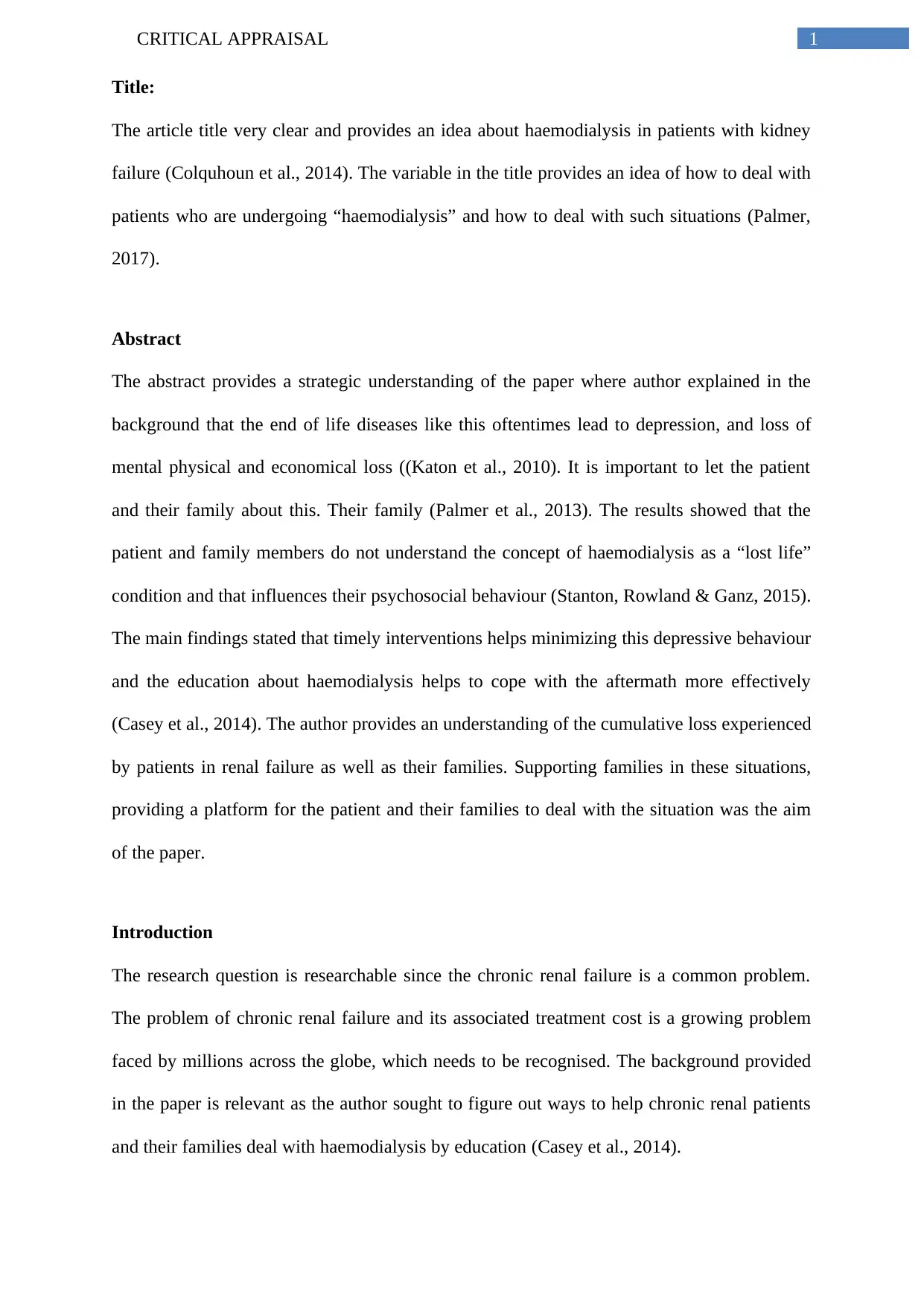
Title:
The article title very clear and provides an idea about haemodialysis in patients with kidney
failure (Colquhoun et al., 2014). The variable in the title provides an idea of how to deal with
patients who are undergoing “haemodialysis” and how to deal with such situations (Palmer,
2017).
Abstract
The abstract provides a strategic understanding of the paper where author explained in the
background that the end of life diseases like this oftentimes lead to depression, and loss of
mental physical and economical loss ((Katon et al., 2010). It is important to let the patient
and their family about this. Their family (Palmer et al., 2013). The results showed that the
patient and family members do not understand the concept of haemodialysis as a “lost life”
condition and that influences their psychosocial behaviour (Stanton, Rowland & Ganz, 2015).
The main findings stated that timely interventions helps minimizing this depressive behaviour
and the education about haemodialysis helps to cope with the aftermath more effectively
(Casey et al., 2014). The author provides an understanding of the cumulative loss experienced
by patients in renal failure as well as their families. Supporting families in these situations,
providing a platform for the patient and their families to deal with the situation was the aim
of the paper.
Introduction
The research question is researchable since the chronic renal failure is a common problem.
The problem of chronic renal failure and its associated treatment cost is a growing problem
faced by millions across the globe, which needs to be recognised. The background provided
in the paper is relevant as the author sought to figure out ways to help chronic renal patients
and their families deal with haemodialysis by education (Casey et al., 2014).
Title:
The article title very clear and provides an idea about haemodialysis in patients with kidney
failure (Colquhoun et al., 2014). The variable in the title provides an idea of how to deal with
patients who are undergoing “haemodialysis” and how to deal with such situations (Palmer,
2017).
Abstract
The abstract provides a strategic understanding of the paper where author explained in the
background that the end of life diseases like this oftentimes lead to depression, and loss of
mental physical and economical loss ((Katon et al., 2010). It is important to let the patient
and their family about this. Their family (Palmer et al., 2013). The results showed that the
patient and family members do not understand the concept of haemodialysis as a “lost life”
condition and that influences their psychosocial behaviour (Stanton, Rowland & Ganz, 2015).
The main findings stated that timely interventions helps minimizing this depressive behaviour
and the education about haemodialysis helps to cope with the aftermath more effectively
(Casey et al., 2014). The author provides an understanding of the cumulative loss experienced
by patients in renal failure as well as their families. Supporting families in these situations,
providing a platform for the patient and their families to deal with the situation was the aim
of the paper.
Introduction
The research question is researchable since the chronic renal failure is a common problem.
The problem of chronic renal failure and its associated treatment cost is a growing problem
faced by millions across the globe, which needs to be recognised. The background provided
in the paper is relevant as the author sought to figure out ways to help chronic renal patients
and their families deal with haemodialysis by education (Casey et al., 2014).

2CRITICAL APPRAISAL
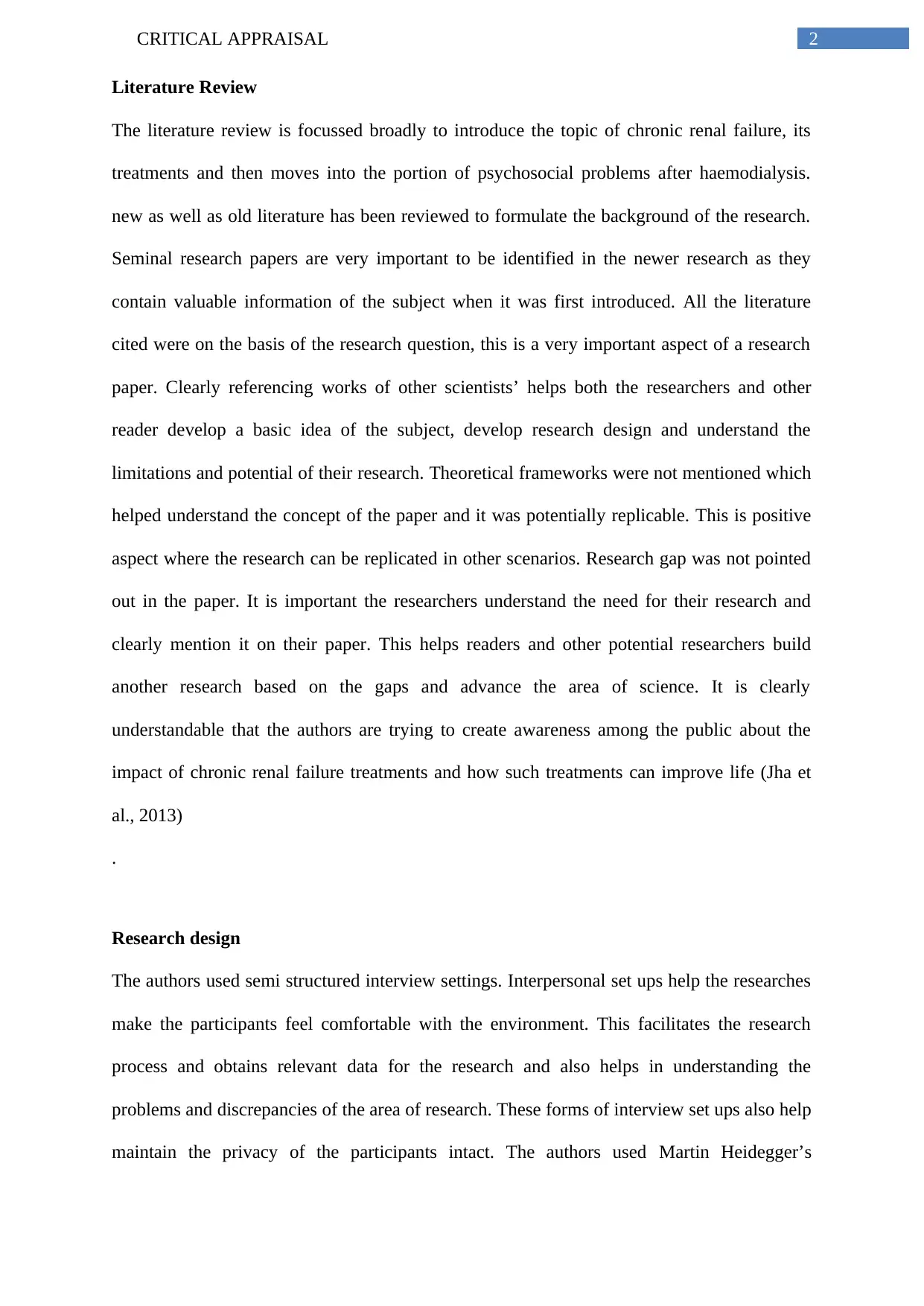
Literature Review
The literature review is focussed broadly to introduce the topic of chronic renal failure, its
treatments and then moves into the portion of psychosocial problems after haemodialysis.
new as well as old literature has been reviewed to formulate the background of the research.
Seminal research papers are very important to be identified in the newer research as they
contain valuable information of the subject when it was first introduced. All the literature
cited were on the basis of the research question, this is a very important aspect of a research
paper. Clearly referencing works of other scientists’ helps both the researchers and other
reader develop a basic idea of the subject, develop research design and understand the
limitations and potential of their research. Theoretical frameworks were not mentioned which
helped understand the concept of the paper and it was potentially replicable. This is positive
aspect where the research can be replicated in other scenarios. Research gap was not pointed
out in the paper. It is important the researchers understand the need for their research and
clearly mention it on their paper. This helps readers and other potential researchers build
another research based on the gaps and advance the area of science. It is clearly
understandable that the authors are trying to create awareness among the public about the
impact of chronic renal failure treatments and how such treatments can improve life (Jha et
al., 2013)
.
Research design
The authors used semi structured interview settings. Interpersonal set ups help the researches
make the participants feel comfortable with the environment. This facilitates the research
process and obtains relevant data for the research and also helps in understanding the
problems and discrepancies of the area of research. These forms of interview set ups also help
maintain the privacy of the participants intact. The authors used Martin Heidegger’s
Literature Review
The literature review is focussed broadly to introduce the topic of chronic renal failure, its
treatments and then moves into the portion of psychosocial problems after haemodialysis.
new as well as old literature has been reviewed to formulate the background of the research.
Seminal research papers are very important to be identified in the newer research as they
contain valuable information of the subject when it was first introduced. All the literature
cited were on the basis of the research question, this is a very important aspect of a research
paper. Clearly referencing works of other scientists’ helps both the researchers and other
reader develop a basic idea of the subject, develop research design and understand the
limitations and potential of their research. Theoretical frameworks were not mentioned which
helped understand the concept of the paper and it was potentially replicable. This is positive
aspect where the research can be replicated in other scenarios. Research gap was not pointed
out in the paper. It is important the researchers understand the need for their research and
clearly mention it on their paper. This helps readers and other potential researchers build
another research based on the gaps and advance the area of science. It is clearly
understandable that the authors are trying to create awareness among the public about the
impact of chronic renal failure treatments and how such treatments can improve life (Jha et
al., 2013)
.
Research design
The authors used semi structured interview settings. Interpersonal set ups help the researches
make the participants feel comfortable with the environment. This facilitates the research
process and obtains relevant data for the research and also helps in understanding the
problems and discrepancies of the area of research. These forms of interview set ups also help
maintain the privacy of the participants intact. The authors used Martin Heidegger’s
⊘ This is a preview!⊘
Do you want full access?
Subscribe today to unlock all pages.

Trusted by 1+ million students worldwide

3CRITICAL APPRAISAL
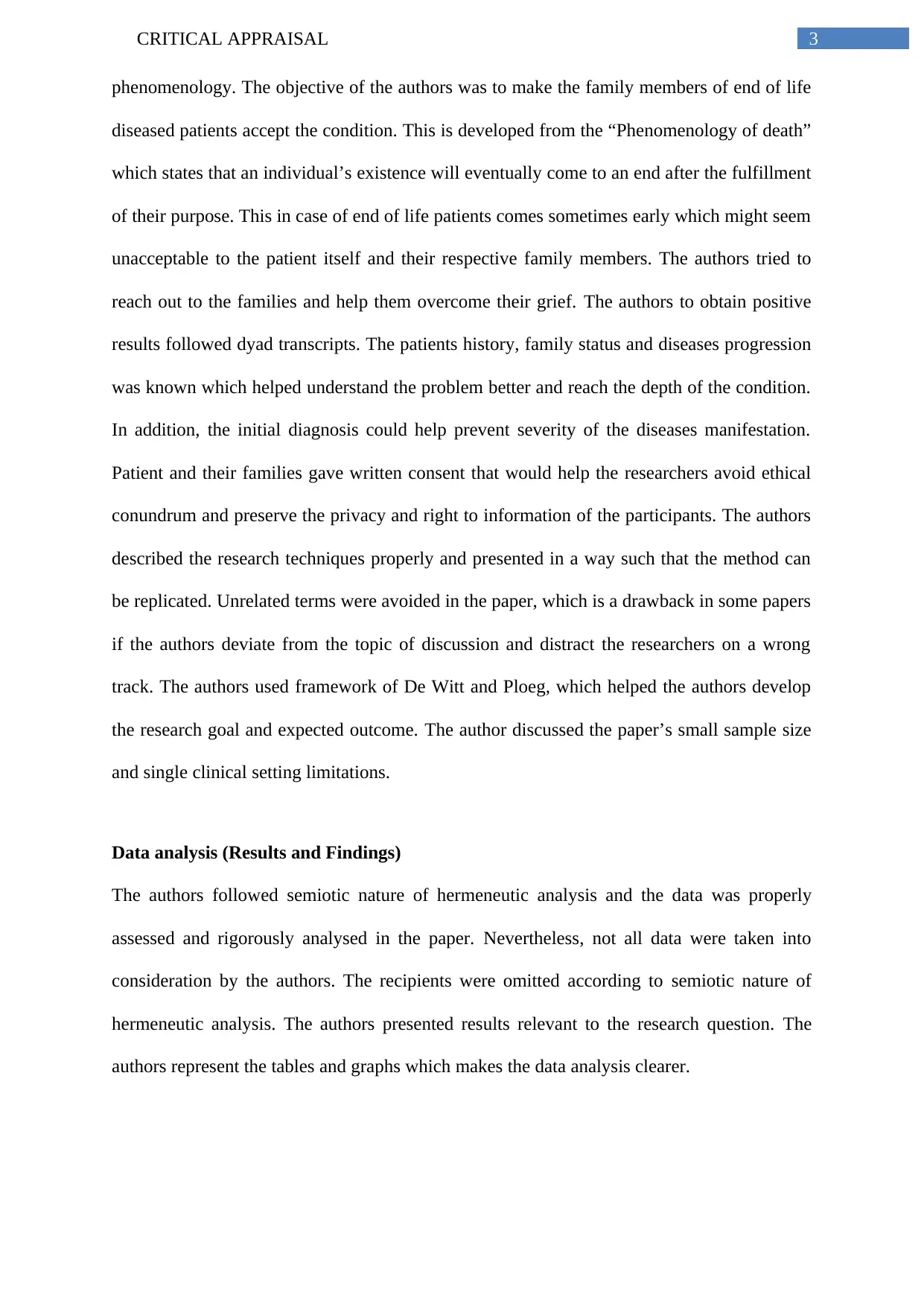
phenomenology. The objective of the authors was to make the family members of end of life
diseased patients accept the condition. This is developed from the “Phenomenology of death”
which states that an individual’s existence will eventually come to an end after the fulfillment
of their purpose. This in case of end of life patients comes sometimes early which might seem
unacceptable to the patient itself and their respective family members. The authors tried to
reach out to the families and help them overcome their grief. The authors to obtain positive
results followed dyad transcripts. The patients history, family status and diseases progression
was known which helped understand the problem better and reach the depth of the condition.
In addition, the initial diagnosis could help prevent severity of the diseases manifestation.
Patient and their families gave written consent that would help the researchers avoid ethical
conundrum and preserve the privacy and right to information of the participants. The authors
described the research techniques properly and presented in a way such that the method can
be replicated. Unrelated terms were avoided in the paper, which is a drawback in some papers
if the authors deviate from the topic of discussion and distract the researchers on a wrong
track. The authors used framework of De Witt and Ploeg, which helped the authors develop
the research goal and expected outcome. The author discussed the paper’s small sample size
and single clinical setting limitations.
Data analysis (Results and Findings)
The authors followed semiotic nature of hermeneutic analysis and the data was properly
assessed and rigorously analysed in the paper. Nevertheless, not all data were taken into
consideration by the authors. The recipients were omitted according to semiotic nature of
hermeneutic analysis. The authors presented results relevant to the research question. The
authors represent the tables and graphs which makes the data analysis clearer.
phenomenology. The objective of the authors was to make the family members of end of life
diseased patients accept the condition. This is developed from the “Phenomenology of death”
which states that an individual’s existence will eventually come to an end after the fulfillment
of their purpose. This in case of end of life patients comes sometimes early which might seem
unacceptable to the patient itself and their respective family members. The authors tried to
reach out to the families and help them overcome their grief. The authors to obtain positive
results followed dyad transcripts. The patients history, family status and diseases progression
was known which helped understand the problem better and reach the depth of the condition.
In addition, the initial diagnosis could help prevent severity of the diseases manifestation.
Patient and their families gave written consent that would help the researchers avoid ethical
conundrum and preserve the privacy and right to information of the participants. The authors
described the research techniques properly and presented in a way such that the method can
be replicated. Unrelated terms were avoided in the paper, which is a drawback in some papers
if the authors deviate from the topic of discussion and distract the researchers on a wrong
track. The authors used framework of De Witt and Ploeg, which helped the authors develop
the research goal and expected outcome. The author discussed the paper’s small sample size
and single clinical setting limitations.
Data analysis (Results and Findings)
The authors followed semiotic nature of hermeneutic analysis and the data was properly
assessed and rigorously analysed in the paper. Nevertheless, not all data were taken into
consideration by the authors. The recipients were omitted according to semiotic nature of
hermeneutic analysis. The authors presented results relevant to the research question. The
authors represent the tables and graphs which makes the data analysis clearer.
Paraphrase This Document
Need a fresh take? Get an instant paraphrase of this document with our AI Paraphraser

4CRITICAL APPRAISAL
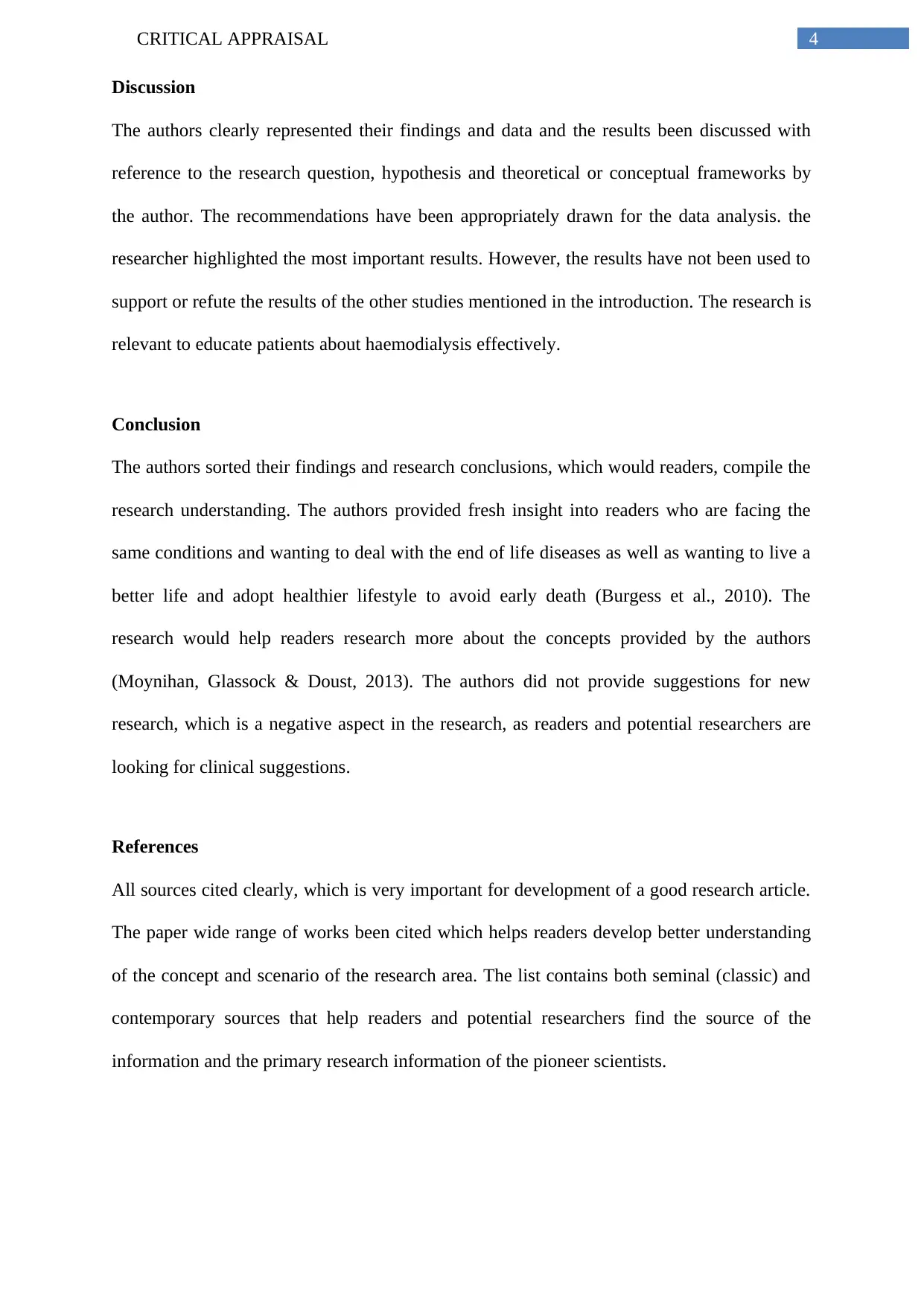
Discussion
The authors clearly represented their findings and data and the results been discussed with
reference to the research question, hypothesis and theoretical or conceptual frameworks by
the author. The recommendations have been appropriately drawn for the data analysis. the
researcher highlighted the most important results. However, the results have not been used to
support or refute the results of the other studies mentioned in the introduction. The research is
relevant to educate patients about haemodialysis effectively.
Conclusion
The authors sorted their findings and research conclusions, which would readers, compile the
research understanding. The authors provided fresh insight into readers who are facing the
same conditions and wanting to deal with the end of life diseases as well as wanting to live a
better life and adopt healthier lifestyle to avoid early death (Burgess et al., 2010). The
research would help readers research more about the concepts provided by the authors
(Moynihan, Glassock & Doust, 2013). The authors did not provide suggestions for new
research, which is a negative aspect in the research, as readers and potential researchers are
looking for clinical suggestions.
References
All sources cited clearly, which is very important for development of a good research article.
The paper wide range of works been cited which helps readers develop better understanding
of the concept and scenario of the research area. The list contains both seminal (classic) and
contemporary sources that help readers and potential researchers find the source of the
information and the primary research information of the pioneer scientists.
Discussion
The authors clearly represented their findings and data and the results been discussed with
reference to the research question, hypothesis and theoretical or conceptual frameworks by
the author. The recommendations have been appropriately drawn for the data analysis. the
researcher highlighted the most important results. However, the results have not been used to
support or refute the results of the other studies mentioned in the introduction. The research is
relevant to educate patients about haemodialysis effectively.
Conclusion
The authors sorted their findings and research conclusions, which would readers, compile the
research understanding. The authors provided fresh insight into readers who are facing the
same conditions and wanting to deal with the end of life diseases as well as wanting to live a
better life and adopt healthier lifestyle to avoid early death (Burgess et al., 2010). The
research would help readers research more about the concepts provided by the authors
(Moynihan, Glassock & Doust, 2013). The authors did not provide suggestions for new
research, which is a negative aspect in the research, as readers and potential researchers are
looking for clinical suggestions.
References
All sources cited clearly, which is very important for development of a good research article.
The paper wide range of works been cited which helps readers develop better understanding
of the concept and scenario of the research area. The list contains both seminal (classic) and
contemporary sources that help readers and potential researchers find the source of the
information and the primary research information of the pioneer scientists.

5CRITICAL APPRAISAL
Reflection
The research paper puts into the perspective the therapeutic relationship of the patient and the
nurse. It also helped me understand the role of nurses in the patient education and support in
lost life situations. Chronic renal failure is a complicated disease that requires effective
treatment and guidance as well as financial stability. As a nurse, it is my duty to educate the
patient as well as their family about the pros and cons of a therapeutic care. I wish to be able
to clearly communicate with both the parties and fill them with information that will help
them assess the situation and cooperate accordingly. The haemodialysis is a financial
effective treatment. I should keep in mind to timely inform the patient’s family about the care
plan so that they are not surprised or depressed about the patient’s condition. I wish to
support them in every way I can and help assess the situation as well as teach them that early
detection does not mean that the patient will not survive, but that the patient has a better
chance to live due to early commencement of treatment. I wish to remove stigmas from the
minds of patients and their family alike regarding the efficacy of haemodialysis and provide
better understanding to promote the treatment. I want educate myself in the current clinical
research so that I can apply newer techniques in my professional career and suggest
alternatives to the patient and their family. I wish to assess each patient individually and
provide them a more focussed care and prevent any signs of depression based on current
evidence. The paper also made me focus on the importance of prevention of shock among
patients and their family members about the knowledge of chronic diseases detection.
Previously I had not considered the impact of the shock factor among chronically morbid
patients, but in future, I will keep in mind and provide comfort to prevent the negative impact
of health-scares. I will in future try to calm down the patient as well as their families in these
situations.
Reflection
The research paper puts into the perspective the therapeutic relationship of the patient and the
nurse. It also helped me understand the role of nurses in the patient education and support in
lost life situations. Chronic renal failure is a complicated disease that requires effective
treatment and guidance as well as financial stability. As a nurse, it is my duty to educate the
patient as well as their family about the pros and cons of a therapeutic care. I wish to be able
to clearly communicate with both the parties and fill them with information that will help
them assess the situation and cooperate accordingly. The haemodialysis is a financial
effective treatment. I should keep in mind to timely inform the patient’s family about the care
plan so that they are not surprised or depressed about the patient’s condition. I wish to
support them in every way I can and help assess the situation as well as teach them that early
detection does not mean that the patient will not survive, but that the patient has a better
chance to live due to early commencement of treatment. I wish to remove stigmas from the
minds of patients and their family alike regarding the efficacy of haemodialysis and provide
better understanding to promote the treatment. I want educate myself in the current clinical
research so that I can apply newer techniques in my professional career and suggest
alternatives to the patient and their family. I wish to assess each patient individually and
provide them a more focussed care and prevent any signs of depression based on current
evidence. The paper also made me focus on the importance of prevention of shock among
patients and their family members about the knowledge of chronic diseases detection.
Previously I had not considered the impact of the shock factor among chronically morbid
patients, but in future, I will keep in mind and provide comfort to prevent the negative impact
of health-scares. I will in future try to calm down the patient as well as their families in these
situations.
⊘ This is a preview!⊘
Do you want full access?
Subscribe today to unlock all pages.

Trusted by 1+ million students worldwide

6CRITICAL APPRAISAL
References
Burgess, D. J., Warren, J., Phelan, S., Dovidio, J., & Van Ryn, M. (2010). Stereotype threat
and health disparities: what medical educators and future physicians need to
know. Journal of general internal medicine, 25(2), 169-177. DOI: 10.1007/s11606-
009-1221-4
Casey, J. R., Hanson, C. S., Winkelmayer, W. C., Craig, J. C., Palmer, S., Strippoli, G. F., &
Tong, A. (2014). Patients’ perspectives on hemodialysis vascular access: a systematic
review of qualitative studies. American journal of kidney diseases, 64(6), 937-953.
http://dx.doi.org/10.1053/j.ajkd.2014.06.024
Colquhoun, H. L., Levac, D., O'Brien, K. K., Straus, S., Tricco, A. C., Perrier, L., ... &
Moher, D. (2014). Scoping reviews: time for clarity in definition, methods, and
reporting. Journal of clinical epidemiology, 67(12), 1291-1294.
DOI: https://doi.org/10.1016/j.jclinepi.2014.03.013
Jha, V., Garcia-Garcia, G., Iseki, K., Li, Z., Naicker, S., Plattner, B., ... & Yang, C. W.
(2013). Chronic kidney disease: global dimension and perspectives. The
Lancet, 382(9888), 260-272. http://dx.doi.org/10.1016/ S0140-6736(13)60687-X
Katon, W. J., Lin, E. H., Von Korff, M., Ciechanowski, P., Ludman, E. J., Young, B., ... &
McCulloch, D. (2010). Collaborative care for patients with depression and chronic
illnesses. New England Journal of Medicine, 363(27), 2611-2620. DOI:
10.1056/NEJMoa1003955
Kourkouta, L., & Papathanasiou, I. V. (2014). Communication in nursing practice. Materia
socio-medica, 26(1), 65. . DOI: 10.5455/msm.2014.26.65-67
Monaro, S., Stewart, G. and Gullick, J. (2014), A ‘lost life’: coming to terms with
haemodialysis. Journal of Clinical Nursing, 23 (21-22), 3262–3273.
DOI:10.1111/jocn.12577
References
Burgess, D. J., Warren, J., Phelan, S., Dovidio, J., & Van Ryn, M. (2010). Stereotype threat
and health disparities: what medical educators and future physicians need to
know. Journal of general internal medicine, 25(2), 169-177. DOI: 10.1007/s11606-
009-1221-4
Casey, J. R., Hanson, C. S., Winkelmayer, W. C., Craig, J. C., Palmer, S., Strippoli, G. F., &
Tong, A. (2014). Patients’ perspectives on hemodialysis vascular access: a systematic
review of qualitative studies. American journal of kidney diseases, 64(6), 937-953.
http://dx.doi.org/10.1053/j.ajkd.2014.06.024
Colquhoun, H. L., Levac, D., O'Brien, K. K., Straus, S., Tricco, A. C., Perrier, L., ... &
Moher, D. (2014). Scoping reviews: time for clarity in definition, methods, and
reporting. Journal of clinical epidemiology, 67(12), 1291-1294.
DOI: https://doi.org/10.1016/j.jclinepi.2014.03.013
Jha, V., Garcia-Garcia, G., Iseki, K., Li, Z., Naicker, S., Plattner, B., ... & Yang, C. W.
(2013). Chronic kidney disease: global dimension and perspectives. The
Lancet, 382(9888), 260-272. http://dx.doi.org/10.1016/ S0140-6736(13)60687-X
Katon, W. J., Lin, E. H., Von Korff, M., Ciechanowski, P., Ludman, E. J., Young, B., ... &
McCulloch, D. (2010). Collaborative care for patients with depression and chronic
illnesses. New England Journal of Medicine, 363(27), 2611-2620. DOI:
10.1056/NEJMoa1003955
Kourkouta, L., & Papathanasiou, I. V. (2014). Communication in nursing practice. Materia
socio-medica, 26(1), 65. . DOI: 10.5455/msm.2014.26.65-67
Monaro, S., Stewart, G. and Gullick, J. (2014), A ‘lost life’: coming to terms with
haemodialysis. Journal of Clinical Nursing, 23 (21-22), 3262–3273.
DOI:10.1111/jocn.12577
Paraphrase This Document
Need a fresh take? Get an instant paraphrase of this document with our AI Paraphraser

7CRITICAL APPRAISAL
Moynihan, R., Glassock, R., & Doust, J. (2013). Chronic kidney disease controversy: how
expanding definitions are unnecessarily labelling many people as diseased. BMJ:
British Medical Journal (Online), 347. DOI: 10.1136/bmj.f4298
Palmer, N. (2017). Knowing your treatment options: understanding home
haemodialysis. Journal of Kidney Care, 2(3), 174-175.
https://doi.org/10.12968/jokc.2017.2.3.174
Palmer, S., Vecchio, M., Craig, J. C., Tonelli, M., Johnson, D. W., Nicolucci, A., ... &
Strippoli, G. F. (2013). Prevalence of depression in chronic kidney disease: systematic
review and meta-analysis of observational studies. Kidney international, 84(1), 179-
191. DOI: https://doi.org/10.1038/ki.2013.77
Stanton, A. L., Rowland, J. H., & Ganz, P. A. (2015). Life after diagnosis and treatment of
cancer in adulthood: Contributions from psychosocial oncology research. American
Psychologist, 70(2), 159. http://dx.doi.org/10.1037/a0037875
Moynihan, R., Glassock, R., & Doust, J. (2013). Chronic kidney disease controversy: how
expanding definitions are unnecessarily labelling many people as diseased. BMJ:
British Medical Journal (Online), 347. DOI: 10.1136/bmj.f4298
Palmer, N. (2017). Knowing your treatment options: understanding home
haemodialysis. Journal of Kidney Care, 2(3), 174-175.
https://doi.org/10.12968/jokc.2017.2.3.174
Palmer, S., Vecchio, M., Craig, J. C., Tonelli, M., Johnson, D. W., Nicolucci, A., ... &
Strippoli, G. F. (2013). Prevalence of depression in chronic kidney disease: systematic
review and meta-analysis of observational studies. Kidney international, 84(1), 179-
191. DOI: https://doi.org/10.1038/ki.2013.77
Stanton, A. L., Rowland, J. H., & Ganz, P. A. (2015). Life after diagnosis and treatment of
cancer in adulthood: Contributions from psychosocial oncology research. American
Psychologist, 70(2), 159. http://dx.doi.org/10.1037/a0037875
1 out of 8
Related Documents
Your All-in-One AI-Powered Toolkit for Academic Success.
+13062052269
info@desklib.com
Available 24*7 on WhatsApp / Email
Unlock your academic potential
Copyright © 2020–2025 A2Z Services. All Rights Reserved. Developed and managed by ZUCOL.