Psychology: Reflective Writing - Obedience, Authority, and Ethics

Verified

Added on  2023/01/19

|5
|1149
|100
Essay
AI Summary
This essay provides a reflective analysis of two significant psychological studies: Theodor Adorno's work on the authoritarian personality and Stanley Milgram's experiments on obedience to authority. The author explores the motivations behind human actions, particularly the inclination to inflict harm, and examines the state mechanisms that facilitate such actions. The essay delves into Adorno's research, which, drawing on Freudian concepts, aimed to understand how personality traits contribute to authoritarianism, questioning whether the 'German problem' could manifest elsewhere. In contrast, Milgram's study, which involved administering electric shocks, revealed the factors influencing irrational obedience, such as the clarity of the order-giver and proximity between the subject and the victim. The author contrasts the ethical considerations of both studies, highlighting the ethical issues raised by Milgram's experiment and the potential for bias in psychological research. The essay concludes that Adorno's research aligns with ethical standards and remains unbiased, while Milgram's experiment raises serious concerns about the welfare of participants and the balance between research outcomes and ethical conduct. It emphasizes the need for stringent guidelines in psychological research.
Document Page
Running head : Psychology
Psychology
Name of the student
Name of the author
Authors note
tabler-icon-diamond-filled.svg

Paraphrase This Document

Need a fresh take? Get an instant paraphrase of this document with our AI Paraphraser
Document Page
Running head : Psychology
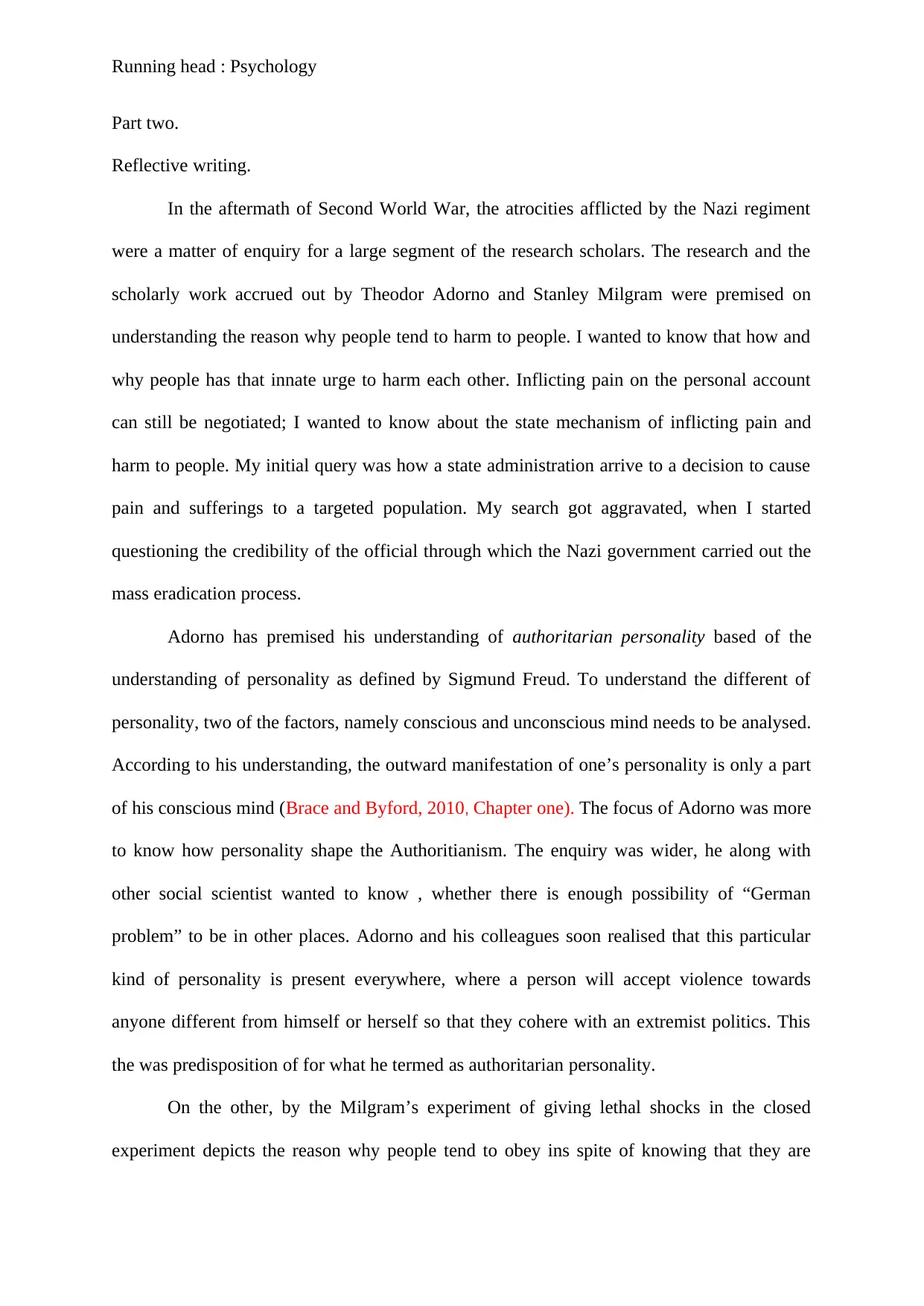
Part two.
Reflective writing.
In the aftermath of Second World War, the atrocities afflicted by the Nazi regiment
were a matter of enquiry for a large segment of the research scholars. The research and the
scholarly work accrued out by Theodor Adorno and Stanley Milgram were premised on
understanding the reason why people tend to harm to people. I wanted to know that how and
why people has that innate urge to harm each other. Inflicting pain on the personal account
can still be negotiated; I wanted to know about the state mechanism of inflicting pain and
harm to people. My initial query was how a state administration arrive to a decision to cause
pain and sufferings to a targeted population. My search got aggravated, when I started
questioning the credibility of the official through which the Nazi government carried out the
mass eradication process.
Adorno has premised his understanding of authoritarian personality based of the
understanding of personality as defined by Sigmund Freud. To understand the different of
personality, two of the factors, namely conscious and unconscious mind needs to be analysed.
According to his understanding, the outward manifestation of one’s personality is only a part
of his conscious mind (Brace and Byford, 2010, Chapter one). The focus of Adorno was more
to know how personality shape the Authoritianism. The enquiry was wider, he along with
other social scientist wanted to know , whether there is enough possibility of “German
problem” to be in other places. Adorno and his colleagues soon realised that this particular
kind of personality is present everywhere, where a person will accept violence towards
anyone different from himself or herself so that they cohere with an extremist politics. This
the was predisposition of for what he termed as authoritarian personality.
On the other, by the Milgram’s experiment of giving lethal shocks in the closed
experiment depicts the reason why people tend to obey ins spite of knowing that they are
Document Page
Running head : Psychology
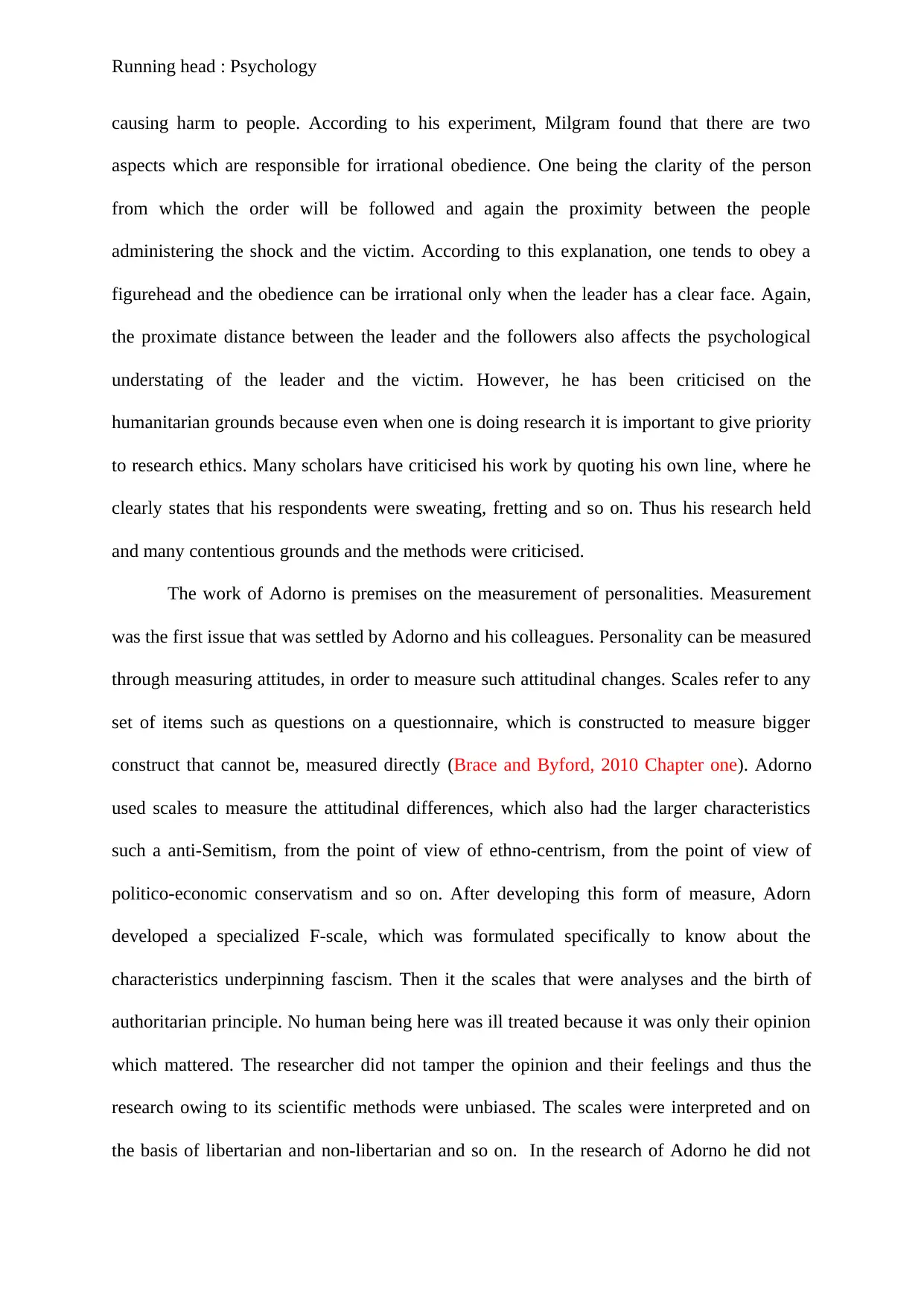
causing harm to people. According to his experiment, Milgram found that there are two
aspects which are responsible for irrational obedience. One being the clarity of the person
from which the order will be followed and again the proximity between the people
administering the shock and the victim. According to this explanation, one tends to obey a
figurehead and the obedience can be irrational only when the leader has a clear face. Again,
the proximate distance between the leader and the followers also affects the psychological
understating of the leader and the victim. However, he has been criticised on the
humanitarian grounds because even when one is doing research it is important to give priority
to research ethics. Many scholars have criticised his work by quoting his own line, where he
clearly states that his respondents were sweating, fretting and so on. Thus his research held
and many contentious grounds and the methods were criticised.
The work of Adorno is premises on the measurement of personalities. Measurement
was the first issue that was settled by Adorno and his colleagues. Personality can be measured
through measuring attitudes, in order to measure such attitudinal changes. Scales refer to any
set of items such as questions on a questionnaire, which is constructed to measure bigger
construct that cannot be, measured directly (Brace and Byford, 2010 Chapter one). Adorno
used scales to measure the attitudinal differences, which also had the larger characteristics
such a anti-Semitism, from the point of view of ethno-centrism, from the point of view of
politico-economic conservatism and so on. After developing this form of measure, Adorn
developed a specialized F-scale, which was formulated specifically to know about the
characteristics underpinning fascism. Then it the scales that were analyses and the birth of
authoritarian principle. No human being here was ill treated because it was only their opinion
which mattered. The researcher did not tamper the opinion and their feelings and thus the
research owing to its scientific methods were unbiased. The scales were interpreted and on
the basis of libertarian and non-libertarian and so on. In the research of Adorno he did not
Document Page
Running head : Psychology
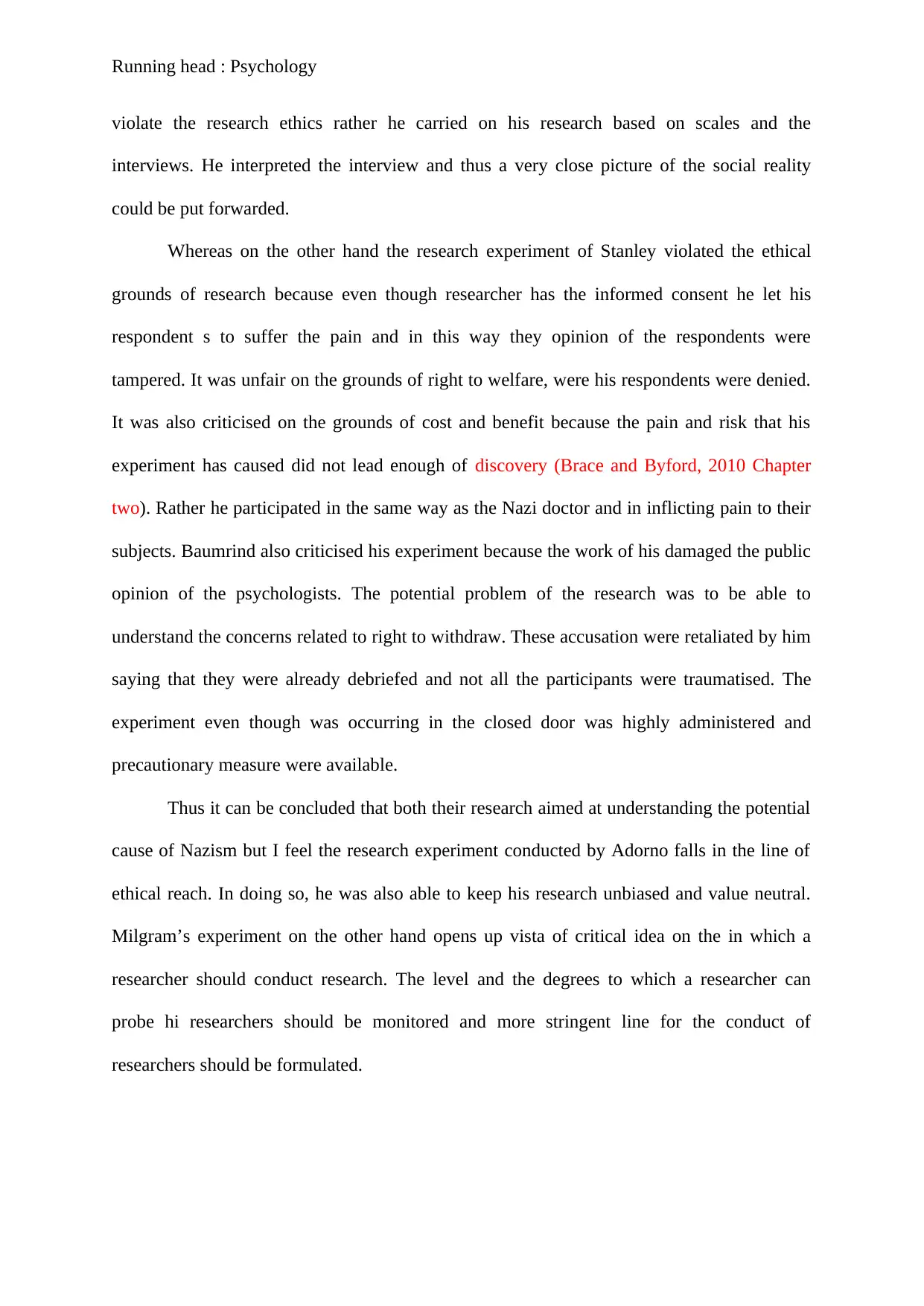
violate the research ethics rather he carried on his research based on scales and the
interviews. He interpreted the interview and thus a very close picture of the social reality
could be put forwarded.
Whereas on the other hand the research experiment of Stanley violated the ethical
grounds of research because even though researcher has the informed consent he let his
respondent s to suffer the pain and in this way they opinion of the respondents were
tampered. It was unfair on the grounds of right to welfare, were his respondents were denied.
It was also criticised on the grounds of cost and benefit because the pain and risk that his
experiment has caused did not lead enough of discovery (Brace and Byford, 2010 Chapter
two). Rather he participated in the same way as the Nazi doctor and in inflicting pain to their
subjects. Baumrind also criticised his experiment because the work of his damaged the public
opinion of the psychologists. The potential problem of the research was to be able to
understand the concerns related to right to withdraw. These accusation were retaliated by him
saying that they were already debriefed and not all the participants were traumatised. The
experiment even though was occurring in the closed door was highly administered and
precautionary measure were available.
Thus it can be concluded that both their research aimed at understanding the potential
cause of Nazism but I feel the research experiment conducted by Adorno falls in the line of
ethical reach. In doing so, he was also able to keep his research unbiased and value neutral.
Milgram’s experiment on the other hand opens up vista of critical idea on the in which a
researcher should conduct research. The level and the degrees to which a researcher can
probe hi researchers should be monitored and more stringent line for the conduct of
researchers should be formulated.
tabler-icon-diamond-filled.svg

Paraphrase This Document

Need a fresh take? Get an instant paraphrase of this document with our AI Paraphraser
Document Page
Running head : Psychology
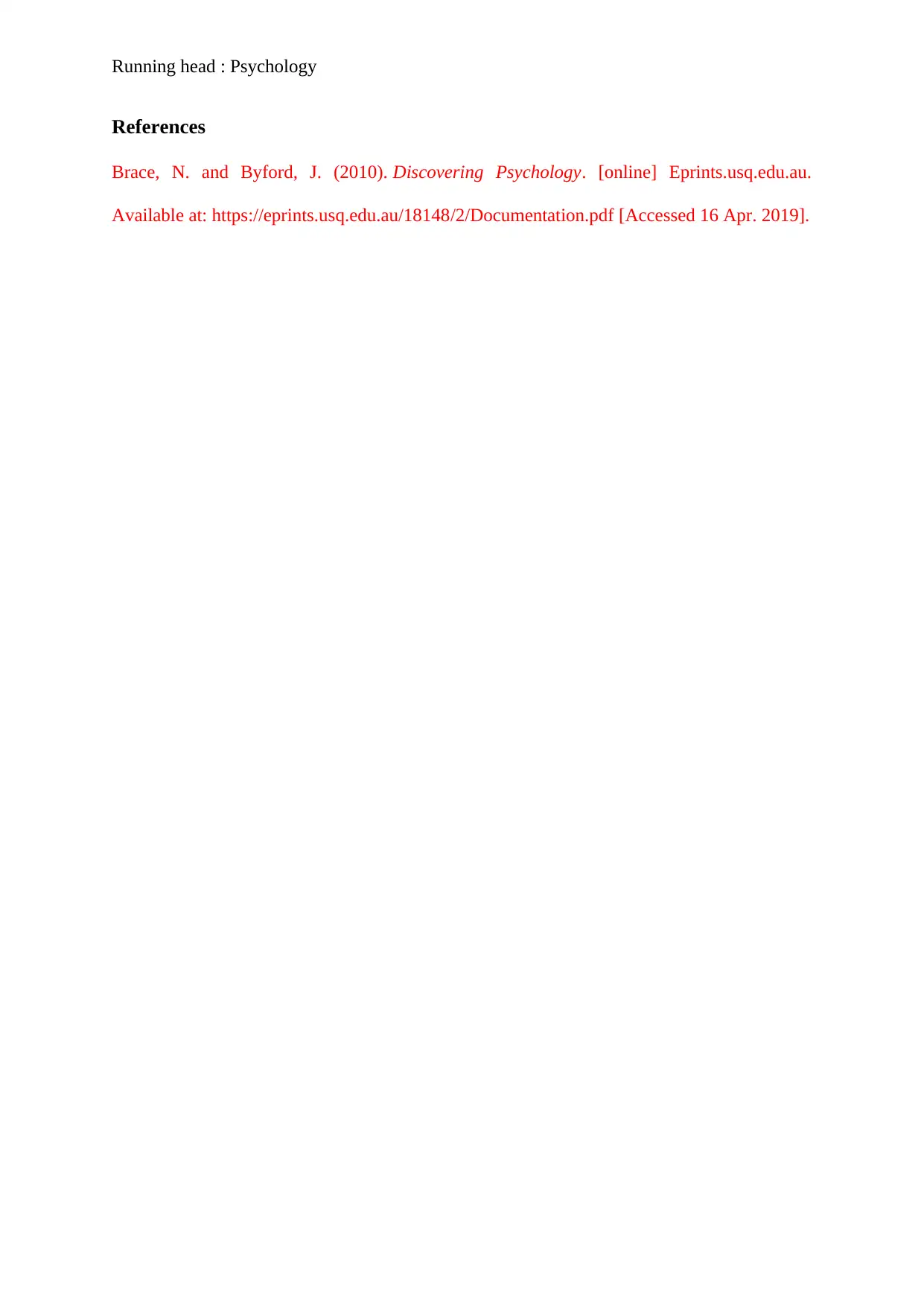
References
Brace, N. and Byford, J. (2010). Discovering Psychology. [online] Eprints.usq.edu.au.
Available at: https://eprints.usq.edu.au/18148/2/Documentation.pdf [Accessed 16 Apr. 2019].
chevron_up_icon
1 out of 5
circle_padding
hide_on_mobile
zoom_out_icon
[object Object]