Object Modelling Report: Analysis of ATM System Processes and Diagrams
VerifiedAdded on 2021/06/16
|12
|2297
|24
Report
AI Summary
This report provides a detailed analysis of an ATM system using object modelling techniques. It begins with an introduction outlining the report's purpose: to describe the Collins ATM system and provide staff with sufficient knowledge about the machine. The report then explores use case diagrams to illustrate the ATM system's processes and actors, emphasizing the importance of clear communication between business and development teams. Following the use case section, the report delves into sequence diagrams for three key ATM processes: withdrawing money, transferring money, and checking balances. Each sequence diagram is accompanied by a description of the involved components (display, keyboard, account, cash dispenser, bank) and the sequence of interactions. The report concludes with a bibliography of related research papers.
Running head: OBJECT MODELLING
Object Modelling
Name of the Student:
Name of the University:
Author Note
Object Modelling
Name of the Student:
Name of the University:
Author Note

Paraphrase This Document
Need a fresh take? Get an instant paraphrase of this document with our AI Paraphraser
1
OBJECT MODELLING
Table of Contents
Introduction......................................................................................................................................2
Use Case..........................................................................................................................................2
Sequence Diagrams.........................................................................................................................4
Withdraw Money.........................................................................................................................4
Transfer Money...........................................................................................................................7
Check Balance.............................................................................................................................9
Bibliography..................................................................................................................................11
OBJECT MODELLING
Table of Contents
Introduction......................................................................................................................................2
Use Case..........................................................................................................................................2
Sequence Diagrams.........................................................................................................................4
Withdraw Money.........................................................................................................................4
Transfer Money...........................................................................................................................7
Check Balance.............................................................................................................................9
Bibliography..................................................................................................................................11
2
OBJECT MODELLING
Introduction
The report is used for the description of the Collins ATM system. The ATN setup in the
bank would be very useful for the customers of the organization. However, the staffs of the
organization should have efficient knowledge on the processing and methods of the system and
hence the report is developed to provide the staffs of the organization with sufficient knowledge
about machine that is to be installed in the bank of the organization. Three sub process among all
the process of the ATM have been described in this report.
The report provides the reader with the Use case diagram designed previously. Additional
descriptions of the Use case is also provided in this report. In addition to this, the main body of
the
report contains the description about the three sub processes of the ATM system that can be
performed by the customers. The sequence diagrams have been provided in the report that would
describe the sub process to the reader efficiently. In addition to the diagrams descriptions about
the sequence in which the process has been described efficiently in this report.
Use Case
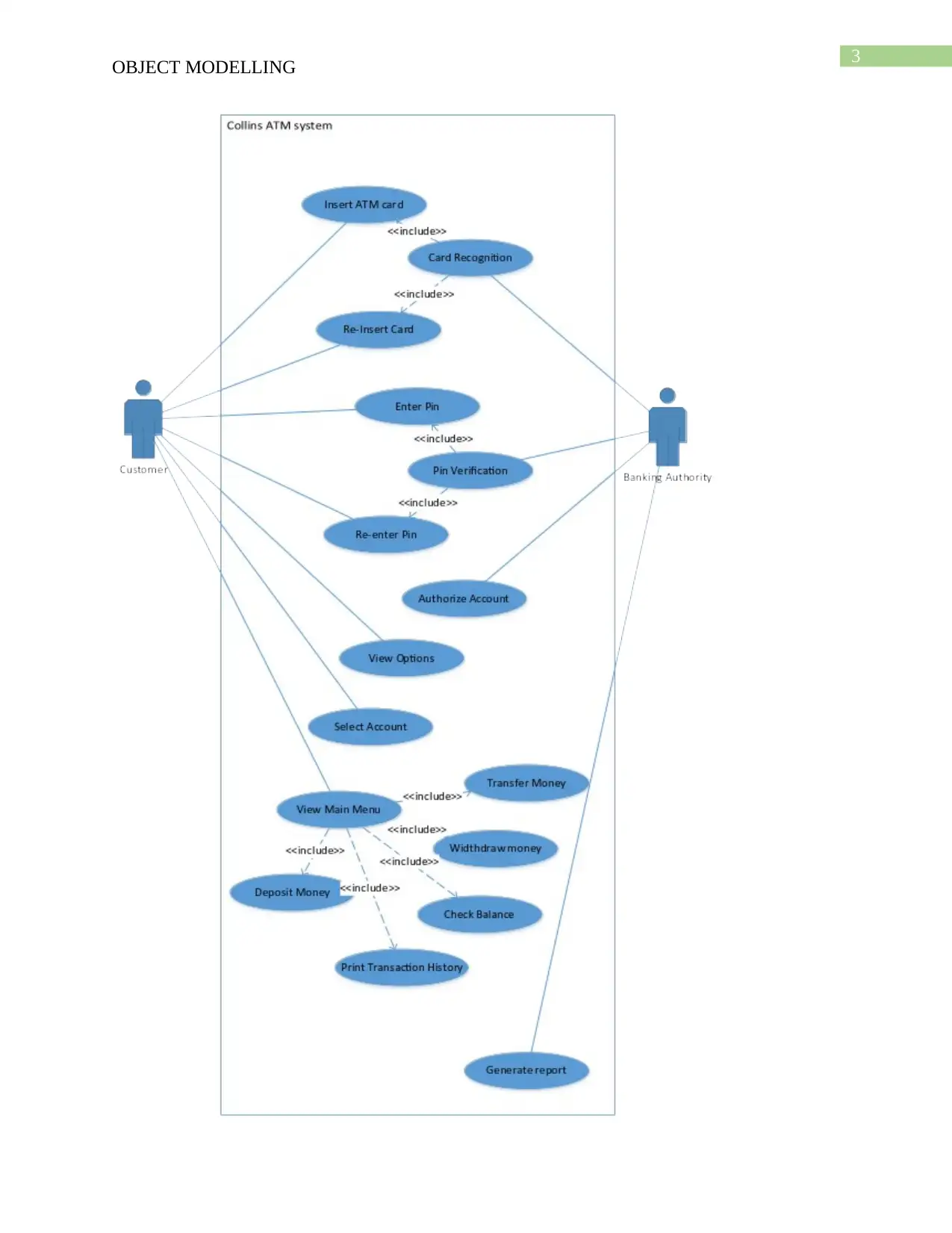
The Use Case diagram provides the information about the process of the ATM system
and the actors associated with it. Ensuring that both the business community and the developers
share a common understanding of the business and software requirements is notoriously difficult.
Any standard method for structuring the communication between these two parties drastically
reduces the probability of miscommunication. Hence the use cases are provided at all the types
of documentation procedures.
OBJECT MODELLING
Introduction
The report is used for the description of the Collins ATM system. The ATN setup in the
bank would be very useful for the customers of the organization. However, the staffs of the
organization should have efficient knowledge on the processing and methods of the system and
hence the report is developed to provide the staffs of the organization with sufficient knowledge
about machine that is to be installed in the bank of the organization. Three sub process among all
the process of the ATM have been described in this report.
The report provides the reader with the Use case diagram designed previously. Additional
descriptions of the Use case is also provided in this report. In addition to this, the main body of
the
report contains the description about the three sub processes of the ATM system that can be
performed by the customers. The sequence diagrams have been provided in the report that would
describe the sub process to the reader efficiently. In addition to the diagrams descriptions about
the sequence in which the process has been described efficiently in this report.
Use Case
The Use Case diagram provides the information about the process of the ATM system
and the actors associated with it. Ensuring that both the business community and the developers
share a common understanding of the business and software requirements is notoriously difficult.
Any standard method for structuring the communication between these two parties drastically
reduces the probability of miscommunication. Hence the use cases are provided at all the types
of documentation procedures.
⊘ This is a preview!⊘
Do you want full access?
Subscribe today to unlock all pages.

Trusted by 1+ million students worldwide
3
OBJECT MODELLING
OBJECT MODELLING
Paraphrase This Document
Need a fresh take? Get an instant paraphrase of this document with our AI Paraphraser
4
OBJECT MODELLING
From the use case diagram, it is evident that the main actors of the system are the
customers or user and the Banking authority. It can also be seen that the main process of the
system is the main menu and there are various sub processes under the main menu option.
Therefore, the three main sub process under it are chosen for description in this report that is the
Transfer Money, Check Money and Check Balance.
Sequence Diagrams
Each of the use case scenarios can be modeled by a sequence diagram for obtaining a set
of objects that participate the interaction. Hence the sequence diagram of the three most effective
processes of the have been described in this report. The illustrations and the description of the
sequence diagrams of the sub processes have been provided below.
Withdraw Money
OBJECT MODELLING
From the use case diagram, it is evident that the main actors of the system are the
customers or user and the Banking authority. It can also be seen that the main process of the
system is the main menu and there are various sub processes under the main menu option.
Therefore, the three main sub process under it are chosen for description in this report that is the
Transfer Money, Check Money and Check Balance.
Sequence Diagrams
Each of the use case scenarios can be modeled by a sequence diagram for obtaining a set
of objects that participate the interaction. Hence the sequence diagram of the three most effective
processes of the have been described in this report. The illustrations and the description of the
sequence diagrams of the sub processes have been provided below.
Withdraw Money
5
OBJECT MODELLING
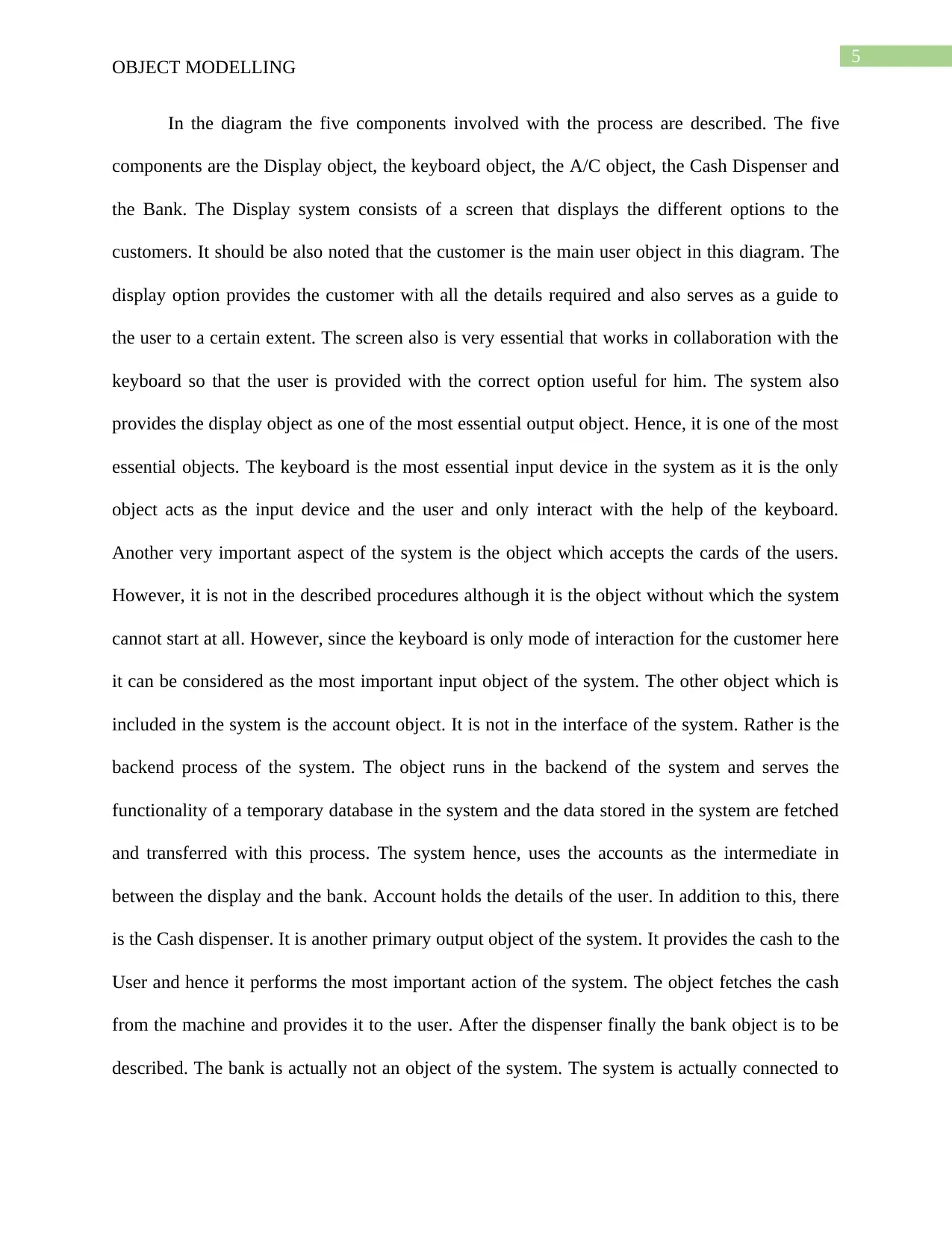
In the diagram the five components involved with the process are described. The five
components are the Display object, the keyboard object, the A/C object, the Cash Dispenser and
the Bank. The Display system consists of a screen that displays the different options to the
customers. It should be also noted that the customer is the main user object in this diagram. The
display option provides the customer with all the details required and also serves as a guide to
the user to a certain extent. The screen also is very essential that works in collaboration with the
keyboard so that the user is provided with the correct option useful for him. The system also
provides the display object as one of the most essential output object. Hence, it is one of the most
essential objects. The keyboard is the most essential input device in the system as it is the only
object acts as the input device and the user and only interact with the help of the keyboard.
Another very important aspect of the system is the object which accepts the cards of the users.
However, it is not in the described procedures although it is the object without which the system
cannot start at all. However, since the keyboard is only mode of interaction for the customer here
it can be considered as the most important input object of the system. The other object which is
included in the system is the account object. It is not in the interface of the system. Rather is the
backend process of the system. The object runs in the backend of the system and serves the
functionality of a temporary database in the system and the data stored in the system are fetched
and transferred with this process. The system hence, uses the accounts as the intermediate in
between the display and the bank. Account holds the details of the user. In addition to this, there
is the Cash dispenser. It is another primary output object of the system. It provides the cash to the
User and hence it performs the most important action of the system. The object fetches the cash
from the machine and provides it to the user. After the dispenser finally the bank object is to be
described. The bank is actually not an object of the system. The system is actually connected to
OBJECT MODELLING
In the diagram the five components involved with the process are described. The five
components are the Display object, the keyboard object, the A/C object, the Cash Dispenser and
the Bank. The Display system consists of a screen that displays the different options to the
customers. It should be also noted that the customer is the main user object in this diagram. The
display option provides the customer with all the details required and also serves as a guide to
the user to a certain extent. The screen also is very essential that works in collaboration with the
keyboard so that the user is provided with the correct option useful for him. The system also
provides the display object as one of the most essential output object. Hence, it is one of the most
essential objects. The keyboard is the most essential input device in the system as it is the only
object acts as the input device and the user and only interact with the help of the keyboard.
Another very important aspect of the system is the object which accepts the cards of the users.
However, it is not in the described procedures although it is the object without which the system
cannot start at all. However, since the keyboard is only mode of interaction for the customer here
it can be considered as the most important input object of the system. The other object which is
included in the system is the account object. It is not in the interface of the system. Rather is the
backend process of the system. The object runs in the backend of the system and serves the
functionality of a temporary database in the system and the data stored in the system are fetched
and transferred with this process. The system hence, uses the accounts as the intermediate in
between the display and the bank. Account holds the details of the user. In addition to this, there
is the Cash dispenser. It is another primary output object of the system. It provides the cash to the
User and hence it performs the most important action of the system. The object fetches the cash
from the machine and provides it to the user. After the dispenser finally the bank object is to be
described. The bank is actually not an object of the system. The system is actually connected to
⊘ This is a preview!⊘
Do you want full access?
Subscribe today to unlock all pages.
Trusted by 1+ million students worldwide
6
OBJECT MODELLING
the bank in the real case scenario. The system interacts with the bank and the bank delivers the
information stored in its database. The system sometimes acts as a medium in between the user
and the bank. The main primary actor object is this diagram is the user. The user goes to the
main menu and selects the withdraw cash option. After this the system displays the user the
option of entering the value which the user wants to withdraw. The system takes the users input
into account and checks with the bank. The bank then checks the user data with its own database,
If the user has a sufficient balance then the banks allows the transfer. The system the n checks if
it has enough cash and proceeds with the request of the user. The user then receives the cash
from the dispenser. And the system continues the process until the machine runs out of cash.
OBJECT MODELLING
the bank in the real case scenario. The system interacts with the bank and the bank delivers the
information stored in its database. The system sometimes acts as a medium in between the user
and the bank. The main primary actor object is this diagram is the user. The user goes to the
main menu and selects the withdraw cash option. After this the system displays the user the
option of entering the value which the user wants to withdraw. The system takes the users input
into account and checks with the bank. The bank then checks the user data with its own database,
If the user has a sufficient balance then the banks allows the transfer. The system the n checks if
it has enough cash and proceeds with the request of the user. The user then receives the cash
from the dispenser. And the system continues the process until the machine runs out of cash.
Paraphrase This Document
Need a fresh take? Get an instant paraphrase of this document with our AI Paraphraser
7
OBJECT MODELLING
Transfer Money
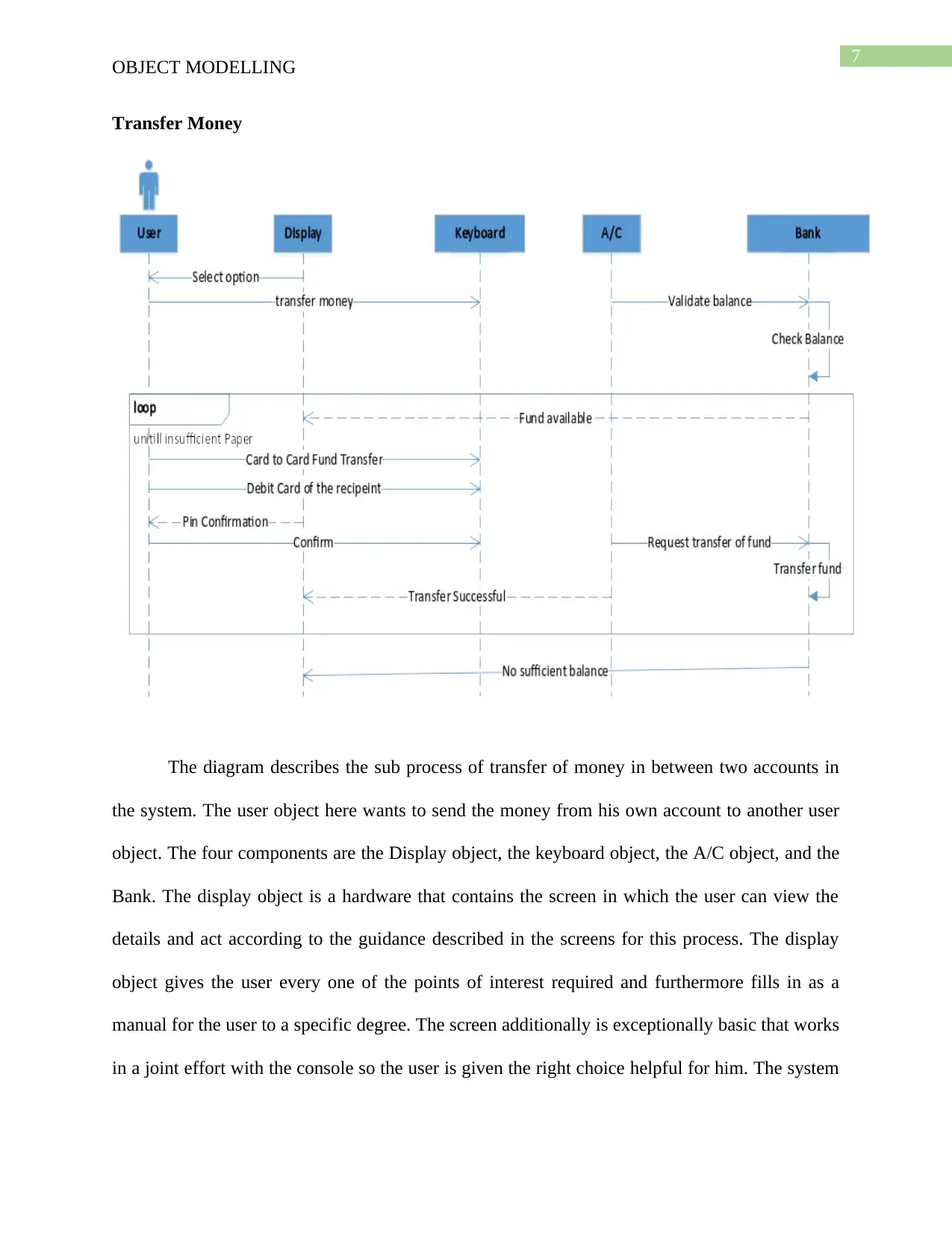
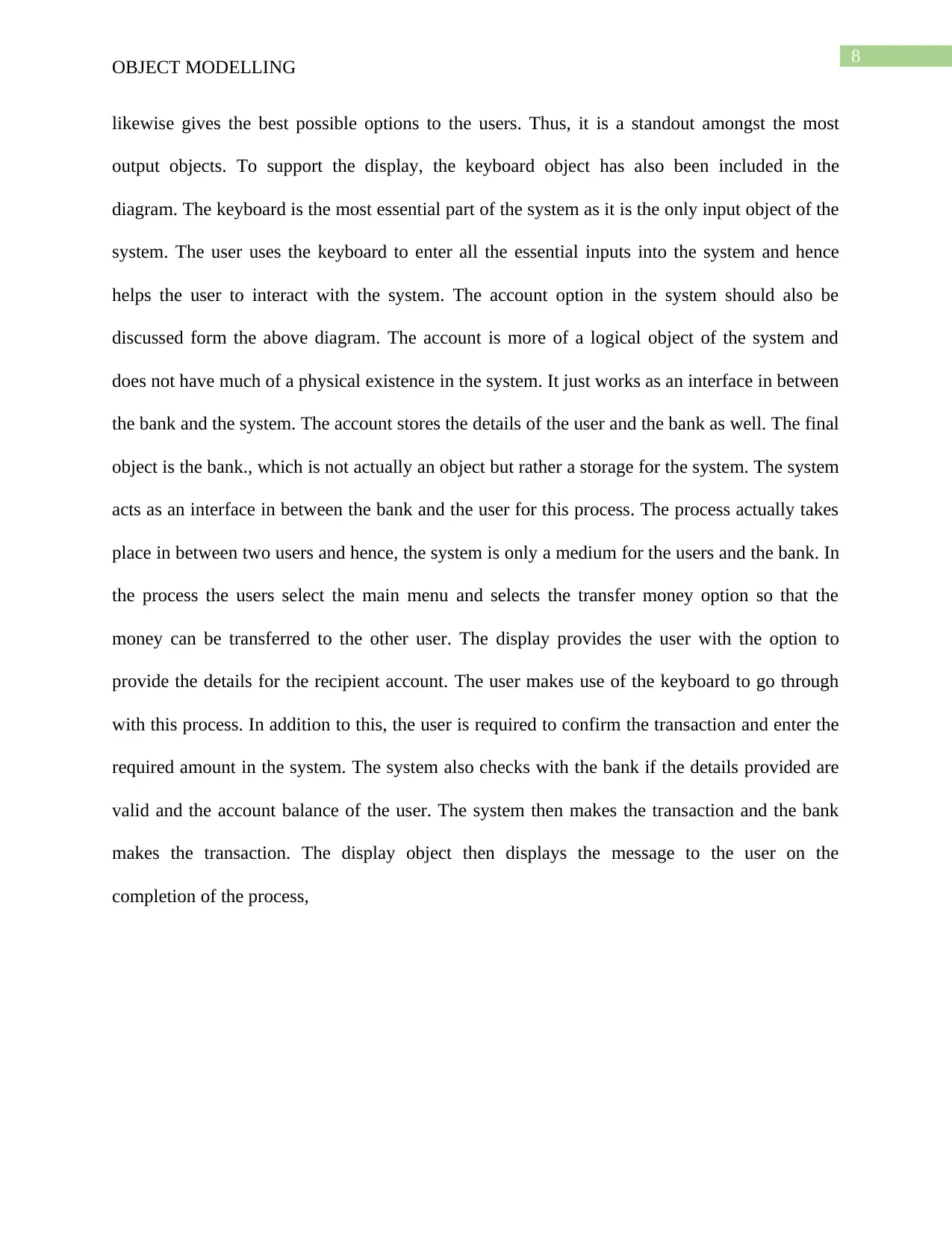
The diagram describes the sub process of transfer of money in between two accounts in
the system. The user object here wants to send the money from his own account to another user
object. The four components are the Display object, the keyboard object, the A/C object, and the
Bank. The display object is a hardware that contains the screen in which the user can view the
details and act according to the guidance described in the screens for this process. The display
object gives the user every one of the points of interest required and furthermore fills in as a
manual for the user to a specific degree. The screen additionally is exceptionally basic that works
in a joint effort with the console so the user is given the right choice helpful for him. The system
OBJECT MODELLING
Transfer Money
The diagram describes the sub process of transfer of money in between two accounts in
the system. The user object here wants to send the money from his own account to another user
object. The four components are the Display object, the keyboard object, the A/C object, and the
Bank. The display object is a hardware that contains the screen in which the user can view the
details and act according to the guidance described in the screens for this process. The display
object gives the user every one of the points of interest required and furthermore fills in as a
manual for the user to a specific degree. The screen additionally is exceptionally basic that works
in a joint effort with the console so the user is given the right choice helpful for him. The system
8
OBJECT MODELLING
likewise gives the best possible options to the users. Thus, it is a standout amongst the most
output objects. To support the display, the keyboard object has also been included in the
diagram. The keyboard is the most essential part of the system as it is the only input object of the
system. The user uses the keyboard to enter all the essential inputs into the system and hence
helps the user to interact with the system. The account option in the system should also be
discussed form the above diagram. The account is more of a logical object of the system and
does not have much of a physical existence in the system. It just works as an interface in between
the bank and the system. The account stores the details of the user and the bank as well. The final
object is the bank., which is not actually an object but rather a storage for the system. The system
acts as an interface in between the bank and the user for this process. The process actually takes
place in between two users and hence, the system is only a medium for the users and the bank. In
the process the users select the main menu and selects the transfer money option so that the
money can be transferred to the other user. The display provides the user with the option to
provide the details for the recipient account. The user makes use of the keyboard to go through
with this process. In addition to this, the user is required to confirm the transaction and enter the
required amount in the system. The system also checks with the bank if the details provided are
valid and the account balance of the user. The system then makes the transaction and the bank
makes the transaction. The display object then displays the message to the user on the
completion of the process,
OBJECT MODELLING
likewise gives the best possible options to the users. Thus, it is a standout amongst the most
output objects. To support the display, the keyboard object has also been included in the
diagram. The keyboard is the most essential part of the system as it is the only input object of the
system. The user uses the keyboard to enter all the essential inputs into the system and hence
helps the user to interact with the system. The account option in the system should also be
discussed form the above diagram. The account is more of a logical object of the system and
does not have much of a physical existence in the system. It just works as an interface in between
the bank and the system. The account stores the details of the user and the bank as well. The final
object is the bank., which is not actually an object but rather a storage for the system. The system
acts as an interface in between the bank and the user for this process. The process actually takes
place in between two users and hence, the system is only a medium for the users and the bank. In
the process the users select the main menu and selects the transfer money option so that the
money can be transferred to the other user. The display provides the user with the option to
provide the details for the recipient account. The user makes use of the keyboard to go through
with this process. In addition to this, the user is required to confirm the transaction and enter the
required amount in the system. The system also checks with the bank if the details provided are
valid and the account balance of the user. The system then makes the transaction and the bank
makes the transaction. The display object then displays the message to the user on the
completion of the process,
⊘ This is a preview!⊘
Do you want full access?
Subscribe today to unlock all pages.
Trusted by 1+ million students worldwide
9
OBJECT MODELLING
Check Balance
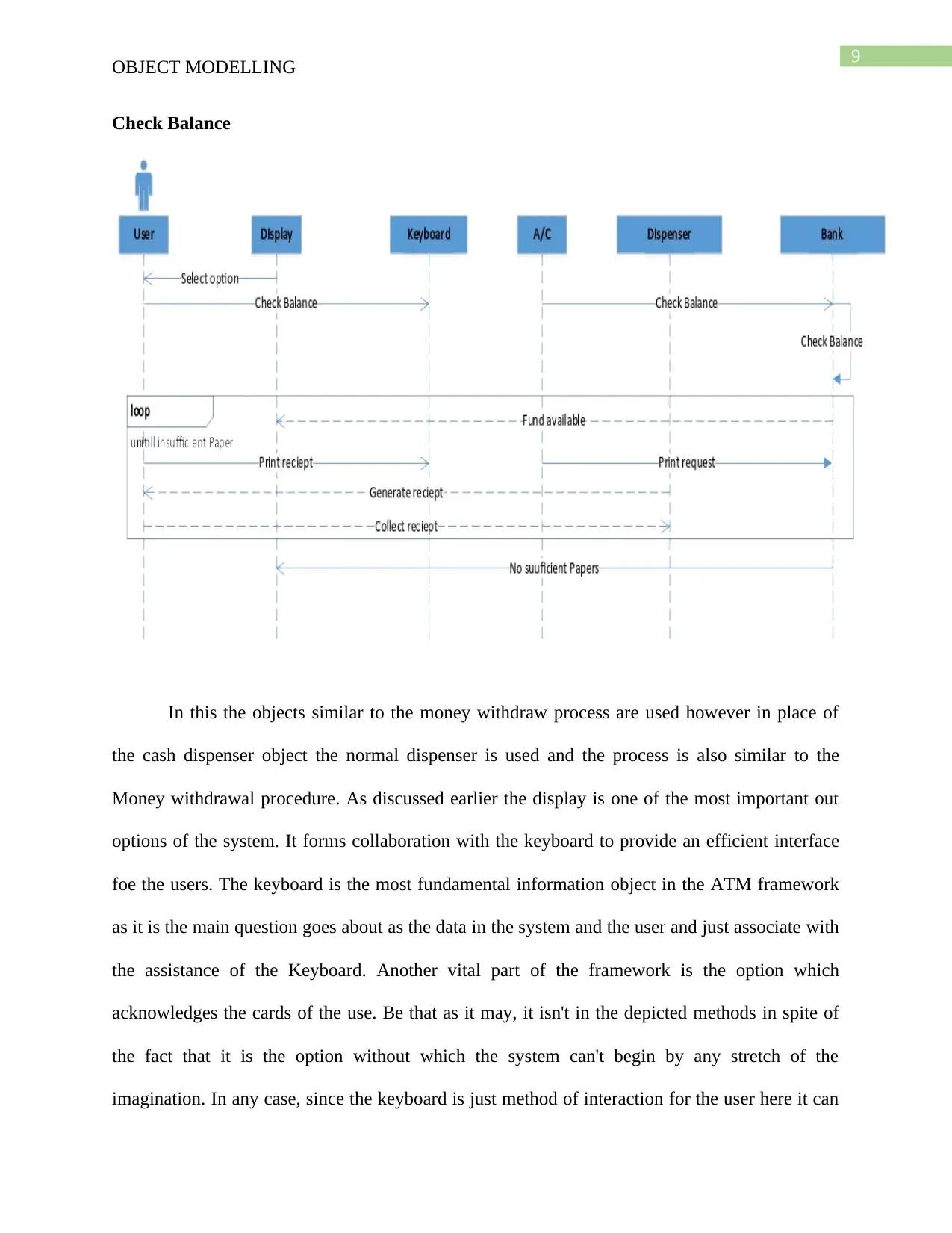
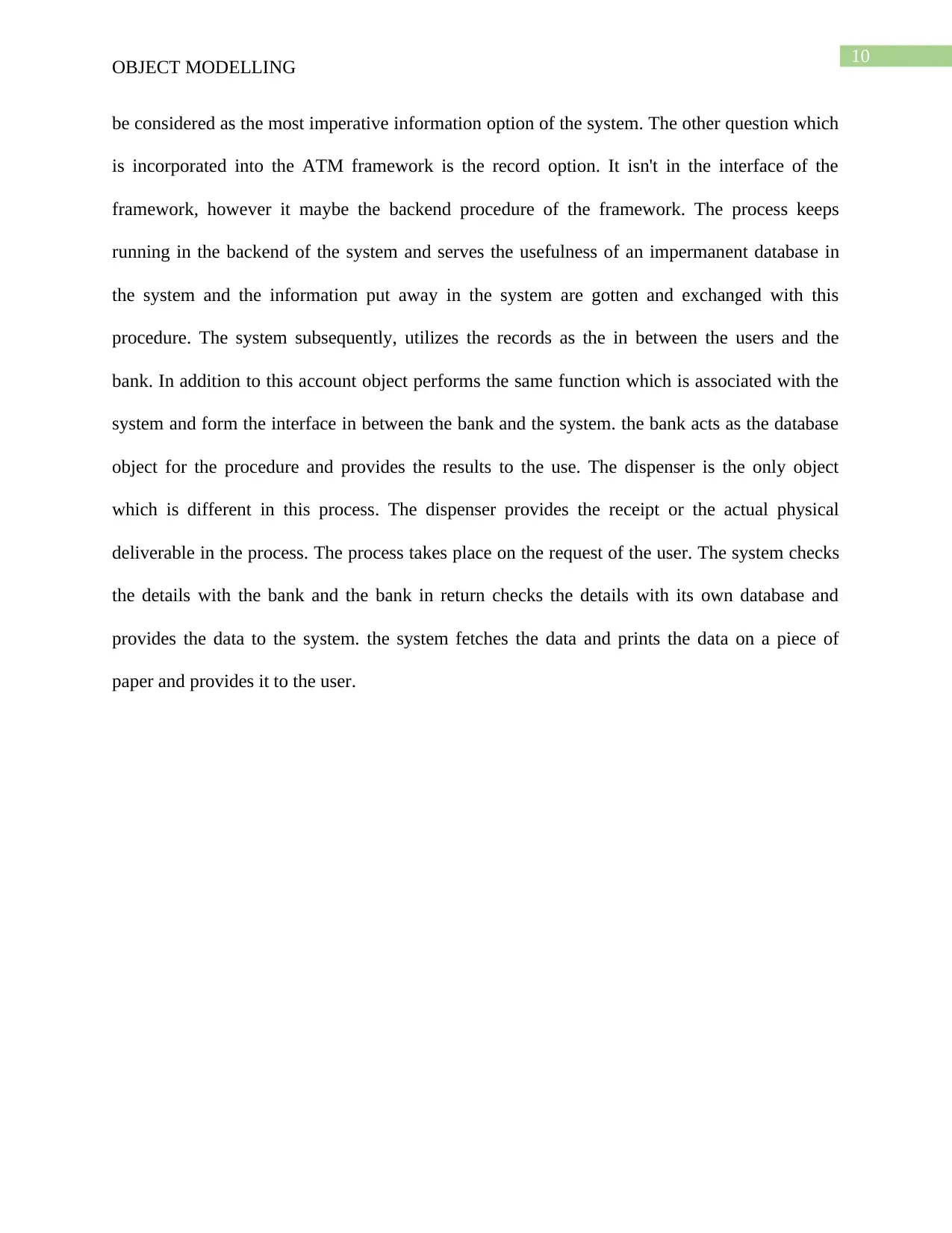
In this the objects similar to the money withdraw process are used however in place of
the cash dispenser object the normal dispenser is used and the process is also similar to the
Money withdrawal procedure. As discussed earlier the display is one of the most important out
options of the system. It forms collaboration with the keyboard to provide an efficient interface
foe the users. The keyboard is the most fundamental information object in the ATM framework
as it is the main question goes about as the data in the system and the user and just associate with
the assistance of the Keyboard. Another vital part of the framework is the option which
acknowledges the cards of the use. Be that as it may, it isn't in the depicted methods in spite of
the fact that it is the option without which the system can't begin by any stretch of the
imagination. In any case, since the keyboard is just method of interaction for the user here it can
OBJECT MODELLING
Check Balance
In this the objects similar to the money withdraw process are used however in place of
the cash dispenser object the normal dispenser is used and the process is also similar to the
Money withdrawal procedure. As discussed earlier the display is one of the most important out
options of the system. It forms collaboration with the keyboard to provide an efficient interface
foe the users. The keyboard is the most fundamental information object in the ATM framework
as it is the main question goes about as the data in the system and the user and just associate with
the assistance of the Keyboard. Another vital part of the framework is the option which
acknowledges the cards of the use. Be that as it may, it isn't in the depicted methods in spite of
the fact that it is the option without which the system can't begin by any stretch of the
imagination. In any case, since the keyboard is just method of interaction for the user here it can
Paraphrase This Document
Need a fresh take? Get an instant paraphrase of this document with our AI Paraphraser
10
OBJECT MODELLING
be considered as the most imperative information option of the system. The other question which
is incorporated into the ATM framework is the record option. It isn't in the interface of the
framework, however it maybe the backend procedure of the framework. The process keeps
running in the backend of the system and serves the usefulness of an impermanent database in
the system and the information put away in the system are gotten and exchanged with this
procedure. The system subsequently, utilizes the records as the in between the users and the
bank. In addition to this account object performs the same function which is associated with the
system and form the interface in between the bank and the system. the bank acts as the database
object for the procedure and provides the results to the use. The dispenser is the only object
which is different in this process. The dispenser provides the receipt or the actual physical
deliverable in the process. The process takes place on the request of the user. The system checks
the details with the bank and the bank in return checks the details with its own database and
provides the data to the system. the system fetches the data and prints the data on a piece of
paper and provides it to the user.
OBJECT MODELLING
be considered as the most imperative information option of the system. The other question which
is incorporated into the ATM framework is the record option. It isn't in the interface of the
framework, however it maybe the backend procedure of the framework. The process keeps
running in the backend of the system and serves the usefulness of an impermanent database in
the system and the information put away in the system are gotten and exchanged with this
procedure. The system subsequently, utilizes the records as the in between the users and the
bank. In addition to this account object performs the same function which is associated with the
system and form the interface in between the bank and the system. the bank acts as the database
object for the procedure and provides the results to the use. The dispenser is the only object
which is different in this process. The dispenser provides the receipt or the actual physical
deliverable in the process. The process takes place on the request of the user. The system checks
the details with the bank and the bank in return checks the details with its own database and
provides the data to the system. the system fetches the data and prints the data on a piece of
paper and provides it to the user.
11
OBJECT MODELLING
Bibliography
Aldoma, A., Prankl, J., Svejda, A., & Vincze, M. (2015). Object Modelling with a Handheld
RGB-D Camera. arXiv preprint arXiv:1505.05643.
Chan, T. O. (2015). Cylindrical and Polygonal Object Modelling and its use in LiDAR
Calibration and Point Cloud Registration (Doctoral dissertation, University of Calgary).
Fitzsimmons, A., Snodgrass, C., Rozitis, B., Yang, B., Hyland, M., Seccull, T., ... & Lacerda, P.
(2018). Spectroscopy and thermal modelling of the first interstellar object 1I/2017 U1
‘Oumuamua. Nature Astronomy, 2(2), 133.
Lachat, E., Macher, H., Mittet, M. A., Landes, T., & Grussenmeyer, P. (2015). First experiences
with Kinect v2 sensor for close range 3D modelling. The International Archives of
Photogrammetry, Remote Sensing and Spatial Information Sciences, 40(5), 93.
Logofet, D. O., Belova, I. N., Kazantseva, E. S., & Onipchenko, V. G. (2017). Local population
of Eritrichium caucasicum as an object of mathematical modelling. I. Life cycle graph and a
nonautonomous matrix model. Biology Bulletin Reviews, 7(5), 415-427.
Malsane, S., Matthews, J., Lockley, S., Love, P. E., & Greenwood, D. (2015). Development of
an object model for automated compliance checking. Automation in Construction, 49, 51-58.
Shi, Z., Hospedales, T.M. and Xiang, T., 2015. Bayesian joint modelling for object localisation
in weakly labelled images. IEEE transactions on pattern analysis and machine
intelligence, 37(10), pp.1959-1972.
OBJECT MODELLING
Bibliography
Aldoma, A., Prankl, J., Svejda, A., & Vincze, M. (2015). Object Modelling with a Handheld
RGB-D Camera. arXiv preprint arXiv:1505.05643.
Chan, T. O. (2015). Cylindrical and Polygonal Object Modelling and its use in LiDAR
Calibration and Point Cloud Registration (Doctoral dissertation, University of Calgary).
Fitzsimmons, A., Snodgrass, C., Rozitis, B., Yang, B., Hyland, M., Seccull, T., ... & Lacerda, P.
(2018). Spectroscopy and thermal modelling of the first interstellar object 1I/2017 U1
‘Oumuamua. Nature Astronomy, 2(2), 133.
Lachat, E., Macher, H., Mittet, M. A., Landes, T., & Grussenmeyer, P. (2015). First experiences
with Kinect v2 sensor for close range 3D modelling. The International Archives of
Photogrammetry, Remote Sensing and Spatial Information Sciences, 40(5), 93.
Logofet, D. O., Belova, I. N., Kazantseva, E. S., & Onipchenko, V. G. (2017). Local population
of Eritrichium caucasicum as an object of mathematical modelling. I. Life cycle graph and a
nonautonomous matrix model. Biology Bulletin Reviews, 7(5), 415-427.
Malsane, S., Matthews, J., Lockley, S., Love, P. E., & Greenwood, D. (2015). Development of
an object model for automated compliance checking. Automation in Construction, 49, 51-58.
Shi, Z., Hospedales, T.M. and Xiang, T., 2015. Bayesian joint modelling for object localisation
in weakly labelled images. IEEE transactions on pattern analysis and machine
intelligence, 37(10), pp.1959-1972.
⊘ This is a preview!⊘
Do you want full access?
Subscribe today to unlock all pages.
Trusted by 1+ million students worldwide

1 out of 12


Related Documents


Your All-in-One AI-Powered Toolkit for Academic Success.
+13062052269
info@desklib.com
Available 24*7 on WhatsApp / Email
![[object Object]](/_next/static/media/star-bottom.7253800d.svg)
Unlock your academic potential
Copyright © 2020–2026 A2Z Services. All Rights Reserved. Developed and managed by ZUCOL.