Quality Management and Customer Satisfaction in Hospitality Industry
VerifiedAdded on 2023/06/15
|27
|6655
|483
Report
AI Summary
This report provides a comprehensive overview of quality management and customer satisfaction within the hospitality industry. It includes a letter discussing definitions of quality, inspection, assurance, and quality management approaches by Deming, Juran, and Crosby. An essay explores strategies for achieving high customer satisfaction, continuous improvement models like Six Sigma and the Parasuraman gap model, and methods for ensuring ongoing improvement through value-added strategies in food ordering, checkout processes, and point-of-sale systems. The report also details how to measure and plan for quality, the advantages and disadvantages of user surveys, methods to encourage participation by under-represented groups, and improving quality through complaints procedures. Furthermore, the report touches on the role of self-assessment, the importance of communication and record-keeping, implementing quality schemes in staff consultation, and new systems to improve service quality.
Running head: Hospitality Management
Hospitality Management
Name of the Student
Name of the University
Author Note
Hospitality Management
Name of the Student
Name of the University
Author Note

Paraphrase This Document
Need a fresh take? Get an instant paraphrase of this document with our AI Paraphraser
1Hospitality Management
Contents
Task 1: Letter............................................................................................................................2
Task 2: Essay..............................................................................................................................5
Task 3: Report..........................................................................................................................10
3.1: How quality management can be measured and how to plan for quality and control
quality:..................................................................................................................................10
3.2: advantages and disadvantages of user and non-user survey to determine customer
needs in a restaurant industry...............................................................................................11
3.3: Encourage participation by under-represented group though consultation methods....12
3.4: Improving quality through complaints procedure.........................................................13
Task 4: Memo..........................................................................................................................15
4.1: Role of Self Assessment...............................................................................................15
4.2: communication and record keeping importance...........................................................16
4.3 Implementing quality scheme in Staff consultation process:....................................17
4.4 The New System that can improve service quality:.......................................................18
References:...............................................................................................................................20
Contents
Task 1: Letter............................................................................................................................2
Task 2: Essay..............................................................................................................................5
Task 3: Report..........................................................................................................................10
3.1: How quality management can be measured and how to plan for quality and control
quality:..................................................................................................................................10
3.2: advantages and disadvantages of user and non-user survey to determine customer
needs in a restaurant industry...............................................................................................11
3.3: Encourage participation by under-represented group though consultation methods....12
3.4: Improving quality through complaints procedure.........................................................13
Task 4: Memo..........................................................................................................................15
4.1: Role of Self Assessment...............................................................................................15
4.2: communication and record keeping importance...........................................................16
4.3 Implementing quality scheme in Staff consultation process:....................................17
4.4 The New System that can improve service quality:.......................................................18
References:...............................................................................................................................20
2Hospitality Management
Task 1: Letter
Dear Steve,
In any commercial operation, quality management is an important aspect which needs
to be properly addressed to ensure future success and continuity of the operation. This is why
I shall discuss the different approaches to quality management which can be utilized in the
context of a commercial operation.
According to ISO 8402-1986, quality can be explained on the basis of totality of
characteristics or features of a product or service that has the ability to meet the implied needs
of the product or service (Oliver et al. 1994; Petrovsky et al. 2017; Grimmelikhuijsen et al.
2017). Quality control can be understood as a system that can be used to maintain standards
in the quality of products or services by measuring the output to the specifications (Mitra
2016)
Quality of a service or product can also be measured on the basis of three
characteristics: intangibility, heterogeneity and inseparability (Hilton 2016; Manhas et al.
2015; Özer et al. 2013; Biege et al. 2013). Quality Inspection is a process of checking a
product or service. The inspection can be done following a standardized checklist based on
required specifications of the product or service (Anjoran 2018). Quality Assurance is a
process that is used to prevent defects or mistakes in a product or a service. This process
focuses on planning, documenting and agreeing upon a set of standards and guidelines that
can ensure quality of the product or service (Robinson 2017). Quality Assurance is a process
that is used to prevent defects or mistakes in a product or a service. This process focuses on
planning, documenting and agreeing upon a set of standards and guidelines that can ensure
quality of the product or service (Winkler et al. 2017).
Task 1: Letter
Dear Steve,
In any commercial operation, quality management is an important aspect which needs
to be properly addressed to ensure future success and continuity of the operation. This is why
I shall discuss the different approaches to quality management which can be utilized in the
context of a commercial operation.
According to ISO 8402-1986, quality can be explained on the basis of totality of
characteristics or features of a product or service that has the ability to meet the implied needs
of the product or service (Oliver et al. 1994; Petrovsky et al. 2017; Grimmelikhuijsen et al.
2017). Quality control can be understood as a system that can be used to maintain standards
in the quality of products or services by measuring the output to the specifications (Mitra
2016)
Quality of a service or product can also be measured on the basis of three
characteristics: intangibility, heterogeneity and inseparability (Hilton 2016; Manhas et al.
2015; Özer et al. 2013; Biege et al. 2013). Quality Inspection is a process of checking a
product or service. The inspection can be done following a standardized checklist based on
required specifications of the product or service (Anjoran 2018). Quality Assurance is a
process that is used to prevent defects or mistakes in a product or a service. This process
focuses on planning, documenting and agreeing upon a set of standards and guidelines that
can ensure quality of the product or service (Robinson 2017). Quality Assurance is a process
that is used to prevent defects or mistakes in a product or a service. This process focuses on
planning, documenting and agreeing upon a set of standards and guidelines that can ensure
quality of the product or service (Winkler et al. 2017).
⊘ This is a preview!⊘
Do you want full access?
Subscribe today to unlock all pages.

Trusted by 1+ million students worldwide
3Hospitality Management
In total quality control and management, the following six steps can be implemented
to ensure and maintain quality: a) defining the quality characteristics of the service b)
identifying how to measure those characteristics c) setting quality standards for each
characteristic d) setting quality control for each characteristic e) Identify and eliminate causes
of bad quality f) continuous improvements (Goetsch and Davis 2014).
Additionally, different steps can also be used to receive accreditation from the
investors. Accreditation from Investors in People can be obtained through 4 steps, namely:
Discovery, Online Assessment (IIP40 online assessment), Employee interview and
observations, and Accreditation reports and feedbacks (investorsinpeople.com 2018; Smith et
al. 2015).
W Edwards Deming suggested 14 aspects which can help in the management of
quality, which are: consistency, adoption of new philosophy, mass inspection, minimize total
cost, constant improvement, training, leadership, reduce fear, break barriers between
departments, remove negative practice, remove numerical quota, remove barriers to
workmanship, education and retraining and cooperation. The Deming wheel or PDCA cycle
further suggests that quality of a service can be managed through a cycle of Planning, Doing,
Checking and Acting (PDCA) (Dudin et al. 2015; Johnson 2016; Goetsch and Davis 2014).
Joseph Juran provided a cross functional approach towards quality management,
comprising of three processes: Quality Control , planning of the quality and Quality
improvement (Goetsch and Davis 2014).
Philip Crosby defined the four absolutes of quality management as: a conformation to
requirements, preventing as a system of quality, maintaining zero defects in overall
performance and price of non-conformance as a quality measurement. He outlined 5
In total quality control and management, the following six steps can be implemented
to ensure and maintain quality: a) defining the quality characteristics of the service b)
identifying how to measure those characteristics c) setting quality standards for each
characteristic d) setting quality control for each characteristic e) Identify and eliminate causes
of bad quality f) continuous improvements (Goetsch and Davis 2014).
Additionally, different steps can also be used to receive accreditation from the
investors. Accreditation from Investors in People can be obtained through 4 steps, namely:
Discovery, Online Assessment (IIP40 online assessment), Employee interview and
observations, and Accreditation reports and feedbacks (investorsinpeople.com 2018; Smith et
al. 2015).
W Edwards Deming suggested 14 aspects which can help in the management of
quality, which are: consistency, adoption of new philosophy, mass inspection, minimize total
cost, constant improvement, training, leadership, reduce fear, break barriers between
departments, remove negative practice, remove numerical quota, remove barriers to
workmanship, education and retraining and cooperation. The Deming wheel or PDCA cycle
further suggests that quality of a service can be managed through a cycle of Planning, Doing,
Checking and Acting (PDCA) (Dudin et al. 2015; Johnson 2016; Goetsch and Davis 2014).
Joseph Juran provided a cross functional approach towards quality management,
comprising of three processes: Quality Control , planning of the quality and Quality
improvement (Goetsch and Davis 2014).
Philip Crosby defined the four absolutes of quality management as: a conformation to
requirements, preventing as a system of quality, maintaining zero defects in overall
performance and price of non-conformance as a quality measurement. He outlined 5
Paraphrase This Document
Need a fresh take? Get an instant paraphrase of this document with our AI Paraphraser
4Hospitality Management
‘vaccines’ for improvement of quality: integrity, systems, communication, operations and
policies (Sallis 2014; Goetsch and Davis 2014).
All these three theories aim to improve quality through the focus on the improvement
of the quality of the process and also the final product or service provided, and also
incorporates the process of identifying the challenges or barriers towards optimum
performance and thereby removing them.
I strongly believe that such information will be highly useful for your consideration.
Regards,
‘vaccines’ for improvement of quality: integrity, systems, communication, operations and
policies (Sallis 2014; Goetsch and Davis 2014).
All these three theories aim to improve quality through the focus on the improvement
of the quality of the process and also the final product or service provided, and also
incorporates the process of identifying the challenges or barriers towards optimum
performance and thereby removing them.
I strongly believe that such information will be highly useful for your consideration.
Regards,
5Hospitality Management
Task 2: Essay
In the hospitality industry, customer satisfaction is an important aspect, since the
industry focuses on experiences of the customer. It is helpful to assess the level of happiness
of a customer to the given services in the hospitality industry and therefore, a focus on
customer satisfaction helps to keep expectations of the customer at the forefront of the
business process. Customer satisfaction is a key aspect which depends on the behaviors of the
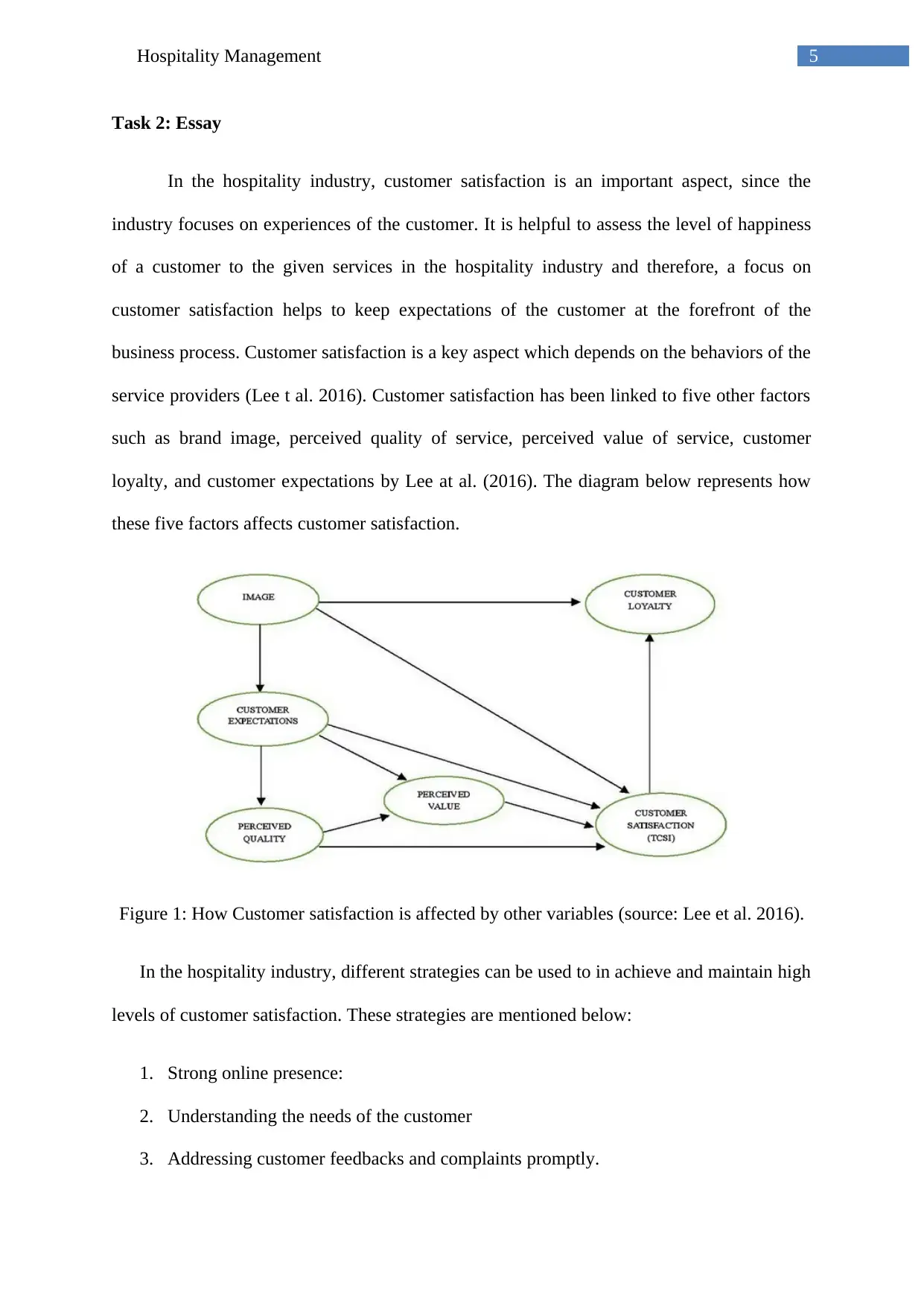
service providers (Lee t al. 2016). Customer satisfaction has been linked to five other factors
such as brand image, perceived quality of service, perceived value of service, customer
loyalty, and customer expectations by Lee at al. (2016). The diagram below represents how
these five factors affects customer satisfaction.
Figure 1: How Customer satisfaction is affected by other variables (source: Lee et al. 2016).
In the hospitality industry, different strategies can be used to in achieve and maintain high
levels of customer satisfaction. These strategies are mentioned below:
1. Strong online presence:
2. Understanding the needs of the customer
3. Addressing customer feedbacks and complaints promptly.
Task 2: Essay
In the hospitality industry, customer satisfaction is an important aspect, since the
industry focuses on experiences of the customer. It is helpful to assess the level of happiness
of a customer to the given services in the hospitality industry and therefore, a focus on
customer satisfaction helps to keep expectations of the customer at the forefront of the
business process. Customer satisfaction is a key aspect which depends on the behaviors of the
service providers (Lee t al. 2016). Customer satisfaction has been linked to five other factors
such as brand image, perceived quality of service, perceived value of service, customer
loyalty, and customer expectations by Lee at al. (2016). The diagram below represents how
these five factors affects customer satisfaction.
Figure 1: How Customer satisfaction is affected by other variables (source: Lee et al. 2016).
In the hospitality industry, different strategies can be used to in achieve and maintain high
levels of customer satisfaction. These strategies are mentioned below:
1. Strong online presence:
2. Understanding the needs of the customer
3. Addressing customer feedbacks and complaints promptly.
⊘ This is a preview!⊘
Do you want full access?
Subscribe today to unlock all pages.
Trusted by 1+ million students worldwide
6Hospitality Management
4. Staff training: This can help to ensure that all staff has the necessary skills to work in
harmony towards the satisfaction of the customer, helping smooth running of the
business and therefore further improve customer satisfaction.
5. Tacking, analysis and reporting on customer satisfaction
(Pizam et al. 2016; Kim et al. 2015; Radojevic et al. 2015; Bruns-Smith et al. 2015)
Several continuous improvement models are available which can be implemented in the
operations of a restaurant, which includes: six sigma, kizen, failfast/fail forward, perpetual
beta, Parasuraman gap model of service quality (Goetsch and Davis 2014; Dale 2015).
Six sigma is aimed to increase efficiency and reduce errors or wastage. Using this
technique, one can define measure, analyze, improve and control the process. This strategy
can help to improve order accuracy, improve quality and also reduce errors in team work.
This strategy can be used to increase performance of the staff (Pyzdek and Keller 2014).
Kaizen focuses on small, incremental changes in a process that leads to increased
efficiency and quality of the service. The steps include: training, ensuring the acquired skills
are used in practice, building work team and employee environment, using problem-solving
strategies in work team and developing a sense of operator ownership. This can be useful to
bring about slight changes in the operations (Androniceanu 2017).
Fail Fast strategy is useful in situations of high level of uncertainty, and helps to identify
products or services which are not working and does not move quickly. In a restaurant, this
can be useful to identify projects which are or are not worth investment (Khanna et al. 2016).
Perpetual beta is a strategy that considers a process as a state of continuous development
(or beta stage) (Fredericks et al. 2017). This strategy can be utilized to ensure continuous
improvement of various processes in the organization.
4. Staff training: This can help to ensure that all staff has the necessary skills to work in
harmony towards the satisfaction of the customer, helping smooth running of the
business and therefore further improve customer satisfaction.
5. Tacking, analysis and reporting on customer satisfaction
(Pizam et al. 2016; Kim et al. 2015; Radojevic et al. 2015; Bruns-Smith et al. 2015)
Several continuous improvement models are available which can be implemented in the
operations of a restaurant, which includes: six sigma, kizen, failfast/fail forward, perpetual
beta, Parasuraman gap model of service quality (Goetsch and Davis 2014; Dale 2015).
Six sigma is aimed to increase efficiency and reduce errors or wastage. Using this
technique, one can define measure, analyze, improve and control the process. This strategy
can help to improve order accuracy, improve quality and also reduce errors in team work.
This strategy can be used to increase performance of the staff (Pyzdek and Keller 2014).
Kaizen focuses on small, incremental changes in a process that leads to increased
efficiency and quality of the service. The steps include: training, ensuring the acquired skills
are used in practice, building work team and employee environment, using problem-solving
strategies in work team and developing a sense of operator ownership. This can be useful to
bring about slight changes in the operations (Androniceanu 2017).
Fail Fast strategy is useful in situations of high level of uncertainty, and helps to identify
products or services which are not working and does not move quickly. In a restaurant, this
can be useful to identify projects which are or are not worth investment (Khanna et al. 2016).
Perpetual beta is a strategy that considers a process as a state of continuous development
(or beta stage) (Fredericks et al. 2017). This strategy can be utilized to ensure continuous
improvement of various processes in the organization.
Paraphrase This Document
Need a fresh take? Get an instant paraphrase of this document with our AI Paraphraser
7Hospitality Management
Parasuraman gap model of service quality also called the 5 gap model identifies 5 gaps
that should be addresses by an organization: Gap 1 is the difference between customer
expectation and the perception of the management regarding customer expectation. Gap 2 is
the distance between management’s perception and actual experiences of the customer. Gap 3
is the distance between specification of experience and the delivery of experience. Gap 4 is
the distance between delivery of customer experience and what had already been
communicated to them and Gap 5 is the distance between customer perception regarding
service experiences and has been actually delivered to them (Vinayak and Bedi 2017; Ross
2017).
A restaurant business is a very competitive industry, and the success of a restaurant
often depends on transient factors such as the taste of the food, customer expectations or
needs, economy as well as the presence of competitors who use more innovative strategies to
attract customers (Alonso-Almeida 2015). Due to this, it is not merely enough for restaurants
to just plan an improvement strategy to expect a successful outcome, but must be able to
implement a process of improvement as a continuous and regular phenomenon (Hutchins
2016). Without a continuous improvement process, a restaurant can fall back to ineffective
processes even after the initial implementation of the improvement strategy (Ylänen 2017).
Discussed below are some strategies which can be used to ensure continuous improvement of
the business process:
Added value can be understood as a difference between the final selling price of a
commodity or service with the marketing value of the product. This is a type of value that
makes a product or service more appealing to the customer (Bowie et al. 2016). The added
value of a product can be improved by the following strategies:
Parasuraman gap model of service quality also called the 5 gap model identifies 5 gaps
that should be addresses by an organization: Gap 1 is the difference between customer
expectation and the perception of the management regarding customer expectation. Gap 2 is
the distance between management’s perception and actual experiences of the customer. Gap 3
is the distance between specification of experience and the delivery of experience. Gap 4 is
the distance between delivery of customer experience and what had already been
communicated to them and Gap 5 is the distance between customer perception regarding
service experiences and has been actually delivered to them (Vinayak and Bedi 2017; Ross
2017).
A restaurant business is a very competitive industry, and the success of a restaurant
often depends on transient factors such as the taste of the food, customer expectations or
needs, economy as well as the presence of competitors who use more innovative strategies to
attract customers (Alonso-Almeida 2015). Due to this, it is not merely enough for restaurants
to just plan an improvement strategy to expect a successful outcome, but must be able to
implement a process of improvement as a continuous and regular phenomenon (Hutchins
2016). Without a continuous improvement process, a restaurant can fall back to ineffective
processes even after the initial implementation of the improvement strategy (Ylänen 2017).
Discussed below are some strategies which can be used to ensure continuous improvement of
the business process:
Added value can be understood as a difference between the final selling price of a
commodity or service with the marketing value of the product. This is a type of value that
makes a product or service more appealing to the customer (Bowie et al. 2016). The added
value of a product can be improved by the following strategies:
8Hospitality Management
1. Identification of risks and areas of improvement: Through the process of audits of
functions and processes in the restaurant, key areas of risks as well as scopes of
improvement can be identified, and therefore be addressed in the improvement
plan.
2. Analysis of the process can be done, after the key areas of improvement and
strategic risks have been identified through the audit. Analysis allows the
identification of the weak links.
3. Planning of a strategy for improvement. The strategy can address the reason for
implementing the change, the process that needs to be changed, and how will the
processes be changed. Any financial resources implicated by these changes must
also be clearly outlined.
4. Preparation of the staff for the change or implementation of the new process, and
briefing them on the reasons for implementation of the change.
(Bowie et al. 2016)
These strategies can be implemented at different processes in the restaurant:
A. Food Ordering: This process can be improved by many ways like having separate
ordering lines for each food type, regular inventory count on the same day of every
week, preventing the ordering of too much perishable food.
B. Checkout: electronic process of checkout can be helpful to make the process more
efficient, and also reduce costs.
C. Food leaving kitchen can also be inspected before it reaches the customer table, to
ensure incorrect or cold meals are not being served.
D. Point of sale systems can also be incorporated by integrating the above aspects into a
single intelligent system that can help to streamline the ordering process, automate
inventory count, and trigger orders of raw materials upon reaching pre-stock levels.
1. Identification of risks and areas of improvement: Through the process of audits of
functions and processes in the restaurant, key areas of risks as well as scopes of
improvement can be identified, and therefore be addressed in the improvement
plan.
2. Analysis of the process can be done, after the key areas of improvement and
strategic risks have been identified through the audit. Analysis allows the
identification of the weak links.
3. Planning of a strategy for improvement. The strategy can address the reason for
implementing the change, the process that needs to be changed, and how will the
processes be changed. Any financial resources implicated by these changes must
also be clearly outlined.
4. Preparation of the staff for the change or implementation of the new process, and
briefing them on the reasons for implementation of the change.
(Bowie et al. 2016)
These strategies can be implemented at different processes in the restaurant:
A. Food Ordering: This process can be improved by many ways like having separate
ordering lines for each food type, regular inventory count on the same day of every
week, preventing the ordering of too much perishable food.
B. Checkout: electronic process of checkout can be helpful to make the process more
efficient, and also reduce costs.
C. Food leaving kitchen can also be inspected before it reaches the customer table, to
ensure incorrect or cold meals are not being served.
D. Point of sale systems can also be incorporated by integrating the above aspects into a
single intelligent system that can help to streamline the ordering process, automate
inventory count, and trigger orders of raw materials upon reaching pre-stock levels.
⊘ This is a preview!⊘
Do you want full access?
Subscribe today to unlock all pages.
Trusted by 1+ million students worldwide
9Hospitality Management
This system can also be integrated to mobile payment systems to further ease the
payment and collection process. These systems can also help to improve accuracy of
the orders, speed preparation time and improve the productivity of the staff.
(Bowie et al. 2016)
Different types of information can be made available to the customers to improve
marketing of the brand/organization. These include ratings and feedbacks of the restaurants,
coverage in social media and public media, highlighting special offers/promotional/value
added services or products for the customers. Also, information on the food like calorific
value, serving size can also be provided (Green et al. 2015) These aspects can help customers
to understand the services or products of the organization.
This system can also be integrated to mobile payment systems to further ease the
payment and collection process. These systems can also help to improve accuracy of
the orders, speed preparation time and improve the productivity of the staff.
(Bowie et al. 2016)
Different types of information can be made available to the customers to improve
marketing of the brand/organization. These include ratings and feedbacks of the restaurants,
coverage in social media and public media, highlighting special offers/promotional/value
added services or products for the customers. Also, information on the food like calorific
value, serving size can also be provided (Green et al. 2015) These aspects can help customers
to understand the services or products of the organization.
Paraphrase This Document
Need a fresh take? Get an instant paraphrase of this document with our AI Paraphraser
10Hospitality Management
Task 3: Report
3.1: How quality management can be measured and how to plan for quality and control
quality:
In an organizational level, a formal evaluation can be a part of the management
strategy such as total quality management (TQM) or continuous quality improvement (CQI)
(Dale 2015). These strategies allow the gathering and analysis of data in order to measure the
service quality. Few approaches in the assessment of the quality management practice, such
as SERVQUAL, LibQUAL+TM, Performance Indicators (PI) Benchmarking and
Accreditation (Chaturvedi 2017; Mallya and Patwardhan 2018; Gössling 2015; Come 2015;
Widarsyah et al. 2017)
Quality planning in a restaurant can include the following strategies:
A. Cost Benefit Analysis- This helps to understand the different costs of the
organizations versus the potential benefits, and therefore be used to eliminate
those costs which can be prohibitive (Svensson 2016)
B. Design planning can be done at the early stages to ensure quality standards are
maintained
C. Understanding the costs of poor quality planning for chefs helps to understand the
costs incurred by the restaurants when the chef fails to deliver as per the
customer’s expectations
D. Planning quality management strategies can be implemented to every aspects of
the restaurant
E. Quality quantifiers can be implemented using quality checklists which can be self
assessed.
(Goetsch and Davis 2014)
Task 3: Report
3.1: How quality management can be measured and how to plan for quality and control
quality:
In an organizational level, a formal evaluation can be a part of the management
strategy such as total quality management (TQM) or continuous quality improvement (CQI)
(Dale 2015). These strategies allow the gathering and analysis of data in order to measure the
service quality. Few approaches in the assessment of the quality management practice, such
as SERVQUAL, LibQUAL+TM, Performance Indicators (PI) Benchmarking and
Accreditation (Chaturvedi 2017; Mallya and Patwardhan 2018; Gössling 2015; Come 2015;
Widarsyah et al. 2017)
Quality planning in a restaurant can include the following strategies:
A. Cost Benefit Analysis- This helps to understand the different costs of the
organizations versus the potential benefits, and therefore be used to eliminate
those costs which can be prohibitive (Svensson 2016)
B. Design planning can be done at the early stages to ensure quality standards are
maintained
C. Understanding the costs of poor quality planning for chefs helps to understand the
costs incurred by the restaurants when the chef fails to deliver as per the
customer’s expectations
D. Planning quality management strategies can be implemented to every aspects of
the restaurant
E. Quality quantifiers can be implemented using quality checklists which can be self
assessed.
(Goetsch and Davis 2014)
11Hospitality Management
Quality Control can be implemented in a restaurant by:
A. Improving/maintaining guest service: a good service will foster good
experience of the customer, and hence help to develop customer loyalty
B. Improving/maintaining quality of food: Quality of food in terms of its taste or
smell as well as their presentation can include an artistic appeal to the food
and therefore help to improve customer satisfaction
C. Staff training: this helps to ensure that allows staff have the necessary skills
and conduct the best practices to ensure satisfaction of the customers
D. Cleanliness and Sanitation: Proper cleanliness and sanitation helps to
maintain a clean, healthy and hygienic environment, and is a significant
consideration in any hospitality organization
(Mitra 2016)
3.2: advantages and disadvantages of user and non-user survey to determine customer
needs in a restaurant industry
In the restaurant industry, user surveys refers to the surveys filled up by the customers
in the form of customer feedback or customer satisfaction survey questionnaires, while non-
user surveys are the surveys done on the general public and not specifically to customers. The
surveys can be crucial to evaluate the needs or expectations of the customer and thereby
address such aspects to improve the quality of service (Hill and Alexander 2017). The
process has different advantages and disadvantages such as:
Advantages of surveys:
Real-time feedback: This can help to stay focused on the customer reaction to
all aspects of the business process, and help to identify current customer
trends.
Quality Control can be implemented in a restaurant by:
A. Improving/maintaining guest service: a good service will foster good
experience of the customer, and hence help to develop customer loyalty
B. Improving/maintaining quality of food: Quality of food in terms of its taste or
smell as well as their presentation can include an artistic appeal to the food
and therefore help to improve customer satisfaction
C. Staff training: this helps to ensure that allows staff have the necessary skills
and conduct the best practices to ensure satisfaction of the customers
D. Cleanliness and Sanitation: Proper cleanliness and sanitation helps to
maintain a clean, healthy and hygienic environment, and is a significant
consideration in any hospitality organization
(Mitra 2016)
3.2: advantages and disadvantages of user and non-user survey to determine customer
needs in a restaurant industry
In the restaurant industry, user surveys refers to the surveys filled up by the customers
in the form of customer feedback or customer satisfaction survey questionnaires, while non-
user surveys are the surveys done on the general public and not specifically to customers. The
surveys can be crucial to evaluate the needs or expectations of the customer and thereby
address such aspects to improve the quality of service (Hill and Alexander 2017). The
process has different advantages and disadvantages such as:
Advantages of surveys:
Real-time feedback: This can help to stay focused on the customer reaction to
all aspects of the business process, and help to identify current customer
trends.
⊘ This is a preview!⊘
Do you want full access?
Subscribe today to unlock all pages.
Trusted by 1+ million students worldwide

1 out of 27


Related Documents


Your All-in-One AI-Powered Toolkit for Academic Success.
+13062052269
info@desklib.com
Available 24*7 on WhatsApp / Email
![[object Object]](/_next/static/media/star-bottom.7253800d.svg)
Unlock your academic potential
Copyright © 2020–2026 A2Z Services. All Rights Reserved. Developed and managed by ZUCOL.